Severe natural disaster events that threaten lives and cause widespread damage can have a significant impact on the mental health of affected populations.Reference Laugharne, Van de Watt and Janca 1 , Reference Stanke, Murray and Amlôt 2 At an individual level, this impact can vary in intensity and duration and be mediated by a number of factors that include access to effective treatment and care.Reference Bonanno, Brewin and Kaniasty 3 , Reference Norris, Friedman and Watson 4 Existing barriers in the access to and utilization of mental health care that are encountered in the general populationReference Parslow and Jorm 5 tend to be amplified in the wake of disaster.Reference Elhai and Ford 6 , Reference Rodriguez and Kohn 7
Primary care-based provision of mental health services has therefore been recognized as a key strategy to increasing mental health care access in the broader population 8 and in disaster circumstances.Reference Lima, Santacruz and Lozano 9 – Reference Redwood-Campbell and Abrahams 11 In Australia, the particular importance of the primary care system is underpinned by the fact that in any given year approximately 71% of those seeking mental health treatment will do so through their general practitioner, or GP.Reference Slade, Johnston and Teesson 12
As a cornerstone of the Australian primary mental health care system, the Access to Allied Psychological Services (or ATAPS) program has facilitated access to affordable mental health care for Australians since 2001.Reference Hickie and Groom 13 ATAPS enables GPs and other eligible referrers to refer consumers with high prevalence disorders (such as depression and anxiety) to mental health professionals for up to 12 (or 18 in exceptional circumstances) individual (and or group) sessions of evidence-based mental health care (predominantly cognitive behavioral therapy or CBT). The program is now being implemented nationwide by 61 primary care agencies known as Medicare Locals (formerly Divisions of General Practice, or Divisions). Importantly, ATAPS has been found to produce positive clinical outcomes for consumers in the general population.Reference Pirkis, Bassilios and Fletcher 14
Simultaneously, the ATAPS program has provided a launch pad for innovative mental health services (so-called Tier 2 ATAPS initiatives) that are specifically designed to cater to the mental health care needs of hard-to-reach and at-risk population groups,Reference Reifels, Bassilios and King 15 such as those affected by severe natural disasters.Reference Bassilios, Reifels and Pirkis 16 Two prime examples of such initiatives were first implemented in response to some of the most significant disaster events in recent Australian history, namely, the 2009 Victorian Black Saturday Bushfires and the 2010-11 Queensland Floods and Cyclone Yasi. A brief overview of the respective impacts of these disaster events and the ensuing ATAPS response follows.
In late January and early February 2009, the Black Saturday Bushfires, Australia’s worst-ever fire disaster, affected large parts of the state of Victoria (4,500 km2), impacting 109 towns and 33 communities, destroying 2300 houses, and resulting in 173 deaths, 7562 people being displaced, and an estimated A$4.4 billion in damage. 17 - Reference Cameron, Mitra and Fitzgerald 19
In late December 2010 and January 2011, Australia’s most severe flood disaster inundated more than three-fourths of the state of Queensland (approximately 1 445 000 km2). These floods affected 70 towns, 29 000 homes and businesses, 2.5 million people, and resulted in 33 deaths, evacuation of tens of thousands of people, and estimated damage of A$5 billion.Reference Holmes 20 In addition to the floods, Tropical Cyclone Yasi, a Category 5 storm, made landfall in northern Queensland in early February 2011, resulting in 1 death, damage to countless buildings, thousands of evacuations, and an estimated A$3 billion in damage.
As part of the mental health response to these disasters, the Australian Government provided additional ATAPS funding to Divisions and Medicare Locals in order to boost psychological service provision to the population in affected areas. As a result, 2 disaster-specific ATAPS bushfire and ATAPS flood/cyclone initiatives were established in February 2009 and January 2011, respectively, that introduced certain flexibilities in the ATAPS model. These flexibilities included the initial allowance for an unlimited number of sessions, the waived requirement for a consumer diagnosis at referral, and the introduction of provisional referral pathways (alongside GP referral). The latter enabled bushfire case managers to refer to the ATAPS bushfire initiative, as well as Centrelink social worker, state mental health service, and consumer (self) referrals to the ATAPS flood/cyclone program.
To date, no research has examined patterns and predictors of the use of primary mental health care services across different natural disaster types. The current study is the first to explicitly contrast and investigate ATAPS usage patterns in the context of major bushfire and flood/cyclone disasters. Such research has the potential to inform and optimize delivery of primary mental health care services in future disaster circumstances.
Methods
Data Source
To minimize the inherent challenges of comparative disaster mental health service research, equivalent ATAPS service utilization data were retrieved for both disaster initiatives from a web-based national minimum dataset (MDS) on February 5, 2013, for the 2-year postdisaster analysis period. The MDS is a purpose-designed national dataset that forms part of the ongoing evaluation of the ATAPS program. It captures de-identified consumer- and session-level information, which ATAPS providers (ie, Medicare Local staff and mental health professionals) routinely enter through a web-based interface under a funding agreement with the Department of Health. The MDS data retrieved for the purpose of this study included referral- and session-level data for the ATAPS bushfire initiative (January 2009 to December 2010) and the ATAPS flood/cyclone initiative (January 2011 to December 2012).
At the time of the data download, a total of 30 primary care agencies had ATAPS bushfire and ATAPS flood/cyclone initiative referrals recorded on the MDS for respective 2-year analysis periods. This included 19 agencies in Victoria (10 Divisions and 9 Medicare Locals) and 11 agencies in Queensland (6 Divisions and 5 Medicare Locals). Thirteen agencies were involved in the ATAPS flood/cyclone initiative (7 Divisions and 6 Medicare Locals) and 18 agencies in the ATAPS bushfire initiative (9 Divisions and 9 Medicare Locals); including 1 Victorian Medicare Local that had received both ATAPS bushfire and flood/cyclone initiative referrals. A total of 271 mental health professionals had delivered disaster-specific ATAPS (186 bushfire, 85 flood/cyclone) services during the analysis period.
Analyses
Descriptive and comparative analyses examined overall levels and patterns of service uptake as well as sociodemographic and clinical profiles of consumers referred to the ATAPS bushfire and ATAPS flood/cyclone initiatives over the 2-year postdisaster period.
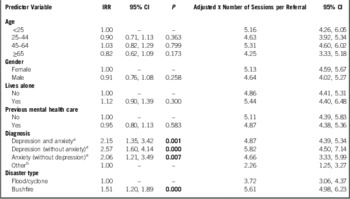
In addition, a negative binomial regression analysis was conducted to examine predictors of service use intensity. The outcome variable was the number of ATAPS sessions utilized by consumers over the 2-year period. The predictors included consumer characteristics (age, gender, household structure, previous mental health care, and diagnosis) and disaster type (bushfire versus flood/cyclone). Cluster-adjusted robust standard errors were used to account for individuals with multiple referrals. For the purpose of interpretation, model coefficients were used to calculate marginal effects—that is, the predicted number of sessions for each predictor, adjusted for all other predictors in the model. These results are referred to as adjusted means. The analyses were conducted in SPSS V22 (IBM, Armonk, NY) and Stata V13.1 (StataCorp, College Station, TX).
Results
Referral Patterns
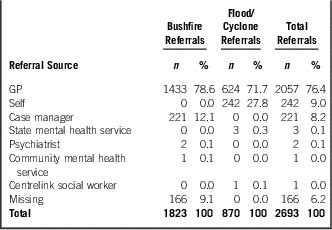
The data presented in Table 1 show that a total of 1823 bushfire and 870 flood/cyclone referrals were made to the 2 Tier 2 ATAPS initiatives over the analysis period, representing 1802 and 842 consumers, respectively. The majority of referrals were made by GPs (78.6% bushfire, 76.4% flood/cyclone), followed by consumer self-referrals (27.8% in the flood/cyclone context) and referrals from case managers (12.1% in the bushfire context). Other referral pathways were utilized only infrequently. Overall, bushfire and flood/cyclone referrals accounted for 13.3% and 6.3%, respectively, of total ATAPS referrals received by involved agencies (across all ATAPS initiatives) during the analysis period.
Two-Year Access to Allied Psychological Services (ATAPS) Bushfire and ATAPS Flood/Cyclone Initiative Referrals, by Source

Abbreviation: GP, general practitioner.
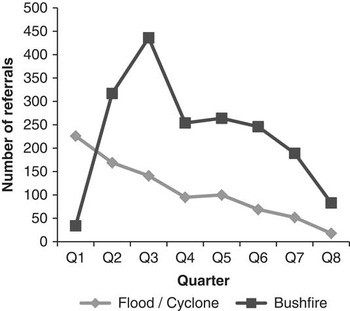
Figure 1 illustrates resulting 2-year referral patterns for the 2 initiatives, with time frames displayed by quarter to enable comparison. The number of bushfire referrals rose rapidly to a peak of 436 referrals in the third quarter, after which it declined rapidly to steady again throughout quarters 4, 5, and 6 (with about 250 referrals made during each of these quarters). Following this, bushfire referral numbers fell to 83 referrals in the last quarter of the 2-year period. By contrast, flood/cyclone initiative referral numbers were overall significantly lower and peaked in the first quarter (226 referrals), after which they declined more gradually (including a period of relative stability during quarters 4 and 5, with approximately 100 referrals made in each) to a low of 18 referrals in the final quarter.
Two-Year Access to Allied Psychological Services (ATAPS) Bushfire and ATAPS Flood/Cyclone Initiative Referrals, by Quarter

Session Patterns
Of the 1823 bushfire referrals, 1531 referrals (84%) resulted in at least 1 session with a mental health professional during the 2-year period, while 292 referrals (16%) resulted in no session. Of the 870 flood/cyclone referrals, 660 referrals (75.9%) resulted in at least 1 session, while 210 referrals (24.1%) resulted in no session. In total, 9446 bushfire and 3222 flood/cyclone sessions were recorded on the MDS for the analysis period, including 536 bushfire and 216 flood/cyclone sessions that were unattended.
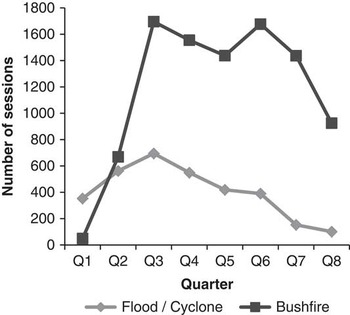
Figure 2 illustrates quarterly patterns in sessions delivered via the 2 initiatives over the 2-year period. Consistent with the initial referral pattern, the number of bushfire sessions rose rapidly to a peak in the third quarter (1696 sessions). It then remained remarkably high until the seventh quarter (with over 1400 sessions delivered in each quarter, and a second peak of 1677 sessions in the sixth quarter). Notably, even during the last quarter of the 2-year analysis period, 925 bushfire sessions were delivered.
Two-Year Access to Allied Psychological Services (ATAPS) Bushfire and ATAPS Flood/Cyclone Initiative Sessions, by Quarter

Although considerably lower in absolute terms, the number of flood/cyclone sessions equally rose to a peak in the third quarter (695 sessions), after which it declined gradually to a low of 101 sessions in the last quarter of the 2-year period.
Consumer Characteristics
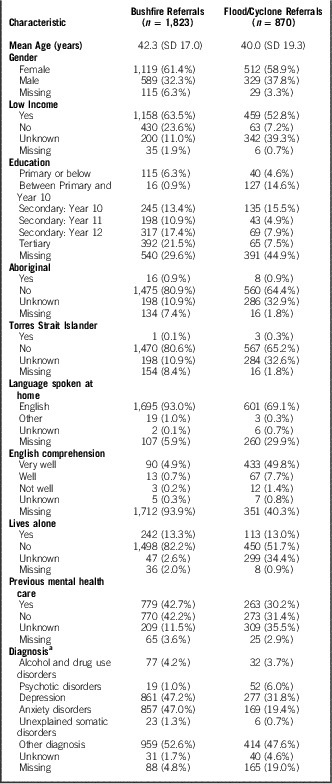
Table 2 outlines the sociodemographic and clinical consumer characteristics associated with referrals to the 2 ATAPS initiatives. Notwithstanding variations in the amount of missing and unknown data, bushfire affected consumers were on average more likely to be slightly older (42.3 versus 40 years), female (61.4% versus 58.9%), on a low income (63.5% versus 52.8%), and to be speaking English at home (93% versus 69.1%) than flood/cyclone affected consumers. Both consumer groups were equally likely to be of Aboriginal or Torres Strait Islander background and to be living in 1-person households. Clinical characteristics indicated a greater likelihood for bushfire initiative consumers to have a history of previous mental health care (42.7% versus 30.2%) and to be diagnosed with depression (47.2% versus 31.8%), anxiety (47% versus 19.4%), and/or other diagnoses (52.6% versus 47.6%). By contrast, flood/cyclone initiative consumers were more likely to be diagnosed with psychotic disorders (6% versus 1%). Due to the waived diagnosis requirement, the majority of free-text descriptors of diagnoses classified as “other” simply referenced the name of the respective disaster, followed by variants of posttraumatic stress disorder (PTSD) and trauma in the bushfire, and variants of PTSD and adjustment disorders in the flood/cyclone context.
Sociodemographic and Clinical Consumer Characteristics Associated With Access to Allied Psychological Services (ATAPS) Bushfire and ATAPS Flood/Cyclone Initiative Referrals

Note. Percentages may not add to 100% due to rounding.
a Multiple diagnoses permitted.
Service Engagement
The proportions of disaster-specific ATAPS referrals that did not result in treatment (16% bushfire, 24.1% flood/cyclone) were respectively lower and higher than comparison figures for all Tier 2 ATAPS initiatives combined (17%) and the ATAPS program as a whole (21.1%).Reference Bassilios, Nicholas and Reifels 21 The majority of referrals without sessions were made by general practitioners (GPs; 85.3% and 86.7%, respectively). Limited pretreatment consumer distress data indicated very similar mean Kessler 10 scores for bushfire and flood/cyclone affected consumers with (30.6 and 32.5) and without (31.2 and 31.9) resulting sessions.Reference Kessler, Andrews and Colpe 22
Flood/cyclone consumers without sessions were more likely than those with sessions to be: younger (34.8 versus 39.8 years); female (66.7% versus 56.4%); living alone (19.5% versus 10.9%); on a low income (68.6% versus 47.7%); diagnosed with alcohol and drug use (9% versus 2%), psychotic (17.6% versus 2.3%), depression (43.8% versus 28.4%), and/or anxiety disorders (32.4% versus 15.5%). By comparison, the profiles of bushfire consumers with and without sessions appeared to be more similar, except for the greater (and reverse) likelihood of those with bushfire sessions to be diagnosed with ICD 10 F1–F5 disorders.
Predictors of Service Use Intensity
Table 3 presents the results of the negative binomial regression analysis conducted on pooled data from both disasters, with the 2-year rate of sessions utilized by consumers as the outcome variable. The results show that after adjusting for multiple referrals per consumer and other variables in the model, only consumer diagnosis and disaster type were significantly associated with the level of uptake of ATAPS sessions. More specifically, consumers affected by bushfires (IRR 1.51, 95% CI 1.20-1.89), diagnosed with depression (IRR 2.57, 95% CI 1.60-4.14), anxiety (IRR 2.06 95% CI 1.21-3.49), or both of these disorders (IRR 2.15, 95% CI 1.35-3.42) utilized ATAPS sessions at significantly higher rates than their respective counterparts. The adjusted mean number of sessions was 5.6 for bushfire, and 3.7 for flood/cyclone, consumers. Consumer age, gender, household structure and mental health care history did not account for significant differences in service use intensity.
Incident Rate Ratios and Adjusted Mean Number of Sessions Per Referral

Note. Abbreviations: IRR, incident rate ratio; CI, confidence interval. The analysis controlled for all predictor variables listed in the table and for multiple referrals per person.
a With or without alcohol and drug use disorders, psychotic disorders and/or unexplained somatic disorders.
b Includes alcohol and drug use disorders, psychotic disorders, unexplained somatic disorders, and/or unknown or missing diagnoses.
Discussion
This study indicates that the bushfire disaster resulted in significantly greater ATAPS service volume with more than twice the number of referrals and almost 3 times the number of sessions than the flood/cyclone disaster. Overall service usage patterns for both initiatives were largely consistent with the characteristic first-year peak in disaster mental health symptoms identified in a literature reviewReference Norris and Elrod 23 and associated service demand. However, it is noteworthy that bushfire ATAPS demand remained high and peaked again during the second year. The considerable bushfire service volume at the end of the 2-year analysis period indicates the existence of a likely need for mental health services beyond that period.Reference Laugharne, Van de Watt and Janca 1 Irrespective of disaster type, service delivery peaked in the third quarter, thus highlighting a potential peak period for future ATAPS activity in similar disaster circumstances. The creation of flexible referral pathways that enabled consumer self-referrals and linkage to a disaster-specific case management service significantly enhanced service access and uptake.
The consumer profile of disaster-specific ATAPS initiatives was largely consistent with that of the broader ATAPS program, in that a majority of consumers were female, on low incomes, spoke English at home, and were diagnosed with depression and/or anxiety disorders.Reference Bassilios, Nicholas and Reifels 21 Notable differences included the slightly older mean age and greater ascription of “other” diagnoses for disaster-affected consumers. While Australian population surveys indicate that men are more frequently exposed to disaster events,Reference Mills, McFarlane and Slade 24 the greater use of ATAPS by women is consistent with broader population trends in the use of mental health care services.Reference Burgess, Pirkis and Slade 25
Despite the greater geographical scope of the flood/cyclone disaster, the exact reasons for lesser ATAPS uptake and engagement remain unclear (eg, lesser exposure to life-threatening or traumatic events; lower prevalence or severity of emerging mental health issues; barriers in access to care; or availability of other services). Key factors associated with treatment seeking include the type and degree of the traumatic event.Reference Gavrilovic, Schutzwohl and Fazel 26 It is possible that the severity of the bushfire disaster, including known risk factors such as very little warning, the immediate threat to life, and a high death toll,Reference Norris, Friedman and Watson 4 produced more prevalent and adverse mental health outcomes, which, in turn, translated into greater ATAPS service volume. Interestingly, similar patterns involving a rapid early peak and steady subsequent decline in referrals to the flood/cyclone initiative have also been observed in referrals to comparable psychological services in the United States following Hurricane Katrina (despite the ongoing high prevalence of mental disorders in that context).Reference Rosen, Matthieu and Norris 27 Most flood affected people were further impacted by “rising-tide” rather than “rapid onset” or flash flooding, with the latter type of event being responsible for most fatalities and typically associated with more adverse health outcomes. The frequent occurrence of seasonal floods and tropical cyclones in Queensland and the opportunity to learn from previous disasters further suggest the potential for greater population awareness and/or preparedness. This is underpinned by recent study findings which indicate that the majority of surveyed residents in the path of Cyclone Yasi felt relatively well prepared for it.Reference Usher, Buettner and West 28
Context-specific factors and secondary stressors in the disaster aftermathReference Lock, Rubin and Murray 29 may have had differential impacts on levels of mental health care need, service uptake, and engagement. The different number of agencies and providers involved in each initiative, arguably a direct reflection of service need, may have equally accounted for differences in service uptake.
By contrast to previous studies, which examined treatment use versus nonuse as a dichotomous variable,Reference Elhai and Ford 6 this study examined the frequency or intensity of service use in a treatment-seeking sample of disaster affected Australians. Multivariate regression analysis highlighted the importance of disaster type and needs-based factors (ie, consumer diagnosis) as significant drivers of ATAPS use intensity. Significantly higher utilization rates among people diagnosed with depression, anxiety, or both of these disorders indicate that the ATAPS program is reaching its primary target group even in disaster circumstances. This finding extends previous insights into affective and anxiety disorders as principal drivers of 12-month mental health service use frequency in the general populationReference Andrews, Slade and Issakidis 30 to primary mental health care service use in disaster contexts. By contrast to population based findings, the intensity of postdisaster ATAPS use was overall greater for individuals diagnosed with depression rather than those with comorbid depression and anxiety disorders (as indicated by adjusted mean session numbers of 5.82 versus 4.87).
While gender has previously been associated with the frequency of 6-month mental health treatment use among primary care patients,Reference Elhai, Patrick and Anderson 31 it was not predictive of the intensity of 2-year ATAPS use postdisaster. This suggests that while female gender constitutes a risk factor for adverse disaster mental health outcomesReference Norris, Friedman and Watson 4 and overall more women utilize the ATAPS program following disaster, the intensity of ATAPS use does not differ significantly between women and men.
Study Strengths and Limitations
This study could not assess the adequacy of the substantial ATAPS service volume in each disaster context vis-à-vis the total prevalence of ATAPS-relevant mental health care needs in the affected population, the uptake of other mental health services, or whether those most in need of services were the ones receiving treatment.
This study managed to overcome many challenges of comparative disaster mental health service research through the shared ATAPS focus, the use of a single data source, identical units, and time frames for analysis.Reference Peacock 32 Nevertheless, since both ATAPS initiatives unfolded in different real-time contexts, it is possible that different contextual, program-, agency-, or consumer-level factors may have impacted on service use that were not specifically controlled for in this study. In particular, the transition from Divisions to Medicare Locals (between July 2011 and June 2012) would have more likely impacted on the ATAPS flood/cyclone initiative.
To enable prospective and retrospective data entry for both initiatives, the MDS was changed in April 2009 and July 2011, respectively. Prior service data captured by local MDS users under other ATAPS initiatives may have underestimated early service volume, while potential data entry lags may have underestimated later flood/cyclone initiative uptake. Changing program parameters (ie, cessation of unlimited sessions and funding for some bushfire agencies from July 2010; cessation of unlimited flood/cyclone sessions and the waived diagnosis requirement from July 2011) may have equally impacted on service use.
Finally, this study did not examine the impact of enabling factors on disaster service use, which tends to be overshadowed by that of need-based variables,Reference Elhai and Ford 6 or the impact of other predisposing (ie, degree of disaster exposure or associated physical injury) and need-based variables (ie, symptom severity), which have previously been investigated.Reference Dorn, Yzermans and Kerssens 33 , Reference Goto, Wilson and Kahana 34 Notwithstanding the above limitations, this study provided valuable insights for future disaster mental health service delivery both in Australia and internationally.
Conclusions
Comparative disaster mental health service research can extend our knowledge base in terms of the likely need for and utilization of mental health care services following disaster. This study established that the substantial demand for primary mental health care services following major natural disasters can vary in magnitude and trajectory with disaster type. Disaster-specific ATAPS services provide a promising model to cater for this demand in a primary care setting. This model has implications for countries with primary care systems in which general practitioners occupy important triage roles for mental health careReference Clark 35 and for facilitating access and referral to enhanced disaster mental health care services in other contexts.Reference Rosen, Matthieu and Norris 27 , Reference Hamblen, Norris and Pietruszkiewicz 36 , Reference Jones, Allen and Norris 37 Simultaneously, study findings highlight that the creation of flexible referral pathways (beyond GP referral) can significantly enhance service access. Disaster-type and needs-based variables as drivers of ATAPS use intensity indicate an equitable level of service use in line with the program intention. Despite the unprecedented scale of events, the natural disaster types examined in this study are highly characteristic of Australia’s disaster risk profileReference Middelmann 38 and therefore relevant to informing future disaster mental health responses. Established service use patterns can assist with estimating future capacity requirements in similar disaster circumstances. Future research should examine the impact of program- and agency-level factors on disaster mental health service useReference Rosen, Greene and Young 39 and key factors underpinning service engagement.
Acknowledgments
This work was supported through funding from the Australian Government Department of Health. An earlier version of this paper was presented at the joint conference of the International Society for Traumatic Stress Studies (ISTSS), The Seventh Hospital of Hangzhou, and the Zhejiang Behavior Medicine Association in Hangzhou, China, in October 2014. There were no reported conflicting interests for this article.