Autobiographical memory (AM) is memory for information relating to the self (Brewer, Reference Brewer and Rubin1986). It comprises two components: semantic AM, which encompasses biographical personal information (e.g., names, addresses, and trait information), and episodic AM, which contains personally experienced events. AM has many social functions, such as facilitating social intimacy (Nelson, Reference Nelson1993) and social problem solving (Goddard, Dritschel, & Burton, Reference Goddard, Dritschel and Burton1996). Accordingly, AM deficits, manifesting as a bias toward overgeneral rather than specific memory recall, have been found in groups known to be poor at social problem solving, such as suicide attempters and clinically depressed samples (Williams & Dritschel, Reference Williams, Dritschel, Conway, Rubin, Spinnler and Wagenaar1992). The ability to retrieve specific autobiographical memories is a reliable predictor of recovery from depression (e.g., Brittlebank, Scott, Williams, & Ferrier, Reference Brittlebank, Scott, Williams and Ferrier1993), suggesting that access to AM is an important factor in good mental health. Given that AM plays a valuable role in social functioning, it constitutes a potential target for social skills interventions. It is therefore pertinent to examine AM in autism spectrum disorder (ASD), a condition particularly associated with abnormalities in the social domain.
There is a growing body of research demonstrating AM difficulties in ASD. For example, Goddard, Howlin, Dritschel, and Patel (Reference Goddard, Howlin, Dritschel and Patel2007) examined AM in young adults with ASD using a cueing method that required participants to retrieve specific memories (i.e., individual events pertaining to one particular day) at speed. When compared to typically developing adults matched on gender, age, and full-scale IQ, the ASD group demonstrated greater difficulty in recalling specific memories to word cues, particularly when the words depicted emotions. This was demonstrated by both longer retrieval latencies, more errors related to categorical memories (i.e., memories for collections of events), and failures of memory retrieval. The deficit appeared to be largely independent of general memory functioning, because groups did not differ in tests of logical memory or digit span. Further studies with adults have also shown difficulties in specific AM retrieval when cued by lifetime periods (e.g., Crane & Goddard, Reference Crane and Goddard2008) and life-goal cues (Crane, Goddard, & Pring, Reference Crane, Goddard and Pring2009), adding weight to the evidence that a difficulty in retrieving specific autobiographical memories is a robust phenomenon in ASD.
Compared with research on AM in adults with ASD, there are relatively few studies directly examining AM in children. Millward, Powell, Messer, and Jordan (Reference Millward, Powell, Messer and Jordan2000) investigated recall of events experienced either personally or vicariously by children with ASD (aged 12–16) and moderately severe language delay. The ASD group had greater difficulty recalling activities they had performed themselves than activities they had seen another child perform. This was in contrast to a comparison group of typically developing 5- to 6-year-olds. The authors concluded that memory difficulties in autism were due to a “lack of experiencing self.” Bruck, London, Landa, and Goodman (Reference Bruck, London, Landa and Goodman2007) focused on qualitative aspects of retrieval in children with ASD, aged 5–10 years. They showed an impaired access characterized by less detailed narratives of the past. These difficulties were particularly pronounced for earlier life events compared to more recent life events. Other research by Goldman (Reference Goldman2008) demonstrated that, although an appreciation of narrative structure was apparent in children with autism aged 9–13 years, their memory narratives lacked high points, making the relevance of their life stories unclear.
There are a number of reasons why deficits in AM in ASD should be apparent from childhood. Theories of AM development propose that certain cognitive factors need to be intact before enduring memories of experience can be laid down. Such factors include (a) the self-concept (cf. Howe & Courage, Reference Howe and Courage1997), (b) theory of mind (e.g., Perner & Ruffman, Reference Perner and Ruffman1995; Welch-Ross, Reference Welch-Ross1997), (c) social skills, and (d) the ability to use a narrative structure (Reese, Reference Reese1999). These factors are all key elements of social interaction, a process that is crucial for AM development. Nelson (Reference Nelson1993) suggests that before the AM system has developed, children's event memories are in the form of generalized events. The specific event system develops as children recognize that sharing memories plays a crucial role in social interaction. There is evidence of difficulties in each of these domains in individuals with ASD, although the degree of impairment is variable. Thus, although some aspects of the self-concept in ASD are intact, others are not. First, children with and without ASD are equally able to recognize images of themselves using delayed video recognition feedback (cf. Lind & Bowler, Reference Lind and Bowler2009; Dissanayake, Shembrey, & Suddendorf, Reference Dissanayake, Shembrey and Suddendorf2010). However, recognition of their own psychological states is impaired (Williams, Reference Williams2010), and they report a reduced self-understanding (Dritschel, Wisley, Goddard, Robinson, & Howlin, Reference Dritschel, Wisley, Goddard, Robinson and Howlin2010). Second, although individuals of normal IQ with ASD have been known to pass some tasks designed to test theory of mind, they nevertheless experience at least a partial “mind blindness” (cf. Baron-Cohen, Reference Baron-Cohen2001). Third, by definition ASD is characterized by qualitative abnormalities in social interaction. Fourth, Losh and Capps (Reference Losh and Capps2003) found that children with ASD had narrative skills equivalent to a comparison group when narrating a story with structure provided; however, when relating less-structured narratives concerning their own past, the ASD group used less complex syntax and required more prompts for elaboration and clarification of their stories.
Although there is good evidence of general difficulties in AM among children with ASD, the specific profile of AM performance, including associations and dissociations between different indices of AM functioning, the possible predictors of that performance, and the developmental trajectory of performance have not been systematically examined using a range of AM measures. Moreover, the relationship between AM and general memory performance has not been investigated. Thus, in the present study, the following questions were addressed
What is the profile of AM impairments in ASD, and does it change with maturation (as assessed by age group differences)?
A key index of AM functioning is the ability to retrieve specific memories. Research has shown that adults with ASD have difficulties retrieving specific memories, and we hypothesized that children with ASD would manifest the same difficulty compared to a typically developing, IQ- and age-matched comparison group. Because aspects of AM development are delayed in ASD, we also predicted that the reported age of earliest memories would be later.
We also wished to explore whether AM deficits would be less marked in older children, who have more advanced cognitive, social, and language skills than younger children, and who may also have been able to develop compensatory strategies to account for social and emotional processing difficulties that affect AM. Bruck et al. (Reference Bruck, London, Landa and Goodman2007) found no evidence of age group effects in their study; however, their sample was limited to children between 5 and 10 years of age and focused on the ability to recall narratives of past events. We examined a wider age range and used different methodologies to examine both episodic and semantic components of AM.
Finally, in order to provide a more comprehensive profile of AM deficits in ASD, we also examined qualitative differences, in particular the extent to which children (young/old and with/without ASD) referenced internal states (i.e., emotions and cognitive processing) when describing the personal past. Development of the link between self and AM is theorized to be driven by internal-states language that allows the child to derive a sense of self extended in time (cf. Fivush & Nelson, Reference Fivush and Nelson2006). Brown, Morris, Nida, and Baker-Ward (Reference Brown, Morris, Nida and Baker-Ward2012) demonstrated that internal states featured less in descriptions of positive and negative events and early experiences in boys with Asperger disorder when compared to those of typically developing, age- and IQ-matched controls. We aimed to examine whether this finding could be replicated with a larger, more diverse sample with regard to gender and also to demonstrate greater use of internal states in older children as the linkages between self and AM become more established. We were also interested in level of detail. In their study of younger and older adults, St. Jacques and Levine (Reference St. Jacques and Levine2007) demonstrated that emotional memories were more detailed than neutral memories; therefore, we envisaged, in accordance with our prediction about emotions and internal states, that younger (versus older) children and children with ASD (vs. without) would retrieve less detailed memories.
Are AM deficits more or less apparent within certain time frames?
Difficulties in accessing episodic personal memory may be a consequence of problems with encoding. Bowler, Gardiner, and Grice (Reference Bowler, Gardiner and Grice2000) found that although adults with ASD performed as well as a comparison group on a word recognition task the quality of their recall differed. They used a “remember–know” paradigm where participants reported whether their word recognition was based on “remembering” (where contextual details associated with the word's presentation are recalled) or “knowing” (i.e., a feeling of familiarity). The results indicated that individuals with ASD reported knowing a previous word more frequently than did a comparison group, who were more likely to report remembering. This group difference in the quality of recall raises questions about whether deficits in episodic memory in ASD may be more or less apparent within certain time frames. Using functional magnetic resonance imaging, Gilboa, Winocur, Grady, Hevenor, and Moscovitch (Reference Gilboa, Winocur, Grady, Hevenor and Moscovitch2004) have shown a neuroanatomical dissociation between very recent events and more remote events, with the former associated with knowing and the latter with remembering. Thus, in ASD, one would expect to find memory for remote events to be poor (because of a lack of remembering) and memory for very recent events intact (as knowing is preserved). Some preliminary evidence for this is provided by Bruck et al. (Reference Bruck, London, Landa and Goodman2007), who found that, although memory for both recent and remote events were impaired in boys with ASD, difficulties were particularly apparent for remote events. We wanted to examine whether this finding extended to a mixed-sex sample with a wider age range.
Is there a dissociation between semantic and episodic AM?
Research has shown that although children with autism can have excellent memories for factual information and often display good rote-memory, they are less skilled at encoding and/or recalling contextual information associated with an event (O'Shea, Fein, Cillessen, Klin, & Schultz, Reference O'Shea, Fein, Cillessen, Klin and Schultz2005). Similarly, research with adults with ASD has demonstrated memory difficulties for free recall but intact memory when support at recall is provided, for example, in cued recall (Bowler, Gardiner, & Berthollier, Reference Bowler, Gardiner and Berthollier2004). One suggestion is that memory deficits in autism are tied to the episodic memory system with the semantic memory system remaining intact (Ben Shalom, Reference Ben Shalom2003). Although evidence for this in the AM domain is scarce, Klein, Chan, and Loftus (Reference Klein, Chan and Loftus1999) report a single-case study of an adult with high-functioning autism who showed this dissociation. This individual displayed good trait knowledge but was unable to access incidents upon which his trait knowledge was built. Moreover, using an AM fluency task where participants are required to generate events and names of relevant people across various different time periods, Crane and Goddard (Reference Crane and Goddard2008) demonstrated a personal episodic memory deficit in adults with ASD in the absence of a personal semantic memory deficit. In contrast, Bruck et al. (Reference Bruck, London, Landa and Goodman2007) found that in children with ASD deficits extended across both semantic and episodic AM. Maturation may affect the development of semantic memory, and different variables may predict performance on these two types of memory retrieval. We predicted that deficits in older children with ASD would be more pronounced in episodic personal memory compared to semantic personal memory but that younger children with ASD would be impaired in both.
What are the predictors of AM deficits in ASD?
It is important to examine AM deficits within the context of general memory; facets of general memory may be predictors of AM performance. General memory comprises both visual and verbal memory. Impairments in visual memory, but not verbal memory, have been found in ASD (e.g., Gunter, Ghaziuddin, & Ellis, Reference Gunter, Ghaziuddin and Ellis2002; Goddard et al. Reference Goddard, Howlin, Dritschel and Patel2007). Visual imagery is known to play a key role in AM retrieval. Neurological case studies have shown impairments in AM arising from damage to the occipital lobes (Ogden, Reference Ogden1993) and within the context of visual agnosia and visual–perceptual deficits (O'Connor, Butters, Miliotis, Eslinger, & Cermak, Reference O'Connor, Butters, Miliotis, Eslinger and Cermak1992). Moreover, experimental research by Williams, Healy, and Ellis (Reference Williams, Healy and Ellis1999) demonstrated the important role of imagery in accessing AMs to word cues; the more imageable the cue word, the more specific the memory retrieved. Furthermore, cue words with high visual associations were significantly more likely to elicit specific memory retrieval than to cue words high in auditory, motor, olfactory and tactile associations. Therefore, visual imagery appears to be key to the efficient access to specific memories.
Other predictors for AM deficits in ASD relate to executive dysfunction. It has been argued that the central executive is required for AM retrieval. According to Conway and Pleydell-Pearce (Reference Conway and Pleydell-Pearce2000a), retrieval involves access to an autobiographical knowledge base that contains hierarchical layers ranging from the conceptual and abstract to highly specific details of specific events. Access to these layers is modulated by central executive control processes. Evidence for this argument comes from a slow cortical potential study by Conway, Pleydell-Pearce, and Whitecross (Reference Conway, Pleydell-Pearce and Whitecross2001) where they observed left frontal activation while searching for specific memories to cue words. This, they argued, reflected central executive control processes. There is ample evidence that executive functioning is impaired in ASD across different ages and ability levels (cf. Hill, Reference Hill2004). It is also theorized that impairments in executive function underlie many of the symptoms of autism (e.g., Ozonoff, Pennington, & Rogers, Reference Ozonoff, Pennington and Rogers1991), including deficits in cognitive functioning that could impact the retrieval of AM retrieval.
Executive functioning is composed of different processes, such as inhibition of a prepotent response, cognitive flexibility, initiation and planning (e.g., Shallice & Burgess, Reference Shallice and Burgess1996; Miyake et al., Reference Miyake, Friedman, Emerson, Witzki, Howerter and Wager2000).). There is debate about whether executive functioning is a combination of these processes or is composed of distinct components. Miyake et al. (Reference Miyake, Friedman, Emerson, Witzki, Howerter and Wager2000) addressed this issue by using confirmatory factor analysis and found evidence for three factors that include updating/monitoring, flexibility, and inhibition. Rather than simply argue that executive processes underlie AM retrieval, subsequent research has used conceptual frameworks, such as Miyake et al.'s (Reference Miyake, Friedman, Emerson, Witzki, Howerter and Wager2000) three-factor model, as motivation for examining how specific processes of executive functioning relate to AM retrieval. There is evidence presented by Dalgleish et al. (Reference Dalgleish, Williams, Perkins, Golden, Barnard and Au-Yeung2007) that inhibition is involved, based on the finding that errors on tasks of executive control are associated with the ability to produce specific memories in both nonclinical and dysphoric samples. Errors reflect difficulty with resisting a prepotent response that is not relevant to the goal of the task. Raes, Verstraeten, Bijttebier, Vasey, and Dalgleish (Reference Raes, Verstraeten, Bijttebier, Vasey and Dalgleish2010) also found that scores on a self-report measure of inhibitory control mediated the relationship between overgeneral memory and depressed mood. Valentino, Bridgett, Hayden, and Nuttall (Reference Valentino, Bridgett, Hayden and Nuttall2012) examined the relationship between executive function and AM in depressed children, using measures that mapped onto the three components of inhibition, updating/monitoring, and flexibility. A Stroop task was employed as the inhibition measure, verbal fluency as the updating/monitoring measure, and the Wisconsin card sorting task as the flexibility measure. Verbal fluency was argued to be an updating measure because generating category items involves listing exemplars and monitoring if they are representative of the superordinate category. They found evidence for verbal fluency but not inhibition and flexibility to be related to the ability to retrieve specific autobiographical memories. Further evidence for a relationship between verbal fluency and AM comes from Heeren, Van Broek, and Philpot (Reference Heeren, Van Block and Philpot2009), who found that performance on a verbal fluency task mediated the relationship between mindfulness training and improved AM specificity in a clinically depressed sample. Williams and Dritschel (Reference Williams, Dritschel, Conway, Rubin, Spinnler and Wagenaar1992) also reported verbal fluency to be associated with the ability to retrieve specific autobiographical memories. However, it is debatable as to which EF subcomponent verbal fluency relates, as it has also been described as an index of cognitive flexibility (Heeren et al., Reference Heeren, Van Block and Philpot2009) and shifting and inhibition (McDowd et al., Reference McDowd, Hoffman, Rosek, Lyons, Pahwa and Burns2011).
There is some evidence that planning may also impact AM retrieval. Hewitt, Evans, and Dritsche (Reference Hewitt, Evans and Dritschel2006) found that the retrieval of specific memories was related to the ability to plan how to execute everyday activities in patients with traumatic brain injury, implying that AM may be an underlying process in planning. There is a need for further examination of these different executive processes in the context of AM. There has been no examination of these processes with respect to AM retrieval in ASD.
Another reason for examining executive processes as predictors of AM retrieval is that there is some evidence that executive processes related to AM performance are impaired in ASD. Robinson, Goddard, Dritschel, Wisley, and Howlin (Reference Robinson, Goddard, Dritschel, Wisley and Howlin2009) reported impaired performance in inhibition and planning but no impairments in cognitive flexibility and verbal fluency in children and adolescents with ASD once the effects of IQ were controlled. In contrast, Kleinhans et al. (Reference Kleinhans, Richards, Weavers, Clark Johnson, Greenson and Dawson2005) found that adults with ASD had impaired performance on a test of cognitive flexibility and category fluency with preservation of inhibition performance. Hill and Bird (Reference Hill and Bird2006) found increased response latencies on another test of cognitive flexibility, the Hayling test, in adults with ASD. Thus, although findings are inconsistent there seems to be evidence that individuals with ASD have deficits in executive processes associated with AM retrieval. However, the relationship between specific executive processes and AM retrieval has not been examined in ASD. Therefore, two further issues to be explored were (a) how general memory (in particular visual memory), impacts on AM ability and (b) the extent to which specific executive processes of inhibition, cognitive flexibility/shifting, planning, and verbal fluency would impact on AM ability. In summary, the following was predicted:
1. Children with ASD will report later early memories and retrieve fewer specific memories compared to an age- and IQ-matched, typically developing comparison group.
2. Memories of younger (vs. older) and ASD (vs. comparison groups) will be less detailed; specifically, terms related to internal states (emotions and references to cognition) will be employed less by younger children and will feature less frequently in the memories of children with ASD than in those of the comparison group.
3. AM difficulties in ASD will be more pronounced for remote time periods compared to recent periods.
4. Younger children with ASD will be impaired on both semantic and episodic AM; older children will show less impairment in semantic AM, demonstrating an impairment on episodic AM alone.
5. AM performance will be associated with indices of visual memory and executive function.
Methods
Participants
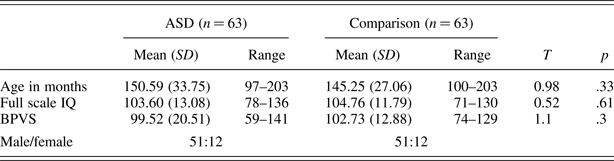
Experimental participants were recruited from specialized schools for children with ASD and from local autism support groups across London and Scotland; comparison participants were recruited from mainstream schools. Inclusion criteria were a full-scale IQ of 70 or above, age between 8 and 16 years, and English as a first language. Additional criteria for the experimental group were a formal diagnosis of ASD, based on DSM-IV-TR criteria, from a multidisciplinary diagnostic team including a clinical psychologist or psychiatrist. Clinical diagnosis was reconfirmed on the basis of a score of ≥13 on the Social Communication Questionnaire (SCQ; Rutter, Bailey, & Lord, Reference Rutter, Bailey and Lord2003), Lifetime Version. The SCQ has established validity for a diagnosis of autism (Berument, Rutter, Lord, Pickles, & Bailey, Reference Berument, Rutter, Lord, Pickles and Bailey1999), with an SCQ score above 13 recommended as a cutoff for research purposes (Lee, David, Rusyniak, Landa, & Newschaffer, Reference Lee, David, Rusyniak, Landa and Newschaffer2007). Comparison participants were matched for full-scale IQ, gender, and British Picture Vocabulary Score (BPVS; Dunn, Dunn, Whetton, & Burley, Reference Dunn, Dunn, Whetton and Burley1997). To ensure the comparison group did not include children with developmental disorder, children were excluded if they had a known neurological abnormality, diagnosed learning difficulties, or a history of special needs. Of the 154 participants who met inclusion criteria, 28 were eliminated because their IQ scores could not be matched. The final sample therefore consisted of 63 participants (12 female) in each group. Overall, there were no statistically significant differences between groups on any of the control variables (see Table 1).
Demographic data for ASD and comparison groups

Note: ASD, autism spectrum disorder; BPVS, British Picture Vocabulary Scale.
Measures of control and independent variables
SCQ
The SCQ is a 40-item checklist for completion by parents or carers derived from the Autism Diagnostic Interview—Revised (Rutter, LeCouteur, & Lord, Reference Rutter, LeCouteur and Lord2003). The SCQ correlates well with this much more detailed and lengthy diagnostic interview (correlation between total scores = 0.73; Rutter et al., Reference Rutter, Bailey and Lord2003).
Wechsler Abbreviated Scale of Intelligence (WASI)
The WASI (Wechsler, Reference Wechsler1999) is a brief measure of IQ suitable for use with individuals from age 6 years and older. Scores can be linked to the Wechsler Intelligence Scale of Children, Third Edition. Due to time constraints, full-scale IQ was measured using the two-subtest version (matrix reasoning and vocabulary) of the WASI.
BPVS
The BPVS (Dunn et al., Reference Dunn, Dunn, Whetton and Burley1997) is a widely used picture-based test of receptive vocabulary that has also been used extensively for assessing comprehension in individuals with ASD.
Dependent variable measures
AM cueing task
This task (Crovitz & Schiffman, Reference Crovitz and Schiffman1974) was used to assess the ability to retrieve specific autobiographical memories and to examine the prediction that children with ASD manifest a specificity deficit. Participants were required to retrieve specific memories as quickly as possible in response to cue words varying in emotional valence: five positive (happy, safe, surprised, proud, interested), five negative (sad, embarrassed, angry, afraid, lonely) and five neutral (narrow, search, fast, height, challenge). The three groups of words were matched using the MRC psycholinguistic database (Coltheart, Reference Coltheart1981) for length, F (2, 12) = 0.7, p = .93; familiarity, F (2, 9) = 0.26, p = .78; concreteness, F (2, 8) = 0.20, p = .843; and imageability, F (2, 9) = 0.18, p = .84.
Participants' understanding of the cues was established prior to memory retrieval by assessment of their word definitions. These were scored using the procedure of Losh and Capps (Reference Losh and Capps2003), where 0 = inappropriate/unable to define, 1 = appropriate hedonic tone, and 2 = appropriate. Once children had produced their own definition, they were given a dictionary definition in an attempt to produce equivalent understanding across participants.
A specific memory was described to participants as something that happened to them on a particular day and in a particular place. Examples were given and practice items administered to ensure understanding of the task requirements. When participants responded with inappropriate general memories they were prompted to think of a specific instance. Participants were also asked “when” each memory occurred in order to clarify that the event retrieved was contextualized in time. Otherwise, children were prompted during memory retrieval to elicit further information only if they became distracted or paused for excessive lengths of time (e.g., “and then what?”). Responses were transcribed at time of testing and audiorecoded. Latencies to the first word of each response were taken from the audio recordings utilising a stopwatch.
Memories were categorized according to the criteria used by Goddard et al. (Reference Goddard, Howlin, Dritschel and Patel2007). Specific memories were of events particular to one day (e.g., last birthday). General memories were either “categoric,” referring to repeated events (e.g., “going on holidays”), or “extended,” referring to events that occurred over an extended timeline (e.g., “my holiday in Italy”).
Recent and remote memory task (RRMT)
A semistructured interview was developed to assess autobiographical episodic memory for recent events, such as those occurring within the previous week (e.g., “tell me everything you did after you ate dinner until right before you went to sleep”), and remote events (e.g., “tell me the first thing that ever happened to you, that you can remember, in your whole life”). The task was employed to assess differences in access to recent versus remote memories, to examine predictions concerning age of earliest memory, and to measure the use of internal state language, emotion, and detail in memory reports. There were 12 questions in total, 6 pertaining to each time period. Participants' memory responses were coded as either specific or general, in accordance with the aforementioned criteria. Interrater agreement for memory coding was acceptable with a Cohen K value of 0.80. Qualitative aspects of memories retrieved were also assessed. Number of details was classified as the number of individual pieces of information contained within each memory (e.g., “I went upstairs, brushed my teeth, read a book”). Cognitions, evaluations, and preferences were classified as the number of statements that indicated memory of a cognitive state (e.g., “I had to wait for my mum to come and collect me,” “Mum said I could”), personal judgments and opinions (e.g., “it was a big house,” “I really liked the house”), and personal preferences (e.g., “I went on the swings, but I really wanted to go on the slide”). These three dimensions were totalled to give an “internal states” score. Emotions were classified as the number of direct and inferred affective references (e.g., “I was really happy,” “it made me laugh”). The extent of prompting required was also assessed by counting the number of incidences where participants were eventually able to produce memories following prompts (e.g., “can you remember something from before you started school?”). Interrater reliability was acceptable for all memory measures, with Pearson's product–moment correlation ranging between .72 and .94.
Children's Autobiographical Memory Interview
The Children's Autobiographical Memory Interview (Bekerian, Dhillon, & O'Neill, Reference Bekerian, Dhillon and O'Neill2001) is a structured interview examining access to semantic and episodic AMs across different lifetime periods. It was used to examine the prediction that deficits in ASD would be tied to episodic memory in older children with ASD and apparent in both semantic and episodic AM in younger children with ASD. Lifetime periods used were based around notable experiences and the British school system and included the present, preschool, primary and senior school, earliest and last birthday, favorite TV program, last holiday and first hospital visit. Examples of semantic and episodic questions arising from the primary school period are (a) “Can you tell me the names of teachers from primary school?” (semantic) and (b) “Do you remember your first day at primary school?” (episodic). Semantic questions were scored out of a total of 50 points and episodic questions were scored out of a total of 10 points. Episodic memories were further classified as either specific or general, in accordance with the criteria previously specified. Interrater reliability for memory categorization was checked by the same two raters, one of whom was blind to participants' group membership. This proved to be acceptable, with a Cohen K value of 0.78.
Predictors of AM performance
Children's Memory Scale (CMS)
This battery was used to assess general memory, immediate and delayed verbal and visual memory, and attention/concentration (Cohen, Reference Cohen1997). The battery yields separate factor scores as well as a general memory score, which is a composite of verbal and visual immediate and delayed recall. The visual task requires respondents to (a) recognize previously presented faces and (b) learn spatial locations. The verbal tasks involve story recall ability and the ability to learn a list of unrelated words and recall them over four learning trials. The purpose of the CMS in the present study was twofold. First, to establish whether AM deficits are either independent of general memory functioning or part of a wider memory impairment (as assessed by verbal and general memory components) and, second, to assess the contribution of a visual memory impairment to AM deficits. General memory was assessed though measures of immediate and delayed verbal and visual memory, with delayed recall occurring 20–40 min after initial presentation.
Executive function measures
WCST
The WCST (Heaton, Reference Heaton2003) is a measure of mental flexibility and set shifting. In the current study, the WCST-64: Computerized Version 2, Research Edition was administered. Standardized scores were used and the primary index of executive dysfunction was the total number of perseverative errors produced.
Tower of London
This is a measure of planning and problem solving (Culbertson & Zillmer, Reference Culbertson and Zillmer2005). Standardized scores were used and the primary index of executive dysfunction was the total number of moves required to complete the puzzles.
Stroop
The Stroop is a measure of response inhibition and mental flexibility where participants are required to name the color of ink used to produce congruent and incongruent color words (Stroop, Reference Stroop1935). In the current study a computerized version of the Stroop was used. The primary index of executive dysfunction was the total number of correct responses produced for incongruent items.
Junior Hayling sentence completion task
This task is a measure of verbal inhibition and speed of processing (Shallice et al., Reference Shallice, Marzocchi, Coser, Del Savio, Meuter and Rumiati2002). In Part A, participants were presented with 10 simple sentences that they had to complete with the correct word as quickly as possible. In Part B, to measure the capacity for verbal inhibition, children were given 10 sentences that they had to complete with an incorrect word as quickly as possible. Responses were timed with a stopwatch, starting when the last word of the sentence was read and stopping when the child produced a response. In Part A, sentences were scored for the number correctly completed. In Part B, 3 points were given for a correctly completed sentence, 1 point for a sentence completed with a word semantically related to either the sentence or the missing word and 0 points for a sentence completed with an unrelated word. The primary index of executive dysfunction was the total score for Section B, with higher scores indicating poorer verbal inhibition capacity.
Verbal fluency
Verbal fluency is a measure of productive vocabulary as assessed by ability to generate items from the category cues of animals, fruit and vegetables and clothes within 60 s. One point was scored for each item generated, unless the item was repeated or an error.
Procedure
Participants were tested individually in their respective schools or at home. The order of tasks was fixed and testing occurred across three separate sessions, lasting approximately 60 min each. In Session 1, participants first completed the WASI, BPVS, and verbal fluency test followed by the Children's Autobiographical Memory Interview. In Session 2, the dot locations and stories subtests of the CMS were presented first, then the executive-based WCST and Stroop were administered, followed by the AM cueing task and the delayed components of the CMS subtests. In the third testing session, the faces, word pairs, numbers, and sequences subtests of the CMS were administered first, followed by the remaining, executive-based Tower of London and Hayling sentences, the RRMT test, and the delayed components of the CMS subtests. Task order was organized for the purpose of maximizing the data set in the event of participant dropout.
Results
Where appropriate, data were analyzed with a series of 2 (diagnosis: ASD vs. comparison) × 2 (age: younger vs. older) multivariate analysis of variance (MANOVA). The younger age group comprised participants between 8 years and 12 years, 6 months (n = 62), and the older participants were aged from 12 years, 7 months, to 17 years (n = 64). Where data were nonnormally distributed, nonparametric statistics were used. Median or mean scores are presented as appropriate; however, means are presented in tables for the purposes of comparison across measures.
AM performance
Cueing task
The cueing task was used to address the profile of AM deficits in ASD, in particular, the ability to retrieve specific AMs as quickly as possible. First, in order to ensure that groups did not differ in their understanding of cue words, a Mann–Whitney test was applied to the data pertaining to participants' descriptions of cue word meanings. This proved to be nonsignificant (z = 1.34, p = .18). A 2 (diagnosis) × 2 (age) MANOVA was then employed to examine differences in the numbers of each memory type retrieved: (a) specific, (b) categoric, (c) extended, and (d) failures to retrieve. An overall significant main effect of diagnosis emerged, Wilks λ = 0.86, F (4, 119) = 4.87, p = .001, η2 = 0.14. The age main effect and Diagnosis × Age interaction were nonsignificant (ps > .1). Follow-up univariate tests demonstrated that the ASD group compared to the comparison group retrieved significantly fewer specific memories, F (1, 122) = 18.44, η2 = 0.13, p < .001, ASD mean = 8.93, SD = 3.19 versus comparison mean = 11.20, SD = 2.49, significantly more categoric memories, F (1, 122) = 12.61, η2 = 0.09, p < .001, ASD mean = 2.72, SD = 1.56 versus comparison mean = 1.68, SD = 1.67, and significantly more failures to retrieve memories to cues, F (1, 122) = 5.92, η2 = 0.046, p = .02, ASD mean = 2.17, SD = 2.43 versus comparison mean = 1.27, SD = 1.70.
RRMT
Two mixed MANOVAs were used to address the questions of (a) whether the ASD group had poorer access to the remote than to the recent past and whether age was related to these factors and (b) whether groups, by age and diagnosis, differed in the qualitative aspects of memories. An analysis of variance (ANOVA) was applied to data pertaining to age of earliest memory to establish whether groups differed by age and diagnosis.
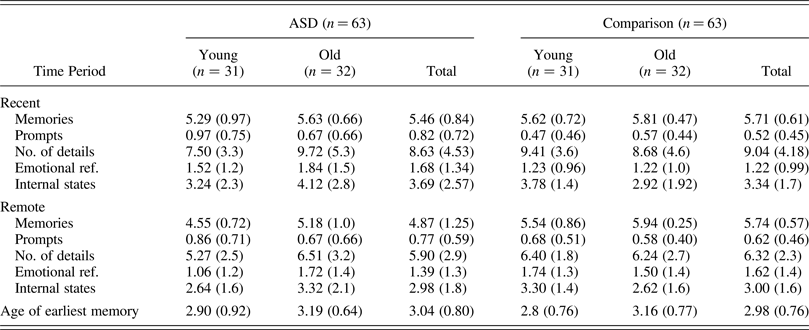
The dependent variables of interest with respect to memory access were (a) the number of memories retrieved and (b) the number of prompts required. The overall MANOVA yielded significant between-subject main effects of diagnosis, Wilks λ = 0.85, F (2, 21) = 11.06, p < .001, η2 = 0.16, and age, Wilks λ = 0.93, F (2, 121) = 4.81, p = .01, η2 = 0.07. The within-subject main effect of time (recent vs. remote) was significant, Wilks λ = 0.94, F (2, 121) = 4.13, p = .02, η2 = 0.06, as was the Diagnosis × Time interaction, Wilks λ = 0.91, F (1, 121) = 5.97, p = .003, η2 = 0.09. All other interactions were nonsignificant (p > .1). Follow-up univariate tests demonstrated significant differences in the number of memories retrieved with a Diagnosis × Time interaction, F (1, 122) = 9.62, p = .002, η2 = 0.07; as predicted, the ASD group did not significantly differ from the comparison group in the number of memories recalled from the recent past but retrieved significantly fewer memories than did the comparison group from the remote past (ASD mean = 4.87, SD = 1.45 vs. comparison mean = 5.74, SD = 0.57, p < .001). Univariate tests also demonstrated that the older group retrieved more memories across both time periods than did the younger group F (1, 122) = 9.04, p = .003, η2 = 0.07 and the ASD group required more prompting across both time periods than did the comparison group, F (1, 122) = 6.49, p = .01.
A MANOVA was then applied to the qualitative data with the dependent variables of interest as (a) internal states, (b) emotion, and (c) detail. A main effect of time, Wilks λ = 0.92, F (3, 120) = 31.89, p < .001, η2 = 0.44, and a Time × Diagnosis emerged as significant, Wilks λ = 0.92, F (3, 120) = 3.39, p = .02, η2 = 0.08. All other main effects and interactions were nonsignificant (ps > .05). Univariate tests showed internal states, F (1, 122) = 9.04, p = .003, η2 = 0.07, and detail, F (1, 122) = 75.19, p < .001, η2 = 0.38, to increase with time. Emotion significantly interacted with diagnosis, F (1, 122) = 6.35, p = .01, η2 = 0.05; as the ASD group were significantly less emotional in their remote memories than the comparison group (Bonferroni t = 2.54, p < .05) and significantly more emotional in their recent memories than the comparison group (Bonferroni t = 2.55, p < .05).
Finally, differences in the reported age of earliest memory were examined here as a function of diagnosis and age. These were found to be nonsignificant with respect to diagnosis (p > .1) but was significant with respect to age, F (1, 122) = 5.45, p = .02, as younger participants reported earlier first memories (mean = 2.85, SD = 0.84) relative to older participants (mean = 3.17, SD = 0.68). See Table 2.
Recent and remote memory task: Mean number of memories retrieved across time periods
Note: ASD, autism spectrum disorder.
Children's Autobiographical Memory Interview
Here the predicted dissociation between semantic and episodic AMs in the ASD group was addressed. In order to make comparisons across age as well as diagnosis, scores were recalculated in order to equate the number of lifetime periods examined such that the number of total memories was divided by the number of school periods. Data from two participants within the ASD group were missing. The dependent variables of interest were number of (a) episodic and (b) semantic memories retrieved. The overall MANOVA yielded both a significant diagnosis main effect, Wilks λ = 0.74, F (2, 119) = 20.16, p < .001, η2 = 0.25, and age main effect, Wilks λ = 0.24, F (2, 119) = 19.10, p < .001, η2 = 0.24. The interaction was nonsignificant (p > .05). Follow-up univariate ANOVAs for diagnosis showed that both episodic and Semantic dependent variables were significant. In contrast to predictions, the ASD group performed more poorly than the comparison group on both episodic, F (1, 120) = 12.15, p = .001, η2 = 0.09, and semantic, F (1, 120) = 40.27, p < .001, η2 = 0.25, memory tasks (episodic means: ASD = 1.03, SD = 0.02 vs. comparison = 1.12, SD = 0.02; semantic means: ASD = 5.38, SD = 0.08, vs. comparison = 6.06, SD = 0.07). The time univariate ANOVAs demonstrated the younger age group to perform more poorly than the older age group on both episodic, F (1, 120) = 35.74, p < .0005, η2 = 0.23, and semantic memories, F (1, 120) = 18.00, p < .0005 (episodic means: younger = 1.01, SD = 0.02 vs. older = 1.14, SD = 0.02; semantic means: younger = 5.49, SD = 0.08 vs. older = 5.94, SD = 0.07).
Predictors of AM deficits
The remaining analyses were initially conducted with both Age and Diagnosis as factors in order to highlight interaction effects. All analyses yielded nonsignificant interactions (all ps > .3). Because age group differences were only of interest in the context of ASD, age was subsequently dropped from the following analyses, which focus on differences between groups by diagnosis.
CMC
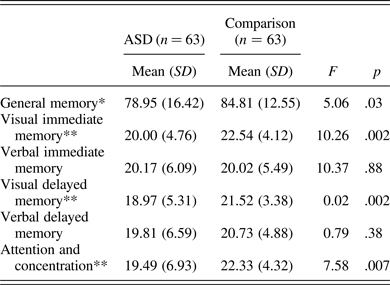
A MANOVA was used to examine memory performance on the CMC (see Table 3). This demonstrated a significant main effect of diagnosis, Wilks λ = 0.81, F (5, 120) = 4.52, p = .001, η2 = 0.16. Univariate ANOVAs showed that children with ASD exhibited a visual memory impairment that was pervasive across both immediate and delayed tasks but a preserved verbal memory. Their attention and concentration skills were also poorer than the comparison group.
Children's Memory Scale scores
*p < .05. **p < .01.
Executive function
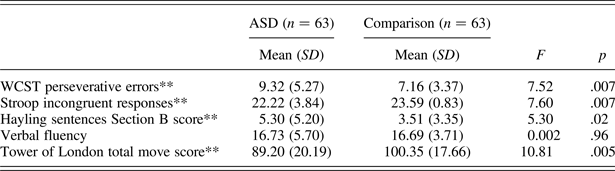
Table 4 provides mean scores on all tests of executive function. A MANOVA was used to examine group differences on these measures. Following overall significance of the multivariate tests, Wilks λ = 0.85, F (5, 120) = 4.58, p = .001, η2 = 0.16, univariate ANOVAs were inspected (see Table 4). These revealed poorer mental flexibility in the ASD group relative to the comparison group as demonstrated by the number of perseverative errors produced on the WCST. Response inhibition was assessed by both the Stroop and Hayling sentence tasks. Here, the ASD group demonstrated significantly poorer performance on both tasks. With respect to the Stroop task, this contrasts with previous research (e.g., Hill & Bird, Reference Hill and Bird2006) and may be explained in terms of the mode of presentation (i.e., computerized; cf. Robinson et al., Reference Robinson, Goddard, Dritschel, Wisley and Howlin2009). Poorer planning in the ASD group was also found when assessed by the Tower of London task, and this is consistent with previous research (e.g., Ozonoff et al., Reference Ozonoff, Pennington and Rogers1991). Verbal fluency performance did not significantly differ between groups, a finding which is consistent with Robinson et al. (Reference Robinson, Goddard, Dritschel, Wisley and Howlin2009).
Executive function scores
**p < .01.
The relationship between general memory and executive function as predictors of AM performance
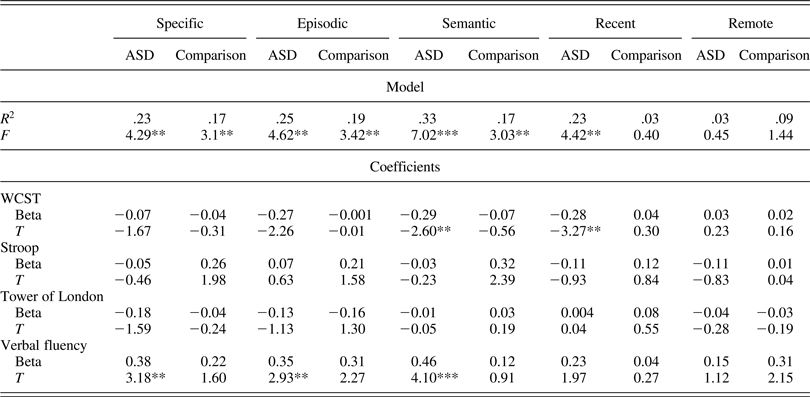
Multiple regression analyses were used to examine whether immediate and delayed visual and verbal memory performance could reliably predict the number of specific memories retrieved on the cueing task, the number of episodic and semantic memories retrieved on the Children's AM Inventory, and the number of recent and remote memories retrieved on the RRMT. Analyses were conducted separately for each group in order to explore potential group differences in the contribution of underlying processes in retrieval. None of the regression analyses was found to be statistically significant (ps > .05), indicating AM performance to be independent of visual/verbal memory ability. Regression analysis was then used to examine executive function measures as predictors of the same dependent variables. The two measures of inhibition (Stroop and Hayling) were highly correlated so in order to avoid collinearity, scores on the Stroop rather than the Hayling were entered into the regression analysis. The Stroop was selected because analyses of diagnostic group difference yielded a higher F ratio than that of the Hayling and because this was the measure of inhibition used by Valentino et al. (Reference Valentino, Bridgett, Hayden and Nuttall2012). The results of these regression analyses can be seen in Table 5. As can be seen from the table, for the ASD group, all regressions apart from that pertaining to remote memory were statistically significant (ps ≤ .01), suggesting that executive functioning plays an important role in access to AM. A similar pattern was observed in the comparison group, although the regression for recent as well as remote memory was not significant. Examining the unique variance that each independent variable contributed showed verbal fluency to be the most significant predictor of AM in the ASD group. In addition, cognitive flexibility/shifting (as assessed by WCST) significantly contributed to the variance in ability to retrieve both semantic memories (as assessed by the Children's Autobiographical Memory Inventory) and recent memories. With respect to the comparison group, there was little evidence for the importance of any one executive measure in AM. Clearly, these results should be interpreted with caution given the number of regressions performed; however, the consistent pattern of results in both sets of analyses gives support to the role of executive function, rather than general memory, in AM performance.
The relationship between executive functions and autobiographical memory
Note: ASD, autism spectrum disorder; WCST, Wisconsin card sort task.
**p < .01. ***p < .001.
Discussion
In this study we examined AM in children with and without ASD in order to identify patterns of functioning and predictors of performance. Using a variety of methodologies, we found children with ASD had difficulty retrieving specific events and required more prompting, relative to a typically developing comparison group, when retrieving remote and recent memories. Contrary to prediction, the ASD and comparison groups did not differ in their reported age of earliest memories, although the ASD group retrieved fewer memories from the remote past compared to the comparison group. Across all participants, recent memories contained more internal states and details than did remote memories. The ASD group made fewer references to emotions in their remote memories but more emotional references in their recent memories compared to the comparison group. They were also less able than comparison participants to generate both semantic and episodic memories when cued by lifetime periods. Impairments did not appear to be part of a general memory problem, as the current study showed verbal memory to be preserved, and visual memory, although poorer in the ASD group, did not significantly predict AM performance. Instead, executive deficits, particularly poorer cognitive flexibility as assessed by the WCST and verbal fluency, were associated with AM difficulties in ASD. With respect to the typically developing comparison group, a similar, pattern emerged, with central executive measures, rather than general memory, contributing to performance, although no one executive measure was emphasized.
We assessed AM with three different tasks in order to examine age differences and to compare the ability to retrieve (a) specific memories, (b) recent and remote memories, and (c) semantic and episodic memories and to investigate predictors of performance. Specificity of memory was first examined on the cueing task, which requires the retrieval of specific memories to cue words as quickly as possible. Here the ASD group, regardless of age, produced fewer specific memories and, when unable to generate specific memories in response to cue words, either failed to retrieve any memory or offered a general memory. These findings are in keeping with our research with adults with ASD (Goddard et al., Reference Goddard, Howlin, Dritschel and Patel2007) and replicate a growing body of research consistently demonstrating a specific memory deficit in ASD (e.g., Crane & Goddard, Reference Crane and Goddard2008; Crane, Goddard, & Pring, Reference Crane, Goddard and Pring2009, Reference Crane, Goddard and Pring2010). Performance on the cueing task is typically explained in terms of a resource framework, where specific memory retrieval is cognitively demanding because it requires the inhibition of related general memories while a specific memory is accessed (Dalgleish et al., Reference Dalgleish, Williams, Perkins, Golden, Barnard and Au-Yeung2007). In nondysphoric adults, Dalgleish et al. (Reference Dalgleish, Williams, Perkins, Golden, Barnard and Au-Yeung2007) found that inhibition, as evidenced by errors on tasks of executive control and verbal fluency performance, was related to the ability to retrieve specific memories. In children, Raes et al. (Reference Raes, Verstraeten, Bijttebier, Vasey and Dalgleish2010) found that inhibitory control as measured by a self-report questionnaire mediated the relationship between depression and specific memory access (as measured by the number of overgeneral memories offered on a cueing task). In this study, executive function proved reliably to predict specific memory retrieval and provided one explanation for reduced specificity. However, unlike Dalgleish et al. (Reference Dalgleish, Williams, Perkins, Golden, Barnard and Au-Yeung2007) and Raes et al. (Reference Raes, Verstraeten, Bijttebier, Vasey and Dalgleish2010), only verbal fluency was associated with the ability to retrieve specific memories. One reason for the inconsistent findings may be the use of different indices of inhibition. The Stroop task assesses response or behavioral inhibition but not cognitive inhibitory processes. Cognitive inhibition arises when previously, but not currently, relevant information for a task causes interference (Friedman & Miyake, Reference Friedman and Miyake2004). More research is needed that examines different types of inhibition, such as weak cognitive inhibition, with respect to AM retrieval in ASD.
Our findings correspond with those of Valentino and colleagues who also employed the Stroop as a measure of inhibition and likewise found verbal fluency but not inhibition or flexibility (as measured by perseverative errors on the WCST) to be associated with overgeneral memory. Verbal fluency involves the spontaneous generation of many exemplars to a given cue. The AM retrieval task also involves retrieving a specific memory to a given cue. This process would involve generating suitable descriptions and then inhibiting inappropriate responses. Our data suggest that the generation of suitable memories is problematic in ASD.
The cognitively demanding nature of the cueing task, with its emphasis on speed of retrieval and specificity, makes it difficult to establish whether retrieval or encoding explanations are appropriate when attempting to explain greater memory failures in the ASD group. One advantage of the RRMT is that it allowed an examination of memory that is less dependent on attentional demands because participants are not directed toward the type of memory required and there are no time constraints. Arguably, therefore, this represents a more ecologically valid assessment of AM. As predicted, the ASD group, both young and old, were as able as the comparison group to reflect on recent experience but showed an impairment in their access to the remote past. They also required substantially more prompting. These findings are consistent with Bruck et al. (Reference Bruck, London, Landa and Goodman2007), who also found that children with ASD had particularly poor memory for the remote past. It is interesting there were no group differences in the reported age of earliest memory. It is clearly very difficult to establish the source and accuracy of age reports, and the mean ages reported (i.e., <3 years) suggest that participants may have reported knowing (e.g., based on family reports) rather than remembering. The age-related increase in age of earliest reported memory is, however, in line with recent research, which demonstrates that younger children are able to report on earlier memories than are older children; because memories from early childhood are more vulnerable to interference and forgetting, their consolidation become less likely (Peterson, Warren, & Short, Reference Peterson, Warren and Short2011).
When examining qualitative aspects of recent and remote memories, there was evidence that, across all participants, memories were less detailed and contained fewer references to internal states when recalling the remote past than the recent past. Although the ASD group made fewer emotion references in their remote memories relative to the comparison group, they made more emotion references in their recent past. Emotional processing may, therefore, represent a potentially important strategy for children with ASD that helps compensate for delays in AM development. In typical development, emotion has also been found to enhance AM recall by producing more detailed accounts (St. Jacques & Levine, Reference St. Jacques and Levine2007). The ASD group also demonstrated a deficit decline in access to recent memories, as they performed at an equivalent level to the comparison group. This suggests that emotion may be powerful in facilitating the encoding and consolidation of events. These gains may be a consequence of natural improvements or may be due to experiencing interventions aimed at helping children to recognize emotions. Cognitive flexibility predicted performance on this task and may be an important mechanism driving the link between emotion recognition and improved access to recent memories. Research has demonstrated that cognitive flexibility underlies deficits in emotion recognition in both schizophrenia (Lee, Lee, Kweon, Lee, & Lee, Reference Lee, Lee, Kweon, Lee and Lee2009) and traumatic brain injury (Milders, Ietswaat, Crawford, & Currie, Reference Milders, Ietswaat, Crawford and Currie2008).
Consistent with our other measures of AM, access to the recent past was significantly associated with executive function, with cognitive flexibility emerging as a significant predictor for the ASD group. Access to the remote past, however, was not predicted by either general memory variables or executive function. We predicted that any deficits would be tied to the remote rather than recent past, based on the assumption that events may be more likely encoded with noetic (rather than autonoetic) awareness, which probably impedes the efficient organization of experience into an enduring AM. One mechanism that may serve as a base around which to organize one's autobiography and which may not operate optimally in ASD is the self. In adults with ASD, there is preliminary evidence to suggest that the links between self and memory are relatively intact. Crane et al. (Reference Crane, Goddard and Pring2009) showed similar patterns in ASD and a comparison group in the extent to which self-related goal cues primed the retrieval of autobiographical memories. Moreover, adults with ASD were equally able to identify self-defining memories relative to every day memories, although their ability to update self-knowledge based on new experiences was compromised (Crane et al., Reference Crane, Goddard and Pring2010) However, in children these links may be less stable as a consequence of an underdeveloped self-image, although research in this area is inconclusive. Thus, although Lind and Bowler (Reference Lind and Bowler2009) found evidence of an intact sense of self when examining delayed mirror self-recognition, other studies indicate impaired self-awareness (e.g., Millward et al., Reference Millward, Powell, Messer and Jordan2000) and less differentiation of the self (Mitchell & O'Keefe, Reference Mitchell and O'Keefe2008). Self-awareness is likely linked to self-reflection, and both these components might be important for the rehearsal and reporting of AMs, which would help to consolidate storage. In line with Nelson and Fivush's (Reference Nelson, Fivush, Tulving and Craik2000) theory, reduced rehearsal and reporting of AMs are likely to impede the development of the self. In addition, the capacity for metarepresentational thought is inextricably bound with development of the self-memory links, as evidenced by research demonstrating that a delay in passing false-belief tasks is linked to episodic memory development (Perner, Kloo, & Gornik, Reference Perner, Kloo and Gornik2007). Future research examining theory of mind skills and the self-memory links in children could clarify how these factors interact in the development of AM and help explicate the deficit in remote memory in ASD.
In line with research by Bruck et al. (Reference Bruck, London, Landa and Goodman2007), this study showed semantic AM to be impaired in our ASD group. We predicted that this effect would diminish with age, as research has shown intact semantic memory in adults with ASD (Klein et al, Reference Klein, Chan and Loftus1999; Goddard & Crane, Reference Crane and Goddard2008); however, the findings did not support our hypothesis. Although there was clear evidence of age group effects, these findings were not specific to the ASD group. Semantic AM would therefore appear slower to develop in ASD, with deficits leveling out in adulthood, A longitudinal study would give more insight into the developmental trajectory. Semantic AM concerns facts about the self and, therefore, a delay in self-concept development may be a cause of, or concomitant to, semantic AM impairment in children with ASD. Dritschel et al. (Reference Dritschel, Wisley, Goddard, Robinson and Howlin2010) found that children with ASD felt that significant others in their lives knew more about their internal states (e.g., are they tired, interested) than they did. Semantic memory retrieval was associated with both verbal fluency and cognitive flexibility, as assessed by the WCST, and problems may also be due to generativity difficulties
This study also provides information on memory development in typically developing children. Age differences were found for recalling semantic and episodic personal information across different lifetime periods, whereas ability to retrieve specific memories to single word cues was not affected by age. It is likely that there are differences in the retrieval strategies in these two tasks. The episodic and semantic memory tasks may be more dependent on constructing a life narrative where events and facts to be retrieved are organized within time frames. The cueing task provides a less detailed cue, which requires the construction of a series of descriptors for a successful match (cf. Conway & Pleydell-Pearce, Reference Conway and Pleydell-Pearce2000b). Research shows that memories on the cueing task tend to come from the recent time period rather than require a search across the life span (Rabbitt & Winthorpe, Reference Rabbitt, Winthorpe, Gruneberg, Morris and Sykes1988). Our data suggest that by the age of 8 years the specific memory system is functioning efficiently but gains are yet to be made in the effective organization of AMs around lifetime periods that may be more dependent on the development of a coherent life narrative.
We hypothesized that the memories of older children, relative to younger, would contain more internal states in line with Fivush and Nelson's (Reference Fivush and Nelson2006) suggestion regarding the role of internal state language in development of the self-memory system. We also predicted that older children would generate more detailed memories. Our findings did not directly support these predictions when examining age group differences. However, across all participants, memories contained more internal states and details from the recent than the remote past, suggesting maturational effects in the reconstruction of internal states and detailed memories. Our data, therefore, provide some support for internal state language facilitating the development of a comprehensible life story around which to anchor memories of personal experiences.
Study strengths and limitations
The current study provides data from a large sample of well-matched children with ASD across a broad age range and, in addition to identifying a specific memory deficit compared to typically developing controls, it provides new information on the profile of deficits in AM in this group, highlighting problems with the remote rather than recent past. It also suggests that children with ASD improve in their ability to make gains remembering emotional aspects of experience with age but, unlike adults with ASD, children manifest a deficit in both personal semantic and episodic memory. Some indication as to potential predictors underlying AM deficits is also provided through regression analysis, although causal relations cannot be implied because of the nature of the design. Moreover, replication of these findings is required given the relatively large number of regressions conducted on the sample.
Despite the relatively large sample size, a weakness of the study is the reliance on verbal techniques for eliciting autobiographical memories. The findings may be tied to the methodologies used and reflect reporting style rather than remembering. In addition, practical constraints governed the order of tasks, but administering the AM measures first would have minimized potential fatigue effects. Time constraints prevented a confirmation of diagnosis with a structured diagnostic interview, such as the Autism Diagnostic Observation Scale, and the study failed to screen the comparison sample for ASD, for example, with the SCQ. Finally, IQ was assessed with the two-subtest form, which can only measure general intellectual ability; therefore, we were unable to assess verbal and performance IQ independently.
Conclusions
Overall, the findings demonstrate that children with ASD, between the ages of 8 and 17, have difficulty retrieving specific autobiographical memories, have an impaired access to the remote past, and manifest problems retrieving specific and episodic memories across the life span. Maturation seems to increase emotion language in memory, which is consistent with other research demonstrating that IQ and social skills show some improvement over time (e.g., Anderson, Oti, Lord, & Welch, Reference Anderson, Oti, Lord and Welch2009; Howlin, Goode, Hutton, & Rutter, Reference Howlin, Goode, Hutton and Rutter2004) This study found AM deficits in the context of preserved recent memory and general verbal memory abilities. Although AM impairments in ASD may be subtle, these deficits could, nevertheless, have a pervasive and negative impact on everyday social functioning. Interventions aimed at emotion processing may help ameliorate these deficits.