




No CrossRef data available.
On Perception and Sonority in Cluster Simplification: Consonant Deletion in Icelandic Preterites
Published online by Cambridge University Press: 01 September 2004
Abstract
This article investigates the motivations for consonant cluster simplification through an analysis of consonant deletion in Icelandic, in clusters of three consonants created by the addition of the preterite suffix -ti/-di/-ði directly to the verb stem. It is argued that deletion is driven by perceptual factors interacting with sonority requirements. Deletion targets stops and nonstrident obstruents and its likelihood correlates with similarity in manner and place of articulation between the consonants and their adjacent segments. These two generalizations are elucidated in terms of perceptual cues, and an optimality-theoretic analysis is developed in which more perceptible consonants are protected from deletion by higher-ranked faithfulness constraints.I am grateful to Ólafur Páll Jónsson and Haraldur Bernharðsson, as well as Hanna Óladóttir, for patiently going through a long list of verbs with me and answering my questions. Haraldur also provided me with useful references and easy access to them. Thanks also to Michael Kenstowicz, Eiríkur Rögnvaldsson, and two anonymous JGL reviewers for answering questions, discussing different issues, and commenting on earlier versions of this research.
Information
- Type
- ARTICLES
- Information
- Copyright
- © 2004 Society for Germanic Linguistics
Introduction
The simplification of consonant clusters in Icelandic has served to illustrate an approach to consonant deletion in terms of syllabic wellformedness. In analyzing the data in 1 Itô (1986) assumes that Icelandic allows only one consonant in the coda and that all other consonants go in the onset. In 1a the syllabification [m.pr] is possible and all the consonants in the sequence are licensed. But in 1b–c the medial consonant is lost since neither [pt] nor [vn], according to Itô, are acceptable onsets given their sonority profile. These sequences show up in the infinitive kemba ‘comb’ and the nominative hálfur ‘half’, in which the stem is followed by a vowel-initial suffix.

A more detailed investigation of consonant deletion in Icelandic reveals a more complex situation than suggested by the simple syllabic approach sketched above. In this paper I examine clusters formed by the addition of the past tense morpheme -ti/-di/-ði directly to verb stems ending in two consonants. The form in 1b is one such example (kemb-di). Judgments were obtained from two native speakers of Icelandic, complemented by pronunciations indicated in dictionaries and other studies.
This set of data is limited yet surprisingly rich, as these preterite forms display substantial variability across different lexical items and different speakers. The observed patterns can be largely understood in terms of two tendencies: First, deletion preferentially targets stops and nonstrident fricatives; second, its likelihood correlates with the degree of similarity between the consonants and their adjacent segments. These tendencies, which can be observed in a variety of other languages (Côté 2000a, in press a, b), are elucidated in perceptual terms. Specifically, the likelihood that a consonant deletes correlates with its relative perceptual salience, determined by the quality and quantity of its internal and contextual cues. As an alternative to the standard syllabic approach, I develop a perception-based one, formalized in optimality theory (Prince and Smolensky 2004), in which more perceptible consonants are protected from deletion by higher-ranked faithfulness constraints. This perceptually based account pursues a very productive line of research highlighting the role of perceptual factors in segmental processes (see, for example, Flemming 1995; Boersma 1998; Steriade 1999a, b, c; Côté 2000a; several contributions in Hume and Johnson 2001; Wilson 2001; Hume 2004). It is also consistent with recent work questioning the syllabic basis of consonant phonotactics (Steriade 1999a, b; Côté 2000a; Blevins 2003; see also Lamontagne 1993). In the analysis of Icelandic preterites, perceptibility constraints interact with additional factors, the Sonority Sequencing Principle and the avoidance of voiced fricatives.
The article follows a simple progression. After introducing the relevant data and the observed tendencies (section 2), I develop a sequential and perception-based analysis (section 3). Section 4 very briefly considers consonant clusters in Icelandic in contexts other than preterite forms, addressing the question of the generality of the tendencies observed.
Data
I examine here preterite forms (1st and 3rd person singular) obtained by adding the suffix -ti/-di/-ði directly to the verb stem. The relevant verb stems, in Einarsson's (1945) terminology, are those pertaining to the first three classes of weak verbs. The fourth class, the largest and most productive one, uses -aðI as the preterite suffix, whose initial vowel automatically prevents the formation of new clusters in morpheme concatenation. See Ragnarsdóttir et al. 1999 for a general presentation of past tense inflection in Icelandic. The variants -di, -ti, and -ði of the suffix can be considered predictable allomorphs of a unique underlying form, which are selected according to the nature of the stem-final consonant. For the purposes of this study, the factors that determine the choice of the allomorph with each verb can be considered irrelevant and I simply take this choice as given; see Richter 1982 and Gussmann 2002 for analyses of the preterite morpheme.
Combinations of -ti/-di/-ði with stems ending in one consonant yield sequences of two consonants, which are always maintained in the output (with possibly some modifications, but not outright deletion). But when stems end in two consonants, suffixation results in sequences of three consonants, which may be phonotactically undesirable. These clusters may then be simplified by consonant deletion.
Verbs taking -di/-ti/-ði in the preterite and ending in two consonants are limited in number. I have used here a list of forty-seven verbs, presented in table 1 according to the stem-final sequence of consonants. For each verb the table provides the orthographic and phonetic forms of the infinitive, its gloss, and the preterite form. The stem-final sequences of consonants appear in the infinitives, formed by the addition of the suffix [-a]. These sequences exemplify different combinations of a liquid (L), a nasal (N), and an obstruent (O). One category of stems ending in two consonants is excluded from this study: those ending in a coronal stop or coronal non-sibilant fricative, which involve the formation of geminate consonants when followed by the preterite suffix, for example, hlýddi ‘obey-pret’ [hlit:I] (cf. hlýða [hli:ða] ‘obey-inf.’). These geminate consonants then degeminate in postconsonantal position: sendi ‘sendpret.’[sεnti](cf. senda [sεnti] ‘send-inf.’).

Judgments on the pronunciation of the preterite forms were obtained from two native speakers of Icelandic, referred to as H and O. These judgments are complemented by the pronunciations indicated in Blöndal 1920 and Einarsson 1945. Relevant preterite forms are also found in Richter 1982, Rögnvaldsson 1989, and Gussmann 2002 as well as, more marginally, Halle and Clements (1983:163) (who cite Höskuldur Thráinsson as the source of their data). Additional references will be mentioned when relevant.
Speakers O and H provide the most complete data as they gave judgments on all the verbs in the list (with one exception) and had to be explicit on what they considered possible and impossible pronunciations for each verb. Blöndal and Einarsson provide pronunciations for most of the verbs in table 1, and they often indicate two, even three possible pronunciations. It is not clear to what extent they reliably give all the pronunciations they consider acceptable, and whether it can be inferred that pronunciations that they fail to mention are excluded. Also, some of the transcriptions they provide may be misleading in that they use full segments to indicate what appear to be secondary articulations (see note 4). In any case, a clear pattern emerges from their indications when one looks at them from a more global point of view, so the relative uncertainty regarding the possible pronunciations of specific items has no significant effect on the final results. Einarsson 1945 is comprised of a grammar and a lexicon. Almost all the data below are taken from the lexicon, in which every form is given with its pronunciation. In some cases, however, additional forms or observations on the pronunciation of certain verbs can be found in the grammar.
Finally, Richter, Rögnvaldsson, Gussmann, and Halle and Clements give examples of consonant deletion in a reduced number of preterite forms. It is not always clear, however, whether deletion is obligatory or optional, whether other verbs with the same segmental makeup may behave differently, and whether additional clusters fail to reduce. So they provide only a very partial picture of deletion in preterite forms, but their examples at least support the possibility of consonant omission in forms where other sources tend to retain the whole cluster.
Each group of stems in table 1 is now examined in detail. Stem-final clusters are divided into four groups and discussed in the following order: sonorant+obstruent, obstruent+sonorant, obstruent+obstruent and sonorant+sonorant. One generalization emerges immediately: If deletion applies, it always targets a nonstrident obstruent if there is one in the stem. In the absence of any obstruent, postvocalic [r] is the only consonant susceptible to deletion.
Sonorant+Obstruent Stem-final Clusters
The obstruent in such clusters may combine with a nasal or a liquid [r, l]. First, nasal+obstruent stems followed by the preterite morpheme show no variation across speakers or verbs; the obstruent invariably deletes, as shown in 2.1
The different sources adopt different transcription conventions, and often ones that do not conform to the IPA system. I use here uniform IPA transcriptions. Icelandic stops are all phonetically voiceless but show a contrast in aspiration. Authors vary in their transcription of unaspirated stops: Rögnvaldsson (1989) systematically uses [

], while Richter (1982), Helgason (1993), and Gussmann (2002) write [p, t, k]. Einarsson (1945) distinguishes the underlyingly unaspirated [
], from the deaspirated [p, t, k]. Blöndal (1920) and Gibson (1997) do not note devoicing of orthographic <b, d, g> and simply transcribe them [b, d, g]. For the purposes of this study it does not really matter which system we adopt, as long as it is used consistently. For the sake of maintaining phonetic accuracy while avoiding unnecessary diacritics, I simply use [p, t, k] (and [c], palatal stops being predictable from the context) for all unaspirated stops.

Stems ending in [l, r]+obstruent show more variation in the preterite form, both within and across speakers. Unlike with nasals, the stem obstruent is not automatically lost. In the [l]+obstruent forms in 3 the obstruent is obligatorily omitted. But in those in 4 the velar obstruent is variably retained by speaker O; Blöndal and Einarsson also note this variable retention. Speaker H, however, treats all [l]+obstruent forms alike and uniformly omits the obstruent.


When preceded by [r], stem-final obstruents only variably delete for all speakers, as shown in 5. Variable obstruent retention does not necessarily hold for every verb and every speaker. For instance, speaker H retains the whole cluster in [εrkðI] ‘tease-pret’. (5c), optionally deletes the stop in [pεr(k)ðI] ‘taste-pret’. (5a), and obligatorily omits it in [

] ‘mark-pret’. (5e). Individual verbs may behave differently, but this range of behaviors indicates that obstruent deletion is globally variable for stems ending in [r]+obstruent sequences. The same word may also be treated differently by different speakers. For instance, the form verpti ‘lay eggs-pret’. (5g) was reported with a stable clustermedial stop by speaker O [

] and with obligatory deletion by speaker H [

], while Einarsson indicates variable deletion [

]. I largely disregard here the detailed behavior of individual verbs, which certainly depends on factors such as frequency and register.
Again, speaker H distinguishes himself from speaker O, Blöndal, and Einarsson, and the two patterns appear in distinct columns in 5. Speaker O, Blöndal, and Einarsson, although they share the same global pattern, may diverge for specific forms on whether deletion is either obligatory or optional, or optional or excluded; such variations have no effect on the issues discussed here and are not noted. In the last column both forms in 5i and [

] in 5h were reported only by speaker O; this is noted in parentheses.

Rögnvaldsson (1989: 51) notes the ungrammaticality of the pronunciations [

] or [

] According to him (p.c.), [
] is a spelling pronunciation.
Two main patterns emerge for verbs with a stem-final sonorant+obstruent sequence. One pattern is exemplified by speaker H, who drops all obstruents next to [l] but variably retains them after [r], depending on the particular sequence and verb. H, then, treats [l]+obstruent and nasal+obstruent combinations alike, with categorical obstruent deletion, and differently from [r]+obstruent sequences. The other pattern is illustrated by speaker O, whose judgments correspond fairly closely to the pronunciations indicated in Blöndal and Einarsson. For them obstruent deletion is variable next to liquids, [r] or [l], and obligatory next to nasals.
The available data suggest a hierarchy among sonorant consonants with respect to the likelihood of deletion of an adjacent obstruent. An obstruent is most likely to be omitted after a nasal, which triggers obligatory deletion for all speakers. Omission is less likely next to an [l], as it is obligatory only for a subset of speakers, and least likely after [r], which does not clearly trigger obligatory deletion for any speaker. As discussed in more detail below, this hierarchy is to be related to the level of contrast in manner of articulation between the obstruent and the sonorant.
Two additional aspects of these patterns need to be mentioned. First, speakers differ on the realization of stops in preterites with stems ending in liquid+obstruent. Stops alternate with fricatives in various contexts in Icelandic; compare sleppa ‘let go-inf.’ [stlεhpa] with sleppti ‘let go-pret.’ [stlεftI] or sagna ‘story-gen. pl.’ [sakna] with saga ‘story-nom. sg.’ [

] and sagt ‘say-past. part.’ [saxt]. In the preterite forms under consideration, fricativization applies in the speech of speaker O, as well as for Einarsson and Blöndal. The process appears to be systematic with aspirated [k] in the infinitive (aspiration resulting in the devoicing of the preceding sonorant), which alternates with [x] in the preterite, as in infinitive [

] versus preterite [

] (4b), or infinitive [

] versus preterite [

] (5e). Fricativization also variably applies to aspirated [p] for consultant O, but I found no mention of this in Blöndal or Einarsson. O accepts the alternate pronunciations [

] and [

] for skerpti (5h), [

] and [

] for skyrpti (5i), but fricativization with labials seems to be blocked in verpti (5g). Speaker H, however, appears to lack the fricativization process altogether and keeps stem-final stops as such in the preterite, for example, ergði [εrkðI] (5c).
3Speaker H always omits the obstruent in [l]+obstruent and obstruent+[l] stems, but he mentions that, if a segment had to surface in a form like [sIltI] (7a), it would definitely be a stop and not a fricative.
The second point concerns the absence of voiced fricatives in the preterite forms. Underlying [v] in the infinitive is systematically omitted in the preterite, as in erfa ‘inherit-inf.’ [εrva] versus erfði ‘inherit-pret.’ [εrðI] (5j). As for [

], it could be expected to arise in the preterite from fricativization of the underlying unaspirated [k] in the infinitive (for those speakers who apply this process). If aspirated [k] in [

] yields [

] in the preterite (4a), why does [fIlca] correspond to the preterite [fIltI] (3a) and not [

]? To anticipate the analysis to come, the absence of [v] and [
] will be related to a general constraint against voiced fricatives.
4A note concerning the transcriptions indicated in Blöndal and Einarsson is in order. For [l]+obstruent and [r]+obstruent stems involving voiced [l] and [r], these sources provide forms like fylgdi ‘follow-pret.’ [

], skelfdi ‘frightenpret.’ [scεl(v)tI], ergði ‘tease-pret.’ [

], and erfði ‘inherit-pret.’ [

]. Such transcriptions suggest that the obstruent is variably retained, accompanied by a process of stop fricativization, contrary to what is indicated in 3 and 5. In fact, the pronunciations with a full voiced fricative sound unnatural and hypercorrect (Gussmann 2002). According to an anonymous reviewer and E. Rögnvaldsson (p.c.), the fricatives in [

], [scεlvtI], [

], and [εrvðI] rather represent an attempt at indicating velarization or labialization on the liquid, not a distinct velar or labial segment. Consequently, I have omitted these voiced fricatives from the transcriptions. However, if they were fully pronounced in 3, 5, and 7, the generalizations and analysis to follow would not be affected in a significant way. The only modifications would concern the status of voiced fricatives, which is completely orthogonal to the analysis, and the ranking of the Sonority Sequencing Principle (section 3.4). The perceptual aspects, in particular, would remain unchanged.
Velarization and labialization of the liquid is not noted in the forms in 3–7 and will be disregarded in the discussion below. According to E. Rögnvaldsson (p.c.), velarization and labialization are variable and velarization is more prominent than labialization. He also notes that velarization and labialization are much weaker with [r] than with [l], and could be related to the spelling. The status of these secondary articulations remains unclear, in particular as it relates to fricativization and voicing (secondary articulations appear on voiced but not voiceless liquids; E. Rögnvaldsson, p.c.). Their integration into the analysis would not be problematic, however, if they were to be analyzed as a secondary retention of the point of articulation of the deleted obstruent, or as [

] and [v] becoming secondary articulations on the adjacent liquid (which could be related to the fact that these sounds are usually realized as approximants [

] and [ν]; Helgason 1993).
Obstruent+Sonorant Stem-final Clusters
All obstruent+sonorant stems obligatorily lose their obstruent in the preterite. This applies to obstruent+nasal (6) and obstruent+[l] (7) stems.5
With obstruent+[l] stems, Blöndal and Einarsson provide three possible pronunciations for the preterite form, for example, sigldi ‘sail-pret.’: [

], [sIltI] and, more surprisingly, [

], with apparent metathesis of the stem-final consonants. Kress (1963:41–42) notes the same alternation between these three forms. As in liquid+obstruent stems (see note 4), the voiced fricative in these transcriptions appears to indicate possible velarization/labialization. This accords with Helgason (1993), for instance, who considers [sIltI] with deletion of the obstruent to be the only natural pronunciation of sigldi. Interestingly, Einarsson (p. 14) indicates that the [
] is shortened before [lt], as in [
], which may point to its nonsegmental status. As for the reason why two distinct forms, [
] and [sIl
tI], are indicated, E. Rögnvaldsson (p.c.) suggests that they do not imply a phonetic or phonological distinction and that [sIl
tI] may be related to the fact that speakers tend to misspell this (and other similar) forms and write silgdi instead of sigldi.


Obstruent+Obstruent Stem-final Clusters
The only final cluster with two obstruents is [sk], which appears in two stems. The velar stop has a strong tendency to be lost in the preterite, as shown in 8. For speaker H, retention of the [k] is acceptable, though somewhat marginally, with one of the two verbs (8a). Einarsson also marks the stop as optional in this form. Speaker O (in agreement with Blöndal) omits the stop in both forms.

Sonorant+Sonorant Stem-final Clusters
These clusters include [lm], [rm] and [rn]. In the preterite form the cluster-medial nasal never deletes in any of my sources. Initial [l] also appears stable, so [lm] clusters before the preterite morpheme surface intact for my two consultants, and neither Einarsson nor Rögnvaldsson, who otherwise give a long list of cases of consonant deletion, note the dropping of a consonant in such forms. This is shown in 9.

Postvocalic [r], however, may be dropped before a nasal. For my two consultants, as well as Einarsson (see also Gussmann 2002:206), [rm] stems behave like [lm] ones above and tolerate no simplification (10). Only Rögnvaldsson indicates the deletion of the initial [r] in similar forms.6
Blöndal does not provide specific pronunciations for the preterite forms in 10, only for the infinitive. It might be inferred from this that no particular process applies in the preterite and that [r] remains, as in Einarsson.

With [rn] stems (11), [r]-deletion is more frequent and occurs not only in Rögnvaldsson (R), who cites the form [stIntI] (11a), but also in consultant H's speech. H considers that deletion is optional but preferred in this case. The possibility of [r]-dropping is also noted in Blöndal (B) and Einarsson (E) (p. 82). Speaker O, unlike all the others, rejects the [r]- less outputs.

What is of particular interest to us here is the variation observed in the domain of application of [r]-deletion. For Rögnvaldsson, it applies before [n] and [m] alike, whereas for speaker H and Einarsson it is restricted to [n]. Again, I suggest that the distinction between [n] and [m] with respect to the likelihood of omitting the preceding [r] relates to the role of contrast between adjacent segments in consonant deletion, here contrast in place of articulation.
Analysis
The data introduced in the preceding section highlight a number of generalizations that our analysis will need to account for. These are given in 12.

I argue that these generalizations receive a perceptual explanation and develop an analysis in which perceptual factors are integrated into both faithfulness and markedness constraints. These constraints ensure that only the least perceptible consonants and features delete. Faithfulness constraints protect the perceptually stronger segments and features from deletion by associating them with higher-ranked constraints; markedness constraints establish that weaker consonants are more marked than stronger ones. In addition to the generalizations in 12, the analysis needs to integrate the avoidance of voiced fricatives in the preterite, and categorical deletion in obstruent+sonorant stems. I assume these two facts are motivated by factors beyond perceptibility requirements, in particular the Sonority Sequencing Principle for obstruent+sonorant stems.
The analysis follows a sequential approach that makes no reference to the syllable. This is at least consistent with the general claim that syllables are largely irrelevant to consonant phonotactics (see, for example, Lamontagne 1993; Steriade 1999a, b; Côté 2000a; Blevins 2003).7
This does not mean that syllables are irrelevant in general in phonology, but their role could be restricted to a subset of phonological domains, for instance rhythmic processes like segment lengthening or stress assignment.
Whether the approach is syllabic or sequential, it is clear that the fate of any sequence of three consonants must be determined by looking at the entire sequence. If a syllabic analysis were to be pursued, it would not be sufficient to consider only whether the last two consonants form a permissible onset, as done by Itô (1986), who assumes that Icelandic allows no more than one coda consonant (an assumption that may appear surprising to the extent that other authors argue that Icelandic codas must admit at least two consonants; see for instance Richter 1982, Gibson 1997, and several references in Berg 2001). Similarly, we cannot simply look at the wellformedness of the first two consonants as codas. Consider the following three forms: kembdi [

] (3e), with [p] deletion, timbri [

] (1a), and skyrpti [

] (5i), the last two forms with retention of the full cluster. The contrast between kembdi and timbri may be explained by the fact that [pr], but not [pt], is a permissible onset sequence. But this cannot account for the wellformedness of [
], with the same combination [pt] in cluster-final position. Likewise, the distinction between kembdi and skyrpti can follow from the fact that [

] but not [mp] forms an acceptable coda, but this is not sufficient to derive timbri, which also contains [mp]. The correct formulation is more global: [
t] and [mpr] are acceptable sequences, but [mpt] is not. A syllabic analysis would state that [mpt] is not acceptable because it is not syllabifiable: The first two consonants do not form a possible coda and the last two not a permissible onset. The forms [
] and [
] would be syllabified [

] and [

], respectively. The approach taken here is more direct and not mediated by syllabification.
8According to Gussmann (2002), cluster simplification in preterites takes place to avoid “superheavy rhymes.” This account fails to explain why reduction does not take place in [vεrmtI] ‘warm-pret.’ or [hIlmtI] ‘conceal-pret.’, while it does in [εrðI] ‘inherit-pret.’ (infinitive [εrva]) or [scεltI] ‘frighten-pret.’ (infinitive [scεlva]). It is not clear why [rv] and [lv] yield [r] and [l] (with or without labialization on the remaining liquid) but [rm] and [lm] do not.
This analytical section is organized as follows. After a general discussion of the interaction between consonant deletion and perceptibility (3.1), I address the special status of nonstrident obstruents (3.2) and the role of contrast, with a detailed account of all the obstruentfinal stems (3.3). The contribution of the Sonority Sequencing Principle to the analysis of obstruent+sonorant stems is presented in 3.4. The section ends with a discussion of sonorant+sonorant stems (3.5) and a general summary (3.6).
General Considerations on Consonant Deletion and Perceptibility
I view segmental processes and consonant phonotactics as constrained or motivated by requirements on the perceptibility of segments and features. Consonants in particular should be perceptually salient, and deletion applies when a consonant lacks perceptual salience and becomes more easily confusable with nothing, that is when the cues that permit a listener to detect its presence are diminished.9
Lack of perceptual salience is not the only possible motivation for consonant deletion, but the one I assume is relevant here.
The perceptual salience of a segment—or its degree of confusability with zero—is a function of the quantity and quality of the auditory cues that signal its presence in the speech stream. For consonants, cues can be grouped into two categories: internal cues produced during the closure part of the consonant, and contextual cues that originate from neighboring segments. In addition, an important cue to stops is their release burst. (See Wright 1996 for a summary of available cues to consonants' place and manner of articulation). I hypothesize that there is a correlation between the perceptibility scale of consonants and the likelihood that they delete. In other words, the likelihood that a certain consonant deletes depends on the quality and quantity of the auditory cues associated with it in a given context. In my view, however, the effect of perception on consonant deletion is not direct but mediated by phonological features, or other phonological categories, which have perceptual correlates (see Côté in press b for discussion).
Important cues to consonants are found in neighboring vowels. Formant transitions from and to adjacent vowels provide optimal contextual cues to consonants because of their high amplitude and dynamic pattern, which gives information about the changing configuration of the vocal tract. They provide cues to all aspects of the articulation of consonants: place, manner, and laryngeal settings. The major role played by vocalic transitions entails the desirability for consonants to be adjacent to at least one vowel (see, for example, Wright 2001). In Icelandic, word-internal cluster simplification applies in sequences of three (or more) consonants (generalization 12a), that is, when there is at least one consonant that is not adjacent to a vowel, and therefore lacks the associated perceptual cues. Consonant deletion does not take place in word-internal two-consonant sequences, in which both consonants are flanked by a vowel. This is a common situation crosslinguistically, which is expressed here in terms of adjacency to vowels (rather than avoidance of complex syllabic constituents, for example).
The requirement that consonants be adjacent to a vowel is expressed in the markedness constraint in 13a, also used independently by Steriade (1999c) and Fleischhacker (2001). Consonant deletion in triconsonantal clusters is obtained by ranking C[harr ]V above MAXC, the faithfulness constraint against consonant deletion (13b). This is shown in the tableau in 14.


This basic ranking raises two problems for the Icelandic data. First, if nonadjacency to vowels is a necessary condition for cluster simplification to take place, it is not a sufficient one. All the preterite forms examined here contain clusters of three consonants but not all of them display consonant deletion. Second, MAXC and the markedness constraint in 13a do not determine which of the consonants will actually delete. Whether the first, second or last consonants deletes, MAXC is violated and C[harr ]V is obeyed in exactly the same way.
These problems are solved by expanding MAXC into a family of constraints built on the notion of relative perceptibility. More perceptible segments or features are less susceptible to loss; formally this is accounted by associating them with higher-ranked MAX constraints, which protect them from deletion, while less perceptible elements are subject to lower-ranked constraints. For example, MAXC1>>MAXC2 if C1 is more salient than C2. If C[harr ]V ranks between MAXC1 and MAXC2, the presence of a consonant that is not adjacent to a vowel compels the deletion of C2 but not that of C1, which is protected by its greater salience and more highly ranked faithfulness constraint.
Any factor that affects perceptibility may be integrated into MAXC constraints.10
Perceptual factors may also be integrated into markedness constraints. Although this may seem an undesirable duplication, it is necessary to account for the full range of facts. Markedness constraints are necessary to identify marked clusters, which may be avoided not only by consonant deletion but also by vowel epenthesis, metathesis, etc., depending on the relative ranking of the various faithfulness constraints. But they cannot predict which consonant in an undesired cluster will delete, if deletion is the preferred repair strategy. This is done here with perceptually specified faithfulness constraints (Côté 2000a; see Wilson 2001 for a different approach to cluster simplification based on perceptual factors).
- The nature of the consonants: Stops and nonstrident fricatives have weaker internal cues;
- The level of contrast between adjacent segments: The more similar a consonant is to its neighboring segments, the less perceptible and the more susceptible to deletion it is.
The Special Status of Nonstrident Obstruents
The data reveal a clear hierarchy of deletion in terms of categories of consonants. The most vulnerable consonants are the stops and nonstrident fricatives [

] (the latter two only for the speakers who fricativize velar stops, namely, O, Blöndal, and Einarsson), which generally delete if they are present in the stem. If the stem contains no obstruents, only postvocalic [r] may delete (this case will be analyzed in section 3.5.). Nonstrident obstruents contrast with nasals and laterals, which are stable in all positions (generalization 13b). For instance, the cluster [lmt] in hylmdi (9) is maintained by all speakers, whereas [lkt]/

] or [

]/[

] (depending on whether fricativization applies) invariably or optionally lose their medial obstruent (6, 7). These clusters only differ in the identity of the middle consonant: A nasal in the first case, a (nonstrident) obstruent in the second. Also, in obstruent+nasal and obstruent+[l] stems, it is the postvocalic obstruent and not the cluster-medial sonorant that deletes.
The status of [s], the only strident fricative in Icelandic, with respect to deletion, is not clearly revealed by the preterite data. The only stemfinal cluster involving [s] is [sk], which normally loses its medial stop in the preterite (8). This suggests that interconsonantal [k] is weaker than postvocalic [s], which is expected based on the relative strength of their internal cues but also on the fact that [s] benefits from postvocalic transitions. However, a look at the behavior of [s] in contexts other than weak preterites shows that it is more resistant than nonstrident fricatives (section 4); this confirms that the set of deletable obstruents includes stops and nonstrident fricatives and excludes [s] as well as sonorants.
I suggest that the contrast between nonstrident obstruents, sonorants and [s] in their propensity to delete follows from the relative perceptual salience of the consonants' internal cues. Aperiodic signals, such as those found in stop release bursts and fricative noise, are more easily masked in noise than periodic signals (Wright 2001). So it may be hypothesized that segments with aperiodic signals (obstruents) are more susceptible to loss than segments with formant structure (sonorants). Among obstruents, however, stops are weaker than fricatives. Due to the absence of oral or nasal airflow, the closure part of a stop is silent or associated only with low-amplitude vocal fold vibrations. The noncontextual perceptual cues to stops are rather concentrated in their release burst, but stops not followed by a vowel do not reliably benefit from an audible burst. Among fricatives, nonstrident ones are associated with noise of low amplitude. Miller and Nicely (1955), for example, show that the distinction between stops and the weak fricatives becomes unreliable in masking noise. Strident fricatives [

] involve much stronger frication noise.
The greater resistance of sonorants and strident fricatives is accounted for by splitting MAXC into constraints specific to different categories of consonants, sonorants, obstruents, and strident fricatives (15a–c). The constraints are ranked as in 15d, which will protect sonorant and strident consonants from deletion.

Contrast and Obstruent-final Stems
If nonstrident obstruents are more vulnerable, not all of them delete with the same likelihood. In sonorant+obstruent stems, this depends essentially on the nature of the adjacent consonants in the sequence and the level of contrast in manner of articulation between them.
The general idea is that consonants that are more similar to adjacent segments are more readily deleted than consonants that are more contrastive. Like the greater vulnerability of obstruents, this is related to perception. After many others (for example, Kawasaki 1982, Ohala and Kawasaki 1985, Boersma 1998), I assume the existence of a correlation between the amount of acoustic modulation in a sound sequence and its perceptual salience. Contrast enhances perceptibility, and therefore favors retention. The greater the modulation, the greater the salience, the more easily perceptible the segments involved are.11
The correlation between contrast and perceptibility receives some direct support from a perceptual experiment described in Côté 2000b. In this experiment all the possible word-final clusters of two consonants ending in a stop in French were recorded in syllables of the form [daC1C2] / [taC1C2], where C2 is a stop. The release burst of the final stop was removed from the signal. For comparison, [daC1] / [taC1] syllables, without the final stop, were also recorded. A total of 432 such syllables were presented to 6 native speakers of French, who had to identify the postvocalic sequence of one or two consonants. The results indicate a correlation between the rate of detection of the final stop and the amount of contrast, in manner and place of articulation, between the stop and the preceding consonant.
We can hypothesize that, everything else being equal, sound combinations displaying a greater modulation in a given dimension or modulation in a larger number of dimensions are perceptually better, and are predicted to be more common, than other sequences with a smaller modulation in the same dimension or modulation in fewer dimensions. This can be transposed in featural terms, assuming that features are associated with some acoustic/perceptual contrast: A segment is more perceptible if it contrasts in n features with its neighboring segments than if it contrasts in n−1 features (keeping constant the nature of the contrasting features).12
A perceptual approach to phonotactics must refer to features that are perceptually meaningful. Standard features are not defined in a totally consistent way. Most are described in articulatory terms, others have an acoustic definition (for example, [strident]), and some may be better understood in acoustic terms (for example, [sonorant], as involving formant structure). But by and large it can be assumed that features have acoustic/perceptual correlates (a feature such as [continuant] grouping stops and nasals may be exceptional in being essentially articulatory).
Contrast in both manner and place of articulation is relevant in Icelandic clusters.13
Agreement in voicing may also play a role in other patterns; see examples in Côté (in press a, b).
Contrast in manner is computed by means of the major class features proposed by Clements (1990): [sonorant], [approximant], and [vocoid]. The feature specifications for different classes of segments appear in 16. In addition, obstruents are distinguished by the feature [strident], which I assume is not specified for sonorants: Stops and fricatives other than [s] are specified [-strident], while [s] is [+strident].
Crucially, [r] is specified here as [+vocoid], unlike the lateral [l], which is then the only consonant in Icelandic left in the liquid category. This assumption accords well with the fact that [r] relates to [j] in terms of phonotactic behavior in Icelandic (Árnason 1980b:38–43) (see Côté in press a for a similar proposal for French). Categorizing [r] as a glide-like consonant is also justified phonetically. This consonant is produced in Icelandic as an apical trill or tap, which involves vocalic portions between any two apico-alveolar contacts, but also often at the beginning and end of the consonant (Pétursson 1973, Ladefoged and Maddieson 1996). These vowel-like portions are consistent with a [+vocoid] specification.

Contrast in manner of articulation between two categories of segments is determined by comparing their plus- or minus-specifications in 16. In particular, a hierarchy is established between glides (including [r]), liquids, and nasals in terms of the level of similarity they display with obstruents: Glides contrast with obstruents in [vocoid], [approximant], and [sonorant]; liquids contrast with them in [approximant] and [sonorant]; nasals only in [sonorant].
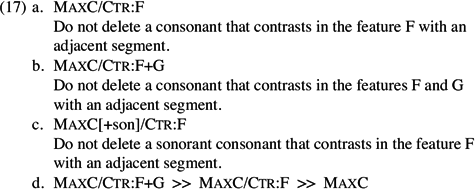
The effect of contrast in cluster simplification is accounted for by integrating contrasting features into MAXC constraints, as in 17. Contrast may refer to one (17a) or many (17b) features; it may be associated with the general MAXC as well as the more specific MAXC[+son] (or MAXC[-son]) (17c). These constraints are ranked as in 17d: Consonants that contrast in more features are more salient and more resistant to deletion, and the MAXC constraints associated with them are ranked higher.
Contrast constraints may also refer specifically to the preceding or following consonant (18), as it is clear that a given consonant X may not be equally perceptible in the context XY (if followed by a segment Y) and in the context YX (if preceded by Y), even though the level of contrast is the same in both sequences. This follows from differences in the distribution of acoustic cues as well as nonlinearities in the response of the auditory system to acoustic modulation. In particular, the onset of a stimulus signal (for example, frication noise at high frequencies or formant structure at lower frequencies) is perceptually more salient than its offset (Bladon 1986, Silverman 1995, Wright 1996, Delgutte 1997).

Obstruents in particular receive better contextual cues from a following sonorant than from a preceding sonorant, due to the enhanced auditory response at the onset of formant structure (and voicing for voiceless obstruents). MAXC[-son] constraints that refer to contrast in [sonorant], [approximant], and/or [vocoid] with the following segment are therefore ranked higher than the corresponding constraints that refer to the preceding segment. This, in conjunction with the ranking schema in 17d, generates the rankings in 20 among the MAXC[-son]/CTR:F constraints defined in 19. The two vertical hierarchies express the fact that obstruents are more vulnerable if they contrast in fewer features (because the MAXC constraint they are associated with is ranked lower); the horizontal lines establish that obstruents are less marked if followed rather than preceded by a sonorant.


Prevocalic obstruents are in a perceptually optimal position since they contrast maximally with the following segment and also benefit from an enhanced auditory response. Their stability, specifically here that of the suffix consonants [t, ð], is guaranteed by the the highestranked MAXC[-son]/→CTR:[son+app+voc]. The vertical hierarchy on the right derives the correlation between the likelihood of obstruent deletion and contrast in manner between the obstruent and the preceding consonant. Recall that speaker H systematically deletes obstruents when the preceding segment in the stem is a nasal (2) or [l] (3–4), but variably retains them next to [r] (5). Speaker O, Blöndal, and Einarsson also obligatorily delete nonstrident obstruents after a nasal, but marginally retain them after [l] and more readily next to [r]. Nasals, then, trigger deletion more than [l], and [l] more than [r]. This generalization is restated in featural terms as follows. With only a contrast in [sonorant] (after a nasal), the obstruent is obligatorily deleted by all speakers, in violation of MaxC[-son]/←tr:[son]; with a larger contrast in [sonorant]+[approximant] (after [l]), the obstruent is variably retained by a subset of speakers (O, B, E) but still systematically deleted by others (H), violating MAXC[–son]/←CTR:[son+app]; with a maximal contrast in [son+app+vocoid] (after [r]), all speakers allow the optional retention of the obstruent.14
The hierarchy between nasals, [l] and [r] with respect to the likelihood of deletion of an adjacent obstruent is accounted for here in terms of contrast. Alternatively, the same generalization could be expressed in terms of sonority distance: The greater the distance between the obstruent and the preceding consonant, the more stable the obstruent is. The contrast approach is more general as it potentially involves all dimensions of segments, manner of articulation but also place and laryngeal setting (see Côté in press a, b).
We now have the essential ingredients to provide a formal analysis of the deletion patterns in stems ending in an obstruent (nasal+obstruent, [l]+obstruent, [r]+obstruent, and [sk]). Let us start with nasal+obstruent stems [

], which are subject to categorical obstruent deletion (2). This is shown in the tableau in 21 with [mp] as an example (V represents any vowel). Four outputs should be considered: the faithful one and the outputs with deletion of each of the three consonants in the sequence. The faithful candidate violates C[harr ]V (21a), the constraint requiring every consonant to be adjacent to a vowel. The other candidates violate at least one of the MAXC constraints. Deletion of the nasal violates MAXC[+son] (21b), that of the suffix consonant [t] MAXC[-son]/→CTR:[son+app+voc] (21d). The winning candidate [VmtI] violates MAXC[-son]/←CTR:[son] since the deleted obstruent [p] contrasts in [son] with the preceding nasal (and contrasts in no manner features with the following [t]) (21c). This constraint must rank below C[harr ]V and MAXC[+son]; 20 has already established that it is ranked below MAXC[-son]/→CTR:[son+app+voc]. This constraint is never violated in the data and candidates with deletion of prevocalic obstruents will not be shown in the following tableaux.

Verbs with a stem ending in [r]+obstruent display for all speakers variation between deletion of the medial obstruent and retention of the full cluster (5). Following Anttila (1997) and Auger (2001), among others, I assume that variation derives from rankings between constraints that remain indeterminate, specifically here the ranking between C[harr ]V and the highest MAXC constraint violated by the output with deletion. In this situation, the permissible outputs are those generated by all the possible strict rankings compatible with the ranking indeterminacy. The possible rankings are MAXC>>C[harr ]V and C[harr ]V>>MAXC, which yield variation between full cluster retention (optimal if MaxC>>C[harr ]V) and deletion (optimal if C[harr ]V>>MAXC).
Deletion of the medial obstruent violates MaxC[-son]/←Ctr:[son+app+voc] since the obstruent contrasts in all those features with [r]. Retention of the entire cluster violates C[harr ]V and the ranking between these two constraints remains indeterminate. The omission of [r] violates MAXC[+son] and, as with nasals above, this compels a fatal violation. This is illustrated in the tableau in 22 with [
] as an example (5g-i). (In this and the following tableaux, I disregard the process of fricativization used by some speakers in the preterite with liquid+obstruent stems.)

Recall that voiced fricatives never surface in the preterite forms, either underlying as in [εrva] ‘inherit-inf.’ or as a result of the fricativization of labial or velar stops for speaker O, Einarsson, and Blöndal. In fact, voiced fricatives are generally vulnerable in Icelandic and are regularly omitted in various contexts (Helgason 1993). To account for the absence of [v] and [
] I use the constraint in 23. This constraint is consistent with the relative markedness of voiced fricatives with respect to voiceless ones crosslinguistically, which may be motivated both articulatorily and perceptually. On the one hand, the production of simultaneous voicing and noise requires greater effort (Ohala 1983). On the other hand, “the strong low-frequency energy that results from voicing tends to mask the lower-amplitude frication noise in the higher frequency range” (Ladefoged and Maddieson 1996:176).
15The situation is more complicated since the voiced fricatives [v, ð,
] tend to be produced as approximants (Helgason 1993). But a complete analysis of the phonetics and phonology of voiced fricatives in Icelandic would lead me too far afield.

Consider stems ending in [rv] taking [ðI] as the preterite suffix (5j,k). In order to ensure the absence of the stem [v], but not that of the suffix [ð], *[

] must rank between MAXC[-son]/→CTR:[son+app+voc] and MAXC[-son]/←CTR:[son+app+voc]. The ranking between the latter constraint and C[harr ]V is not determined (22). The candidates with deletion of the suffix [ð] are eliminated by undominated MAXC[-son]/→CTR:[son+app+voc] (24d–e), the one with [r] deletion by MAXC[+son] (24b). The ranking *[
]>>MAXC[-son]/←CTR:[son+app+voc] then favors [v] deletion [VrðI] (24c) over retention [VrvðI] (24a).

With [l]+obstruent sequences, we observe interspeaker variation (4). The two stem consonants contrast in [son+app], a level intermediate between the nasals and [r]. Speaker H treats these forms like the nasal+obstruent ones and deletes the obstruent; speaker O (as well as Einarsson and Blöndal) indicates variable deletion, as with [r]. We conclude that in H's grammar C[harr ]V dominates MAXC[-son]/←CTR:[son+app] and the tableau for [l]+obstruent forms would be identical to the one with nasals (21), with contrast in [son+app] rather than [son]. In O's grammar, the ranking between MAXC[-son]/←CTR:[son+app] and C[harr ]V remains indeterminate, as in 22. These tableaux are omitted.
In stems ending in [sk] (8), the stop contrasts in the feature [strident] with the preceding consonant, and its deletion violates the constraint in 25. Contrast in [strident] is independent from contrast in the other manner features in 16, and speakers may or may not consider this contrast sufficient to retain the adjacent stop (however they behave with respect to [son], [app] and [vocoid]). So the constraint in 25 remains unranked with respect to those in 19. Speaker O and Blöndal delete the stop, so C[harr ]V dominates MAXC[-son]/←CTR:[strident], as illustrated in 26. Speaker H and Einarsson optionally keep the medial obstruent, with indeterminate ranking between MAXC[-son]/←CTR:[strident] and C[harr ]V, as in 27. For all speakers MAXC[+str] is undominated and eliminates the candidate with deletion of [s].


Sonority and Obstruent+Sonorant Stems
Obstruent+sonorant stems raise a couple of additional issues. The obstruent invariably deletes, before [n] (6) or [l] (7), a fact that is not predicted by the ranking so far. Consider the verb [sIkla] ‘sail-inf.’ and its preterite [sIltI] (7a). The deleted [k] in this form appears in the context V__[l]; it contrasts in [son+app+voc] with the preceding segment and in [son+app] with the following one. Deletion then violates MAXC[-son]/←CTR:[son+app+voc] and MAXC[-son]/→CTR:[son+app], as shown in the tableau in 28. It has already been established that MAXC[-son]/←Ctr:[son+app+voc] and C[harr ]V remain unranked with respect to each other (tableau 22). This predicts, contrary to the facts, that the [k] in [sIkla] should be optionally or obligatorily retained, depending on the ranking of MAXC[-son]/→CTR:[son+app]. If ranked above C[harr ]V (ranking A), only the incorrect output [sIkltI] survives; if ranked below C[harr ]V (ranking B), or if ranking between the two constraints remains undetermined, both [sIkltI] and [sIltI] are optimal.16
If ranking is indeterminate between C[harr ]V and the two MAXC[-son] constraints, there are six possible complete rankings of the three constraints. The candidate [sIkltI] wins in four of them, [sIltI] in two.
The existence of morpheme-internal sequences like [

] (Richter 1982:77) also shows that stops occur before [l] in triconsonantal clusters, so [k] deletion in [sIltI] is not motivated simply by a constraint against such clusters, like C[harr ]V.

I suggest that the relevant markedness constraint ruling out [sIkltI] is the Sonority Sequencing Principle (SSP), which, in its standard syllabic definition, requires the level of sonority to go up in syllable onsets and down in codas (for example, Hankamer and Aissen 1974, Hooper 1976, Clements 1990). The faithful candidate [sIkltI] contains the sequence [klt], with a sonorant consonant trapped between two obstruents. Such a form cannot be syllabified without violating the SSP: A syllabification [sIkl.tI] contains an ill-formed coda, and [sIk.ltI] an ill-formed onset. This situation arises when a consonant is flanked on each side by a less sonorous one, that is when a consonant corresponds to a local sonority maximum.18
This presumes that only vowels can function as sonority maxima (syllabic nuclei) in the language. This definition and the constraint in 29a can easily be accomodated to allow syllabic consonants.

If SSP is ranked sufficiently high, invariable obstruent deletion is predicted in obstruent+sonorant forms. But obstruent+nasal stems raise one more issue: The obstruent deletes but its place of articulation remains on the nasal, as in infinitive [cεkna] versus preterite [cεηtI] (6) (see generalization 12g). This also has a perceptual motivation: The retention of the place feature of the stop follows from the robustness of the place cues carried by the preceding vowel. On the other hand, the nasal lacks good place cues between two obstruents. I suggest using MAXF(eature) constraints (see Zhang 2000 and the references cited there) and posit the constraint in 30a that militates against the deletion of a place feature cued by an adjacent [+vocoid] segment. This constraint ranks above the general MAX[place] constraint.

In the case of obstruent+[l] stems, however, the remaining lateral retains its coronal place of articulation. I assume that MAX[place]/[voc] is dominated by a constraint requiring that lateral consonants be coronal (31).19
As mentioned in note 4, there is a possibility that the velar or labial place of articulation appears as secondary articulation on the lateral. Notice, however, that this applies in [l]+obstruent as well as obstruent+[l] stems. I leave this issue aside.

The tableaux in 32 and 33 illustrate how the correct outputs are obtained, for obstruent+[n] and obstruent+[l] stems, respectively. The sequences [kl] (7a,b) and [kn] (6a–c) are used as illustrations (the sequences [pl] and [pn] behave identically). In 32, candidates with stop deletion each violate two MAXC[-son] constraints (32c,d). SSP must rank above them to eliminate the faithful candidate (32a), while [n] deletion is excluded by MAXC[+son] (32b). MAX[pl]/[+voc], which prevents the deletion of the place of articulation of the postvocalic [k], determines the winner with velar [N] (32d) over coronal [n] (32c). The rankings of MAXC[-son]/→CTR:[son] and MAX[pl]/[+voc] are irrelevant as long as the former remains lower than SSP and the latter dominates MAX[pl].

The tableau in 33 is almost identical. One difference concerns the constraint LAT=COR. Ranked above MAX[pl]/[+voc], it eliminates the output [V;tI] with a velar lateral (33d). The level of contrast between [k] and the following lateral is also greater than between [k] and a nasal, and [k] deletion violates MAXC[-son]/→CTR:[son+app] rather than MAXC[-son]/→CTR:[son].

[r] Deletion and Sonorant+Sonorant Stems
With sonorant+sonorant stems different deletion patterns emerge. Speaker O retains all sonorant consonants in the preterite forms, irrespective of their nature and position. For him, then, MAXC[+son] dominates C[harr ]V and no more rankings are needed to generate the correct outputs. The retention of both stem consonants in [hIlmtI] (9) is illustrated in 34; [r]-initial sequences behave identically.

Other speakers also retain the entire sequence in [hIlmtI] but allow postvocalic [r] deletion when no weak obstruent is present in the stem. This process also appears to be driven by contrast, in both manner and place of articulation (generalizations 12e and 12f). Postvocalic [r] does not contrast in manner with the preceding vowel, also specified [+vocoid,+approximant, +sonorant]. All other sonorant consonants contrast in at least one manner feature with the preceding segment; they are protected from deletion by the constraint in (35) (which stands for all the MAXC[+son]/←CTR:F constraints in which F corresponds to a manner feature or combination of features).

Deletion is also affected by contrast in place of articulation. The data in 10 and 11 show that speaker H and Einarsson omit postvocalic [r] before [n] but not before [m], which I relate to the fact that [r] and [n] share the same place of articulation. The following constraint excludes [r] deletion in [rm].

The tableau in 37 illustrates the grammar of speaker H and Einarsson for preterite forms with sonorant+sonorant stems. Deletion of the sonorants in [VlmtI] (37a) violates MAXC[+son]/←CTR:M, since [l] contrasts with the preceding vowel in [vocoid] and [m] with the preceding lateral in [approximant]. The faithful candidate violates the lower-ranked C[harr ]V and comes out as optimal. Postvocalic [r] deletion, however, does not violate MAXC[+son]/←CTR:M but the lower-ranked MAXC[+son] (37b,c). In [rm] sequences it also violates MAXC[+son]/→CTR:Pl (37b) but not in [rn] (37c). Ranking MAXC[+son]/→CTR:Pl and MAXC[+son]/←CTR:M above C[harr ]V excludes deletion in [lm] and [rm]; unrankedness between C[harr ]V and MAXC[+son] yields variable [r] deletion in [rn].20
Rögnvaldsson (1989) indicates deletion in both [rn] and [rm] stems. Thus, contrast in place seems irrelevant. I assume that if a specific contrast is not active in a grammar, like the place contrast here, the corresponding constraint is simply not projected. Likewise, Speaker O does not delete any sonorant consonants in preterites. For him MAXC[+son] is inviolable and no more specific MAXC[+son] constraints are needed.

Final Ranking
To sum up the analysis, the rankings established are put together in the figure 1 below. There are three types or rankings: fixed (universal) rankings, language-specific rankings common to all Icelandic speakers, and speaker-specific rankings. They are indicated by different lines.
This grammar contains several zones of variability, which are accounted for with crucial non-ranking between constraints:
- Indeterminate ranking between C[harr ]V and MAXC[-son]/←CTR:[son+app+voc] yields variable obstruent deletion with [r]+obstruent stems.
- Indeterminate ranking between C[harr ]V and MAXC[-son]/←CTR:[son+app] yields variable obstruent deletion with [l]+obstruent stems (speaker O, Blöndal, and Einarsson only).
- Indeterminate ranking between C[harr ]V and MAXC[-son]/←CTR:[strident] yields variable obstruent deletion with [sk] stems (speaker H and Einarsson only).
- Indeterminate ranking between C[harr ]V and MAXC[+son] yields variable [r] deletion with [rn] stems (speaker H, Blöndal, and Einarsson) (also [rm] for Rögnvaldsson).

Final Constraint Ranking.
Beyond Weak Preterites
To what extent do the generalizations drawn from the preterite forms also apply to clusters in different morphological and prosodic contexts? A complete analysis of cluster simplification in Icelandic is beyond the scope of this article, but the following few remarks on nonpreterite data simultaneously support the proposed account and raise additional issues, which, it is hoped, will be addressed in future studies.
At the level of the morpheme, Icelandic allows a number of clusters of three or more consonants. Richter (1982:73, 77) lists the clusters found in initial and noninitial position within a morpheme. These clusters are consistent with the analysis developed for preterite forms. Initially, stops and fricatives other than [s] always precede a sonorant consonant. Morpheme-internally, they are only found in presonorant or postvocalic position. That is, weak obstruents occur in perceptually favorable positions, as predicted by a perceptual analysis. In contrast, [s] is a lot freer in its distribution, appearing for instance in interobstruent position, as in the noninitial cluster [xst] (for example, in rakstur ‘raking of hay-nom.’ [

]).
21Two sequences in the noninitial list appear to contradict these generalizations: [

] and [nks]. The clusters are given in underlying representations and these clusters are in fact pronounced [rð] and [ηs]. Initial obstruent+[v], as well as initial [skv] and noninitial [nkv], are also potentially problematic, depending on how the consonant transcribed [v] is specified. According to Gibson (1997), this consonant is underlyingly an approximant [V], distinct from the fricative /v/.
The preterite data considered here also appear largely representative of cluster simplification at the word level, which occurs essentially at the stem-suffix boundary. Rögnvaldsson (1989) provides a list of over 85 three- of four-consonant clusters at the word level in which deletion takes place (see also Einarsson 1945). Simplification results in sequences of two or three consonants. First, the cluster-final consonant never deletes; this consonant is either prevocalic, as in the preterite forms, or word-final. It is well known that word edges carry special licensing properties, which have been variably treated in terms of extrametricality (see, for example, Borowsky 1986, Itô 1986, Booij 1999), final consonants as onsets (for example, Kaye 1990, Dell 1995), indirect licensing (Piggott 1999, Spaelti 1999), or enhanced perceptual cues (Côté 2000a). In any case, a full account of cluster simplification in Icelandic needs to consider the special status of word edges.
After the exclusion of the cluster-final consonant, a clear hierarchy of deletion emerges. First, stops and nonstrident (labial, dental, or velar) fricatives delete, in cluster-initial and/or medial position. Obstruent deletion (other than that of [s]) is observed in 72 different clusters. After omission of the obstruents, clusters of more than two consonants undergo deletion of postvocalic [r], if one is present. This occurs in 15 clusters before [l], nasal consonants or [s], for example, [rnt]→[nt] in fernt ‘four of-neut.’ [

]. The two processes of weak obstruent and postvocalic [r] deletion reflect exactly what we observed in preterite forms. In particular, [l] and [s] never delete. Preterites, then, are representative of word-level consonant cluster phonotactics.
22The vulnerability of stops also shows up at the phrasal level, with the possible omission of interconsonantal stops, as in óttalegt bull ‘sheer nonsense’ [ouhtalεx(t)

But there is one interesting exception to the obstruent-thenpostvocalic-[r] rule, observed in four different clusters. It consists in deleting [n] between a consonant and [s]. For instance [fns]→[fs] in hrafns ‘raven-gen.’ [

] and [rns]→[

] in barns ‘child-gen.’ [

.
23For the word b e r n s k a ‘youth, childhood’, Rögnvaldsson gives the pronunciation [pεnska], with deletion of the postvocalic [r] rather than the medial [n] before [s]. Einarsson, however, indicates variable deletion of [n] rather than [r]: [

].

]). Nasal deletion also spares [m], which remains in the same context where [n] deletes (for example, [rms]→[ms] in harms ‘sorrow-gen.’ [hams]
24Notice that Einarsson retains the [r] in this form, for which he indicates [harms]. But he does delete the [r] in barns. This illustrates again the distinction between [n] and [m] with respect to the deletion of a preceding [r], distinction that does not appear in Rögnvaldsson's data.
Beyond the word level, cases of [n] deletion can also be found in compounds like those in 38, where the [n] ending the first element in the compound is variably omitted.25
Thanks to an anonymous reviewer for bringing such examples to my attention.

A more detailed study of cluster phonotactics in compounds is necessary, but such examples clearly suggest that compounds obey different constraints than at the word level. It may be that elements in the compound are subject to similarity constraints with the corresponding isolated words. For instance, if the part regn in regnhlíf is related to the word regn ‘rain’ [

], a pronunciation like *[rεη] could be excluded. The voicelessness of [

], which weakens it auditorily, may also be relevant.
Conclusions
I have suggested that consonant deletion in preterite forms of weak verbs in Icelandic can be explained with two basic sequential principles: 1) a requirement that consonants be perceptually salient; and 2) sonority sequencing. Perceptual factors account for a number of generalizations observed in the preterite forms, which are elucidated in terms of internal and contextual cues and auditory considerations. Reduction takes place only in clusters of more than two consonants, that is when at least one consonant cannot benefit from the good cues present in adjacent vowels. Deletion preferentially targets stops and nonstrident fricatives, the consonants with the weakest internal cues. The likelihood of deletion correlates with the degree of similarity between the consonants in the cluster, in manner but also in place of articulation. This is related to the correlation between the perceptibility of a segment and the level of contrast it displays with its adjacent segments. Formally, the analysis uses essentially perceptually motivated faithfulness constraints that block the deletion of perceptually stronger segments.
References
Anttila Arto.
1997.
Deriving variation from grammar.
Variation, change and phonological theory,
ed. by Frans Hinskens,
Roeland van Hout, and
Leo Wetzels,
35–
68.
Amsterdam:
John Benjamins.
Árnason Kristján.
1980a.
Some processes in Icelandic connected speech.
The Nordic languages and modern linguistics 4: Proceedings of the Fourth International Conference of Nordic and General Linguistics,
ed. by Even Hovdhaugen,
212–
222.
Oslo:
Universitetsforlaget.
Árnason Kristján.
1980b.
Quantity in historical phonology.
Cambridge:
Cambridge University Press.
Auger Julie.
2001.
Phonological variation and optimality theory: Evidence from word-initial vowel epenthesis in Vimeu Picard.
Language Variation and Change
13.
253–
303.Google Scholar
Berg Thomas.
2001.
An experimental study of syllabification in Icelandic.
Nordic Journal of Linguistics
24.
71–
106.Google Scholar
Bladon Anthony.
1986.
Phonetics for hearers.
Language for hearers,
ed. by Graham McGregor,
1–
24.
Oxford:
Pergamon Press.
Blevins Juliette.
2003.
The independent nature of phonotactic constraints: An alternative to syllable-based approaches.
The syllable in Optimality Theory,
ed. by Caroline Féry and
Ruben van de Vijver,
375–
403.
Cambridge:
Cambridge University Press.
Blöndal Sigfús.
1920.
Íslenzk-dönsk orðabók / Islands-dansk ordbog [Icelandic-Danish Dictionary].
Reykjavík:
Kaupmannahöfn og Kristíaníu, Pór. B. Pórláksson og H. Aschehoug, and Co.
Boersma Paul.
1998.
Functional phonology: Formalizing the interactions between articulatory and perceptual drives.
The Hague:
Holland Academic Graphics.
Booij Geert E.
1999.
The role of the prosodic word in phonotactic generalizations. Studies on the phonological word,
ed. by Tracy Alan Hall and
Ursula Kleinhenz,
47–
72.
Amsterdam:
John Benjamins.
Borowsky Toni J.
1986.
Topics in the lexical phonology of English.
Doctoral dissertation,
University of Massachusetts,
Amherst.
Clements George N.
1990.
The role of the sonority cycle in core syllabification.
Between the grammar and physics of speech,
ed. by John Kingston and
Mary E. Beckman,
283–
333.
Cambridge:
Cambridge University Press.
Côté Marie-Hélène.
2000a.
Consonant cluster phonotactics: A perceptual approach. Doctoral dissertation, MIT.
Côté Marie-Hélène.
2000b.
The perception of stops in post-consonantal position and the role of auditory cues in stop deletion. Unpublished manuscript, MIT.
Côté Marie-Hélène.
In press a. Consonant cluster simplification in Québec French. Probus 16.2.
Côté Marie-Hélène.
In press b. Syntagmatic distinctness in consonant deletion. To appear in: Phonology 21.1.
Delgutte Bertrand.
1997.
Auditory neural processing of speech.
The handbook of phonetic sciences,
ed. by William J. Hardcastle and
John Laver,
507–
538.
Oxford:
Basil Blackwell.
Dell François.
1995.
Consonant clusters and phonological syllables in French.
Lingua
95.
5–
26.Google Scholar
Einarsson Stefán.
1945.
Icelandic: Grammar, texts, glossary.
Baltimore, MD:
Johns Hopkins University Press.
Fleischhacker Heidi.
2001.
Cluster-dependent epenthesis asymmetries.
UCLA working papers in linguistics
7.
71–
116Google Scholar
Flemming Edward.
1995.
Auditory representations in phonology.
Doctoral dissertation,
University of California,
Los Angeles.
Fujimura Osamu,
Marian J. Macchi, and
Lynn A. Streeter.
1978.
Perception of stop consonants with conflicting transitional cues: A cross-linguistic study.
Language and Speech
21.
337–
346.Google Scholar
Gibson Courtenay St. John.
1997.
Icelandic phonology in Optimality Theory.
Doctoral dissertation,
University of Iowa.
Gussmann Edmund.
2002.
The dental suffix in modern Icelandic: Phonology, morpho(phono)logy, and the lexicon.
Studia Anglica Posnaniensia
38.
191–
214.Google Scholar
Halle Morris, and
George N. Clements.
1983.
Problem book in phonology.
Cambridge, MA:
MIT Press.
Hankamer Jorge, and
Judith Aissen.
1974.
The sonority hierarchy.
Chicago Linguistic Society
10.
131–
145.Google Scholar
Helgason Pétur.
1993.
On coarticulation and connected speech processes in Icelandic.
Reykjavík:
Málvísindastofnun Háskóla Íslands.
Hooper Joan B.
1976.
An introduction to natural generative phonology.
New York:
Academic Press.
Hume Elizabeth.
2004.
The indeterminacy/attestation model of metathesis.
Language
80.
203–
237.Google Scholar
Hume Elizabeth, and
Keith Johnson, eds.
2001.
The role of speech perception in phonology.
San Diego:
Academic Press.
Itô Junko.
1986.
Syllable theory in prosodic phonology.
Doctoral dissertation,
University of Massachusetts,
Amherst.
Jun Jungho.
1995.
Perceptual and articulatory factors in place assimilation: An Optimality theoretic approach.
Doctoral dissertation,
University of California,
Los Angeles.
Kawasaki Haruko.
1982.
An acoustical basis for universal constraints on sound sequences.Doctoral dissertation,
University of California,
Berkeley.
Kress Bruno.
1963.
Laut- und Formenlehre des Isländischen.
Halle:
Max Niemeyer.
Ladefoged Peter, and
Ian Maddieson.
1996.
The sounds of the world's languages.
Oxford:
Basil Blackwell.
Lamontagne Gregory A.
1993.
Syllabification and consonant cooccurrence conditions.
Doctoral dissertation,
University of Massachusetts,
Amherst.
Miller George A., and
Patricia E. Nicely.
1955.
An analysis of perceptual confusion among some English consonants.
Journal of the Acoustical Society of America
27.
338–
352.Google Scholar
Ohala John J.
1983.
The origins of sound patterns in vocal tract constraints.
The production of speech,
ed. by Peter F. MacNeilage,
189–
216.
New York:
Springer Verlag.
Ohala John J., and
Haruko Kawasaki.
1985.
Prosodic phonology and phonetics.
Phonology Yearbook
1.
113–
127.Google Scholar
Pétursson Magnús.
1973.
Quelques remarques sur l'aspect articulatoire et acoustique des constrictives intrabuccales islandaises.
Travaux de l'Institut de phonétique de Strasbourg
5.
79–
99.Google Scholar
Piggott Glyne L.
1999.
At the right edge of words.
The Linguistic Review
16.
143–
196.Google Scholar
Prince Alan, and
Paul Smolensky.
2004.
Optimality Theory: constraint interaction in generative grammar. Oxford:
Basil Blackwell.
Ragnarsdóttir Hrafnhildur,
Hanne Gram Simonsen, and
Kim Plunkett.
1999.
The acquisition of past tense morphology in Icelandic and Norwegian children: An experimental study.
Journal of Child Language
26.
577–
618.Google Scholar
Richter Gregory C.
1982.
A generative phonology of modern Icelandic.
Doctoral dissertation,
University of California,
San Diego.
Rögnvaldsson Eiríkur.
1989.
Íslensk hljóðfræði: kennslukver handa nemendum á háskólastigi [Icelandic Phonetics: An Introductory Handbook for University Students].
Reykjavík:
Málvísindastofnun Háskóla Íslands.
Silverman Daniel.
1995.
Phasing and recoverability.
Doctoral dissertation,
University of California,
Los Angeles.
Spaelti Philip.
1999.
Weak edges and final geminates in Swiss German.
Unpublished manuscript,
University of California,
Santa Cruz.
Steriade Donca.
1999a.
Alternatives to syllable-based accounts of consonantal phonotactics.
Proceedings of LP '98: Item order in language and speech, ed. by Osamu Fujimura,
Brian D. Joseph, and
Bohumil Palek,
vol. 1,
205–
245.
Prague:
The Karolinum Press.
Steriade Donca.
1999b.
Phonetics in phonology: The case of laryngeal neutralization.
Papers in phonology 3,
ed. by Matthew K. Gordon,
25–
246.
(UCLA working papers in linguistics, 2.)
Steriade Donca.
1999c.
The phonology of perceptibility effects: The P-map and its consequences for constraint organization.
Unpublished manuscript,
University of California,
Los Angeles.
Wilson Colin.
2001.
Consonant cluster neutralisation and targeted constraints.
Phonology
18.
147–
197.Google Scholar
Wright Richard A.
1996.
Consonant clusters and cue preservation in Tsou.
Doctoral dissertation,
University of California,
Los Angeles.
Wright Richard A.
2001.
Perceptual cues in contrast maintenance.
The role of speech perception in phonology,
ed. by Elizabeth Hume and
Keith Johnson,
251–
277.
San Diego:
Academic Press.
Zhang Jie.
2000.
Non-contrastive features and categorical patterning in Chinese diminutive suffixation: MAX[F] or IDENT[F]?
Phonology
17.
427–
478.Google Scholar
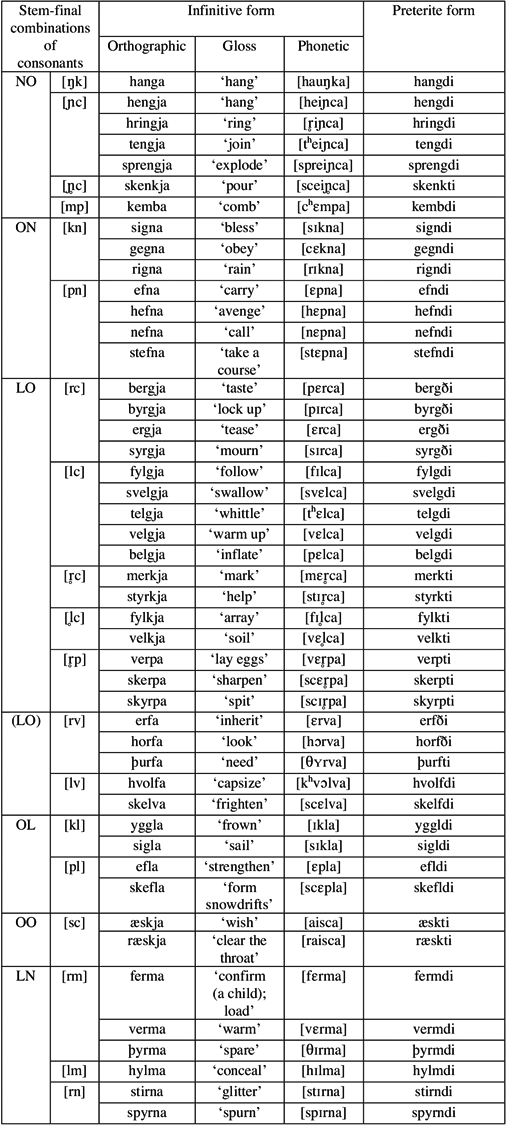
Table 1. Verbs with Stems Ending in Two Consonants and Taking -di/-ti/-ði in the Preterite.
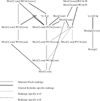
Final Constraint Ranking.
 You have Access