1. Introduction
In the earliest attested varieties of West Germanic (WGmc) languages, the normal inflectional ending for the 2nd person singular present indicative of the vast majority of verbs—as well as for the 2nd person singular past indicative of weak verbs—was -s.Footnote 1 In some of the languages, this 2nd person singular -s also occurs in the present and past subjunctive. Over the course of the first few centuries for which there is textual evidence (roughly from 700 C.E. on), one increasingly finds the innovative ending -st instead of -s everywhere except in Low Franconian (Dutch) and the adjoining Westphalian portion of Low-German-speaking territory (Brinkmann Reference Brinkmann1931:150–152). In HG and to a lesser extent in English, one can follow the progress and spread of the change through the 9th, 10th, and later centuries (Campbell Reference Campbell1959:301, Braune & Reiffenstein Reference Braune and Reiffenstein2004:261). A few examples of OHG forms—early ones in -s (ca. 800 C.E.) and corresponding later ones in -st (ca. 1000 C.E.)—are given in 1.Footnote 2
(1)


The change affects Low German somewhat later. There is no sign of the new -st in the major OS texts from the first half of the 9th century (Gallée Reference Gallée1910:246), but it has become the normal ending outside of Westphalian by the time of the earliest attestations of MLG in the 13th century (Lasch Reference Lasch1974:224–225). In Frisian, the change to -st is complete by the time of the earliest surviving (13th century) texts (Steller Reference Steller1928:57). By contrast, -s occurs more or less consistently throughout both OLF (Kyes Reference Kyes1983) and MD (Franck Reference Franck1971:116), while modern standard Dutch—like modern English—has replaced the old 2nd person singular with what were originally 2nd person plural forms. More recently, an accretion of -t (or in some cases -ð) in the 2nd person singular present indicative has affected some verbs in Icelandic and Faroese (Orešnik Reference Orešnik1980; see section 4.3 below).
This article first presents a systematic survey of existing accounts of the 2nd person singular -s→-st changes in WGmc languages (see section 2) and then turns to a close examination of a number of problems with two of the most popular kinds of accounts: those that characterize the change—partially or entirely—as an analogical extension in the use of an existing 2nd person singular -st ending (section 3) and those that treat it as a case of grammaticalization of an enclitic subject pronoun -tu (section 4.1).
The account that I advocate bears some prima facie resemblance to these approaches in that it also involves both reanalysis of forms with enclitic -tu and analogy based on existing forms, but I argue, on the one hand, that the reanalysis of the -tu forms is a strictly “formal” matter, in the sense that it involves only the segmental make-up of the agreement ending and has no effect on the function of either the ending or the subject pronoun—as would be the case with grammaticalization (section 4.2)—and, on the other hand, that the analogy at work here is based entirely on patterns of phonological alternation—so that the prior existence of 2nd person singular forms ending specifically in -st plays no crucial role (section 4.3). I also argue in section 4.2 against the widespread view that the formal reanalysis of the -stu forms is an instance of “recutting” (Hock Reference Hock1991:200–202)—a shift in the location of the host-clitic boundary—and maintain instead that the innovative analysis of the -stu forms is licensed by an ambiguity that arises through neutralization of a phonological contrast.
When the mechanisms behind the 2nd person singular -s→-st change are properly understood, it becomes clear that the analogy and reanalysis components of this development are not two independent, contributing factors, as they are often portrayed in the literature, but rather two inextricable aspects of a single, coherent account. The phonological nature of the mechanisms behind this change also helps clarify the relationship of 2nd person singular -s→-st to the broader phenomenon of accretion of final t in Germanic languages, as in German Saft ‘juice’ from OHG/MHG saf (cognate with English sap) or English against from earlier forms ending in -(e)s (see section 4.4).
2. Previous Accounts of 2nd Person Singular -s→-st
Going back to the 19th century, scholars have cited two main factors in their accounts of 2nd person singular -s→-st: i) the analogical influence of a small set of verbs whose 2nd person singular present indicative already ended in -st in earlier Germanic or WGmc; ii) reanalysis of verb ± enclitic subject pronoun sequences, such as OHG giloubistu from giloubis ± thu/du ‘believest thou’ or OE dēstu from dēs ± þu ‘dost thou’. Almost all accounts mention both of these factors. Accounts differ in: (a) the relative importance that they attribute to each factor; (b) what—if anything—they have to say about interaction between the two factors; (c) the nature of the analogy that they posit for factor i); and (d) the nature of the reanalysis that they posit for factor ii). Many existing accounts are quite vague on some or all of these points.
An unprecedentedly clear position has recently been staked out by Ringe & Taylor (Reference Ringe and Taylor2014:353–355), who deviate from all previous accounts that I am aware of—including Sihler Reference Sihler1986, which they cite as the basis for their own account—in two related respects. First of all, they deny any significance whatsoever to enclitic pronouns, claiming that verbs were rarely followed by subject pronouns in OE, thus attributing the -s→-st change entirely to factor i). Second, they propose explicitly and unequivocally that the analogy at work here hinges on the morphological status of -st as an agreement ending. As I explain below, many other scholars—notably Sihler (Reference Sihler1986)—assume, on the one hand, that the -st is somehow crucial, but, on the other hand, characterize the analogical mechanism as an extension of the relationship between existing pairs of 2nd person singular forms with and without an enclitic subject pronoun, as in OE wástu : (þú) wást ‘know.2sg.prs.ind’—a relationship that can be described in a number of ways that make no reference to an -st ending.
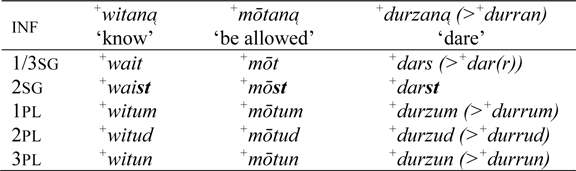
The only verbs with 2nd person singular present indicative forms ending in -st in PGmc were three members of the small inflection class traditionally known as preterite-presents because their present-tense paradigm looks like the past tense of an ordinary strong verb: ±waist ‘know’; ±darst ‘dare’; and ±mōst ‘be allowed’ (all 2sg.prs.ind). The normal 2nd person singular present indicative ending for preterite-present verbs in PGmc and throughout the older Germanic languages was -t. The s in the three forms listed above was not (originally) part of an ending but rather a root-final segment. The s did not occur throughout the present-tense paradigm of these verbs, however, as it was a product of one or another early sound change conditioned by the -t ending (or in the case of ±darst, was preserved by that ending). Table 1 shows the reconstructed PGmc present indicative paradigm for these three verbs (based on Ringe Reference Ringe2006:260–261).
Reconstructed PGmc present indicative paradigms.

Ringe & Taylor’s contention is that the historically accidental occurrence of -st in the 2nd person singular (only) of the present indicative of these three verbs allowed “learners to abduce a 2sg. ending *-st” (2014:354), which could then spread analogically to other lexical items. The purported spread of -st began slowly as it first replaced -t in WGmc in two or three preterite-present verbs with root-final n, yielding OE/OS canst/OHG kanst ‘can.2sg.prs.ind’ (compare Gothic kant), OE (ġe-)manst ‘remember’, OS farmanst ‘scorn’ (compare Old Norse mant ‘remember’), and presumably also ±anst ‘grant’ (compare Icelandic annt ‘love’), although this last verb happens not to be attested in the 2nd person singular present indicative in any of the older WGmc languages (Campbell Reference Campbell1959:343–346; Sihler Reference Sihler1986:203–204, 212–213, note 10).
Most accounts—including Ringe & Taylor’s—also emphasize the importance of bist, 2nd person singular present indicative of the (non-preterite-present) verb meaning ‘be’—both as the first instance of analogical spread of -st beyond the preterite-presents and as an additional model for the later generalization of this ending to other verbs. Some authors argue that bist is an especially important analogical model because of the match between its final -ist and the -ist of the present indicative of strong and class 1 weak verbs (Schatz Reference Schatz1927:318–319, Somers Reference Somers2011:158–159; see table 7 and the associated discussion in section 4.1 below). The -st in bist clearly predates the -s→-st change in any other non-preterite-present verb. It occurs almost categorically in OS, with just one instance of bis in one of the two manuscripts of the Heliand, as it does in most early OE and OHG texts that otherwise show no sign of -st spreading beyond the preterite-presents. The early 9th-century Murbach Hymns and Monsee Fragments (OHG), for example, both have invariable bist (or pist; 26 tokens), but only -s in the 2nd person singular present indicative of other non-preterite-present verbs (25 tokens). Shorter texts from the first half of the 9th century and earlier all confirm this pattern (Benediktiner Regel, Freisinger Paternoster, St. Galler Paternoster, Hildebrandslied, Weissenburger Katechismus).
There is one OHG text from this period, Tatian’s gospel harmony, that shows variation between bis and bist. Somers (Reference Somers2011:157–158) interprets this as evidence of a still incomplete -s→-st change in this verb, but given the OE, OS, and other OHG evidence, bist is generally assumed to date back to prehistoric WGmc, and the occasional attested bis forms in OHG are taken to reflect a secondary -st→-s development (Sihler Reference Sihler1986:213, note 12; Braune & Reiffenstein Reference Braune and Reiffenstein2004:308). Variation between bis and bist also occurs in OLF (Kyes Reference Kyes1983, s.v. wesan) and MD (Franck Reference Franck1971:141–142).
Whatever its origins, bist clearly was available as a model when the general -s→-st change occurred in the older WGmc languages. Whether bist itself represents an early instance of the spread of -st is less clear but also less crucial for present purposes (see Lühr Reference Lühr, Untermann and Brogyanyi1984; Sihler Reference Sihler1986:195, 204–205).
In addition to Ringe & Taylor, a number of other linguists—including Scherer (Reference Scherer1868:211), von Kienle (Reference Kienle1969:283), and Franck (Reference Franck1971:116)—also see analogy of the early -st verbs as the primary factor behind the general spread of the ending, but they all grant a secondary role to verb ± enclitic pronoun collocations. There are also several who grant more or less equal importance to these two factors (for example, Wright & Wright Reference Wright and Wright1908:240, Schatz Reference Schatz1927:318, Brinkmann Reference Brinkmann1931:150, Paraschkewow Reference Paraschkewow2003:385, Rabanus Reference Rabanus2008:116–117). Finally, as I discuss in section 4.3 below, many authors who place the main focus on the forms with enclitic subject pronouns nevertheless regard the early -st verbs as playing a crucial role in the change.
Regarding the precise role ascribed to reanalysis of verb ± enclitic subject pronoun sequences, there is, first of all, a basic distinction between accounts that characterize the change as grammaticalization/morphologization, where the enclitic pronoun is seen as undergoing formal reduction and functional reanalysis to become part of the agreement suffix, versus accounts that posit a reanalysis involving only the phonological make-up of the agreement ending, with no change in the functional status or syntactic behavior of either the ending or the pronoun. Proponents of both of these types of accounts recognize that the sequence of 2nd person singular ending -s and subject pronoun þu/thu or du ‘thou’ yields -stu through regular phonological processes throughout WGmc. Morphologization accounts posit further reduction of -stu to -st, accompanied—or followed—by reanalysis of -st as (only) an agreement ending. Other reanalysis accounts hinge instead on the phonological ambiguity of -stu. Based on regular phonological patterns in the older WGmc languages, surface -stu could reflect either underlying -s ± þu or -st ± þu. In other words, a speaker/learner trying to figure out the phonological make-up of the agreement ending based only on -stu forms would have no evidence for choosing between -st and -s. Given that tokens of the relevant verbs in other environments would presumably point to -s, one important task for proponents of this kind of account is to identify countervailing factors that might have biased speakers/learners toward the innovative -st ± þu analysis of -stu.
Proponents of the type of account just described often characterize the reanalysis involved as a “recutting”: The t in forms such as OHG giloubistu ‘believest thou’ or OE dēstu ‘dost thou’, which was originally a reflex of the þ in the pronoun þu ‘thou’, was reanalyzed as (also) belonging to the verbal agreement suffix.Footnote 3 In section 4.2 below, I show that this reanalysis is definitely not a straightforward recutting, and I argue that the mechanism behind this change can be better understood if one compares it to familiar cases of phonological reanalysis that have nothing to do with recutting.
3. Problems with Morphological Analogy Accounts
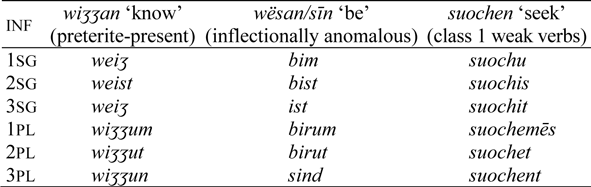
As noted above, Ringe & Taylor’s (2014) account is exceptional in its explicit characterization of the -s→-st change as the analogical spread of a “2nd person singular ending *-st” (p. 354). A similar view is implicit, however, in the position taken by many other scholars that only those preterite-present verbs whose 2nd person singular form ended in -st were relevant as analogical models for the change. The development posited in these accounts would be unusual in two important respects. First of all, it would violate the principle behind the “proportional” model of analogical innovation: “one word can be subject to analogical influence from another in its inflection only if it [already] corresponds to the other word in the formation of one or more forms” (Paul Reference Paul1886:95; translation from Fertig 2015:94). Table 2 shows that the supposed models for the -s→-st change—certain preterite-present verbs and the verb be—did not correspond to ordinary verbs in the formation of any present indicative forms.Footnote 4
OHG present indicative paradigms.

Since Paul Reference Paul1886, the widespread practice of using solvable proportional equations to model analogical innovations has provided linguists with a convenient, informal way of capturing the constraint imposed by the principle cited above. Where there are no formal correspondences elsewhere in the paradigm between the items that are supposedly serving as the model for an analogical innovation and the items affected by that innovation, no proportional equation can be formulated that yields the attested innovative form as a solution. As illustrated in 2, any proportional equation that tries to capture the -s→-st change using forms from table 2 as models produces either no straightforward solution or a solution that does not match the attested change.
(2)

The proportional principle follows deductively from Paul’s version of word-and-paradigm morphology (see Ackermann & Malouf Reference Ackerman, Malouf, Hippisley and Stump2016, James Blevins Reference Blevins2016), but its validity as an empirical observation about the vast majority of attested analogical changes is theory-independent, as generations of historical linguists have confirmed (see Stump Reference Stump2016:261). There are counterexamples to the proportional principle, but, as Paul himself observed, they nearly always involve affixes that “can be perceived as essentially the normal ending for an inflectional form” (1886:95; see Fertig Reference Fertig2013:46–47). Paul attributed this perceived “normal” status to the “exceptional frequency” of certain endings, where it is clear that he is talking about type frequency rather than—or in addition to—token frequency. Wurzel (1984:139–42, Reference Wurzel1989:135–7) builds on Paul’s observation and coins the term superstable marker to refer to inflectional exponents that can spread without any paradigmatic support. He argues that exponents acquire this status by being established in a variety of inflectional classes, which imparts on them a special association with a paradigmatic position independent of any particular inflectional class (see Fertig Reference Fertig2000:41). Carstairs-McCarthy (Reference Carstairs-McCarthy1999:1017) defines his closely related notion of “class defaults” as “affixes shared by more than one inflection class and all of whose rivals are peculiar to one class” (see Carstairs-McCarthy Reference Carstairs-McCarthy1994).
Several centuries later, -st unquestionably does become the “normal” 2nd person singular ending in German by all of these criteria, but in early OHG and OE, -s rather than -st would have been the only candidate for this status. The type frequency of -st was extremely low. Even among the preterite-presents it only occurred on about half of the verbs in the class. Not until centuries later—long after it had become ubiquitous everywhere else—did it finally spread to the remaining preterite-presents: OHG darft/OE þearft ‘need’; OHG maht/OE meaht ‘may/can’; OHG scalt/OE scealt ‘shall.2sg.prs.ind’). The darft → darfst and maht → mahst (or magst) changes in German occurred largely in the 15th century; the German cognate of shall did not adopt 2nd person singular -st until the 16th (Fertig Reference Fertig2000:39–40).
Evidence that speakers of at least some of the dialects commonly referred to as OHG still regarded -t rather than -st as the normal 2nd person singular ending for preterite-present verbs comes from the emergence of the form wilt ‘will/want.2sg.prs.ind’, which gradually begins to replace earlier wil(i) in late OHG. The same change had happened prehistorically in OE. The original present indicative forms of this verb are historically optative. The adoption of 2nd person singular -t is just one of a number of inflectional innovations that attest to the pervasive analogical influence of the preterite-presents on the paradigm of will throughout WGmc.
There has been a great deal of analogical change involving the preterite-present verbs in Germanic languages. The attested developments fall into three categories: i) innovations within the preterite-present class, making the paradigms of the members more similar to each other (Fertig Reference Fertig1999); ii) occasional influence on individual verbs outside the class that show semantic/functional affinity to the preterite-presents, such as English need (he need not), German brauchen ‘need’, and above all will, mentioned above; iii) conversely, loss of preterite-present morphology among verbs that do not share the typical semantic and syntactic characteristics of this class, such as German gönnen ‘not begrudge’, taugen ‘be suitable’, English owe, dare (Wurzel 1984:149, Reference Wurzel1989:145). I am not aware of any other cases, however, where anyone has suggested that an inflectional exponent or pattern spread from the preterite-present class to large numbers of ordinary verbs. Similar considerations speak against bist serving as an important analogical model for the spread of a 2nd person singular -st ending. Bybee & Moder (Reference Bybee and Moder1983) argue generally that the “autonomy” of very high-frequency forms makes them not only resistant to analogical influences from other (classes of) items but also unlikely to exert much of an analogical influence themselves, since each individual form is simply stored as a separate, unanalyzed lexical item.
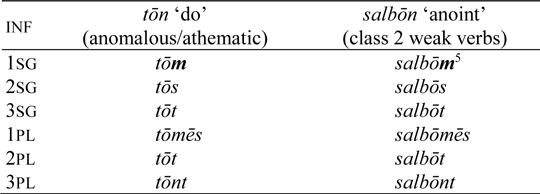
There are in fact known instances of inflectional exponents spreading from single, high-frequency lexical items to large numbers of other items. One example from Germanic verbal morphology involves the athematic 1st person singular present indicative ending -m in OHG and OS. In OE, this ending only occurs on the verbs be (eom) and—in Anglian dialects—do (dōm). In OHG, it has spread apparently from tuom (early OHG tōm), the cognate of Anglian dōm, to all class 2 and 3 weak verbs (Cowgill Reference Cowgill1959:11). In stark contrast to the alleged spread of 2nd person singular -st, however, the paradigmatic support for this extension of 1st person singular -m was as strong as it could be. This is especially striking in class 2, where the class-defining stem-final -ō- coincidentally made the present-tense paradigm of early OHG tōm look exactly like a class 2 weak verb with t- as its root, as shown in table 3 (based on Braune & Reiffenstein Reference Braune and Reiffenstein2004:260–261, 310; see Prokosch Reference Prokosch1939:209, 211; Campbell Reference Campbell1959:332–333; Krahe & Meid Reference Krahe and Meid1969a:122–125; Ringe Reference Ringe2006:31–32, 135, 174–175; Ringe & Taylor Reference Ringe and Taylor2014:161–162).
Early OHG present indicative paradigms.

To summarize, neither the lack of paradigmatic (“proportional”) parallels between the handful of verbs with early -st and the great mass of ordinary s-verbs nor the fact that -st clearly did not qualify as a “class default” or a “superstable marker” for 2nd person singular in the early WGmc languages would, by itself, be grounds for rejecting accounts that treat the 2nd person singular -s→-st change as the spread of an -st ending by morphological analogy. Taken together, however, these two considerations surely put the burden on advocates of such accounts to identify other examples of analogical changes with similar characteristics.
One argument that Ringe & Taylor and a number of other scholars offer in support of a key role for bist and the preterite-presents is that -st supposedly spreads first to i) forms that are—like bist and the preterite-presents—monosyllabic; and ii) present indicative forms. Although Sihler (Reference Sihler1986:207), Somers (Reference Somers2011:148), and Ringe & Taylor (Reference Ringe and Taylor2014:354) all explicitly claim that the point about monosyllabic forms applies to OHG as well as OE, the data do not support this claim (see Somers Reference Somers2011:157). Since OHG generally lacks the contracted verbs of OE, there are only three verbs other than the preterite-presents and be that normally have monosyllabic 2nd person singular present indicative forms before the 11th century: tuon ‘do’, gēn/gān ‘go’ and stēn/stān ‘stand’. Otfrid, in contrast to his contemporaries, does consistently use contracted quīs(t) as 2nd person singular present indicative of quëdan ‘say’. Table 4 compares 2nd person singular present indicative agreement endings of disyllabic -is(t) verbs with monosyllabic verbs in Otfrid and Tatian (contracted quīs(t) in Otfrid only). It shows that for the two major OHG texts with -s~-st variation in the present indicative, there is no significant difference between monosyllabic forms and the major classes of disyllabic forms in their affinity for -st (p=0.8412, two-tailed Fisher’s exact). I return to the claim of -st arising first in the present indicative in section 4.1 below (see especially table 7 and the associated discussion).
2nd person singular present indicative agreement endings.

Ringe & Taylor’s claim that the sequence of 2nd person singular verb form ± subject pronoun was not common at the relevant time also calls for further investigation. Although the nature of existing corpora makes it difficult to assess this claim for OE, the Referenzkorpus Altdeutsch and ANNIS (Krause & Zeldes Reference Krause and Zeldes2016) now make it quite easy to do so for OHG and OS. In both languages, just about 30% of 2nd person singular present indicative tokens in the corpus texts—across all clause types—are immediately followed within the same clause by an enclitic or free-standing subject pronoun (364 of 1189 tokens for OHG; 62 of 208 for the OS Heliand and Genesis). Although, as an anonymous reviewer points out, these numbers are a rather crude measure of the prevalence of the verb ± subject pronoun collocation, they do suggest that this collocation may well have been common enough to have played a special role in the -s→-st change.
4. Alternatives to a Morphological Analogy Account
A number of alternatives to the morphological analogy account discussed in section 3 are considered in the following subsections. One fundamental conceptual difference between the section 3 account and all other existing accounts is that under the former the -s→-st change is understood as a replacement of the old ending, -s, by the new one, -st, making the presence of an s in both endings a coincidence. As a result, it would be reasonable to regard the prehistoric replacement of -t by -st in preterite-present verbs such as canst/kanst as an early instance of the same change that later spreads to verbs with 2nd person singular -s. All other accounts, by contrast, characterize the -s→-st change as the addition of a final t and thus identify the s in -st with the old -s ending.
4.1. The -s→-st Change as Grammaticalization
The view that the t in -st is a morphologized remnant of pronominal -tu, the enclitic version of the subject pronoun þu, goes back at least to Pfalz Reference Pfalz1918. This view is especially widespread among scholars concerned with modern Bavarian dialects where an uncontroversial, similar-looking case of morphologization has occurred in the 2nd person plural (Mettke Reference Mettke1970:30; Altmann Reference Altmann1984:200; Rowley 1994:493; Fuß Reference Fuß2005:162–164, 2011:59–60; Rabanus Reference Rabanus2008:261; Fuß & Wratil 2013:172). The 2nd person plural agreement ending in standard German and in older stages of German is -t, but these dialects have (a reflex of) -ts, as shown in 3.
(3)

The historical source of the s in 2nd person plural -ts is clearly the subject pronoun es, an originally dual form that many Bavarian dialects use instead of—or in variation with—a cognate of standard German 2nd person plural ihr. Unlike the standard language and many other varieties of German, the 2nd person plural subject pronoun itself is always optional in modern Bavarian, and null subjects are in fact very common. Some of the dialects with 2nd person plural -ts have a similar development in the 1st person plural that results in a new agreement ending -ma, which historically reflects a coalescence of the older ending -n with the enclitic version of the subject pronoun wir, as in 4.
(4)

That the -s→-st development in the 2nd person singular is parallel to Bavarian -t→-ts in the 2nd person plural is an eminently reasonable assumption, especially since phonetic reduction (apocope) of enclitic -tu could yield the attested form, just as reduction of -es to -s does in the 2nd person plural. Historically, however, 2nd person singular -s→-st and 2nd person plural -t→-ts did not occur in parallel. The 2nd person singular development occurred centuries earlier. Wiesinger (Reference Wiesinger1989:44) dates the morphologization of Bavarian 2nd person plural es to the 13th century (see Fuß 2011:68). As described in section 1 above, the 2nd person singular development is also much more widespread, occurring sooner or later in most varieties of WGmc. Another noteworthy difference is the lack of any reasonable alternative to analyzing the development in the 2nd person plural as the absorption of the enclitic pronoun into the agreement ending. In the 2nd person singular, by contrast, absorption of a reduced enclitic (t < tu) is just one of a number of plausible ways of accounting for the t in -st, as I show in sections 4.2 and 4.3 below. While these differences certainly do not mean that the same mechanisms could not be behind both developments, they do justify taking a closer look at the case for a grammaticalization account of 2nd person singular -s→-st.
Perhaps the biggest issue concerns other changes that would be expected to go hand-in-hand with this kind of grammaticalization. When hearers/learners reanalyze a subject pronoun as an agreement affix, they are also reanalyzing a clause that contained a subject pronoun as a clause that lacks one. This is the main way that pro-drop emerges historically (Fuß Reference Fuß2005, 2011). After this kind of development has occurred in a language, one would expect to find null subjects under the relevant circumstances for some time. In the specific case of continental WGmc, careful analysis of differences among the modern dialects with complementizer agreement suggests that changes involving grammaticalization of subject pronouns may have proceeded in the following stages, with null subjects characteristic of stages 2–4 (Axel & Weiß 2011:33–35).
Stage 1: Starting point, prior to grammaticalization; the enclitic pronoun still behaves like a pronoun syntactically. It can occur suffixed to the finite verb only when a subject pronoun would be expected in that position. Otherwise, the verb has a different, older agreement ending. In subordinate clauses, the subject enclitic may be attached to the complementizer (in lieu of a full subject pronoun). It never co-occurs in the same clause with a free-standing subject pronoun or with itself (that is, attached to both the complementizer and the verb). This is the current stage of development of 1st person plural -ma in certain parts of Central and North Bavarian and of enclitic subject pronouns generally in many Germanic languages and dialects, past and present (see Altmann Reference Altmann1984).
Stage 2: The affixal reflex of the old clitic becomes obligatory in main clauses, where it is suffixed to the verb. It can now co-occur with a pre- or postverbal full subject pronoun in main clauses (only). Subordinate clauses remain unchanged from stage 1. This situation is characteristic of the 1st person plural in North Bavarian dialects of the southern Upper Palatinate.
Stage 3: The affixal reflex of the old clitic becomes obligatory in all clauses, main and subordinate, but never occurs more than once in a clause. It is suffixed to the verb in (verb-first/second) main clauses and to the complementizer in (verb-final) subordinate clauses. Verbs in subordinate clauses still have the older agreement ending. When a full pronominal subject is used, it must co-occur in the clause with exactly one occurrence of the new agreement affix. This is the current stage of development of 1st person plural -ma in some Central Bavarian dialects of Lower Bavaria, as shown in 4 and 5, and corresponds to the 2nd person plural pattern described by Pfalz (Reference Pfalz1918:18) for the village of Sangerberg (now Prameny in the Czech Republic), where -ts occurs on complementizers in subordinate clauses and on main-clause verbs in first/second position versus -t on verbs in final position.
Stage 4: The new affix becomes obligatory on the verb in all clauses. In subordinate clauses, it must be present on both the complementizer and the verb, regardless of whether the clause also includes a full subject pronoun. This is the current stage of development of 2nd person plural -ts in much of Central Bavarian. Synchronically, 2nd person singular -st appears to be at this stage in those dialects as well.
Stage 5: Overt subject pronouns become obligatory once again, so that every relevant finite clause now includes both a subject pronoun and at least one instance of the agreement ending that is itself a historical reflex of a subject pronoun. As the subject pronouns become cliticized to verbs or other hosts, the cycle is completed with a return to stage 1.
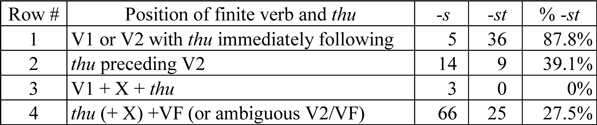
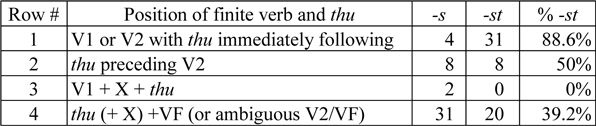
As Axel & Weiß (2011:28–30) note, one generally finds little evidence of null subjects after the 2nd person singular -s→-st change in OHG and MHG. The same is true of OE and the other WGmc languages. Furthermore, unlike the 2nd person plural and the 1st person plural, there are no modern dialects with a stage 2 or stage 3 pattern for the 2nd person singular. Somers (Reference Somers2011:167–178) claims that something resembling a stage 2 pattern is found in Otfrid’s OHG Evangelienbuch. She shows that the new -st ending occurs much more often on the verb when it is in first (V1) or second (V2) position, as is typical in main clauses, than when it is in final position (VF) in subordinate clauses. Closer examination of the data reveals, however, that the significant difference is actually between cases where the verb is immediately followed by the subject pronoun thu, which favor -st over -s by a factor of nearly 8 to 1, versus cases where thu occurs elsewhere in the clause—either before the verb or after it with other material intervening. In this latter case, regardless of whether the verb is in first, second, or final position, -s occurs at least as often as -st, as shown in tables 5 and 6. Table 5 includes all 2nd person singular verb forms that would have ended in -s in early OHG, with the exception of wizîst, present subjunctive of wizzan ‘know’, a high-frequency preterite-present form that invariably ends in -st in Otfrid, for reasons that are not entirely clear (see Somers Reference Somers2011:175–176). The relevant forms are: present indicative of all verbs other than preterite-presents, bist and wili; present and past subjunctive of all verbs (except wizîst); past indicative of all verbs other than strong verbs and tuon, which have the 2nd person singular ending -i rather than -s(t) in OHG. Table 6 includes only the present indicative, which allows for more direct comparison with the findings and correlations reported by Somers (Reference Somers2011:168–172).
Relation of agreement endings to position of verb and subject pronoun thu in Otfrid’s Evangelienbuch.

Relation of agreement endings to position of verb and subject pronoun thu in Otfrid’s Evangelienbuch.

Two-tailed Fisher’s exact tests show the difference between rows 1 and 2 of these tables to be statistically significant (table 5: p=0.0001; table 6: p=0.0047), while that between rows 2 and 4 is not (table 5: p=0.3118; table 6: p=0.5636). These results mean that the presence of thu immediately after the verb significantly increases the likelihood that a verb in first or second position ends in -st rather than -s. In contrast, in clauses where thu precedes the verb (immediately or otherwise), it makes no statistical difference whether the verb is in second or in final position or whether the clause is subordinate or main.Footnote 6 Clause type is still indirectly relevant, however, in the sense that the verb ± thu word order is only possible in main clauses.
The pattern of syntactic distribution of -s and -st described by Somers and Otfrid’s actual pattern revealed in tables 5 and 6 correspond to the two types of “double agreement” that Weiß (Reference Weiß2005) and Axel & Weiß (2011) report for continental WGmc dialects. These are patterns where the same person/number value is marked differently on the verb depending on the syntactic context. In one type, which I refer to as DA-1, the agreement morphology depends on whether the verb is in first/second position in the clause or is in clause-final position (=right sentence bracket). In all of the examples presented by Weiß—and all of the examples that I am aware of—this pattern of double agreement is associated with cases of morphologization of enclitic subject pronouns, specifically with stages 2 and 3 of the five stages described above. An example is shown in 5, where the 1st person plural verb form in 5a (=4 above), in second position in the clause, has the -ma agreement ending, contrasting with the -n ending on the verb in clause-final position in 5b. Note also the -ma ending on the complementizer in 5b. The Sangerberg 2nd person plural pattern described under stage 3 above is also of this type.
(5)

In Axel & Weiß’s other type of double-agreement pattern (henceforth DA-2), the inflection depends on whether the verb is immediately followed by a pronominal subject. This pattern generally does not appear to be associated with historical morphologization of subject pronouns but rather with phonological interaction between agreement endings and adjacent pronouns—whereby only the phonological shape of the agreement ending (and, in some cases, that of the pronoun as well) are affected, with no change in the syntactic behavior of either element. A well-known example is the “n-drop” phenomenon (Axel & Weiß 2011:38–40) that is widespread in the 1st person plural in medieval and early modern German, illustrated in 6, where the first 1st person plural form, fieng, is immediately followed by the subject pronoun wir and thus has a ∅ ending, whereas the second 1st person plural form, warn, has the older -n ending.
(6)

DA-2 patterns are quite widespread in WGmc. The 2nd person singular in modern standard Dutch, for example, has a ∅ ending when the verb is immediately followed by the subject pronoun jij/je but otherwise ends in -t (Booij Reference Booij2002:58). Similar alternations occur in both the 1st person plural and 2nd person plural in OE (Campbell Reference Campbell1959:296–297) and in a number of nonstandard continental WGmc varieties today (Zwart Reference Zwart1997, Weiß Reference Weiß2005).Footnote 7
As Axel & Weiß (2011:40) point out, both types of double agreement pattern originate “in environments in which a pronominal subject (clitic) immediately followed the verb.” Unlike DA-2, however, DA-1 is not strongly associated with the presence of a subject pronoun in this position synchronically because the enclitic subject that formerly followed the verb has become part of the agreement ending. One thus expects at least some clauses with the new agreement ending to have no subject pronoun at all. Furthermore, co-occurrence with preverbal subject pronouns in main clauses is a defining characteristic of the DA-1 pattern (see stages 2 and 3 above).
The data in tables 5 and 6 show that the double agreement pattern in the 2nd person singular present indicative in Otfrid is much closer to DA-2 than to DA-1 and would thus suggest that this is not a case of morphologization of a pronoun but rather of purely phonological interaction between an agreement ending and a following pronoun. The same seems to hold for Christus und die Samariterin, a much shorter late 9th-century text and the only OHG text besides Otfrid with any hint of a double agreement pattern. Axel & Weiß (2011:28) cite the contrast between -st in kërōst thu ‘desire.2sg.prs you.sg’ versus -s in thu wissīs ‘you.sg know.2sg.pst.sbjv’ as evidence of double agreement in Christus und die Samariterin, and a few pages later they suggest that the pattern in this text was one where the new -st ending was initially subject to a “restriction to the verb-second/first position” (p. 39), that is, a DA-1 pattern. While it is true that thu wissīs is in a subordinate clause (obe thu wissīs ‘if you knew’), the other 2nd person singular forms in this text are not consistent with a DA-1 pattern. They point instead to DA-2. Counting all 2nd person singular forms that would have originally ended in -s, there are two tokens in Christus und die Samariterin that are immediately followed by the subject pronoun, thu or du, both of which have the -st ending. The three tokens in V2/1 position with thu/du elsewhere in the clause all end in -s. Of forms in verb-final position in subordinate clauses, two end in -st, four in -s.
Some additional evidence from these same texts complicates the picture, however. The examples in 7 are of main clauses in Otfrid’s Evangelienbuch with 2nd person singular present indicative forms of strong and weak verbs and apparent null subjects. Exact counts are difficult because it is not always clear what is a true null-subject clause as opposed to a loose coordinate structure; furthermore, some verb forms are ambiguous between indicative and subjunctive and even between present and preterite. However, it seems safe to say that the number of such clauses in the Evangelienbuch (with 2nd person singular present indicative of verbs other than preterite-presents and bist) is in the 14–17 range. In their discussion of pro-drop in OHG, Axel & Weiß (2011:28) indicate that there is no correlation between the occurrence of 2nd person singular null subjects and the choice between the older -s and the newer -st ending. This is undoubtedly true of Tatian, the only text included in their discussion that has any -st forms, but in Otfrid, the -st : -s ratio in (apparent) null subject clauses—for the forms under consideration—is somewhere between 13:2 (87% -st) and 12:4 (75% -st). This is close to the proportion of -st endings in clauses where the verb is immediately followed by thu (see row 1 of tables 5 and 6).
(7)

In the only clause of this type in Christus und die Samariterin, shown in 8, the verb also has the -st ending.
(8)

The pattern of double agreement in these two texts—at least for the present indicative of the verbs considered—thus seems to be as follows: -st clearly dominates when the verb is immediately followed by the pronominal subject thu/du or when the clause contains no pronominal subject at all. When thu/du is present but occurs elsewhere in the clause, by contrast, -s is somewhat more common than -st. This distribution does not match either of the patterns of double agreement commonly found in continental WGmc dialects. The high percentage of -st with apparent null subjects would seem to suggest that the -t—in at least some of these cases—does reflect an enclitic pronoun. Otherwise, one would expect the proportions of -s and -st in clauses with no subject pronoun to be roughly comparable to what one finds in other environments where the verb is not immediately followed by a subject pronoun.
An alternative to invoking grammaticalization, however, is to posit that some of the apparent cases of 2nd person singular null subjects with -st in Otfrid and Christus are actually not null subjects at all, but rather instances of a phonetically reduced—but not grammaticalized—enclitic subject pronoun (see Schrodt Reference Schrodt2004:74). These pseudo-cases would exist alongside the occasional true null-subject clauses of OHG (Axel & Weiß 2011:28) and inflate the percentage of -st forms in clauses that appear to lack a 2nd person singular subject pronoun. Crucially, apocope of word-final -u—which had been a regular sound change after heavy syllables in earlier WGmc—does not, by itself, entail grammaticalization. The pronominal -t on the affected verb forms has not necessarily been reanalyzed as part of the agreement ending; it could still be functioning as an enclitic pronoun, just like its unreduced counterpart -tu. This would mean that 2nd person singular -st in Otfrid and Christus would actually have two different ultimate sources: phonological interaction of the agreement ending with an adjacent pronoun and phonetic reduction of -tu to -t. Given the rarity in later OHG and in MHG of examples like those in 7 and 8, the first source would appear to be the one that matters for the subsequent development of the language.
By the time of Otfrid and Christus, the spread of the new -st ending to all syntactic environments was well under way, and—at least in the present indicative—it was on the verge of pulling even with -s in frequency of occurrence in clauses where the subject pronoun preceded the verb. In section 4.4 below, I argue that the low perceptual salience of the difference between word-final fricatives versus word-final fricative ± t clusters, together with variability in the production of final t in this environment in normal speech, helps account for the relatively rapid spread of the new ending to all syntactic environments.
The apparent lack of historical continuity between the OHG emergence of 2nd person singular -st and the appearance of the Bavarian stage 4 patterns centuries later does not rule out the possibility that the OHG development amounted to a grammaticalization of -tu. However, it does weaken the case for such accounts, as does the fact that related languages with very similar -s→-st changes, including English, never show any trace of the syntactic phenomena that might be expected after grammaticalization of a subject pronoun. How can one make sense of the syntactic developments that eventually did occur in Bavarian 2nd person singular clauses if they are not directly connected to the historical -s→-st change? Axel & Weiß’s (2011:26–28) account of the OHG 1st person plural ending -mēs, where they suggest that this ending, though not pronominal in origin, was reanalyzed as pronominal by speakers of OHG, may be helpful in this regard. The analogical influence of the patterns that were emerging in the 2nd person plural, with the grammaticalization of the subject pronoun es, could have contributed to a reanalysis of the long-established 2nd person singular ending -(s)t as a pronominal ending that could license null subjects.
It is also possible, however, that grammaticalization of the 2nd person singular enclitic subject pronoun did occur in the 13th century in parallel with the development of -(e)s in the 2nd person plural. Note, however, that the 2nd person singular had already acquired the -(s)t ending centuries earlier and regular degemination still applied. Therefore, the product of phonetic reduction of the 2nd person singular enclitic subject pronoun in 13th-century Bavarian was -Ø—as it would have been for preterite-present verbs regardless of when grammaticalization of -tu occurred. In other words, the new Bavarian 2nd person singular agreement ending that included the morphologized pronoun would have been formally indistinguishable from the old -(s)t ending that had arisen by other means during the OHG period.
Grammaticalization accounts of the 2nd person singular -s→-st change are also problematic for at least one theoretical claim about pronoun→agreement-affix developments. The central hypothesis of Fuß (Reference Fuß2005:1) is that “new verbal agreement morphology arises historically only for those slots of the agreement paradigm where the existing verbal inflection is non-distinctive” (see also p. 230). Fuß acknowledges that OHG 2nd person singular -s→-st appears to be a counterexample to this proposed principle since -s was already an unambiguous marker of the 2nd person singular (present). He argues, however, that it is actually not a counterexample because -st originally arose only in the present indicative in OHG, and its emergence was thus motivated as a consistent way of marking the indicative–subjunctive distinction, which was previously unmarked in the 2nd person singular in two large classes of weak verbs. Class 2 and 3 verbs such as salbōn ‘anoint’ and habēn ‘have’ had the 2nd person singular forms salbōs and habēs for both the indicative and the subjunctive in early OHG. Fuß (Reference Fuß2005:235–237) acknowledges that the later spread of -st to the subjunctive undermined the distinctive function that originally motivated the emergence of the new ending in the indicative, but he argues that that is not a problem for his hypothesis, which is only intended to account for the initial rise of new agreement markers.
Examination of the OHG data invalidates Fuß’s argument, however. As Schatz (Reference Schatz1927:318–319) and Somers (Reference Somers2011:167–172) show for Otfrid’s Evangelienbuch, the -s→-st change in the present indicative occurs mainly in strong and class 1 weak verbs, which already distinguished between indicative -is and subjunctive -ēs. The accretion of -t is much less common in class 2 and 3 weak verbs, as shown in table 7 (adapted from Somers Reference Somers2011:169, table 10). A two-tailed Fisher’s Exact test shows this difference to be statistically significant (p=0.0068).
2nd person singular present indicative agreement endings by inflection class in Otfrid’s Evangelienbuch.

In other words, the new -st ending dominates in the present indicative of those classes of verbs where the indicative and the subjunctive were already distinct, whereas the old -s ending still prevails in those classes where the indicative–subjunctive ambiguity exists. One is left with the inescapable conclusion that 2nd person singular -s→-st would indeed be a counterexample to Fuß’s hypothesis if it were truly an instance of a clitic pronoun becoming (part of) an agreement affix through grammaticalization.
4.2. The -s→-st Change as a Consequence of Formal Reanalysis
By formal reanalysis, I mean reanalysis that only affects the phonological form of one or more of the elements involved, with no change in their functional status. Many scholars have attributed the 2nd person singular -s→-st change partly or entirely to formal reanalysis of one sort or another.
As mentioned in section 2 above, several accounts characterize the change as an instance of recutting (Hock Reference Hock1991:200; see Brunner Reference Brunner1951:159, Schirmunski Reference Schirmunski1962:520, Nübling Reference Nübling2013:305). The t in forms such as OHG giloubistu ‘believest thou’ and OE dēstu ‘dost thou’ corresponds historically to the initial segment of the enclitic pronoun. The occurrence after a fricative of t for the þ of the full pronoun þu reflects a phonological regularity that dates back to PGmc (Steller Reference Steller1928:30, Campbell Reference Campbell1959:193–194, Lasch Reference Lasch1974:159). In the classic textbook examples of recutting (for example, Hock Reference Hock1991:200–202), the position of a morphological boundary is reanalyzed as falling one segment earlier or later than previously. In other words, one of two adjacent words or morphemes loses a segment, which the other one gains. Thus, English indefinite article ± noun sequences such as a napron and an ewt were recut as an apron and a newt, respectively.
Although some scholars cite such examples in support of a recutting account of 2nd person singular -s→-st (for example, Salmons Reference Salmons2012:143), this case is clearly different in that the pronoun does not lose the segment that the agreement ending gains. One might say that speakers are reanalyzing the t as belonging to both elements, that they are shifting the morpheme boundary 1/2 segment to the right, so that it falls in the middle of the t. Better analogs than apron and newt would thus be cases such as the PGmc suffix ±-assu acquiring an initial n—as in English -ness, German -nis, etc.—based on instances where it was attached to stems ending in n, as in Gothic ibn ‘equal’–ibnassus ‘equality’, OS efn–efnissi; OE efn–efnes, all cognate with modern English even–evenness (Krahe & Meid Reference Krahe and Meid1969b:159–162). A recent English case is the suffixal element -sicle, as in popsicle, which emerged from a reanalysis of icicle as ice ± sicle rather than the original ice ± ickle (Fertig Reference Fertig2013:32–33).
Degemination is presumably a prerequisite for the reanalysis of a single segment at a morpheme boundary as an underlying sequence of two identical segments: Speakers/learners “undo” a presumed degemination to arrive at the innovative form. Indeed, degemination of tt following a consonant, for example, stt→st, was a regular phonological pattern across the older WGmc languages (Steller Reference Steller1928:30, Campbell Reference Campbell1959:184, 300, Lasch Reference Lasch1974:225–226, Braune & Reiffenstein Reference Braune and Reiffenstein2004:101, 157, 299). As Sihler (Reference Sihler1986:204–209) points out, both degemination and the st for ±sþ regularity mentioned above are necessary to create the “structural ambiguity” in -stu forms that made the 2nd person singular s→st change possible. Without degemination, one would expect a surface contrast between -stu and -sttu; without st for ±sþ, one would expect -sþu versus -stu. Historically at least, the WGmc assimilation of t ± þ to tt also played a role by feeding degemination (Steller Reference Steller1928:30, Campbell Reference Campbell1959:193–194).
This dependence on regular phonological alternations—specifically on the surface ambiguity that results from phonological neutralizations—makes the reanalysis at work here different from garden-variety recutting; it might prompt one to ask whether this is a different kind of reanalysis, not only in 2nd person singular -s→-st but also in cases such as -ness and -sicle. Arguably, the crucial ambiguity in such cases is closely akin to that which arises from phonologically regular deletion of a consonant adjacent to a nonidentical segment, as, for example, in the English deletion of t between a preceding fricative and a following nasal: fast–fasten; haste–hasten; moist–moisten; soft–soften, etc. A speaker/learner who knows the derived verb stiffen but has never encountered the underlying adjective would have no way of knowing whether that adjective ends in -t, like moist and soft, or not, like loose(–loosen), in much the same way that speakers/learners of the older WGmc languages had no way of knowing—based on -stu forms—whether the bare 2nd person singular form of a particular verb ended in -s or -st. A hypothetical reanalysis of the ambiguous -fṇ in stiffen as underlying -ft ± ṇ obviously could not be characterized as recutting, however, since the added t would not correspond to any segment in either the surface form or the prereanalysis underlying forms.
Thinking of the reanalysis behind the -s→-st change in this way helps clarify the conceptual difference between a morphologization/grammaticalization account (see section 4.1) and a formal reanalysis account. The difference between recutting and morphologization is relatively subtle because both involve one or more phonological segments that originally belonged to one element being reanalyzed as belonging to an adjacent element. Indeed, some scholars do not seem to see a clear distinction between morphologization and recutting (Fuß Reference Fuß2005:35, Rabanus Reference Rabanus2008:116–117, 261, Somers Reference Somers2011:143, 156; compare Axel & Weiß 2011:28). Any resemblance to morphologization disappears, however, if the question speakers/learners grapple with when confronting ambiguous -stu is not, “Where does the boundary fall between the agreement ending and the enclitic pronoun?” but rather, “What regular phonological processes are reflected in the -stu form that I need to undo in order to get the bare 2nd person singular form?”
4.3. Analogy Redux
In section 3, I argued against an account of 2nd person singular -s→-st as morphological analogy consisting of the spread of an existing -st ending from bist and a few preterite-present verbs.Footnote 8 The formal reanalysis account proposed in the last section, however, does entail a type of analogy, specifically, analogical extension of a pattern of phonological alternation. Like the more familiar kind of analogical innovation based on paradigmatic morphological patterns, innovations based on phonological alternations have, since Paul Reference Paul1886, been modeled with proportional equations. A number of scholars have proposed equations for 2nd person singular -s→-st such as: “wástu : þú wást :: berestu : X, where X = þú berest” (Sihler Reference Sihler1986:209; compare Paul Reference Paul1879:549, von Kienle Reference Kienle1969:283). The model form wást(u) in this equation is the 2nd person singular present indicative of OE witan ‘know’, one of the preterite-present verbs whose -st goes back to PGmc (see table 1). The scholars who propose such equations generally seem to overlook the fact that the -st plays no crucial role in the analogy. It remains constant across the two forms on the left-hand side of the equation and thus does not factor into the formal relationship modeled by pairs of forms such as wástu : þú wást. A verb with any other consonant before the final t—such as OE meaht(u) ‘may’—would serve just as well in Sihler’s equation as one with -st.
In fact, if any particular preterite-present verb plays a special role in the -s→-st change, it is surely shall: OE scealtu : þú scealt; OHG scaltu : thu/du scalt. Because the root of this verb ends in something other than a voiceless fricative, it is the only preterite-present of which the -tu form, by itself, provides unambiguous evidence of a 2nd person singular present indicative form ending in -t. In all other cases, including bistu, the t in -tu could reflect (only) the initial consonant of the pronoun þu (or du in later OHG), but the root-final l in shall would not trigger a þ → t or d → t change. Without a final t on the verb form itself, attaching the enclitic pronoun would yield * ±scealþu in OE and * ±scalþu or * ±scaldu in OHG (compare OHG wildu from wil(i) ± du). The relatively high-frequency form scealtu/scaltu might thus have played a special role in biasing learners toward positing a final t on the verb when analyzing ambiguous -(s)tu forms.
That the final consonant of the agreement ending need not even be the same in the model and target forms becomes apparent when one considers a related development in modern Icelandic. Accretion of a final ð has affected all monosyllabic 2nd person singular present indicative forms that previously ended in -r, where the -r could be either the final segment of the root, as in 9a, or a 2nd/3rd person singular agreement ending on verbs with CV roots, as in 9b.
(9)

This development results in two new 2nd person singular agreement endings in Icelandic: -ð and -rð. That it involved reanalysis of forms with enclitic subject pronouns—berðu ‘bear.2sg-you.sg’, færðu ‘get-you.sg’—is uncontroversial (Einarsson Reference Einarsson1945:91). Icelandic also has a number of monosyllabic 2nd person singular present indicative forms that previously ended in -s. These show -t accretion just as in WGmc. Modern northern Faroese has a very similar development, except that the added consonant is -t after both -r and -s.
Orešnik (Reference Orešnik1980) proposes a simple morphological analogy account of the developments in Icelandic, Faroese, and WGmc. She refers to the forms with enclitic subject pronouns as the “long” 2nd person singular forms as opposed to the enclitic-less “short” forms. Orešnik posits that speakers take the long forms as basic and correctly observes that the innovative short forms with the accreted consonant can, in every case, be derived from the long forms simply by dropping the final u. She proposes that learners inferred this “clipping” rule from cases where it had always yielded the correct short form, as with the preterite-presents (for example, Icelandic þarft(u) ‘need.2sg-(you.sg)’), and then applied it to other verbs, which resulted in the attested accretion of -t and -ð.
At first glance, something along the lines of Orešnik’s u-clipping rule would appear to be precisely what is implicit in proportional equations such as “wástu : þú wást :: berestu : X, where X = þú berest” (Sihler Reference Sihler1986:209). As soon as one considers the broader phonological patterns of alternation and distribution in the languages in which these innovations occurred, however, one sees that the relationship between a short form ± þu and the corresponding long form is phonologically regular, both before and after the -t/-ð-accretion, and there is thus no reason to believe that this relationship has been morphologized. Yet the descriptive accuracy of Orešnik’s u-clipping rule does underscore the irrelevance of the -st ending to the analogical developments under discussion.
As in WGmc, regular assimilation and degemination make Icelandic -ðu forms such as berðu and færðu—as well as Icelandic and Faroese -tu forms—ambiguous between ber ± þú, fær ± þú versus berð ± þú, færð ± þú. Once again, the preterite-presents and the verb be, which had already had -t in the 2nd person singular present indicative since PGmc—such as Icelandic kannt from kunna ‘know (how to)’, þarft from þurfa ‘need’, ert from vera ‘be’ (compare 3sg er)—seem to have played a role in biasing speakers/learners toward the innovative analysis. In addition, Icelandic—unlike WGmc—has -t or -st as the 2nd person singular past indicative ending for all strong verbs. The final t is preceded by a consonant in all of these 2nd person singular forms, triggering degemination (after assimilation) in the -tu forms: kanntu ‘know (how to).2sg-you.sg’, þarftu ‘need.2sg-you.sg’, ertu ‘be.2sg-you.sg’, etc. One can thus set up proportional equations parallel to those presented above for WGmc, as in 10.
(10)

The solution to the equation in 10, þú færð, is what speakers/learners would come up with if they assume that færðu reflects the same phonological processes (assimilation and degemination) as þarftu. The difference between the -t agreement ending in the model and the -rð in the target is of no relevance to the analogical mechanism at work here.
Strictly speaking, the model forms on the left-hand side of the equation would not even have to be 2nd person singular verb forms. As Paul (Reference Paul1886:87) and Hale & Reiss (Reference Hale and Reiss2008:239, note 21) emphasize, analogical innovations based on patterns of phonological alternation do not require morphologically parallel models. In principle, any pair of related forms that provides evidence for the relevant phonological alternations could serve as an analogical model for the innovations under discussion. As suggested above, the true importance of 2nd person singular pairs such as OE meahtu : þú meaht ‘you.sg can’ and bistu : þú bist or Icelandic þarftu : þú þarft lies in the special, local role they play in biasing learners toward guessing that forms such as giloubistu, dēstu, and færðu most likely also reflect assimilation and degemination. In other words, 2nd person singular -s→-st and -r→-rð would have been possible analogical developments even if there had previously been no verbs whatsoever with 2nd person singular forms like those of the preterite-presents and ‘be’, but the existence of those verbs made the change much more likely.
Some direct evidence for this claim comes from Faroese, where the t-accretion mentioned above has occurred in northern but not in southern dialects. Orešnik (Reference Orešnik1980:203–204) attributes this difference to the loss in the southern dialects of the -(s)t agreement ending in the 2nd person singular present indicative of modal verbs and past indicative of strong verbs, for example, northern Faroese tú kanst ‘you.sg know (how to)’ versus southern tú kann. Faroese also provides further clear evidence of the irrelevance to later developments of the s in forms such as kanst. The old 2nd person singular present indicative ending on most verbs in Faroese—as in Icelandic and North Germanic generally—is -r rather than -s. Although many of the forms serving as analogical models for t-accretion end in -st and none end in -rt, the change often results in an innovative -rt ending, as in býrt, 2nd person singular present indicative of búgva ‘live, dwell’.
4.4. Accretion of Final -t Elsewhere in the Lexicon
Paraschkewow Reference Paraschkewow2003 is the only existing study of 2nd person singular -s→-st I am aware of that calls attention to the many other instances of accretion of final t (and sometimes d) in German. In fact, this phenomenon is even more widespread in German than Paraschkewow indicates and occurs in English as well. Accretion of -t is especially common after voiceless fricatives, and several scholars suggest that it occurs most frequently after s (for example, Benware Reference Benware1979). German examples include Axt ‘ax’ < MHG ackes < OHG askus; Habicht ‘hawk’ < MHG habech/habich < OHG habuh; Hüfte ‘hip’ < O/MHG huf; Hulst ‘holly’ < MHG huls < OHG hul(i)s; jetzt ‘now’ < Early New High German jetz; Morast ‘morass’ < MLG mōras; Obst ‘fruit’ < MHG ob(e)ʒ < OHG obaʒ; Palast ‘palace’ < MHG palas < Old French palais, pales; Papst ‘pope’ < O/MHG bābes; Saft ‘juice, sap’ < O/MHG saf; selbst ‘self’ < MHG selbes; sonst ‘otherwise’ < MHG sust < O/MHG sus; Werft ‘dockyard’ < Low German Werf. A derivational suffix is affected in -icht < MHG -ech < OHG -ahi, which occurs in modern German words such as Dickicht ‘thicket’, Dornicht ‘brambles’, Kehricht ‘sweepings’, Röhricht ‘reeds’ (Paul Reference Paul1916:329, Kluge Reference Kluge1975, s.v. Dickicht).
A related but more complicated development has occurred in the much more productive German derivational suffix -schaft (Benware Reference Benware1979:346, Paul 1989:161). In OHG, this suffix—then usually spelled -scaft—occurred alongside -scaf, which is directly cognate with Dutch -schap, Swedish -skap, etc. and closely related to English -ship, Frisian -skip. Cognates of -schaft also occur elsewhere in Germanic, such as the obsolete English noun shaft ‘creation, nature (of something)’, but as a derivational suffix, the forms without -t dominate everywhere except HG. It is also only in HG that the two suffixes differed only in the presence versus absence of final t. In all other Germanic languages, the form without -t ended in p rather than f. The f in OHG -scaf reflects the regular HG shift of voiceless stops to fricatives. A plausible explanation for the gradual replacement of -scaf by the more-or-less synonymous -scaft during the OHG period would be that speakers first reanalyzed these two forms as phonological variants of the same suffix, consistent with other cases of variation between word-final fricative versus fricative ± t (Pfeifer Reference Pfeifer1993, s.v. -schaft). The resolution of this variation in favor of -schaft would then be parallel to the resolution of 2nd person singular -s~-st variation in favor of -st.
English examples of accretion of final t after a fricative include against, (a)midst, amongst, and whilst, all of which descend form forms with the genitive/adverb-forming suffix -(e)s; betwixt < Middle English betwix; raft ‘large amount’ < earlier raff; tift ‘petty quarrel’ < tiff; tuft < French touffe, and possibly hoist and unbeknownst. Under the entry for graft, n.1, (< earlier graff) the Oxford English Dictionary notes that “there has been much phonetic confusion between (f) and (ft) at the end of words” and under the entry for tuft, n., lists several specific examples of attested variation: “cliff, clift; draff, draft; graff, graft, and vulgar paragraft, telegraft.”
There may also be an instance of something akin to accretion of word-final -t in PGmc, a case that happens to be highly relevant to the present topic. Generally, the PGmc reflex of an Indo-European T ± T sequence across a morpheme boundary—where T represents any nonsibilant coronal obstruent—is ss (Ringe Reference Ringe2006:18, 87–88). In verbal morphology, this ss is well preserved in the older Germanic languages in the past tense forms of the common preterite-present verb meaning ‘to know’: OE wisse 1st/3rd person singular past indicative of witan, cognate with Gothic, OS, OHG wissa. OHG also has muosa (with simplification of geminate ss after a long vowel) as past tense of the modal verb cognate with OE mōtan ‘must’. In the 2nd person singular present indicative of these verbs (and in North and East Germanic in the 2nd person singular past indicative of a large number of strong verbs), the Germanic sequence of root-final t and suffixal t would also be expected to yield ss, but instead—as shown in section 2 and tables 1 and 2 above—one finds -st throughout the Germanic languages. Scholars have suggested a variety of explanations for this -st, but Sihler (Reference Sihler1986:199–203) points out that this is the only instance of T ± T that always occurs in absolute word-final position in PGmc. His proposal that T ± T > st word-finally versus ss elsewhere is essentially equivalent to regarding this phenomenon as an early instance of accretion of word-final t after a fricative.
The evidence of widespread -t accretion in Germanic can be seen as broadly supporting a phonological account of 2nd person singular -s→-st. Yet this evidence might raise questions in many people’s minds about whether this is really analogy based on patterns of phonological alternation. Perhaps the accretion of -t after word-final fricatives in German and English should instead be regarded as an irregular sound change, with 2nd person singular -s→-st simply the first instance of a lexically gradual development that then continued for centuries. The difference between these two views is arguably not as stark as it might first appear. The type of analogy under discussion is licensed by categorical neutralization of phonemic contrasts. The irregular sound change that has resulted in accretion of final t in some words, such as German Axt ‘ax’ and English tuft, but not in phonologically similar words, such as Ochs ‘ox’ and stuff, is surely licensed—at least in part—by variable phonetic neutralization of phonemic contrasts. The low perceptual salience of the difference between word-final /s/ and /st/, /f/ and /ft/, etc. in both English and German is clearly relevant here, as is the fact that the difference is often not maintained at all—due to deletion of -t—in casual speech. This deletion is apparent in compounds in most varieties of present-day English, especially when the second element begins with a consonant: test tube, Best Buy, softball, fast forward, left wing (Labov Reference Labov1994:552–555). Braune & Reiffenstein (Reference Braune and Reiffenstein2004:158–159) note a number of instances of deletion of final t in OHG texts in the same kinds of environments where it occurs in modern English. Loss of final t after voiceless fricatives is a regular sound change in a number of modern German dialects (Schirmunski Reference Schirmunski1962:403). These phenomena are all broadly consistent with the widespread general tendency in Germanic to delete the middle consonant in sequences of three consonants (Noreen Reference Noreen1923:212–215, Mettke Reference Mettke1970:127, Lasch Reference Lasch1974:161, Paul 1989:139, Braune & Reiffenstein Reference Braune and Reiffenstein2004:102). A prominent instance of t-deletion in Germanic verbal inflection that underscores the close connection between t-deletion and t-accretion occurs in the 3rd person singular present indicative of be. The contrast between English is and German ist goes back to the earliest attested stages of these languages. The German form retains the PGmc/Proto-Indo-European -t that also occurs in Gothic ist, Latin est, etc. Deletion of the -t in ist begins later in continental WGmc than in English but soon becomes widespread outside of standard German (Sehrt Reference Sehrt1925:679, Steller Reference Steller1928:69, Schirmunski Reference Schirmunski1962:403, Franck Reference Franck1971:142, Lasch Reference Lasch1974:246, Jacobs Reference Jacobs2005:216).
Phonetic t-accretion can be regarded as a kind of hypercorrective reaction to the natural tendency toward t-deletion in consonant clusters (Idiatov Reference Idiatov2017). Learners gradually become aware that many of the words that they usually hear with final fricatives actually have a t following the fricative when hyperarticulated, and/or when followed by a vowel-initial word within the same phrase. Since the direct acoustic evidence for this t is very limited, it is likely that learners often resort to guessing which words have it and which do not (Benware Reference Benware1979:330 and references there; compare Blevins 2008:94). All of the diverse phenomena that linguists have referred to as “hypercorrection” are in essence analogical (Labov Reference Labov1966; Ohala 1981, 2012; Hock & Joseph Reference Hock and Joseph2009:181–182; Fertig Reference Fertig2016:444–445). The type of hypercorrection behind phonetic t-accretion can be modeled with proportional equations based on the relationship between more casual and more careful phonetic realizations—and/or realizations in different environments—of a word where the final t is original, as it is in craft on the left-hand side of the equation in 11.
(11)

The difference between this kind of analogy and the one described in section 4.3 above is that the relations in 11 are based on phonetic variation, whereas those in section 4.3 are based on a categorical phonological alternation. Recognizing that accretion of word-final t after a fricative is a pervasive phenomenon in English and German, I would suggest that factors specific to the 2nd person singular -s→-st change, such as the phonological ambiguity of the frequent -stu forms and the role of the preterite-presents and bist as models, should not be regarded as answers to the question “Why did the 2nd person singular -s→-st change happen?” but rather to the questions “Why did it happen so early, centuries before the first evidence of most other instances of t-accretion?” and “Why is this particular instance of t-accretion so widespread in WGmc?” Concerning the early date of 2nd person singular -s→-st, note that aside from -schaft, which, as explained above, is a more complex phenomenon, the only other instance of t-accretion in OHG is einst ‘erstwhile, once’ < earlier eines, which first occurs with t in the 11th-century work of Notker, well after 2nd person singular -st had taken hold. Other cases of t-accretion really take off in German starting in the 13th century (Pfeifer Reference Pfeifer1993, s.v. Axt ‘ax’, Palast ‘palace’, Papst ‘pope’; compare Mettke Reference Mettke1970:132–133). The earliest examples I have found in English are from the late 14th century (OED, s.v. whilst).
In any case, as mentioned in section 4.1 above, phonetic factors such as the low perceptual salience of the distinction between word-final s and st and phonetic variability in the production of the -t become directly relevant to the development in the 2nd person singular as soon as one looks beyond the origins of the new agreement ending in the neutralizing context of a following enclitic subject pronoun and considers how the new ending spread so quickly to other syntactic environments (see Ringe & Taylor Reference Ringe and Taylor2014:354). On the one hand, the possibility of phonetic deletion of word-final t in any environment would have meant that tokens with final s did not constitute unambiguous evidence for learners that the ending was in fact -s rather than -st. On the other hand, the low salience of the difference would have meant that -st forms produced by innovators attracted relatively little notice from speakers in the community who retained the older ending.
5. Conclusion
In its recognition of reanalysis of verb ± enclitic forms ending in -stu and analogy based on the preterite-presents and bist as two factors favoring the 2nd person singular -s→-st change, this article is—at least superficially—in agreement with most existing accounts. It departs from existing work, however, in its characterization of the nature of both the analogy and the reanalysis. Previous accounts have—explicitly or, more often, implicitly—treated the role of the preterite-presents and bist as a matter of morphological analogy: the spread through the lexicon of a 2nd person singular -st agreement ending. I showed in section 3 that this purported analogical change would be unprecedented in that the inflectional exponent that supposedly spread had neither paradigmatic (“proportional”) support nor any of the hallmarks of a “class default” ending (Carstairs-McCarthy Reference Carstairs-McCarthy1994) or a “superstable marker” (Wurzel Reference Wurzel1989:135–137).
The proportional equations formulated by authors such as von Kienle (Reference Kienle1969:283) and Sihler (Reference Sihler1986:209)—“wástu : þú wást :: berestu : X, where X = þú berest”—indicate that the -st ending per se is in fact not what is being extended analogically. This point is driven home by the -r→-rð change and related developments in modern Icelandic and Faroese, where 2nd person singular forms ending in -(s)t also served as the analogical models. These proportional equations also highlight the tight link between the analogical role of the preterite-presents and bist, on the one hand, and the reanalysis of the ambiguous -stu forms, on the other. These are not two competing explanations or two independent factors contributing to the -s→-st change, as they are often portrayed in the literature, but rather two aspects of a single, coherent process. It is precisely the formal relationship between 2nd person singular forms with and without the enclitic subject pronoun that is extended analogically from verbs whose 2nd person singular present indicative had always ended in -t to other forms that had previously ended in -s. This relationship can be characterized descriptively as u-clipping—a morphological process posited by Orešnik (Reference Orešnik1980) to derive the enclitic-less forms from their longer counterparts. However, given the phonological regularity of the relationship between the forms with and without the enclitic, there is no reason to believe that this relationship has been morphologized, as a u-clipping process would entail.
As for the nature of the reanalysis of the -stu forms, I have argued in sections 4.1 and 4.2 that this is neither grammaticalization of an enclitic pronoun nor a shift in the location of a morpheme boundary. Rather, it is best understood as a reanalysis of morphologically complex forms that are ambiguous due to regular, neutralizing phonological alternations. Speakers/learners came to analyze the -stu forms of all verbs as reflecting a synchronic degemination of t ± t (from t ± þ or t ± d) across a host-clitic boundary, though this analysis was only historically correct for a handful of verbs. Recognizing the phonological nature of both the reanalysis and the analogical extension behind the 2nd person singular -s→-st change also sheds light on the close connection between this development and the general phenomenon of -t accretion in German and English.