Surgical site infection (SSI) is among the most serious complications of spinal surgery in terms of the health status and clinical outcomes of patients as well as costs.Reference de Lissovoy, Fraeman, Hutchins, Murphy, Song and Vaughn1,Reference Rosenthal, Heinrich, Chung and Yu2 Despite prophylactic antibiotics and aseptic techniques, SSIs occur at a rate of 0.6%–11.9% in patients undergoing spinal surgery.Reference Weinstein, McCabe and Cammisa3−Reference Davne and Myers5 Given these circumstances, various attempts have been made to reduce the incidence of infections after spinal surgeries.
Many infection control measures, recommended for every surgery with sufficient evidence, have been tried, yet other measures that have also shown effectiveness are not commonly used because their application has been limited to spinal surgery cases only, with low evidence levels. Several studies have demonstrated infection prevention interventions to reduce infection rates in patients undergoing spinal surgeries, including irrigation with povidone-iodine solution,Reference Chang, Chang, Wang, Yu, Liu and Chen6,Reference De Luna, Mancini, De Maio, Bernardi, Ippolito and Caterini7 prophylactic vancomycin administration,8,9 and intrawound vancomycin powder.Reference Evaniew, Khan, Drew, Peterson, Bhandari and Ghert10,Reference Chiang, Herwaldt, Blevins, Cho and Schweizer11
However, applying complex and expensive infection prevention interventions in every patient undergoing surgery may result in poor allocation of limited human, temporal, and medical resources. Therefore, preoperative identification of high-risk patients and intensive use of infection prevention interventions for such patients is highly desirable. In this study, we developed a scoring system to identify spinal surgery patients with high SSI risk.
Patients and methods
We conducted a retrospective study using the institutional database on spinal surgeries performed at 2 university hospitals in Kanagawa, Japan, from September 2005 through May 2011. Approvals for the study design and publication of this article were obtained from both hospitals.
In total, 824 patients (532 men and 292 women) were enrolled. We excluded patients who had undergone percutaneous surgery and debridement for infection. The mean patient age at the time of surgery was 54.5 years (range, 9–87 years). All patients received standard systemic antibiotic prophylaxis consisting of 1 g cefazolin for 3 days (1 g × 3 times on the day, and 1 g × 2 times 1 and 2 days postoperatively) and were followed up for at least l year after the operation. Assessments were performed mainly by reviewing the patients’ medical records. SSI was diagnosed based on the definitions in the Japanese version of the Center for Disease Control and Prevention (USA) publication, which was translated by Japan Nosocomial Infections Surveillance (Ministry of Health, Labour, and Welfare, Japan). For patients in whom SSI was difficult to diagnose, the final diagnoses were made by physicians belonging to the infection control team, who were not among the orthopedic or spinal surgeons involved in the current study.
We extracted demographic data and clinical characteristics that were necessary to prepare data mandatory for application for Japan Nosocomial Infections Surveillance from the patients’ medical records. The variables assessed were selected to identify high-risk patients based on preceding reports.12-Reference Wakatake, Fujitani and Kodama14 The following items were assessed: age, sex, body mass index, American Society of Anesthesiologists physical status classification score, operative procedure category (laminectomy, spinal fusion or re-spinal fusion), wound class, emergency operation (within 36 hours after the decision to start), operative time, blood loss, National Nosocomial Infections Surveillance risk index (calculated following the protocol of Japan Nosocomial Infections Surveillance based on the methods of the Center for Disease Control and Prevention), presences of diabetes medically diagnosed and treated with oral antidiabetic agents or insulin (including untreated cases diagnosed during preoperative screening), chronic skin disease (including atopic dermatitis, allergic contact dermatitis, psoriasis, etc. medically diagnosed and treated with steroid ointment or oral steroid, but excluding infections caused by fungi, etc), dialysis, malignant tumor, smoking, oral steroid administration and immunosuppressive therapy, preoperative total serum protein, and total serum albumin.
Development of SSI prediction data
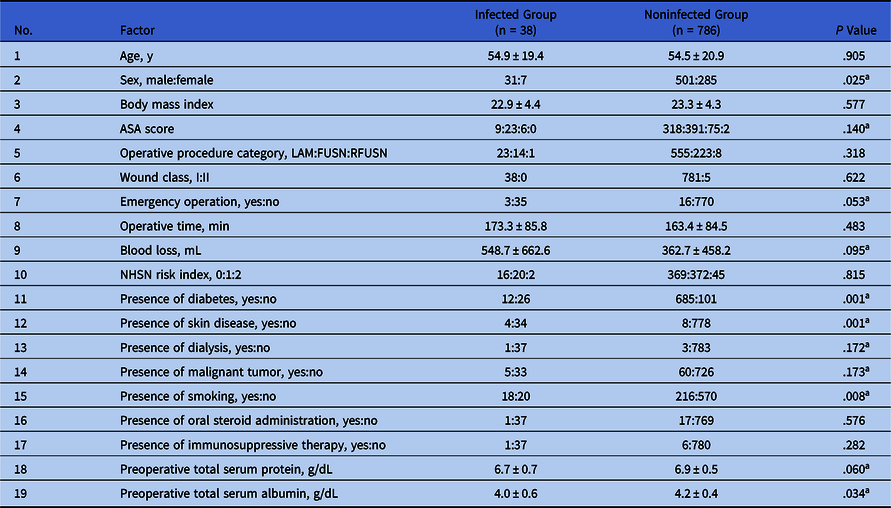
The predictive model outcome was SSI. We initially identified factors that were individually associated with SSI. We conducted univariate analyses for the 19 factors (Table 1) to compare the infected and noninfected groups. We then narrowed down the variables only to those factors whose P values were <.2. These variables were then subjected to multiple logistic regression analysis by applying the stepwise method to extract variables significantly related to SSI. Finally, we performed a multiple logistic regression analysis for the factors with P values <.05, which were then assigned scores for use in the predictive model.
Results of Univariate Analysis

Note. ASA, American Society of Anesthesiologists; LAM, laminectomy; FUSN, spinal fusion; RFUSN, re-spinal fusion; NHSN, National Healthcare Safety Network.
a Values with P <.2 were extracted for multiple logistic regression analysis.
Scoring of each parameter
To decide the scores for each parameter, we used β coefficient values rather than odds ratios. Using 5 parameters obtained by the final logistic regression analysis, β coefficient values, which correspond to the natural logarithm of the odds ratios, were calculated. Then, each coefficient value was divided by the smallest coefficient value and rounded off to the nearest integer (score for each parameter ≈ β/minimum β of the final model) to create a clinical prediction model.
Assessment of discriminative ability and internal validity
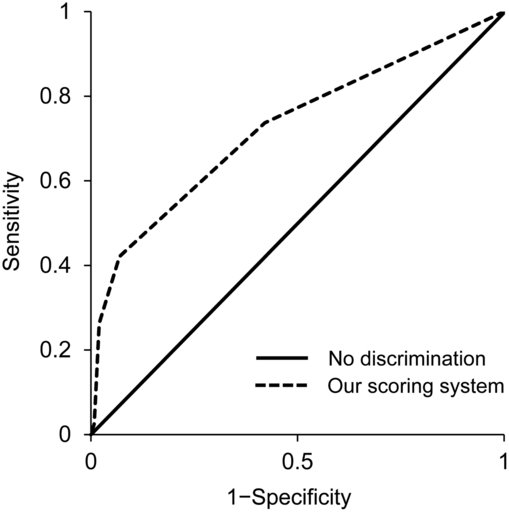
We created a receiver-operating characteristic (ROC) curve for the scores. We calculated the area under the curve (AUC) values, and we assessed the discriminative ability of this scoring system for detecting infections based on the sensitivity and single-specificity values obtained. We then assessed the internal validity of the prediction model by applying the bootstrap resampling method.Reference Steyerberg, Harrell and Borsboom15 We randomly extracted samples from the population by employing the replacement method, and compared the AUC obtained by logistic regression analysis in the original population and the bootstrap-corrected AUC based on 1,000 bootstrap samples from the same population as an indicator of internal validity.
Statistical analysis
Using SPSS Statistics version 21 software (IBM, Tokyo, Japan) in the univariate analysis, we compared dichotomous data using the χ2 test for nominal variables and either the t test or the Mann-Whitney U test for continuous variables. For the multivariate analysis, we performed multiple logistic regression analysis by applying the stepwise method. We conducted the receiver operating characteristic (ROC) curve analysis, bootstrap sampling, and ROC curve optimism analyses using R version 3.5.3 software (R Core Team, R Foundation for Statistical Computing, Vienna, Austria).Reference Core Team16
Results
Development of SSI prediction data
Among 824 patients, 38 were diagnosed as having SSI. The total infection rate was thus 4.8%. The univariate analysis revealed sex, emergency operation, blood loss, presences of diabetes, skin disease, dialysis and smoking, the total serum protein value and the total serum albumin value to be items related to SSI, with P values <0.2 (Table 1). In the subsequent multiple logistic regression analysis, the SSI rate showed significant relationships with emergency operation, blood loss, presence of diabetes, total serum albumin value, and the presence of skin disease as continuous variables (Table 2).
Results of Multiple Logistic Regression Analysis

Note. CI, confidence interval.
a P <.05 was considered to indicate a statistically significant difference.
Decision on scores for each parameter
According to clinical prediction rules, we assigned points to each variable, weighted by the corresponding regression coefficients and rounded off to the nearest integer. Based on the obtained β coefficient, we assigned 3 points to “presence of skin disease” and “total serum albumin value <3.2 g/dL,” 2 points to “emergency operation” and “blood loss >400 mL,” and 1 point to “presence of diabetes,” (Table 3). A patient’s risk score was simply the total number of points based on the risk factor profile, with higher scores corresponding to increased risks of SSI.
Scores for Each Parameter

Note. Score for each parameter ≈ β/minimum β(0.905) of the final model.
Assessment of discriminative ability and internal validity
In the original population, the AUC of the ROC curve was 0.733, and because discrimination of the model is regarded as good at AUC >0.7–0.8, the discriminative ability was considered to be adequate for a clinical prediction rule model (Fig. 1).
Receiver operating characteristic (ROC) curve for the clinical prediction rules. The area under the curve (AUC) obtained with this model was 0.733.

The bootstrap-corrected AUC of the ROC curve from 1,000 bootstrap samples was 0.714. Because there is little difference between the AUC of the original population and the bootstrap-corrected AUC, we considered our model to have been validated.Reference Steyerberg, Harrell and Borsboom15
Risk classification
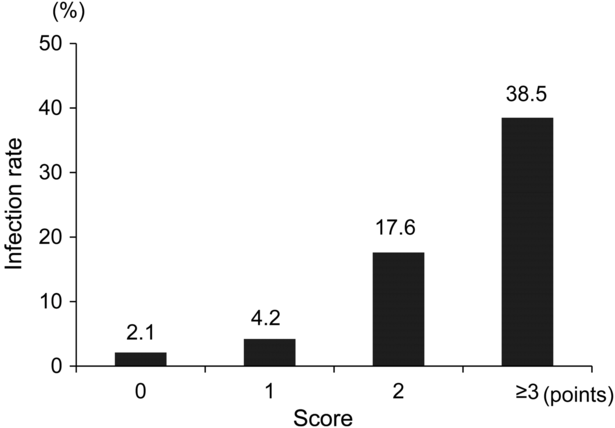
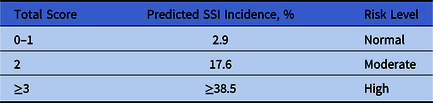
The infection rates were 2.1%, 4.2%, 17.6%, and 38.5% at 0, 1, 2 and 3 or more points, respectively. A risk classification was thereby created in which the infection rate increased as the total score increased (Fig. 2). We thus created a risk classification tool based on total scores (Table 4).
Infection rate for each score in the general population. As the number of points increased, the infection rate rose. The increase in those with scores of 0 or 1 point was small, but those of cases with scores between 1 and 2 points, and between 2 and 3 points were large.

Risk Classification

Note. SSI, surgical site infection.
Discussion
We have developed a scoring system comprising of 5 independent predictors: blood loss >400 mL, presence of diabetes, emergency operation, preoperative total serum albumin <3.2 g/dL, and presence of skin disease. These factors enable the prediction of the incidence of infections following spinal surgery with a high probability. This model represents a unique infection predicting index for patients undergoing spinal surgery in the orthopaedic surgery field. Preoperative risk stratification using this model allows us to identify high-risk patients based on their high scores. The SSI risk can thus be reduced by applying preoperative interventions, such as glycemic control, improvement of preoperative malnutrition and reconsideration of surgical methods, to these high-risk patients. In addition, the stratified risk classification can serve as an index for selecting the optimal antibiotic prophylaxis as an aggressive SSI prevention measure, as well as various intraoperative interventions. The use of expensive infection prevention strategies can be restricted to those most likely to benefit from such strategies, thereby reducing healthcare costs.
The SSI risk factors are roughly divided into patient-related and provider-related factors. Among the factors incorporated into the risk scores, “diabetes,” “low albumin value,” and “skin disease” remained as patient-related factors, while “emergency operation” and “blood loss” remained as controllable provider-related factors. Regarding the provider-related factors, “emergency operation” prevents adequate performance of preoperative medical interventions. It is, however, impossible to completely eliminate this factor not to fulfill the risk scores. “Blood loss,” the only postoperative factor, cannot easily be eliminated nor can it be accurately ascertained preoperatively, but prediction of blood loss is possible to some extent from the scale of the operation. The only way to avoid a high risk score is to downsize the operation (eg, using decompression alone not combined with fusion, or separating decompression and fusion into 2 separate operations). In addition, when blood loss exceeds 400 mL during surgery with the score meeting the criterion for the risk score, applicable options can be added during surgery. The other 3 risk factors are patient-related and difficult to control. For the “presence of diabetes,” it is not possible to eliminate diabetes itself to achieve a lower score. Based on the general understanding that glycemic control is more important than HbA1c control,12 we tried preoperative glycemic control using a sliding scale aiming for a blood glucose level <200 mg/dL in all cases. However, no definite goal or predictive cutoff value for HbA1c or blood glucose indicates an increased infection incidence. Determination of such goals may constitute an intervention. In cases with poor glycemic control, a possible intervention is to postpone the operation until the specified goal is achieved or to perform dietary restriction and treatment in cooperation with the department of internal medicine, after early admission of the patient. “Hypoalbuminemia” is a significant risk factor for SSIs as defined by guidelines.Reference Chen, Lee, Huang, Hsieh and Tsai17 Although we may not have taken specific and effective measures in the present series, if albumin ≥3.2 mg/dL is achieved, the risk scores can be considered as not having been fulfilled. It is possible to give dietary instruction to patients, but rapid improvement of poor nutritional status is very difficult to achieve on an outpatient basis, particularly in the elderly. As a possible intervention, the operation should be postponed until the goal is achieved, or the patient should be hospitalized at an early stage for actual nutritional management in cooperation with internists and nutritionists. In the presence of a chronic “skin disease,” although the disease itself cannot be eliminated if the score criterion is not met, preventing and reducing the invasion of indigenous bacteria in the skin is a useful intervention. In patients with poor skin conditions, it is necessary to preoperatively consult with a dermatologist to intensify the treatment. When a patient harbors resistant bacteria, bacterial elimination may be necessary. If a rash accompanied by exfoliation reaches the operative field, additional physical washing and disinfection, combined with alcohol use, should be performed preoperatively. The use of iodine-containing surgical drapes and antibacterial sutures is another possible intervention. These are considered to be the feasible interventions, based on this model, during the preoperative period.
SSIs can have devastating consequences, leading to prolonged hospitalization, mortality, unfavorable surgical outcomes and rises in the associated healthcare costs.Reference Chen, Lee, Huang, Hsieh and Tsai17-Reference Calderone, Garland, Capen and Oster19 Therefore, many attempts have been made to decrease the SSI rate in the spinal surgery field. Tools, such as antimicrobial surgical drapesReference Johnston, Fairclough, Brown and Morris20,Reference Ritter and Campbell21 and antimicrobial sutures,Reference Ueno, Saito and Yamagata22,Reference Wang, Jiang, Cao and Ding23 commonly recommended in guidelines based on evidence of effectiveness in risk reduction, are thus desirable and have been widely introduced as care bundle elements. The problem is that certain infection prevention measures, which are not generally recommended but are regarded as possible options, are only used for limited numbers of patients at the discretion of their surgeons. Diluted isodine was demonstrated to be useful for washing by meta-analyses,24,Reference Berríos-Torres, Umscheid and Bratzler25 and the World Health Organization and the Centers for Disease Control and Prevention thus recommend considering it as a possible option. Among microorganisms responsible for SSIs after spinal surgeries, methicillin-resistant Staphylococcus aureus (MRSA) is predominant.Reference Yamada, Abe and Higashikawa26 Prophylactic administration of vancomycin is now recommended in various guidelines worldwide,Reference Mangram, Horan, Pearson, Silver and Jarvis27,Reference Bratzler and Houck28 however, has not gained international consensus. Although the evidence level is low, the American College of Surgeons and Surgical Infection Society guidelines state that topical use of intrawound vancomycin powder may reduce SSIs.Reference Evaniew, Khan, Drew, Peterson, Bhandari and Ghert10,Reference Chiang, Herwaldt, Blevins, Cho and Schweizer11,Reference Ban, Minei and Laronga29 However, application of these complex and expensive infection control measures to every patient might not be an optimal use of limited human, temporal, and medical resources. Therefore, identification of patients at high infection risk is desirable, to prioritize the use of infection control measures in selected patients. Recently, Berbari et alReference Berbari, Osman and Lahr30 developed a stratification tool to identify patients undergoing prosthetic joint replacement surgery who are at high risk for SSI. This tool is considered useful as an infection predicting index for patients receiving prosthetic joint replacement surgery. However, no studies have focused on a stratified tool for predicting SSIs in the spinal surgery field. This may partially be attributable to no infection prevention guidelines having been formulated for spinal surgery, despite that the incidence of SSIs being higher in spinal surgeries than in orthopedic operations in general. To achieve effective infection prevention in the field of spinal surgery, indices exclusive to this form of surgery are indispensable.
Many studies have attempted to extract risk factors for SSI occurrence in the spinal surgery field, but the factors extracted have varied among reports. Moreover, the incidence of SSIs is not determined by a single factor since SSIs are caused by various factors acting synergistically. Therefore, a multivariate approach is necessary for meaningful assessment of the infection risk. Clinical prediction rules were used for building the scoring system in this study and represent a tool, which supports the decision-making processes of both patients and doctors in medical settings by reducing the uncertainty in clinical practice.Reference Wasson, Sox, Neff and Goldman31-Reference Wells, Anderson and Rodger35 This tool has one of the highest evidence levels among those used for studies on diagnosis and prognostication. Clinical prediction rules can present the diagnosis and prognosis of a disease in terms of probability through a combination of variables that can be determined in clinical practice (eg, medical history, physical findings, blood tests, imaging findings, etc). Clinical prediction rules are used to prevent the occurrence of clinical events by administering appropriate interventions to high-risk patients, identified based on their risk probability. Clinical prediction rules are an established statistical method and were thus suitable for the present study.
The ultimate purpose of this scoring system-building study is to prevent SSIs. Therefore, addition of modulatory options for SSI prevention is necessary in each risk stratum. The optimal intervention for a certain grade of risk remains unclear; the results of the present study do not yet allow us to draw conclusions regarding risk grades. Our next step will be to verify the validity of this infection prediction procedure by applying this scoring system to patients in other hospitals (ie, verification of external validity). SSIs occur through interactions among multiple risk factors, and these risk factors may differ among countries and races. Exclusion of all relevant factors is difficult, and such exclusion may not necessarily reduce the incidences of SSIs to the desired rate of zero. Furthermore, unknown risk factors may exist. Modifications of this scoring system, through the cooperation of our group with many spinal surgeon colleagues, are deemed to be necessary to obtain a more reliable predictive system. We hope that this method will be widely adopted and improved.
Our study has several limitations. First, the patients were limited to a single ethnic population. Therefore, their characteristics and the study results may not be generalizable to other populations. Second, in conducting multiple logistic regression analysis, if the number of predictors is large as compared to the number of events, the accuracy of the model is reduced. The number of events should be at least 7 times larger, ideally as much as 10 times larger, than the number of predictors. Although our conditions are acceptable for reliable analysis, accumulation of more SSI cases is required. Third, we did not verify the external validity of our risk score in another independent validation cohort. Therefore, the application of our prediction rule to other patient groups may be limited.
Acknowledgments
We thank the operating room nurses and Infection Control Team members of Kitasato University Hospital and Kitasato University East Hospital in Kanagawa, Japan, for their cooperation in collecting the data analyzed in this study.
Financial support
No financial support was provided relevant to this article.
Conflicts of interest
All authors report no conflicts of interest relevant to this article.