Introduction
Postnatal depression affects about 10–15% of women in the year after birth (O'Hara & Swain, Reference O'Hara and Swain1996; Gaynes et al. Reference Gaynes, Gavin, Melzer-Brody, Lohr, Swinson, Gartlehner and Brody2005) with symptoms including low mood, fatigue, anxiety, thoughts of self-harming and poor mother–infant interactions (Murray, Reference Murray1992; Beck, Reference Beck1995; Cooper & Murray, Reference Cooper and Murray1995; American Psychiatric Association, 2000). Current treatments recommended for postnatal depression include antidepressants and psychological therapies (National Institute for Health and Care Excellence, 2007). There are some risks in taking antidepressants and reluctance amongst new mothers to take them (Turner et al. Reference Turner, Sharp, Folkes and Chew-Graham2008, Reference Turner, Chew-Graham, Folkes and Sharp2010). Although non-pharmacological interventions can be effective (Dennis & Hodnett, Reference Dennis and Hodnett2007; Morrell et al. Reference Morrell, Slade, Warner, Paley, Dixon, Walters, Brugha, Barkham, Parry and Nicholl2009; Sharp et al. Reference Sharp, Chew-Graham, Tylee, Lewis, Howard, Anderson, Abel, Turner, Hollinghurst, Tallon, McCarthy and Peters2010) there can be long waiting lists to access treatment and they can be costly. Exercise has the potential to address barriers associated with traditional treatments: it is free, accessible and is without stigma or side effects (Daley et al. Reference Daley, MacArthur and Winter2007; Lewis et al. Reference Lewis, Gjerdingen, Avery, Sirard, Guo, Schuver and Marcus2014).
The American College of Obstetrics and Gynecology (2002) and the National Institute for Health and Care Excellence (2007) in England have stated that self-help strategies such as exercise should be considered as a treatment for postnatal depression, although this guidance from the National Institute for Health and Care Excellence (NICE) was based on evidence at the time from trials that had recruited general populations and two small trials of women at risk of postnatal depression. A systematic review with meta-analysis by the trial authors found five small trials in women at risk of postnatal depression, but no samples with clinically defined depression (Daley et al. Reference Daley, Jolly and MacArthur2009). The review showed that exercise significantly reduced postnatal depression scores relative to comparators, but significant heterogeneity was present and the effect size became non-significant when the trial that included exercise with social support was excluded (Armstrong & Edwards, Reference Armstrong and Edwards2003). We recently updated this review (Blamey et al. Reference Blamey, Daley and Jolly2012) and no further trials that had recruited women with clinically diagnosed depression have been published.
It remains uncertain therefore whether exercise reduces symptoms of postnatal depression and a high-quality trial in women with clinically diagnosed depression was considered essential. Following a pilot trial, this randomized controlled trial (RCT) evaluated the effectiveness of a facilitated exercise intervention as a treatment for postnatal depression alongside any usual care compared with a group who only received usual care (Daley et al. Reference Daley, Winter, Grimmett, McGuinness, McManus and MacArthur2008). The study was purposively designed as a pragmatic trial where women were eligible for inclusion regardless of whether they were receiving or not receiving other specific treatments (i.e. antidepressants or psychological intervention) because it would not have been safe or ethical to interrupt or withdraw usual care and test exercise alone until there is evidence that exercise is likely to provide benefit in this population. We hypothesized that participants receiving the exercise intervention would report lower depressive symptom scores at follow-up than those receiving usual care.
This study is known as the PAM-PeRS trial (Physical Activity for Mums-Promoting Health and Recovery Study).
Method
Setting and participants
A total of 147 family medicine practices in Birmingham, UK were invited to assist with recruitment; 67 agreed. Recruitment commenced in April 2010 and follow-up completed in April 2013. Women were eligible if they were within 6 months of giving birth, aged 18 years or more and had an International Classification of Diseases (ICD)-10 diagnosis of a major depressive episode (World Health Organization, 2011), following initial screening using the Edinburgh Postnatal Depression Scale (EPDS; Cox et al. Reference Cox, Holden and Sagovsky1987) and a clinical diagnostic interview (Lewis et al. Reference Lewis, Pelosi, Araya and Dunn1992). Women with a diagnosis of mixed anxiety and depression were also eligible. Patients were excluded if they were pregnant again, experiencing psychotic symptoms or dependent on illicit drugs or alcohol. Women needed to be currently inactive (not meeting the current guidelines for physical activity) (Department of Health, 2004).
Patient identification and diagnosis of depression
Women who had recently given birth and who lived within two primary care trusts in Birmingham were identified from the Child Health System (CHS), a centralized computer registration system of all new births in the areas that allowed systematic identification of women in the 67 participating family medicine practices. Every 2 weeks the CHS completed search lists of new births in participating practices and mailed the trial information letter and EPDS to these women. Women were sent this at 10–14 weeks after birth and there were several reasons for this; many women feel overwhelmed when they have a new baby to care for and may be less inclined to participate in a research study in the first few weeks of giving birth. Having a contact date of 10–14 weeks, rather than shortly after giving birth, gave women the chance to get into a routine with their baby before committing to a long-term research study. Symptoms of depression in some cases can resolve naturally after a period of adjustment to the baby and this study was focused on identifying those women who would need assistance with resolving their depression. Women who scored 10+ on this first EPDS (EPDS-1) then completed a second EPDS (EPDS-2) 2 weeks later by telephone to rule out the possibility of transient depression. Women who scored 13+ on the EPDS-2 then completed the Clinical Interview Schedule-Revised (CIS-R) (Lewis, Reference Lewis1994; Jenkins et al. Reference Jenkins, Lewis, Bebbington, Brugha, Farrell, Gill and Meltzer1997) at a home visit to ensure they met the ICD-10 criteria for experiencing a major depressive episode.
Other recruitment methods
Women who presented with depression after 6 weeks, but within 6 months of giving birth, were also able to participate via referral from their general practitioner (GP) or health visitor. Health professionals from two perinatal mental health community services were also able to refer women. Women identified in these ways also had to meet all the study entry criteria as previously described.
Outcomes, process measures and allocation of participants to trial groups
The primary outcome was difference in mean EPDS score (adjusted for baseline) between the groups at 6 months follow-up. We used the EPDS as our primary outcome of symptoms of depression so that we could compare the results with other postnatal depression treatment trials, as the use of the EPDS is standard practice within postnatal depression research. It can be very difficult to obtain a high rate of follow-up in women with postnatal depression and using the EPDS, rather than a clinical interview, was considered to provide the best opportunity to achieve high follow-up rates.
Secondary outcomes were difference in mean EPDS score at 12 months follow-up and rates of improved and recovered responses on the EPDS at follow-up. Participants completed the 12-Item Short-Form Health Survey (SF-12; Ware et al. Reference Ware, Kosinski and Keller1996), EQ-5D™ (Brooks, Reference Brooks1996), a body image subscale to assess maternal adjustment and maternal attitudes (MAMA; Kumar et al. Reference Kumar, Robson and Smith1984), the Subjective Vitality Scale (Bostic et al. Reference Bostic, Rubio and Hood2000), and items relating to perceived social support (Sallis et al. Reference Sallis, Grossman, Pinski, Patterson and Nader1987; Singleton & Lewis, Reference Singleton and Lewis2003) and self-efficacy for exercise (Sallis et al. Reference Sallis, Pinski and Grossman1988) were also completed. Body weight and height were measured objectively. Physical activity was measured by self-report [International Physical Activity Questionnaire (IPAQ)-short] (Craig et al. Reference Craig, Marshall, Sjöström, Bauman, Booth, Ainsworth, Pratt, Ekelund, Yngve, Sallis and Oja2003) and objectively using the Actiheart device.
During intervention weeks 4, 8, 12, 16 and 20 the intervention group was asked to complete exercise diary logs as previously used in our pilot trial (Daley et al. Reference Daley, Winter, Grimmett, McGuinness, McManus and MacArthur2008). Logs were completed with the physical activity facilitator (PAF) in person, over the telephone or sent/returned by post.
Randomization, concealment and blinding
An Internet randomization service was used to allocate participants to the trial groups and was concealed from researchers involved in recruiting and randomizing participants. The allocation sequence was generated using a computer program with random permuted blocks of size 10. Participants were randomized into one of two trial groups (50:50 split) and further randomized for wearing the Actiheart or not (60:40 split). The randomization was stratified by EPDS score (13–16 and 17+). The person delivering the intervention was not involved in recruiting participants. Participants, researchers and those delivering the intervention could not be blinded to group allocation. The primary outcome, EPDS score, was completed by postal questionnaire (along with other secondary outcomes).
Data collection
Eligible women were asked to provide written informed consent. At baseline and 6 and 12 months post-randomization follow-up, the questionnaires were mailed to participants and collected at home visits by the research team or returned by post. Those randomized to wear the Actiheart had the device fitted at the home visit. The research team collected the Actiheart from these participants and the IPAQ was then completed. Participants who had worn the Actiheart at baseline were asked to wear it again at follow-up. Participants were asked to wear it the Actiheart for three consecutive days and to then complete the IPAQ.
Intervention
A detailed description of the 6 months intervention can be found in the published protocol (Daley et al. Reference Daley, Jolly, Sharp, Turner, Blamey, Coleman, McGuinness, Roalfe, Jones and MacArthur2012). The initial goal (weeks 1–12) was for participants to progress towards accumulating 30 min of moderate-intensity exercise on 3 days per week. During weeks 13–24 participants were encouraged to work towards accumulating 30 min of moderate-intensity exercise on 3–5 days per week. Similar to our pilot trial (Daley et al. Reference Daley, Winter, Grimmett, McGuinness, McManus and MacArthur2008) the intervention involved two face-to-face personalized exercise consultations (during months 1 and 2) and telephone calls (during months 3 and 4). The face-to-face consultations were centred on equipping women with the skills, knowledge and confidence needed to participate in regular exercise and were delivered by a PAF in participants’ homes. Consultations lasted between 40 and 60 min. Participants were given a pedometer. At 4 weeks later participants had a second consultation centred on the prevention of relapse back to an inactive lifestyle and/or improving maintenance of an active lifestyle. Telephone support calls (15–20 min) were made during months 3 and 4 of the intervention. Information leaflets were mailed in months 3, 4, 5 and 6 of the intervention to further encourage exercise participation.
Usual-care comparator
Usual care could have included women spontaneously consulting their GP and given active treatment or just consultation to discuss symptoms, or informal counselling from their health visitor or referral by their health visitor to the GP, or that they consulted no one and had no treatment. The usual-care group was sent the study ‘Looking after yourself’ leaflet at baseline and exercise was not further encouraged beyond receipt of this single leaflet.
Sample size and statistical analyses
A sample size of 83 patients randomized to each group (n = 166) would be sufficient to detect a 1.95 (s.d. = 3.9; Heh et al. Reference Heh, Huang, Ho, Fu and Wang2008) unit difference in EPDS score between the groups at the 6 months follow-up with 90% power, 5% significance level. This increased to 104 in each arm when allowance was made for a 20% drop-out rate at the 6 months follow-up (n = 208). When considered as a continuous variable two EPDS points are considered a moderate effect-size change (0.5 s.d.) (Matthey, Reference Matthey2004).
All analyses used the intention-to-treat principle, whereby participants were analysed in the group to which they were randomized. All participants that had complete data for the EPDS at 6 months were included in the primary analysis. The primary analysis compared the mean EPDS score at 6 months post-randomization follow-up between trial groups, adjusting for baseline scores using analysis of covariance. The EPDS-2 score was used as the baseline score. Similar analyses were conducted for the secondary outcomes (except physical activity) adjusting for baseline outcome score and baseline EPDS. Secondary analyses adjusted for baseline score, baseline EPDS and covariates (age, baseline weight and ethnicity), again using analysis of covariance. To explore longer-term effects, a repeated-measures mixed-model analysis of the primary and secondary outcomes was undertaken, comparing groups across the follow-ups. Adjustments were made for covariates as previously described. Bootstrapped analyses (1000 repetitions) were performed where residuals were non-normally distributed.
To assess clinically meaningful change on the EPDS following the principles of Jacobson & Traux (Reference Jacobson and Traux1991), analysis of the proportion of women per group who were ‘recovered’ (i.e. a reduction in EPDS score of four points or more plus scored less than 13 points) versus not recovered (Matthey, Reference Matthey2004) was conducted using χ2 tests. Categorizing data in this way provides a better indication of whether real changes have occurred at the level of the individual participant (for a more detailed discussion, see Jacobson & Traux, Reference Jacobson and Traux1991; Matthey, Reference Matthey2004). In addition, in order that we could compare our findings with other previous postnatal depression treatment trials we compared those who improved (i.e. proportions below 13 on the EPDS) versus not improved.
The IPAQ results were negatively skewed and comparison between the groups was undertaken using quantile regression analysis, with baseline physical activity included as a covariate. All statistical analysis was carried out using SAS version 9.2 (SAS Institute Inc., USA) and Stata version 12 (StataCorp LP, USA).
Ethics approval
Favourable ethical opinion was granted for this study by the Birmingham, East, North and Solihull Research Ethics Committee (reference 09/H1206/94).
Results
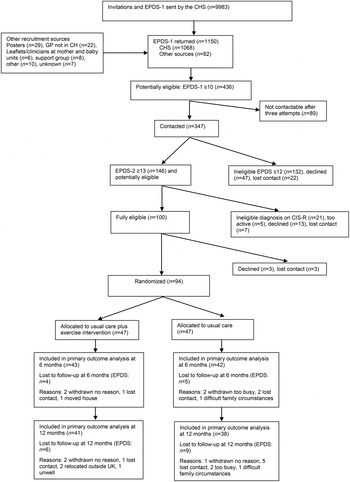
Study invitations and EPDS-1 were sent by the CHS to 9983 women and 1068 were returned (10.7%). An additional 82 women recruited via other methods completed the EPDS-1. Of these, 436/1150 (37.9%) scored 10+ on the EPDS-1, of whom 146/436 (33.5%) scored 13+ on the EPDS-2 2 weeks later and were offered a home visit to diagnose depression using the CIS-R and to assess other eligibility criteria. Of these 146 women, 100 (68.5%) were fully eligible and 94 were randomized (Fig. 1). The characteristics of responders and non-responders to the EPDS-1 were similar in terms of age, deprivation (McLennan et al. Reference McLennan, Barnes, Noble, Davies and Garratt2011) and ethnicity.
Trial flow. EPDS, Edinburgh Postnatal Depression Scale; CHS, Child Health System; GP, general practitioner; CIS-R, Clinical Interview Schedule-Revised.

Randomization and participants’ baseline characteristics
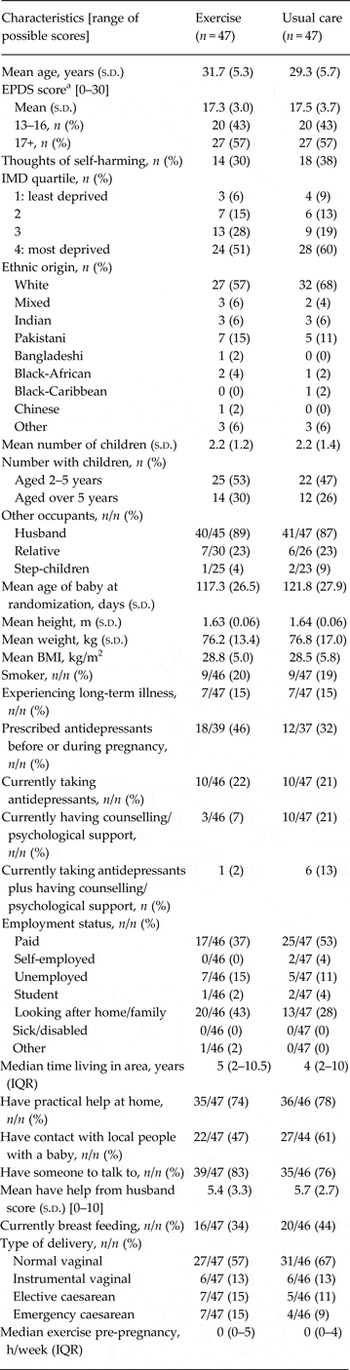
Our sample-size calculation indicated that 166 participants needed to be recruited, rising to 208 with 20% loss to follow-up. We did not meet this target and 94 participants were randomized to the exercise plus usual-care group (n = 47) or the usual-care-only group (n = 47). Table 1 describes the baseline characteristics that show a good balance between groups on these variables, although more usual-care participants were receiving counselling/psychological support than the intervention group (21% v. 7%). The majority of participants lived in the two highest deprivation quartiles (74/94, 79%) and 37% (35/94) were of non-white ethnicity. The questionnaire assessments (EPDS and/or CIS-R) showed that a large proportion of participants had thoughts of self-harming (32/94, 34%). Of the participants, 17 (18.1%) were diagnosed on the CIS-R with a severe depressive episode, 50 (53.2%) with a moderate/severe episode, 15 (15.9%) with a mild episode and 12 (12.8%) were diagnosed with mixed anxiety and depressive disorder. These diagnoses were balanced across groups.
Baseline characteristics of randomized participants

s.d., Standard deviation; EPDS, Edinburgh Postnatal Depression Scale; IMD, Index of Multiple Deprivation; BMI, body mass index; IQR, interquartile range.
a Stratification variable. A higher score on the EPDS indicates high levels of probable depression.
Information about follow-up
Rates of breastfeeding, risk of self-harm, use of antidepressants and counselling (and both treatments) at 6 and 12 months post-randomization are shown in online Supplementary Table S1. More usual-care participants were also receiving psychological support at follow-up than in the exercise group.
At 6 months post-randomization 85/94 (90.4%) participants completed follow-up for the primary outcome and at 12 months post-randomization the follow-up rate was 79/94 (84.0%). Participants lost to follow-up tended to be marginally younger compared with those who were followed up but were similar in terms of group allocation, baseline mean EPDS score, deprivation quartile score (McLennan et al. Reference McLennan, Barnes, Noble, Davies and Garratt2011) and ethnicity.
Primary outcome
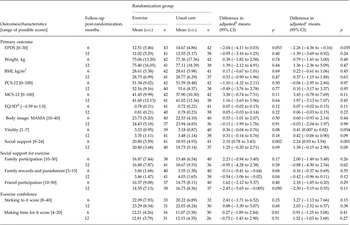
After adjusting for baseline scores, analyses revealed a −2.04-point mean difference in EPDS score, favouring the exercise intervention group [95% confidence interval (CI) −4.11 to 0.03, p = 0.053]. When adjusting for baseline EPDS score and pre-specified demographic variables, the mean difference increased and was statistically significant (−2.26, 95% CI −4.36 to −0.16, p = 0.03) (Tables 2 and 3).
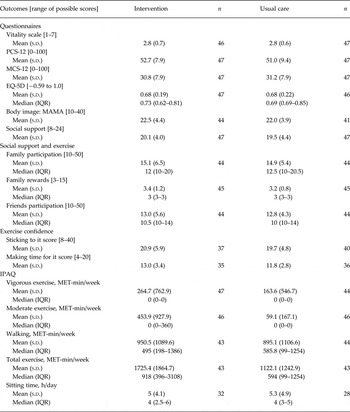
Baselines questionnaires and measurements a

s.d., Standard deviation; PCS-12, 12-item Physical Component Summary; MCS-12, 12-item Mental Component Summary; IQR, interquartile range; MAMA, Maternal Adjustment and Maternal Attitudes; IPAQ, International Physical Activity Questionnaire; MET, metabolic equivalents.
a Higher scores on all questionnaires except sitting time indicate more positive health/behaviours.
Follow-up data for outcomes at 6 and 12 months post-randomization a

s.d., Standard deviation; CI, confidence interval; EPDS, Edinburgh Postnatal Depression Scale; BMI, body mass index; PCS-12, 12-item Physical Component Summary; MCS-12, 12-item Mental Component Summary; IQR, interquartile range; MAMA, Maternal Adjustment and Maternal Attitudes.
a Higher scores on all questionnaire-based outcomes except EPDS indicate more positive health/behaviours.
b Adjusted by baseline value and baseline EPDS.
c Adjusted by baseline value, baseline EPDS, age, weight and ethnicity.
d Bootstrapped CIs and p values.
Secondary outcomes
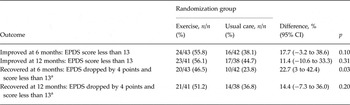
At 6 months significantly more of the intervention group were considered ‘recovered’ and no longer a case (46.5% v. 23.8%, p = 0.03) compared with the group receiving usual care. By 12 months, the proportions considered ‘recovered’ (i.e. a reduction in EPDS score of four points or more plus scored less than 13 points) had increased in both groups (51.2% v. 36.8%) but the difference between the groups was reduced and not statistically significant (Table 4).
Proportions improved and recovered on the EPDS 6 and 12 months post-randomization

EPDS, Edinburgh Postnatal Depression Scale; CI, confidence interval.
a Criteria for determining clinically important change (Jacobson & Traux, Reference Jacobson and Traux1991; Matthey, Reference Matthey2004).
The exercise group had significantly higher social support scores than the usual-care group at 6 months in both adjusted models; however, the effect was not sustained at 12 months. In the fully adjusted analysis there was some evidence of a difference in vitality scores at 6 months, favouring the exercise group (p = 0.054), but this effect was not significant at 12 months (p = 0.09). The exercise group reported significantly lower social support at 12 months for exercise–family rewards scores (p = 0.04) than the usual-care group when adjusting for baseline score, but there was no significant difference between the groups in the fully adjusted model (Tables 2 and 3).
There were no significant differences between the groups on any of the physical activity outcomes derived from the IPAQ (online Supplementary Table S2). Only eight participants (8.5%) wore the Actiheart and provided useable data for analyses at both 6 and 12 months follow-up. These data are therefore not reported since they do not provide reliable information on which to base any conclusions (see discussion later) but they are available from the first author (A.J.D.) on request.
Intervention implementation and adherence to the intervention goals
Delivery of the various intervention components was very high; 41/47 (87%) participants received all four individual contacts (two consultations and two telephone support calls); 43/47 (91.4%), 44/47 (93.6%) and 46/47 (97.9%) received at least three, two and one, respectively, of the individual intervention contacts.
A total of 163/235 (69.4%) (i.e. 47 participants × 5 logs) of the exercise logs were completed by the intervention group, with the majority (40/47) completing at least 3/5 logs. Only four participants failed to complete a single log. In the logs participants reported completing an overall average of 146 (s.d. = 142) min of moderate/vigorous exercise. The exercise group reported increased levels of exercise over the course of the intervention; in logs 1 to 5 participants reported means per week of 161.1, 217.5, 203.2, 222.5 and 245.0 min of moderate/vigorous exercise, respectively (range equates to 23–35 min per day). The most common types of exercise reported were brisk walking with pram, brisk walking without pram, exercise DVDs, Wii fit workouts, jogging and swimming.
Discussion
Women diagnosed with postnatal depression and randomized to a facilitated home-based exercise intervention for 6 months reported lower mean EPDS scores than those randomized to usual care only. Depressed women were twice as likely to report a clinically meaningful change in their EPDS score (i.e. ‘recovered’) at 6 months follow-up if they had been randomized to the exercise intervention. These results emerged despite the fact that substantially more (between two- and three-fold higher) usual-care participants were receiving psychological support at baseline and 6 months follow-up than the exercise group. The benefits of the intervention were seen only at 6 months follow-up but given the longer-term adverse effects of postnatal depression for the mother and the development of the baby this is the most critical time to offer treatment.
The magnitude of the difference in mean EPDS scores between the groups was of a moderate size (Affonso et al. Reference Affonso, De, Horowitz and Malberry2000; Matthey, Reference Matthey2004). This is smaller than the overall size found in our meta-analysis (Daley et al. Reference Daley, Jolly and MacArthur2009) of exercise for postnatal depression (−4.00 EPDS points, 95% CI −7.64 to −0.35), but which largely included small studies with high drop-out and less stringent inclusion criteria than used here. In particular, none of the previous trials had recruited women with a clinical diagnosis of depression after giving birth. These findings should, however, be considered in light of the relatively low response (11%) to the initial invitation letter, meaning it is possible that women who were more motivated to be active were recruited to the trial.
Our findings are broadly comparable with those reported for other types of treatments for postnatal depression. In the RESPOND trial (n = 254) (Sharp et al. Reference Sharp, Chew-Graham, Tylee, Lewis, Howard, Anderson, Abel, Turner, Hollinghurst, Tallon, McCarthy and Peters2010), which initially randomized women to antidepressants or non-directive counselling but which also allowed women to stop one treatment and start the other or add the other treatment to the first one, it was reported that the proportion of women improving (scoring 13 or less on the EPDS) was 62% for antidepressants and 51% for listening visits 18 weeks after randomization. These proportions are similar to the proportions considered as improved (56%) and recovered (47%) in our study at 6 months follow-up. The PONDER trial (Morrell et al. Reference Morrell, Slade, Warner, Paley, Dixon, Walters, Brugha, Barkham, Parry and Nicholl2009) studied the effectiveness of health visitors providing psychological support for 1 h per week over 8 weeks compared with usual care in women (n = 418) considered at risk of postnatal depression (EPDS≥12). The difference in EPDS score between the groups was 2.1 points (95% CI −3.3 to −0.9) (adjusted) favouring the intervention group, very similar to our reported mean group difference and CIs.
The exercise intervention group also had higher social support scores at 6 months, indicating that these participants felt more supported than those receiving usual care. Exercise can provide a reason for engaging with others and as part of this intervention participants were encouraged to find social support, and to ask friends/family to support them with their exercise. Findings suggest that the intervention group was able to achieve this and plausibly benefitted from doing so. This is important because women with postnatal depression can become isolated at a time when they need support the most. Exercise may be a vehicle by which these women (and health professionals responsible for their care) can engage others in their social networks to offer support. Moreover, most forms of exercise typically involve some level of engagement or connection with others, whether that is by attending exercise groups/classes or taking a walk in the local community, for example.
No significant differences between the groups at follow-up were recorded for self-reported physical activity; there are several plausible explanations for this. Women receiving usual care may have over-reported their exercise, which is common in the general population. The intervention group, however, was taught how to accurately assess and report their exercise as a way of self-monitoring their progress so were made more aware of what constitutes different intensities of exercise, potentially resulting in this group reporting their exercise more accurately than those receiving usual care. As individuals can increase their exercise without professional support, usual-care participants may have increased their exercise following informed consent. It is also possible that the intervention group did not achieve higher exercise levels compared with the usual-care group.
We were not able to corroborate the self-reported exercise data using data from the Actiheart (objective assessment) because so few women were prepared to wear the device at follow-up. Many participants found the Actiheart uncomfortable and/or it interfered with breastfeeding so removed it. However, the logs completed by the exercise group throughout the intervention showed that this group reported increasing their exercise levels over time and maintained participation in at least 150 min of moderate/vigorous intensity exercise per week. A real increase in exercise may explain the significant improvements in psychological outcomes for the women in the intervention group relative to the usual-care group, but other mechanisms are also possible. It is possible that the improvements in psychological outcomes are due to non-specific effects associated with the contacts with the PAF, which may have been perceived as therapeutic by women. It may also have been that the PAF acted as a mechanism for women to seek out additional social support to help them with their exercise endeavours, and it is this social support that facilitated improvement in their mental health.
Strengths and limitations of the study
The response rate was relatively low and whilst we did not meet our recruitment target the size of difference seen in EPDS score exceeded the pre-specified effect size in our sample-size calculation. Several alternative strategies were used during the trial to try and improve recruitment but with varied success. To facilitate recruitment future trials will need to involve several centres and/or recruit over several years. A very recent trial of depression (Krusche et al. Reference Krusche, Rudolf von Rohr, Muse, Duggan, Crane and Williams2014) found that an intensive advertisement campaign that targeted community settings (e.g. adverts on buses, social media and regular radio adverts) was very cost effective. Our trial had minimal involvement from mass media and in future trials this might be a useful supplement to the recruitment strategies used here. This is the largest exercise RCT of any postnatal women considered to be depressed and the only study to recruit women with a clinical diagnosis of depression. This study was extremely rigorous in determining a diagnosis of depression, using a two-stage process that resulted in an ICD-10 diagnosis of a major depressive episode or mixed anxiety and depression, rather than only a high score on a screening questionnaire as used in all previous studies. The effect of the intervention on EPDS score is in line with larger high-quality studies that have evaluated other treatments for postnatal depression, providing reassurance about the robustness of our findings.
At baseline most women were experiencing a severe/moderate depressive episode and 34% reported thoughts of self-harming, demonstrating recruitment of those women clearly in need of intervention. A large proportion of participants were of non-white ethnicity (37%) and/or living in the two highest Index of Multiple Deprivation (IMD) deprivation quartiles (79%); typically these populations are very difficult to recruit to mental health treatment trials. Loss to follow-up was very low (6% at 6 months, 16% at 12 months). We are not able to be certain of the exact mechanism of effect by which the intervention improved outcomes but we do know that the intervention group achieved the behavioural goals asked of them during the exercise intervention. Nevertheless, this trial provides the first steps of evidence and the foundation for further studies on this question in women with clinically defined postnatal depression. Studies that focus on investigating potential mechanisms of effect in this population are needed.
Conclusions
This trial contributes new evidence to indicate that a facilitated exercise intervention that involved encouragement to exercise and to seek out social support to exercise may be an effective treatment for women experiencing postnatal depression, including those at risk of self-harming.
Supplementary material
For supplementary material accompanying this paper visit http://dx.doi.org/10.1017/S0033291715000409
Acknowledgements
This study was funded by the National Institute for Health Research (NIHR) School for Primary Care Research. A.J.D. is supported by a NIHR Senior Research Fellowship. C.M. and K.J. are part-funded by the NIHR through the Collaborations for Leadership in Applied Health Research and Care for West Midlands (CLAHRC-WM) programme. The views expressed in this publication are those of the authors and not necessarily those of the National Health Service, the NIHR or the Department of Health.
We would like to thank patients and staff who participated in the study and members of the trial steering committee, particularly Professor Nanette Mutrie. We would also like to thank the Mental Health Research Network for their help with recruiting participants and for developing the trial website. We would also like to thank the Primary Care Clinical Research and Trial Unit at the University of Birmingham for their help with developing the study database and recruiting participants.
A.J.D., K.J., C.M., A.K.R., D.J.S., K.M.T., M.M. and I.J. were responsible for the initial proposal, secured funding for the study and drafted the original protocol. R.V.B. and S.C. also contributed to drafting the published protocol. A.J.D. as the principal investigator had overall management responsibility for the study. R.V.B. as trial coordinator was responsible for the day-to-day conduct of the study. S.C. delivered the intervention. R.V.B. prepared the data from the Actihearts for analysis. A.K.R. conducted the sample-size calculations, wrote the analysis plan and conducted the statistical analyses. A.J.D. wrote the initial draft of the manuscript with assistance from C.M. and K.J. All authors contributed to and approved the final manuscript. A.J.D. is the guarantor.
Additional data can be obtained from the corresponding author (K.J.) for the purposes of secondary research. The ISRCTN trial registration no. is CCT-NAPN-13286.
Declaration of Interest
None.