Introduction
Promoting social inclusion and combating social exclusion emerged as important social policy issues in Europe during the 1980s, reflecting concerns about the social costs arising from long-term unemployment, the impact of poverty and social divisions within communities (Atkinson et al. Reference Atkinson, Cantillon, Marlier and Nolan2002; Scharf, Phillipson and Smith Reference Scharf, Phillipson and Smith2005). While some research addressed such questions from a lifecourse perspective, with a particular focus on older people (Barnes et al. Reference Barnes, Heady, Millar, Middleton, Tsakloglou, Papadopoulos and Room2002, Reference Barnes, Blom, Cox and Lessof2006), the dominant approach tended to be around children and families and younger adults. As a consequence, important sections of the population vulnerable to multiple disadvantages were under-represented in much of the research literature (Levitas et al. Reference Levitas, Pantazis, Fahmy, Gordon, Lloyd and Patsios2007).
One group that may be especially susceptible to social exclusion are older people living in socially deprived inner-city neighbourhoods. The urban context, as represented by large metropolitan centres, presents a variety of environmental pressures, these arising from the closure of local services and amenities, crime-related problems, poor housing and social polarisation (Rodwin and Gusmano Reference Rodwin and Gusmano2006; Smith Reference Smith2009). Such developments may increase the hazards and risks associated with later life (Phillips et al. Reference Phillips, Siu, Yeh, Cheng, Andrews and Phillips2005; Phillipson Reference Phillipson, Dannefer and Phillipson2010). Environmental perspectives in gerontology have made some progress in investigating these issues (Rowles and Chaudhury Reference Rowles and Chaudhury2005; Wahl, Scheidt and Windley Reference Wahl, Scheidt and Windley2003). They have also been addressed in studies examining social exclusion in old age (Scharf, Phillipson and Smith Reference Scharf, Phillipson and Smith2005; Smith Reference Smith2009). However, the interconnections between place, urbanisation and social exclusion remain under-explored in social gerontology, especially in the context of changes affecting major urban areas (Phillipson Reference Phillipson, Dannefer and Phillipson2010).
Against this background, this article aims to examine conceptual and empirical aspects of the social exclusion debate, exploring links with issues of place and space in urban settings in two contrasting European nations. The analysis will be developed as follows: first, the article will outline key elements of discussions about social exclusion in relation to an urban context; second, it will describe the methods of two comparable empirical qualitative studies among people aged 60 and over living in deprived urban neighbourhoods in Belgium and England; third, research findings will be presented, focusing on different facets of neighbourhood exclusion and inclusion in urban settings. The article concludes by reflecting on the key conceptual and policy issues arising from a comparative perspective, with a particular focus on debates around developing ‘age-friendly’ cities.
Concepts and definitions of social exclusion
While the concept of social exclusion is increasingly common in social policy debates and research, a variety of definitions have been identified (Levitas et al. Reference Levitas, Pantazis, Fahmy, Gordon, Lloyd and Patsios2007). The branding of 2010 as the European year of ‘combating poverty and social exclusion’ emphasised a common theme underlying conceptual debates by drawing attention to the core concerns of poverty and social exclusion. While there are clear overlaps between these notions, the multidimensional, and highly dynamic nature, of exclusion is generally acknowledged in policy and research (Marlier and Atkinson Reference Marlier and Atkinson2010). Poverty, often referred to as a lack of economic resources, is considered to be just one – albeit a central – element of exclusion. By contrast, exclusion is taken to denote a wider set of disadvantages, these linked to limited participation in, or marginalisation from, mainstream institutions (Levitas et al. Reference Levitas, Pantazis, Fahmy, Gordon, Lloyd and Patsios2007; Marlier and Atkinson Reference Marlier and Atkinson2010; Ogg Reference Ogg2005; Scharf, Phillipson and Smith Reference Scharf, Phillipson and Smith2005).
The importance of identifying multiple dimensions is emphasised in many approaches to social exclusion. For example, Levitas et al. (Reference Levitas, Pantazis, Fahmy, Gordon, Lloyd and Patsios2007: 9) define exclusion as ‘the lack or denial of resources, rights, goods and services, and the inability to participate in the normal relationships and activities, available to the majority of people in a society, whether in economic, social, cultural or political arenas’. Other conceptualisations usefully draw together elements associated with participation in social activities. For instance, Burchardt, Le Grand and Piachaud (Reference Burchardt, Le Grand, Piachaud, Hills, Le Grand and Piachaud2002) identify four distinct elements of exclusion: consumption, defined as an individual's ability to purchase goods and services; production, i.e. engagement in economically or socially valued activities; political engagement, or involvement in local or national decision-making processes; and social interaction, i.e. engagement in significant social relationships with family, friends and community. Given its multi-dimensional nature, studies on social exclusion have generally adopted multiple rather than a single set of indicators (Barnes et al. Reference Barnes, Heady, Millar, Middleton, Tsakloglou, Papadopoulos and Room2002; Ogg Reference Ogg2005; Scharf, Phillipson and Smith Reference Scharf, Phillipson and Smith2005). In his comparison of data from ten European countries, for example, Ogg (Reference Ogg2005) identified the following dimensions of exclusion: the regularity of meeting with friends and relatives; taking part in social activities; self-rated physical health and mental health; self-rated income; and the quality of the local area.
An important theme in the conceptual debate has been the changing neighbourhood environment and possible links to social exclusion (e.g. Glennerster et al. Reference Glennerster, Lupton, Noden and Power1999; Lupton Reference Lupton2001). This reflects a growing body of evidence suggesting that exclusion tends to be spatially concentrated in localities such as disadvantaged inner-city areas (Eurocities 2009; Madanipour Reference Madanipour2003; Murie, Musterd and Kesteloot Reference Murie, Musterd and Kesteloot2006). Research also highlights a growing overlap between socially excluded people and socially excluded places (Forrest Reference Forrest2008; Scharf, Phillipson and Smith Reference Scharf, Phillipson and Smith2005), with policies that target the neighbourhood as a primary focus for promoting social inclusion (Cattell Reference Cattell2001; van Gent, Musterd and Ostendorf Reference van Gent, Musterd and Ostendorf2009). The current policy goal of creating ‘age-friendly’ cities, to take one example, reflects attempts to develop supportive and inclusive communities for older citizens at the neighbourhood level (see further below) (World Health Organization (WHO) 2007).
The significance of the neighbourhood dimension in later life reflects four main factors: first, the greater time spent at home and in the locality following retirement (Blokland Reference Blokland2003); second, increased reliance upon neighbourhood relationships for support in old age (Krause Reference Krause, Wahl, Scheidt, Windley and Schaie2004); third, the length of time likely to have been spent residing in the same locality (Phillipson Reference Phillipson2007); and, fourth, emotional bonds and attachments arising from associations within the community (Gilleard, Hyde and Higgs Reference Gilleard, Hyde and Higgs2007; Rowles Reference Rowles1978; Scharf, Phillipson and Smith Reference Scharf, Phillipson and Smith2003). Reflecting the importance of the spatial dimension of exclusion in later life, Scharf, Phillipson and Smith (Reference Scharf, Phillipson and Smith2005) developed an approach to conceptualising and assessing exclusion that explicitly incorporates the neighbourhood dimension. They identified five forms of social exclusion relevant to the circumstances of older people living in deprived urban communities. These included exclusion from material resources, social relations, civic activities and basic services, as well as a dimension termed ‘neighbourhood exclusion’. The latter may reflect negative views about the neighbourhood relating to physical decay, loss of amenities and certain types of social change linked with population turnover and rising crime rates.
Although the above evidence points to a significant geographic influence on older people's experiences of exclusion, further research is needed that identifies the ways in which neighbourhood exclusion operates in later life. Moreover, little is known about the nature of exclusionary processes and variations as they operate across different countries. Consequently, this article aims to explore common themes in the experience of neighbourhood exclusion and inclusion among older people living in similar types of deprived urban communities across two European nations. The article draws on comparable empirical qualitative studies from Belgium and England, exploring the following issues: first, factors reflecting the spatial dimension of exclusion across the different areas; second, the variety of ways in which older residents react to exclusionary pressures by developing strategies of control which promote a sense of neighbourhood integration; and, third, the implications for urban policy, especially in the context of developing ‘age-friendly’ cities.
Methods
The data for the present research were derived from two studies of older people living in Belgium and England. The English study focused on issues concerned with social exclusion in socially deprived urban areas (Scharf et al. Reference Scharf, Phillipson, Smith and Kingston2002). The Belgian Ageing Study (Verté, De Witte and De Donder Reference Verté, De Witte and De Donder2007) refers to a research programme which monitors local challenges and opportunities, as well as issues of quality of life, among home-dwelling older people. As part of these broader research projects, this paper will report exploratory findings from two comparable empirical qualitative studies, which aimed to explore perceptions of the neighbourhood and experiences of social exclusion among people aged 60 and over. The English study was conducted between 2000 and 2003; the data from the Belgian study were collected in Brussels between 2007 and 2009.
In both countries, the study areas were selected on the basis of criteria of urban deprivation, using the Index of Local Deprivation (Department of the Environment, Transport and the Regions 1998) for those in England and the Atlas of Deprived Areas (Kesteloot and Meys Reference Kesteloot and Meys2008; Kesteloot et al. Reference Kesteloot, Vandenbroecke, Van der Haegen, Vanneste and Van Hecke1996) for those in Belgium. The study areas in England were: Clubmoor, Granby and Pirrie in Liverpool; Park, Plashet and St. Stephens in the London Borough of Newham; and Cheetham, Longsight and Moss Side in Manchester. The research areas in Belgium were all located in the Brussels-Capital Region, which hosts the largest number of neighbourhoods with the most severe types of deprivation (Kesteloot and Meys Reference Kesteloot and Meys2008). The areas that were included in the Belgian study were: Marollen in Brussels, Brabantwijk in Schaerbeek, and Old-Molenbeek in Molenbeek. Each of the England communities was ranked in the 50 most deprived neighbourhoods in England (out of more than 8,000 neighbourhoods) at the time of the study.
The research areas in Belgium were ranked in the 20 (of 178) most deprived areas in Brussels (Jacobs and Swyngedouw Reference Jacobs and Swyngedouw2000). While the areas differ in their population profile, socio-economic structure and their proximity to their respective city centres, they share an accumulation of features associated with intense urban deprivation. These include above-average rates of unemployment and low-income households, and relatively poor housing conditions (Kesteloot and Meys Reference Kesteloot and Meys2008; Social Exclusion Unit 1998). Many of these areas also experienced industrial decline during the 1970s and 1980s, which resulted in high levels of population turnover and precarious living conditions among those who stayed in these areas.
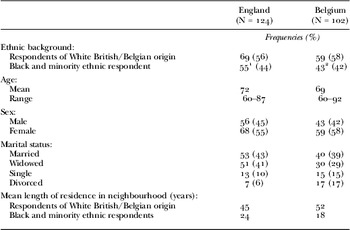
The findings presented in this study are based on 124 semi-structured interviews in England and 102 semi-structured interviews in Belgium with people aged 60 and over. Eighty-five of the 124 in-depth interviews in England were undertaken with people who had previously taken part in an earlier phase of the research project, which involved a random sample survey on issues relating broadly to social exclusion and quality of life in older age (Scharf et al. Reference Scharf, Phillipson, Smith and Kingston2002); these participants were selected purposively to reflect the diversity of the survey population, but especially to ensure coverage of older people experiencing different forms of social exclusion. In addition, interviews were conducted with 19 older Somali people in Liverpool and 20 older Pakistani people in Manchester to reflect the experiences of particularly marginalised populations. These participants were recruited through a range of community groups and stakeholder contacts within the study areas.
Data collection in Belgium comprised 59 interviews with older people of Belgian origin; 20 interviews with older Moroccan people; and 23 interviews with Turkish elders. Recruitment of respondents ranged from the more formal to the fully informal: through relevant community organisations, including social service centres, voluntary and religious organisations, as well as through informal gatherings or meeting places in the neighbourhood. This purposive sampling strategy sought to target a heterogeneous group of people of Belgian, Turkish and Moroccan origin in order to reflect a broad spectrum of neighbourhood connections.
The participants in England were aged between 60 and 87 years with an average age of 72 years. The majority of older migrants in England were in their sixties although exact birth dates among the migrant population were often uncertain, mainly due to the absence of birth certificates in the case of respondents from Somalia. The participants in Belgium were aged between 60 and 97 years with an average age of 69 years. The data point to a broad degree of similarity between the two samples in relation to key socio-demographic characteristics (see Table 1).
Socio-demographic characteristics of samples

Notes: 1. People of Pakistani, Somali or Black Caribbean origin. 2. People of Turkish or Moroccan origin.
In both countries, interviews were undertaken in the language of the respondents' choice by members of the research team, or by interviewers recruited from the relevant ethnic group. All interviews were audio-recorded, transcribed verbatim and, where necessary, translated into either English (for the English study) or Dutch (for the Belgian study). Both studies employed a similar topic list, and included such issues as participants' perceptions of their neighbourhood, the nature of their social relationships with neighbours and experiences of urban daily life.
For the purpose of this analysis, the same coding schedule was adopted for both the English and the Belgian studies. In order to increase the credibility of the findings, the coding frames and strategies were subject to systematic review by the principal investigators and refined through a process of consensus. All interviews were coded and analysed using computer software programs designed to facilitate scientific text analyses: Winmax for the English study and ATLAS.ti for the Belgian study. Once the interviews were coded, the researchers identified how these themes were interrelated within each of the studies (Silverman Reference Silverman2001). The next step in the analysis involved the clustering of codes into key themes focusing on the experience of neighbourhood exclusion and inclusion common to each dataset. The researchers then jointly re-read the interview data to refine and verify the overall themes to achieve validity in the findings. The aim was further to identify whether or not there were any specific patterns with regards to the key themes identified in both countries.
Results
The findings indicated that a focus on neighbourhood and place identifies both the daily challenges and exclusionary pressures facing older people, as well as the way they strive to create a sense of home and belonging. Four main themes emerged as key dimensions of the experience of neighbourhood exclusion and inclusion across the different study areas: ‘community change’, ‘feelings of crime and security’, ‘management of urban space’ and ‘strategies of control’.
Community change
The interviews were carried out in the context of environments that had undergone major population change and industrial decline: factors which may contribute to an experience of rejection or exclusion from the locality (Scharf, Phillipson and Smith Reference Scharf, Phillipson and Smith2005). This was especially significant given the length of time respondents had lived in each locality – 45 years for White British and 52 years for those of Belgian origin. Many commented on the changes they had experienced over this time and how this had affected their sense of ‘home’. Whilst some reported significant improvements in their lives, others compared present aspects of their neighbourhood unfavourably with earlier times. Typical observations included:
We were always together, day and night … Everyone was watching out for each other … We never thought we would end up like this [feeling unsafe] … never. (71-year-old White woman, 71 years in the neighbourhood, Old-Molenbeek, Brussels)
Well you don't congregate like same as like on bonfire night. In the old days all the neighbours used to be sat outside with chairs … Having treacle toffee and roasted potatoes… Nobody cares about you now. (68-year-old White man, 68 years in the neighbourhood, Cheetham, Manchester)
Respondents often reflected on difficulties in coming to terms with economic and social changes brought about by the decline of industries supporting the various communities – especially in the decades from the 1970s onwards. Many experienced financial insecurity over this period, with loss of work affecting themselves, family members and friends. A 69-year-old White man who lived in Old-Molenbeek, also known as ‘the little Manchester’Footnote 1 of Belgium, reported how this had affected his social network:
Everyone who used to live here were workers, but when they lost their job they had no reason to stay … Anyone who had the choice moved away. They were fed up with all the misery. Nobody wanted to raise children here. One of my mates who lived across the street was a plumber … he installed our bathroom. He moved to New-Molenbeek. Our neighbour was a cabinetmaker, he moved to Dilbeek. I haven't heard from them for a long time.
High population turnover is often a feature of deprived urban areas, one that may have a detrimental effect on social networks and relationships (Smith Reference Smith2009). In both studies, people commented on the changing composition of their locality, with the moving away of family, friends and acquaintances. Some respondents commented upon the absence, as a result, of people of a similar age (and background) to themselves. The impact of population change on the experience of exclusion from local social relationships was reflected in the comments of a 65-year-old White woman in Cheetham, Manchester:
I only live here because my house is here … When we moved here first we had the school, we had the church, we had my husband's work and it was different. The population has all changed you know … There's more of a transient population now.
References to what has been termed a ‘loss of togetherness’ (Blokland Reference Blokland2001) figured prominently in such comments. Many people who had ‘aged in place’ felt that the ‘community spirit’ that once characterised their area had been lost. This was evident, for example, in the comment below:
Most people who I knew around here are gone now. They either died or they moved away … In the old days, the neighbourhood was much more sociable. Now, there are a lot of new arrivals and we don't socialise with them. It's difficult … I feel like a stranger in my own neighbourhood. (79-year-old White woman, 51 years in the neighbourhood, Brabantwijk, Brussels)
For this and other respondents there was a discrepancy between the present reality of their lives and a ‘lost community’ to which they expressed attachment. Some long-term residents made reference to ‘new arrivals’, people belonging to different ethnic backgrounds to themselves, as if they presented a threat to the ‘safe’ sense of community associated with earlier times:
There aren't many of us [White people] down here now because they're nearly all Asians … All right, some of them are quite nice – some of them. I speak to them and I'm sociable to them, but you still feel as if you're being taken over. (75-year-old White woman, 46 years in the neighbourhood, St Stephens, London)
I tell you, our race has thinned out. There are not many Belgians around here anymore and we can't communicate with the Moroccans. The social relationships have definitely changed for the worse. People don't have a chat anymore in the local shops because there are too many foreigners. (75-year-old White woman, 55 years in the neighbourhood, Old-Molenbeek, Brussels)
However, representation of areas as previously ‘close-knit’ itself needs critical examination. Blokland (Reference Blokland2001: 274), in her study of inner-city Amsterdam, has suggested that older people's nostalgia for a ‘lost community’ reflects a tendency to play down social divisions that may have been apparent in the past. Indeed, our interviews suggest that people rarely referred to conflicts that may have been present in earlier days. One explanation may be that older people's view of their community reflects current needs and issues affecting their daily life. Among those who refer to their locality as being more ‘sociable’ in earlier times, many commented on the limited number of close friends available within their area. Others reported difficulties in gaining access to social services and meeting places.
However, despite adverse comments, people would often express strong emotional feelings about their neighbourhood. Even those who held the strongest views about the ‘loss of community’ still reported a close identification with their neighbourhood. Many residents expressed their attachment though a reluctance to move to a new location:
I don't fancy another area for living. (67-year-old Black Caribbean man, 40 years in the neighbourhood, Moss Side, Manchester)
Listen, I was born here. I like this neighbourhood and I want to stay here until I die. (84-year-old White woman, 84 years in the neighbourhood, Old-Molenbeek, Brussels)
Next to this temporal dimension, older people's affiliation with place was also expressed in terms of a sense of belonging arising from integration within the neighbourhood. For example, older people who felt they could count on neighbours to receive help or support were more likely to express a sense of belonging to their community. They also tended to mention ‘friendly neighbours’ and proximate friends as reasons why they would not leave the area (see also Scharf et al. Reference Scharf, Phillipson, Smith and Kingston2002; Verté et al. Reference Verté, Dury, De Witte, Buffel and De Donder2009). Among the Turkish population in Brussels, this was evident in the saying ‘find your neighbour, choose your house’, suggesting that trustful and supportive neighbours are the most important criterion for determining the choice of a home. Many older migrants, as well as long-term residents across all study areas, shared the conviction that ‘looking out for one another’ brought about ‘a feeling of home’ and a sense of ‘safety’ in the neighbourhood.
Feelings of security and safety
Feelings of security have been identified as a key factor in the experience of neighbourhood exclusion in old age (De Donder Reference De Donder2011). This may be especially the case in urban areas where experiences of crime and insecurity are a prominent feature of people's daily lives.Footnote 2 Among respondents, this was illustrated by the following comments from a 75-year-old woman in Liverpool and a 67-year-old man in Brussels:
I'm used to going out at night but I can't now. I'm frightened.
I used to be very active in the neighbourhood committee. But now I don't go anymore. The meetings are always during the evening and since I was mugged one night, I don't go out after dark anymore.
There was also evidence that the experience of crime and insecurity influences older people's perceptions of their locality. When asked what people disliked about their area, many respondents spontaneously referred to how their neighbourhood had become much more insecure as a result of increased criminal activity such as burglaries, thefts and physical attacks. Although a few respondents noticed some improvement in recent years, most long-term residents talked about how issues of insecurity led to a sense of neighbourhood decline:
Oh it has changed a lot with all these muggings … It never used to be like this when we first came round here. You could leave your door open … I don't know what's happened at all. It is a sick world isn't it? (69-year-old White woman, 69 years in the neighbourhood, Moss Side, Manchester)
People who felt insecure often referred to their personal experiences with crime. Nearly half of the respondents across both study areas had experienced one or more types of crime, with this having a severe impact upon the quality of daily life. As an 85-year-old woman in London said:
Well … I was all right until I was mugged. Now I'm frightened.
The fear of becoming a victim again occupied a central place in many of the interviews. For some, experiences with crime caused a disruption in their sense of being ‘at home’:
It's not the same anymore. They broke into my house twice. It's difficult to feel yourself at home here. (71-year-old White woman, 23 years in the neighbourhood, Brabantwijk, Brussels)
Some respondents explicitly linked their feelings of insecurity to aspects of physical and psychological vulnerability. Previous studies have shown that older people who are vulnerable may experience higher feelings of insecurity for a variety of reasons. These include ‘their physical limits to avoid crime, their physical disabilities after attack, their high sensitivity to perceived risk, or a lesser capability of control’ (Oh and Kim Reference Oh and Kim2009: 22). Links between fear of crime and vulnerability were also prominent in some of the interviews:
I used to go round to my friend's a couple of nights … but I'm frightened now … it's not getting any better on the streets. But since I've had my hip done I've always felt a bit wary. If anyone did actually try to attack me, I wouldn't be able to defend myself. (75-year-old White woman, 57 years in the neighbourhood, Clubmoor, Liverpool)
Managing urban space
Problems related to crime were themselves linked to strategies for managing urban space, an issue especially significant for female respondents. In this context, Tonkiss (Reference Tonkiss2005: 95) has argued that urban space can be seen as ‘sexed’ and ‘gendered’ in that women's spatial practices are constrained by what she terms ‘geographies of violence and fear’. This was illustrated in our study through the spatial strategies that many older women had developed on the basis of their perceptions of safety and danger. Such strategies were further complicated by factors related to physical and psychological vulnerability, which accounted for a variety of ways in which women negotiated space. Older women's fears in public space were based primarily on feelings of vulnerability to unknown men, ‘strangers’ or groups of youth who were perceived as ‘intimidating’:
We have youth gangs here, and they wait for you on the corner or in the hallways. You never know who's coming behind you if you are alone as a woman. (70-year-old White woman, 30 years in the neighbourhood, Marollen, Brussels)
Against this, feelings of insecurity expressed by some respondents, both men and women, were not necessarily directly related to fear of becoming a victim of crime. Instead, they reflected more general uncertainties about their ability to cope with a changing environment. This was expressed for example by elders who experienced difficulties with walking in areas with heavy traffic or who feared they might fall without having someone to help them. In these examples, a discrepancy between the demand character of the environment and the capabilities of the person contributed to feelings of insecurity (Kahana Reference Kahana, Lawton, Windley and Byerts1982; Lawton Reference Lawton, Lawton, Windley and Byerts1982).
In contrast with the above, some respondents reported feeling largely safe in their area, with this influenced by sharing the same space with others for daily routines (Blokland Reference Blokland2003). This was expressed strongly among older Turkish migrants in Brussels, who stressed the importance of living together with people who belong to their community. Many of them commented on the ‘togetherness’ of the Turkish community in that everyone was connected with each other. It was also evident that they tended to use public space collectively, rather than going out alone. Some Turkish women, for example, reported that their husbands or other family members accompanied them when leaving the home, providing them with a sense of safety:
If I go out I'm usually with other people. I don't go out alone, so why would I be scared? (67-year-old Turkish woman, 22 years in the neighborhood, Brabantwijk, Brussels)
Analyses of the interviews with different migrant groups in the three English cities and Brussels also highlighted differences between men and women in terms of the use of public space. For example, older migrant men tended to have more informal gatherings with friends outdoors than migrant women. The mosques, cafes or teahouses, where the men met each other, were described as ‘male spaces’ in the interviews – by male as well as female participants. In this respect, our study points at the role of Islamic prescriptions, stipulating that men and women keep sufficient physical distance in public. This may sustain such ‘male territoriality’, since women are not allowed to enter a space where men are already present (Peleman Reference Peleman2003). A number of older migrant women in our studies, for example, avoided particular places in public space because they were afraid that the men would spread gossip about them and hence damage their reputations.
Against this, our findings also suggested that older migrant women succeeded in appropriating specific places, especially in private spaces such as their home or in the homes of family or friends where they had informal meetings amongst women (see also Peleman Reference Peleman2003). This was also the case in some semi-public spaces. For example, some women met to attend language courses or literacy programmes in community centres and did voluntary work such as cooking for students. Many Moroccan women also referred to a particular park, where they met other women and regularly took their grandchildren. They attached great importance to this park because it was seen as a ‘female space’, free of male control.
Strategies of control
Although the findings indicated a range of exclusionary pressures facing older people in urban environments, many of those interviewed also developed strategies of control that enabled them to rise above concerns about safety and related issues. This was especially evident in the variety of strategies taken by participants in order to reduce their feelings of insecurity. These include: reducing the risk of victimisation by avoiding dangerous settings and situations; managing risks through precautionary behaviours; and engaging in collective action aimed at promoting community safety.
On the first of these, we found that many older people adopted ‘avoidance strategies’ (Skogan and Maxfield Reference Skogan and Maxfield1981) linked to the spatial as well as temporal use of urban space. For example, many people avoided particular places such as certain parks, ‘streets in the red light district’ and places where ‘gangs of youth hang out’, because they were perceived as dangerous. Typical examples of ‘risk management strategies’ (Skogan and Maxfield Reference Skogan and Maxfield1981) were the purchase of medical alert devices and security devices in the home for those who could afford it. Many respondents in England also took particular precautions when collecting their pension from the Post Office. A number of women reported that they would never take their purse with them when going outdoors and some deliberately dressed down, avoiding the wearing of jewellery or similar.
A further strategy, however, was to develop collective responses to issues of community safety, embracing activities ranging from informal social control to collective actions supported by local organisations. For example, some commented on their shared willingness with neighbours or other residents to intervene in local social control, keeping an eye out for risks to each other's homes:
When we [the residents in this apartment building] see something that is out of the ordinary, an open door for example, we will always inform our neighbours … I've called the police twice already. (64-year-old White man, 31 years in the neighbourhood, Old-Molenbeek, Brussels)
If I see a car out there and the car is there for a good while I will go out and say ‘Who you come visiting for?’ … Like my neighbour next door – he went away on holiday and I see two lads and I ask them. Maybe if I didn't ask them, maybe they break in. (60-year-old Black Caribbean woman, 22 years in the neighbourhood, Longsight, Manchester)
Evidence also showed that organisations such as Neighbourhood Watch schemes and resident committees were able to foster collective action, often through strategic networking aimed at improving the liveability of the environment. By intervening on behalf of local safety, whether rubbish removal, organising street parties or creating social meeting places, older people may contribute to a social good that potentially benefits all residents:
When we started it [tenants' association] up, at the back – where the pub is – there was a row of burnt-out shops … It was full of drug addicts … there were needles … Well, our first priority and this is why we formed it, was to get rid of these shops … and we did and we've got a play area there now. (65-year-old White woman, 39 years in the neighbourhood, Cheetham, Manchester)
I'm part of the neighbourhood committee … We discuss the issues we want to change and also organise street parties. The lady next door and I put the tables outside and everyone comes for a drink. It is important because people don't have much social contact around here. They stay in their homes because they feel insecure. (67-year-old White woman, 31 years in the neighbourhood, Brabantwijk, Brussels)
The findings suggested that some older migrants also create ‘places of belonging’ by participating in residents committees, community centres and religious associations. In general, we found that older women's participation in such activities tended to be rather limited, especially among Somali people. However, some women had important roles as volunteers in self-help organisations and community centres. An older Moroccan woman in Brussels, for example, said:
I go to the community centre every day. I help with cooking and I'm involved in organising activities so that we can do things together … it's important to mix with people from different cultural backgrounds. (64-year-old Moroccan woman, 17 years in the neighbourhood, Old-Molenbeek, Brussels)
Similarly, several older men reported how they contributed to actions aimed at identifying particular problems in their communities and developing strategies to improve their areas. Most of these men had an extensive social network and received a good deal of respect in their community. For example, a Turkish religious leader in Brussels talked about his links with local politicians, whom he sought to inform about issues of importance for the Turkish community. Similarly, several older Pakistani people in Manchester were involved in meetings that allowed them to express their views on crime and safety issues to local councillors and police officers. A Pakistani man reported how he sought to address the problems in his neighbourhood:
If I feel there is a deficit or something in the area which could be improved I usually just attend the community meeting, where you can discuss any problems you are having. Or even better, if I ever have the need to demand for better services in the area I just visit the councillor of the area who sometimes takes notice of what you have to say.
Discussion: developing ‘age-friendly cities’
This article has explored experiences of neighbourhood exclusion and inclusion among older people living in a number of deprived inner-city areas across two European countries. In this study, qualitative data from Belgium and England were drawn upon that provided comparable study areas and issues for investigation. The research sought to gain a cross-national perspective on themes relating to place and ageing, comparing deprived urban communities. The findings suggest more similarities than differences between the respective datasets. For example, experiences of population turnover and changing economic and social structures in the neighbourhood appear to translate into desires for a ‘lost community’, this finding equal expression from respondents in both countries (see also Blokland Reference Blokland2001). Such views partly reflect the considerable investments older people have made in their locality, and a sense of disillusion that the changes affecting their neighbourhoods seem beyond their control (Scharf et al. Reference Scharf, Phillipson, Smith and Kingston2002). However, despite a range of exclusionary pressures facing older people in deprived areas, many also develop strategies of control. As a result, older people should not be seen as the passive victims of issues related to urban change; they also react to it by re-engaging in processes of collective action which help transform both themselves and the communities in which they live.
Some limitations of the research should be highlighted: first, the findings discussed represent themes prevalent across the different cities and wards. Despite similarities in the issues identified as sources of neighbourhood exclusion and inclusion, local conditions can vary greatly between (and even within) deprived communities (Scharf, Phillipson and Smith Reference Scharf, Phillipson and Smith2003). Future analyses will focus on identifying variations across localities and the reasons for such differences. While this underlines the need to further explore older people's narratives in different types of disadvantaged communities, it also calls for a perspective which incorporates the variety of factors that shape and structure the urban environment (Rodwin and Gusmano Reference Rodwin and Gusmano2006).
Second, despite an attempt to attain a high level of comparability, differences between the two datasets in the nature of their respective samples represents a further limitation. In particular, the recruitment of respondents belonging to ethnic minorities posed particular challenges for the research. Community organisations and gatekeepers that valued the research were effective and necessary enablers in the recruitment process in both studies. However, a range of barriers were also identified in gaining access to particular groups of older migrants. These include the workload of community-agency staff that may leave little time for identifying potential research participants, as well as the control that gatekeepers have over the selection of who participates in the research.
Notwithstanding the above, the research provides evidence of the role of environmental factors and issues associated with urban change in generating exclusion in later life. Moreover, the findings raise a number of issues for policy and practice, notably for the emerging debate around developing age-friendly communities. The idea of ‘age-friendly cities’ arose from policy initiatives launched by the WHO, and attempts to develop supportive urban communities for older citizens. These have been defined as encouraging ‘active ageing by optimising opportunities for health, participation and security in order to enhance quality of life as people age’ (WHO 2007: 12).
Our research suggests that deprived inner-city neighbourhoods in particular may present a number of challenges to the ideal of creating ‘age-friendly cities’. Three themes may warrant further attention when trying to develop such communities: first, addressing inequalities and improving the quality of life of older people living in disadvantaged communities; second, actively involving older people in different aspects of urban (re)development; and, third, acknowledging the contrasting issues faced by different generations and different groups within the older population who share urban space.
On the first point, developing age-friendly environments will require interventions that can respond to the highly unequal contexts experienced by urban ageing populations. A considerable number of older people who live in areas of concentrated poverty experience a wide set of interlocking disadvantages, reflecting processes and dynamics ocurring over time – these involving localities as well as individuals. Following this, policies and programmes directed at achieving age-friendly communities in these areas will require a range of interventions. On the one hand, it will be important to remove the barriers that limit older people's involvement in neighbourhood life. On the other hand, there will be a need to develop partnerships between different local stakeholders and organisations to support age-friendly communities. This may require support from different forms of welfare provision, including social care services, transportation and social housing. At the same time, the involvement of older people will be a vital dimension (Scharf, Phillipson and Smith Reference Scharf, Phillipson and Smith2005).
Second, making cities more ‘age-friendly’ will require policies which actively involve older people, as well as the generation that is approaching old age, as key actors in setting the agenda for future urban development. Without such policies, ‘the right to the city’ – the right to participate in the production of urban space (Lefebvre Reference Lefebvre1991) – will most likely remain a privilege of those who directly control urban planning and design. In this context, the impact of private developers on urban planning has been spelt out by Davis as follows:
Where urban forms are dictated by speculators and developers, bypassing democratic controls over planning and resources, the predictable social outcomes are extreme spatial segregation by income or ethnicity, as well as unsafe environments for children, the elderly and those with special needs. (2010: 41)
Against the above, Lefebvre's (Reference Lefebvre1991) position is that ‘the right to the city’ is earned by living in the city, suggesting that all decisions that affect the production of space in the city should be subject to citizen control (in Purcell Reference Purcell2003: 577–8). This would imply that older residents, alongside other urban dwellers, influence decision-making around issues such as where capital will be invested, where new public transportation lines will run, or where new social housing will be built. Yet the evidence suggests that the opportunities for older people to participate in decision-making processes in their community are often limited to issues associated with health and social care services (Verté, De Witte and De Donder Reference Verté, De Witte and De Donder2007). Despite the growth of the ‘age-friendly approach’, older people rarely feature in policies aimed at regenerating localities or broader efforts aimed at promoting sustainable urban development (Simpson Reference Simpson2010). However, our research shows that there is a considerable potential for involving older people in different aspects of community (re)development. Urban regeneration policies, for example, could benefit from the skills and experience of older people and the attachment and commitment they bring to their localities. Older people's contributions to building community and maintaining social order, as shown in this research, may be especially important in tackling neighbourhood issues and driving neighbourhood change.
Third, achieving recognition of the needs of different generations within cities, and exploiting the potential of the city for groups of whatever age, will be central to the process of making cities more age-friendly. At the same time, there is also a need to develop strategies targeted at different groups within the older population, with awareness, for example, of contrasting issues faced by different ethnic groups, people with particular physical or mental health needs, and those living in areas with poor housing alongside high population turnover. It is important to acknowledge, however, that interventions in favour of particular groups might not necessarily benefit others. As Yücesoy (Reference Yücesoy2006: 1) suggests, urban space represents ‘a variety of social and spatial practices, contesting and conflicting interests and actions, identity displays and struggles’. Rather than focusing on prescribed ‘outcome’ models of age-friendliness, there is a need for policies to support and stimulate the process of local negotiation between interests and identities of the different parties involved. In doing so, a particular role for community developers will be to enhance the ‘agency’ of those who have little opportunity to shape the situations they are in (Buffel et al. Reference Buffel, Verté, De Donder, De Witte, Dury, Vanwing and Bolsenbroek2012). Opportunities for interacting with and changing structures should be enhanced, including efforts and contributions from diverse groups of older people.
In conclusion, achieving recognition of the special needs experienced by older people belonging to different ethnic backgrounds will be of particular importance to developing age-friendly communities. Global cities host large numbers of older migrant populations with diverse characteristics, including some of the most affluent and accomplished and some of the most deprived and socially excluded (Warnes et al. Reference Warnes, Friedrich, Kellaher and Torres2004: 307). Older migrants who live in deprived urban areas in particular may face multiple risks of exclusion. Research in various countries highlights the precariousness of the living conditions of older migrants living in such areas, especially in terms of a lack of basic comfort and safety and housing quality (Becker Reference Becker2003; Naegele Reference Naegele2008; Scharf et al. Reference Scharf, Phillipson, Smith and Kingston2002). However, little is known about the ways in which older migrants manage issues of daily life in disadvantaged communities. Exploring the different resources and barriers, as experienced by different groups of older migrants to create a sense of ‘home’ in their locality, will be a vital challenge for social gerontology to address.
Acknowledgements
The authors wish to acknowledge the support of the Fund for Scientific Research Flanders in Belgium and the Economic and Social Research Council in England (Grant No. L480254022). We would like to thank other investigators on this project, including Paul Kingston, Allison Smith, Aycha Bautmans, Anne-Sophie Smetcoren, Sema Sönmez, Noor Talpe, Naboue Vaassen and Dominique Verté, the community organisations who were involved in the study, the respective City Councils who were partners in this project and all the residents who participated in the research. We are also grateful to the editor and anonymous reviewers for their feedback and constructive commentary.