Introduction
Penrose’s hypothesis describes an inverse relationship between numbers of psychiatric inpatients and prisoners (Penrose, Reference Penrose1939). Penrose based his hypothesis on cross-sectional data across countries. More recently, a strong reciprocal relationship was found when comparing places in psychiatric hospitals and prisons over time in Ireland (Kelly, Reference Kelly2007).
Inevitably, many factors influence the numbers of psychiatric inpatients and prisoners. Mundt et al. (Reference Mundt, Chow, Arduino, Barrionuevo, Fritsch, Girala, Minoletti, Mitkiewicz, Rivera, Tavares and Priebe2015), for example, studied six South American countries and showed that, consistent with the Penrose hypothesis, each psychiatric bed removed was associated with five additional prison places, but that economic growth tended to reduce this ratio. Blüml et al. (Reference Blüml, Waldhör, Kapusta and Vyssoki2015) used data from Eurostat, the statistical office of the European Union, to demonstrate that the nature of the relationship between numbers of psychiatric inpatients and prisoners varied across 26 European countries between 1993 and 2011, following adjustment for socioeconomic covariates.
These studies are, however, cross-sectional studies of static relationships (i.e. numbers of psychiatric inpatients and prisoners) rather than studies of dynamic factors (i.e. numbers of admissions to psychiatric hospitals and committals to prisons over a year). We hypothesised that the numbers admitted to psychiatric hospitals and committed to prisons each year in Ireland would have the same reciprocal relationship over time, consistent with the Penrose hypothesis; that is a test of the dynamic relationship, comparing numbers of admissions to psychiatric hospitals and committals to prisons (dynamic measures) rather than the numbers of places in each (static, cross-sectional measures).
Methods
Data were obtained on psychiatric inpatient numbers in Ireland on the annual psychiatric hospital census date each year and total annual admissions to psychiatric hospitals from the reports of the Irish Health Research Board for the years 1986–2010 (Daly et al. Reference Daly, Walsh and Moran2013). Daily average prison populations and total annual prison committals were drawn from Crime Council statistics (corrected version of Irish Prison Service annual reports) up to 2009; data for 2010 were taken from the Irish Prison Service Annual Report 2010 (Irish Prison Service, 2011). Only publicly available aggregated annual statistical returns from public bodies were used for this data analysis. No patient identifiable data were accessed at any time. The National Forensic Mental Health Service Research and Audit Ethics Committee approved the research project.
Results
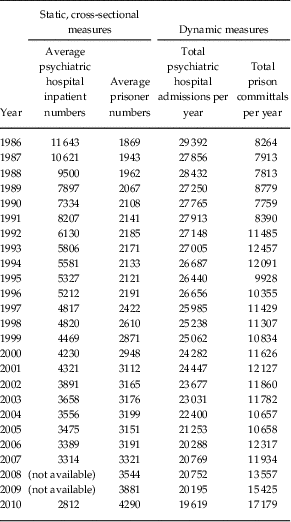
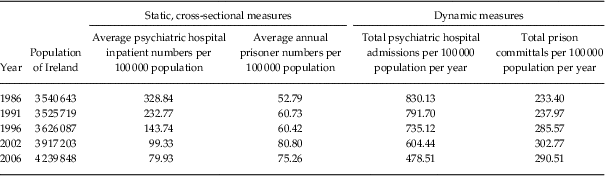
The Irish psychiatric inpatient population on census night each year fell from 11 643 in 1986 to 2812 in 2010 whereas over the same years prison numbers rose from 1869 to 4290 (Pearson r=−0.809, p<0.001), a ratio of 3.6 psychiatric beds closed for every additional prison place (Table 1). There was a strong reciprocal relationship between annual admissions to psychiatric hospitals and annual committals to prison over the same years (Pearson r=−0.788, p<0.001) (Fig. 1). Psychiatric hospital admissions fell from 29 392 in 1986 to 19 619 in 2010 whereas prison committals rose from 8264 to 17 179, an increase of 91 prison committals for every 100 psychiatric hospital admissions foregone – a near one-to-one dynamic association. The population of Ireland increased over the years studied, from 3 540 643 in 1986 to 4 239 848 in 2006 (the most recent census year in this period). The static and dynamic measures per 100 000 population in census years are shown in Table 2. They echo the reciprocal relationships identified using absolute numbers in Table 1, with the exception of 2006, when prison measures decreased per 100 000 population but continued to increase in absolute terms, consistent with the Penrose hypothesis; further longitudinal study would be needed to determine the precise significance (if any) of this small fluctuation in relative (but not absolute) statistics.
Total numbers of psychiatric hospital admissions and prison committals each year in Ireland, 1986–2010. Dashed line: total number of psychiatric hospital admissions per year; continuous line: total number of prison committals per year. Sources: Daly et al. (Reference Daly, Walsh and Moran2013); Irish Prison Service (2011).

Average annual numbers of psychiatric hospital inpatients and prisoners, and total numbers of psychiatric hospital admissions and prison committals each year in Ireland, 1986–2010

Sources: Daly et al. (Reference Daly, Walsh and Moran2013); Irish Prison Service (2011).
Average annual numbers of psychiatric hospital inpatients and prisoners, and total numbers of psychiatric hospital admissions and prison committals, per 100 000 population in each census year in Ireland, 1986–2006

Sources: Central Statistics Office (2018); Daly et al. (Reference Daly, Walsh and Moran2013); Irish Prison Service (2011).
Discussion
Penrose’s hypothesis applies to admissions to psychiatric hospitals and committals to prisons in Ireland over time (dynamic measures), just as it does to the number of places in psychiatric hospitals and prisons in Ireland and elsewhere (more static, cross-sectional measures).
This analysis extends research in this field beyond Penrose’s original cross-sectional correlation (Penrose, Reference Penrose1939) and beyond trend data for static bed numbers (Kelly, Reference Kelly2007; Mundt et al. Reference Mundt, Chow, Arduino, Barrionuevo, Fritsch, Girala, Minoletti, Mitkiewicz, Rivera, Tavares and Priebe2015), to correlation of the dynamic movements of psychiatric patients and prisoners over time. Lengths of stay in both psychiatric hospitals and prisons are heavily skewed towards short stays, so further analysis of the equivalence of number substitution is difficult.
Nonetheless, and although this association remains an ecological observation, the association is robust, replicable across jurisdictions, shows a consistent time trend, and holds both for cross-sectional bed numbers and for annual psychiatric admissions and prison committals. A definitive study to establish inter-relationships of the pathways between psychiatric hospitals and prisons would require a capture–recapture methodology or case register linkage studies.
This is a complex area which requires consideration of the several possible reasons for the significant associations found in this study. The decline in psychiatric inpatient numbers occurred in parallel with the provision of more community focussed resources but the relationships identified in this and other studies supporting the Penrose hypothesis suggest that these resources are currently inadequate for preventing prison committal in countries where data support Penrose’s hypothesis (e.g. Ireland).
In addition, drug use has increased in Ireland in recent times (Bates, Reference Bates2017) and this might account for the increased numbers of prisoners with substance misuse, the most common disorder found in newly admitted prisoners (Curtin et al. Reference Curtin, Monks, Wright, Duffy, Linehan and Kennedy2009), especially since the discontinuation of admissions to psychiatric hospitals for substance misuse. Other relevant factors might include increased vulnerability to homelessness and non-engagement with psychiatric services.
Although a causal relationship between declining psychiatric hospital bed numbers and rising numbers in prisons has not been shown (Prins, Reference Prins2011), the removal of a once well-resourced but highly structured support for people with substance misuse problems, mental illness and co-morbidity without equivalent supports in the community may be part of a causal link as equivalent levels of structured support are rarely supplied in the community.
It has been shown that the changing size of the prison population is largely a matter of policy rather than an epidemiological function of the changing age structure or geographic and economic characteristics of the population served (Grove et al. Reference Grove, Macleod and Godfrey1998). Mental illness is very common in Irish prisons (Kelly, Reference Kelly2005; O’Neill et al. Reference O’Neill, Smith, Caddow, Duffy, Hickey, Fitzpatrick, Caddow, Cronin, Joynt, Azvee, Gallagher, Kehoe, Maddock, O’Keeffe, Brennan, Davoren, Owens, Mullaney, Keevans, Maher and Kennedy2016) and there is evidence that severely mentally ill patients committed to prison are predominantly already known to community mental health services, fulfilling another requirement for a possible causal explanation for the association reported here, although it is still not a full explanation (Curtin et al. Reference Curtin, Monks, Wright, Duffy, Linehan and Kennedy2009).
The same may be true of psychiatric bed numbers and equivalent levels of support in the community, with little advocacy at present for the protection or enhancement of such resources in mental health services (Kelly, Reference Kelly2006). The notably high prevalence of mental illness in Irish prisons adds greatly to the need for future studies to explore further the possible causal nature of the relationship between declining psychiatric admissions and rising prison committals in Ireland and elsewhere (Kelly, Reference Kelly2016). Such studies of the activities of general psychiatric services might be most helpful when focussed on younger men, who constitute the great majority of prison committals.
To this end, future research could also usefully study numbers of admissions to psychiatric hospitals and committals to prisons (dynamic measures) in other countries to see if the relationships we have identified in Ireland also pertain internationally. It would also be interesting if there were any countries in which psychiatric inpatient beds increased over time and there was a concurrent decrease in prison numbers; that is the Penrose hypothesis holding true in reverse. This would provide an interesting test of the hypothesis but it would require a country with an increasing number of psychiatric beds and Blüml et al. (Reference Blüml, Waldhör, Kapusta and Vyssoki2015) showed that the number of psychiatric beds decreased in all 26 European countries that they studied between 1993 and 2011.
It is already apparent that planning future need for psychiatric services depends on a knowledge of the current prison population, if only to provide psychiatric in-reach and diversion services, as well as appropriate follow-up. More than 70 years after Penrose’s paper, the association between prison and psychiatric services remains a challenge for the success of modern mental health policies and services.
Acknowledgements
The authors are very grateful to the editor and reviewers for their comments and suggestions.
Financial Support
This research received no specific grant from any funding agency, commercial, or not-for-profit sectors.
Conflict of Interest
The authors declare that there are no conflicts of interest to disclose.
Ethical Standards
The authors assert that all procedures contributing to this work comply with the ethical standards of the relevant national and institutional committee on human experimentation with the Helsinki Declaration of 1975, as revised in 2008. The study protocol was approved by the ethics committee of each participating institution; the National Forensic Mental Health Service Research and Audit Ethics Committee approved the research project.