On 22 October 1952 the Museum of Modern Art (MoMA) in New York City opened the doors to its first exhibition dedicated to the products of a single industrial company. The exhibition Olivetti: Design in Industry showcased the typewriters and calculators of the Olivetti company, Italy’s preeminent manufacturer of office machines and a leading example of the Modern Movement in the rapidly expanding industrial arts. It also incorporated Olivetti print advertisements, technical instruction manuals, a model of the main factory, photographs of the Olivetti workers’ housing quarters and an eight-foot tall commercial billboard taken from the Italian countryside and erected in the MoMA courtyard. Individually these materials were all worthy of serious critical praise, but the greatest merit of the Olivetti company—according to the MoMA bulletin—was ‘the organisation of all the visual aspects of an industry, unified under a single high standard of taste’ (Olivetti: Design in Industry 1952, 3). Olivetti was promoted as the paragon of modern design, the pioneer and flag-bearer of a co-ordinated corporate image that American industry, in its role as cultural producer, was fervently encouraged to follow.
The exhibition Olivetti: Design in Industry has become a frequent point of reference in scholarship on design history and Italian studies. According to the standard narrative, it marks the entrance of industrial design into the temple of high art, or more precisely the recognition, on the part of the established art world, of the cultural legitimacy of mass-produced goods. This interpretation is often predicated on the assumption that the Olivetti company had no part in the exhibition’s organisation, and that MoMA acted on its own accord in order to bestow such an honour on the Italian company. Thus Jonathan M. Woodham writes of the exhibition as ‘the first time a European manufacturer had been invited to display its products and graphic design at the Museum [of Modern Art]’ (Woodham Reference Woodham1997, 157, emphasis mine). Dario Scodeller is even more explicit, calling the exhibition a ‘recognition of Olivetti’s corporate project’ and ‘an homage’ on MoMA’s part (Scodeller Reference Scodeller2007, 118-24, emphasis mine).Footnote 1 Likewise, Dominic Bradbury glosses the exhibition as one that ‘validated…the rapid growth of the company’ (Bradbury Reference Bradbury2014, 277, emphasis mine), while Reference Lees-Maffei and FallanKjetil Fallan and Grace Lees-Maffei describe the ‘international recognition’ bestowed by MoMA, which ‘chose Olivetti for its very first monographic exhibition’ (Fallan and Lees-Maffei Reference Fallan and Lees-Maffei2014, 14, emphasis mine).
A close look at the collections of the Museum of Modern Art Archives and the Archivio Storico Olivetti reveals that Olivetti: Design in Industry was organised and paid for by the Olivetti company itself, with the museum playing a relatively minor role of cultural legitimisation. The fiction that MoMA simply “recognised” Olivetti’s outstanding contribution to the industrial arts was promoted, from the beginning, by both the museum and the company, and it has trickled down to the most current scholarship. But my interest here is not so much in correcting the historical record as it is in exploring what new types of analyses such a correction can enable. If Olivetti: Design in Industry was a clever case of corporate marketing, might this give us license to relate it with another New York location, the Olivetti showroom on Fifth Ave?
In this article, I will work toward a comparative analysis of these two spaces, both sites of art and merchandise, aesthetic contemplation and consumer acquisition. For context, I will begin with an overview of post-war Italian design at American museums before elaborating my claim that Olivetti: Design in Industry was organised and paid for by the Olivetti company. My comparative analysis of the MoMA exhibition and the New York Olivetti showroom will then demonstrate how these two spaces were in constant communication, raising questions about culture, industry and the modern experience of objects on display.
Olivetti’s New York presence is an illuminating example of the confusion, permeating the modern city, between art and technology, museum space and retail space. For Walter Benjamin, who meditated on this confusion in a very different time and place, the retail store was ‘the last promenade for the flâneur’, an image that resonates certainly with nineteenth-century Paris, but also, as I intend to make clear, with 1950s New York (Benjamin Reference Benjamin1999, 10).
Post-war Italian Design at American Museums
The first major review of post-war Italian design in the United States was a special issue of the New York magazine Interiors published in July 1948.Footnote 2 This issue boasted fifty glossy pages of recent Italian furniture and home décor, including products by Franco Albini, Pier Giacomo Castiglioni, Marco Zanuso and other famous designers.
The American industrial designer George Nelson introduced the review with a short note about artistic excellence in the face of material ruin. ‘Not the least of the virtues of poverty’, Nelson proclaimed, ‘is the way it brings out the essentials’ (Nelson Reference Nelson1948, 71). Nelson purposefully channelled a Catholic sensibility (the note’s title ‘Blessed are the Poor’ echoes Matthew 5:3) in order to suggest that the destruction of war had revealed the Italian people’s fundamentally moral character, making them most worthy of salvation. Implicit in this formulation was an understanding of fascism as something foreign to Italian society, something whose evil spirit had invested Italy’s body politic only to be exorcised in the wreckage of buildings and institutions. Now that this barrier had been removed, Nelson seemed to say, Italian civilisation could resume the forward march of its long and storied tradition.
Being the first major note on post-war Italian design published in the United States, Nelson’s introduction to the Interiors review set the tone for several magazine issues and museum exhibitions that would soon follow. While book-length interpretations of Italian fascism were slow in appearing (due to the time requirements for research, organisation, writing, editing, printing, advertising and circulating), these more ephemeral media made the first post-war bids at understanding the fascist period within the broader context of modern Italian history. They sought to restage and rehabilitate Italian national identity by presenting the harmless objects of everyday life: chairs, tables, desks, lamps, beds. They emphasised either Italian design’s clean break with the recent past or its continuity with older heritages, especially the visual art of the Renaissance. In other words, they lifted the fascist period from the timeline of modern Italian history and discounted its vibrant design culture as something unimportant, irrelevant or plainly bad.
In reality, all of the designers represented in the Interiors review had worked with the implicit blessing of the Fascist Party, and many were directly influenced by its most ardent champions, men like Gio Ponti and Giuseppe Terragni. The details of these relationships must be determined on a case-by-case basis (something that is beyond the scope of this article), but what is certain is that post-war Italian design was heavily indebted to fascist ideas about tradition and innovation, nationalism and modernity. Most American commentators were willing to overlook this glaring continuity in favour of an approach to Italian culture that emphasised novelty, freedom and creativity. Accordingly, they presented the Italian people as victims of a powerful but ultimately inconsequential political aberration.
Benedetto Croce had articulated a similar analysis in his famous Bari speech to the first congress of the National Liberation Committee on 28 January 1944. According to Croce, Italian fascism was to be understood within the broader context of a centuries-old peninsular civilisation that had given birth to the Roman Empire, the Renaissance, the Risorgimento and the Resistance. Though fascism was by all accounts a regrettable historical episode, Croce insisted that this long-view of history revealed its status as a mere ‘parenthesis’ in the progression of Italian civilisation (Croce Reference Croce1963, 56-7). From there, the step to excise and dismiss the recent past as something alien to the Italian tradition was short and easily bridged.
Nelson may have read Croce’s article ‘The Fascist Germ Still Lives’, published in The New York Times Magazine on 28 November 1943, and he was certainly familiar with its argument that fascism was a disease ready to plague any feeble national body. Anticipating the Bari speech, Croce wrote to advise the American public: ‘I permit myself to suggest that fascism be not judged as a “morbus Italicus” but as a contemporary sickness from which Italy was the first to suffer’ (Croce Reference Croce1943, 45). Though Croce’s intent was to warn against the spread of fascism to other developed nations, the effect of his analysis was to provide American commentators with testimony of the animosity between the history of fascism and Italian national identity. Nelson and his peers at other design magazines and cultural institutions mobilised the Crocean interpretation of fascism in order to dramatize Italian national identity in industrial products and to reassure the American public that the Italian people were a moral, peaceable bunch.
The first major American museum exhibition to focus on post-war Italian design was the traveling show Italy at Work, organised by the Compagnia Nazionale Artigiana (CNA). Italy at Work opened on 29 November 1950 at the Brooklyn Museum of Art, and it closed on 15 November 1953 at the Rhode Island School of Design. In the intervening years it appeared in ten American cities from St. Louis to San Francisco, Portland to Pittsburgh, and it generated wide-ranging debate about the outlook of Italian creativity in a moment of great economic uncertainty (Pepall, Reference Pepall2006).
The exhibition Italy at Work was the result of assiduous planning, including a two-month voyage across the Italian peninsula during which a delegation of four men selected 2500 products from the studios of 250 artisans and craftsmen. The CNA was administered by the Italian Ministero del commercio con l’estero but financed by the United States government, and the exhibition’s organising committee was composed mainly of American diplomats and museum directors.
The industrial designer Walter Dorwin Teague led the selection committee on its trip to Italy, and he published his memories in the November 1950 issue of Interiors. Teague wrote:
Since the war, the artists of Italy have been frolicking like boys let out of school. The Italian spirit, so long suppressed by the heavy hand of politics, had been storing up its energy against this day when it can do as it pleases again. (Teague Reference Teague1950, 199)
In keeping with this understanding of post-war Italian design as a project wholly divorced from the recent past, Teague reported that the selection committee’s main criteria were originality and contemporaneity. With only a few exceptions, the exhibition included objects produced after 1945.
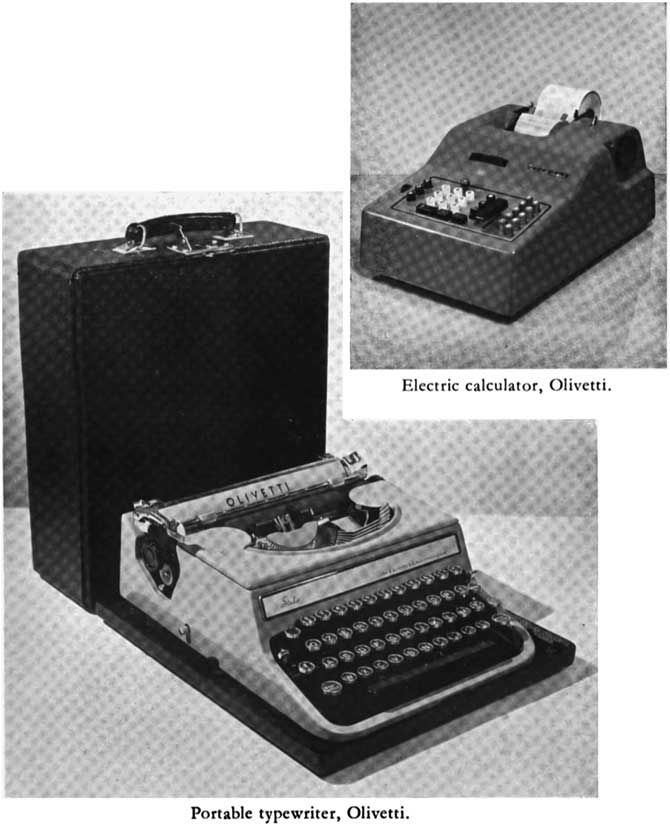
Due to the exhibition’s special historical and political intentions, the organising committee decided that the standard accompanying catalogue of artworks was unsuitable for Italy at Work. Instead, the CNA published a full-length handbook to the exhibition that included substantial chapters on Italian society, the regional distribution of production and the main tendencies in modern Italian art. The Art Institute of Chicago curator Meyric R. Rogers authored the handbook, whose appendix counted more than one hundred photographs of exhibition objects. Most of the objects represented were hand-made artefacts produced in small quantities, but some were the creations of industrial processes employing a combination of living and machine labour. Among this latter set were two Olivetti products: the Divisumma 14 calculator and the MP 1 typewriter. Olivetti does not seem to have received any particularly special attention in the Italy at Work exhibition, and its products were collocated under the handbook’s final section dedicated to industrial design.
Olivetti products in the Italy at Work exhibition handbook; Rogers 1950, 123

Like Nelson’s review and Teague’s memories before it, so Rogers’ handbook subscribed to the Crocean interpretation of fascism in order to present the Italian people as the rightful inheritors of the Renaissance tradition, a people whose creative energies had been momentarily suppressed only to be liberated with the arrival of democracy. But in Rogers’ case this desire to settle the recent past was complicated by a quickly deteriorating political present. In the six months between the selection committee’s Italy trip and the exhibition’s opening, the United States government had forcefully stepped up its policy of containment against communist revolutionary groups, especially after the June 1950 invasion of South Korea and the break out of the Korean War. With the situation in Europe still meagre, it became more important than ever to affirm Italian support for American capitalism.
The Italy at Work exhibition handbook was an early Cold War document that betrayed deep-seated American anxieties about Italy’s commitment to a liberal democratic political system. With rising unemployment across the peninsula and growing support for the Communists and Socialists, Americans needed to tell themselves stories about the Italian people’s preference for liberal values. ‘The Italian is an individualist’ Rogers declared in the opening line of the handbook’s introductory chapter. ‘Hence this exhibition’ (Rogers Reference Rogers1950, 13). This supposed link between the nature of italianità and the need for a public presentation of everyday objects underwrote the exhibition’s project of restaging Italian national identity. But it also belied any claim to do so impartially by showing how Italy at Work was filtered through a value system that presupposed American ideals. If the exhibition endeavoured to restage Italian national identity it was difficult to tell where its restaging ended and its construction ex novo began.
After testifying to the devastating wreckage of post-war Italy, Rogers commended the Italian people for their nevertheless entrepreneurial spirit. According to Rogers, the Italian acceptance of personal responsibility paired with an enthusiasm for hard work (highlighted in the exhibition’s title) had allowed Italian craftsmen and industrial designers to succeed and even excel in creatively rebuilding their society. ‘Such action’, Rogers wrote, ‘was possible only to a people radically untouched by government paternalism and instinctively distrustful of it’ (Rogers Reference Rogers1950, 13). If this seemed like a reference to the history of fascism it was only partially that. More accurately, it was an expression of American anxiety about “totalitarian” states, a term that in the 1940s and 1950s made room for Fascist Italy, Nazi Germany, Communist Russia and several Cold War-era Soviet satellite states (Todd Reference Todd2002, 219-220). This slippage was reflected in Rogers’ language, which mixed the simple past tense (‘Such action was possible’) with a temporally ambiguous participial adjective (‘only to a people radically untouched by government paternalism’) and a simple present tense descriptive adjective (‘and instinctively distrustful of it’).
The professed raison d’être of the Italy at Work exhibition was much simpler, and it originated in the economic relationship between the United States and Italy during the Marshall Plan years. The Economic Cooperation Administration (ECA) Mission to Italy provided part of the exhibition funds in hopes that the show would stimulate a direct exchange of Italian consumer goods for American cash. In other words, the ECA sought to intensify the flow of American money into Italian households and to reinforce the commercial ties between two nations by encouraging the museum-going American public to “buy Italian”.
The exhibition’s selection committee chose only those objects likely to attract American eyes, and the excitement of aesthetic contemplation was never far removed from the possibility of consumer acquisition. Rogers’ handbook made this link a priority:
Since pleasure in [useful and beautiful objects] is always heightened by the possibility of possession, the stimulation of this exhibition should be all the greater in that practically all the exhibits or their equivalents are not only within the reach of the average buying public but will be so available… If the movement represented by the exhibition is to develop to the greater health of Italy and our western world the producer-consumer chain must be completed. (Rogers Reference Rogers1950, 18)
With Italy at Work museum space became retail space, while cultural institutions played a promotional role that was normally covered by trained marketing professionals. Museums were not obliged to renounce their claim to artistic appraisal, but they were made to broaden that claim until it included a statement of commercial endorsement. In the process, the inventions of Italian craftsmen and industrial designers were caught somewhere between art and merchandise.
The exhibition Italy at Work was an important precursor to Olivetti: Design in Industry, and the Olivetti company probably conceived the MoMA show through its participation in the former. Both exhibitions invited spectators to develop into consumers by challenging the boundaries that separate art from merchandise. But Italy at Work was not yet a case of corporate marketing. While it used museum space to promote the sale of consumer goods, its final goal was to push Italian public opinion in the direction of liberal democracy. It subordinated business to politics while denying Italian companies any say in the presentation of their products. Nevertheless, it made a major contribution to the perception of Italian design as simultaneously beautiful and useful. No sooner had the exhibition opened than the Olivetti company was arranging to put that perception to work.
Olivetti: Design in Industry
As Riamonda Riccini has rightly observed, the historiography of the Olivetti company—its focus on the charismatic founder Camillo and his visionary son Adriano—‘runs the risk of becoming mythologised’ and doing a disservice to its subject (Riccini Reference Riccini2014, 92). This is partly because the scholarship on Olivetti is actively patronized by the family’s estate, and most of the recent work has been printed by its publishing house Edizioni di Comunità.Footnote 3 Rather than concentrate on these men, their group of all-star designers and best-selling products, my approach to Olivetti focuses on the elaboration of discourses like art and industry, italianità and American-style consumerism.
The Olivetti company opened its first American office on 9 February 1950.Footnote 4 The Olivetti Corporation of America (OCA) was located at 580 Fifth Ave in New York City, and it was run by the Olivetti family’s most “American” son, Dino Olivetti.Footnote 5 From 1950 to 1959, when OCA merged with the Underwood Typewriter Company, the New York office was an important centre of communication between the Italian company and the American market. Dino corresponded regularly with his brother in Italy, company president Adriano Olivetti, and together they strategised the marketing, sales and distribution of Olivetti products throughout the United States.
During the first two years of operations, OCA did not have direct access to the American market; instead it provided advertising support and inventory to a network of independent American businessmen who owned exclusive company rights to specific territories. Sales figures were modest, barely reaching eight thousand units in 1951.Footnote 6 Starting in November 1952 OCA began to phase out this network, and by July 1954 the Italian company could sell its products directly to most of the American market, including all of New York City.
The earliest mention of Olivetti: Design in Industry comes from a letter written by Dino and sent to Adriano on 1 May 1951.Footnote 7 In this letter, Dino informed Adriano that the forthcoming issue of the New York magazine Fortune would include an article about the Olivetti company partially explaining the exhibition. Dino’s casual remark, together with the usual time requirements for exhibition planning and article preparation, suggests that Olivetti: Design in Industry was already well underway and may have been many months in the making. The Fortune article, Dino wrote, had been proposed by the magazine’s art director Leo Lionni, a Dutch-born Italian citizen living in the United States who happened to admire the Olivetti company. Citing the difficulty of translating Olivetti advertisements for the American public, Dino urged Adriano to consider recruiting Lionni for a position at OCA. By the end of the month Lionni was in charge of Olivetti’s American advertising.
When the June 1951 issue of Fortune was published, it contained no mention of the exhibition Olivetti: Design in Industry. Lionni’s anonymous article ‘Design with a Point’ sang the praises of Olivetti, but it made no reference to the MoMA show nor to the possibility of any museum exhibition. It is difficult to say why Fortune did not follow through with the plan to announce and explain Olivetti: Design in Industry. One likely reason is that Lionni’s late OCA hiring suddenly complicated the article’s stakes, raising questions about the ethics of hyping an exhibition that could be shaped by a Fortune employee.
In any case, Lionni’s Fortune article was still a full-scale dress rehearsal for the MoMA show. Six of the photographs from the Fortune article reappear in the MoMA bulletin, and some of the descriptions from the former are remarkably close to those of the latter. Where the Fortune article celebrates ‘one standard of taste [that] guides every visual aspect of the [Olivetti] company’s operations’ (‘Design with a Point’ 1951, 113) the MoMA bulletin cheers ‘the organization of all the visual aspects of an industry, unified under a single high standard of taste’ (Olivetti: Design in Industry 1952, 3). Both documents share an imaginary and linguistic archive that is located in the person of Lionni and in the promotional materials available to him as OCA art director.
Since the June 1951 Fortune issue elected to pass over the exhibition in silence, the task of announcing Olivetti: Design in Industry passed on to MoMA. But rather than risk the consequences of a premature announcement, the museum decided to maintain the secret until some of the finer details could be arranged. By January 1952 Dino and Adriano had named Lionni director of the exhibition, and in February the museum finalised a budget totaling US $6462.Footnote 8 This included US $392 of ‘overhead’ payable directly to MoMA, plus a US $1000 ‘packing, crating and insurance’ fee requested for travel to fifteen other American museums. Later on, this idea to make Olivetti: Design in Industry a travelling exhibition was abandoned and the associated fee was dropped.
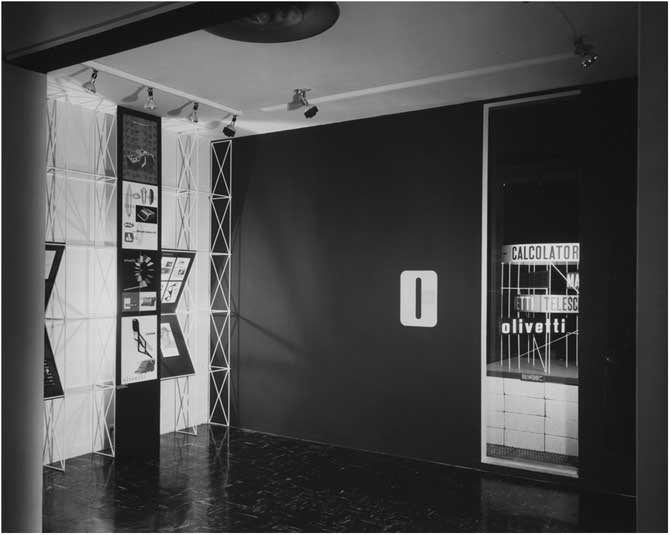
On 13 June 1952 Dino wrote to the architect and MoMA director Philip C. Johnson confirming that ‘the Olivetti company in Italy is willing to undergo the expenses of the exhibition’.Footnote 9 The exhibition budget effectively became an invoice for the rendering of corporate marketing services and the Olivetti company paid all costs including MoMA’s US $392 ‘overhead’ commission. Lionni’s personal collection provided much of the exhibition materials, while Dino and Adriano sent Johnson more resources from the company headquarters in Italy. The final list of items included Olivetti typewriters and calculators, sales displays and brochures, technical instruction manuals, print advertisements, corporate logos, a calendar, a model of the main factory and photographs of the workers’ housing quarters, family nursing school and retail stores.Footnote 10 Arrangements were made for the spatial distribution of these items within the northwest gallery, and part of the exterior courtyard was reserved for the construction of an eight-foot tall Olivetti billboard taken from the Italian countryside.
Inside the northwest gallery, with a view to the outdoor courtyard; Museum of Modern Art Archives, New York

MoMA finally announced Olivetti: Design in Industry on 3 October 1952, just three weeks before the exhibition was scheduled to open.Footnote 11 The press release highlighted some of the show’s most exciting parts (the giant billboard took centre stage here) and it proclaimed Lionni director of the exhibition. But it did not say anything of his professional relationship with the Olivetti company. In the words of the press release, Lionni was simply the ‘art director of Fortune magazine’, and there was no indication that at OCA he held the same title. There was also no indication that the Olivetti company had actively organised the exhibition nor that Dino and Adriano had paid the museum for agreeing to host the show. While such an open disclosure would have been unusual in a press release, MoMA’s decision to keep quiet gave the American public no reason to question the exhibition’s independence from business concerns. Instead, the press release presented Olivetti: Design in Industry as a disinterested tribute to a creative and innovative Italian company.
This misconception was reinforced by a second press release that coincided with the exhibition’s opening.Footnote 12 ‘The purpose of the exhibition Olivetti: Design in Industry’, it confirmed, ‘is to give recognition to the achievement of this manufacturer of business machines’. This statement was not untrue, as MoMA did intend to acknowledge the Olivetti company’s accomplishments in industrial design. But it was misleading because it smoothed over the Italian company’s collaboration with the museum.
Even though the American public knew nothing of the co-operation between the Olivetti company and MoMA, Olivetti: Design in Industry was already a revolutionary exhibition. Before 1952 MoMA had defended a rather narrow definition of art that privileged architecture, painting, sculpture, theatre and photography. Exhibition series like Machine Art (put on in 1934, 1938 and 1940), Useful Objects (convened eight times between 1938 and 1948) and Good Design (presented in 1950, 1951 and 1952) had already displayed machine-produced consumer goods, but they had focused on the objects themselves, not the industrial processes of mass production. On the contrary, Olivetti: Design in Industry foregrounded the methods of modern industry. It drew less attention to the company’s typewriters and calculators than to the Olivetti system as an organic site of orchestrated production. In this respect, it expanded the field of modern art and forever changed what was admissible at a MoMA exhibition.Footnote 13
The Olivetti company also paid MoMA US $2500 to print a special issue of the museum’s monthly bulletin, dedicated entirely to the Italian company and timed to coincide with the opening of Olivetti: Design in Industry.Footnote 14 Dino and Adriano selected Lionni to design the museum bulletin, and the exhibition budget anticipated distribution for fifteen thousand copies.
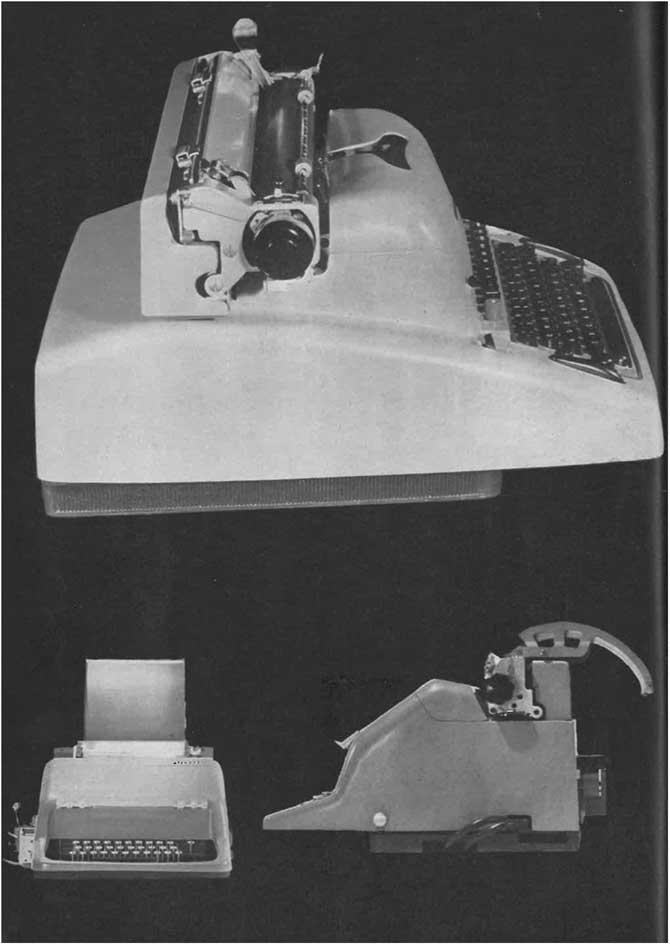
The museum bulletin integrated Olivetti company history with an overview of current products. It included photographs of the exhibition materials, especially those that highlighted the Italian company’s commitment to social goals. Some pages featured high-quality photographs of Olivetti typewriters and calculators shot in a studio with professional lighting equipment that was normally reserved for pieces of sculpture. Rather than present these products within the context of their daily use—on the desk of a busy secretary, in the hands of an enterprising businessman—the museum bulletin staged them in complete isolation, protecting their claim to arthood and promoting their appeal to an upper-middle-class New York public.
Olivetti products in the MoMA bulletin; Olivetti: Design in Industry 1952, 10

Penny Sparke has written about such representational practices in the international promotion of Italian design from the mid-1950s to the mid-1960s. According to Sparke, the tendency to photograph Italian products by themselves, and to publish these photographs in glossy magazines like Domus and Stile Industria, revealed a desire to change the Italian household product ‘from a utility artefact into a covetable object’ (Sparke Reference Sparke1988, 128). The social consequences of this process, Sparke shows, were the reinforcement of an ethos of conspicuous consumption and the fetishisation of Italian products: their removal from politically-motivated social contexts of use and their elevation to the status of formal art.
While I agree with Sparke that such representational practices tended to push Italian design in the direction of time-honoured art, it is interesting to note that in the case of Olivetti the binary logic of ‘utility artefact’ versus ‘covetable object’ would miss the point of Dino and Adriano’s radical challenge. Olivetti: Design in Industry did not simply ask the American public to stop considering the company’s products as useful tools and to start regarding them as art. On the contrary, it contested the boundaries that separate the purely instrumental from the aesthetically appreciable by positioning Olivetti’s typewriters and calculators somewhere between these two categories. Accordingly, the museum bulletin was not a company sales catalogue, nor was it a review of MoMA artworks. But it mixed elements of these two genres and invited readers to confront Italian design in an ambiguous zone linking merchandise and art.
The museum bulletin announced on its opening page that Lionni was its designer, but it did not immediately disclose the fact that he was also employed by the Olivetti company. Through this strategic silence the museum bulletin gave itself the authority to mobilise Lionni’s work in the service of Olivetti’s reputation without appearing to compromise its stance of independence from business concerns. While this was true of the entire museum bulletin as a document that drew its materials from Lionni’s OCA archive, it was particularly important for the first pages, which drummed up the Olivetti company’s worldwide renown. The bulletin’s first paragraph raved: ‘Even Fortune magazine joins the critics concerning Olivetti’s excellent advertising’ (Olivetti: Design in Industry 1952, 2). For Lionni, as we know from Dino and Adriano’s correspondence, this veiled reference to the article ‘Design with a Point’ amounted to little more than a self-citation.
For the reading public, it was possible to untwist the complex network linking Lionni, Fortune magazine, MoMA and the Olivetti company, but this would have taken considerable detective work and a bit of special knowledge. In a note buried toward the back of the museum bulletin, MoMA finally mentioned that Lionni ‘today produces the promotional designs for Olivetti in this country’ (Olivetti: Design in Industry 1952, 17). This probably went unnoticed by most readers, either because they did not read the entire bulletin or because they did not grasp the connection between Lionni and the MoMA exhibition itself. Very few people would have recognised Lionni as the art director of Fortune magazine, a role that had little visibility among the American public.
It is difficult to say why MoMA, having carefully avoided the topic for so long, decided to include in the museum bulletin an explicit statement about the professional relationship between Lionni and the Olivetti company. It seems likely that MoMA foresaw the possibility that this relationship would become public knowledge anyway, and therefore planted the statement as a defence against any eventual accusation of an unacknowledged conflict of interests. It would have made little difference to Dino and Adriano, who surely knew that the exposure from Olivetti: Design in Industry could not be retracted so easily, and at such a late moment.
There was, of course, nothing illegal about a cultural institution promoting the products of an industrial company from which it received payment. But the fact that MoMA and the Olivetti company took such care to limit the possibility that the American public would grasp the situation confirms the difficulty with which the art world would have struggled to tolerate such a practice. John Potvin has written about a similar agreement at the heart of the Guggenheim Museum’s retrospective on Giorgio Armani (2000), which becoming public knowledge generated a critique that the museum had ‘transitioned into the business of renting space, using its cultural capital to amass cash reserves, unethically swinging its doors open to the highest bidder’ (Potvin Reference Potvin2012, 52). Almost fifty years earlier, Olivetti: Design in Industry would have surely raised a cry.
But the fact that Olivetti: Design in Industry was organised and paid for by the Olivetti company itself seems to have gone completely undetected by the American public. Even the ever-astute Aline B. Saarinen, in a review for the New York Times, insisted that the exhibition was conceived ‘in proselytizing recognition of [the Olivetti company’s] achievement’ (Louchheim Reference Louchheim1952, X9). This discourse of recognition has proven remarkably powerful, to the point that the exhibition has become, not without some irony, a marker of its opposite: a show without any company involvement. Thus AnnMarie Brennan, writing more than sixty years on, can gloss a 1964 Olivetti exhibition on arte programmata as one ‘unlike the 1952 MoMA show’ because in 1964 the company ‘now performed the role of curator by sponsoring and orchestrating’ everything (Brennan Reference Brennan2015, 244). It is not Brennan’s goal to analyse the co-operation between museums and companies, and she uses the example only to pursue a brilliant discussion of immaterial labour. Still, it is instructive to note how much of what Brennan says of the 1964 show could describe the 1952 exhibition:
[The 1964 show] performed as a machine for the purposes of adding value to the Olivetti brand through its association with the art world. Indeed, the ambiguous association between product and art object, promoted through the Arte Programmata exhibition, becomes clear when we discover that Olivetti was not merely a sponsor of the exhibition, but in fact instrumental in its fabrication. (Brennan Reference Brennan2015, 244)
The illusion that MoMA merely recognised the Olivetti company’s greatness, on its own accord and at its own expense, was from the beginning a necessary part of the exhibition’s marketing success. It was a discourse that distracted from an uncomfortable reality behind the rhetoric: that the Olivetti company had paid MoMA for the rendering of marketing services.
By insisting on the commercial nature of the relationship between the American museum and the Italian company, I do not intend to suggest that Olivetti: Design in Industry was in any way an illegitimate show, nor that Olivetti’s industrial products did not belong in a modern art gallery. Such a position would be founded on the dubious assumption that art exhibitions before Olivetti: Design in Industry were always wholly independent from business considerations. Even (or perhaps especially) a show like Italy at Work, with its innocent presentation of struggling craftsmen and industrial designers, carried for its participants financial implications that were far more important than any tenuous stance of cultural solidarity with the United States.
Accordingly, what set Olivetti: Design in Industry apart was not a question of kind; it was a question of degree. Dino and Adriano understood the commercial benefits latent in museum space as an artistic medium, and they made those benefits manifest in the materials of the MoMA exhibition. They understood the unwritten financial implications of co-operation with a major American cultural institution, and they set down a formal agreement for the purchase of museum-based corporate marketing services. This strategy purposefully aimed at what others had only achieved with much less foresight: the use of museum space as a marketing medium.
The one thing that MoMA could not do was to actually sell Olivetti’s products. If the Italian company were to capitalise on the New York demand it would need to complete the cycle itself. It would need, as Dino and Adriano already knew, a local commercial presence.
The Olivetti Showroom
The idea of selling Olivetti products directly to the American market predated the opening of Olivetti: Design in Industry,Footnote 15 and by December 1952—just days after the exhibition’s closing—Adriano was writing to Dino about the possibility of ‘a sales office at the Olivetti Corporation of America’.Footnote 16 The Italian company already operated its own retail stores in many international capitals, including Paris, London, Mexico City, Vienna, Brussels, Johannesburg and Rome.Footnote 17 These stores were known for their liberal use of artistic imagery and for their superstar architects (the Rome store, for example, was designed by the famous rationalist architect Ugo Sissa).
On 29 December 1952 Dino sent an urgent telegram to Adriano confirming that OCA had acquired retail space for a store and that a commercial contract was in preparation.Footnote 18 The space was located at 584 Fifth Ave, in the same building as the OCA office, and it enjoyed ground-level street-front access to the heart of midtown Manhattan. It is important to realise that MoMA was located on 53rd Street, just steps off Fifth Ave, and anyone who walked down that avenue for more than a half kilometre would have seen both the museum and the Olivetti company’s new retail space. Accordingly, the store location offered Dino and Adriano the chance to re-propose Olivetti’s products to the local public, only this time in a context that was more explicitly commercial. In other words, the advantage of the retail space was not only its proximity to the OCA office, nor its position at the centre of America’s busiest shopping district; it was above all the possibility of communicating with the same neighbourhood community that had seen Olivetti: Design in Industry.
The New York Olivetti showroom took more than a year to construct, and it saw the collaboration of many groups and individuals working both in Italy and in the United States. For the showroom’s general layout, Dino and Adriano hired the Italian architects Ludovico Barbiano di Belgiojoso, Enrico Peressutti and Ernesto Nathan Rogers.Footnote 19 Before the Olivetti showroom, these three had worked together on installations for museum exhibitions, and it was not a coincidence that they were chosen to take up the mantle of Olivetti: Design in Industry. The trio was already well-known in the United States, having lectured at Harvard University, the Massachusetts Institute of Technology, Princeton University and elsewhere. They had also been commissioned by MoMA to build the United States pavilion at the 1951 Triennale di Milano.
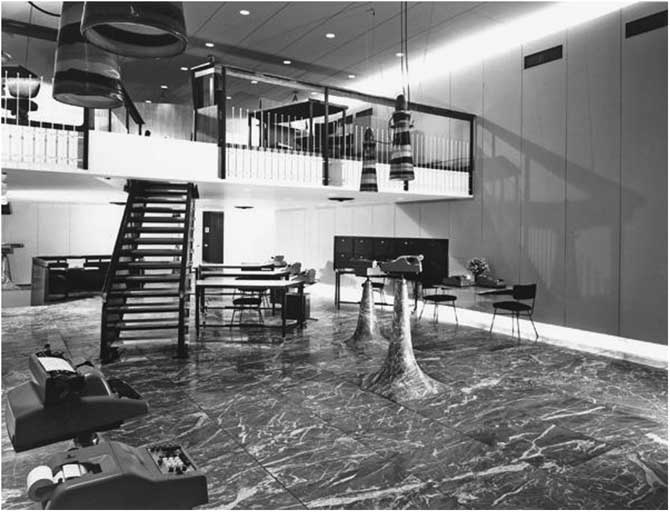
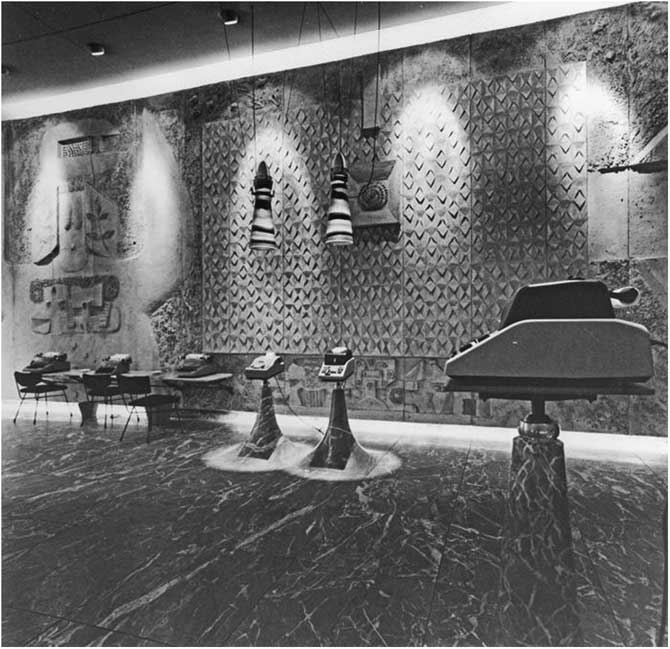
What Belgiojoso, Peressutti and Rogers offered was as much another art exhibition as it was a company store. The New York Olivetti showroom was a walkable landscape of creativity populated by typewriters and calculators that confronted spectators and customers as artworks and merchandise. A glass façade spanned the length of the building, allowing passers-by to survey the entire showroom from the street. Inside, the blue-green marble floors had been mined from a cave in the northern Italian Val d’Ossola. They extended in all directions, like the glistening waters of a shallow sandbar, bending skyward here or there and anchoring the company’s products to the sales floor. The cone-shaped lighting fixtures, reminiscent of giant seashells, had been designed exclusively by the Venini glassblowers of Murano. They hung from the ceiling to spotlight scattered workstations where Olivetti machines were ready for testing. A rotating dumbwaiter sent typewriters and calculators down to the basement for repairs, and an open riser staircase led up to the mezzanine level of sales desks and company employees.
Inside the New York Olivetti showroom; Associazione Archivio Storico Olivetti, Ivrea

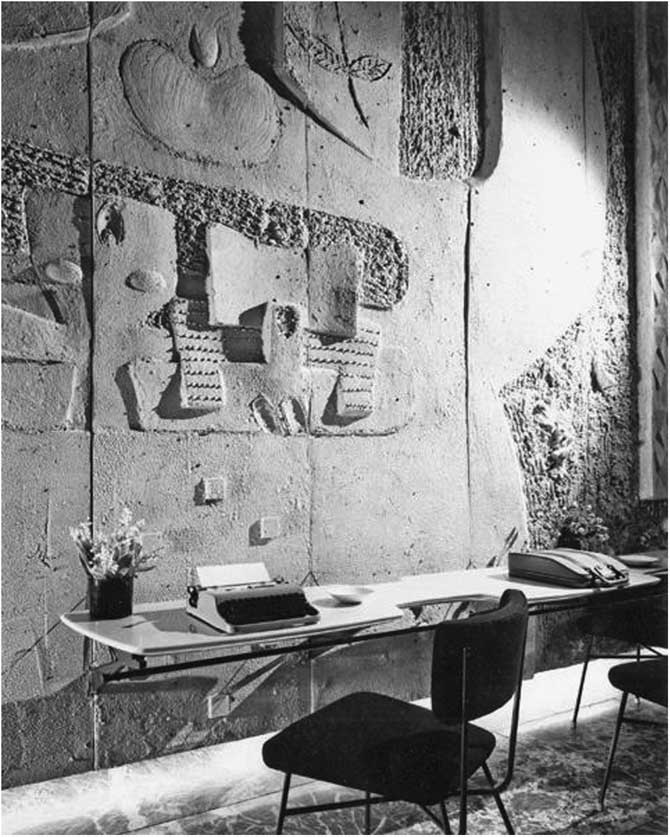
The most original feature of the Olivetti showroom was the Italian sculptor Costantino Nivola’s vast bas-relief, which occupied most of the south wall. Nivola was a long-time Olivetti employee who had been chased from Italy by the Fascist racial laws, settling first in France, then with his wife in Long Island, New York. He was the pioneer of a creative technique whereby sand sculptures could be cast in concrete and reproduced in unusual spaces. Nivola used this technique for the Olivetti showroom piece, transforming the space even further into a sort of art gallery with consumer goods.
Costantino Nivola’s bas-relief; Associazione Archivio Storico Olivetti, Ivrea

On 26 May 1954 the Olivetti showroom opened for business. More than five hundred people attended the ceremonious event, including American businessmen, Italian diplomats, journalists and cultural figures. The president of the Fifth Avenue Association W.E.S. Griswold Jr had the honour of cutting a typewriter ribbon strung up across the showroom’s front door, and Dino led the guests across the marble floors amid sustained applause and well wishes.Footnote 20 In a statement prepared and distributed to members of the press, Dino explained the Olivetti approach to the showroom’s construction: ‘By using the materials and design talents of Italy, we hoped to bring something of contemporary Italian taste to Fifth Avenue’.Footnote 21 In emphasising the italianità of the showroom’s materials and presentation, Dino was tapping into a growing American interest in the linea italiana of industrial design, a series of products that masterfully combined form with function, beauty with utility. The national identity of industrial products is, as Grace Lees-Maffei has noted, at its strongest outside of the country of origin, an insight that companies like Alessi have since learned to exploit in their marketing (Lees-Maffei Reference Lees-Maffei2002, 51).
The Olivetti showroom’s star product was the Lettera 22 portable typewriter, designed in 1949 by the Italian architect Marcello Nizzoli. Starting in July 1954 the showroom also sold the Divisumma 14 calculator, designed in 1948 by the same artist. These two products dotted the showroom sales floor, where they rested atop pedestals of glossy marble.
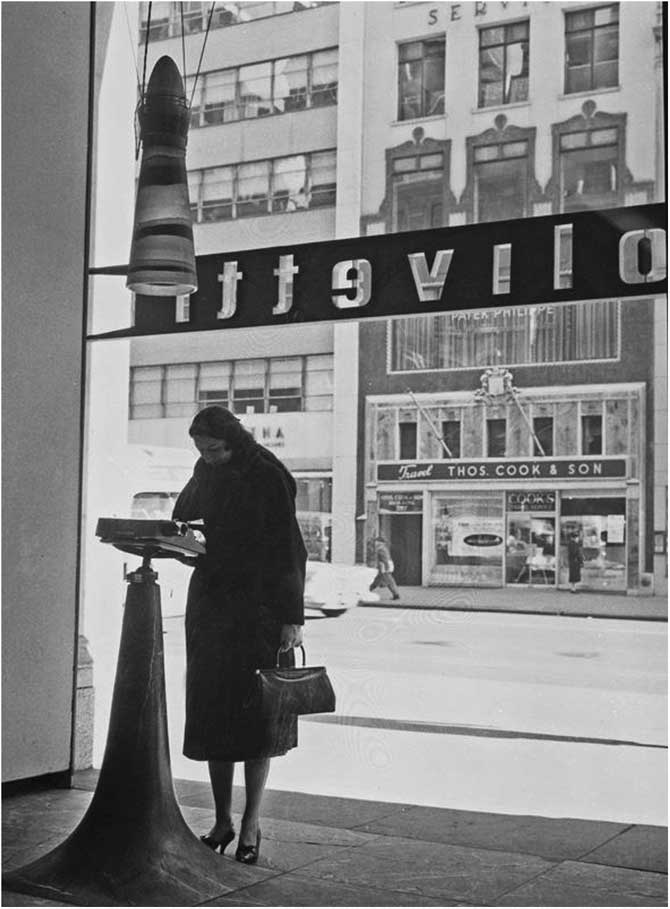
In addition to the ten pedestals inside the showroom, there was also one outside which furnished a Lettera 22 typewriter directly to the pedestrians of Fifth Ave. Passers-by could stop on the sidewalk and test the company’s product even without entering the interior space of the Olivetti showroom. The exterior typewriter was regularly stocked with paper, and New Yorkers made ample use of it for communication, self-expression and philosophical musings. ‘Peace, it’s wonderful’ wrote one anonymous visitor (Hamill Reference Hamill1962, 4). ‘I love you, I love you, I love you’ was the message of another (‘Confidenze di passanti’ 1955, 4). A nameless aesthete quoted from Chaucer: ‘Whan that Aprille with his shores soote…’, only to be rebuked by the next typist: ‘Wake up, man, we’re in the twentieth century!’ (‘Confidenze di passanti’ 1955, 4).Footnote 22 A thorough discussion of these writings is beyond the scope of this article, but it is important not to think of them as mere trivialities. On the contrary, they are the valuable fragments of an ephemeral material culture, the result of a complex urban encounter between human intelligence and technological representation. They are the improvised record of a modern world, ranging widely in topic from pets to politics, religion to romance.
Outside the New York Olivetti showroom; Associazione Archivio Storico Olivetti, Ivrea

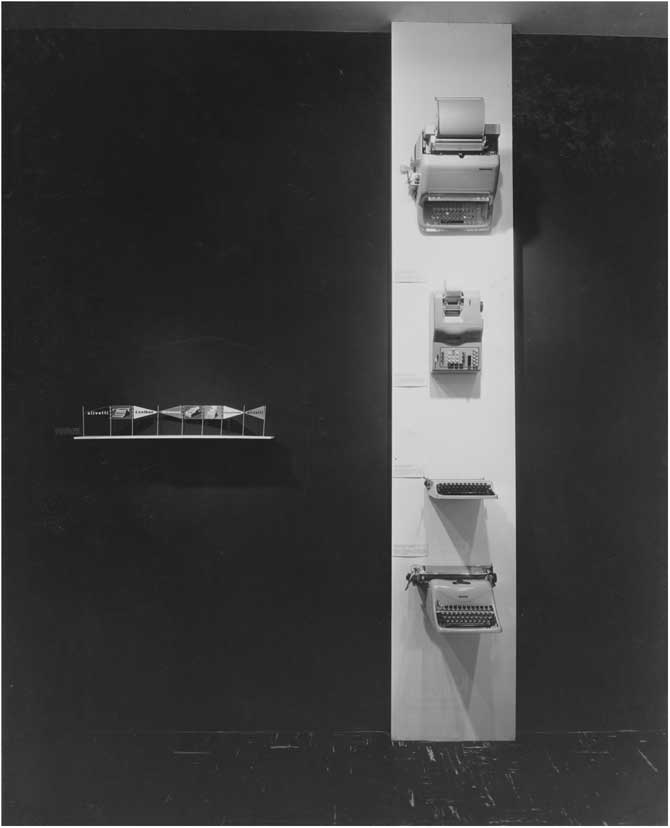
Anyone who looks at photographs of Olivetti: Design in Industry together with photographs of the Olivetti showroom will recognise the similarities of approach to the problem of presenting the Italian industrial object to the American public. In both cases, Olivetti’s typewriters and calculators were proffered as self-sufficient tools, stand-alone products that might lend themselves to any modern context, whether professional or recreational. These were not the component parts of a composite office environment, to be placed on desks, against walls or beside files. On the contrary, they were complete workstations with nothing to hide, out in the open and begging to be inspected from all possible perspectives. Inspection, of course, meant two things at once: detached aesthetic contemplation and practical performance testing.
Olivetti products on display at Olivetti: Design in Industry; Museum of Modern Art Archives, New York

Olivetti products on display at the New York Olivetti showroom; Associazione Archivio Storico Olivetti, Ivrea

It is imperative to think of Olivetti: Design in Industry and the Olivetti showroom together, as one extended case of corporate marketing that took the form first of an art show, then of a retail store. One thinks immediately of Warhol’s quip that ‘all department stores will become museums, and all museums will become department stores’, wondering if the artist was aware that his words about the future were equally descriptive of the past (cited in Potvin Reference Potvin2012, 47). Olivetti: Design in Industry anticipated the Olivetti showroom, and the latter echoed the former. In other words, the art exhibition was already a sort of retail store, and the retail store was still a sort of art exhibition. In the minds of those who visited both, these spaces must have run together. Olivetti’s products simply did not respond to the outdated and separate categories of art and merchandise. They lingered in an ambiguous zone between creativity and commerce, generating—perhaps uncomfortable but certainly effective—conversation about Italian design.
The Olivetti showroom was widely reviewed in both the Italian and the American press, especially in professional architecture journals that normally ignored retail stores. These reviews were mixed, most praising the beauty of individual elements while lamenting the clutter of the space as a totality.Footnote 23 On the positive side of the spectrum there were Olga Reference GueftGueft’s article in Interiors and Gio Ponti’s analysis in Domus, both of which might be summed up by Ponti’s remark that the showroom was ‘full of novelty, and full of poetic values’ (Ponti Reference Ponti1954, 3). These reviewers ignored the commercial side of the Olivetti showroom, treating the space as another work of visual art that could be exhaustively analysed with the critical tools of their discipline.
It took a sociologist like Lewis Mumford to unpack what was truly novel about the Olivetti showroom: it’s complex integration of business and art. In a harsh review published in The New Yorker Mumford chided the Olivetti showroom for its overwhelming and disorienting mix of disparate artistic styles, periods, materials, media and colours, more appropriate—Mumford joked—to Coney Island than to midtown Manhattan. ‘The one purpose of this showroom’, Mumford wrote, ‘should be to give a buyer a chance to study the Olivetti machines in peace, without the nervous competition of many other objects’ (Mumford Reference Mumford1954, 116). For Mumford, the showroom’s creative aspirations were at war with its commercial goals, producing a struggle for attention that ultimately left customers unable to make a decision.
Abstracting from the Olivetti showroom to reflect more broadly on the history of ideas, Mumford identified a tendency of modern thought to conceive industry in opposition to culture. This did not mean, according to those who subscribed to this conception, that industry and culture were antagonistic, nor that they should be kept separate. On the contrary, it meant that industry and culture were complementary or, more precisely, that in the age of industrial society culture was a necessary corrective to rampant capitalism. Accordingly, Mumford surmised that the Olivetti company had employed art to address ‘certain feelings that [many people believe] are omitted by the calculus of the machine’ (Mumford Reference Mumford1954, 116). This was a mistake, Mumford implied, because Olivetti’s typewriters and calculators were already in themselves cultural objects. If industry was already culture, then any attempt to introduce culture into industry was plainly redundant and caused confusion.Footnote 24
It is somewhat ironic that Mumford took this line of critique with—of all companies—Olivetti, because nobody knew better than Dino and Adriano that industrial products were also objects of culture. This was the foundational idea undergirding the corporate marketing strategy that encompassed Olivetti: Design in Industry and the Olivetti showroom. But Mumford should not be dismissed so easily. On the contrary, his critique reopens a series of questions that we thought were securely closed. If Olivetti’s typewriters and calculators are already in themselves works of art, what are they doing among all that marble, glass and sculpture? Do they really need these cultural crutches to prop up their claim to arthood? Is the Olivetti showroom nothing more than a projection of the company’s ego ideal, a material attempt to resolve the identity crisis at the heart of industrial design?
That Dino and Adriano felt the need to surround Olivetti’s products with so much conventional art confirms the distance industry still had to travel if it were to partake of culture. The Olivetti company may well have been confident in its identity as a modern artist, but the question was really not one that the company had the authority to resolve. On the contrary, it was the public that decided what constituted culture, and it was the public that needed to be convinced. The only way for Dino and Adriano to bring the conservative public taste around was by drawing on the practices and institutions already familiar to it. In the context of Olivetti’s corporate marketing this meant drawing on Belgiojoso, Peressutti and Rogers’ architecture, Venini’s glassblowing, Nivola’s bas-reliefs, and especially MoMA’s name. Far from breaking with tradition, the Olivetti company—like much of revolutionary art—had its eyes set on the future and its feet planted in the past. It contributed not to a total redefinition of modern art, but to an expansion of the field to include everyday consumer goods and industrial products.Footnote 25
On 18 August 1954 MoMA opened the doors to a new exhibition, The Modern Movement in Italy: Architecture and Design. A giant retrospective of Italian creativity since 1930, this exhibition finally emphasised the continuity—so repudiated by the Crocean interpretation—between the fascist and post-war years. One of the design sections was dedicated entirely to the Olivetti company. It was not paid for by Dino, nor by Adriano or any other Italian businessman. This time around, it was MoMA’s disinterested recognition of an innovative and thriving Italian company. The Olivetti showroom was preparing to celebrate its third month of business. Anyone who walked down Fifth Ave for more than a half kilometre may have seen two Olivettis, maybe more.
Acknowledgements
Many thanks to the archival staff at the Archivio Storico Olivetti for assistance on research, especially Enrico Bandiera, Antonio Perazzo and Lucia Alberton. This project received generous support from the International Institute and the Weiser Center for Europe and Eurasia, both at the University of Michigan. I am also indebted to Giorgio Bertellini for countless and helpful conversations.
Jim Carter is a PhD Candidate in the Department of Romance Languages & Literatures at the University of Michigan. He was trained in modern Italian cultural history at Hofstra University, New York University and the University of Florence. His dissertation explores the Olivetti company as a site of cinematic and literary production from the 1940s through the 1960s. Jim developed a course on “Made in Italy”, which he currently teaches at the University of Michigan.