Introduction
Sugarcane (Saccharum spp.) is an important cash crop that accounts for more than 70% of sugar production and 40% of bio-ethanol production globally (Mustafa et al., Reference Mustafa, Joyia, Anwar, Parvaiz, Khan and de Oliveira2018). In 2019, more than 1.9 billion tons and 28.2 million ha of sugarcane were harvested in 110 tropical and subtropical countries (FAOSTAT, 2020). Modern cultivated sugarcane is derived from complex interspecific hybrids mainly between Saccharum spontaneum and Saccharum officinarum (Roach, Reference Roach1972; Yang et al., Reference Yang, Song, Todd, Peng, Paudel, Luo, Ma, You, Hanson, Zhao, Zhang, Ming and Wang2019). Saccharum spontaneum is a wild relative with considerably higher hardiness but lower biomass and sugar content than S. officinarum (Roach, Reference Roach1989; Zhang et al., Reference Zhang, Zhang, Tang, Zhang, Hua, Ma, Zhu, Jones, Zhu, Bowers, Wai, Zheng, Shi, Chen, Xu, Yue, Nelson, Huang, Li, Xu, Zhou, Wang, Hu, Lin, Deng, Pandey, Mancini, Zerpa, Nguyen, Wang, Yu, Xin, Ge, Arro, Han, Chakrabarty, Pushko, Zhang, Ma, Ma, Lv, Chen, Zheng, Xu, Yang, Deng, Chen, Liao, Zhang, Lin, Lin, Yan, Kuang, Zhong, Liang, Wang, Yuan, Shi, Hou, Lin, Jin, Cao, Shen, Jiang, Zhou, Ma, Zhang, Xu, Liu, Zhou, Jia, Ma, Qi, Zhang, Fang, Fang, Song, Wang, Dong, Wang, Chen, Ma, Liu, Dhungana, Huss, Yang, Sharma, Trujillo, Martinez, Hudson, Riascos, Schuler, Chen, Braun, Li, Yu, Wang, Wang, Schatz, Heckerman, Van Sluys, Souza, Moore, Sankoff, VanBuren, Paterson, Nagai and Ming2018). As a primary supplier of important agronomic traits such as biotic and abiotic stress tolerance, S. spontaneum has been widely used as a parent in conventional hybridization-based sugarcane breeding programmes (Roach, Reference Roach1978; Moore et al., Reference Moore, Paterson, Tew, Moore and Botha2014).
In vitro culture techniques, especially embryogenic callus induction and regeneration, play key roles in plant biotechnology for germplasm conservation, propagation and genetic improvement. Pathogen-free preservation of genetic lines of sugarcane by embryogenic calli requires less space, time and other resources (Glaszmann et al., Reference Glaszmann, Rott, Engelmann, Croft, Piggin, Wallis and Hogarth1996). Embryogenic calli of elite cultivars are produced and proliferated for rapid micropropagation of sugarcane (Mordocco et al., Reference Mordocco, Brumbley and Lakshmanan2009). Artificial sugarcane seeds are also produced by encapsulating somatic embryos within alginate (Martinez-Montero et al., Reference Martinez-Montero, Martinez and Engelmann2008); embryogenic calli are used for mutation breeding, and mutants with desirable traits are selected (Mahlanza et al., Reference Mahlanza, Rutherford, Snyman and Watt2013).
These biological phenomena implicate the significance of induction and regeneration of embryogenic calli in sugarcane. Successful embryonic callus induction and plant regeneration require appropriate media containing different hormonal combinations and suitable genotypes amenable to in vitro culture. Although several universal tissue culture systems have been established and optimized (Barba et al., Reference Barba, Zamora, Mallion and Linga1977; Basso et al., Reference Basso, da Cunha, Ribeiro, Martins, de Souza, de Oliveira, Nakayama, das Chagas Noqueli Casari, Santiago, Vinecky, Cancado, de Sousa, de Oliveira, de Souza, de Almeida Cancado, Kobayashi and Molinari2017), the effects of genotypic variation are difficult to overcome in sugarcane given the presence of considerable genotypic variations in response of sugarcane tissue culture to these systems, as reported in various studies (Fitch and Moore, Reference Fitch and Moore1990; Tolera et al., Reference Tolera, Diro and Belew2014; Mahlanza et al., Reference Mahlanza, Rutherford, Snyman and Watt2019). Although the genetic diversity of S. spontaneum has been illustrated by phenotypic traits (Govindaraj et al., Reference Govindaraj, Amalraj, Mohanraj and Nair2014), cytological features (Panje and Babu, Reference Panje and Babu1960; Zhang et al., Reference Zhang, Nagai, Yu, Pan, Ayala-Silva, Schnell, Comstock, Arumuganathan and Ming2012) and molecular markers (Chang et al., Reference Chang, Yang, Yan, Wu, Bai, Liang, Zhang and Gan2012; Liu et al., Reference Liu, Li, Xu, Lin and Deng2016), genotypic variations in in vitro cultures have rarely been reported. In a recent study, the reference genome of S. spontaneum was fine-sequenced, and more than 35,000 genes were annotated using bioinformatics tools (Zhang et al., Reference Zhang, Zhang, Tang, Zhang, Hua, Ma, Zhu, Jones, Zhu, Bowers, Wai, Zheng, Shi, Chen, Xu, Yue, Nelson, Huang, Li, Xu, Zhou, Wang, Hu, Lin, Deng, Pandey, Mancini, Zerpa, Nguyen, Wang, Yu, Xin, Ge, Arro, Han, Chakrabarty, Pushko, Zhang, Ma, Ma, Lv, Chen, Zheng, Xu, Yang, Deng, Chen, Liao, Zhang, Lin, Lin, Yan, Kuang, Zhong, Liang, Wang, Yuan, Shi, Hou, Lin, Jin, Cao, Shen, Jiang, Zhou, Ma, Zhang, Xu, Liu, Zhou, Jia, Ma, Qi, Zhang, Fang, Fang, Song, Wang, Dong, Wang, Chen, Ma, Liu, Dhungana, Huss, Yang, Sharma, Trujillo, Martinez, Hudson, Riascos, Schuler, Chen, Braun, Li, Yu, Wang, Wang, Schatz, Heckerman, Van Sluys, Souza, Moore, Sankoff, VanBuren, Paterson, Nagai and Ming2018). This breakthrough provided a suitable platform for the isolation, identification and characterization of endogenous genes that account for various economically important traits in S. spontaneum by using different cutting-edge technologies and powerful molecular tools such as CRISPR/Cas9 system and RNA interference. All these technologies and tools are based on the requirement of screening and identification of suitable S. spontaneum genotypes having excellent callus induction and regeneration capacity.
In the present study, we determined the effect of genetic variations on embryogenic callus induction and regeneration in S. spontaneum. We aimed to investigate the genetic effect and to screen genotypes with high tissue culture susceptibility, which will be helpful in in situ gene function identification in S. spontaneum. A simplified methodology for the screening of large-scale sugarcane genotypes in in vitro cultures has also been suggested.
Materials and methods
Experimental design
We used a set of S. spontaneum germplasm conserved in the National Germplasm Repository of Sugarcane in Kaiyuan (NGRS-KY, Yunnan Province, China). Six genotypes, namely GD41, GX87-20, HNLS5, SC79-1-4, YN2011-44 and YN75-1-2, were collected from South China, whereas three genotypes, namely LAO2, S.SP2003-2 and VN2, were obtained through germplasm exchange.
A completely randomized experimental design with three replications was used. Non-contaminated plate cultures from the same batch of explants were included in a replication unit; each genotype was represented by more than 300 explants in each of the three replications.
Embryonic callus induction and regeneration
After 6–8 months of growth in the field, healthy apical portions of the shoots were sampled. The young leaf rolls were obtained by removing older leaves and through surface sterilization with 70% ethanol. We took 1 cm-long segments of leaf rolls, approximately 2 cm above the apical meristem. The young leaf rolls were excised into square slices having a width of approximately 2 mm and a length of approximately 5 mm. These slices were used as explants and abaxially cultured in induction medium containing 4.75 g/l of Murashige & Skoog (MS) salts, 0.5 g/l of casein acid hydrolysate, 0.15 g/l of citric acid, 0.1 g/l of L-cysteine, 2.0 mg/l of 2,4-dichlorophenoxyacetic acid, 30 g/l of sucrose and 5.0 g/l of agar. The cultures were incubated in the dark at 28 ± 2°C for 3 weeks. Browned and necrotic parts were removed from the calli before subculturing. After 3 weeks of subculturing, calli were classified into different types based on their morphological characteristics described by Taylor et al. (Reference Taylor, Ko, Adkins, Rathus and Birch1992). All the calli of different types were counted, and the data were recorded.
The embryonic calli were collected and placed in differentiation medium containing 4.75 g/l of MS salts, 0.15 g/l of citric acid, 0.1 g/l of L-cysteine, 0.5 mg/l of N-(phenylmethyl)-9H-purin-6-amine, 20 g/l of sucrose and 5.0 g/l of agar. An MGC-450BP light incubator (Bluepard Instruments Co., Ltd., Shanghai, China) was used to provide the environmental conditions, with a temperature of 28 ± 2°C, a light intensity of 200 μmol/m2/s and a photoperiod of 16/8 h (light/dark). After every 3 weeks, the embryonic calli were transferred to a fresh medium. After two rounds of cultivation, regeneration was checked. Embryogenic calli with at least one green spot or small shoots were considered as regenerated and were transferred to rooting medium containing MS salts without any hormones and incubated under the aforementioned environmental conditions.
The pH of the media was adjusted to 5.9 with NaOH prior to autoclaving. After autoclaving, when the medium temperature reached 50°C, filter-sterilized L-cysteine was added and the media were poured into sterile Petri dishes (NEST Biotechnology Co., Ltd., Wuxi, China). All the medium components were purchased from Coolaber Technology Co., Ltd, Beijing, China.
Statistical analysis
We assessed the following five parameters to determine the response of different S. spontaneum genotypes to embryogenic callus induction and regeneration:
 $${\rm Callus\ induction} = \displaystyle{{{\rm Total}{\rm number\ }{\rm of} {\rm calli}} \over {{\rm Total}{\rm number\ }{\rm of}{\rm explants}}}\;\;\times \;100$$
 $${\rm Embryonic\ callus\ ratio} = \displaystyle{{{\rm Number\ of\ embryonic\ calli}} \over {{\rm Total\ number\ of\ calli\ }}}\;\times \;100$$
 $${\rm Embryonic\ callus\ induction} = \displaystyle{{{\rm Number\ of\ embryonic\ calli}} \over {{\rm Total\ number\ of\ explants\ }}}\;\times \;100$$
 $$ \eqalign{& {\rm Embryonic\ callus\ regeneration} = \cr& \displaystyle{{{\rm Number\ of\ regenerated\ embryonic\ calli}} \over {{\rm Number\ of\ embryonic\ calli\ cultured\ for\ regeneration}}}\;\times \;100$$
 $$ \eqalign{& {\rm Regeneration\ capacity} = \cr& \displaystyle{{{\rm Number\ of\ regenerated\ embryonic\ calli}} \over {{\rm Total\ number\ of\ explants}}}\;\times \;100$$
One-way analysis of variance and Pearson's correlation analysis were performed using SPSS 24.0 software (IBM Corp, Armonk, NY, USA). Broad-sense heritability, a quantitative genetics parameter, defined as the percentage of genetic variance in total phenotypic variance, was determined.
Results
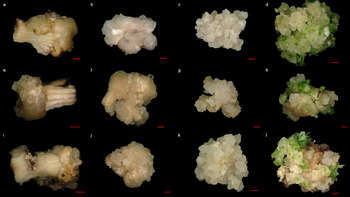
Calli were induced on explant surfaces and edges 3–5 days after cultivation. Three types of calli were induced with different frequencies from each genotype (Table S1). Type I calli were sticky and watery, mostly with serious browning (Fig. 1(a), (e) and (i)); Type II calli were semi-translucent and incompact with a relatively wet surface (Fig. 1(b), (f) and (j)); Type III calli were dry and compact with a nodular surface and were recognized as embryonic calli (Fig. 1(c), (g) and (k)). After the transfer of calli to regeneration medium, multiple green spots and shoots were observed on the surface of embryonic calli (Fig. 1(d), (h) and (l)). The regenerated embryonic calli developed into plantlets on blank MS medium after 6–8 weeks (data not shown).
Three types of calli and differentiation of embryonic calli for Saccharum spontaneum genotypes. VN2 (a–d), YN2011-44 (e–h) and HNLS5 (i–j) were shown. Tissue culturing for induction and regeneration of the callus is described in the Materials and methods section. Scale bar = 1 mm.

Five parameters were assessed to investigate the in vitro culture response of different S. spontaneum genotypes. Statistical analysis revealed that responses of all the genotypes to callus induction, embryogenic callus ratio, embryogenic callus induction and regeneration capacity vary significantly (all P < 0.01, Table 1). The highest broad-sense heritability was noticed for callus induction (96.8%), followed by embryogenic callus induction (96.3%), embryogenic callus ratio (93.5%) and regeneration capacity (86.1%). No significant difference was observed among all the genotypes in embryogenic callus regeneration, which also displayed the lowest broad-sense heritability of 5.1% (Table 1).
Response to embryogenic callus induction and regeneration of Saccharum spontaneum genotypes

a,b Originated from China (a) and other countries (b).
**Statistically significant at the level of 0.01; ns, not significant.
Pearson's correlation analysis revealed strong positive correlations among callus induction, embryogenic callus ratio, embryogenic callus induction and regeneration capacity (Table 2). A non-significant correlation was observed between embryonic callus regeneration and all the other parameters (Table 2).
Correlations among tissue culture susceptibility parameters

Pearson’ s correlation coefficients for each measurement are shown.
Statistical significance of the correlations was two-tail tested. **Statistically significant at the level of 0.01; ns, not significant.
The highest values of the four parameters with significant genotypic variation were observed for the VN2 genotype. Moreover, the highest regeneration capacity was observed for VN2 (51.5%), followed by that for YN2011-44 (39.0%) and HNLS5 (27.0%) (Table 1).
Discussion
The strong regeneration capacity and high transformation suitability of embryonic calli make them essential in many aspects of S. spontaneum research, particularly regarding the functional characterization of useful genes (Birch, Reference Birch, Moore and Botha2014). In the present study, we observed significant variations in response to embryogenic callus induction and regeneration between the nine genotypes of S. spontaneum that can be attributed to genetic differences between these genotypes.
Other reports on sugarcane cultivars (Gandonou et al., Reference Gandonou, Errabii, Abrini, Idaomar, Chibi and Senhaji2005; Raza et al., Reference Raza, Ali, Mukhtar, Mansoor, Arshad and Asad2010; Basnayake et al., Reference Basnayake, Moyle and Birch2011; Mahlanza et al., Reference Mahlanza, Rutherford, Snyman and Watt2019) are in agreement with our findings. Moreover, similar results have been reported for other crops such as wheat progenitors (Aegilops sp. and Triticum sp., Özgen et al., Reference Özgen, Birsin and Benlioglu2015) and rice (Oryza sativa, Hoque and Mansfield, Reference Hoque and Mansfield2004). Although the universality of the genetic effect on tissue culture responses has been proven by extensive research, only a few studies have quantitatively assessed this effect. In the present study, by estimating broad-sense heritability, we found that the genetic factor mainly accounts for embryogenic callus induction-related parameters (>93%) and regeneration capacity (~86%). The results provide evidence on the role of genetic factor in determining tissue culture responses of different S. spontaneum genotypes, highlighting the importance of genotype screening in tissue culture and in determining the model or pioneer genotype in S. spontaneum.
Although the set of clones tested in this study was only a small subsample of S. spontaneum collections, the role of genetic factor in tissue culture responses is evident. Three clones exhibited high regeneration capacity, and the highest value was observed for VN2. These clones are suitable for future tissue culture-related studies because of their high tissue culture susceptibility.
The present data support the assumption that embryogenic calli differentiation is less critical than calli production (Bower and Birch, Reference Bower and Birch1992; Mahlanza et al., Reference Mahlanza, Rutherford, Snyman and Watt2019). High regeneration frequency is a distinguishing feature of embryonic calli (Barba et al., Reference Barba, Zamora, Mallion and Linga1977; Taylor et al., Reference Taylor, Ko, Adkins, Rathus and Birch1992; Gandonou et al., Reference Gandonou, Errabii, Abrini, Idaomar, Chibi and Senhaji2005; Birch, Reference Birch, Moore and Botha2014; Basso et al., Reference Basso, da Cunha, Ribeiro, Martins, de Souza, de Oliveira, Nakayama, das Chagas Noqueli Casari, Santiago, Vinecky, Cancado, de Sousa, de Oliveira, de Souza, de Almeida Cancado, Kobayashi and Molinari2017), and in this study, the embryonic callus regeneration frequency was found to be high for all the clones (>80%, Table 1). Regeneration frequency of embryonic callus is not affected by genetic variation as evident by statistical analysis and low broad-sense heritability value (Table 1). These results are in agreement with those of previous studies on sugarcane cultivars (Gandonou et al., Reference Gandonou, Errabii, Abrini, Idaomar, Chibi and Senhaji2005) and wheat progenitors (Özgen et al., Reference Özgen, Birsin and Benlioglu2015) and suggest a possibility that regenerated plantlets can be obtained when embryogenic calli are well inducted. The strong intrinsic differentiation ability of the embryonic callus, which is independent of genotypic variation, could account for some aspects of high embryonic callus regeneration frequency observed in all the genotypes.
Our results facilitate the optimization of tissue culture susceptibility screening experiments. Callus induction was closely correlated with embryonic callus induction (r = 0.890, P < 0.01) and regeneration capacity (r = 0.881, P < 0.01) (Table 2), indicating that the embryonic callus induction and regeneration of S. spontaneum genotypes can accurately be predicted on the basis of the callus induction frequency. We therefore suggest that the simple investigation of callus induction is sufficient to represent the entire tissue culture susceptibility, including embryonic callus induction and plant regeneration. This approach represents an effective strategy for genotype screening, especially for large-scale projects.
We found a significant variation in responses of different genotypes to embryonic callus induction and regeneration in S. spontaneum. Several elite genotypes were identified to be of practical value in plant genomics and advanced biotechnology. As callus induction and regeneration capacity are genetically controlled phenomena, the genetic characters of the VN2 genotype can be incorporated in the modern recalcitrant cultivars of sugarcane through conventional breeding, making them amenable to tissue culture and suitable for transgenic development. High-throughput RNA sequencing of embryogenic and regenerated calli of the VN2 genotype can help explore and identify the candidate genes responsible for regeneration, which in turn will facilitate the rapid identification of modern cultivars susceptible to tissue culture by using molecular techniques.
Supplementary material
The supplementary material for this article can be found at https://doi.org/10.1017/S1479262121000198.
Acknowledgements
The authors gratefully acknowledge the extensive input of the referee Dr Abbas Zaheer. We also thank Yanmei Dao for assistance in tissue culture studies. This study was funded by the National Natural Science Foundation of China (grant No. 31901590) and Yunnan Fundamental Research Projects (grant No. 2019FA016, 2017FB054). Saccharum spontaneum plants were provided by the National Infrastructure for Crop Germplasm Resources (NICGR-2019-44). The authors would like to thank TopEdit (www.topeditsci.com) for linguistic assistance during the preparation of this manuscript.
Conflict of interest
None.