




No CrossRef data available.
Article contents
Habitat selection by Lernanthropus cynoscicola (Copepoda: Lernanthropidae): host as physical environment, a major determinant of niche restriction
Published online by Cambridge University Press: 09 October 2003
Abstract
As a potential ultimate cause of microhabitat restriction for ectoparasites of fish, it has been postulated that selection has favoured narrow microhabitats to facilitate mating. The evidence for this hypothesis is evaluated with males and females of the parasitic copepod Lernanthropus cynoscicola, by using methods commonly used in community ecology, and considering the influence of host ontogeny on site selection. No evidence supporting the mating hypothesis was found after comparison of niche measurements between both sexes. Furthermore, aggregation among individuals of the same sex was stronger than among males and females, and the co-occurrence of both sexes did not depart from that expected by chance; also, negative correlations between the intensity of infection of both sexes were observed. Restriction of the microhabitats cannot therefore be due to facilitation of mating. Moreover, both sexes displayed a sequential displacement over the gill arches and differential preferences by specific gill sections in response to an increasing host size, probably as a consequence of a host-size related cline of optimal conditions where fitness is improved. Thus, reproductive benefits other than increased chances of mating may have played a role in the evolution of restricted niches in parasites, and selection may have favoured a narrowing of the niche around sites where fitness is maximized.
Information
- Type
- Research Article
- Information
- Copyright
- 2003 Cambridge University Press
INTRODUCTION
The study of habitat selection by parasites has generated intense debate in the field of parasitology in an attempt to understand how and why parasites select their sites (Sukhdeo & Sukhdeo, 1994; Sukhdeo & Bansemir, 1996). Nevertheless, there is little agreement on the mechanisms that drive restriction (proximate causes) or on the selection pressures leading to that restriction (ultimate causes). Among ultimate causes of microhabitat restriction, Rohde (1979, 1989, 1994) proposed that selection has favoured narrow microhabitats because this increases the chance of encountering a potential mate in low-density infrapopulations, i.e. because it increases mating success. Despite being generally accepted, evidence supporting the mating hypothesis is circumstantial. It is based mainly on the absence of evidence favouring interspecific interactions (Competition hypothesis) as responsible for restricted habitats, and arose simply as an alternative explanation to it (see Rohde, 1989, 1994). Definitive proof for facilitation of mating would require controlled experimental tests, but such a process, occurring over evolutionary time, cannot be experimentally demonstrated on short ecological time-scales and thus remains entirely hypothetical.
Whereas proximate mechanisms that lead to microhabitat selection have been little studied, especially in marine parasites (Rohde, 1994; Sukhdeo & Sukhdeo, 1994), the mating hypothesis has been postulated, discussed and developed in the mainstream of parasite community ecology. Nevertheless researchers working at the community level seem to have overlooked, or at least underestimated, a number of studies carried out at the population level. These investigations concluded that factors other than mechanisms inherent to the parasites themselves lead to niche restriction and that abiotic factors can account for the narrow habitats of ectoparasites (de Meeüs et al. 1995). Particularly, it has been postulated that the characteristic differential distribution of parasites among the gills of the hosts may be the result of variations in the rate and volume of respiratory flow over the different gills rather than a choice exercised by the parasite (Llewellyn, 1956; Kabata, 1959; Suydam, 1976; van den Broek, 1979; Davey, 1980; Etchegoin & Sardella, 1990; Poulin, Curtis & Rau, 1991). These mechanisms may be considered as proximate causes of site restriction, thus their ultimate causes should be the adaptation to environmental complexity.
The parasitic fauna, together with the host and its environment, form an interacting ecological complex (Hair & Holmes, 1975); this is especially true for gill parasites, which are in direct contact with the external environment of the host. Furthermore, niches are not static: microhabitat specificity may be affected, among other factors, by host age (Rohde, 1993, 1994). Because of ontogenetic changes, a fish can be considered as a fluctuating environment as it grows, and thus serves as an example of how ecological events can act on the distribution of parasites. Lernanthropus cynoscicolaTimi & Etchegoin, 1996 is a common gill parasite of Cynoscion guatucupa (=C. striatus) (Timi & Etchegoin, 1996). Individuals of both sexes are parasitic, but whereas females are probably immobile as adults (Wilson, 1922), males could be able to move to find their partners, as seen in other siphonostomatoid copepods (Kabata, 1981; Raibaut & Trilles, 1993); this species also shows a marked sexual dimorphism, therefore males and females may differ in the degree of niche segregation, such as was observed for other lernanthropids (Davey, 1980). This may give a clue as to whether occurrence of intraspecific contact or other factors are responsible for niche restriction. According to the mating hypothesis, both niche breadth and niche specificity of males and females should be similar, niche overlap between sexes should be high, and inter-sex aggregation should be higher (or at least the same) than intra-sex aggregation. Furthermore both sexes should display similar distribution patterns, independently of variability of host-related environmental factors as the fish grows.
In the present paper, evidence for these hypotheses are assessed at both the infrapopulation and component population levels (Bush et al. 1997) applying methods commonly used in community ecology. The aim of this paper was to evaluate whether both males and females of the ectoparasitic copepod L. cynoscicola select microhabitats to increase mating success or as a consequence of adaptations to environmental complexity e.g. influence of host ontogeny on site selection by parasites.
MATERIALS AND METHODS
A total of 1095 specimens of stripped weakfish, Cynoscion guatucupa (Cuvier, 1829), collected at irregular intervals from 1992 to 2002, were examined for parasitic copepods; 854 fish were obtained from commercial catches at Mar del Plata Port (38° 08′ S–57° 32′ W), from July 1992 to June 2002, with specimens smaller than 30 cm being obtained as accidental catches of prawn fishery. Additional samples of 216 specimens caught by a research cruise carried out in Uruguayan waters in July 1993 (35° 38′ S–53° 19′ W) and 25 specimens from commercial catches at Bahía Blanca Port (38° 45′ S–62° 15′ W) in March 1998 were also examined.
Each fish was measured (total length in centimetres) and sexed when gonadal development allowed the identification of each sex. Four gill arches of each branchial cavity were excised, placed in a Petri dish and examined using a stereoscopic microscope. Left and right arches were numbered (I–IV) in an anterior-posterior sequence; each arch was divided into 3 (anterior, middle and posterior) approximately equal longitudinal sections. The parasites were identified, counted and sexed.
The site of attachment of each copepod was recorded in relation to 3 parameters (1) left or right branchial cavity, (2) gill arches (I, II, III or IV) and (3) anterior, middle or posterior section of each gill arch.
Non-parametric tests, as described by Zar (1984), were used because in each case both normality and homoscedasticity were rejected even on log-transformed data.
Since there were no differences in parasite prevalence and abundance (sensuBush et al. 1997) (Chi-square test, P>0·05 and Mann–Whitney test, P>0·05, respectively) for copepod males, females and males+females between males and females of C. guatucupa, hosts of both sexes were pooled together. As no differences in parasite prevalence and abundance (Chi-square test, P>0·05; Wilcoxon's matched pairs test, P>0·05, respectively) between left and right branchial cavities were observed for copepod males, females and males+females, the attachment of copepods to either side was considered as a chance event, thus only parasitized gill cavities were considered as units of study for further analyses.
For copepods of both sexes, the following niche measurements were calculated at the level of copepod infrapopulations (considering gill arches in each branchial cavity and gill sections in each gill arch, as units of a niche set) (1) niche width using Levin's (B) index (Rohde, 1994), (2) niche overlap, using percent similarity (PS), and asymmetrical percentage similarity (Rohde & Hobbs, 1986), (3) specificity indices (S) of density (intensity) and frequency (prevalence) of Rohde (1980) adapted to measure microhabitat preferences (Rohde, 1994). According to Poulin (1998), with a limited number of microhabitats the actual range of these specificity indices may be artificially increased but, as all indices were calculated on the same number of microhabitats, they were considered as comparable. Niche width and niche overlap were also calculated at the component population level (considering the total number of copepods on each gill arch and on each gill section across the entire sample).
In order to compare intra-sex versus inter-sex aggregation, the indices of intraspecific (J) and interspecific (C) aggregation, and the relative strength of intraspecific versus interspecific aggregation (A), were adapted considering both sexes of L. cynoscicola as different ‘species’ (see Morand et al. 1999).
To determine whether co-occurrences of males and females of L. cynoscicola in the same habitat were more or less frequent than expected by chance, a null model of expected frequencies based on the actual prevalence of copepods of both sexes was generated according to Janovy et al. (1995).
To assess the pairwise relationship between the intensity of copepods of both sexes across the considered niches, Spearman's rank correlation coefficients (Rs) were calculated, excluding double-zeros (i.e. niches not infected by copepods of either sex).
Friedman ANOVA by ranks tests and non-parametric multiple comparisons (Zar, 1984) were used to analyse data of infection levels over the 4 gill arches in all parasitized gill cavities and over the 3 gill sections in all parasitized gill arches.
RESULTS
A total of 507 copepods was found (prevalence: 24·29%, mean abundance: 0·46±1·14, mean intensity: 1·91±1·62, range: 1–17), including 84 males (prevalence: 5·85%, mean abundance: 0·08±0·37, mean intensity: 1·31±1·36, range: 1–7) and 423 females (prevalence: 21·92%, mean abundance: 0·39±0·97, mean intensity: 1·76±0·85, range: 1–11), 4 of them juvenile. All parasites were found attached to the gill filaments, except a male which was attached to the genital complex of a female. Other ectoparasites were also found, the monogeneans Diplectanum squamatum Santos, Timi and Gibson, 2002 (prevalence 100% in a subsample of 87 fish), and 2 unidentified species of the families Diclidophoridae and Macrovalvitrematidae (prevalence 0·01 and 0·05, respectively).
Host lengths ranged between 3 and 63 cm, L. cynoscicola was only detected on fish longer than 12 cm, therefore fish smaller than 13 cm (n=263) were excluded from subsequent analyses. Host sex was determined for 480 fish (179 males and 301 females).
No significant differences were observed between host sexes for either prevalence or abundance values calculated for male copepods (χ2=1·87, P=0·17; Mann–Whitney test, Z=0·68, P=0·50, respectively), female copepods (χ2=0·01, P=0·93; Mann–Whitney test, Z=0·20, P=0·84, respectively) and male+female copepods (χ2=0·01, P=0·91; Mann–Whitney test, Z=0·04, P=0·97, respectively) (Table 1), therefore hosts of both sexes were considered together for subsequent analyses. No significant differences in prevalence or abundance were found between left and right branchial cavities for males (χ2=0·35, P=0·55; Wilcoxon's matched pairs test, Z=0·54, P=0·59, respectively), females (χ2=0·26, P=0·61; Wilcoxon's matched pairs test, Z=0·94, P=0·34, respectively) and males+females (χ2=1·17, P=0·29; Wilcoxon's matched pairs test, Z=1·02, P=0·31, respectively) (Table 1).

At the level of gill arches, niche width of infrapopulations was similar between copepods of both sexes (Mann–Whitney test, Z=1·40, P=0·16); at the component population level, Levin's index for both sexes was also similar but higher than those of infrapopulations (Table 2). At the level of gill sections, niche width of infrapopulations showed a similar pattern (Mann–Whitney test, Z=0·06, P=0·95), nevertheless at component populations level, Levin's index was 2-fold higher for males than for females (Table 2).

Niche overlap was higher at the level of gill sections than at that of gill arches at both infrapopulation and component population levels (Table 2); however, no significant differences were observed in asymmetrical percentage similarity between infrapopulations of both sexes at gill arch (Wilcoxon's matched pairs test, Z=1·84, P=0·07) and gill section (Wilcoxon's matched pairs test, Z=0, P=1·00) levels. In other words, males' niche proportions occupied by females (OM,F) were similar to those of females occupied by males (OF,M). Percentage similarity and both asymmetrical percentage similarity at component population level were the same because there were no empty niches at this level, due to the summed data.
Niche specificity based on both density and frequency was similar between copepods of both sexes at the level of gill arches but higher for females at the level of gill sections (Table 2).
The intra-sex aggregation of both males and females of L. cynoscicola as well as the degree of inter-sex aggregation increased from gill arches to gill sections. The more restricted the habitat considered, the more overdispersed were the parasites (Table 3). The same trend was registered when considering only parasitized fish (data not shown). A positive association between sexes was observed (C>0), nevertheless, at both levels intra-sex aggregation was higher among males than among females and inter-sex aggregation was lower than intra-sex aggregation of either males and females. In all cases the relative strength of intra-sex versus inter-sex aggregation was >1, indicating that aggregation among individuals of the same sex was stronger than among males and females.

The co-occurrence of males and females did not deviate significantly from a null model based on random occurrences at gill arches (χ2=2·30, P=0·51) and gill sections (χ2=7·21, P=0·06) levels (Table 4). Similar results were obtained when considering only parasitized niche sections (χ2=2·28, P=0·52 and χ2=7·23, P=0·06, for gill arches and gill sections, respectively).

The pairwise correlations between the intensity of infection by copepods of both sexes were negative and statistically significant at both gill arches (Rs: −0·63, P<0·001) and gill sections (Rs=−0·71, P<0·001) levels.
Copepods of both sexes were not equally distributed over the 4 gills in the whole sample (Friedman ANOVA χ2=40·10 and χ2=162·39, both P<0·01, for males and females, respectively) (Fig. 1), and showed preferences for different gill arches, males being observed mainly on the 3rd and 4th arches (multiple comparisons, P<0·01) and females being more abundant on the second one (multiple comparisons, P<0·01).

Fig. 1. Relative proportions (%) of the parasitic copepod Lernanthropus cynoscicola infecting 4 gill arches of their fish host Cynoscion guatucupa. (□) Males; ([squf ]) females. Number of copepods per gill arch is indicated over each bar.
Grouping fish into 5 length classes (intervals of 10 cm), it was observed that copepod distribution also showed a sequential displacement in relation to host length. Males were located mainly in gills III and IV in fish of length between 13 and 39 cm, whereas in fish longer than 40 cm, a marked preference for gill IV was observed (Fig. 2). Females favoured the second arch when they were on fish with length between 13 and 39 cm, whereas on longer fish, they occupied mainly arches III and IV, copepods being more abundant on the fourth arch for fish longer than 50 cm (Fig. 2).

Fig. 2. Relative distribution (%) of the parasitic copepod Lernanthropus cynoscicola, both males (A) and females (B), over 4 gill arches of their fish host Cynoscion guatucupa, in relation to host length classes. Number of copepods on each gill arch is indicated at left of each bar.
The distribution pattern of the parasites on each gill includes, furthermore, a preferential habitat selection i.e. copepods of both sexes were not equally distributed over the 3 gill sections in the overall sample (Friedman ANOVA χ2=20·15 and χ2=490·21, both P<0·01, for males and females respectively) (Fig. 3), and showed preferences for different gill sections, males were mainly observed in the middle and posterior sections (multiple comparisons, P<0·01) whereas females were more abundant in the posterior one (multiple comparisons, P<0·01).

Fig. 3. Relative proportions (%) of the parasitic copepod Lernanthropus cynoscicola infecting 3 gill sections of their fish host Cynoscion guatucupa. (□) Males; ([squf ]) females. Number of copepods per gill arch is indicated over each bar.
Grouping fish into 5 length classes (intervals of 10 cm), it was observed that males were located mainly on the middle section in fish of length between 13 and 39 cm, whereas in fish longer than 40 cm, a marked preference for the posterior section was evident (Fig. 4). Females favoured the posterior section in all length classes (Fig. 4).

Fig. 4. Relative distribution (%) of the parasitic copepod Lernanthropus cynoscicola, both males (A) and females (B), over 3 gill sections of their fish host Cynoscion guatucupa, in relation to host length classes. Number of copepods on each gill section is indicated at left of each bar.
DISCUSSION
The evolutionary relevance of niche specificity for copepods belonging to the genus Lernanthropus was addressed by Ho & Do (1985). These authors concluded that the body architecture of these copepods has evolved to minimize the resistance to hydrodynamic forces (host's respiratory currents) flowing over the parasite's body. Therefore copepods of this genus may be used as an interesting model for the study of both the mechanisms and the selection pressures leading to microhabitat restriction.
Niche measurements seem to agree with the mating hypothesis; niche breath, niche overlap and niche specificity of males and females were similar, although at the level of gill sections the component population of males showed a broader niche, whereas females displayed higher microhabitat specificity. Nevertheless, the mating hypothesis suggests that species with good locomotory ability have less restricted microhabitats than sessile species (Rohde, 1979).
Both males and females of the genus Lernanthropus are parasitic, but whereas females probably remain attached to the same spot on the gills of their hosts (Wilson, 1922), males are probably able to move to find their partners, as seen in other siphonostomatoid copepods (Kabata, 1981; Raibaut & Trilles, 1993). This has not been previously observed for this group of copepods under present study, but the finding of a male attached to the genital complex of a female (present work) and, as also observed by Ho & Do (1985) for L. cornutus, indicates that they have some locomotory ability. This assumption is also supported by the fact that males of L. kroyeri show a continuous production of numerous spermatophores, and they probably can fecundate several females (Coste et al. 1979).
According to the mating hypothesis, males of L. cynoscicola should show a wider niche breadth, a higher niche overlap and a lower niche specificity than females. Nevertheless, only a lower niche specificity for gill sectors was observed for males, which casts doubt on the suggestion that, in this case, microhabitat selection is necessarily due to selection for enhanced mating.
Contrasting with the predictions of the mating hypothesis, aggregation among individuals of the same sex was stronger than among males and females. The co-occurrence of copepod males and females, based on presence/absence data, did not depart from that expected by chance, as it should if mechanisms such as facilitation of mating were acting. Furthermore, negative correlations between the intensity of infection of both sexes were observed. This result does not agree with the mating hypothesis. In fact negative correlations are often used as a sure sign of a numerical response to competitive interactions between species (Poulin, 2001).
Limitation of the habitats of L. cynoscicola on the gills of C. guatucupa cannot therefore be due to facilitation of contact among males and females and thus to mating, and other mechanisms, such as adaptations to environmental complexity, should explain the observed patterns.
In fact, both males and females of L. cynoscicola displayed a sequential displacement among gills in response to an increasing host size. These patterns show that site-specificity is not a static process and may involve complex interactions between the host, the parasites and the physical characteristics of the microhabitat, the effects of which are largely uninvestigated (Sharples & Evans, 1995).
The most likely explanation for the observed patterns of parasite location seems to be an adaptation to the force and direction of the branchial ventilating flow. Paling (1968) showed a significantly greater water volume passing over the 2nd and 3rd than over the 1st and 4th gill arches of Salmo trutta. The gradual displacement of both sexes of L. cynoscicola from the 2nd to the 4th gill with increasing host size could indicate a preference for more protected zones (where their capability to remain attached is probably higher) in larger fish, which generate stronger water flows. Similar factors could determine the preference for the posterior section of each gill arch. Thus the cause of niche restriction should be sought in environmental conditions within the gill cavity.
According to the results of niche measurements and co-occurrence analyses, both sexes showed a differential niche preference and displayed different sequential distribution patterns in relation to host size, giving additional evidence against the mating hypothesis.
Some previous studies also reported sequential shifts in the distribution of ectoparasites with increasing host body size (Shotter, 1976; Etchegoin & Sardella, 1990; Sharples & Evans, 1995). Such changes seem to be more common than noticed in many studies which either did not consider host ontogeny or worked with fish of relatively uniform size.
Other alternative ultimate causes of niche restriction have been suggested by Rohde (1994), such as (1) avoidance of predation and hyperparasites, but there is little to no evidence for these mechanisms, (2) reinforcement of reproductive barriers, which has been postulated only for monogeneans (Rohde & Hobbs, 1986; Rohde, 1989, 1991), and (3) adaptations to environmental complexity (adaptations to varying water flow over the gills, among others, in the case of gill parasites). Such adaptations to environmental complexity may determine microhabitat specificity (Price, 1980). Nevertheless, according to Rohde (1993, 1994), environmental factors may represent proximate causes, but their evolutionary significance is not clear i.e. it is unknown why and to what extent such specificity is necessary from an evolutionary perspective. This question was discussed by Combes & Théron (2000) who stated that living environments (hosts) are highly heterogeneous and parasites cope with this constraint by becoming specialized. Specialization leads to aggregation, increasing the probability of genetic exchanges, and thus the genetic diversity, which might constitute the main benefit of being specialized, in other words the ‘mating hypothesis’ remains as the main explanation for niche restriction in parasites.
Selective pressures lead to organisms exploiting any resource which allows them to improve their fitness. If these resources are limited, specialization occurs either because constraints prevent the utilization of other resources, or because this limitation provides a benefit, which must outweight the constraints (Combes & Théron, 2000). This reasoning seems to be dichotomous, the benefit of restriction being enhanced genetic exchange (mating hypothesis) whereas the pressures from the environmental conditions should be considered as constraints. Nevertheless, reproduction may have played a different role in the evolution of restricted niches in parasites. Many types of parasites achieve greater reproductive success in some portions of the range of sites in which they can develop (fundamental niches) than in others, thus selection may have favoured a narrowing of the niche around sites where fitness is maximized (Poulin, 1998, 2001).
The gradual displacements of copepods over the gills with increasing host length could be due to a gradient in the force of the water flow, which determine a host size-related cline of optimal conditions where fitness is improved. Therefore, the ‘optimum’ microhabitat could result from a balance between respiratory needs of copepods and the probability of being dislodged by the water flow, rather than serving to increase the chances of mating.
This study shows that adaptations to environmental complexity, rather than increasing intraspecific contact, seem to be more likely ultimate causes of niche restriction. It is tempting to extend this conclusion to other host-gill ectoparasite systems (such as monogeneans and other copepods) for which the ‘mating hypothesis’ has been postulated as the main cause of niche selection, but not tested rigorously.
Since monogeneans are hermaphroditic and in many groups of copepods only females are parasitic or males live attached to females (Raibaut & Trilles, 1993), comparisons of distribution patterns between sexes can not be performed. However, in light of the present results, some of the evidence supporting the mating hypothesis can be re-interpreted in a different way, as follows. Whereas adult stages typically have more restricted habitats than asexual larvae or asexually reproducing species (Rohde, 1989), larvae may show site preferences because of certain requirements not connected with mating, such as a suitable substratum for attachment and feeding (Rohde, 1979). In fact, Paling (1968) demonstrated that the distribution of glochidia larvae in the gills of S. trutta is determined by the relative volume of water flowing over different gills. In other words, why should environmental conditions act on larval distribution but not on adult parasites? Based on experimental evidence it was also postulated that microhabitats become more restricted at the time of mating (Rohde, 1989), therefore, what mechanism determines the distribution of parasites during non-reproductive periods?
For these host-gill parasite systems, which are affected by similar pressures imposed by the strength of respiratory currents, the use of host age and/or size as indirect measures of environmental variability, and thus as sources of adaptive pressures, could show how common either facilitation of mating or adaptations to environmental complexity are.
I am grateful to Dr Robert Poulin (University of Otago, New Zealand), to Dr Alejandro Bortolus (Brown University, USA) and to Dr Norma Sardella and Dr Jorge Etchegoin (Universidad Nacional de Mar del Plata, Argentina) for their critical comments and valuable suggestions on an earlier version of the manuscript. Financial support was provided by grants from CONICET (PIP # 0516/98) and Universidad Nacional de Mar del Plata (No. 15 E/146).
References
REFERENCES
BUSH, A. O.,
LAFFERTY, K. D.,
LOTZ, J. M. &
SHOSTAK, A. W.
(1997).
Parasitology meets ecology on its own terms: Margolis et al. revisited.
Journal of Parasitology 83, 575–583.CrossRefGoogle Scholar
COMBES, C. &
THÉRON, A.
(2000).
Metazoan parasites and resource heterogeneity: constraints and benefits.
International Journal for Parasitology 30, 299–304.CrossRefGoogle Scholar
COSTE, F.,
RAIBAUT, A.,
MANIER, J.-F. &
ROUSSET, V.
(1979).
Reproduction et sexualité des copépodes parasites de poissons. IV – Étude cytologique ultrastructurale de la spermatogenèse de Lernanthropus kroyeri van Beneden 1851, copépode parasite du loup.
Bulletin de la Société Zoologique de France 104, 125–135.Google Scholar
DAVEY, J. T.
(1980).
Spatial distribution of the copepod parasite Lernanthropus kroyeri on the gills of bass, Dicentrarchus labrax (L.).
Journal of the Marine Biological Association of the United Kingdom 60, 1061–1067.CrossRefGoogle Scholar
DE MEEÜS, T.,
MORAND, S.,
MAGNAN, N.,
DO CHI, T. &
RENAUD, F.
(1995).
Comparative host-parasite relationship of two copepod species ectoparasitic on three fish species.
Acta Œcologica 16, 361–374.Google Scholar
ETCHEGOIN, J. A. &
SARDELLA, N. H.
(1990).
Some ecological aspects of the copepod parasites of the common hake, Merluccius hubbsi, from the Argentine-Uruguayan coasts.
International Journal for Parasitology 20, 1009–1014.CrossRefGoogle Scholar
HAIR, J. D. &
HOLMES, J. C.
(1975).
The usefulness of measures of diversity, niche width and niche overlap in the analysis of helminth communities in waterfowl.
Acta Parasitologica Polonica 23, 253–265.Google Scholar
HO, J.-S. &
DO, T. T.
(1985).
Copepods of the family Lernanthropidae parasitic on Japanese marine fishes, with a phylogenetic analysis of the Lernanthropus genera.
Reports of the Sado Marine Biological Station, Niigata University 15, 31–76.Google Scholar
JANOVY, Jr. J.,
CLOPTON, R. E.,
CLOPTON, D. A.,
SNYDER, S. D.,
EFTING, A. &
KREBS, L.
(1995).
Species density distributions as null models for ecologically significant interactions of parasite species in an assemblage.
Ecological Modelling 77, 189–196.CrossRefGoogle Scholar
KABATA, Z.
(1959).
Ecology of the genus Acanthochondria Oakley (Copepoda, Parasitica).
Journal of the Marine Biological Association of the United Kingdom 38, 249–261.CrossRefGoogle Scholar
KABATA, Z.
(1981).
Copepoda (Crustacea) parasitic on fishes: problems and perspectives.
Advances in Parasitology 19, 1–71.Google Scholar
LLEWELLYN, J.
(1956).
The host specificity, micro-ecology, adhesive attitudes, and comparative morphology of some trematode gill parasites.
Journal of the Marine Biological Association of the United Kingdom 35, 113–127.CrossRefGoogle Scholar
MORAND, S.,
POULIN, R.,
ROHDE, K. &
HAYWARD, C.
(1999).
Aggregation and species coexistence of ectoparasites of marine fishes.
International Journal for Parasitology 29, 663–672.CrossRefGoogle Scholar
PALING, J. E.
(1968).
A method of estimating the relative volumes of water flowing over the different gills of a freshwater fish.
Journal of Experimental Biology 48, 533–544.Google Scholar
POULIN, R.
(1998).
Evolutionary Ecology of Parasites: From Individuals to Communities.
Chapman and Hall, London.
POULIN, R.
(2001).
Interaction between species and the structure of helminth communities.
Parasitology 122 (Suppl.), S3–S11.CrossRefGoogle Scholar
POULIN, R.,
CURTIS, M. A. &
RAU, M. E.
(1991).
Size, behaviour, and acquisition of ectoparasitic copepods by brook trout, Salvelinus fontinalis.
Oikos 61, 169–174.CrossRefGoogle Scholar
PRICE, P. W.
(1980).
Evolutionary Biology of Parasites.
Princeton University Press,
Princeton.
RAIBAUT, A. &
TRILLES, J. P.
(1993).
The sexuality of parasitic crustaceans.
Advances in Parasitology 32, 367–444.CrossRefGoogle Scholar
ROHDE, K.
(1979).
A critical evaluation of intrinsec and extrinsec factors responsible for niche restriction in parasites.
American Naturalist 114, 648–671.CrossRefGoogle Scholar
ROHDE, K.
(1980).
Host specificity indices for parasites and their application.
Experientia 36, 1370–1371.CrossRefGoogle Scholar
ROHDE, K.
(1989).
Simple ecological systems, simple solutions to complex problems?
Evolutionary Theory 8, 305–350.Google Scholar
ROHDE, K.
(1991).
Intra- and interspecific interactions in low density populations in resource-rich habitats.
Oikos 60, 91–104.CrossRefGoogle Scholar
ROHDE, K.
(1993).
Ecology of Marine Parasites,
2nd Edn. CAB International, Wallingford, UK.
ROHDE, K.
(1994).
Niche restriction in parasites: proximate and ultimate causes.
Parasitology 109 (Suppl.), S69–S84.CrossRefGoogle Scholar
ROHDE, K. &
HOBBS, R.
(1986).
Species segregation: competition or reinforcement of reproductive barriers?
In Parasite Lives. Papers on Parasites, their Hosts and their Associations to Honour J. F. A. Sprent
(ed. Cremin, M.,
Dobson, C. &
Moorhouse, D. E.),
pp. 189–199.
University of Queensland Press, St Lucia, London and New York.
SHARPLES, A. D. &
EVANS, C. W.
(1995).
Metazoan parasites of the snapper, Pagrus auratus (Bloch & Schneider, 1801), in New Zealand. 2. Site-specificity.
New Zealand Journal of Marine and Freshwater Research 29, 203–211.CrossRefGoogle Scholar
SHOTTER, R. A.
(1976).
The distribution of some helminth and copepod parasites in tissues of whiting Merlangius merlangus L. from Manx waters.
Journal of Fish Biology 8, 101–117.CrossRefGoogle Scholar
SUKHDEO, M. V. K. &
BANSEMIR, A. D.
(1996).
Critical resources that influence habitat selection decisions by gastrointestinal helminth parasites.
International Journal for Parasitology 26, 483–498.CrossRefGoogle Scholar
SUKHDEO, M. V. K. &
SUKHDEO, S. S.
(1994).
Optimal habitat selection by helminths in the host environment.
Parasitology 109 (Suppl.), S41–S55.CrossRefGoogle Scholar
SUYDAM, E. L.
(1976).
The macroecology of three species of monogenetic trematodes of fishes from the Beaufort-Cape Hatteras area.
Proceedings of the Helminthological Society of Washington 38, 240–246.Google Scholar
TIMI, J. T. &
ETCHEGOIN, J. A.
(1996).
A new species of Lernanthropus (Copepoda: Lernanthropidae) parasite of Cynoscion striatus (Pisces: Sciaenidae), from Argentinean waters and new records of Lernanthropus trachuri (Brian, 1903).
Folia Parasitologica 43, 71–74.Google Scholar
VAN DEN BROEK, W. L. F.
(1979).
Copepod ectoparasites of Merlangius merlangus and Platichthys flesus.
Journal of Fish Biology 14, 371–380.CrossRefGoogle Scholar
WILSON, C. B.
(1922).
North American parasitic copepods belonging to the family Dichelesthiidae.
Proceedings of the United States National Museum 60, 1–100.CrossRefGoogle Scholar
ZAR, J. H.
(1984).
Biostatistical Analysis,
2nd Edn. Prentice-Hall Inc., Englewood Cliffs, New Jersey.

Table 1. Prevalence and mean abundance of Lernanthropus cynoscicola on its fish host species, Cynoscion guatucupa, discriminated by host sex and by left or right branchial cavities
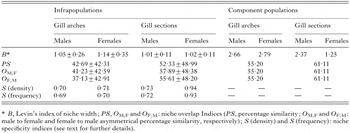
Table 2. Niche measurements of populations of the copepod species Lernanthropus cynoscicola discriminated by sex

Table 3. Intra-sex and inter-sex aggregation indices of the parasitic copepod, Lernanthropus cynosciola on gill arches and gill sections of Cynoscion guatucupa host individuals

Table 4. Number of specimens of Cynoscion guatucupa with different combinations of occurrence of Lernanthropus cynoscicola males and females

Fig. 1. Relative proportions (%) of the parasitic copepod Lernanthropus cynoscicola infecting 4 gill arches of their fish host Cynoscion guatucupa. (□) Males; ([squf ]) females. Number of copepods per gill arch is indicated over each bar.
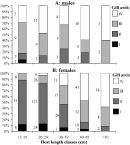
Fig. 2. Relative distribution (%) of the parasitic copepod Lernanthropus cynoscicola, both males (A) and females (B), over 4 gill arches of their fish host Cynoscion guatucupa, in relation to host length classes. Number of copepods on each gill arch is indicated at left of each bar.

Fig. 3. Relative proportions (%) of the parasitic copepod Lernanthropus cynoscicola infecting 3 gill sections of their fish host Cynoscion guatucupa. (□) Males; ([squf ]) females. Number of copepods per gill arch is indicated over each bar.
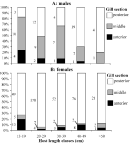
Fig. 4. Relative distribution (%) of the parasitic copepod Lernanthropus cynoscicola, both males (A) and females (B), over 3 gill sections of their fish host Cynoscion guatucupa, in relation to host length classes. Number of copepods on each gill section is indicated at left of each bar.
 You have
Access
- 7
- Cited by