Introduction
The world population of king penguins (Aptenodytes patagonicus Miller) numbers c. 1.6 million breeding pairs, and they are particularly numerous in the Indian Ocean (Woehler & Poncet Reference Woehler and Poncet1993, Crawford et al. Reference Crawford, Cooper, Dyer, Greyling, Klages, Ryan, Pietersen, Underhill, Upfold, Wilkinson, De Villiers, Du Plessis, Du Toit, Leshoro, Makhado, Mason, Merkle, Tshingana, Ward and Whittington2003, Delord et al. Reference Delord, Barbraud and Weimerskirch2004, Bost et al. Reference Bost, Delord, Barbraud, Cherel, Pütz, Cotté, Péron and Weimerskirch2011). In the Atlantic Ocean the bulk of the population, over 450 000 breeding pairs, is situated at South Georgia (Poncet Reference Poncet2006), with only a small colony breeding at the Falkland Islands (Clausen & Huin Reference Clausen and Huin2003). Although previously referred to as the northernmost breeding colony of king penguins (e.g. Otley et al. Reference Otley, Clausen, Christie, Huin and Pütz2007), at 51°S the Falklands colony is situated further south than the large Indian Ocean colonies (situated between 46 and 49°S).
King penguins have an unusual breeding cycle because the time required to fledge a chick exceeds one year (13–14 months including the prenuptial moult) (Van Heezik et al. Reference Van Heezik, Seddon, Cooper and Plos1994, Olsson Reference Olsson1996, Otley et al. Reference Otley, Clausen, Christie, Huin and Pütz2007). Most king penguins are thought to attempt breeding each year, but the rate of successful breeding in two consecutive years varies according to locality (Van Heezik et al. Reference Van Heezik, Seddon, Cooper and Plos1994, Olsson Reference Olsson1996). The fact that the breeding cycle exceeds a full year results in an extended egg laying period of up to four months, with early breeders generally having higher breeding success than later breeders (Olsson Reference Olsson1996). Courtship and egg laying commences in November and extends through to March (Van den Hoff et al. Reference Van Den Hoff, Kirkwood and Copley1993, Van Heezik et al. Reference Van Heezik, Seddon, Cooper and Plos1994, Olsson Reference Olsson1996, Otley et al. Reference Otley, Clausen, Christie, Huin and Pütz2007). In January/February the first chicks start hatching, after an incubation period of 54–55 days (Williams Reference Williams1995). After almost a year at the colony the chicks start fledging in November (Olsson Reference Olsson1996, Otley et al. Reference Otley, Clausen, Christie, Huin and Pütz2007).
In recent years, king penguin numbers have increased throughout most of their range (Van den Hoff et al. Reference Van Den Hoff, Kirkwood and Copley1993, Williams Reference Williams1995, Woehler et al. Reference Woehler, Cooper, Croxall, Fraser, Kooyman, Miller, Nel, Patterson, Peter, Ribic, Salwicka, Trivelpiece and Weimerskirch2001, Crawford et al. Reference Crawford, Cooper, Dyer, Greyling, Klages, Ryan, Pietersen, Underhill, Upfold, Wilkinson, De Villiers, Du Plessis, Du Toit, Leshoro, Makhado, Mason, Merkle, Tshingana, Ward and Whittington2003, Weimerskirch et al. Reference Weimerskirch, Inchausti, Guinet and Barbraud2003, Delord et al. Reference Delord, Barbraud and Weimerskirch2004, Van den Hoff et al. Reference Van Den Hoff, McMahon and Field2009), after more than a century of decline as a result of exploitation for penguin oil (Williams Reference Williams1995). In the absence of supporting evidence (as discussed below), a similar history has tenuously been claimed for the Falklands population, which was reportedly subjected to exploitation during the 1800s with total extermination by 1870 (Williams Reference Williams1995, Woods & Woods Reference Woods and Woods1997, Clausen & Huin Reference Clausen and Huin2003). The aim of this paper is to report on growth of the king penguin population at the Falkland Islands over the past three decades and to review the historical occurrence of this species at this location.
Methods
Study site
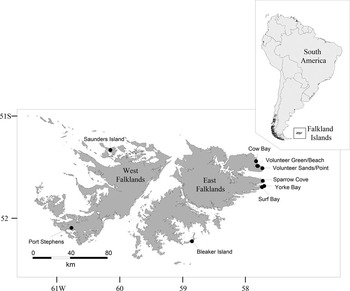
The Falklands archipelago (Fig. 1) covers an area of 12 173 km2 and is made up by two main islands and some 750 smaller islands (Woods Reference Woods2001). Presently, the only significant colony of king penguins is found at Volunteer Point, which lies at the north-east of mainland East Falkland (Fig. 1). Volunteer Point was designated a National Nature Reserve (c. 4060 ha in size) in 1968 and until recently was privately owned by Berkeley Sound Sheep Farming Company, Johnson's Harbour. It is now owned by Unicorn Adventure Ltd.
Volunteer Point and localities where king penguins have been reported around the Falkland Islands.

Data collection
The king penguin colony at Volunteer Point has been monitored annually since 1991, with a single count prior to this in 1989, as part of the Falkland Islands Seabird Monitoring Programme, established and run by Falklands Conservation. Monitoring has taken the form of fledgling counts performed during November. Prior to this, a comparable count was performed in November 1980 (Bingham Reference Bingham1998), allowing for an investigation of population growth since this date.
Since 1989, using tally counters, at least three counts were made each year, either from a vantage point or by walking slowly around the colony. If counts differed by more than 5%, they were repeated. When counts were within 5%, they were averaged.
From 1995, archipelago-wide penguin surveys were conducted at five-yearly intervals. During these surveys, numbers of king penguins outside of the main Volunteer Point breeding locality were recorded.
We calculated the instantaneous/intrinsic rate of population change in the king penguin colony as follows (Caughley Reference Caughley1977):

where ln = natural logarithm, Nt = population size at time t, N0 = population size at the start of the period, r = intrinsic rate of increase, and t = time in years between the first and last observation.
The number of fledglings counted in November of year t was used as an index of Nt. Historical records related to the occurrence of king penguins at the Falklands were collected from various sources. Land owners and individuals with a long history in the Falklands, particularly naturalists, were consulted in an attempt to extract such information. Falkland Islands Government archives were searched, a visitor's book in a shanty at Volunteer Point was inspected and a thorough literature search performed.
Results
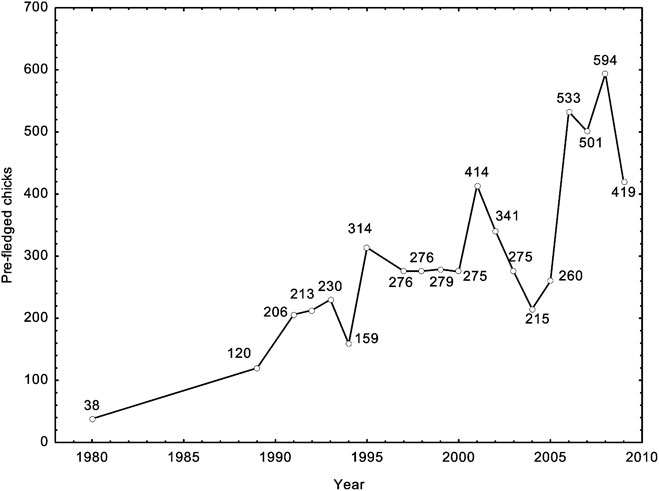
In 1989, 120 king penguin fledglings were counted, a three times increase since the count in 1980 (Fig. 2). Despite some deviations from the increasing trend, particularly in 1994 and 2001–04 (during which the numbers declined over three consecutive years), the long-term increase continued. The number of fledglings more than doubled during the 1990s, reaching 275 individuals by 2000. Fledgling numbers peaked (n = 594) within this study period in 2008, once again more than doubling since 2000. This maximum was followed by a relatively poor year in 2009, when only 419 fledglings were counted (Fig. 2).
Number of king penguin fledglings counted at Volunteer Point at the Falkland Islands between the period 1980–2009.
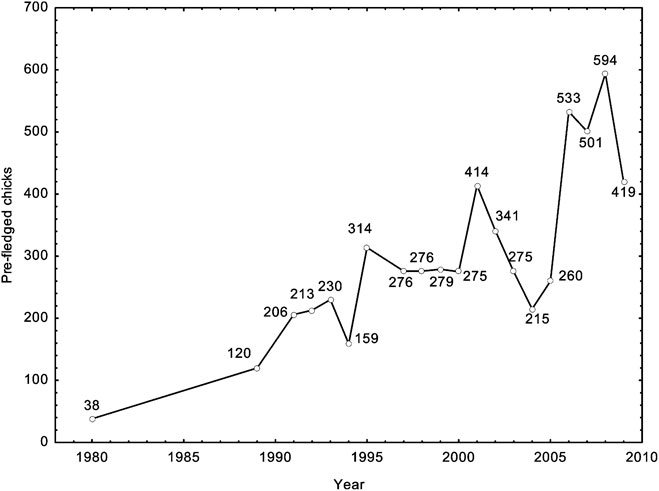
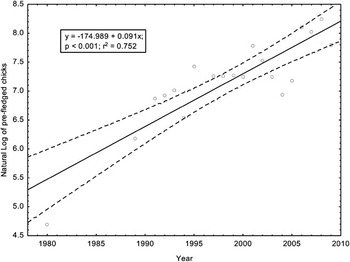
The annual intrinsic rate of increase (r) during the study period was 0.103, or 10.3% per annum. Based on the natural logarithm of individuals counted, the population demonstrated a significant linear increase over time (P < 0.001, df = 19, Figs 2 & 3), with year explaining 75% of the temporal variability in numbers (Fig. 3).
The natural logarithm (loge), and 95% confidence interval, of king penguin fledglings counted at Volunteer Point at the Falkland Islands from 1980–2009.

During an archipelago-wide census (2005/06) eight king penguin fledglings were observed at six other localities. Six were on East Falkland and two at Saunders Island on the west of the archipelago (Fig. 1). Numbers at each locality did not exceed two and in all cases they were associated with gentoo penguin (Pygoscelis papua Forster) colonies.
Discussion
This study clearly indicates significant population growth, at about 10% per annum, in king penguins at the Falklands over the past three decades (Clausen & Huin Reference Clausen and Huin2003). Assuming king penguins at the Falklands attempt breeding on an annual basis (Otley et al. Reference Otley, Clausen, Christie, Huin and Pütz2007, but see Olsson Reference Olsson1996), and breeding success (incorporating over-wintering mortality up to November when chick counts were performed) to be 28% (Otley et al. Reference Otley, Clausen, Christie, Huin and Pütz2007), the population at the Falklands consisted of about 720 breeding pairs in 2009. The unusual and extended breeding cycle of king penguins, combined with uncertainty regarding breeding frequency, a prolonged egg laying period, substantial interannual variation in over winter survival (Weimerskirch et al. Reference Weimerskirch, Stahl and Jouventin1992) and a lack of information on breeding success preclude the calculation of an accurate population estimate (Van Heezik et al. Reference Van Heezik, Seddon, Cooper and Plos1994, Olsson Reference Olsson1996). Furthermore, as we used counts of fledglings as an index of population size, it is important to note that these counts reflect a combination of both breeding numbers and breeding success.
Historical occurrence
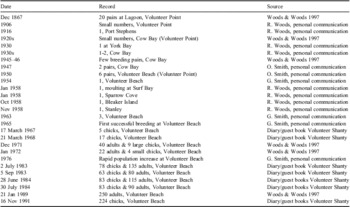
Historical records indicate that in 1867 the Falklands hosted a small population of about 20 king penguins at Volunteer Point (Woods & Woods Reference Woods and Woods1997). Small numbers of king penguins were seen throughout the Falklands over the following century (Table I), with the first observation (by land owner) of successful breeding post-1867 being almost a century later in 1965. Around 1976 the population started growing. Informative and unambiguous accounts prior to 1867 are sparse and largely drawn from Strange (Reference Strange1992) and Woods & Woods (Reference Woods and Woods1997).
Historical records of king penguins at the Falkland Islands.

The observed increase in numbers of king penguins at the Falkland Islands is largely mirrored throughout their breeding range but, unlike other populations, it is unlikely to represent a recovery process following exploitation as suggested elsewhere (e.g. Williams Reference Williams1995). Although it has been stated that king penguins were exterminated (Williams Reference Williams1995, Clausen & Huin Reference Clausen and Huin2003), or almost so (Strange Reference Strange1992, Woods & Woods Reference Woods and Woods1997), from the Falklands during the penguin-oil industry in the mid 1800s (Strange Reference Strange1992), we found no evidence indicating past exploitation of king penguins for oil despite extensive research into historical accounts.
Small numbers of king penguins have on several occasions been associated with gentoo penguin colonies (Woods & Woods Reference Woods and Woods1997). It is easy to imagine in cases like these that both species would have been captured and processed indiscriminately. An account exists of king penguins being killed for oil to waterproof a shepherd's house on West Island (Boyson Reference Boyson1924). However, the credibility of this account has been questioned, as no further records exist to indicate any breeding of king penguins on West Island (Woods, personal communication 2010). In all likelihood the king penguin population at the Falklands was never as numerous (Strange Reference Strange1992, Woods & Woods Reference Woods and Woods1997) as other breeding locations. No records of king penguins at the Falklands exist prior to 1867, when 20 king penguin breeding pairs were counted at Volunteer Point (Table I) and Strange (Reference Strange1992) convincingly argued that such records would have existed if there were historically large numbers of king penguins at the islands.
Population regulation
In the absence of direct human intervention, the numbers of breeding penguins at established colonies are, among other factors, regulated by inter- and intra-specific competition for food resources (Furness & Birkhead Reference Furness and Birkhead1984, Croxall et al. Reference Croxall, Reid and Prince1999, Forcada et al. Reference Forcada, Trathan, Reid, Murphy and Croxall2006). The continued long-term increase in king penguin numbers reported here suggests both forms of competition to be limited. As is the case elsewhere (Moore et al. Reference Moore, Robertson and Wienecke1998, Bost et al. Reference Bost, Zorn, Le Maho and Duhamel2002), king penguins at the Falkland Islands target predominantly myctophids (Oven et al. Reference Oven, Konstantinova and Shevchenko1990, Cherel et al. Reference Cherel, Pütz and Hobson2002), but also cephalopods (Piatkowski et al. Reference Piatkowski, Pütz and Heinemann2001), up to 500 km mostly to the north-east of the Falkland Islands in slope waters of the Patagonian shelf and oceanic waters beyond the shelf (Pütz Reference Pütz2002, Pütz & Cherel Reference Pütz and Cherel2005). The major commercial fisheries operating within the penguins foraging range (inter-specific competition) since the early 1980s (Barton Reference Barton2002) also target squid and fin-fish yet their impacts do not appear to have a negative effect on the king penguin population's capacity for increase. Competition between king penguins and the three other penguin species breeding at the Falklands (gentoo, magellanic (Spheniscus magellanicus Forster) and southern rockhopper (Eudyptes chryosocome chrysocome Forster) penguins) is reduced because king penguins are specialist feeders (Pütz & Cherel Reference Pütz and Cherel2005) while the other species are generalists (Pütz et al. Reference Pütz, Ingham, Smith and Croxall2001).
Stocks of king penguin prey species (particularly myctophids) were probably enhanced by the large crustacean biomass avaliable, after the almost complete extermination of large baleen whales that took place during the mid-twentieth century. This could have resulted in high adult survival and breeding success of king penguins (Rounsevell & Copson Reference Rounsevell and Copson1982, Weimerskirch et al. Reference Weimerskirch, Stahl and Jouventin1992). It could potentially have given rise to observed population growth at the Falkland Islands. However, growth could also have been aided through immigration from other colonies (Otley et al. Reference Otley, Clausen, Christie, Huin and Pütz2007). An individual banded as a fledgling at South Georgia was observed breeding at the Falklands in 1995 (Olsson Reference Olsson1997) and subsequently (Pütz, personal observation).
Irrespective of causative mechanisms associated with the increase in population numbers of king penguins at the Falklands, population growth is much lower than has been observed elsewhere (66% per annum, Van Den Hoff et al. Reference Van Den Hoff, McMahon and Field2009). Although fecundity is regarded as being of lesser importance than survival in terms of governing population growth in long-lived animals (e.g. Lebreton & Clobert Reference Lebreton and Clobert1991), high over-wintering chick mortality has been recorded (including 2009; Falklands Conservation, unpublished data). To some extent such events would limit population growth through reduced recruitment. The fact that king penguins from the Falklands are reliant on food resources associated with the highly productive Patagonian slope waters, for which they travel considerable distances, also place them at risk of anthropogenic impacts, including oil exploration, in these heavily utilized waters (Pütz Reference Pütz2002).
Into the future
King penguin numbers may be reaching carrying capacity at some breeding sites (Delord et al. Reference Delord, Barbraud and Weimerskirch2004), but continued growth at the Falkland Islands seems probable, particularly when considering the limited competition for food resources with the more abundant penguin species at the Falklands and the fisheries that presently operate in the region (see above). Nonetheless, and as is the case for other penguin species (Barbraud & Weimerskirch Reference Barbraud and Weimerskirch2001, Trathan et al. Reference Trathan, Murphy, Forcada, Croxall, Reid and Thorpe2006), large-scale environmental change could substantially impact on this population in the future (Bost & Le Maho Reference Bost and Le Maho1993, Le Bohec et al. Reference Le Bohec, Durant, Gauthier-Clerc, Stenseth, Park, Pradel, Gremillet, Gendner and Le Maho2008). Although the Falklands population of king penguins has limited ecological significance at current numbers, it is unique in that it is the most temperate of all breeding sites, being the furthest away from the Antarctic Polar Front, and it is located close to the highly productive Patagonia shelf region (Pütz Reference Pütz2002, Pütz & Cherel Reference Pütz and Cherel2005). The continued monitoring of this population, with a more detailed study of life history parameters and environmental variables impacting on these, is recommended. Furthermore, king penguins have high tourism value and thus contribute to the revenue potential for ecotourism (Otley et al. Reference Otley, Clausen, Christie, Huin and Pütz2007). Although a warden manages tourist activities at Volunteer Point to reduce disturbance, it is advised that human impacts on breeding success and population trend by closely monitored.
Acknowledgements
The Falkland Islands Seabird Monitoring Programme is financially supported by the Falkland Islands Government through the Environmental Studies Budget. Falklands Conservation thanks the landowners who supported the study in different ways and everyone who participated in data collection throughout the years. Special thanks are due to Ian Strange and Robin Woods for their input and contributions in terms of the historical occurrence of king penguins at the Falkland Islands. Comments from two anonymous reviewers greatly improved the manuscript and were much appreciated.