The Streptococcus genus contains some of the most common pathogenic species that cause respiratory, urogenital, skin and soft tissue, and meningeal infections. Over the recent decades, data from the Centers for Disease Control Preventive Active Bacterial Core Surveillance program and others have found a change in prevalence of Streptococcus-related infections. 1,2 A rise in invasive group B Streptococcus infections is seen in correlation with chronic heart conditions, diabetes, and obesity. Reference Jump, Wilson and Baechle3–Reference Francois Watkins, McGee and Schrag5 More invasive forms of group A Streptococcus infections have risen in the United States, thought to be associated with an emergence of newer virulent strains. Reference Nelson, Pondo and Toews6,Reference O’Loughlin, Roberson and Cieslak7 Although the incidence of group A and B β-hemolytic Streptococcus infections are well characterized, only limited data describes the trends of other β-hemolytic Streptococcus spp worldwide. Reference Schwartz, Keynan, Gilmour, Dufault and Lagace-Wiens8–Reference Lambertsen, Ingels, Schonheyder and Hoffmann11 The purpose of this study is to describe the recent trends of invasive and noninvasive β-hemolytic Streptococcus cultures in the Veterans’ Affairs (VA) cohort from 2009 to 2018. The 30- and 90-day mortality rates were calculated for patients who had a culture for β-hemolytic Streptococcus.
Methods
This retrospective cohort study was conducted on cultures obtained at VA healthcare facilities from January 1, 2009, to January 1, 2019. All patients aged 18 years and older with cultures positive for β-hemolytic Streptococcus at a VA facility were included in the cohort. Data were retrieved from the VA Corporate Data Warehouse using structure query language through SQL Server Management Studio software. Data collection and analysis were completed in the VA informatics and computing infrastructure (VINCI) to retain data security and patient data privacy. The study was approved by the VA Western New York Healthcare System Institutional Review Board.
All α- and γ-hemolytic Streptococcus, or organisms identified as β-hemolytic with speciation as Enterococcus, group D Streptococcus, Gemella morbillorum, and group F Streptococcus were excluded from the analysis. Certain strains of S. anginosus, S. intermedius, and S. constellatus that belong within the α-hemolytic viridans group (which are β-hemolytic and possess Lancefield C and G antigens) were not included in this study. Groups E, P, U, and V were not included in the analysis because so few of these organisms were identified. Anatomical sites of the culture were categorized using the source of culture and ancillary commentary. Sites of culture were classified as blood, bone, catheter, cerebrospinal fluid, eyes–ears–nose–throat (EENT), pleural fluid, joint fluid, skin and soft tissue, sputum, unspecified wound, urine, urogenital, or other (ie, gastrointestinal, hardware, heart, JP drainage, kidney, liver, lung, lymphatic, oral cavity, and pancreatic samples). Cultures with sources labeled as fluid or tissue were categorized as ‘unknown.’ Invasive cultures were defined as organisms recovered from normally sterile sites including blood, bone, cerebral spinal fluid (CSF), pleural fluid, joint fluid, heart, kidney, liver, lung, lymphatic, and pancreatic samples.
Patient demographics and culture specifications including gender, age, location, days until mortality after sample isolation, average weight and height, and race, were obtained. To determine the prevalence of a particular Streptococcus spp from any site of culture or age group per year, data for all positive cultures in the VA from 2009 to 2018 were obtained and categorized by site of culture, year, and age groups (<65, 65–74, 75–84, >84 years). The 30- and 90-day all-cause mortality rates were calculated as percentages for each category of Streptococcus. Data are presented as mean and standard deviation or median with interquartile ranges [IQRs].
Results
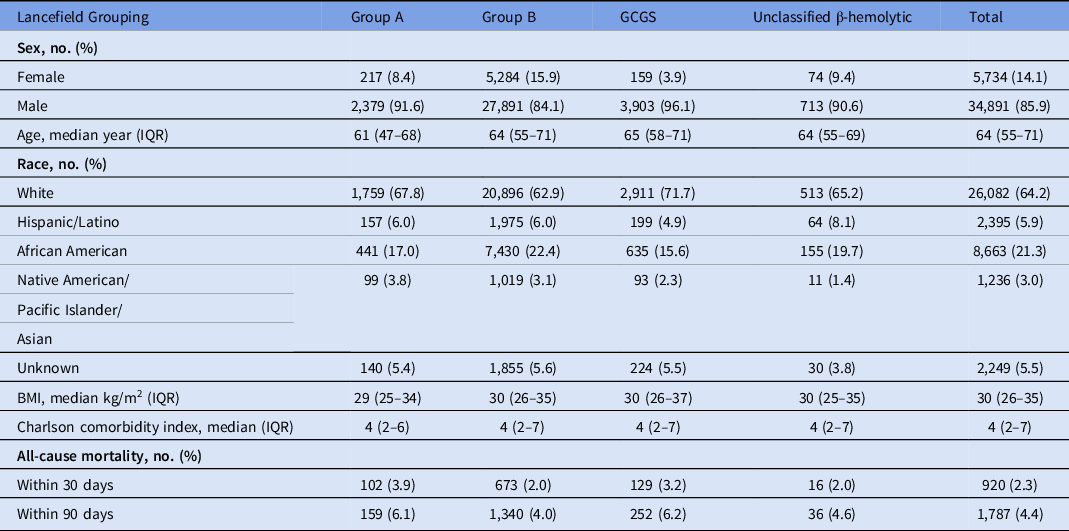
Between 2009 and 2018, 40,625 VA patients had cultures that grew β-hemolytic Streptococcus in 128 stations across 49 states in the United States. Among the samples that tested positive, 5,734 were from women and 34,891 from men. The median patient age was 64 years (IQR, 55–71), the median body mass index (BMI) was 30 kg/m 2 (IQR, 26–35 kg/m 2 ), and the median Charlson comorbidity index was 4 (IQR, 2–7). The 30-day all–cause mortality from all β-hemolytic Streptococcus cases was 2.3% and the 90-day all-cause mortality rate was 4.4%. The 30- and 90- day all-cause mortality rates among Streptococcus cases were higher in groups A (3.9% and 6.1%, respectively) and in groups C and G combined (GCGS; 3.2% and 6.1%, respectively) than in group B streptococci (GBS; 2.0% and 4.0%, respectively). GCGS were combined into a single category because some facilities reported them by this designation.
During the study period, the ratio of total β-hemolytic Streptococcus cases to total reported positive cultures has remained consistent from year to year at ∼1.4 cases per 100 positive cultures from 2009 to 2018. GAS cases have increased by ∼50% from 0.08 cases per 100 positive cultures in 2009 to 0.12 cases per 100 positive cultures in 2018. Similarly, GCGS cases also increased 30% over the 10-year span, with 0.13 cases per 100 positive cultures reported in 2009 and 0.17 cases per 100 positive cultures in 2018. The number of reported GCGS cases exceeded the number of GAS cases during the study period. Rates of GBS has remained steady at ∼1.1 cases per 100 positive cultures from 2009 to 2018. Collectively, GBS remains the most prevalent β-hemolytic Streptococcus isolated from human cultures. (Table 1)
Characteristics of VA Patients With Positive β-Hemolytic Streptococcus Cultures From 2009 to 2018

Note. VA, Veterans’ Afffairs Health System; GCGS, group C and G Streptococcus; IQR, interquartile range; BMI, body mass index.
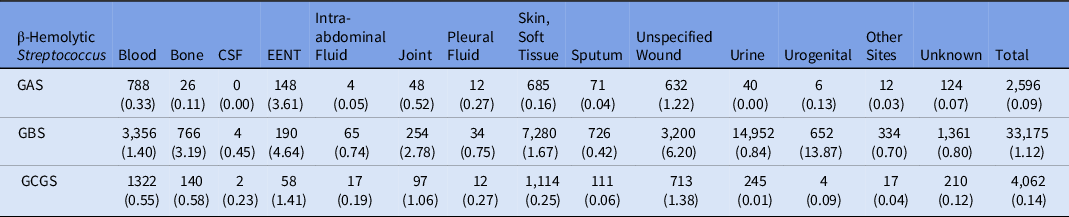
When assessing sites of culture, β-hemolytic Streptococcus was isolated most frequently from urogenital cultures at 14.8%, followed by EENT cultures at 9.66%, wound cultures at 8.8%, joint cultures at 4.4%, bone cultures at 3.9%, and blood cultures at 2.3%. GAS was identified with the highest frequency from EENT, unspecified wound, and urogenital samples at rates of 4.6%, 3.6%, and 1.2%, respectively. GBS were identified from urogenital, unspecified wound, EENT, bone, and blood samples at rates of 13.87%, 6.2%, 4.6%, 3.2%, and 1.4%, respectively. GCGS were identified from EENT, unspecified wound, and joint samples at rates of 1.4%, 1.4%, and 1.1%, respectively. The 5 cases with group E, P, U, V Streptococcus were identified in blood, skin and soft tissue, and unspecified wound cultures, all of which occurred in men (Table 2).
Distribution of β-Hemolytic Streptococcus Cases From All Positive Cultures Categorized by Site of Culture From 2009 to 2018

Note. CSF, cerebrospinal fluid; EENT, eyes–ears–nose–throat; GAS, group A Streptococcus spp; GBS, group B Streptococcus spp; GCGS group C and G Streptococcus spp.
Group A Streptococcus
The trends of group A Streptococcus in EENT, blood, skin and soft-tissue, and wound cultures increased between 2009 and 2018 (Supplementary Fig. 1a online). Within our veteran cohort, invasive forms presented in a yearly average rate of 32% of GAS cases and noninvasive forms in 38% of GAS cases. The proportion of invasive cultures remain steady with a slight decline to 23% and 28% in 2017 and 2018 respectively (Supplementary Fig. 1b online). The 30-day and 90-day all-cause mortality rates were 10 and 14.9 per 100 invasive GAS cases, respectively, with 30-day rates increasing from 2009 to 2014. At its peak, the 30-day all-cause mortality rate was 16 per 100 invasive GAS cases in 2014, but declined to 7.3 per 100 invasive GAS cases in 2018. The 90-day all-cause mortality continued to fluctuate year-to-year, with a maximum rate of 20.7 cases per 100 invasive cases in 2012 and a minimum rate of 7.9 cases per 100 invasive cases in 2009. Rates of 30-day and 90-day all-cause mortality in noninvasive cultures were significantly lower, with averages of 1.3 and 2.4 per 100 noninvasive GAS cases, respectively (Supplementary Fig. 1c online). Invasive GAS cultures were detected in similar rates from all age groups, with yearly averages of 0.03 for <65 years, 0.03 for 65–74 years, 0.02 for 75–84 years, and 0.02 for >84 years invasive GAS cases per 100 positive cultures belonging to the corresponding age group (Supplementary Fig. 1d online).
Group B Streptococcus
The trends of GBS in urogenital cultures have increased from 10.0 to 23.4 per 100 urogenital cultures from 2009 to 2014; however, these cases have declined to 4.8 per 100 urogenital cultures in 2018. GBS increased in blood (from 1.0 to 1.6 per 100 blood cultures), bone (from 2.5 to 3.0 per 100 bone cultures), and skin and soft-tissue cultures (from 1.4 to 1.9 per 100 skin and soft tissue cultures) from 2009 to 2018 (Supplementary Fig. 2a online). Within our cohort, invasive forms were present at a yearly average of 12.7% and noninvasive forms were present in 73.6% of GBS cases, and noninvasive trends remained steady throughout the study period (Supplementary Fig. 2b online). Invasive isolates increased from 10 to 14 per 100 GBS cases from 2009 to 2018. On average, the 30-day all-cause mortality rate reached a yearly average of 7.6 per 100 invasive GBS cases, but the trends show that year-by-year cases declined from 10.8 to 6.9 per 100 invasive GBS cases from 2009 to 2018. The 90-day all-cause mortality rate reached a yearly average of 12 per 100 invasive GBS cases, and year-by-year trends showed declining rates from 18.8 to 11.8 per 100 invasive GBS cases from 2009 to 2018. The 30-day and 90-day all-cause mortality rates were 1.3 and 2.9 per 100 of noninvasive GBS cases, respectively, with trends that remained steady throughout the study period (Supplementary Fig. 2c).
Invasive GBS cultures were detected with slightly higher rates in younger age groups of <65 years and 65–74 years, with averages of 0.16 and 0.14 invasive GBS cases per 100 positive cultures isolated from the corresponding age group, respectively. For the groups aged 75–84 years and >84 years, these rates were 0.12 and 0.10 invasive GBS cases per 100 positive cultures isolated, respectively (Supplementary Fig. 2d online).
Group C and G Streptococcus
GCGS was identified most frequently in wound cultures, and trends fluctuated from year to year (Supplementary Fig. 3a online). At its peak, GCGS were isolated in 2.4 per 100 wound cultures in 2009, and at its nadir in 2015, this rate was 0.9 per 100 wound cultures. Cases of GCGS increased in blood (from 0.3 to 0.8 per 100 blood cultures), EENT (from 0.3 to 0.7 per 100 EENT cultures), and skin and soft tissue (from 0.2 to 0.3 per 100 skin and soft-tissue cultures) between 2009 and 2018. Within our cohort of veterans, invasive forms were present at a yearly average rate of 36% of GCGS cases, with trends increasing from 28 to 40 per 100 GCGS cases from 2009 to 2018 (Supplementary Fig. 3b online). Noninvasive forms were present at a yearly average of 41% of GCGS cases, and this rate remained steady from 2009 to 2018. The 30-day all-cause mortality rate had a yearly average of 6.4 per 100 invasive GCGS cases, which fluctuated from year to year. At its peak, 30-day all-cause mortality occurred in 9.8 per 100 invasive GCGS cases in 2018. Furthermore, the 90-day all-cause mortality rate reached a yearly average of 11.7 per 100 invasive GCGS cases, with trends fluctuating from year to year (Supplementary Fig. 3c online). Also, 30-day and 90-day all-cause mortality rates had yearly averages of 1.5 and 3.5 per 100 of noninvasive GCGS cases, respectively.
Invasive GCGS cultures were detected with rising rates in the elderly, specifically with those aged >84 years. Rates notably increased from 0.01 to 0.08 cases per 100 positive cultures isolated from all patients aged >84 from 2009 to 2018. Trends in other age groups fluctuated from year to year (Supplementary Fig. 3d online).
Discussion
Group B Streptococcus (GBS), inhabit the urogenital tract, rectum, pharynx, and skin. Studies have shown a rise in the incidence of GBS infections in nonpregnant adults, with rates increasing from 8 per 100,000 population in 2008 to 11 per 100,000 population in 2016. Reference Francois Watkins, McGee and Schrag5 GBS remains the most prevalent β-hemolytic Streptococcus to be isolated from positive cultures in VA patients. The severity of GBS invasive disease remains comparable to that reported in previous studies; 30-day all-cause mortality was identified in 7.6 per 100 invasive GBS cases, which is similar to a reported 8.7% among invasive GBS disease in a nationwide VA cohort study from 2008 to 2017. Reference Jump, Wilson and Baechle3 Rates are slightly higher in younger groups aged <65 and 65–74 years, which also supports previous findings of higher rates in patients aged <65 years. Trends of positive GBS blood, bone, and skin and soft-tissue isolates have increased, which have been reported in other studies. Interestingly, there was a significant decrease in rates between 2012 and 2018, and ∼90.4% of these isolates were from women. In 2010, the American College of Obstetricians and Gynecologists, CDC, and other collaborators provided updated guidance for preventing perinatal group B streptococcal disease. Reference Verani, McGee and Schrag12 Recommendations for universal testing for identifying GBS in asymptomatic carriers and intrapartum chemoprophylaxis for all colonized women were issued. Declining rates are potentially reflective of these changes in practice.
GCGS that are pathogenic to humans include S. equi (including subspecies equi and zooepidemicus), S. dysgalactiae subspecies equisimilis, and S. constellatus subspecies pharyngis. S. equi and zooepidemicus are zoonotic organisms that are derived from domesticated animals and transmitted through contact or unpasteurized dairy products. Reference Oppegaard, Skrede, Mylvaganam and Kittang13 An increasing number of S. equisimilis cases have been reported across the world, with a 3-fold increase in Denmark from 1999 to 200214 and a 2.5-fold increase in Finland from 1995 to 2004. Reference Rantala, Vuopio-Varkila, Vuento, Huhtala and Syrjanen15 In the United States, ∼80% of non–group A or B β-hemolytic Streptococcus–related infections were identified as S. equismilis in a small cohort of patients from 2002 to 2004. Reference Broyles, Van Beneden and Beall16 GCGS is the second most prevalent β-hemolytic Streptococcus isolated from positive cultures in VA patients. Our analysis shows that there is a higher prevalence of GCGS than GAS isolation from cultures, which is consistent with findings from other countries. Reference Ekelund, Skinhoj, Madsen and Konradsen14–Reference Broyles, Van Beneden and Beall16 Similar to GAS, GCGS are found most frequently in wound, blood, EENT, and skin and soft-tissue cultures, and rates have been increasing in both invasive and noninvasive forms. The proportion of invasive to noninvasive cultures is remarkable and similar to that of GAS; an average of 36% of GCGS cultures are invasive. However, 30-day all-cause mortality rates occurred in ∼6.4 per 100 invasive GCGS cases, which is lower than the rate of 10 per 100 invasive GAS cases but comparable to the rate of 7.6 per 100 invasive GBS cases. Our study also showed the rate increasing in the >84 age group, which supports the finding recognized in a Norwegian study. Reference Oppegaard, Skrede, Mylvaganam and Kittang13 Potential reasons for increased mortality include a higher number of comorbidities and risk factors in the elderly. With detected infections increasing, GCGS should receive more recognition as pathogens that can cause significant morbidity and mortality in infected adults.
GAS is the third most prevalent β-hemolytic Streptococcus, with EENT, blood, skin and soft-tissue, and wound cultures increasing from 2009 to 2018 in the VA. According to CDC Active Bacterial Core Surveillance, cases of cellulitis and necrotizing fasciitis have been on the rise since 1997. 1 These rates were postulated to be associated with possible serotype changes from cell-wall proteins called the M proteins, which are encoded by 220 identified emm genes that contribute to S. pyogenes virulence by impeding phagocytosis. Reference Bencardino, Di Luca, Petrelli, Prenna and Vitali17 Prevalence of invasive disease has remained high, but it has declined slightly since 2015. The 30-day all-cause mortality rate seemed to have peaked at 14 per 100 invasive GAS cases in 2014; possibly related to a cyclic upsurge of a specific emm types. CDC ABC group A Streptococcus surveillance also noted higher death estimates in 2014 than in 2013 or 2015. 1
This study has several limitations. It was a retrospective study and we had insufficient data to confirm infection or colonization. Also, positive cultures with Streptococcus were identified that were not further classified into species or Lancefield groups. Information regarding sites of culture were categorized based on source of the sample; some isolates did not have a source specified or were vague with descriptions. Those isolates were subsequently categorized as ‘unknown,’ which can lead to misreporting of actual prevalence. GCGS were classified together as some VA facilities report the culture as group C or group G Streptococcus. Furthermore, classification of organisms depends on the microbiological methodologies used during the time of collection. The use of more advanced molecular microbiological identification systems (eg, matrix-assisted laser desorption/ionization time-of-flight mass spectroscopy or MALDI-TOF) may have caused increased reporting of organisms. We also had no way of determining whether GAS outbreaks may have led to varied incidents of GAS.
In conclusion, trends of cultures for invasive and noninvasive β-hemolytic Streptococcus remain high and suggest an association with disease and mortality. The burden associated with β-hemolytic Streptococcus infections should not be underestimated.
Acknowledgments
This material is the result of work supported with resources and the use of facilities at the Veterans’ Affairs Western New York Healthcare System. The contents of this manuscript are not intended to represent the views of the Department of Veterans’ Affairs or the US government.
Financial support
No financial support was provided relevant to this article.
Conflicts of interest
All authors report no conflicts of interest relevant to this article.