Due to immigration and high fertility rates, Latinos are among the fastest growing ethnic/racial group within the United States (Stepler & Lopez, Reference Stepler and Lopez2016). Projections indicate that Latinos will account for 24% of the US population by 2065 (Lopez, Passel, & Rohal, Reference Lopez, Passel and Rohal2015). As a result of the need to navigate multiple cultural reference points, Latino youth are faced with a host of challenges associated with the process of cultural change (Portes & Rumbaut, Reference Portes and Rumbaut2014), placing youth at increased risk for experiencing socioemotional, mental health, and behavioral health problems (Asfour et al., Reference Asfour, Huang, Ocasio, Perrino, Schwartz, Feaster and Prado2017). A growing body of research has indicated important disparities in terms of negative outcomes for Latino youth compared to their White counterparts. Compared with non-Latino Black and non-Latino White youth, Latino youth are at greater risk for internalizing (e.g., anxiety, fear, sadness/depression, suicidal ideation, and social withdrawal) and externalizing (e.g., aggression, conduct problems, delinquent behavior, oppositionality, hyperactivity, and attention problems) problems (McLaughlin, Hilt, & Nolen-Hoeksema, Reference McLaughlin, Hilt and Nolen-Hoeksema2007; Smokowski et al., Reference Smokowski, Rose, Evans, Cotter, Bower and Bacallao2014).
As indicated by the Center for Disease Control's Youth Risk Behavior Surveillance System, compared to non-Latino Black (27%) and non-Latino White youth (25%), Latino youth (35%) were more likely to have felt sad or hopeless almost every day for 2 or more weeks in a row. Latino youth were more likely to have considered attempting suicide (18.8%) and reported having made a suicide plan (15.7%) when compared to non-Latino Black (14.5% and 10.4%) and non-Latino White youth (16.2% and 12.8%; Kann et al., Reference Kann, Kinchen, Shanklin, Flint, Harris and Lowry2014). Consistent with these disparities in suicide ideation, Latino adolescents attempt suicide at a far higher rate than other American youth (Kann et al., Reference Kann, Kinchen, Shanklin, Flint, Harris and Lowry2014), a trend that has been apparent since 1991 (Zayas, Lester, Cabassa, & Fortuna, Reference Zayas, Lester, Cabassa and Fortuna2010). In addition, Latino youth are more likely to have used alcohol or carried a weapon on school property (Kann et al., Reference Kann, Kinchen, Shanklin, Flint, Harris and Lowry2014). Moreover, 28.4% of Latino youth report having been in a physical fight, and 4.7% report having been injured, during the past 12 months. These rates are relatively comparable to those of non-Latino Black students (34.7% and 4.4%, respectively) but significantly higher than non-Latino White students (20.9% and 2.1%, respectively).
These significant mental health disparities, coupled with the fact that Latino youth represent a growing proportion of the US population, emphasize the critical need to identify and understand factors associated with mental, emotional, and behavioral problems among this population. Tangential to this critical need, there has been a growing recognition within the fields of developmental science (Jensen, Reference Jensen2012) and developmental psychopathology (Causadias, Reference Causadias2013) of the need to consider how cultural processes initiate, contribute to, and maintain trajectories of normal and abnormal behavior. However, central to the intersection between cultural psychology, developmental science, and psychopathology, there is a growing need to develop effective assessments that are capable of longitudinally examining the heterogeneity of underlying psychological traits (Klein & Wang, Reference Klein and Wang2010). As noted by Causadias (Reference Causadias2013), “improved and direct individual-level cultural measurement is indispensable to facilitate further elucidation of the role of culture in the development of psychopathology and resilient functioning” (p. 1391).
A large body of research on adjustment among Latino youth has focused on acculturation and enculturation. Broadly, acculturation refers to the process of adapting to a new culture and refers primarily to the extent to which an individual adopts the new receiving culture (sometimes referred to as assimilation), while enculturation refers to the extent to which an individual retains his or her cultural heritage (Berry, Reference Berry1997). However, the definitional complexity surrounding acculturation and enculturation, specifically the domains to which it refers, has led to a lack of consensus in the field about how to measure acculturation and enculturation (Cabassa, Reference Cabassa2003; Zane & Mak, Reference Zane, Mak, Chun, Balls Organista and Marin2003) as well as to the development of several measures, each with a different operationalization of acculturation (Kim & Abreu, Reference Kim, Abreu, Ponterotto, Casas, Suzuki and Alexander2001; Unger, Ritt-Olson, Wagner, Soto, & Baezconde-Garbanati, Reference Unger, Ritt-Olson, Wagner, Soto and Baezconde Garbanati2007). Before research can attend to the role of individual-level cultural processes in explaining mental health disparities, resilience, and well-being among Latino youth, studies must first explore potential strengths and weaknesses of current measures as they relate to internalizing and externalizing problem behaviors.
Contemporary Conceptualizations of Acculturation
In contrast to “unidimensional” perspectives, which place acculturative experiences along a single continuum ranging from “completely unacculturated” to “completely acculturated,” contemporary views of acculturation have increasingly drawn on Berry's (Reference Berry1997) bidimensional conceptualization. According to Berry's (Reference Berry and Padilla1980) seminal acculturation model, acquisition of the receiving-culture (acculturation) and heritage-culture retention (enculturation) can occur independently. In this respect, acquiring the culture of the receiving context does not imply that individuals will discard their own cultural heritage; rather, they may judiciously straddle a fence between two cultural worlds, where different cultural streams will be expressed depending on the situation at hand. Toward this end, acculturation and enculturation have been conceptualized as a process of changing one's behaviors and sense of self, which then allows youth to navigate a social environment consisting of both heritage and designation culture influences (Berry, Reference Berry1997). As a result, acculturation and enculturation have been conceptualized as occurring across a variety of domains including language, behavioral preferences, and cultural identification, among others (Cabassa, Reference Cabassa2003; Schwartz, Unger, Zamboanga, & Szapocznik, Reference Schwartz, Unger, Zamboanga and Szapocznik2010).
In a recent meta-analysis (Yoon, Langrehr, & Ong, Reference Yoon, Langrehr and Ong2011), enculturation was found to be negatively associated with psychological distress and depression and positively associated with self-esteem, whereas acculturation was positively, but not significantly, linked with self-esteem. These findings indicate that loss of one's heritage culture poses a greater risk for youth adaptation than does acquisition of the receiving culture. These findings are also consistent with findings indicating that biculturalism, or the dual endorsement of cultural aspects of both one's heritage and receiving cultures (Berry, Reference Berry1997; Tadmor & Tetlock, Reference Tadmor and Tetlock2006), is associated with the most favorable psychosocial outcomes among a range of mental health indicators such as self-esteem (Nguyen & Benet-Martínez, Reference Nguyen and Benet-Martínez2013; Tadmor, Tetlock, & Peng, Reference Tadmor, Tetlock and Peng2009). Scholars have argued that biculturalism (a) provides individuals with coping strategies from multiple cultural streams, (b) provides the capacity to interact with people from both the larger society and the heritage cultural community (Schwartz, Unger, Baezconde-Garbanati, et al., Reference Schwartz, Unger, Baezconde-Garbanati, Benet-Martínez, Meca, Zamboanga and Szapocznik2015) and (c) helps facilitate cognitive complexity by prompting individuals to reconcile differences between their cultural streams (Chen, Benet-Martínez, Wu, Lam, & Bond, Reference Chen, Benet-Martínez, Wu, Lam and Bond2013).
However, some studies, using unidimensional models of acculturation, have indicated that “greater” degrees of acculturation are associated with problematic health outcomes (e.g., McQueen, Getz, & Bray, Reference McQueen, Getz and Bray2003; Wagner et al., Reference Wagner, Ritt-Olson, Chou, Pokhrel, Duan, Baezconde-Garbanati and Unger2010), a phenomenon known as the immigrant paradox (Alegría et al., Reference Alegría, Canino, Shrout, Woo, Duan, Vila and Meng2008; Allen et al., Reference Allen, Elliott, Fuligni, Morales, Hambarsoomian and Schuster2008). However, it is possible that some of these inconsistencies are attributable to the use of unidimensional measures of acculturation and/or to the specific measurement instruments used to assess acculturation (López, Reference López2009). Literature reviews and meta-analyses often summarize across studies without considering the specific acculturation measure(s) used in each study (Lopez-Class, Castro, & Ramirez, Reference Lopez-Class, Castro and Ramirez2011). As noted by Martinez, Schwartz, Thier, and McClure (Reference Martinez, Schwartz, Thier and McClure2018), these definitional inconsistencies may contribute to conflicting findings regarding a link between acculturation and enculturation processes and internalizing symptoms and externalizing problem behaviors.
Measurement of Acculturation
As noted earlier, there is substantial variability in how measures of acculturation and enculturation have operationalized the constructs. To begin with, these measures vary with regard to their conceptualization of acculturation as a unidimensional or bidimensional construct. Several measures have operationalized acculturation as a unidimensional process, with the assumption that acculturation involves complete adoption of the receiving culture (e.g., United States) and forfeiture of one's family's cultural heritage (straight-line assimilation; Gordon, Reference Gordon1964). However, as noted within most contemporary theories, acculturation and enculturation may be more accurately conceptualized as independent dimensions (Berry, Phinney, Sam, & Vedder, Reference Berry, Phinney, Sam and Vedder2006). Measures utilizing a bidimensional process are more reflective of immigrants’ lived experiences than are unidimensional models (Ryder, Alden, & Paulhus, Reference Ryder, Alden and Paulhus2000; Thomson & Hoffman-Goetz, Reference Thomson and Hoffman-Goetz2009). Moreover, an extensive literature has emphasized that immigrants are able to endorse cultural aspects of both their heritage and receiving cultures (Berry, Reference Berry1997; Tadmor & Tetlock, Reference Tadmor and Tetlock2006). Even within the subset of measures employing bidimensional understandings of acculturation, variability remains in terms of the breadth of each measure. Although most measures focus primarily on cultural practices such as language use, food choices, and media (Kim & Abreu, Reference Kim, Abreu, Ponterotto, Casas, Suzuki and Alexander2001), others include additional domains such as identity and choice of friends and partners.
This distinction is apparent in the contrast between the Acculturation Rating Scale for Mexican Americans—II (ARSMA-II; Cuéllar, Arnold, & González, Reference Cuéllar, Arnold and González1995) and the Bicultural Involvement Questionnaire—Short Version (BIQ-S; Szapocznik, Kurtines, & Fernandez, Reference Szapocznik, Kurtines and Fernandez1980), two of the most prominent measures used with Latino groups in the United States (Jones & Mortimer, Reference Jones and Mortimer2014; Unger et al., Reference Unger, Ritt-Olson, Wagner, Soto and Baezconde Garbanati2007). Both of these measures include items referring to English and Spanish language use and to enjoyment of US and Latino foods. However, there are important distinctions between these two measures. The BIQ-S includes additional items indexing music, dances, and ways of celebrating birthdays and holidays (which the ARSMA-II does not), whereas the ARSMA-II presents additional items referring to peer association and to identifying as Latino/American (which the BIQ-S does not). Further, although these measures were originally developed for use with specific populations, both measures have been used with other Latino groups (Martinez, McClure, Eddy, & Wilson, Reference Martinez, McClure, Eddy and Wilson2011; Unger et al., Reference Unger, Ritt-Olson, Wagner, Soto and Baezconde Garbanati2007).
As a whole, research utilizing the BIQ-S has indicated that enculturation is negatively associated with a range of negative outcomes including internalizing problems (Smokowski & Bacallao, Reference Smokowski and Bacallao2007; Smokowski, Bacallao, & Buchanan, Reference Smokowski, Bacallao and Buchanan2009), aggression (Smokowski & Bacallao, Reference Smokowski and Bacallao2006), risky sex (Ma et al., Reference Ma, Malcolm, Diaz-Albertini, Klinoff, Leeder, Barrientos and Kibler2014; Schwartz, Unger, et al., Reference Schwartz, Unger, Des Rosiers, Lorenzo-Blanco, Zamboanga, Huang and Szapocznik2014), hopelessness, social problems, and aggression (Smokowski, Buchanan, & Bacallao, Reference Smokowski, Bacallao and Buchanan2009); and positively associated with self-esteem (Smokowski et al., Reference Smokowski, Bacallao and Buchanan2009). In contrast, findings from studies utilizing the ARSMA-II have been less consistent. Although studies have found enculturation to be negatively associated with externalizing problem behavior (Gonzales et al., Reference Gonzales, German, Kim, George, Fabrett, Millsap and Dumka2008) and substance use (Unger, Ritt-Olson, Soto, & Baezconde-Garbanati, Reference Unger, Ritt-Olson, Soto and Baezconde-Garbanati2009; Zamboanga, Schwartz, Jarvis, & Van Tyne, Reference Zamboanga, Schwartz, Jarvis and Van Tyne2009), other studies have indicated a positive relationship between enculturation and problematic substance use (Grigsby, Forster, Baezconde-Garbanati, Soto, & Unger, Reference Grigsby, Forster, Baezconde-Garbanati, Soto and Unger2014; Unger, Schwartz, Huh, Soto, & Baezconde-Garbanati, Reference Unger, Schwartz, Huh, Soto and Baezconde-Garbanati2014; Zamboanga et al., Reference Zamboanga, Schwartz, Jarvis and Van Tyne2009). Similarly, although studies have found acculturation, as measured by the ARSMA-II, to be negatively associated with substance use (Unger et al., Reference Unger, Ritt-Olson, Soto and Baezconde-Garbanati2009; Zamboanga et al., Reference Zamboanga, Schwartz, Jarvis and Van Tyne2009), other studies have found acculturation to be positively associated with substance use (Wagner et al., Reference Wagner, Ritt-Olson, Chou, Pokhrel, Duan, Baezconde-Garbanati and Unger2010). In addition, several studies have indicated nonsignificant relationships between enculturation or acculturation and internalizing and externalizing problem behaviors (Brittian, Toomey, Gonzales, & Dumka, Reference Brittian, Toomey, Gonzales and Dumka2013; Kapke, Grace, Gerdes, & Lawton, Reference Kapke, Grace, Gerdes and Lawton2017) or substance use (Unger et al., Reference Unger, Schwartz, Huh, Soto and Baezconde-Garbanati2014). Given the differences between the sets of items included in the BIQ-S and the ARSMA-II, the divergence in the associations of these measures with mental health and substance use, and the growing need to develop effective assessments (Klein & Wang, Reference Klein and Wang2010), there is a critical need for research to attend to the psychometric properties of current individual-level cultural measures and to comparatively evaluate their effectiveness (Causadias, Reference Causadias2013; Doucerain, Segalowitz, & Ryder, Reference Doucerain, Segalowitz, Ryder, Schwartz and Unger2017).
Need for psychometric evaluations of existing measures
To date, there have been limited psychometric analyses of either the BIQ-S or the ARSMA-II. This lack of psychometric evaluation of the BIQ-S and the ARSMA-II is particularly problematic given that these scales were developed over 20 years ago. Although both the BIQ-S and the ARSMA-II have been adapted for use across Latino national subgroups (e.g., Birman, Reference Birman1998; Dennis, Fonseca, Gutierrez, Shen, & Salazar, Reference Dennis, Fonseca, Gutierrez, Shen and Salazar2016), establishing psychometric validity is a necessary first step for addressing measurement variability issues within the field of acculturation. Contrary to the original two-factor structure with which the BIQ was designed, a confirmatory factor analysis (CFA) on BIQ-S scores in a sample of Latino respondents in Miami (Guo, Suarez-Morales, Schwartz, & Szapocznik, Reference Guo, Suárez-Morales, Schwartz and Szapocznik2009) yielded a four-factor model composed of comfort with Spanish, comfort with English, enjoyment of Latino cultural activities, and enjoyment of American cultural activities. With regard to the ARSMA-II, although Lee, Yoon, and Liu-Tom (Reference Lee, Yoon and Liu-Tom2006) conducted an exploratory factor analysis (EFA) supporting the separate heritage and US subscales in a sample of Asian American college students, and although two studies have confirmed the two-factor structure of the brief ARSMA-II using Latino adolescent samples (Bauman, Reference Bauman2005; Burrow-Sánchez, Ortiz-Jensen, Corrales, & Meyers, Reference Burrow-Sánchez, Ortiz-Jensen, Corrales and Meyers2015), no study to date has established the psychometric validity of the full 30-item ARSMA-II using CFA procedures.
Need for establishing longitudinal invariance
It is also critical to note that acculturation and enculturation are inherently developmental process centered on the changes (and continuities) that occur as individuals come in contact with culturally dissimilar people, groups, and social influences (Schwartz et al., Reference Schwartz, Unger, Zamboanga and Szapocznik2010). As a result, and as emphasized by the cultural development and psychopathology perspective (Causadias, Reference Causadias2013), it is critical to attend to the role of “change and continuity” in individual cultural engagement strategies and in the links of these change processes with psychopathology. However, before this can be done, it is important to attend to the issue of longitudinal measurement invariance. An important assumption of growth curve modeling and other prominent longitudinal data analytic methods is that observed longitudinal change is a result of true change, rather than changes in the structure or interpretation of scores generated by the measurement instruments (Brown, Reference Brown2015). Thus, as noted by Little (Reference Little2013), it is essential to assess the adequacy of the expected relations between the measured indicators and the underlying latent constructs, and the consistency of these relations across time.
Need for establishing measurement equivalence and divergence
In addition, perhaps as a result of the variability in how various measures have framed acculturation and enculturation, recent evidence has indicated that scores derived from different measures are unlikely to be equivalent or even strongly related (Martinez et al., Reference Martinez, Schwartz, Thier and McClure2018; Unger et al., Reference Unger, Ritt-Olson, Wagner, Soto and Baezconde Garbanati2007). For example, Unger et al. (Reference Unger, Ritt-Olson, Wagner, Soto and Baezconde Garbanati2007) found modest correlations among scores generated by the Orthogonal Cultural Identification Scale (Oetting & Beauvais, Reference Oetting and Beauvais1991), the Multigroup Ethnic Identity Measure (Phinney, Reference Phinney1992), the AHIMSA (Unger et al., Reference Unger, Gallaher, Shakib, Ritt-Olson, Palmer and Johnson2002), and the ARSMA-II (Cuéllar et al., Reference Cuéllar, Arnold and González1995), indicating that these measures tap into different aspects of acculturation.
More recently, utilizing a sample of Latino youth in Oregon, Martinez et al. (Reference Martinez, Schwartz, Thier and McClure2018) found that acculturation as measured by the BIQ-S (but not the ARSMA-II) was negatively associated with depressive symptoms and with risks for alcohol and drug use. Similarly, enculturation as measured by the BIQ-S (but not the ARSMA-II) was negatively associated with depressive symptoms. In sum, these studies highlight the need for the acculturation literature to begin attending to comparative measurement issues as they relate to mental health. To that end, scholars have begun emphasizing the need for greater empirical attention to the strengths and weaknesses of each acculturation measure (e.g., Burrow-Sánchez et al., Reference Burrow-Sánchez, Ortiz-Jensen, Corrales and Meyers2015). However, it is important to note that the cross-sectional design of the Martinez et al. study limited their capacity to explore how changes within both of these measures overlap, and how longitudinal trajectories in acculturation scores from each measure predict youth outcomes. As noted by Martinez et al. (Reference Martinez, Schwartz, Thier and McClure2018), comparing measures based on longitudinal trajectories is an important future direction. Given that acculturation represents the process of change in immigrants’ cultural orientation as they adapt to life in a new cultural context, acculturation is inherently a developmental process (Schwartz et al., Reference Schwartz, Unger, Zamboanga and Szapocznik2010). For this reason, to attend to the role of “change and continuity” (Causadias, Reference Causadias2013), it is essential to establish the degree to which similar measures of acculturation and enculturation overlap over time, especially in their links with mental health outcomes.
The Present Study
Building on Martinez et al. (Reference Martinez, Schwartz, Thier and McClure2018), we first sought to establish the psychometric validity of the BIQ-S and the ARSMA-II and then explore the degree to which change in BIQ-S and the ARSMA-II subscale scores provide similar versus unique information vis-à-vis change in internalizing symptoms and externalizing problem behaviors. Toward this end, our analyses were guided by three research questions.
Research Question 1. What is the factor structure of the BIQ-S and ARSMA-II, and is this factor structure longitudinally invariant? To answer this question, we utilized exploratory structural equation modeling (ESEM) to establish factor structure for both the BIQ-S and the ARSMA-II, and we followed all steps necessary for evaluating measurement invariance.
Research Question 2. How are developmental trajectories in BIQ and ARSMA-II scores related to one another? Toward this end, we utilized latent growth curve modeling to explore the correlation between growth parameters for each measure's heritage and US acculturation subscales.
Research Question 3. How do trajectories of acculturation and enculturation, as indexed by the BIQ and by the ARSMA, predict changes in mental health outcomes? To investigate this question, we sought to identify the degree to which growth parameters of heritage and US acculturation within both measures relate to youth's internalizing symptoms and externalizing problem behavior. Given the significant disparities between Latino and non-Hispanic White youth in terms of internalizing and externalizing problem behaviors, it is important for research to identify the strengths and weaknesses of specific acculturation and enculturation measures as they relate to mental health outcomes so that future research can further examine longitudinal effects of acculturation on internalizing and externalizing problems.
Method
Participants
The current study was part of a larger 3-year longitudinal study of acculturation and behavioral health outcomes among recently immigrated Latino middle school youth and their parents in Oregon (the Adolescent Latino Acculturation Study; ALAS; Martinez et al., Reference Martinez, McClure, Eddy and Wilson2011; Martinez, McClure, Eddy, Ruth, & Hyers, Reference Martinez, McClure, Eddy, Ruth and Hyers2012). ALAS employed a prospective longitudinal design involving Latino immigrant youth (Grades 6–10) and their parents in Oregon. Participants in the current study were 216 immigrant Latino youth (43% boys; mean age 13.6 years at baseline; SD = 1.44 years, range 10 to 17). Per the study's inclusion criteria, all participants were foreign born. Ninety-four percent of youth were born in Mexico, and the remaining participants traced their roots to nations in Central America (n = 7), South America (n = 5), and the Caribbean (n = 2).
As part of the recruitment strategy, participants were recruited into ALAS based on the time they had spent in the United States at baseline. Based on their number of years in the United States, youth were classified into one of three time-in-residence groups. These permit us to study acculturation among three distinct age-at-immigration categories (i.e., recently immigrated, immigrated in middle childhood, and immigrated in early childhood). TR1 group (recent immigrants; n = 72) had to be in their 2nd through 4th years of US residence as of the initial telephone screening; TR2 youth (immigrated in middle childhood; n = 78) had to be in their 6th through 8th years; and TR3 (immigrated in early childhood; n = 67) had to be in their 10th through 12th years. A 1-year gap between each time-in-residence group was established to better distinguish the groups from one another.
Procedures
ALAS allowed for longitudinal examination of individual acculturation across a 3-year period and consisted of three major interviews conducted once a year, and smaller follow-up interviews every 3 months between major interviews. The current study focuses specifically on data collected as part of the three major interviews (i.e., Time 1–Time 3 with 1-year lags between assessments). Complete details on recruitment strategies and assessment procedures are presented elsewhere (Martinez et al., Reference Martinez, McClure, Eddy, Ruth and Hyers2012). The institutional review board at the Oregon Social Learning Center approved the research protocol, and participants provided written consent (parents) or assent (youth). The assessment battery was available in both English and Spanish, and participants were asked to select their preferred language prior to starting the battery. Overall, 40% of adolescents completed measures in Spanish. Empirical evidence (Schwartz, Benet-Martínez, et al., Reference Schwartz, Benet-Martínez, Knight, Unger, Zamboanga, Des Rosiers and Szapocznik2014) suggests that pooling acculturation data across languages of assessment likely does not introduce bias.
Measures
Our team engaged in a thorough translation process to assure the functional equivalence and understandability of all the measures used in our study (Brislin, Reference Brislin, Lonner and Berry1986; Cauce, Coronado, & Watson, Reference Cauce, Coronado, Watson, Hernandez and Isaacs1998; Foster & Martinez, Reference Foster and Martinez1995). This translation process involved (a) having a translation team perform initial typographical and functional translations in Spanish, (b) using outside experts to conduct back translations into English, and (c) using the entire research team plus outside language experts (as needed) to compare the original versus back translated documents and resolve disagreements. We have found no differences between participants who responded in English or Spanish in terms of individual and family emotional or behavioral functioning (Martinez et al., Reference Martinez, McClure, Eddy and Wilson2011).
The ARSMA-II
The ARSMA-II (Cuéllar et al., Reference Cuéllar, Arnold and González1995) was administered to youth to assess the degree to which youth embrace practices (e.g., language use), preferences (e.g., for certain types of music or reading material), and cultural identifications (e.g., in relationship to one's nativity, such as “Mexicano/a”) reflecting an individual's involvement in heritage and US cultural customs. To ensure that the items were relevant for both Mexican and non-Mexican participants, we modified the items to ask about practices, behaviors, and self-identifications with reference to the person's home country. The ARSMA-II includes 48 self-report, Likert-type items, answered on a scale ranging from 1 (not at all) to 5 (extremely often or almost always).
BIQ-S
Youth also completed the BIQ-S (Szapocznik et al., Reference Szapocznik, Kurtines and Fernandez1980) independently as part of the larger assessment protocol. The BIQ-S consists of 24 items, 12 assessing US practices (sample item: “I enjoy American music.”) and 12 assessing Latino practices (sample item: “I am comfortable speaking Spanish at home.”). We used a 5-point, Likert-type scale ranging from 1 (strongly disagree) to 5 (strongly agree).
Youth Self-Report (YSR)
Internalizing and externalizing problems were measured using the 112-item YSR (Achenbach, Reference Achenbach1991). The YSR consists of 31 items assessing internalizing problems (α = 0.87; sample item: “I cry a lot.”) and 32 items assessing externalizing problems (α = 0.90; sample item: “I argue a lot.”). Responses are reported on a 3-point, Likert-type scale ranging from 1 (not true) to 3 (very true or often true).
Results
Plan of analysis
All analyses were conducted in Mplus 8.0 (Muthén & Muthén, Reference Muthén and Muthén1998–2017). Model fit was evaluated using the comparative fit index (CFI), the root mean square error of approximation (RMSEA), and the standardized root mean square residual (SRMR). According to values suggested by Little (Reference Little2013), good fit is represented as CFI ≥ .95, RMSEA ≤ .06, and SRMR ≤ .06; and acceptable fit is represented as CFI ≥ .90, RMSEA ≤ .08, and SRMR ≤ .08. Although we report the χ2 value, we did not use it to gauge model fit because it tests a null hypothesis of perfect fit, which is rarely plausible with large samples or complex models (Davey & Savla, Reference Davey and Savla2010).
The present analyses proceeded in four steps. First, we sought to establish the factor structure for the heritage and US subscales from the BIQ-S and the ARSMA-II using ESEM (Muthén & Muthén, Reference Muthén and Muthén1998–2017) with a robust maximum likelihood estimator and an oblique Geomin rotation to minimize factor complexity by reducing cross-loadings and increasing interfactor correlations. ESEM is an overarching integration of CFA and EFA (Marsh, Morin, Parker, & Kaur, Reference Marsh, Morin, Parker and Kaur2014). Like traditional CFA, ESEM generates the usual CFA parameters (e.g., residual correlations). At the same time, similar to EFA, ESEM allows each item to freely load on all factors (Asparouhov & Muthén, Reference Asparouhov and Muthen2009).
As a result, we tested a one- to three-factor models for the heritage and US subscales from the BIQ-S and the ARSMA-II separately, comparing the model fit across the three models using the ΔCFI (>.010) and ΔRMSEA (>.010) criteria to determine significant change in model fit (Little, Reference Little2013). ESEM models were conducted separately for each measure because the sample size was not large enough to jointly estimate solutions for both measures within a single model. Assuming six factors (three for heritage-culture retention and three for US-culture acquisition), an ESEM model conducted with the ARSMA-II would require estimation of 177 parameters, which is only slightly less than the sample size for our study. The range of the factor models for each of the heritage and US subscales from the BIQ-S and the ARSMA-II provided the capacity to test the initial conceptual factor structures (i.e., one heritage and US subscale), the factor structure indicated by recent psychometric work conducted with the BIQ-S (a four-factor structure; Guo et al., Reference Guo, Suárez-Morales, Schwartz and Szapocznik2009), and a factor model that is one degree above previous empirical work. In our model comparisons, if fit was equivalent between less versus more complex models, we would retain the less complex model. It should be noted that, although we report the Δχ2 difference test, we did not use it in interpretation because it tests the null hypothesis that two paths or models are exactly equivalent (Meade, Johnson, & Braddy, Reference Meade, Johnson and Braddy2008).
Second, we examined longitudinal invariance for the BIQ-S and the ARSMA-II. As outlined by Brown (Reference Brown2015) and Little (Reference Little2013), all steps necessary for determining measurement invariance were evaluated, including configural, weak factorial, and strong factorial invariance. Configural invariance involves testing whether a specific measure can best be represented by the same number of latent factors over time, and whether these latent factors are defined by the same item indicators across time. Configural invariance, as the least psychometrically demanding level, serves as the baseline for subsequent invariance models. Weak factorial invariance focuses on whether the factor loading for each item on its corresponding latent factor is equal across time. Finally, strong invariance involves determining whether the item intercepts are equivalent across time. Invariance analyses begin with the least restrictive solution and progress toward increasingly restrictive constraints using the CFI (ΔCFI > .010) and RMSEA (ΔRMSEA > .010) to determine significant change in model fit (Little, Reference Little2013). Significant differences in fit between constrained and unconstrained models indicate that the assumption of full invariance cannot be retained, and that follow-up tests should be conducted to identify the specific items responsible for the lack of invariance. If the majority of items have equivalent factor loadings and/or intercepts across time, then partial weak or strong factorial invariance can be assumed (Dimitrov, Reference Dimitrov2010).
Third, we saved the factor scores for the latent variables from the longitudinal invariance models back into the data set and used these factor scores as indicators in latent growth curve models. We followed this procedure because our sample size was not large enough to estimate growth curves for latent variables. Finally, we saved the intercept and slope terms from the growth curve models back into the data set and used them to predict outcome variables at Time 3, controlling for these same outcomes at Time 1. Age and gender were controlled in all analyses by allowing these variables to predict all of the acculturation and enculturation growth parameters and mental health outcome variables.
Step 1: Factor Structure of the BIQ-S and the ARSMA-II
Given the number of parameters and the available sample size, we estimated separate ESEM models for the heritage and US subscales from the BIQ-S and the ARSMA-II (for a total of four ESEM models). For each subscale, we tested one-, two-, and three-factor models and identified the best fitting model using fit indices.
Factor structure of the BIQ-S
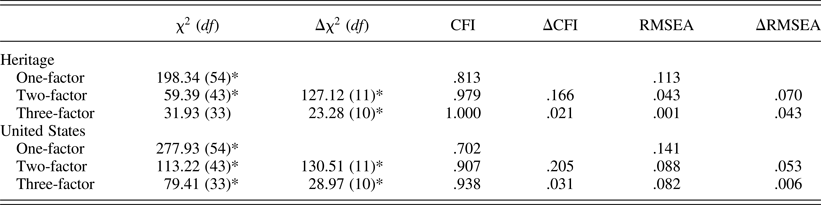
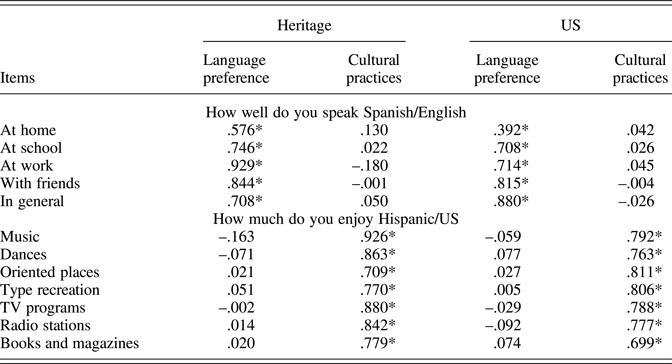
Model fit indices indicated two-factor models for both the heritage and US subscales from the BIQ-S (see Table 1). For the heritage subscale, the two-factor model represented a significant improvement over the one-factor model, Δχ2 (11) = 127.12, p < .001, ΔCFI = .166, ΔRSMEA = .070. Although the three-factor model did indicate superior fit compared to the two-factor model, Δχ2 (10) = 23.28, p = .001, ΔCFI = .021, ΔRSMEA = .043, no items loaded significantly on the third factor. Similarly, the two-factor model for the US subscale fit the model significantly better compared to the one-factor model, Δχ2 (11) = 130.51, p < .001, ΔCFI = .205, ΔRSMEA = .053. Although the ΔCFI criteria indicated that the three-factor model provided significantly better fit than the two-factor model, Δχ2 (10) = 28.97, p < .001, ΔCFI = .031, ΔRSMEA = .006, only one item loaded significantly on the third factor. Factor loadings for both the two-factor heritage and US subscales from the BIQ-S are presented in Table 2.
Model fit for exploratory structural equation models for the BIQ-S

Note: BIQ-S, Bicultural Involvement Questionnaire—Short Version. *p < .050.
Factor loadings for the heritage and US subscales of the BIQ-S

Note: BIQ-S, Bicultural Involvement Questionnaire—Short Version. *p < .050.
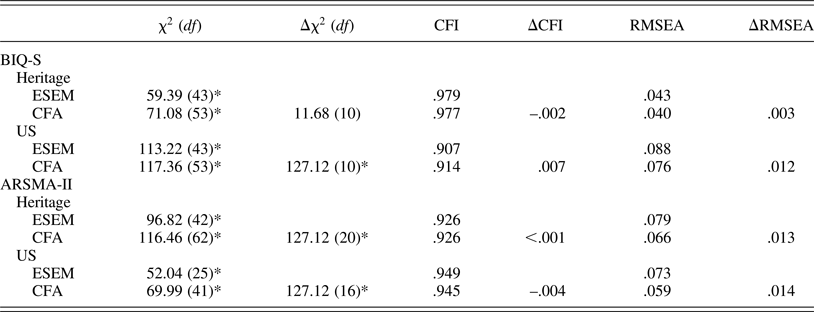
Combined, the two ESEM models indicated a four-factor model for the BIQ-S, composed of heritage language preference (α = 0.86), heritage engagement in cultural practices (α = 0.93), US language preference (α = 0.85), and US engagement in cultural practices (α = 0.92). Although all items were allowed to cross-load, none of the cross-loadings were greater than .30, indicating a simple factor structure or one with no complex items (i.e., items with salient loadings on multiple factors; Sass & Schmitt, Reference Sass and Schmitt2010). To provide greater parsimony, and because subsequent longitudinal invariance models would result in more parameters being estimated than observations in the sample (e.g., invariance for the heritage subscale of the BIQ-S at two time points would result in 165 parameters),Footnote 1 we compared the ESEM models to CFA models, which require fewer parameters because cross-loadings are not estimated. As indicated in Table 3, results indicated no significant differences between the ESEM and CFA model for the heritage subscale, Δχ2 (10) = 11.68, p < .001, ΔCFI = .002, ΔRSMEA = .003, and model fit improved for the CFA model for the US subscale, Δχ2 (10) = 127.12, p < .001, ΔCFI = .007, ΔRSMEA = .012. In addition, the joint heritage and US CFA model for the BIQ-S was associated with acceptable fit, χ2 (246) = 402.845, p < .001, CFI = .920, RSMEA = .055.
Comparison of exploratory structural equation and confirmatory factor analysis models

Note: BIQ-S, Bicultural Involvement Questionnaire—Short Version. ARSMA-II, Acculturation Rating Scale for Mexican Americans II. ESEM, exploratory structural equation model. CFA, confirmatory factor analysis. *p < .050.
Factor structure of the ARSMA-II
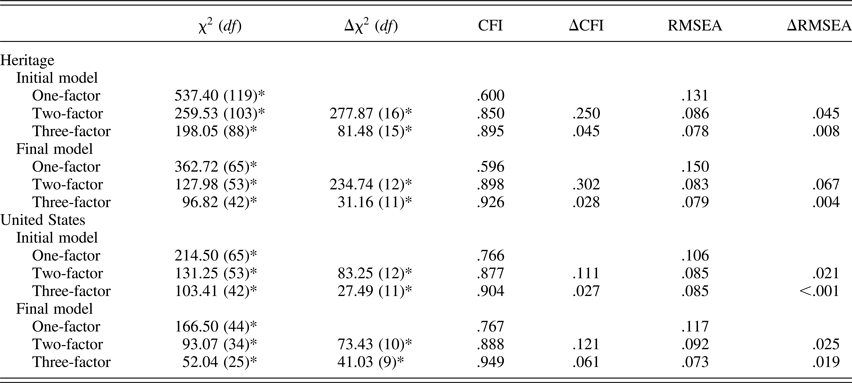
As specified in Table 4, model fit indices indicated poor fit for all models for the heritage subscale of the ARSMA-II. Although the three-factor model provided the best fit, χ2 (88) = 198.05, p < .001, CFI = .895, RSMEA = .078, the third factor was defined solely by Item 14 (“I write in Spanish.”) with a factor loading above 1.00. As a result, we proceeded to reestimate the model without this item. The revised model still indicated the three-factor model provided the best fit, χ2 (75) = 25.23, p < .001, CFI = .902, RSMEA = .076, but several items failed to load on any of the factors. To provide a more parsimonious model, we dropped, in a step-wise fashion, any items that did not significantly load onto any of the factors. Specifically, Item 28 (“I like to identify myself as Latino-American.”) and Item 5 (“I associate with Latinos.”) were dropped from the model. In addition, because Item 17 (“My thinking is done in the Spanish Language.”) significant loaded across all three factors, we also dropped the item from the ARSMA-II heritage subscale. The final ESEM models, reported in Table 4, not only indicated that the three-factor model was associated with acceptable fit, χ2 (42) = 96.82, p < .001, CFI = .926, RSMEA = .079, but also was a significant improvement over the two-factor model, Δχ2 (11) = 31.16, p < .001, ΔCFI = .028, ΔRSMEA = .004.
Model fit for exploratory structural equation models for the ARSMA-II

Note: ARSMA-II, Acculturation Rating Scale for Mexican Americans II.*p < .05.
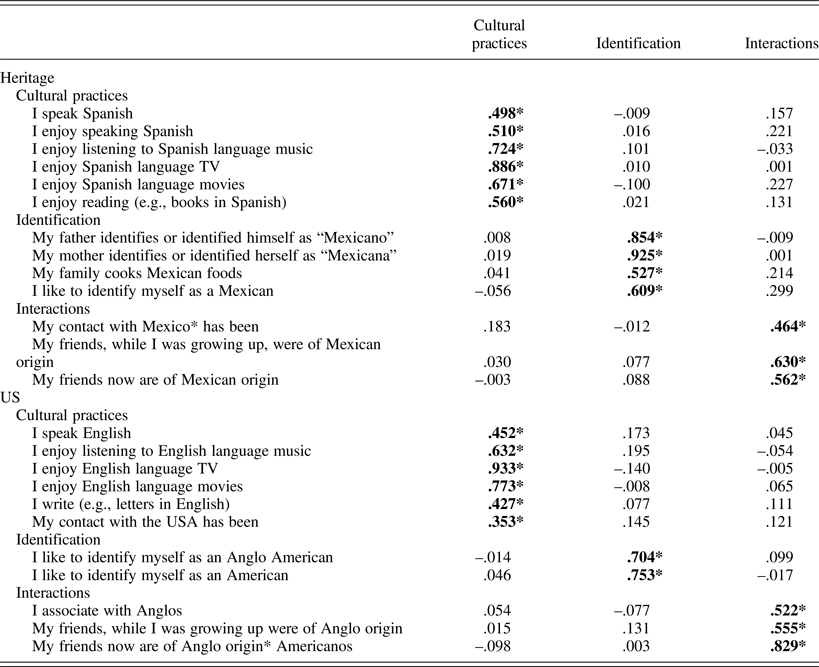
With regard to the ARSMA-II US subscale, and similar to the heritage subscale, fit indices indicated that the three-factor model provided the best fit but was not associated with acceptable fit, χ2 (42) = 103.410, p < .001, CFI = .904, RSMEA = .085. In addition, several items failed to load on any of the factors. Once again, to provide a more parsimonious model, items that did not significantly load on any factor were dropped from the model in a stepwise fashion. Specifically, Items 16 (“My thinking is done in the English Language.”) and 13 (“I enjoy reading books in English.”) were dropped from the model. Once again, the revised ESEM models indicated that the three-factor model was associated with acceptable fit, χ2 (25) = 52.04, p < .001, CFI = .949, RSMEA = .073, and provided a significant improvement over the two-factor model, Δχ2 (9) = 41.03, p < .001, ΔCFI = .061, ΔRSMEA = .019. Factor loadings for the three-factor heritage and US subscales of the ARSMA-II are presented in Table 5.
Factor loadings for the heritage and US subscales of the ARSMA-II

Note: ARSMA-II, Acculturation Rating Scale for Mexican Americans II. *p < .050.
Combined, the two ESEM models indicated a six-factor model composed of engagement in heritage cultural practices (α = 0.85), heritage identifications (α = 0.62), interactions with heritage-cultural peers (α = 0.85), engagement in US cultural practices (α = 0.81), US identifications (α = 0.63), and interactions with US-oriented peers (α = 0.71). Although all items were allowed to cross-load, none of the cross-loadings were greater than |.3|, indicating a simple factor structure with no complex items. Once again, we compared ESEM and CFA models to reduce the number of parameters to be estimated in subsequent analysis. As indicated in Table 3, results not only indicated that the CFA models were associated with better fit for both the heritage, Δχ2 (20) = 127.12, p < .001, ΔCFI < .001, ΔRSMEA = .013, and the US, Δχ2 (16) = 127.12, p < .001, ΔCFI = .004, ΔRSMEA = .014, subscales, but the joint heritage and US CFA model for the BIQ-S was associated with acceptable fit, χ2 (235) = 371.01, p < .001, CFI = .908, RSMEA = .053.
Step 2: Establishing longitudinal invariance
Next, given the absence of significant differences between ESEM and CFA models (as indicated in Table 3), we tested for longitudinal invariance using the traditional CFA approach. CFA models are more restrictive than CFA models, and require fewer parameters, because cross-loadings are not estimated.
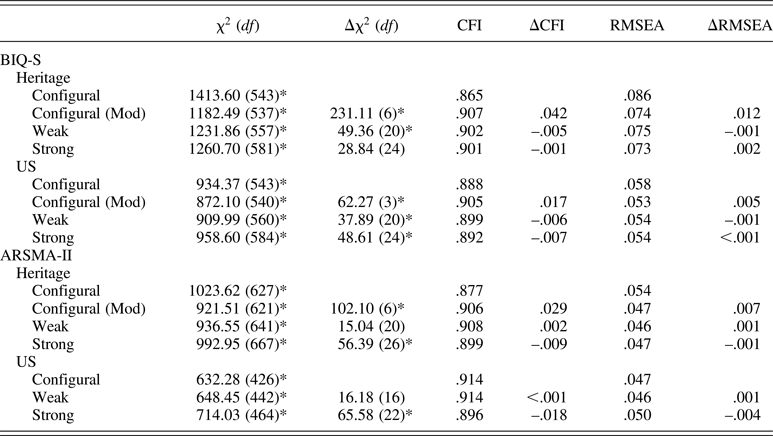
Longitudinal invariance for the BIQ-S
As indicated in Table 6, starting with the BIQ-S heritage subscale, the configural model was associated with poor fit, χ2 (543) = 1,413.60, p < .001, CFI = .865, RSMEA = .086. Per modification indices, we estimated covariances between Items 25 (“How much do you enjoy Hispanic/Latino oriented places?”) and 26 (“How much do you enjoy how Hispanics/Latinos spend free time?”), as well as between Items 23 (“How much do you enjoy Hispanic/Latino music?”) and 24 (“How much do you enjoy Hispanic/Latino dances?”). The modified configural model was associated with acceptable fit, χ2 (537) = 1,182.49, p < .001, CFI = .907, RSMEA = .074. Building on this model, we examined metric invariance by constraining factor loadings to equality across time and comparing this model against the configural invariance model. The assumption of metric invariance was satisfied, Δχ2 (20) = 49.36, p < .001, ΔCFI = .005, ΔRMSEA = .001. Next, we examined scalar invariance by constraining both intercepts and factor loadings to equality across time and comparing this model against the metric invariance model. The assumption of scalar invariance was supported, Δχ2 (24) = 28.84, p = .226, ΔCFI = .001, ΔRMSEA = .002.
Longitudinal Invariance for the BIQ-S and the ARSMA-II

Note: BIQ-S, Bicultural Involvement Questionnaire—Short Version. ARSMA-II, Acculturation Rating Scale for Mexican Americans II. Mod, Modified Configural Model. *p < .050.
Similar to the findings for the heritage subscale, the initial configural model for the BIQ-S US subscale did not provide acceptable fit, χ2 (543) = 934.37, p < .001, CFI = .888, RSMEA = .058. Per modification indices, a covariance between Items 32 (“How much do you enjoy American-oriented places?”) and 33 (“How much do you enjoy American type recreation?”) was estimated. The modified configural model was associated with acceptable fit, χ2 (540) = 872.10, p < .001, CFI = .907, RSMEA = .074. Building on this model, the assumptions of metric, Δχ2 (20) = 37.89, p = .009, ΔCFI = .006, ΔRMSEA = .001, and scalar, Δχ2 (20) = 48.61, p = .002, ΔCFI = .007, ΔRMSEA < .001, invariance were satisfied.
Longitudinal invariance for the ARSMA-II
For the ARSMA-II heritage subscale, the configural model was associated with poor fit, χ2 (627) = 1,023.62, p < .001, CFI = .877, RSMEA = .054. Per modification indices, covariances between Items 1 (“I speak Spanish.”) and 3 (“I enjoy speaking Spanish.”) as well as Items 20 (“My father identifies or identified himself as Mexicano or from his country of origin, such as Peruvian, Guatemalan.”) and 21 (“My mother identifies or identified herself as Mexicana or from her country of origin, such as Peruvian, Guatemalan.”) were estimated. The modified configural model was associated with acceptable fit, χ2 (621) = 921.51, p < .001, CFI = .906, RSMEA = .047. Building on this model, the assumptions of metric, Δχ2 (20) = 15.04, p = .774, ΔCFI = .002, ΔRMSEA = .001, and scalar, Δχ2 (26) = 56.39, p < .001, ΔCFI = .009, ΔRMSEA = .001, invariance were satisfied.
With regard to the US subscale, the configural model was associated with acceptable fit, χ2 (426) = 632.28, p < .001, CFI = .914, RSMEA = .047. Building on this model, the assumptions of metric invariance was satisfied, Δχ2 (16) = 16.18, p = .441, ΔCFI > .001, ΔRMSEA = .001. The assumption of scalar invariance was not satisfied, Δχ2 (22) = 65.58, p < .001, ΔCFI = .018, ΔRMSEA = .004. We therefore sought to identify items that violated the assumption of scalar invariance. Following recommendations by Cheung and Rensvold (Reference Cheung and Resnvold2002), we began with the least restrictive model and proceeded by constraining one intercept at a time, examining the change in the CFI and RMSEA indices. Results indicated none of the individual item intercepts could be considered nonequivalent, indicating partial scalar invariance. We therefore saved the factor scores back to the data set and proceeded with linear growth curve models (Dimitrov, Reference Dimitrov2010).
Step 3: Linear growth curve modeling
Our next step of analysis was to estimate linear growth curve models for the BIQ-S and ARSMA-II. Given the number of parameters and our sample size, we estimated dual-process (heritage and US) models for each pair of corresponding subscales from the BIQ-S and from the ARSMA-II (i.e., BIQ-S language preference and cultural practices; ARSMA-II cultural practices, identifications, and interactions with peers). We therefore estimated a total of five latent growth models. Because statistical tests of model fit in Mplus for latent growth curve models apply the incorrect null model (Widaman & Thompson, Reference Widaman and Thompson2003), we began with an intercept-only model for both heritage and US subscales. Building on this model, we estimated a dual-process linear growth curve model by adding slope estimates for both heritage and US subscales. We then compared the intercept-only against the dual-process models utilizing the CFI (ΔCFI > .010) and RMSEA (ΔRMSEA > .010) to determine significant change in model fit (Little, Reference Little2013). In all growth models, the intercept was set at baseline.
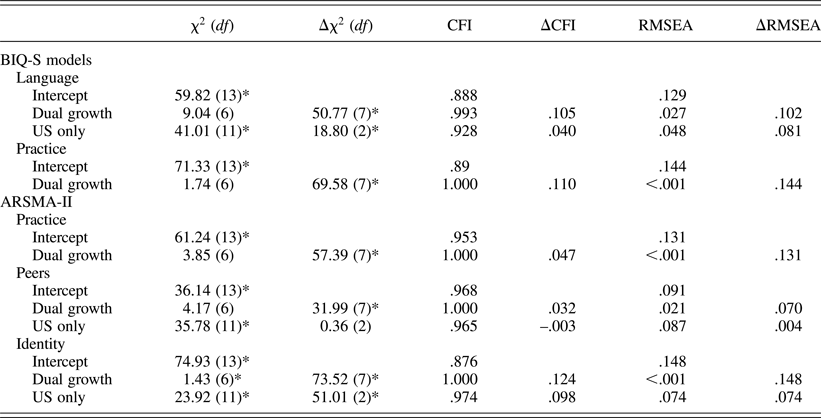
As indicated in Table 7, although results indicated that a dual growth curve model for the BIQ-S language subscale provided significantly better fit, Δχ2 (7) = 50.77, p < .001, ΔCFI = .105, ΔRMSEA = .102, compared to the intercept-only model, there was no significant variance around the heritage slope term and the residual variance was negative. As a result, we opted for a US-growth and heritage intercept-only model for the language preference subscale of the BIQ-S, which also provided significantly better fit than the intercept-only model, Δχ2 (2) = 18.80, p < .001, ΔCFI = .040, ΔRMSEA = .081. With regard to the BIQ-S cultural practice subscale, results indicated that the linear growth curve models fit the data better than the intercept-only model, Δχ2 (7) = 69.58, p < .001, ΔCFI = .110, ΔRMSEA = .144.
Model comparison for latent growth curve models for the BIQ-S and ARSMA-II

Note: BIQ-S, Bicultural Involvement Questionnaire—Short Version. ARSMA-II, Acculturation Rating Scale for Mexican Americans II. *p < .050.
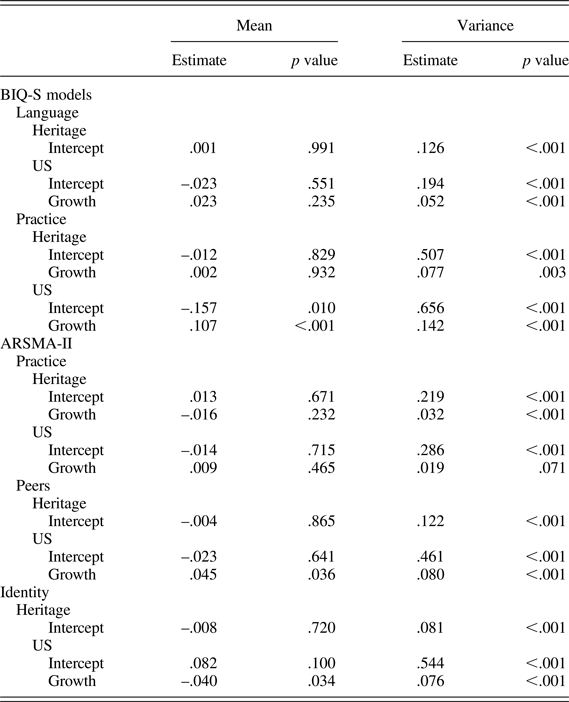
The linear growth curve model fit the data better than intercept-only model for the ARSMA-II cultural practice subscale, Δχ2 (7) = 57.39, p < .001, ΔCFI = .047, ΔRMSEA = .131, as well. Similar to the BIQ-S language subscale, although the dual linear growth curve models were associated with significantly better fit than the intercept-only models for the ARSMA-II interactions with peers, Δχ2 (7) = 31.99, p < .001, ΔCFI = .032, ΔRMSEA = .070, and identification, Δχ2 (7) = 73.52, p < .001, ΔCFI = .124, ΔRMSEA = .148, subscales, there was no significant variance around the heritage slope terms for either model. As a result, we estimated US-growth and heritage intercept-only models for both subscales. For the identification subscale, the US-growth and heritage intercept-only provided significantly better fit than the intercept-only model, Δχ2 (2) = 51.01, p < .001, ΔCFI = .098, ΔRMSEA = .074. Although there was no significant difference between the intercept-only and the US-growth and heritage intercept-only for the interactions with peers subscale, Δχ2 (2) = 0.36, p = .836, ΔCFI = .003, ΔRMSEA = .087, results indicated significant variability around the US slope term. For this reason, we retained the US-growth and heritage intercept-only model for the ARSMA-II interactions with peers subscale as well. Table 8 presents average intercept and growth parameters (when applicable) as well as variance around these parameters. For the BIQ-S, results indicated significant and positive change in US cultural practices (Slopemean = .107, p < .001). For the ARSMA-II, results indicated significant increase in interaction with US-oriented peers (Slopemean = .045, p = .036) coupled with a significant decline in US identification (Slopemean = –.040, p = .034).
Growth parameters for BIQ-S and ARSMA-II heritage and US subscales

Note: BIQ-S, Bicultural Involvement Questionnaire—Short Version. ASRMA-II, Acculturation Rating Scale for Mexican Americans II.
Step 4: Cross-measure predictive validity
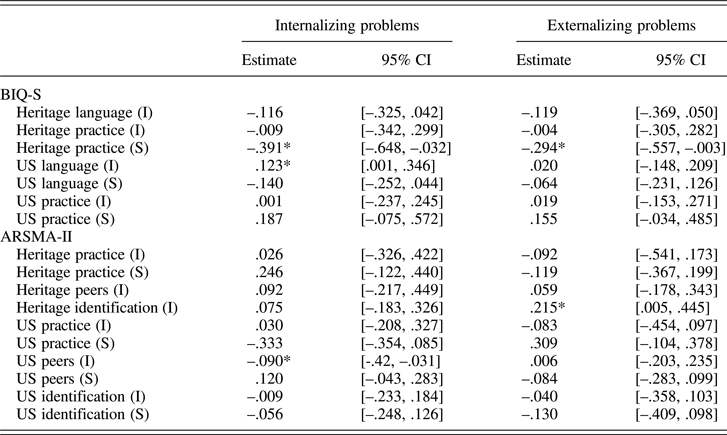
We then estimated a model where intercepts and slopes for the BIQ-S and ARSMA-II were allowed to predict internalizing and externalizing problem behavior, controlling for baseline scores on these outcomes. Given the number of parameters and the modest sample size, we saved the growth parameters and used them as observed variables in subsequent model tests. Ram et al. (Reference Ram, Chow, Bowles, Wang, Grimm, Fujita and Nesselroade2005) report that saved values of intercepts and slopes correlate almost perfectly (r = .98) with their latent counterparts. Standardized path estimates are displayed in Table 9. Results indicated that, for the BIQ-S, change in heritage cultural practices was protective against internalizing, β = –.391, p = .026, 95% confidence interval (CI) [–.648, –.032] and externalizing problems, β = –.294, p = .047, 95% CI [–.557, –.003]. In essence, greater heritage culture retention, as indicated by the BIQ-S, was protective against externalizing problem behaviors. In contrast, the intercept for English preference was positively associated with internalizing problems, β = .123, p = .045, 95% CI [.001, .346]. With regard to the ARSMA-II, results indicated that the intercept for heritage identification was positively associated with externalizing problems, β = .215, p = .026, 95% CI [.005, .445], whereas the intercept for interaction with US-oriented peers was negatively associated with internalizing problems, β = –.090, p = .025, 95% CI [–.420, –.031].
Cross measure predictive validity of the BIQ-S and the ARSMA-II

Note: BIS-Q, Bicultural Involvement Questionnaire—Short Version. ASRMA-II, Acculturation Rating Scale for Mexican Americans II. I, intercept. S, slope. *p < .050.
Discussion
Epidemiological studies have indicated that Latino youth, compared with Black and non-Latino White youth, are at significantly greater risk for internalizing and externalizing problems (Kann et al., Reference Kann, Kinchen, Shanklin, Flint, Harris and Lowry2014). As a result, within the field of developmental psychopathology, there has been a growing recognition of the need to explore the critical importance of sociocultural factors on mental illness (Causadias, Reference Causadias2013). Toward this end, a growing body of research has explored the effect of acculturation and enculturation processes on variety of indicators of adjustment among Latino youth. However, studies linking acculturation and enculturation processes to mental health, including internalizing and externalizing problems, have provided inconsistent findings. Such inconsistencies have been attributable to the measurement instruments used to assess acculturation and enculturation (López, Reference López2009), both in terms of unidimensional-bidimensional orientation and in terms of the specific contents included within a given instrument. Thus, before research can attend to the role of acculturation and enculturation in explaining mental health disparities within Latino youth, it is necessary for studies to explore potential strengths and weaknesses of current measures (Causadias, Reference Causadias2013).
Toward this end, the goal of the current study was to provide longitudinal empirical attention to the psychometric properties of the BIQ-S and the ARSMA-II. We utilized ESEM to establish psychometric validity for both the BIQ-S and the ARSMA-II and to ensure that the identified factor structure was consistent across time. In addition, we utilized latent growth curve modeling to identify change across BIQ-S and ARSMA-II dimensions and ascertain the degree to which growth parameters of heritage and US acculturation within both measures relate to youth internalizing and externalizing problems.
Psychometric properties of the BIQ-S and the ARSMA-II
As previously noted, psychometric evaluations of the BIQ-S or the ARSMA-II, especially together, have been sparse. As a whole, our results supported factor structures inconsistent with the initial conceptual factor structures of the BIQ-S (Szapocznik et al., Reference Szapocznik, Kurtines and Fernandez1980) and the ARSMA-II (Cuéllar et al., Reference Cuéllar, Arnold and González1995). With regard to the BIQ-S, results indicated a four-factor structure composed of comfort with Spanish, comfort with English, enjoyment of Latino cultural activities, and enjoyment of US cultural activities. Although this factor structure was not consistent with the initial conceptual factor structure composed by Szapocznik et al. (Reference Szapocznik, Kurtines and Fernandez1980), it does provide further evidence for a four-factor model found in recent psychometric studies (see Guo et al., Reference Guo, Suárez-Morales, Schwartz and Szapocznik2009).
In terms of the ARSMA-II, as previously noted, no study to date has established the full psychometric validity of the full 30-item scale. Contrary to the initially hypothesized two-factor model (i.e., heritage and US orientation), ESEM models indicated a six-factor structure composed of heritage and US cultural practices, identity, and interactions with peers. Despite the lack of consistency with the conceptual factor structure, differentiation among various components of acculturation is consistent with a growing acknowledgment that acculturation is not only bidimensional in terms of cultural streams but also extends across multiple domains (e.g., language use, customs, identity, etc.; Kang, Reference Kang2006; Schwartz et al., Reference Schwartz, Unger, Zamboanga and Szapocznik2010). However, it should be noted that, unlike the BIQ-S, for which we were able to retain all items, several items from the ARSMA-II did not load on any of the factors and were dropped. Moreover, the final factor structure for the ARSMA-II included a three-item factor for heritage identification and a two-item factor for US identification. Although the strength of the ARSMA-II lies in its capacity to measure various components of acculturation, this breadth may increase the difficulty of extracting clear factor solutions using this measure.
In many respects, longitudinal factorial invariance is one of the most important empirical questions to address (Little, Reference Little2013). Before any longitudinal analyses can be conducted, it is important to ensure any observed longitudinal change is a result of true developmental change, rather than change in the structure of the measure (Brown, Reference Brown2015). Despite shortcomings in the initially hypothesized factor structure of the ARSMA-II, the assumption of longitudinal invariance held for all subscales of the BIQ-S and the ARSMA-II. These findings indicate that the four-factor and six-factor BIQ-S and ARSMA-II solutions, respectively, are not only structurally consistent across time (i.e., configural invariance) but also functionally similar over time in that the expected relations between the measured indicators and the underlying latent constructs are consistent over time (Little, Reference Little2013).
Longitudinal change in BIQ-S and ARSMA-II heritage and US subscales
Utilizing latent growth curve modeling, we also sought to identify change across the heritage and US subscales of the BIQ-S and ARSMA-II. Providing further evidence for the lack of concordance between the BIQ-S and the ARSMA-II, our results indicated distinct patterns of change across the two measures. For the BIQ-S, results indicated significant increases in the degree to which youth engage in US cultural practices. As a whole, this finding is consistent with prior work indicating significant changes in engagement in comfort with English and in US cultural practices. Cultural practices, as a whole, are likely to be among the first domains of acculturation to change (Schwartz, Vignoles, Brown, & Zagefka, Reference Schwartz, Vignoles, Brown, Zagefka, Benet-Martinez and Hong2014), given that adolescents are exposed and socialized to US culture through participation in the school system (Padilla, Reference Padilla2006). Consistently, prior studies have indicated a general trend toward adoption of US cultural practices following immigration (e.g., Knight, Roosa, & Umaña-Taylor, Reference Knight, Roosa and Umaña-Taylor2009; Schwartz, Unger, Zamboanga, et al., Reference Schwartz, Unger, Zamboanga, Cordova, Mason, Huang and Szapocznik2015). In contrast, change in the US cultural practices subscale of the ARSMA-II was nonsignificant. The differences in these growth patterns may be due to a number of factors. Although the BIQ-S differentiates language use from other cultural practices (e.g., listening to American music), the ARSMA-II does not make this distinction. Conflating these two processes may explain the lack of significant growth within the ARSMA-II US cultural practices subscale.
At the same time, results from the ARSMA-II did indicate a tendency to associate with Americanized peers over time. These results may suggest that, although youth may be associating with Americanized peers, they evidence limited change in terms of cultural practices. However, these findings are in opposition to those highlighted by the BIQ-S. It should also be noted that, and contrary to previous studies within states that have long been established as immigrant receiving contexts (i.e., California, New York, Texas, Florida, Illinois, and New Jersey) that have found a general trend towards greater US identification over time (Schwartz, Unger, Zamboanga, et al., Reference Schwartz, Unger, Zamboanga, Cordova, Mason, Huang and Szapocznik2015), the present results, obtained from Oregon, indicate a significant decline in ARSMA-II US identification scores over time. This negative trend may be unique to immigrant youth in Oregon and/or immigrants in new receiving states with less experience with Latino immigration (cf. Schwartz & Unger, Reference Schwartz and Unger2010). Further research is necessary to explore how youth straddle ethnic and national identifications within these new contexts of reception.
Cross-measure predictive validity
The primary goal of the current study was to build upon Martinez et al. (Reference Martinez, Schwartz, Thier and McClure2018) to establish the equivalence of the BIQ-S and the ARSMA-II longitudinally as they relate to internalizing and externalizing problems. The current findings emphasize that different measures of acculturation are not equivalent in terms of their effects on mental health (Unger et al., Reference Unger, Ritt-Olson, Wagner, Soto and Baezconde Garbanati2007). Specifically, and consistent with Martinez et al. (Reference Martinez, Schwartz, Thier and McClure2018), changes in the BIQ-S heritage cultural practices subscale were negatively associated with internalizing and externalizing problem behaviors. Engaging with the heritage culture in terms of language, media, social relationships, and customs may be important in maintaining ties to one's heritage, which may prevent or reduce anxiety, depressive symptoms, and prodeviant attitudes (Mills & Caetano, Reference Mills and Caetano2010; Saint-Jean, Reference Saint-Jean2010). Despite this, neither the US cultural practice nor the interactions with US-oriented peers subscales from the ARSMA-II were significantly predictive of either internalizing of externalizing problems. Moreover, results indicated that heritage identification, as measured by the ARSMA-II, was positively associated with externalizing problem behaviors. This finding is inconsistent with the extensive literature that has highlighted the protective role of ethnic/racial identity (see Rivas-Drake et al., Reference Rivas-Drake, Seaton, Markstrom, Quintana, Syed and Lee2014) and may be attributable to either the nature of the identification items, which included paternal and maternal identification with ones’ heritage, or the context of reception. Adolescent immigrants in Oregon may have limited models for viewing themselves as Latino to begin with. Additional research is necessary to establish the effectiveness of the ARSMA-II as it relates to predicting mental health outcomes among Latino adolescents.
With regard to US subscales of the BIQ-S and the ARSMA-II, results are mixed. Specifically, as indicated by the BIQ-S, early preference for English was positively associated with internalizing problems. In contrast, as indicated by the ARSMA-II, association with US-oriented peers was negatively associated with internalizing problems. The contradiction in terms of these findings may be rooted in the specific domains encapsulated. A preference to speak English may lead youth to experiences language-based discrimination (e.g., made fun of because of their accent; Romero & Roberts, Reference Romero and Roberts2003). At the same time, an early preference and competency for English may place youth in a position where they are forced to serve as language brokers and translate the English language and interpret cultural practices for their parents (Morales & Hanson, Reference Morales and Hanson2005), which has been found to place youth at risk for internalizing behavior and substance use (Martinez, McClure, & Eddy, Reference Martinez, McClure and Eddy2009). In contrast, an early orientation toward more American peers, as measured by the ARSMA-II, may buffer against stress by establishing positive school-based peer relations. Future research is necessary to explore the relations between these specific components of acculturation.
A substantial literature employing unidimensional (or straight-line assimilation) approaches (Gordon, Reference Gordon1964) have often indicated that “greater” acculturation is positively associated with problematic outcomes, a phenomenon known as the immigrant paradox (Schwartz et al., Reference Schwartz, Unger, Zamboanga and Szapocznik2010). However, such approaches do not allow us to ascertain whether these effects are due to adoption of the receiving culture or to loss (or rejection) of one's family's cultural heritage. Consistent with a growing literature employing bidimensional models of acculturation, our study provides further correlational evidence that loss of one's heritage practices, values, and identifications poses a greater risk for mental health than adoption of US cultural practices, values, and identifications (see Schwartz et al., Reference Schwartz, Unger, Baezconde-Garbanati, Zamboanga, Córdova, Lorenzo-Blanco and Szapocznik2016).
Limitations and future directions
The present results should be interpreted in light of several limitations. First, data from the current study was derived from solely one settlement context. As previously noted, Oregon represents a new receiving community for immigrants as opposed to the more traditional immigrant settlement state (e.g., California, Texas, and Florida). As noted by Causadias (Reference Causadias2013), research suggests that individuals mobilize their cultural repertoire in response to different social and cultural environments. As a result, it is difficult to identify whether the current findings are unique to immigrants in new receiving communities. This being said, more research is needed that considers acculturation measurement in these new receiving contexts. Specifically, more comparative studies are necessary to explore the psychometric properties of the BIQ-S and the ARSMA-II in a diverse array of settlement communities. Second, it should also be noted that using only three waves of data prevented us from exploring quadratic change. Moreover, previous studies have indicated that some acculturation and enculturation processes do not always follow a linear trend (Schwartz, Unger, Zamboanga, et al., Reference Schwartz, Unger, Zamboanga, Cordova, Mason, Huang and Szapocznik2015). In addition, the small sample size, particularly within the time-in-residence groups, also limited our capacities to explore the psychometric properties of the BIQ-S and the ARSMA-II, and to establish potentially meaningful differences in the links between these measures and mental health outcomes, within and across the three time-in-residence groups. Large heterogeneity in age at baseline, coupled with the small sample size, is also an important limitation. As noted by Mehta and West (Reference Mehta and West2000), when participants begin a study at different ages, traditional longitudinal models may produce biased estimates for the variance of the intercept and for the covariance between the intercept and slope factors. Future studies, with larger sample sizes, are needed to explore how acculturation and enculturation processes impact externalizing and internalizing problems across early, middle, and late adolescence.
The current study also did not include measures of positive outcomes, making it difficult to ascertain the degree to which acculturation and enculturation processes may be linked to positive youth development. Consistent with the recommendations of García Coll et al. (Reference García Coll, Lamberty, Jenkins, McAdoo, Crnic, Wasik and Vázquez García1996), future studies are necessary to explore how acculturation and enculturation processes are related to positive outcomes. It should also be noted that the current study focused on establishing the cross-measure predictive validity solely for two measures of acculturation. Although the BIQ-S and the ARSMA-II, two of the most prominent measures used with Latin American and Spanish-speaking Caribbean ancestry groups in the United States (Jones & Mortimer, Reference Jones and Mortimer2014; Unger et al., Reference Unger, Ritt-Olson, Wagner, Soto and Baezconde Garbanati2007), it is important for future studies to explore the strengths and weaknesses of other measures of cultural adaptation, such as the Mexican American Cultural Values Scale (Knight et al., Reference Knight, Gonzales, Saenz, Bonds, Germán, Deardorff and Updegraff2010). Finally, our focus solely on self-report measures of individual-level cultural processes also presents a limitation. Although comparative measurement issues within self-report measures of cultural cognitions is an important step in advancing the validity and reliability in the measurement of culture, future research should further pursue the development of alternative methods to self-report data in assessing individual-level cultural processes (Causadias, Reference Causadias2013).
Despite these limitations, the current study includes several notable contributions to our understanding the links between cultural processes and developmental psychopathology. Results with the BIQ-S provided further evidence that loss of one's heritage culture poses a greater risk for mental health problems than does adoption of US cultural practices and identifications. On that note, the differential effects between the BIQ-S and the ARSMA-II vis-à-vis internalizing symptoms and externalizing problems provides further evidence for our contention that measures of acculturation are not interchangeable as they relate to mental health. Finally, the factor structures we identified for the BIQ-S and the ARSMA-II emphasize the need for further psychometric evaluations of current acculturation measures, an area that has received insufficient attention (Doucerain et al., Reference Doucerain, Segalowitz, Ryder, Schwartz and Unger2017; Martinez et al., Reference Martinez, Schwartz, Thier and McClure2018). In sum, the present study represents an important step forward in comparative measurement issues within the field of acculturation as it relates to internalizing symptoms and externalizing behaviors.