Bioethics and Mid-Level Principles
Bioethics in all its forms relies heavily on principles, understood as authoritative statements with prescriptive power. Some forms of professional ethics—medical ethics, nursing ethics, social work ethics, and the like—emphasize, instead, character forming and virtue education, but rules and ideals are still needed for clarity and reflection. Some aspects of healthcare ethics—understood as good governance of health-related services—are dominated by political negotiations, but even these negotiations are ideally guided by moral standards, and they normally generate rules and instructions for practical work. Environmental ethics, species ethics, and life ethics in general may claim values—as opposed to rules—as their foundation, but they have also produced and utilized the principles of biodiversity, precaution, stewardship, and many others. And research ethics has its origins in the Nuremberg code, a set of ten rules;Footnote 1 and was taken further by the Declaration of Helsinki, currently a set of 37 guidelines;Footnote 2 and by the Belmont Report, the starting point of principlism in contemporary bioethics, with its three basic ethical principles.Footnote 3
The authoritative statements with prescriptive power in bioethics and its affiliated fields come in many guises. Lofty ideals concerning human life and its value, the proper arrangement of social and political life, and humanity’s relationship with other kinds of entities (animals and plants, ideologies and religions) always provide the background premises of bioethical considerations. The end results of legal and policy discussions are often presented as advice (“It would be wise for you to do X and to avoid Y.”), orders (“Do X, or else!”), and prohibitions (“Don’t do Y, or else!”); or permissions and licenses (“Exceptionally, you are allowed to do Z.”) and regulations (“You are allowed to do Z, provided that you follow certain specified guidelines.”). For professionals, the guidance often takes the form of rules (“When in doubt, consult a colleague!”) and principles (“A good healthcare professional respects the self-determination of patients.”).
Arguably the most convenient tools in practical bioethics decision making are mid-level principles. These are not fundamental moral norms (which are too clumsy for real-life use), but not exactly-defined action-guiding rules or particular contextual judgments, either.Footnote 4 A set of mid-level principles is a check-list of concerns that need to be taken into account when important decisions regarding people’s lives are made. The set does not necessarily give straightforward answers to problematic questions, but if it is a good fit for the culture in which it is applied, it can help professionals and their support personnel to reach conclusions that are acceptable to all those affected.
Three main sets of principles present themselves in the context of bioethics. The first set was expressed in The Belmont Report and then developed by Tom Beauchamp and James Childress.Footnote 5 According to this model, we should do good (beneficence), avoid causing harm (nonmaleficence), respect persons (autonomy), and act fairly and equitably (justice).Footnote 6 The second and third sets can be construed by observing criticisms against the pragmatic “American” approach.Footnote 7 Suggested principles in some quarters—the second set here—include precaution (“Do not launch hazardous new schemes unless they can be scientifically proven to be safe!”),Footnote 8 subsidiarity (“Do not interfere with the workings of lower-level operators if they can manage by themselves!”),Footnote 9 and solidarity (“Recognize your duty to share the burden of helping those in need in your community!”).Footnote 10 And the third set, strongly influenced by religious thinking, introduces the principles of dignity and vulnerability.Footnote 11
The principles in all three sets are interrelated. The beneficence of The Belmont Report is divided by Beauchamp and Childress into beneficence and nonmaleficence, and then united again in the other models under precaution or vulnerability, emphasizing the avoidance of harm. Subsidiarity is the expression of autonomy on an institutional level: federal or wider regional governments should not meddle in affairs that can be run by states or even smaller units in civil societies. Dignity and autonomy are in some philosophical theories thought to be two sides of the same coin. And the principles of solidarity and justice, and partly also dignity, all remind us to treat each other equally and humanely, although the stress may be on different aspects in different approaches.
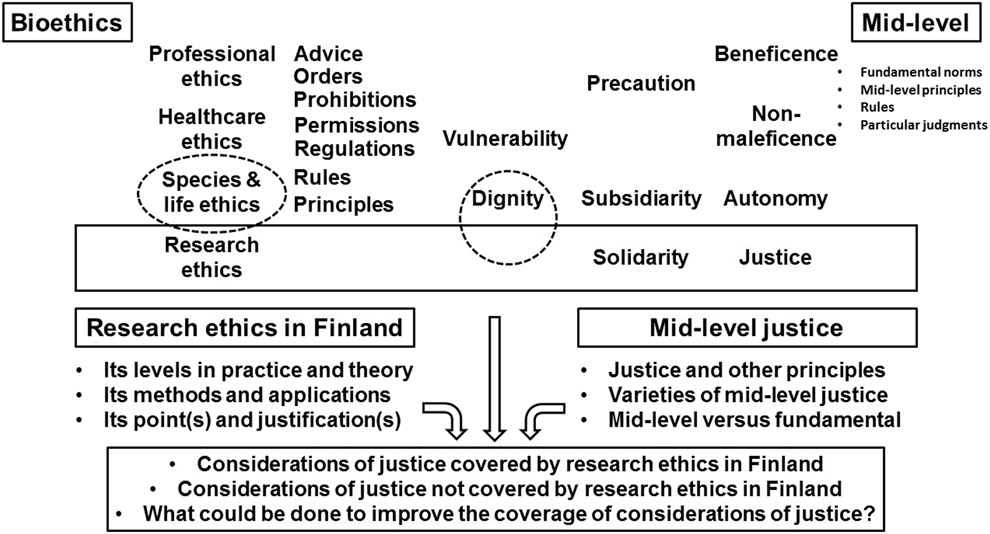
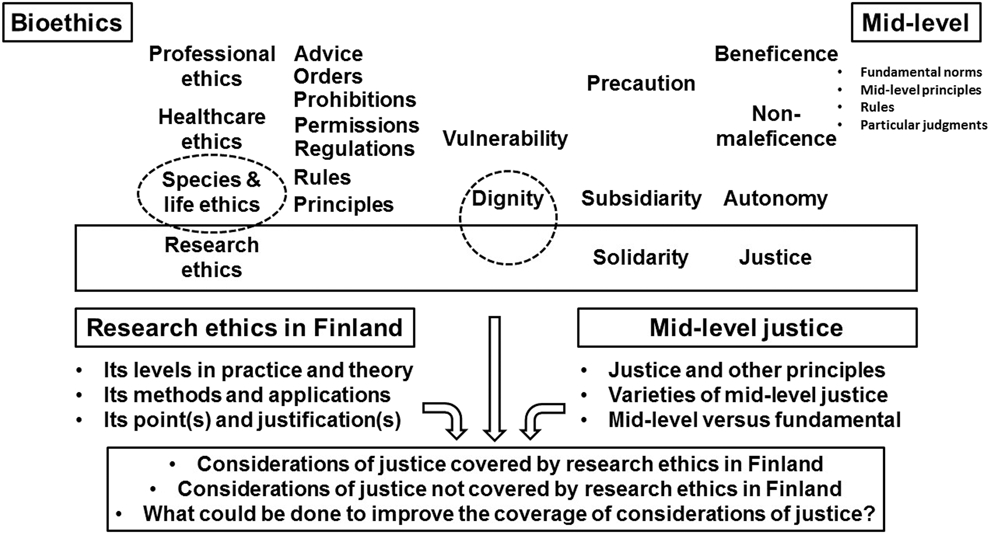
In the following, research ethics in Finland is examined from the viewpoint of justice. Research ethics in Finland—its levels in practice and theory; its methods and applications; and its point(s) and justifications—is first described. Mid-level justice will then be clarified by comparisons with other principles; by an exploration of the varieties of mid-level justice; and by a juxtaposition of mid-level and fundamental moral and political deliberations. These preliminaries will lead to an inquiry into which considerations of justice are, and which are not covered by research ethics in Finland; and to some suggestions as to what more could be done to improve the coverage. The course of the considerations so far is summarized in Figure 1.
Bioethics, principles, and research ethics in Finland.
Research Ethics in Finland
Practical Regulation
Research ethics has developed in Finland hand in hand with international developments in the field.Footnote 12 The official institutional starting point of international research ethics is the Nuremberg Code (1947), widely ignored at first, but currently ranked among the most influential documents in biomedical ethics with the Declaration of Helsinki (1964), which can be seen as its successor. After the publication of the latter statement, bearing the name of Finland’s capital city, civil servants, politicians, and the Finnish Medical Association gradually began to pay attention to the issues raised. A quarter of a century later, Finland commenced more explicit legislative changes that led to the establishment of the current national ethics boards. The interplay between national and international trends, motivations and actions in the creation of these boards has been examined in detail by Jukka Syväterä. According to his analysis, all countries that have founded national bioethics committees (there are over a hundred so far) have left their mark on the existing global model. Against commonly held belief, these nations have not just copied a ready-made international structure, but played, in a general spirit of progress and modernization, an active part in producing and shaping it.Footnote 13
Ritva Halila, a recognized expert on Finnish ethics committees, has summarized neatly the goals and tasks of the national boards that had emerged by the beginning of the millennium.Footnote 14
The Finnish Advisory Board on Research Integrity (TENK, founded 1991) monitors international developments, collects information on research ethics, gives expert opinions and promotes awareness of the issues among the scientific community and the general public, and makes initiatives in the field, including proposals to ministries and the government.Footnote 15 It has also issued instructions for responsible conduct in research and guidelines for handling allegations of misconduct.Footnote 16
The Advisory Board on Biotechnology (BTNK, 1995)Footnote 17 “promotes communication between authorities and researchers in the field, follows the development of environmental effects and risk assessment, […] advances information and education in the field of gene technology [and] monitors and promotes international co-operation on biotechnology.”Footnote 18
The Board for Gene Technology (GTLK, 1995)Footnote 19 aims “to promote the safe and ethically acceptable use of genetically modified organisms, and to prevent and avert any harm this use may inflict on human health, animals, property, or the environment.”Footnote 20 It is also the competent national authority in its field at the European Union level.
The National Advisory Board on Social Welfare and Health Care Ethics (ETENE, 1998)Footnote 21 “follows the development of healthcare and related technologies from an ethical point of view,” “collects and shares information about ethics and international debate,” “takes initiatives, issues statements and recommendations,” and “initiates public discussion on ethical questions in healthcare.”Footnote 22 Although this Advisory Board has an expert position in national healthcare legislation, legally binding national decisions do not belong to its remit.
The National Committee on Medical Research Ethics (TUKIJA), originally for eleven years the Subcommittee on Medical Research Ethics for the National Advisory Board on Health Care Ethics (also TUKIJA, 1999),Footnote 23 gained independent status through legislative changes in 2010.Footnote 24 It serves “as an expert on research ethics”; monitors, steers, and coordinates “the processing of issues related to research ethics”; releases “national opinions on clinical trials on medicinal products, unless the duties are delegated to regional ethics committees”; gives “opinions on previously rejected trial proposals to regional ethics committees where these are resubmitted unchanged”; issues “opinions on the conditions for establishing a biobank”; supports and coordinates “the activities of regional ethics committees regarding the procedures for requesting opinions and matters of ethical principle including provision of related training”; participates “in international cooperation on research ethics between authorities”; gathers and conveys “information on research ethics issues” and provides “information on the international debate on research ethics in the form of publications, training sessions and other such activities”; and promotes “public debate on medical [and] biomedical research.”Footnote 25
The Animal Experiment Board (ELLA, 2013)Footnote 26 was established, following changes in European Union regulations,Footnote 27 to authorize animal experiments in Finland. Other tasks related to animal welfare, previously covered by the Co-Operation Group for Laboratory Animal Sciences (KYTÖ, 2001–2010),Footnote 28 were at the same time taken over by the Council on the Protection of Animals Used for Scientific and Educational Purposes (TOKES, 2013).Footnote 29 The main responsibility of the Council is to promote the 3Rs—i.e., the principles of Replacement, Reduction and Refinement in animal experimentation and teaching use.Footnote 30
Ethics committees and institutional review boards in Finland operate on many levels—university, hospital district, facility, and so on—and laws, common sense, and guidelines issued and training offered by the national bodies provide the foundations of their work. All medical research must be authorized by one of the six regional ethics committees in the country, overseen by the National Committee on Medical Research Ethics. All planned clinical drug trials have to be reported to the national committee, and it will then either process the proposal itself or assign it to a regional committee. Interventional clinical drug trials require a notification to the Finnish Medicines Agency (FIMEA).Footnote 31 Animal experiments need a project license issued by one of the four sections of the Animal Experiment Board or, in case of disagreement, by the entire Board in their joint meeting; and a personal license confirming that the ones performing animal experiments are competent operators in the field.Footnote 32 The creation and use of genetically modified organisms require a notification to and an acceptance by the Board for Gene Technology. The notification and acceptance procedure is tailored for different cases: contained microorganisms,Footnote 33 plants,Footnote 34 and animals;Footnote 35 and field trials involving the release of the organisms into the natural environment.Footnote 36
As an interesting detail, research on human embryos, an internationally debated practice, is not straightforwardly regulated in Finland. Embryos can, according to the Medical Research Act Footnote 37 be used, with the consent of the embryo or gamete donors, up until 14 days from their creation, which is on par with most international standards. An ambiguity is produced, however, by the definition of an embryo in the act as “a living group of cells resulting from fertilization not implanted in a woman’s body.” As notified by all the major national bioethics committees (TENK, ETENE, TUKIJA, KYTÖ, BTNK, and GTLK), this fails to account for embryos produced by the notorious nuclear transfer method (i.e., cloning), which means that “therapeutic cloning” and ensuing studies on nuclear transfer method embryos remain unaccounted for in Finnish law.Footnote 38
Ethical review is required in Finland for research in social and behavioral sciences and the humanities, if the research in question interferes with the physical integrity of its subjects; does not operate on informed consent; involves minors in artificial settings without parental supervision; exposes subjects to particularly strong stimuli; may inflict severe mental harm; or threatens the security of its subjects. Additionally, the need for ethical review can arise externally, by the rules of funding bodies, institutional guidelines, or publishers.Footnote 39
Theoretical Work
Ethical questions in medicine, healthcare, and biomedical research are studied in various ministries, usually in collaboration with universities and university researchers. They are also examined, often indirectly, by the personnel of the National Institute for Health and Welfare.Footnote 40 Investigations at the institute standardly concentrate on healthcare and social policy, especially their impact on well-being and existing inequalities. Some studies address issues in research ethics—like the recently completed project, Ethical Review and Administrative Governance of Clinical Research.Footnote 41
Another potential hub for ethical studies in Finland in the future is the Finnish Institute of Bioethics, founded by young researchers at the University of Tampere in 2015.Footnote 42 The Institute aims at raising awareness about bioethics and biolaw in the country, and the academics associated with it are working on several ethics-related themes. Currently, the themes do not include research ethics, and other activities have so far been limited to dissemination of information.
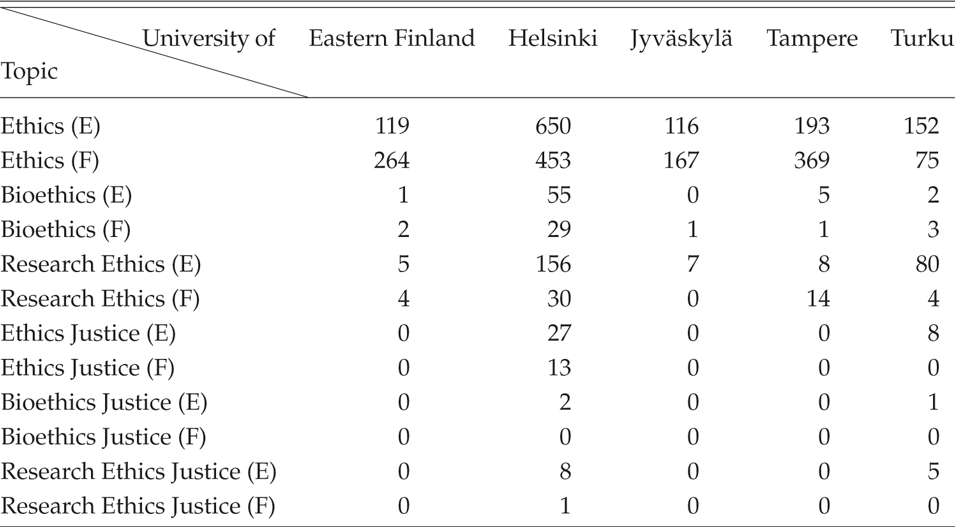
The main operators in the field of theoretical ethics, bioethics, and research ethics are, predictably, university teachers and researchers. A search on the publication databases of Finnish universities turns up hundreds of articles, book chapters, and books on the topics. The search logics may vary, so no far-reaching conclusions can be drawn from the figures, but Table 1 provides the raw results on some focal concepts in English (E) and in Finnish (F).
Publication numbers from university publication data bases in Finland

We followed this very elementary search up by a cursory content analysis of the publications found; by open-ended questionnaires to some of the key persons in bioethics and research ethics in Finland; and by a Google Scholar search and ensuing examination of the researchers whose work showed the most promise for our purpose, i.e., for finding contributions to bioethics or research ethics involving the concept of justice and related notions (equality, equity, solidarity, etc.).Footnote 43
A vast majority of the publications listed in Table 1 were totally irrelevant to us, as could be expected. The words “research” and “ethics” produced an abundance of false positives, referring to either or both in a manner that did not benefit our inquiry. One of the items was an article in the journal Bioethics, regretting in the beginning that for lack of space, the contribution cannot do “justice” to its topic. With some detective work, however, the distribution began to make sense. “Ethics” gets a lot of significant hits in four areas—professional ethics, research ethics, healthcare ethics, and business ethics. Publications on research ethics are more numerous at the Universities of Helsinki and Turku, which can probably be explained by the size of the universities (among the biggest in Finland) and by their many leading roles in practical research ethics. “Bioethics” is a word more readily used among Helsinki academics than others (who prefer “philosophy”), but high numbers in these rows also indicate considerable activity.
As for the content, most “research ethics” findings are practical attempts to explain proper scientific conduct to peers. “Justice” may or may not figure in these efforts, depending on the approach. The few references to justice lead, as a rule, to contributions using or citing a principled, Beauchamp and Childress-inspired model of ethics. The low number of these references is not an indication that matters of justice are forgotten, but a reflection of a particular mindset and vocabulary. Justice in Finland is strongly associated with equality and legislation, and protecting the vulnerable is thought to cover the more specifically research-related considerations. The language is not, however, fixed enough to warrant further word searches, for instance, on “vulnerability.” Another justice-related concern that has dominated discussions in recent years has been substandard scientific practice involving plagiarism, inadequate referencing, and authorship issues.
Work in philosophical bioethics in Finland started at the universities of Turku and Helsinki in the 1980s and 1990s. Turku has kept to the agenda more consistently over the years, and the first (and still only) professorship in the field is held by Veikko Launis, Professor of Medical Ethics in Turku.Footnote 44 Researchers in Turku have studied the questions of risk management and precautionary measures, the concepts of illness and health, naturalness and normalcy in medicine, terminal care and prolongation of life, the ethics of gene technology and medical research, neuroethics, environmental philosophy, animal ethics, the ethics of climate change, and the philosophical and methodological foundations of bioethics.Footnote 45 Researchers in Helsinki have studied most of these issues, as well, but the loss of key personnel and change of focus at the beginning of the millennium spelled the end of their concentrated efforts in Finland.Footnote 46 While Pekka Louhiala stayed on as University Lecturer in Medical Ethics, and continues to have a significant impact on the educational front, Turku graduates steadily colonized philosophical bioethics positions at the universities of Eastern Finland,Footnote 47 Jyväskylä,Footnote 48 and Helsinki.Footnote 49 More recently, the University of Turku became the host institution of the UNESCO Chair in Bioethics Finnish Unit, headed by Helena Siipi.Footnote 50
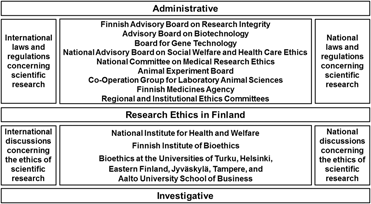
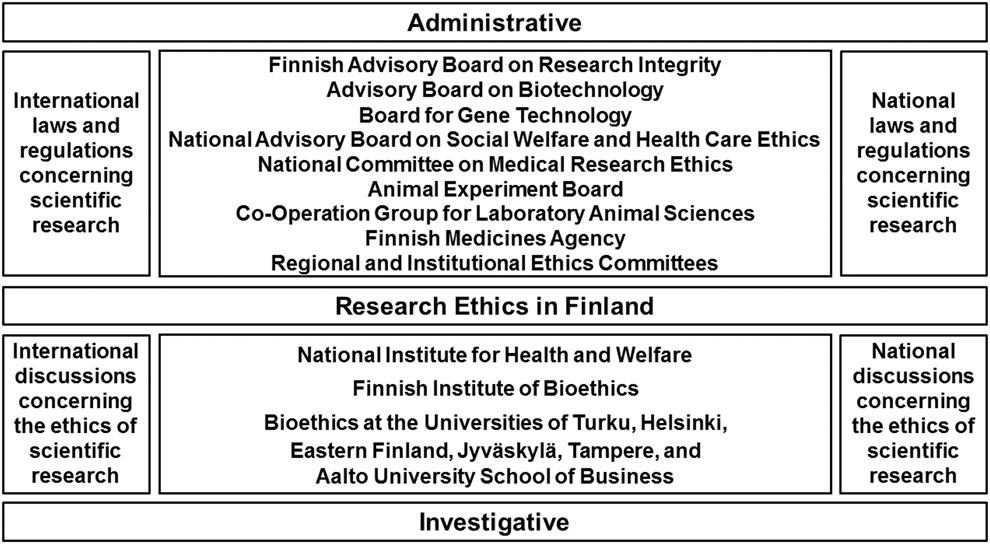
The work of philosophical bioethicists will be elucidated further in the sections below, as will the work done in our newly founded Justice Studies Unit at Aalto University School of Business. A schematic summary of research ethics institutions in Finland is presented in Figure 2.
Research ethics framework and institutions in Finland.
Mid-Level Justice—Its Varieties and Alternatives
What about justice, then? How should we conceptualize it in our quest for justice in Finnish research ethics?
Justice and Other Mid-Level Principles
All mid-level principles are open to many and varied interpretations. The contents of beneficence and harm depend on our theory of value, i.e., what we consider good or bad enough to constitute a benefit or a harm in the relevant sense.Footnote 51 Autonomy assumes partly conflicting meanings according to the background doctrine used: Kantian, Millian, relational, and so on.Footnote 52 Different views on the proper holders of dignity create different readings of the concept.Footnote 53 Precaution and solidarity are understood in particular ways in particular traditions of moral and political philosophy,Footnote 54 as is justice.Footnote 55
Tom Beauchamp, well aware of the variety, characterizes the notion of justice on two levels. Beauchamp describes the gist of his early work with James Childress, and the idea of “principles” they employed, as follows:
Our goal was to develop a set of principles for biomedical ethics. Substantively, our proposal was that traditional preoccupation of health care with a beneficence-based model of health care ethics be shifted in the direction of an autonomy model, while also incorporating a wider set of social concerns, particularly those focused on social justice. The principles are understood as the standards of conduct on which many other moral claims and judgments depend. A principle, then, is an essential norm in a system of moral thought, forming the basis of moral reasoning. More specific rules for health care ethics can be formulated by reference to these four principles, but neither rules nor practical judgments can be straightforwardly deduced from the principles.Footnote 56
As for the principle of justice, Beauchamp continues:
There is no single principle of justice in the four principles approach. Somewhat like principles under the heading of beneficence, there are several principles, each requiring specification in particular contexts. But common to almost all theories of justice – and accepted in the four principles approach – is the minimal (formal) principle that like cases should be treated alike, or, to use the language of equality, equals ought to be treated equally and unequals unequally. This elementary principle, or formal principle of justice, states no particular respects in which people ought to be treated. It merely asserts that whatever respects are relevant, if persons are equal in those respects, they should be treated alike. Thus, the formal principle of justice does not tell us how to determine equality or proportion in these matters, and it lacks substance as a specific guide of conduct.Footnote 57
The descriptions given by Beauchamp in these paragraphs are relatively unproblematic. He and Childress wanted healthcare ethics to move from the utilitarian and paternalistic patterns to a more individual-centered model, yet one that could take into account social concerns. As for justice, they wanted to recognize a formal core of the concept, but leave open the possibility of fashioning different applications of the concept to different situations. There are, however, certain tensions and limitations in their approach. This will be shown after a brief commentary on another, competing, view.
Basic Ethical Principles in European Bioethics and Biolaw
European bioethicists have, since the 1990s, been looking for principles that would be more compatible with European values and attitudes than Beauchamp and Childress’s versions of autonomy, nonmaleficence, beneficence, and justice. Jacob Dahl Rendtorff and Peter Kemp published, in 2000, a report of their wide-ranging study on the issue, and argued that the best principles for European bioethics and biolaw would be autonomy, dignity, integrity, and vulnerability.Footnote 58 Unlike their American predecessors, Rendtorff and Kemp did not want the new principles to be too open-ended or ambiguous; rather, they saw their principles as well defined and interdependent and wanted them to form as compact a unity as possible. This is how they described their endeavor:
The idea in this analysis of European bioethics and biolaw is to show the limitations of a conception of bioethics and biolaw that is built solely on the concept of autonomy, a concept that has been widely influential in American inspired bioethics and biolaw. By showing the limitations of autonomy and viewing this concept in relation to the principles of dignity, integrity and vulnerability we aim to provide a more secure foundation for the protection of the human person in bioethics and biolaw. In this light we will integrate the principles in the framework of solidarity, responsibility and justice.Footnote 59
An important detail here is that Rendtorff and Kemp saw justice, or solidarity, as the ultimate aim of bioethics and biolaw, and devised their four principles to promote the aims of justice, solidarity, and social responsibility in a modern welfare state.Footnote 60 As to their choice of principles, they explain:
The choice of respect for autonomy, dignity, integrity and vulnerability as the four basic ethical principles in bioethics and biolaw expresses an effort to justify the protection of human beings in the fast developing fields of biomedicine and biotechnology. This should contribute to develop European Ethical and Legal Culture which recognizes the human person as an end-in-it-self, as is seen in the perspective of human rights. Persons are “liberty holders” and “right-claim holders”. The ethical principles are not only guidelines for the right of the individual to self-determination, but also for the rights to protection of life and the private sphere of the person (privacy). In this perspective the principles are based on an interpretation of our present European legal culture of human rights, rather than being founded on natural law and renaissance humanism.Footnote 61
So Rendtorff and Kemp’s model is based, according to them, on a contemporary concept of human rights, rather than Roman Catholic (natural law) or Enlightenment (following renaissance humanism) thinking. As they go on, there is a further rejection of utilitarianism, coupled with a strong leaning toward the doctrine of personalism:
The three alternative and supplementary ethical principles to autonomy that we aim to clarify and further investigate (dignity, integrity and vulnerability) preceded the utilitarian account of quality of life that plays an enormous role in bioethical decision making. They should be interpreted as expressing the concrete phenomenological reality of the human life-world. So they are understood as accounts of the ethical understanding of existence and the human person in everyday ethical life.Footnote 62
It is focal to Rendtorff and Kemp’s view that people are seen as social, not only individual, persons. In their view, the concept of autonomy evoked by Beauchamp and Childress fails because it unjustifiably excludes some people (people who are too young, too demented, or too severely cognitively impaired) from the sphere of personhood.Footnote 63 Leaning on existentialist and phenomenological doctrines,Footnote 64 Rendtorff and Kemp replace the American view with their own idea of autonomy with others in just institutions, preferring Immanuel Kant’s reading of self-determination to John Stuart Mill’s.Footnote 65
The rejection of Mill’s liberal utilitarianism, and all it stands for, allows Rendtorff and Kemp to build their own set of auxiliary principles for autonomy. They assume the view that human dignity originates in human communities, and that it is intersubjective by nature.Footnote 66 The integrity of human life for them consists of its physical and psychological togetherness, narrative coherence, and uncorrupted truthfulness, which lay a foundation for related legal notions.Footnote 67 From the vulnerability of the “bodily incarnated human being,”Footnote 68 they proceed to ideals of recognition, responsibility, and solidarity.Footnote 69 After these preliminaries, they conclude that, aided by the principles of autonomy (in the Kantian sense), dignity (in a partly Kantian but also in a human-rights-as-understood-in-European-legislation sense), integrity, and vulnerability, responsibility and solidarity promote justice by properly protecting human persons in a technologically high-risk society, where nation states and their coalitions are morally and politically accountable for social welfare.Footnote 70
Theories of, and Approaches to, Justice
Beauchamp and Childress tried to avoid excessive theoretical depth in formulating their principles, while Rendtorff and Kemp took a more amenable view on philosophical distinctions and deeper normative commitments. Both lines can however, with equal ease, be placed on a relatively uncontroversial conceptual map of theories of, and approaches to, justice. How such a map can be drawn, and what its dimensions are, is described more thoroughly in our earlier work.Footnote 71 An outline will be sufficient for our present purposes.
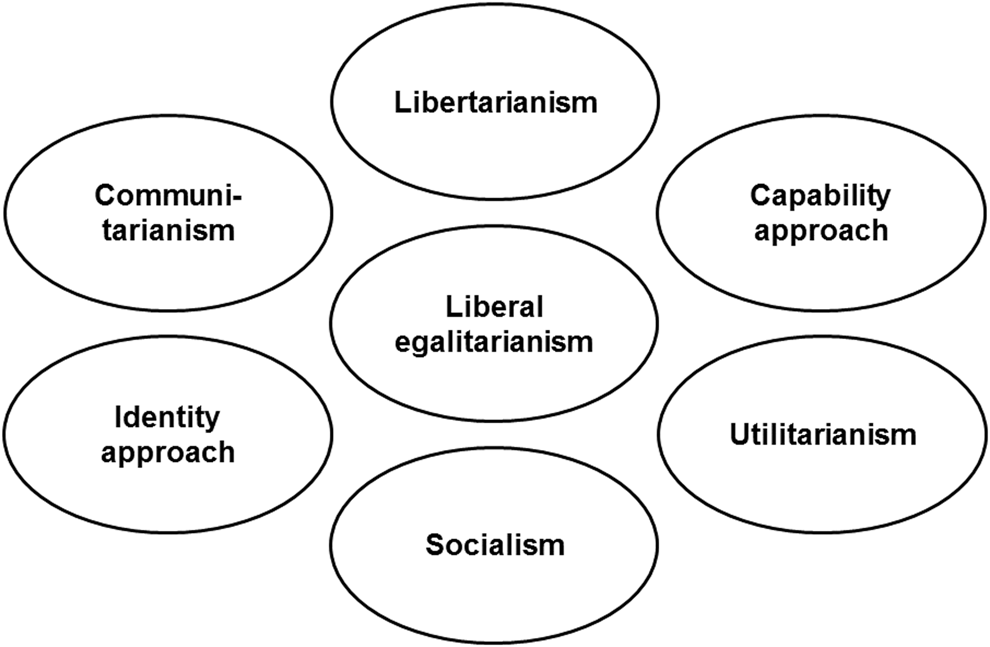
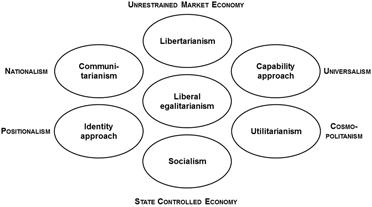
Justice, as noted by Beauchamp,Footnote 72 has a formal core that most theorists accept. We should treat similar cases similarly, and different cases differently; all humans are equal, and laws should recognize this; everybody should be counted for one and no one for more than one; in political decision making, all those who are affected by the decisions should be heard or otherwise accounted for; and so on. After this mutual understanding, however, disagreements start to accumulate, resulting in at least seven partly compatible and partly incompatible doctrines, which are, in alphabetical order: the capability approach, communitarianism, the identity approach, liberal egalitarianism, libertarianism, socialism, and utilitarianism. Figure 3 presents these schematically, in a way that reveals some of their relationships and tensions.
Theories of and approaches to justice.

In the middle of Figure 3, liberal egalitarianism is a compromise view that can meet most of the others halfway. Libertarianism insists that the rights of individuals to life, noninterference, and private property are paramount constituents of justice.Footnote 73 Socialists, in contrast, maintain that an over-emphasis on the rights of property-owning individuals leads to social injustice.Footnote 74 Liberal egalitarians pick the cherries from both views, arguing that private enterprise should be encouraged and the benefits that it produces be redistributed to address issues of social justice. The theory of justice as fairness by John Rawls is the paragon middle-ground doctrine of this type.Footnote 75
Liberal egalitarianism, especially its Rawlsian variety, also seems to provide the golden mean between utilitarianism and communitarianism. Utilitarians want to see the greatest happiness of the greatest number as the goal of all human action.Footnote 76 Rawls eventually rejected the doctrine, but took it seriously enough to stir an ongoing debate on whether his theory is in fact a qualified form of rule utilitarianism.Footnote 77 Communitarians firmly reject technical utility calculations, and they value, instead, organically developed traditions and ways of thinking.Footnote 78 Rawls’s starting point is in a similar idea, albeit in a more abstract guise: he believed that his theory could only be accepted and implemented in a society where citizens have a common understanding of justice to begin with.Footnote 79
The capability approach derives from two sources. Its original formulation is a critical outgrowth of preference utilitarianism, and it takes issue with cultural repression that shapes people’s likings and choices.Footnote 80 The interpretation that has become more popular aspires to be an improved version of Rawls’s theory of justice as fairness.Footnote 81 Liberal egalitarianism can live quite peacefully with both these lines of thinking, as long as they are not stretched too far. In the opposite corner of the moral map in Figure 3, the identity approach stresses the recognition of minorities and oppressed groups in political life.Footnote 82 Since Rawls focused strongly on the situation of the worst off in societies, his theory can easily accommodate this tendency, at least to a certain degree. Liberal egalitarianism reaches its limits, however, in relation to the capability and identity approaches when the value systems of the two latter models become closed.
According to one version of the capability approach, we can compile a fairly detailed and comprehensive list of goods that we should promote by our ethical and political decisions.Footnote 83 While this is a potentially useful route to take, and a reflection of Rawls’s account of primary goods, detailed lists like this come with a price. They need interpretation, someone has to do the interpreting, and the “someone” assigned to the job is usually the philosopher whose list is under scrutiny. This is how we can end up with conflicting views based on almost identical lists.Footnote 84 A liberal egalitarian would prefer, at this point, thinner notions and less detailed value catalogues.Footnote 85
According to any version of the identity approach, societies and states should grant recognition and respect to groups whose voices have not been fully audible in decision-making: women, various ethnic groups, people with disabilities, people with diverse sexual orientations, and people living in otherwise precarious conditions. This is quite acceptable to liberal egalitarians until the question of tolerating the intolerant crops up. If members of the precariat feel that they do not have an obligation to tolerate their privileged oppressors, a liberal egalitarian system is hard put to find a proper response. “We do not have to tolerate the intolerant” is the most likely response, but one that prioritizes the dominant view over the more marginal.
Two Types of Bioethical Justice
Theories of justice represent several polarized stands. Figure 4 displays, in a schematic form, three of them: insistence on economic market freedom versus partiality to state control, cosmopolitanism versus nationalism, and universalism versus positionalism.
Tensions between views on justice.

Libertarians prefer unrestrained market economy or something as close to it as possible, and socialists see a need for strong state controls in economic transactions. Utilitarians are willing to extend their welfare calculations across borders and communitarians are more prone to give precedence to the needs of their fellow compatriots. Champions of capabilities think that morality is the same to all people, and advocates of identities believe that different groups of people live in different ethical universes.
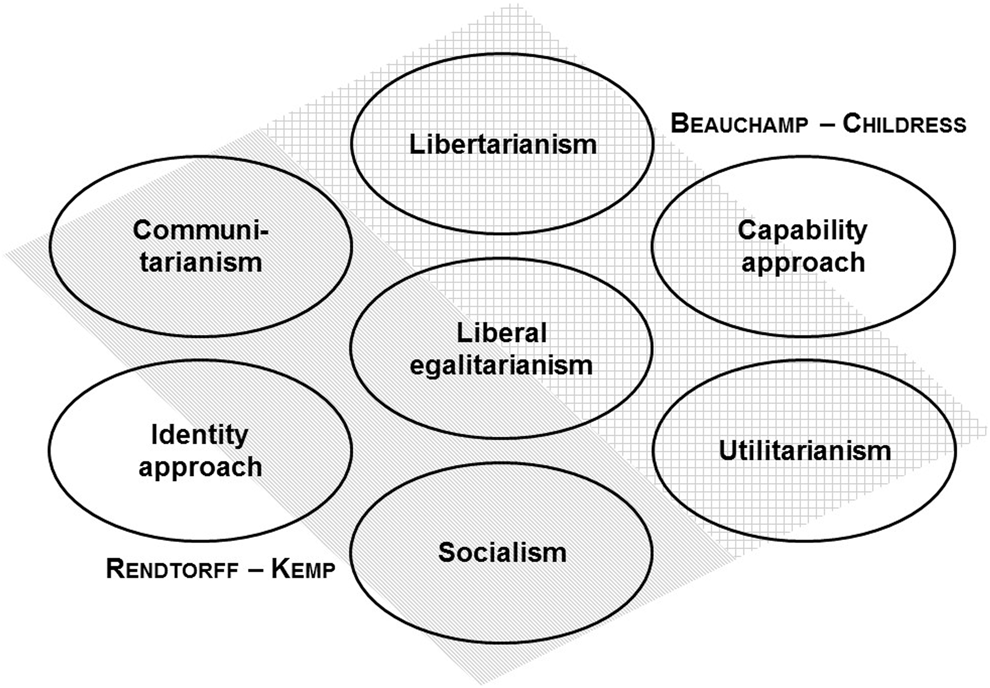
The two sets of bioethical principles by Beauchamp and Childress and Rendtorff and Kemp find their places quite naturally, if not exhaustively, on the conceptual map presented in Figures 3 and 4. Figure 5 shows their general locations.
Bioethical principles and justice – two styles.

Beauchamp and Childress’s place is within the individualistic theories favored in the liberal Enlightenment tradition. Their principle of autonomy of choice draws them toward libertarianism, while their principles of beneficence and nonmaleficence extend their normative base in the direction of utilitarianism. Their principle of justice identifies them firmly as liberal egalitarians and prevents them from straying too far into utilitarian thinking or to the extreme excesses of libertarianism. The capability approach is compatible with their set of principles, insofar as the list of desirable powers and abilities remains short and its demands vague.
Rendtorff and Kemp’s principles belong to a competing school of thought that could be described as post-Enlightenment or (with qualifications) Romanticism. Dignity in their sense, vulnerability, and integrity prompt them to safeguard people’s lives in the way demanded by moderate identity approaches. The same combination also promotes respect for the autonomy of moral agency as cherished by the more Kantian interpretations of liberal egalitarianism. Emerging from these considerations, communal solidarity guides them toward communitarian thinking, while social solidarity and responsibility for others direct them to uphold some versions of socialism. Taken together, all these form a unified, intersubjective account of social justice.
As Figure 5 indicates, the two sets of bioethical principles share common ground in supporting some kind of liberal egalitarianism. Different understandings of autonomy mark a demarcation between the views, though. For Beauchamp and Childress, autonomy remains an attribute of the nonmoral as well as moral choices that individuals make; for Rendtorff and Kemp, the paramount concern is the morally defined self-determination of socially entrenched agents. In practice, this means that the Beauchamp-Childress doctrine retains its original antipaternalistic flavor – something that the Rendtorff-Kemp creed does not value as highly.
The differences between the sets are remarkable in other areas, as well. Although even Beauchamp and Childress do not seem to endorse fully-fledged utilitarianism, Rendtorff and Kemp are plainly hostile in their comments. Calculations of utility for them are a misguided way of settling ethical issues, and they would like to account for the consequence dimension of political choices in the spirit of responsibility, solidarity, and precaution.Footnote 86 Moreover, although Rendtorff and Kemp would probably not sanction all kinds of communitarianism and socialism, the rejection of these two ideologies is much firmer in Beauchamp and Childress’s model. Interestingly, if we take the two sets of principles to be somehow distinctly “American” and “European,” they could also enter each other’s geographic territories, in practice if not in theory. Before the most recent political developments, the “mainstream” ethical atmosphere in the United States was on the way to becoming friendlier toward identity politics than its European counterpart seemed to be. That would have meant an invasion behind enemy lines in the positional corner of Figures 4 and 5. In the opposite corner of universalism in the same Figures, European Human Rights ThinkingFootnote 87 could find a sounding board in the closed-list version of the capability approach. Since, however, Rendtorff and Kemp explicitly deny the connection to natural law theory and Roman Catholic teaching, we are not pursuing this matter further.Footnote 88
Considerations of Justice in Finnish Research Ethics
How does research ethics in Finland account for considerations of justice, then? Let us answer the question separately from three angles: those of practical governance, political morality, and academic points of interest.
Practical Governance
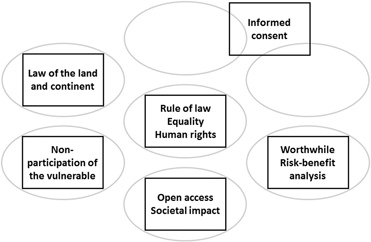
Practical research ethics in Finland is in the hands of national, regional, hospital, and institutional boards and committees, as summarized in Figure 2. In the last instance, national and international law, supplemented by international treaties, defines the jurisdictions and tasks of these boards and committees. Finland is a relative latecomer in the field, and a top-down legal approach based on the rule of law, equality, and human rights is dominant. Rule of law is the basic requirement: whatever regulation exists, it should be publicly declared, forward-looking, consistent, comprehensible, equal to all, and certain in application. Finnish law secures equality on two separate fronts: one concept (“tasa-arvo”—literally “level value”) applies to equality between women and men, and the other (“yhdenvertaisuus” —roughly “equal worth”) covers all other comparisons. Finns tend to be quite legalistic, and morality and law are seen as different only exceptionally—examples of these rare cases are sexual morality (attitudes to gay marriage) and reproductive choices (opinions on the physician’s duty to terminate a pregnancy on request). One reason to this can be linguistic: the Finnish word for justice, “oikeudenmukaisuus,” translates either as “accordance with what is right” or as “accordance with what is law.”
Rule of law, equality, and human rights are at the heart of official research ethics in Finland. Figure 6 shows this, and the location of other important elements of science governance in the country, against the background of the conceptual map of theories of justice introduced in Figures 3–5.
Elements of practical research ethics in Finland.

Starting from the communitarian (northwestern) corner of Figure 6, Finnish law does contain peculiarities that are somehow due to the development of the legal system in the land. The prime example is the nonregulation of therapeutic cloning and the ensuing silent acceptance of research on cloned human embryos, which is not usual in other countries. Footnote 89 With increased legal harmonization on the European Union level, such cases are becoming exceptional. On the other hand, the legal idiosyncrasies of the European Union will then replace the previous national ones.
The role of informed consent in Finnish research ethics is prominent, as can be expected, but also decidedly equivocal. Informed consent is a requirement in all biomedical and biological research involving humans; and in social, behavioral, and humanities research that interferes with the subjects’ physical integrity, exposes them to strong stimuli, may inflict mental harm on them, threatens their security, or involves minors without parental supervision.Footnote 90 The requirement of fully informed consent is, however, at risk in regulations concerning genomic and genetic databank research. The law on this does not necessitate explicit consent for the use of older diagnostic materials,Footnote 91 and it remains vague concerning the future use of collected samples.Footnote 92 A partial explanation of the unenthusiastic attitude toward strict consent is that officially, Finland does not recognize any Tuskegee Syphilis ExperimentFootnote 93-type national mishaps, and may therefore be more amenable to paternalistic methods.
The exclusion of vulnerable groups from potentially dangerous research is included in Finnish research governance as a matter of course, following international trends and regulation. As in the case of informed consent, there is not much recognition of dubious historical practices like lobotomy operations and involuntary sterilizations.Footnote 94 These are cases of bad treatment rather than unethical research, of course, but the spirit is similar. The extension of ethical preview to social and behavioral sciences and the humanities seems to be a step toward more caring attitudes, but even here, the concerns are utilitarian and focus on straightforward physical and psychological harm.
Any research conducted should be worthwhile, and its benefits should be proportionate to its risks. Most preview boards and committees in Finland concentrate on this dimension of ethicalness. The axiology, or theory of value, employed is in the majority of cases materialistic, and focuses on the impact of the research on human and animal wellbeing. This approach is fine and even essential, but it ignores some more abstract moral issues: worries about privacy, personal autonomy, justice (in other senses), and the treatment of human and nonhuman beings as mere means to the ends of others or to the greater good of society (whatever that means).
Open access to the results of research and societal impact are visible themes in Finnish science governance. With the international field of academic publishing in turmoil, universities and national boards are constantly looking for new ways of disseminating the results of science. The Academy of Finland, the main public financer of scientific research in the country, has decreed that projects funded by the Academy must report their findings in open access systems of some kind, although the organization of follow-up and sanctions remain, for the time being, rather unclear. The Academy, as well as most other science funders, also requires research to have societal impacts. What these societal impacts would be, and how their realization could be verified, remains largely unspecified. There are directed calls with more precise goals, but these are either quite general (“To boost national economy” or “To encourage innovative solutions to social problems”) or change with changing political situations.
Political Morality
Finland is a Scandinavian welfare state.Footnote 95 This means that it has a market driven economy, but the state redistributes tax revenue to provide public health and social services, education, daycare for children, unemployment benefits, services for old people, services for those with limited abilities, and so on. The model leans partly on social democratic principles (as is more prominently the case in Sweden and Denmark), but also on moderate conservatism (originally, industrialists taking care of their own workforce) and religious ideals (over 70 percent of the population are members of the Evangelic Lutheran Church of Finland).Footnote 96
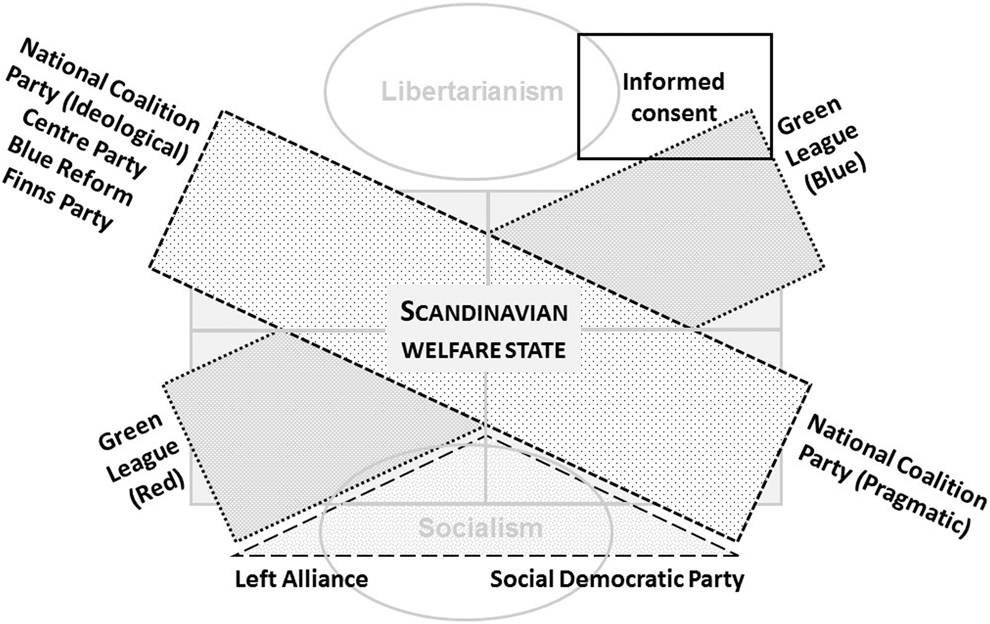
In terms of theories of justice, the ethos of the welfare state extends to all directions but one: it does not accommodate libertarian thinking. Socialism, utilitarianism, the capabilities approach, and social egalitarianism are effortlessly included, communitarian undercurrents have always been there, and identity recognition has been increasingly included. Figure 7 shows the relative positions of the Finnish Scandinavian welfare state (the grey box extending from the middle to the end points marked with grey horizontal and vertical lines) and the main political parties in the country on the conceptual map already used in Figures 3-6.
Welfare ideology and party politics in Finland.

In government in fall 2017 were the Centre Party, the National Coalition Party, and the populist Blue Reform, which separated from the Finns Party (originally in the coalition) in summer 2017. The spectrum of political moralities within these parties range from communitarian and nationalist to utilitarian and globalist. The National Coalition Party potentially covers the whole range, with voters both in the ideological (“Home, religion, fatherland”) and pragmatic (“Let’s do what’s good for business and economy”) ends. The Centre Party also covers most of the same ground, but it is limited at the far ends of the spectrum. Insofar as pragmatism means global cosmopolitan utilitarianism, the Center Party’s agrarian roots prevent it from endorsing this fully. At the other end, the party has kept leaking for decades, as populist movements have attracted voters who have felt that the party’s elite has forgotten ordinary people and their concerns. Finns Party and Blue Reform are the latest incarnations of this phenomenon, although they have also drawn voters from other marginalized demographics. After their separation, the Finns Party appears to be the nationalist force demanding closed borders and the Blue Reform the reasonable little people’s voice, but the situation is unclear.Footnote 97 Other European populist parties have witnessed similar splits.Footnote 98
For decades, government coalitions in Finland have consisted of a combination of one or two of the three big parties, traditionally the Centre Party, the National Coalition Party, and the Social Democratic Party, together with smaller auxiliary parties.Footnote 99 Since the right-wing parties are in government now, a possibility for the next government (2019 at the latest) would be the reemergence of the Social Democrats, but their support does not show strong indications of this, at least not yet. For now, they seem to be searching for their place in a society that has completed many of the reforms they have been advocating. To a degree, this also applies to their rival left-wing party, the Left Alliance. This could change, of course, before the next election.
An interesting development in Finnish politics is the gradual rise of the Green League, who might just pinch a strong coalition position in future elections. This is interesting, because after a radical single-issue (environmental) start, the party is now fully presentable in the no-nonsense welfare state spirit that seems to be a requirement for political power in Finland,Footnote 100 yet provides some genuine alternatives to the current government ideology. Like the National Coalition Party, the Green League operates on a wide radius. Its “red” left wing is vocal on identity issues, not a particularly popular field for the conservative and populist front. Its “blue” wing is more inclined to assume the capabilities approach on universalistic terms, not an absolute no-go zone for the pragmatists of the National Coalition Party, but antagonistic to the more conservative and populist fractions.Footnote 101
After this lengthy introduction, here comes the significance of political morality for research ethics and justice. Informed consent, as depicted in Figure 7, falls outside the welfare state ethos. It is an individualistic and libertarian notion that separates persons from one another and makes them more or less responsible for their own choices. This stands in stark contradiction with the socially embedded, intersubjective, and paternalistic ideology that the (historically) big three parties in Finland—the Social Democratic Party, the Centre Party, and the National Coalition Party have embraced. Informed consent, consequently, is a foreign implant in Finnish research ethics. Finns tolerate and sanction it because this is pivotal to the recognition of international treaties, but they do not understand it well or embrace it fully.
Party politics may change, then, the ideological basis of research ethics in Finland in the future. If the conservatives and social democrats stay in power, the situation stays the same and there will always be well-intentioned doubts about the decision-making powers of individuals as research subjects. If, on the other hand, the Green League gains in influence, some evolution is possible.
Academic Points of Interest
Finnish scholars have done bioethical work and published bioethical books and articles on at least five fronts: descriptive, constructive, empirical, conceptual, and critical.Footnote 102
Descriptive reports explain how research ethics in Finland works, and what its aims and challenges are. Ritva Halila and her collaborators have done much work in this field, and covered topics such as the role of national ethics commissions in Finland,Footnote 103 children’s decision-making powers in medical research participation,Footnote 104 international ethical regulations on medical research in emergency settings,Footnote 105 ethically-problematic treatment decisions in different medical specialties,Footnote 106 and the work of hospital districts’ research ethics committees in Finland.Footnote 107 Issues of justice feature in contributions like these, mainly in the forms of formal equality and considerations of utility and consent.
Constructive efforts endeavor to improve the practices in research ethics and in research governance. The most consistent work in this area in Finland has been done by Henriikka Mustajoki (formerly Clarkeburn) and Arto Mustajoki, who have studied science ethics teaching,Footnote 108 ethical sensitivity development in science students,Footnote 109 honesty in academic writing,Footnote 110 the everyday ethics of researchers,Footnote 111 and the possibility of using a “guided dialogue” method in promoting reflection in research communities.Footnote 112 The justice dimensions of these investigations are deontological and virtue ethical: they concentrate either on the moral rules that researchers or students should internalize and follow, or on the character traits that practices could foster in current and future scientists. Potentially, this can lead to the “responsibilization” of individuals, a trend that Johanna Ahola-Launonen has criticized in a wider healthcare setting,Footnote 113 but if the focus is on structures, not necessarily.
Empirical studies on matters related to healthcare ethics in Finland have attracted the attention of two groups: nursing scientists in Finnish universitiesFootnote 114 and researchers at the National Institute for Health and Welfare.Footnote 115 Nursing scientists have understandably directed their attention to practical healthcare provision, and so research ethics has not been one of their main objects of interest. At the national institute, research ethics is a topic of investigation among others. Good examples are Elina Hemminki’s studies, with collaborators, on Finnish attitudes toward biomedical research in generalFootnote 116 and biobank research in particular,Footnote 117 ethics committee chairpersons’ views on changing rules,Footnote 118 and similarities and differences in research governance in Finland, England, Canada, and the United States.Footnote 119 Justice enters these investigations by the choice of themes, which often have to do with the proper distribution of benefits, burdens, rights, and duties within healthcare delivery and biomedical research.
Conceptual work emphasizes the importance of theoretical coherence and logical consistency. Finnish philosophers have examined practical ethics and bioethical questions from these points of view since the 1970s.Footnote 120 The ethics of science became topical with the rise of modern genetics,Footnote 121 and the doctoral theses of Tuija TakalaFootnote 122 and Veikko LaunisFootnote 123 at the University of Turku took up the topic. Conceptual studies involving, albeit sometimes tangentially, the ethics of scientific research proceeded in Turku in further doctoral work by Helena Siipi,Footnote 124 Elisa Aaltola,Footnote 125 and Marko Ahteensuu.Footnote 126 The scrutiny of ethical theories and principles is, of course, important for the understanding of the fundamentals of research ethics. The justice dimensions of these studies have included analyses of autonomy and solidarity in the quest for genetic information, the ideas of naturalness and unnaturalness, species equality, and precaution in our dealings with the natural environment.
Critical approaches aim to be emancipatory, or liberating, and to challenge current practices and ways of thinking. Traces of criticism can often be found in constructive, empirical, and conceptual endeavors as well, but in some contributions, the challenge is more unmistakably present. In our own work, we have questioned principlist,Footnote 127 utilitarian,Footnote 128 categorical,Footnote 129 sectarian,Footnote 130 over-theoretical,Footnote 131 gendered,Footnote 132 pro-natalist,Footnote 133 heteronormative,Footnote 134 over-practical,Footnote 135 and aimlessFootnote 136 argumentation in bioethics. More specifically and more closely related to research ethics, we have contested UNESCO’s Universal Declaration on Bioethics and Human Rights for its inherent vagueness,Footnote 137 German law on stem cells and stem cell research for its hypocrisy,Footnote 138 and human biobank research and its regulation for their tendency to ignore issues of informed consent.Footnote 139 The biobank case is especially interesting from the viewpoint of justice. As depicted in Figure 7, consent seems to fall outside the scope of welfare-state thinking. If this is the case (and this is a topic for further studies), then countries like Finland, Sweden, Norway, Denmark, and Iceland should be extra careful in their efforts to keep proper permissions from the study subjects in the prime place they traditionally occupy in international research ethics.