


Introduction and background
Dendrobium is a large genus in Orchidaceae (subfamily Epidendroideae) and represents an important resource for both ornamental and medicinal applications. Dendrobium species are mainly epiphytic, lithophytic herbs, with fewer terrestrial representatives, and are distributed primarily in tropical and subtropical regions of Asia and Oceania.
As of 1 January 2026, 1621 Dendrobium species are recognized worldwide according to Plants of the World Online (POWO 2026), of which 96 species are native to China based on the Species 2000 China Node database (The Biodiversity Committee of the Chinese Academy of Sciences 2025). These Chinese native species include 12 endemic taxa (D. wilsonii, D. fanjingshanense, D. shixingense, D. flexicaule, D. huoshanense, D. bannaense, D. xichouense, D. zhenghuoense, D. hainanense, D. jinghuanum, D. luoi and D. jiajiangense), collectively representing an important reservoir of genetic diversity for both ornamental and medicinal breeding. However, their breeding potential and practical utilization in hybridization remain insufficiently explored. In this review, we summarize the germplasm resources of Chinese native Dendrobium species and systematically analyse hybrid breeding records using data from the Royal Horticultural Society (RHS) and OrchidWiz databases. By examining breeding history, parental genetic lineages, and hybridization compatibility, we aim to clarify the current breeding patterns and core limitations of Dendrobium hybridization. Furthermore, key challenges and prospective strategies for the hybrid breeding of Chinese native Dendrobium are discussed to provide a reference for future cultivar development and the sustainable utilization of orchid germplasm resources.
Biological and genetic basis of Dendrobium hybrid breeding
Hybridization success in Dendrobium is primarily constrained by chromosomal compatibility, phylogenetic relatedness, and reproductive isolation barriers. Most Chinese Dendrobium species, including D. crepidatum, D. nobile and D. officinale, are diploid (2n = 38), which provides a stable cytogenetic foundation for intra- and interspecific hybridization. Beyond cytogenetic stability, reproductive isolation governed by self-incompatibility (SI) acts as another core constraint determining hybridization performance in Dendrobium. Species diversification in Dendrobium has been shaped by environmental adaptation and historical geo-climatic changes. Recent comparative genomic analyses further suggest that SI evolution in Dendrobium is associated with genomic variation at the S-locus, with candidate genes such as CYP734A50 potentially mediating this process (Chen et al. Reference Chen, Wang, Niu, Chen, Chen, Zheng, Liang, Li, Zheng, Liang, Zhang, Zhao, Li, He, Wang, Huang, Zheng, Zhang, Chen, Zhou, Zeng, Zhou, Huang, Zhao, Peng, He, Zou, Han, Tsai, Lan, Zhang, Liu and Xu2025). Orchids exhibit highly diverse SI phenotypes, with multiple pollen tube arrest patterns occurring at different floral positions during pollination (Zhang et al. Reference Zhang, Jia, Liu, Chen, Luo and Niu2021). In addition to SI differentiation, phylogenetic relatedness and reticulate evolution further shape interspecific crossing compatibility across the genus. Interspecific hybridization compatibility in Dendrobium is predominantly governed by SI systems, self-compatibility (SC) systems and reticulate evolutionary relationships. These key factors collectively determine hybridization performance and cannot be fully predicted by phylogenetic distance alone (Duan et al. Reference Duan, Huang, Zheng, Li, Zhang, Su, Liu, Hao, Chen, Xiang and Niu2025). Orchid SI is modulated by auxin and ethylene signalling pathways, with a regulatory mechanism distinct from the canonical S-RNase system in dicots (Zhang et al. Reference Zhang, Jia, Liu, Chen, Luo and Niu2021). Species with closer reticulate evolutionary relationships display markedly higher interspecific compatibility. SI and SC taxa are widely distributed across the 14 sections of Dendrobium, and hybrid combinations follow the typical SI × SC crossing rule, with SC × SC and SI/SC crosses achieving far higher fruit set rates than SI × SI combinations (Duan et al. Reference Duan, Huang, Zheng, Li, Zhang, Su, Liu, Hao, Chen, Xiang and Niu2025). Phylogenomic analyses divide Dendrobium into four major evolutionary clades, with obvious genetic divergence and reproductive isolation detected among different sections. Sect. Dendrobium exhibits high genetic conservation and the strongest cross-compatibility, whereas Sect. Densiflora and Sect. Formosa show greater genetic differentiation and relatively weak hybridization barriers, directly revealing the intrinsic mechanism by which phylogenetic distance governs interspecific hybridization outcomes (Chen et al. Reference Chen, Wang, Niu, Chen, Chen, Zheng, Liang, Li, Zheng, Liang, Zhang, Zhao, Li, He, Wang, Huang, Zheng, Zhang, Chen, Zhou, Zeng, Zhou, Huang, Zhao, Peng, He, Zou, Han, Tsai, Lan, Zhang, Liu and Xu2025). Hybridization success can be effectively predicted and quantified according to phylogenetic divergence among Dendrobium sections and species. SI acts as a primary reproductive barrier restricting the wide utilization of germplasm in Dendrobium hybrid breeding. Such phylogenetic and reproductive differences lay a solid foundation for molecular marker-assisted parental screening and hybrid prediction. These advances indicate that parental selection in Dendrobium should shift from morphology-based empirical approaches to genome-informed predictive frameworks.
Phylogenetically guided breeding in Dendrobium is strongly supported by molecular marker analyses. Whole-genome resequencing-based single-nucleotide polymorphism (SNP) data provide unprecedented resolution for Dendrobium phylogenetic analysis and parental selection (Zhang et al. Reference Zhang, Fu, Li and Zhang2025). In addition to nuclear SNP data, organelle phylogenomics also provides novel insights. Phylogenomic analyses based on complete mitochondrial genomes have provided improved resolution for Dendrobium species relationships, and mitochondrial phylogenies exhibit unique topological features distinct from plastid-derived trees. Furthermore, abundant chloroplast-derived sequences exist in Dendrobium mitogenomes, which can influence phylogenetic reconstruction and should be considered in evolutionary studies (Wang et al. Reference Wang, Yu, Yang, Hou, Li, Niu, Zhang, Xue, Liu and Ding2023). SRAP and rDNA ITS markers consistently reveal high interspecific genetic diversity and a well-resolved phylogenetic structure among Chinese Dendrobium species, enabling reliable species delimitation and parental germplasm screening (Feng et al. Reference Feng, Lu, Gao, Liu and Wang2014; Liu et al. Reference Liu, Fang, Zhang, Guo and Ye2019). Traditional markers such as SRAP and ITS have long been used for diversity analysis, as extensively reviewed for orchids including Dendrobium (Li et al. Reference Li, Dong, Zhao, Wu, Liu and Zhai2021). With advances in high-throughput sequencing, whole-genome-based SNP and phylogenomic tools now provide far higher resolution (Zhang et al. Reference Zhang, Zhao, Li, Ke, Yin, Lan and Liu2022). Morphological traits effectively reveal genetic relationships and sectional differentiation among Dendrobium accessions, supporting germplasm classification and parental selection in breeding (Nor Hazlina et al. Reference Nor Hazlina, Wahba, Fadelah and Wickneswari2013). Modern tools including marker-assisted selection, genetic mapping, and genome editing have accelerated the improvement of ornamental and medicinal traits in Dendrobium (Li et al. Reference Li, Dong, Zhao, Wu, Liu and Zhai2021; Unni and Thomas Reference Unni and Thomas2022; Zhang et al. Reference Zhang, Zhao, Li, Ke, Yin, Lan and Liu2022). In vitro propagation, ploidy manipulation, mutagenesis and genome editing have emerged as powerful biotechnological strategies to overcome reproductive barriers and accelerate trait improvement in Dendrobium breeding (Saputro and Linggabuwana Reference Saputro and Linggabuwana2026). Notably, simple sequence repeat (SSR)-based clustering of Dendrobium correlates closely with floral and vegetative morphological traits including flower colour, flower shape and shoot type, rather than geographic origin, providing reliable guidance for germplasm evaluation and parental selection in hybrid breeding (Reddy et al. Reference Reddy, Momin, Singh, Kumar, Wangchu and Bhargav2024).
When phylogenetic and pre-fertilization barriers cannot be overcome by conventional crossing, modern biotechnological approaches offer alternative solutions for Dendrobium hybrid improvement. Phylogenetic distance is a decisive factor influencing hybridization success in Dendrobium. Crosses between closely related taxa generally exhibit higher fertilization rates, normal embryo development and improved seedling viability, whereas distant crosses frequently result in fertilization failure, embryo abortion, morphological abnormalities or sterility (Hu et al. Reference Hu, Li, Ren, Yang, Wu, Feng and Ye2025). Recent studies demonstrate that optimizing pollen–stigma synchronization can partially alleviate pre-fertilization barriers and significantly improve fruit set and hybrid seed viability in Dendrobium (Wu et al. Reference Wu, Qian, Guan, Yue, Li, Bruce, Yang, Yi, Liao and Yin2025a). Further transcriptomic and physiological analyses indicate that stigma maturation and pollen–stigma interaction are modulated by transcription factors, KIN-class genes and ROS via hormone signalling, MAPK cascades and plant–pathogen interaction pathways (Wu et al. Reference Wu, Ren, Ruan, Hu, Li and Li2025b). Such molecular regulation coordinates stigma development and physiological activity, ultimately controlling pollen recognition, germination efficiency, fruit-set performance and progeny fertility in Dendrobium interspecific hybridization. When conventional crossing encounters reproductive barriers, polyploid induction and protoplast fusion represent promising alternative breeding approaches. Polyploidization, commonly induced via colchicine treatment of protocorms, can effectively enhance genetic compatibility, overcome interspecific hybrid sterility, and improve ornamental characteristics as well as medicinal compound accumulation in key species such as D. wardianum and D. officinale (Vilcherrez-Atoche et al. Reference Vilcherrez-Atoche, Iiyama and Cardoso2022; Chen et al. Reference Chen, Liu, Lan and Peng2023; Liu et al. Reference Liu, Duan, Jia, Hao, Xiang, Chen and Niu2023). Protoplast fusion has also been successfully validated in D. nobile, enabling the generation of heterokaryons that integrate genetic traits from Chishui and Ruili landraces (Xu et al. Reference Xu, Chu, Pan, Zheng, Qian, Chen and Li2016). Collectively, these biotechnological strategies offer feasible solutions to cross reproductive barriers and promote the hybrid utilization of Chinese native Dendrobium. Such cytogenetic and molecular regulatory mechanisms well explain the sectional utilization bias observed in current Dendrobium hybrid breeding (Chen et al. Reference Chen, Wang, Niu, Chen, Chen, Zheng, Liang, Li, Zheng, Liang, Zhang, Zhao, Li, He, Wang, Huang, Zheng, Zhang, Chen, Zhou, Zeng, Zhou, Huang, Zhao, Peng, He, Zou, Han, Tsai, Lan, Zhang, Liu and Xu2025; Duan et al. Reference Duan, Huang, Zheng, Li, Zhang, Su, Liu, Hao, Chen, Xiang and Niu2025).
Hybrid breeding patterns and utilization of Chinese native Dendrobium
Commercial Dendrobium breeding has been reported to be largely structured around sectional classification, reflecting strong phylogenetic constraints on cross-compatibility (Li et al. Reference Li, Zhang, Zhang, Wong, Liang, Pang, Wu, Zhao and Yu2025). Most successful hybrids are derived from species within the same or closely related sections, suggesting that genetic affinity is an important determinant of breeding success. This global pattern provides a useful framework for interpreting the sectional utilization bias observed in Chinese native Dendrobium breeding, where germplasm selection is similarly influenced by taxonomic relationships. In addition, ornamental Dendrobium is often categorized into temperate deciduous (nobile-type) and tropical evergreen (phalaenopsis-type) groups, representing distinct genetic and ecological adaptive strategies (Zhang et al. Reference Zhang, Zhao, Li, Ke, Yin, Lan and Liu2022; Li et al. Reference Li, Zhang, Zhang, Wong, Liang, Pang, Wu, Zhao and Yu2025).
Hybrid registration trends and parental utilization
As of 1 January 2026, 18,085 Dendrobium hybrids have been registered with the RHS, among which 1,035 hybrids involved Chinese native species as parents (Supplementary Table 1; The International Orchid Register 2026). However, their utilization is highly uneven: only 63 of the 96 Chinese native species have been used in hybridization, whereas the remaining species have no recorded hybridization history (Supplementary Table 1). Notably, endemic Chinese species are rarely represented, indicating that uniquely regional germplasm remain largely underutilized in global breeding programmes.
Parental usage is strongly biased towards a small number of species, particularly those with high ornamental or medicinal value. Species such as D. nobile, D. moniliforme and D. officinale dominate breeding programmes, reflecting selection driven by economic and functional traits rather than overall genetic diversity. At the sectional level, Sect. Dendrobium is disproportionately represented, whereas several sections remain entirely unused, highlighting significant gaps in germplasm exploitation.
At the sectional level, Sect. Dendrobium accounts for the largest number of Chinese native species involved in RHS-registered hybrids and exhibits the longest and most continuous history of hybrid registration, with substantially higher hybrid numbers than any other section (Fig. 1). Early hybridization was almost exclusively confined to this section, with subsequent gradual inclusion of species from Sect. Densiflora and Sect. Formosa. In contrast, several sections have only been incorporated in recent years or remain minimally utilized (Supplementary Table 1; Fig. 1). Temporal analysis indicates that hybrid registrations in Sect. Dendrobium experienced multiple peaks and sustained growth over time, a pattern also observed in Sect. Densiflora and Sect. Formosa, although at a smaller scale (Fig. 1).
Number of hybrids by section registered on Royal Horticultural Society (as of 1 January 2026).

Award performance and progeny outcomes
To evaluate the ornamental value and breeding potential of Chinese native Dendrobium, award records and progeny data for 96 species were analysed based on OrchidWiz data (Table 1). Among them, 63 species had been used in hybridization, generating 15,159 registered progeny, and 48 species had received awards. Species from Sect. Densiflora dominated among the most highest awarded taxa, with D. lindleyi and D. chrysotoxum ranking highest, indicating strong ornamental value but limited representation of Sect. Dendrobium among top-awarded species.
Number of awards registered on OrchidWiz for Chinese native Dendrobium (sorted by number of awards)

Table 1 Long description
The table lists Chinese native Dendrobium species by OrchidWiz award counts, alongside each species’ section, number of hybrid progeny, number of those hybrids that received awards, and the awarded-hybrid proportion. Dendrobium nobile ranks first with 63 awards for the native species and 172 awarded hybrid progeny out of 2,773 hybrids, about 6 percent. Several other Sect. Dendrobium species have many hybrids but similarly low awarded-hybrid proportions, including D. heterocarpum with 162 awarded hybrids out of 2,693 and D. findlayanum with 141 out of 2,435, both about 6 percent. The highest awarded-hybrid proportions occur in species with small hybrid counts, such as D. capillipes at 2 awarded hybrids out of 3, D. densiflorum at 4 out of 8, and D. bellatulum at 9 out of 19. Some species combine high native awards with moderate hybrid success, including D. thyrsiflorum with 63 native awards and 8 awarded hybrids out of 20, and D. chrysotoxum with 73 native awards and 4 awarded hybrids out of 47. Many species listed have zero awarded hybrid progeny despite having hybrids recorded, and several have zero native awards as well. Because the list is sorted by native-species awards, it emphasizes recognition of the native taxa rather than hybrid performance, and proportions can look high when based on very few hybrids.
Note: Compiled by the authors based on data from the OrchidWiz database (accessed January 2026).
To further assess breeding potential, 55 species with available records were evaluated using four indices: number of awards, total progeny, awarded progeny and proportion of awarded progeny (Table 1). D. nobile produced the largest numbers of progeny and awarded progeny, reflecting high cross-compatibility and extensive utilization in breeding. However, its relatively low proportion of awarded progeny (6%) suggests that high output does not necessarily translate into elite ornamental performance (Table 1). Several other Sect. Dendrobium species also showed high progeny production (Table 1), supporting their role as core parental resources.
In contrast, Sect. Densiflora species such as D. lindleyi, D. chrysotoxum and D. thyrsiflorum exhibited high award frequencies but relatively low progeny numbers (Table 1), suggesting that their excellent ornamental traits are constrained by limited cross-compatibility. Overall, these patterns highlight a trade-off between compatibility and ornamental quality: Sect. Dendrobium provides broadly compatible breeding materials, whereas Sect. Densiflora represents valuable but underutilized germplasm with high ornamental potential. This compatibility–ornamental trait trade-off further underpins the sectional imbalance observed in global and domestic Dendrobium hybrid utilization and cultivar development. This pattern implies that current Dendrobium hybrid breeding relies on a narrow genetic base, potentially limiting long-term genetic improvement and environmental adaptability.
Recent cultivar registration and breeding characteristics
In China, cultivar development of Dendrobium is currently managed primarily through an official registration system. By 1 January 2026, a total of 137 Dendrobium varieties have been registered (Ministry of Agriculture and Rural Affairs of China 2026), with D. officinale accounting for nearly 50% (62 varieties), followed by D. phalaenopsis, D. huoshanense and a few other species. Varieties derived from most other native species remain scarce, indicating highly uneven germplasm utilization focused on medicinal taxa. Recently authorized cultivars further reveal a structural imbalance: all medicinal varieties were independently developed in China, but many ornamental cultivars rely on introduced materials, indicating insufficient domestication and innovation of ornamental traits using local germplasm (Supplementary Table 2). This structural imbalance suggests a clear need to strengthen the innovation and breeding of ornamental varieties using Chinese native Dendrobium germplasm.
Key traits and utilization value
Beyond hybrid registration and awards performance, a trait-oriented perspective provides a more mechanistic understanding of the breeding potential of Chinese native Dendrobium. Rather than serving only as a diverse genetic reservoir, these species represent functionally differentiated resources whose value depends on how specific traits align with breeding objectives and existing utilization bias.
As summarized in Table 2, key traits of Chinese native Dendrobium can be classified into five categories. Ornamental traits, including flower colour, form, fragrance and flowering duration, determine market value and are particularly prominent in Sect. Densiflora, which remains underutilized despite its high aesthetic potential. Medicinal traits, reflected by the accumulation of polysaccharides, alkaloids, and other bioactive compounds, define core germplasm resources for medicinal and functional breeding. Compatibility-related traits, such as high interspecific crossability and the ability to produce multigenerational hybrids, are concentrated in Sect. Dendrobium and largely explain its dominance in breeding programmes. In addition, traits related to growth habit, ecological adaptability and stress tolerance enhance cultivation stability and broaden the environmental range of hybrid deployment. However, these traits are rarely explicitly incorporated into breeding strategies, indicating a gap between available genetic resources and their practical utilization. Taken together, a trait-based perspective highlights a fundamental imbalance in current breeding practices: traits associated with compatibility and medicinal value are preferentially utilized, whereas those linked to ornamental diversity and environmental resilience remain underexploited. Integrating multiple trait dimensions into breeding design will be essential for expanding germplasm utilization and improving both efficiency and innovation in Dendrobium breeding.
Key traits and utilization value of Chinese native Dendrobium germplasm resources
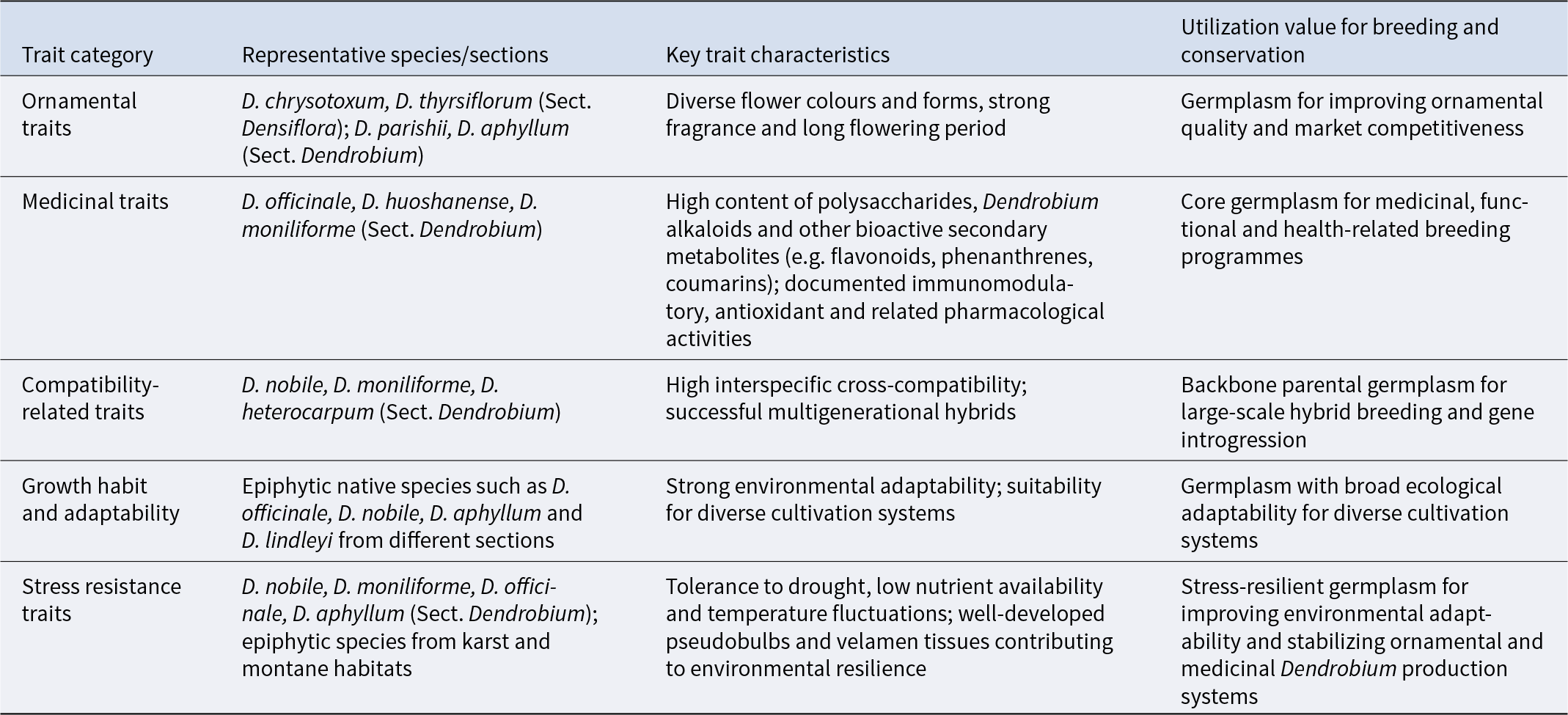
Table 2 Long description
The table groups Chinese native Dendrobium germplasm into five trait categories and links representative species or sections to key characteristics and breeding or conservation uses. Ornamental resources include D. chrysotoxum and D. thyrsiflorum in Sect. Densiflora and D. parishii and D. aphyllum in Sect. Dendrobium, valued for diverse flower colors and forms, strong fragrance, and long flowering periods to improve marketable ornamental quality. Medicinal resources such as D. officinale, D. huoshanense, and D. moniliforme in Sect. Dendrobium are highlighted for high polysaccharides, alkaloids, and other bioactive metabolites with documented immunomodulatory and antioxidant activities, making them core material for health-related breeding. Compatibility-related traits are emphasized for D. nobile, D. moniliforme, and D. heterocarpum in Sect. Dendrobium due to high interspecific cross-compatibility and successful multi-generation hybrids, supporting large-scale hybrid breeding and gene introgression. Growth habit and adaptability focus on epiphytic species including D. officinale, D. nobile, D. aphyllum, and D. lindleyi from different sections, noted for strong environmental adaptability across cultivation systems. Stress resistance is associated with D. nobile, D. moniliforme, D. officinale, D. aphyllum, and epiphytes from karst and montane habitats, described as tolerant of drought, low nutrients, and temperature fluctuations, aided by pseudobulbs and velamen tissues to stabilize ornamental and medicinal production. Species may appear in multiple categories, indicating overlapping trait value rather than mutually exclusive groupings.
Constraints and future strategies in hybrid breeding of Chinese native Dendrobium
Although Chinese native Dendrobium species represent rich and diverse germplasm resources, their utilization in hybrid breeding remains constrained by multiple interconnected factors, resulting in uneven and inefficient exploitation. These limitations are reflected in three major aspects: the overall low utilization of native germplasm, strong biases in parental selection and sectional representation, and the inconsistent performance of hybrid progeny. Current Dendrobium breeding overemphasizes medicinal germplasm development, while many ornamental-value endemic and sectional resources remain underexplored due to insufficient targeted parental design. This imbalance not only reduces effective genetic diversity but also challenges the prevailing assumption that resource richness necessarily translates into breeding innovation.
Recent genome-scale studies have begun to reshape our understanding of Dendrobium as a genetic resource. Pan-genomic and phylogenomic analyses reveal deep evolutionary divergence among major sections, indicating that these lineages function as genetically distinct and unevenly exploited resource pools (Li et al. Reference Li, Zhang, Zhang, Wong, Liang, Pang, Wu, Zhao and Yu2025). Comparative genomics further suggests that intrinsic genomic divergence, lineage-specific adaptive evolution and differentiation of SI systems jointly contribute to the observed sectional bias in hybridization success (Chen et al. Reference Chen, Wang, Niu, Chen, Chen, Zheng, Liang, Li, Zheng, Liang, Zhang, Zhao, Li, He, Wang, Huang, Zheng, Zhang, Chen, Zhou, Zeng, Zhou, Huang, Zhao, Peng, He, Zou, Han, Tsai, Lan, Zhang, Liu and Xu2025). However, current breeding practices have not fully incorporated these advances and still rely heavily on empirical selection, thereby limiting the predictive power of modern genomic knowledge. A single indicator such as phylogenetic distance is insufficient to fully explain hybridization outcomes, requiring a multifactor integrative perspective. Advances in orchid genomics and developmental biology have provided important insights into reproductive development, adaptive evolution and metabolic regulation, while emerging analytical approaches, including machine learning-assisted phenotyping and chemical profiling, enable rapid and non-destructive trait evaluation (Nargar and Chen Reference Nargar and Chen2023; Ma and Wang Reference Ma and Wang2025). Despite these developments, their integration into breeding decision-making remains limited.
A critical but often overlooked constraint is the incomplete conservation, evaluation, and systematic utilization of native germplasm. Although germplasm collections have been established in major production regions, previous studies indicate insufficient taxonomic coverage and a lack of standardized, trait-based evaluation systems. As a result, germplasm availability does not translate into effective utilization, particularly for species with high ornamental potential but low representation in hybrid progeny. This mismatch highlights a fundamental gap between resource conservation and breeding application, suggesting that current germplasm systems are not yet functionally aligned with breeding objectives (Li et al. Reference Li, Dong, Zhao, Wu, Liu and Zhai2021; Saputro and Linggabuwana Reference Saputro and Linggabuwana2026).
Phylogenetic divergence, SI differentiation and reticulate evolution collectively govern interspecific compatibility in Dendrobium, and together with genomic variation, well explain the sectional utilization bias in current hybrid breeding practices (Niu et al. Reference Niu, Huang, Xu, Li, Yang, Zhang, Zhang, Chen, Niu, Luo and Liu2018; Chen et al. Reference Chen, Wang, Niu, Chen, Chen, Zheng, Liang, Li, Zheng, Liang, Zhang, Zhao, Li, He, Wang, Huang, Zheng, Zhang, Chen, Zhou, Zeng, Zhou, Huang, Zhao, Peng, He, Zou, Han, Tsai, Lan, Zhang, Liu and Xu2025; Duan et al. Reference Duan, Huang, Zheng, Li, Zhang, Su, Liu, Hao, Chen, Xiang and Niu2025). Elucidating the molecular mechanisms of SI will be critical to break reproductive barriers and unlock the breeding potential of underutilized Dendrobium species. To address these limitations, future breeding strategies require a shift from empirical and trait-isolated approaches towards integrative, mechanism-informed frameworks. First, expanding and standardizing germplasm systems remains essential, but should be coupled with functional trait evaluation to ensure direct relevance to breeding objectives. Second, phylogeny-informed breeding must be refined using high-resolution genomic tools. In contrast to earlier reliance on SSR and ITS markers (Li et al. Reference Li, Dong, Zhao, Wu, Liu and Zhai2021), recent advances – such as SNP genotyping, genome-wide marker systems, and high-throughput sequencing – provide substantially improved resolution for assessing genetic relationships and predicting hybrid compatibility (Zhang et al. Reference Zhang, Zhao, Li, Ke, Yin, Lan and Liu2022; Duan et al. Reference Duan, Huang, Zheng, Li, Zhang, Su, Liu, Hao, Chen, Xiang and Niu2025). However, the key challenge lies not in data generation, but in translating genomic information into actionable breeding decisions. Although conventional molecular markers lack sufficient resolution for phylogenetic inference and compatibility prediction, mitochondrial genome resources provide valuable polymorphic loci and serve as effective supplementary molecular tools for Dendrobium germplasm evaluation and parental selection (Wang et al. Reference Wang, Liu, Wang, Ming, Qi and Zhou2024). Future Dendrobium breeding should prioritize high-resolution GBS-SNP, whole-genome resequencing and transcriptome-derived functional markers to replace traditional low-resolution molecular tools. Integrating pan-genome profiling, in situ germplasm evaluation and multiple biotechnological approaches can establish a systematic breeding workflow for germplasm assessment and phylogeny-targeted hybrid improvement (Chen et al. Reference Chen, Wang, Niu, Chen, Chen, Zheng, Liang, Li, Zheng, Liang, Zhang, Zhao, Li, He, Wang, Huang, Zheng, Zhang, Chen, Zhou, Zeng, Zhou, Huang, Zhao, Peng, He, Zou, Han, Tsai, Lan, Zhang, Liu and Xu2025). Future Dendrobium breeding progress relies on the integration of genomic tools and conventional crossing strategies to maximize the utilization of native genetic resources.
Beyond initial hybridization, conventional strategies such as directional crossing and recurrent backcrossing have been widely proposed to improve trait introgression. Building on these approaches, this review further proposes a multidimensional selection framework that simultaneously integrates ornamental, medicinal and adaptive traits, thereby addressing current utilization biases. Moreover, when reproductive barriers limit conventional hybridization, emerging biotechnological approaches – including genomics-assisted breeding, polyploid induction, somatic hybridization and in vitro propagation – offer effective alternatives for expanding genetic combinations. While these methods have been reported in previous studies, their application has often been fragmented and species-specific.
In this context, this review advances an integrative conceptual framework in which hybridization success is interpreted as the outcome of interactions among phylogenetic relationships, reproductive system variation (e.g., SI types) and genomic divergence. By explicitly linking these factors with germplasm utilization patterns and trait-based selection, this framework extends beyond previous descriptive reviews and provides a more predictive basis for breeding design. Overall, this synthesis not only highlights existing constraints but also proposes a more targeted and mechanism-oriented pathway for improving breeding efficiency and unlocking the full potential of Chinese native Dendrobium germplasm. Collectively, the above lines of evidence allow us to synthesize an integrative framework linking phylogenetic relationships, reproductive system differentiation and genomic divergence to interpret hybrid compatibility and sectional utilization bias in Dendrobium.
Prospects
Collectively, sustainable advancement of Dendrobium breeding requires a shift from experience-driven practice to data-guided, resource-efficient breeding strategies. The future development of hybrid breeding in Chinese native Dendrobium will depend on a transition from experience-driven practices towards more systematic and data-informed breeding strategies. Continued efforts in comprehensive germplasm exploration, conservation, and standardized trait evaluation are expected to expand the range of parental materials and improve the effective utilization of native genetic diversity, particularly for underutilized and recently described taxa. Advances in phylogeny-guided parent selection, together with molecular and biotechnological tools, will play an increasingly important role in overcoming compatibility barriers and enhancing breeding efficiency. Importantly, future studies should move beyond descriptive and retrospective analyses by quantitatively modelling the interactions among phylogenetic relationships, reproductive systems and genomic divergence, thereby enabling more predictive hybrid breeding frameworks. At the same time, greater emphasis on ornamental traits, alongside the targeted improvement of medicinal quality and market-oriented breeding objectives, is likely to promote the diversification of cultivar types and broaden the application of native Dendrobium resources. Collectively, these developments are expected to facilitate the sustainable utilization of Chinese native Dendrobium germplasm and support the long-term advancement of both breeding research and the ornamental orchid industry.
Supplementary material
The supplementary material for this article can be found at https://doi.org/10.1017/S1479262126100744.
Funding statement
This work was funded and supported by Guizhou Provincial Science and Technology Support Plan Project (Qiankehezhicheng [2023] general 014).
Competing interests
The authors declare that they have no known competing financial interests or personal relationships that could have appeared to influence the work reported in this paper.



