1 Introduction
It is widely accepted as a general trend in languages that yes–no questions are intonationally characterised by a ‘higher pitch somewhere in the utterance’ (Bolinger Reference Bolinger and Greenberg1978: 501), where a rise on the terminal part of the contour ‘is clearly the dominant strain’ (ibid.), as opposed to final falling movement for statements. Rising/high pitch for cueing interrogativity and falling/low pitch for marking assertiveness can be considered intonation universals (Cruttenden Reference Cruttenden1981), the associated meaning of such different pitch use being explained by referring to some biological code (Ohala Reference Ohala1983, Reference Ohala1984; Gussenhoven Reference Gussenhoven2004).
This observation is very general, and is applied when considering the so-called grammatical function of intonation. In fact, in studying question intonation, a wider range of intonational realisations are possible, as attitudinal, pragmatic, communicative aspects are normally taken into account (Crystal Reference Crystal1969, Ladd Reference Ladd1978, Bolinger Reference Bolinger1989). This has been extensively attested, for example, in English (Geluykens Reference Geluykens1988, Bolinger Reference Bolinger1989, Pierrehumbert & Hirschberg Reference Pierrehumbert, Hirschberg, Cohen, Morgan and Pollack1990, Bartels Reference Bartels1999, Hirschberg Reference Hirschberg, Horn and Ward2006 among others).
For Italian, however, the grammatical function of intonation of marking sentence modality is particularly relevant, as this role is played by intonation alone, where no syntactic or lexical markers are used. When dealing with the description of Italian intonation, the first problem is defining a reference model of the spoken language, as the so-called ‘Standard Italian’ has a very special status with respect to other languages like English or German. Traditionally, Standard Italian is referred to as either the variety derived from the ‘cultivated’ Florentine variety (fiorentino colto) or, more generally, from some ‘Tuscan variety’ (see Bertinetto & Loporcaro Reference Bertinetto and Loporcaro2005, also for further references). Yet, because of the complex evolution of Italian political history, the process of standardisation has been successfully achieved only for the written language, not for spoken Italian, which is nowadays characterised by a wide range of distinct regional accents (De Mauro Reference De Mauro1963, Lepschy & Lepschy Reference Lepschy and Lepschy1993, Tosi Reference Tosi2001).Footnote 1 In other words, Standard Italian has never been taught in schools or universities; consequently, everybody in Italy speaks with a regional accent, in both formal and informal situations. Standard Italian is taught to actors as part of their professional training. It was also taught to TV and radio professional speakers in the past, even though nowadays this is not considered a requirement any more, and newsreaders use their own native regional variety when reading aloud the news.
In this respect, for Italian speakers, regional accent can be considered a behavioural biometric trait (Savino Reference Savino, Esposito, Bratanić, Keller and Marinaro2007, Reference Savino2009). Therefore, describing the primary intonational cue for marking interrogativity in Italian implies necessarily dealing with Italian regional variation.
Traditional literature on Standard Italian describes this variety as sharing the feature attributed to the large majority of languages, that is a terminal rise as the primary intonational feature for marking yes–no questions, as opposed to a terminal fall for marking statements, where a low/falling accentual movement precedes the terminal part of the contour in both sentence types. The same is generally claimed to be true for the Florentine variety of Italian, i.e. the variety from which Standard Italian stems. As for other regional accents, according to the general picture offered by past studies, the great majority of varieties – typically those spoken in the north and centre of Italy – seem to share the same property of Standard Italian and Florentine, whereas the Southern accents behave differently, as in those accents the functional rise is realised on the nuclear syllable and followed by a terminal fall. However, a closer look at the literature on regional Italian question intonation reveals that such a geographical distribution of intonational features across Italian accents is not that clear, and that sometimes studies on questions in the same variety even result in diverging intonation analyses. This might be attributed to the fact that these studies are based on speech materials using two different basic speaking styles: spontaneous vs. read. Since most of these previous studies are based on the analysis of read speech, it can be hypothesised that a ‘reading style effect’ might have influenced the intonational realisation of utterances.
The aim of this paper is to call into question the claim that a terminal rise preceded by a low/falling nuclear pitch accent is the most widespread intonational feature for marking questions across Italian accents, and to provide a clearer picture of question intonation in Italian by looking at the distribution of the rise for conveying questioning as in either terminal or non-terminal position across varieties.
In this study, intonation analysis of yes–no questions extracted from the Map Task dialogues collected in the CLIPS national corpus (see Section 4.1 below) covering 15 varieties of Italian has been carried out. Therefore, speaking style is homogeneous since speech materials consist of task-oriented dialogues, i.e. speech data obtained with the same elicitation method for all the 15 Italian accents. Along the spontaneous–read dimension of the speaking style, these task-oriented dialogues can be considered spontaneous, as opposed to spoken productions elicited through some reading tasks and broadly defined as read speech.
The paper is organised in the following way: Sections 2 and 3 provide an overview of the literature on polar question intonation in Standard Italian and in Italian regional accents, respectively; Section 4 describes the corpus of Italian varieties used for analysis, the methodology for selecting the yes–no question types under investigation, and the descriptive framework used for intonation analysis. Results on the distribution of the three main contour types – (fall-)rise, rise-fall and rise-fall-rise – across the 15 Italian accents are illustrated in Section 5 and discussed in Section 6, and some concluding remarks are presented in Section 7.
2 Yes–no question intonation in Standard Italian
Earlier studies on Standard Italian intonation consist, in most of the cases, of contrastive analyses comparing Italian to English intonation for the purposes of teaching the basic intonation patterns of Italian to non-native speakers (Agard & Di Pietro Reference Agard and Di Pietro1965, Chapallaz Reference Chapallaz1979, D'Eugenio Reference D'Eugenio1982). One exception is the work by Canepari (Reference Canepari1979, Reference Canepari1980, Reference Canepari1985) which is explicitly devoted to the description of spoken Standard Italian, along with a comprehensive account of Italian regional variation.
In these studies, the model of Standard Italian is assumed to be the variety spoken in Tuscany – sometimes specifically in Florence – and, within different frameworks of analysis, they all describe the basic pattern of Standard Italian yes–no question intonation as being characterised by a falling-rising movement, as opposed to statements which have a falling contour. Common to all these studies is the terminal rise as the question marker in Standard Italian. The importance of this feature for learners of Italian is emphasised by Chapallaz (Reference Chapallaz1979: 192): she warns non-native speakers learning Italian on how crucial it is ‘to make the rising syllable or syllables at the end of the tune rise sufficiently [in questions], otherwise the group may not sound as a question at all’ (emphasis added – MS).
It is worth noting here that intonation analysis in all of the above studies was carried out on read speech and was analysed only auditorily.
The fact that Standard Italian question intonation has a functional terminal rise was confirmed by later Autosegmental-Metrical accounts of Standard Italian (Avesani Reference Avesani1995), also in connection with intonation modelling for speech technology, like the implementation in text-to-speech systems (Avesani Reference Avesani1990, Quazza et al. Reference Quazza, Salza, Sandri and Spini1993). In her study, based on spontaneous and read speech produced by Tuscan and professional speakers, Avesani (Reference Avesani1995) proposes two alternative tunes for the Standard Italian yes–no question: one rising, i.e. a low nuclear pitch accent followed by a high boundary (L* H-H%), and one falling-rising, i.e. a falling nuclear pitch accent followed by a high boundary (H+L* L-H%). A third possible alternative with a high boundary preceded by a nuclear peak instead of a nuclear low/fall (H* L-H%) is also shown in a figure (Figure 7 in Avesani Reference Avesani1995: 94), even though this tune is not explicitly mentioned in the concluding summary of all the possible contours for Standard Italian yes–no questions. This last type of tune is also found in Grice et al. (Reference Grice, D'Imperio, Savino, Avesani and Jun2005) as the typical question contour in Florentine Italian.
3 Regional variation in Italian yes–no question intonation
In describing the intonational characteristics of yes–no questions across regional accents of Italian, current literature generally claims that in Northern and Central varieties a functional terminal rise seems to prevail, as in Standard Italian, whereas Southern varieties are said to have a functional local rise on the nuclear accented syllable followed by a later fall (D'Imperio Reference D'Imperio2002: 38). Therefore, according to such a general view, the predominant and most typical intonational feature of regional Italian yes–no question intonation should be the same as described for Standard Italian, i.e. a terminal rise preceded by an accentual low/fall, whereas an accentual rise followed by a terminal fall is to be considered an exception to the rule, being restricted to the Southern accents. However, a closer look at past and more recent studies on regional Italian yes–no question intonation suggests that such a geographical distribution of the functional rise in yes–no questions is not that clear-cut.
A rise on the nuclear syllable for marking interrogativity is the property extensively attested for the Southern varieties spoken in Palermo (Grice Reference Grice1991, Reference Grice1995), Bari (Grice & Savino Reference Grice and Savino1995, Reference Grice and Savino1997, Reference Grice and Savino2003a, Reference Grice and Savinob, Reference Grice, Savino, Gilles and Peters2004; Savino Reference Savino1997, Reference Savino and Burr2000; Savino & Grice Reference Savino and Grice2007, Reference Savino, Grice, Frota, Elodierta and Prieto2011) and Naples (Maturi Reference Maturi1988; Caputo Reference Caputo1994; D'Imperio & House Reference D'Imperio and House1997; D'Imperio Reference D'Imperio1999, Reference D'Imperio2000, Reference D'Imperio2001a, Reference D'Imperiob; Crocco Reference Crocco2006). Moreover, these studies, carried out mostly within the Autosegmental-Metrical framework (Ladd Reference Ladd1996) on both spontaneous and read speech, revealed that differences among those varieties are still possible in terms of different alignment of the rising movement with the nuclear syllable: Naples and Palermo have a late nuclear peak (L*+H), whereas in Bari it is earlier, i.e. around the middle of the syllable (L+H*). In all cases, the nuclear rise is followed by a fall represented with low edge tones (L-L%) (for an overall account and comparison of these three varieties, see also Grice et al. Reference Grice, D'Imperio, Savino, Avesani and Jun2005). It is worth noting that an extra terminal rise after the accentual rise has been occasionally observed in Bari Italian task-oriented dialogues (Grice & Savino Reference Grice and Savino1997; Savino Reference Savino1997, Reference Savino and Burr2000), in Palermo Italian (Grice Reference Grice1995), and also in Bari (Savino & Refice Reference Savino and Refice1996, Grice, Savino & Refice Reference Refice, Savino and Grice1997, Refice, Savino & Grice Reference Grice, Savino and Refice1997) and Neapolitan (Maturi Reference Maturi1988) speakers when yes–no question utterances are read aloud (see also Section 6 below).
Another Southern variety with an accentual rise is the one spoken in Cosenza, where Sorianello (Reference Sorianello2001) found that polar questions in both read and spontaneous productions are characterised by a rising-falling contour phonologically described by the author with the sequence L+H* L%.
Nevertheless, this is not the case in all Southern accents: yes–no questions in the Sicilian variety spoken in Catania, for example, have a terminal rising movement preceded by an accentual low instead, analysed with L* H% or L*H H% (Grice Reference Grice1991).
A rising-falling pattern for yes–no questions has also been observed in a number of Central Italian accents, as, for example, the Roman accent (De Dominicis (Reference De Dominicis2002) in read speech, Giordano (Reference Giordano2006) in spontaneous speech, but see Sardelli & Marotta (Reference Sardelli and Marotta2007) and Marotta & Sardelli (Reference Marotta and Sardelli2009), where spontaneous Roman questions are analysed with a falling-rising H*+L H% contour instead), and the Tuscan varieties spoken in Pisa (Gili Fivela Reference Gili Fivela2002, Reference Gili Fivela2004, Reference Gili Fivela2008) and Lucca (Marotta & Sorianello Reference Marotta and Sorianello2001). On the other hand, some other Tuscan accents seem to conform to the expected Standard-like pattern for questions, namely those spoken in Florence (Magno Caldognetto et al. Reference Magno Caldognetto, Ferrero, Lavagnoli and Vagges1978, but see a different analysis in Grice et al. Reference Grice, D'Imperio, Savino, Avesani and Jun2005) and Siena (Marotta & Sorianello Reference Marotta and Sorianello1999). However, it is worth noting that in Sienese the falling-rising pattern (which the authors analyse phonologically with H+L* L-H%) is observed as by far the most widespread in read speech, whereas in spontaneous productions half of the questions were realised with a rising-falling contour instead (Marotta & Sorianello Reference Marotta and Sorianello1999).
Works on the Florentine variety, i.e. the one from which Standard Italian derives, by Magno Caldognetto et al. (Reference Magno Caldognetto, Ferrero, Lavagnoli and Vagges1978) and by Grice et al. (Reference Grice, D'Imperio, Savino, Avesani and Jun2005), deserve special attention. In this case, in fact, a similar pattern for both Florentine and Standard Italian yes–no question intonation is expected, i.e. a terminal rise preceded by an accentual low/fall.
Magno Caldognetto et al. (Reference Magno Caldognetto, Ferrero, Lavagnoli and Vagges1978) (probably the first intonation study on Italian supported by instrumental analysis) analysed a number of isolated utterances realised once as a statement (for example Giovanni arriva ‘John arrives’) and once as a yes–no question (Giovanni arriva? ‘Does John arrive?’) produced by 10 Florentine Italian speakers. Interestingly, even though the F0 traces produced by all speakers show a rising-falling shape on the nuclear syllable followed by a rise in questions, whereas statements have a nuclear falling movement followed by a terminal fall, the authors do not take into account what happens on the nuclear syllable. Instead, they focus their attention on the terminal part of the contour only. In fact, they claim that the terminal contour alone is responsible for marking the statement vs. yes–no question distinction in Florentine: the final contour for statements is a (slight) fall, and for yes–no questions has a ‘sharply rising’ movement. Moreover, Magno Caldognetto et al. (Reference Magno Caldognetto, Ferrero, Lavagnoli and Vagges1978) also analysed the same utterances produced by five speakers of the Northern variety spoken in Padua, and compared them with the Florentine productions. For Padua, F0 contours are not shown, thus implying that they have the same shape as the Florentine ones. The only difference between questions in the two accents reported in this work is that the F0 excursion of the terminal rise is larger in Paduan then in Florentine.
A different analysis for Florentine question vs. statement distinction has been more recently proposed by Grice et al. (Reference Grice, D'Imperio, Savino, Avesani and Jun2005). In this study, both the nuclear pitch accent and the boundary tone are claimed to be responsible for marking such a distinction. In fact, the yes–no question tune is described with H* L-H%, as opposed to the statement tune, which has a H+L* L-L% contour. Note that also this analysis of Florentine is primarily based on read speech.
As for the Northern varieties, for which the same intonational features of Standard Italian are claimed to be expected in questions, studies carried out so far do not give a clear picture in this direction. For example, spontaneous yes–no interrogatives in Milan are described by Sardelli & Marotta (Reference Sardelli and Marotta2007) and Marotta & Sardelli (Reference Marotta and Sardelli2009) with the expected falling-rising F0 shape (which authors analysed phonologically with H+L* H%). On the other hand, studies by Interlandi (Reference Interlandi2003) and Interlandi & Romano (Reference Interlandi and Romano2003) based on both spontaneous and read speech have shown that polar questions produced in the Northern accent of Turin are characterised by an accentual rise followed by a low boundary (phonologically described by the authors with the sequence L*+H L-L%), exactly as in Southern accents.
In their comparative study of nine Italian accents (Milan, Padua and Bologna from the North; Pisa, Macerata and Rome from the Centre; and Naples, Lecce and Cosenza from the South), Endo & Bertinetto (Reference Endo and Bertinetto1997) analyse different types of marked yes–no questions inserted in a text read aloud by a number of speakers for each of the accents under investigation. Results indicate that only for the Northern variety spoken in Milan was it possible to ascertain a more systematic use of the typical Standard-like accentual low/fall followed by a terminal rise, whereas in Padua and Bologna the accentual rise followed by a final fall predominated, as in all the Central and Southern varieties analysed, even though cases of questions with a fall-rise contour are also observed in these accents.Footnote 2 The authors themselves recognised that a number of reasons might have influenced such non-clear-cut results. First of all, the fact that reading text can influence the intonational realisation of questions, as speakers tend to associate reading performances with a more ‘formal’ and supposed ‘Standard-like’ speaking style. Secondly, all yes–no questions the authors inserted in the text for the reading task were marked: in fact, they were echo questions, or questions with marked focus and/or syntactic structure, which the authors hypothesised might have induced possibly different intonational realisations with respect to the unmarked yes–no question type.
A completely different view with respect to the rest of the literature discussed above is offered by Canepari (Reference Canepari1979, Reference Canepari1980, Reference Canepari1985) in his comprehensive study of 21 Italian varieties. In this investigation, he collected and analysed a corpus of isolated sentences (yes–no questions, declaratives and non-final utterances) produced in a reading task by speakers from the following towns: Bolzano, Udine, Trieste, Venice, Trento, Milan, Turin, Genoa and Bologna from the North of Italy; Florence, Perugia, Macerata, Rome, Cagliari and Pescara from the Centre; and Campobasso, Naples, Potenza, Bari, Cosenza and Catania from the South. According to Canepari's analysis, yes–no questions in all of the 21 Italian accents are characterised by a terminal rise as opposed to statements having a final fall. Therefore, all Northern, Central and Southern accents analysed appear to adopt the same intonational strategy used by Standard Italian for cueing interrogativity. In fact, in Canepari's description of Italian intonation, the terminal part of the contour plays the most important role for marking sentence modality (Canepari Reference Canepari1980: 35). Figure 1 reproduces the yes–no question tune for 10 of the 21 Italian accents described in Canepari (Reference Canepari1980), corresponding to a subset of the Northern, Central, and Southern varieties analysed in the present study: they all have a low/falling nuclear accent followed by a final rise.
Polar question intonation contours for 10 of the 21 Italian varieties described by Canepari (Reference Canepari1980), corresponding to a subset of the Northern, Central, and Southern varieties analysed in the present study. In Canepari's intonation scheme, the three rows indicate the tone levels, whereas the columns refer to the following parts: the large column in the middle to the last stressed syllable, the two to its right to the post-tonic syllables, and the one to its left to the syllable immediately preceding the tonic one. The level of the pre-tonic syllable is specified only when ‘marked’, i.e. when it is realised as either high or low.

4 Materials and method
4.1 Corpus
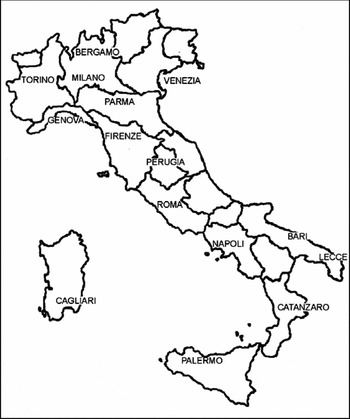
In the present study, an intonation analysis has been carried out on the Map Task dialogues included in the Corpus of Spoken Italian section (Albano Leoni et al. Reference Albano Leoni, Paoloni, Refice, Rinaldo, Savino and Sobrero1998) of the national corpus CLIPS (Corpora e Lessici di Italiano Parlato e Scritto – Corpora and Lexicons of Spoken and Written Italian).Footnote 3 This section collects speech materials of different types and speaking styles relating to a selection of Northern, Central and Southern varieties designated as representative of Italian regional variation according to geolinguistic, sociolinguistic and socioeconomic criteria (Sobrero & Tempesta Reference Sobrero and Tempesta2006). The resulting selected 15 varieties are the ones spoken in Turin, Bergamo/Brescia, Milan, Venice, Genoa, Parma, Florence, Perugia, Rome, Cagliari, Naples, Bari, Lecce, Catanzaro and Palermo. Their geographic locations are illustrated in Figure 2.
Geographic position of the Italian varieties collected in the Corpus of Spoken Italian section of the CLIPS corpus.

For each variety, eight Map Task dialogues are available in the corpus, each with an average duration of 25 minutes. Dialogue participants are all undergraduate or graduate students aged 18–30 years, born in and still living in the target town, with parents who were also born and still living in the target town. For the current investigation, all dialogues available for each variety have been analysed, corresponding to spoken materials produced by 16 speakers for each Italian accent (2 participants × 8 dialogues), with a balanced number of male and female speakers. Table 1 summarises overall duration of dialogue speech materials analysed for each variety.
Overall duration (hours:minutes) of speech materials (Map Task dialogues) for each of the 15 Italian varieties collected in the Corpus of Spoken Italian section of the CLIPS corpus.

4.2 The Map Task
In the Map Task (Anderson et al. Reference Anderson, Bader, Bard, Boyle, Doherty, Garrod, Isard, Kowtko, McAllister, Miller, Sotillo, Thompson and Weinert1991), pairs of participants (an Instruction Giver and an Instruction Follower) are each given a map. One of the maps has a route drawn on it. The task consists of reproducing as accurately as possible the route on the other map by exchanging information via verbal communication. The task is complicated by the fact that the two maps are not identical in terms of presence and position of the landmarks, thus stimulating possible misunderstandings as in everyday, natural interaction. Given the nature of the task, questions are therefore likely to be produced by participants in the dialogues. In designing the maps, some form of control over speakers' production can be exerted by the experimenter, like selecting the landmark names according to specific research objectives, and eye contact can be inhibited in order to maximise the use of the verbal channel during communication.
The first use of the Map Task for Italian dates back to Grice & Savino (Reference Grice and Savino1995, Reference Grice and Savino1997, Reference Grice and Savino2003a, Reference Grice and Savinob, Reference Grice, Savino, Gilles and Peters2004) and Savino (Reference Savino1997, Reference Savino and Burr2000) on intonation in Bari Italian. Since these maps were specially designed for intonation analysis, landmark names were controlled for prosodic structure, with names having stress in various positions, and mostly consisting of voiced segments. Moreover, the Bari Italian participants in the Map Task sessions were not informed in advance of the discrepancies between the two maps, thus allowing the authors to make some assumptions on what constituted shared information, and to introduce an element of surprise into the dialogues.
Slight modifications of these maps were also used in two national projects – AVIP (Archivio di Varietà dell'Italiano Parlato – Spoken Italian Varieties Archive) and API (Archivio del Parlato Italiano – Spoken Italian Archive) – to collect and annotate a corpus of spoken Italian dialogues including Bari, Naples and Pisa accents (Refice et al. Reference Refice, Savino, Altieri and Altieri2000).
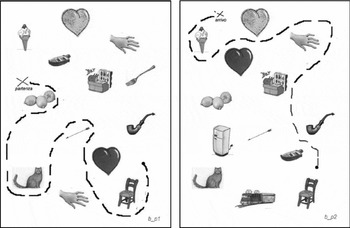
The methodology used for eliciting the dialogues collected in CLIPS presents a number of variants with respect to both the original Map Task and to the Italian maps described above. First of all, in CLIPS each map in a pair has a different route drawn on it, so that each participant plays both the Instruction Giver and Instruction Follower roles within the same session, rather than in two separate ones. Moreover, in the maps no names are attached to the landmarks, consequently reducing control over speakers' productions. These features are visible in Figure 3, which shows one of the map pairs used for the Map Task dialogue sessions collected in the CLIPS corpus. On the other hand, in introducing subjects to the task, the same strategy previously adopted by Grice & Savino (Reference Grice and Savino1995, Reference Grice and Savino1997, Reference Grice and Savino2003a, Reference Grice and Savinob, Reference Grice, Savino, Gilles and Peters2004) and Savino (Reference Savino1997, Reference Savino and Burr2000) for eliciting Map Task dialogues in Bari Italian was used: crucially, participants were not informed in advance that the two maps were different.
One of the two pairs of maps used in the Map Task dialogues recording sessions of the spontaneous speech materials collected in the CLIPS corpus (originals are colour pictures).

4.3 Pragmatic analysis: Types of yes–no questions analysed
A preliminary step in the investigation was the pragmatic analysis of the polar questions in the dialogues, according to the HCRCFootnote 4 Map Task coding scheme (Carletta et al. Reference Carletta, Isard, Isard, Kowtko, Doherty-Sneddon and Anderson1997), based on both orthographic transcriptions and audio files. In this way, all yes–no questions were identified as the Query-yn, Check and Align conversational moves. According to the above mentioned coding scheme, Query-yn moves ask for new information (typically about the landmarks on the map, e.g. Do you have a lake?), whereas Check moves ask for confirmation about transferred or inferred information (typically instructions for drawing the route, e.g. So I have to go to the right?), and Align moves typically ask confirmation about participant's understanding or accomplishment of a (sub)task (as for example Okay?, Are you with me?, Have you drawn the curve?). Queries are normally unbiased questions (i.e. they are not biased towards a particular answer type), whereas Checks and Aligns being confirmatory questions can be considered (positively) biased.
In a number of studies on Bari Italian intonational realisations of these three question types also based on Map Task dialogues (Grice & Savino Reference Grice and Savino2003a, Reference Grice and Savinob, Reference Grice, Savino, Gilles and Peters2004; see also Grice & Savino Reference Grice and Savino1997; Savino Reference Savino1997, Reference Savino2006; Savino & Grice Reference Savino and Grice2007, Reference Savino, Grice, Frota, Elodierta and Prieto2011), it was ascertained that also Check and Align yes–no questions can be either biased or unbiased, according to:
(i) whether or not accessible information (about which confirmation is requested) is active in the speaker's consciousness (Chafe Reference Chafe1974), and
(ii) the confidence of the speaker regarding the correctness of the inference made in the question.
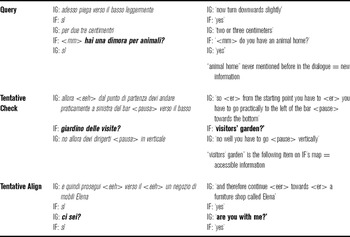
Unbiased Checks and Aligns have been called tentative Checks and Aligns in the above-mentioned works. In the present study, all Queries-yn, and tentative Checks and Aligns were extracted for intonation analysis. An example for each category within the related context, excerpted from Grice & Savino (Reference Grice and Savino2003a), is shown in Table 2.
Examples of Query, and tentative Check and Align yes–no questions in the Bari Italian Map Tasks (from Grice & Savino Reference Grice and Savino2003a). IG = Instruction Giver, IF = Instruction Follower; target utterances are highlighted in bold.

4.4 Intonation analysis
The intonation of selected utterances was analysed within an Autosegmental-Metrical (henceforth AM) framework (Ladd Reference Ladd1996). However, since a definitive phonological description implies a more systematic observation of a number of phenomena (such as tonal alignment and association) where hypotheses have to be tested also using controlled speech, the phonological analysis presented in this study has to be considered provisional. The main scope here is describing the nuclear pitch accents and boundary tones as rising or falling, and providing an overall description of the main intonation contours encountered, thus following the same criterion as that adopted by Venditti, Hirschberg & Liscombe (Reference Venditti, Hirschberg and Liscombe2006).
What we are interested in here is to observe the position of the rise for marking interrogativity (terminal vs. non-terminal), as opposed to the (low) falling movement which is characteristic of unmarked statement intonation in Italian. It is worth noting that an accentual low/fall followed by a low boundary in statements is typical for Italian, independently of the variety considered. Within the AM framework, this contour is generally described with the sequence (H+)L* L-L%, where the pitch range of the falling nuclear accent is normally very compressed (Grice et al. Reference Grice, D'Imperio, Savino, Avesani and Jun2005). According to what is generally claimed in the literature, from the analysis of CLIPS data we would expect to find as prototypical yes–no question contours:
(i) in Northern and Central varieties, a contour with a terminal rise preceded by an accentual low/fall, i.e. a (H+)L L-H% contour type (rise in terminal position); and
(ii) in Southern accents, a contour with an accentual rise followed by a terminal fall, i.e. a L+H L-L% contour type (rise in non-terminal position).
In addition, since in some of the Southern varieties a high boundary (H%) instead of a low boundary (L%) has been attested in relation to some paralinguistic meaning (as reported in Section 3), the L+H L-H% contour type, i.e. an accentual rise followed by an extra final rise is also expected to be found at least in Bari, Naples and Palermo dialogues.
Selected utterances were analysed using the Praat software package for speech analysis (Boersma & Weenink Reference Boersma and Weenink2001).
5 Results
5.1 Distribution of yes–no question contour types in the 15 Italian varieties
The number of yes–no questions included in this study for each variety (a total of 2,368) is shown in Table 3. For the Venetian data, results refer to seven of the eight dialogues available in the corpus, as in the remaining dialogue participants interacted using dialect throughout the recording session. For the Cagliari data, it was impossible to analyse two of the eight dialogues available because of the very low amplitude of the recorded signal characterising those two dialogues.
Number of polar questions analysed for each of the 15 Italian accents in the CLIPS corpus (total number 2,368).

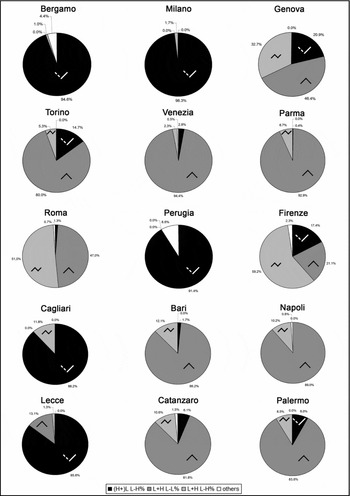
In this section, an overview of the distribution of the yes–no question contour types encountered in the data is presented. This distribution, variety by variety, is shown in pie-charts in Figure 4. In these charts, black areas indicate the percentage of (H+)L L-H% contour type, i.e. those with a rise in terminal position without an accentual rise ((fall-)rise shape), whereas grey areas represent the percentage of cases of an accentual rise with and without a final rise. In particular, dark grey zones refer to L+H L-L% contour cases (rise-fall shape), and light grey to L+H L-H% contour cases (rise-fall-rise shape). Finally, the white zones in the charts represent cases of contours different from the three main ones (these are included in the broad category ‘others’).
Distribution (in percentage) of yes–no question contour types for each of the 15 Italian varieties analysed.

By looking at the statistical results, it can be noted that the (H+)L L-H% contour type is the most widespread intonation pattern in only five accents, those spoken in Bergamo (94.6%), Milan (98.3%), Perugia (91.4%), Cagliari (88.2%), and Lecce (85.6%). Note that in Bergamo and Milan the contour is falling-rising (i.e. the pitch accent preceding the final rise is falling), whereas in the remaining three it is rising (i.e. an accentual low precedes the final rise), even though here the two contour types are collapsed into one broad category (for a detailed description and examples of all contours see Section 5.2 below).
For seven other varieties, results clearly show that by far the most prevalent intonation contour is the L+H L-L%, i.e. one characterised by an accentual rise followed by a terminal fall: Turin (80%), Venice (94.4%), Parma (92.9%), Bari (86.2%), Naples (89%), Catanzaro (81.8%), and Palermo (83.6%). It is worth noting that, as expected, cases of an accentual L+H followed by a L-H% boundary have also been found in Bari (12.1%), Naples (10.2%) and Palermo (8.5%). As described in Section 3, it has been shown that the L-H% final rise plays a paralinguistic role in question intonation for these varieties. In the CLIPS data, similar small percentages of L+H L-H% cases have also been found in the remaining four varieties, namely Turin (5.3%), Venice (2.3%), Parma (6.7%), and Catanzaro (10.6%). Such a trend encourages speculation that in these four accents a high boundary might play a similar role as in Bari, Naples and Palermo.
As for the remaining three varieties, namely those spoken in Genoa, Florence and Rome, numbers are not clear-cut enough to allow us to determine which contour type can be considered as prototypical in these regional accents.
In Roman questions, there is an almost equal distribution of L+H L-L% (47%) and L+H L-H% (51%) contour types. This indicates that both an accentual rise followed by a final fall, and an accentual rise followed by an extra final rise are equally very common intonational strategies for questioning in this variety.
Also in Genoa, percentages do not show a clear trend: L+H L-L% has 46.4%, L+H L-H% has 32.7%, and H+L L-H% has 20.9%. Note that the great majority of the questions realised with a fall-rise contour (H+L L-H%) are utterances with a marked information structure, where the last pitch accent is post-focal.
In Florence, the L+H L-H% contour prevails over the others, even though 59.2% of distribution cannot be considered as the prototypical one in absolute terms, whereas the L+H L-L% tune has a percentage of 21.1%, and H+L L-H% has a percentage of 17.4%. Also here the H+L L-H% contour is the intonational strategy mostly found in questions with a marked information structure.
However, an observable trend in these three varieties is that an accentual rise – followed by either a falling or a rising boundary – is a more common intonational strategy in questions than a terminal rise preceded by an accentual low/fall. This is particularly clear in Roman questions, where the H+L L-H% accounts for very few cases (1.3%), whereas in Genoa and Florence it seems confined to some marked type of the unbiased polar questions analysed.
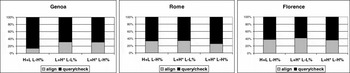
The distribution of L+H L-L% and L+H L-H% tunes in these three varieties might suggest an association of a contour type with one specific pragmatic use of the questions. Yet this does not appear to be the case, as can be seen in Figure 5, which shows the distribution (in percentage) of the pragmatic categories within each of the two contour types for the three Italian accents mentioned. In terms of pragmatic use, Queries and tentative Checks are collapsed here into one category, as they both are unbiased polar questions asking for information, whereas tentative Aligns are unbiased yes–no questions asking for feedback about discourse status. Results indicate that the hypothesis of attributing one contour type to one specific pragmatic use of questions is not sustainable, since both Query and Check (black) and Align (grey) questions are realised with either L+H L-L% or L+H L-H%, where the incidence of the pragmatic types is similar in the two contour type sets. For the sake of completeness, Figure 5 also shows the same distribution for the H+L L-H% contour (recall that for Rome we found very few cases of questions with this contour).
Distribution (in percentage) of the unbiased Align (grey bars) and Query/Check (black bars) polar questions realised as H+L L-H%, L+H L-L% and L+H L-H% in Genoese, Roman and Florentine data.

Results for these three varieties do not point to assigning a specific linguistic or pragmatic function to the boundary tone in unbiased question contours where the accentual rise is followed by either a falling or a rising boundary. Further research is needed for shedding light on this issue.
5.2 Prototypical yes–no question contours in the 15 Italian varieties
The following sections provide discussion of the most commonly occurring question intonation contour for each of the 15 Italian accents. These can be subdivided into two broad groups: (i) those with a rising terminal and no accentual rise, and (ii) those with an accentual rise with or without a terminal rise.
5.2.1 Terminal rise preceded by accentual low/fall: (H+)L L-H% contour type
A terminal rise preceded by an accentual low/fall is the prototypical question contour in Bergamo, Milan, Perugia, Cagliari and Lecce.
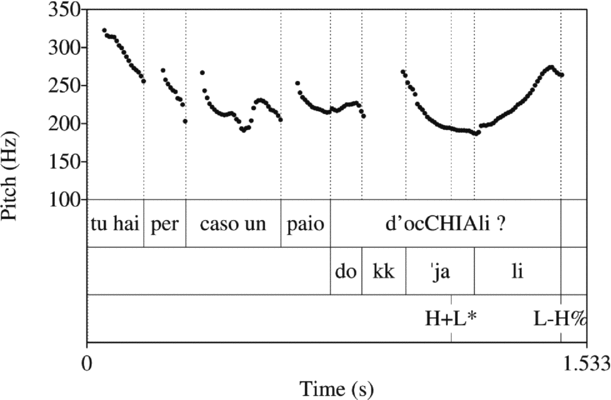
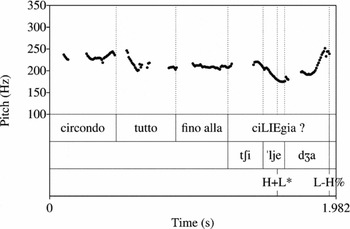
The intonational sequence proposed for describing the falling-rising pattern which is most typical of Bergamo and Milan yes–no questions is H+L*L-H%; an example for Bergamo is shown in Figure 6, and one for Milan in Figure 7. In these and all of the subsequent figures, the F0 trace is shown along with the word-by-word orthographic annotation (upper tier), the syllable-by-syllable broad phonetic transcription of the pre-nuclear, nuclear, and post-nuclear segmental portion of the utterance (mid tier), and the intonation analysis (bottom tier). The nuclear syllable is capitalised in the orthographic tier (as well as in the figure caption), and it is also identifiable in the segmental broad phonetic transcription tier as the one marked with lexical stress.
Bergamo yes–no question (Query) Tu hai per caso un paio di ocCHIAli? ‘Do you have by chance glasses?’ with falling-rising contour (H+L* L-H%).

Milan yes–no question (Check) Circondo tutto fino alla ciLIEgia? ‘Shall I go round everything until the cherry?’ with falling-rising contour (H+L* L-H%).

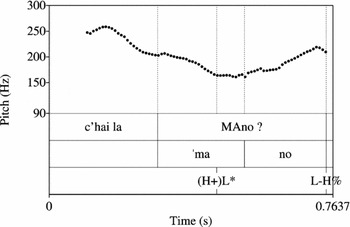
For Cagliari, the (falling-)rising contour is described with (H+)L* L-H% (Figure 8), where parentheses indicate uncertainty about the phonological role of the H tone preceding the valley.
Cagliari yes–no question (Query) C'hai la MAno? ‘Do you have the hand?’ with (falling-)rising contour ((H+)L* L-H%).

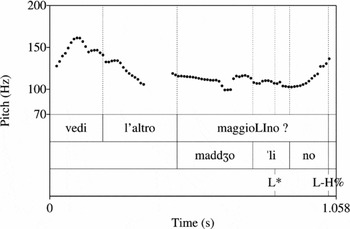
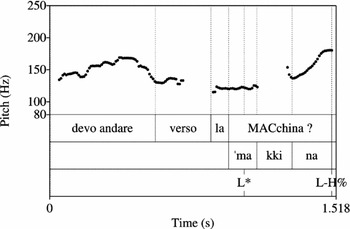
A question intonation contour typical of Perugia and Lecce is a valley followed by a gradual rising movement, described with the sequence L* L-H% for both Italian accents. An example for each of them is shown in Figures 9 and 10, respectively.
Perugia yes–no question (Align) Vedi l'altro maggioLIno? ‘See the other Maggiolino car?’ with rising contour (L* L-H%).

Lecce yes–no question (Check) Devo andare verso la MACchina? ‘Shall I go towards the car?’ with rising contour (L* L-H%).

Interestingly, in their account of Lecce yes–no question intonation, Endo & Bertinetto (Reference Endo and Bertinetto1997) found a rising-falling contour to be the most dominant instead. At the same time, however, authors admit that results on this variety should be treated with particular caution, as some native speakers of Lecce had perceptually judged Lecce yes–no questions elicited by the researchers as not typical of that variety. In fact, Endo & Bertinetto (Reference Endo and Bertinetto1997) specify that the Lecce accent recordings were carried out with speakers from Miggiano, a small town 40 km from Lecce. This indicates the magnitude of possible variability among Italian accents even within a relatively small geographical area, implying that considerable attention needs to be paid to the geolinguistic background when selecting speakers.
5.2.2 Accentual rise with or without a terminal rise: L+H L-L% and L+H L-H% contour types
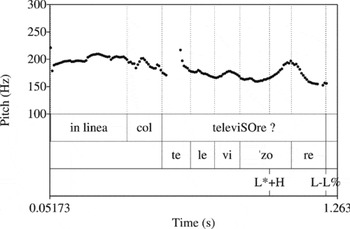
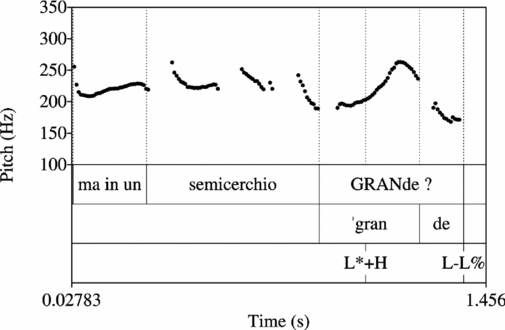
In this group of 10 Italian accents, seven varieties show a highly predominant occurrence of the rise-fall F0 shape, i.e. a rise on the nuclear syllable followed by a low boundary: Turin, Venice, Parma, Bari, Naples, Catanzaro and Palermo. In Turin, Venice, Parma, Naples and Palermo the peak of the rise appears to be aligned late in the nuclear syllable. The analysis for this type of contour proposed by Interlandi (Reference Interlandi2003) and Interlandi & Romano (Reference Interlandi and Romano2003) for Turin, and by Grice (Reference Grice1995) for Palermo is L*+H L-L%, and it is confirmed here. For Naples, D'Imperio (Reference D'Imperio2001a, Reference D'Imperiob among others) proposes an HL- phrase accent instead of L- (see Grice et al. Reference Grice, D'Imperio, Savino, Avesani and Jun2005 for discussion), that is L*+H HL-L%. The latter analysis is retained for Neapolitan in this paper.
Examples of prototypical rise-fall contours in Turin, Parma, Venice, Palermo and Naples yes–no questions are shown in Figures 11a, 12, 13, 14, and 15, respectively.
Turin yes–no questions: (a) (Check) ‘Verso il centro del FOGlio?’ ‘Towards the centre of the sheet?’ with rising-falling contour (L*+H L-L%); (b) (Align) Sei arrivato all'altezza del paraFANgo? ‘Have you arrived at the mudguard?’ with an extra H% to the rising-falling contour (L*+H L-H%).

Parma yes–no question (Check) In linea con il televiSOre? ‘In line with the television set?’ with rising-falling contour (L*+H L-L%).

Venice yes–no question (Check) Ma in un semicerchio GRANde? ‘But in a large semi-circle?’ with rising-falling contour (L*+H L-L%).

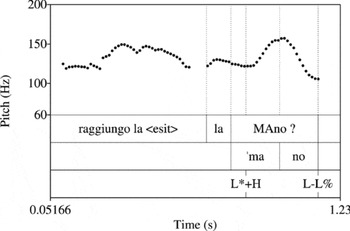
Palermo yes–no question (Check) Raggiungo la <esit> la MAno? ‘Shall I reach the <esit> the hand?’ with rising-falling contour (L*+H L-L%).

Naples yes–no question (Check) E li <esit> e li <ii> e li diVIde? ‘And it <eer> and it divides them?’ with rising-falling contour (L+H* HL-L%).

In Bari (Figure 16) and Catanzaro (Figure 17), the peak of the rise is reached around the middle of the accented syllable. The different alignment with respect to the previous case is reflected in the phonological sequence which describes this rise-fall contour: L+H* L-L%. This analysis has been already proposed for Bari Italian in a number of previous studies also based on Map Task dialogues (Grice & Savino Reference Grice and Savino1995, Reference Grice and Savino1997, Reference Grice and Savino2003a, Reference Grice and Savinob, Reference Grice, Savino, Gilles and Peters2004; Savino Reference Savino1997, Reference Savino and Burr2000; Savino & Grice Reference Savino and Grice2007, Reference Savino, Grice, Frota, Elodierta and Prieto2011).
Bari yes–no question (Query) Tu ce l'hai il secondo cuore ROSso? ‘Do you have the second red heart?’ with rising-falling contour (L+H* L-L%).

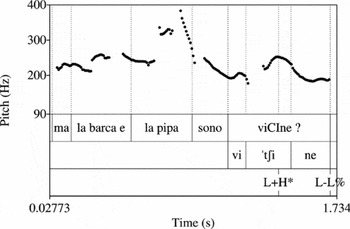
Catanzaro yes–no question (Check) Ma la barca e la pipa sono viCIne? ‘But the boat and the pipe are close to each other?’ with rising-falling contour (L+H* L-L%).

As described above, in all of these seven varieties a rising movement after the fall (L-H%) has been encountered in small percentages in yes–no questions. This was expected for Bari (see e.g. Grice & Savino Reference Grice and Savino1997, Refice, Savino & Grice Reference Refice, Savino and Grice1997, Savino Reference Savino1997, Reference Savino and Burr2000), Palermo (Grice Reference Grice1995) and Naples (Maturi Reference Maturi1988), where this feature has already been attested in the previous studies mentioned in this paper, and associated with some paralinguistic meaning in spontaneous speech (but also with ‘reading style’ effect in read speech, for further discussion on this issue see Section 6 below).
As mentioned in Section 5.1, at this stage, it can only be speculated that a similar paralinguistic role is played by H% also in Turin, Venice, Parma and Catanzaro questions.
An example of this rise-fall-rise contour type is shown for the Turin variety in Figure 11b.
As for the remaining three varieties, i.e. those spoken in Genoa, Rome and Florence, statistical analysis has clearly shown that an accentual rise followed by either a fall or a rise is the most common intonational feature in polar questions, even though numbers are not sharp enough to indicate unambiguously which of the two contour types can be considered as the prototypical one in each of the three accents.
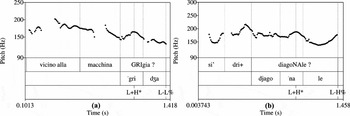
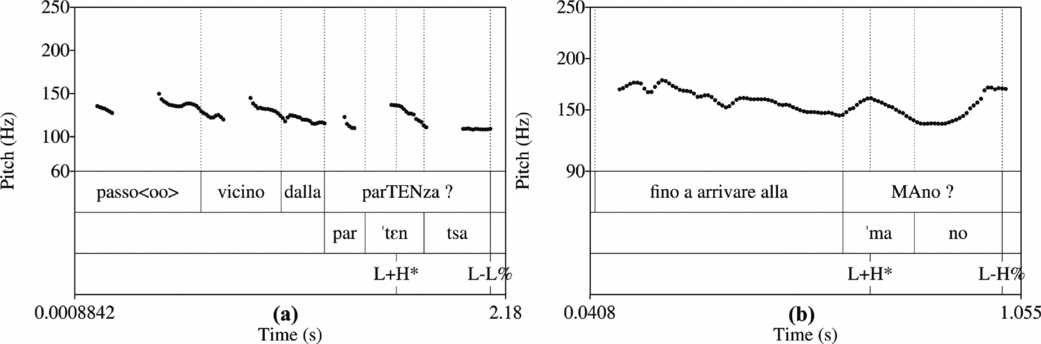
Genoese, Florentine and Roman yes–no question rise-fall contours can be described with the sequence L+H* L-L% (an example for each variety is shown in Figures 18a, 19a and 20a, respectively), and rise-fall-rise with L+H* L-H% (an example for each is shown in Figures 18b, 19b and 20b, respectively). In this latter contour type, it is observed that the size of the F0 excursion in the final rise can vary significantly, ranging from a large to a very reduced one.
Genoa yes–no questions: (a) (Check) Vicino alla macchina GRIgia? ‘Close to the grey car?’ with rising-falling contour (L+H* L-L%); (b) (Check) DiagoNAle? ‘Diagonal?’ with rising-falling-rising contour (L+H* L-H%).

Florence yes–no questions: (a) (Check) Passo<oo> vicino dalla parTENza? ‘Shall I go <eer> close to the start?’ with rising-falling contour (L+H* L-L%); (b) (Check) Fino a arrivare alla MAno? ‘Till getting to the hand?’ with rising-falling-rising contour (L+H* L-H%).

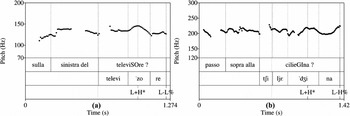
Rome yes–no questions: (a) (Check) Sulla sinistra del televiSOre? ‘To the left of the television set?’ with rising-falling contour (L+H* L-L%); (b) (Check) Passo sopra la cilieGIna? ‘Shall I go above the little cherry?’ with rising-falling-rising contour (L+H* L-H%).

It is worth pointing out that our results on Florence Italian are not in line with those presented by Magno Caldognetto et al. (Reference Magno Caldognetto, Ferrero, Lavagnoli and Vagges1978) (discussed in Section 3 above), according to which the terminal rise alone is responsible for marking interrogativity in this variety, and are partially in line with those reported in Grice et al. (Reference Grice, D'Imperio, Savino, Avesani and Jun2005), where the combination of a nuclear peak and a high boundary is responsible for marking such a distinction. Our analysis of CLIPS data shows that Florentine questions can be characterised by either a high or a low boundary tone after the accentual rise, with a prevailing use of the former. Our findings confirm the important role played by a high boundary in cueing questions in this variety, as reported in Grice et al. (Reference Grice, D'Imperio, Savino, Avesani and Jun2005). At the same time, they call for further research on the specific role of the boundary tone in marking interrogativity in the Florentine variety, since in our data we found that both high and low edge tones can be used after the L+H accent. Similar results obtained in our data for Genoa and Rome raise the same issue also for these two varieties.
6 Discussion
According to what is generally claimed in the literature, the following distribution of the prototypical contour types for yes–no questions should be expected from our analysis:
(i) a terminal rise preceded by an accentual low/fall ((H+)L L-H% contour) in 10 of the 15 varieties: Bergamo, Milan, Genoa, Turin, Venice and Parma from the North; Rome, Perugia, Florence and Cagliari from the Centre;
(ii) an accentual rise followed by a final fall (L+H L-L%) in the remaining five accents: Bari, Naples, Lecce, Catanzaro and Palermo, all from the South.
Our results (summarised in Table 4) show a different picture. First of all, only five (two from the North, two from the Centre, and one from the South) of the 15 Italian varieties analysed have the (H+)L L-H% contour type as the prototypical intonation contour for questions, i.e. a terminal rise preceded by an accentual low/fall.
Distribution of most commonly occurring polar question F0 contours across the 15 Italian regional accents as resulting from the analysis of the Map Task dialogues in the CLIPS corpus. A provisional phonological description of melodic contour for each variety is also presented. Note that for Genoa, Rome and Florence both the rise-fall and the rise-fall-rise contours are included, as both contour types are almost equally distributed in these three varieties. For the remaining varieties characterised by an accentual rise (L+H) followed by a fall (L-L%), an H% in parentheses indicates that an extra final rise has been found in small percentages in the CLIPS dialogues.

The remaining 10 varieties (four from the North, two from the Centre, and four from the South) have a rise on the nuclear pitch accent (L+H) as the most common intonational feature. Among those, in seven accents (Turin, Venice, Parma, Bari, Naples, Catanzaro and Palermo – three from the North and four from the South) the accentual rise is prototypically followed by a low boundary, and occasionally followed by an extra final rise.
For the remaining three accents, namely Genoa, Florence and Rome, the accentual L+H can be followed by either a falling (L-L%) or a rising (L-H%) boundary. In this case, percentages of their distribution do not indicate clearly which tune type can be considered as prototypical. Neither can the rise-fall and the rise-fall-rise contours be associated with a specific pragmatic use (Query and tentative Check or tentative Align) of the unbiased polar questions analysed, as shown in Section 5.1 above. Further research is needed to shed more light on the specific contribution of the boundary tone in marking yes–no questions in these three varieties.
To summarise, in our results two main trends can be identified:
1. An accentual rise (generally followed by a final fall) is a more common intonational strategy for marking questioning than a terminal rise preceded by an accentual low/fall, the latter being claimed in the literature as by far the most prevalent in Italian (Standard, Northern and Central accents).
2. The distribution of the contour types is not geographically related.
It can be hypothesised that the different picture offered by our results of CLIPS data with respect to what is generally described in the literature can be due to the different speech type analysed – spontaneous speech (task-oriented dialogues) in the present study, read speech in the majority of previous works on Italian varieties (including Standard Italian).
As mentioned in Section 3 above, it has already been observed in some varieties that a terminal rise in questions is the most typical intonational feature in read speech. Past investigations on Bari Italian have demonstrated that speakers tend to produce yes–no questions with an extra terminal rise after the accentual rise (L+H L-H%) in reading tasks (Savino & Refice Reference Savino and Refice1996, Grice, Savino & Refice Reference Grice, Savino and Refice1997, Refice, Savino & Grice Reference Refice, Savino and Grice1997). Maturi (Reference Maturi1988) observes the same tendency in his Neapolitan speakers, whereas Sienese speakers tend to use two completely different intonational strategies: an accentual rise followed by a fall in spontaneous speech, and a terminal rise preceded by an accentual fall in read speech (Marotta & Sorianello Reference Marotta and Sorianello1999).
Recall also that Endo & Bertinetto (Reference Endo and Bertinetto1997), in their analysis of yes–no questions in nine Italian accents elicited through a reading task (as reported in Section 3 above), warn the readers about the reliability of their results, as the influence of the reading speaking style has to be taken into account. All these authors hypothesise that Italian speakers tend to produce terminal rises in read questions because they unconsciously assume that a more ‘formal’ and ‘Standard-like’ speaking style has to be used in a reading task, where ‘Standard-like’ speaking style is associated with ‘ending the contour with a rise’ in questions.
Apparently, this can be realised by speakers when reading texts aloud by either adding an extra rise after a rising pitch accent (as demonstrated in Bari and Naples by Grice, Savino & Refice Reference Grice, Savino and Refice1997 and Refice, Savino & Grice Reference Refice, Savino and Grice1997), or by producing the typical terminal rise after a low/falling pitch accent (as shown for Sienese speakers in Marotta & Sorianello Reference Marotta and Sorianello1999, or for Turin, Venice, Bari, Naples readers in Canepari Reference Canepari1980, see discussion below).
The influence of the ‘reading task effect’ can also explain why results of the present study contrast with those obtained by Canepari (Reference Canepari1980) in his analysis of yes–no questions in 21 Northern, Central and Southern varieties, where all of them are described as being characterised by a functional terminal rise preceded by an accentual low/fall (as reported in Section 3). In fact, Canepari's analysis is also based on read speech: the author explains that in order to analyse comparable speech materials, all speakers from the 21 varieties were asked to read aloud the same set of isolated sentences. If we compare our results with those obtained by Canepari as reproduced in Figure 1 above, it can be noted that only for Milan, Perugia and Cagliari do both analyses agree in reporting a falling-rising F0 contour, whereas for the remaining ones (Genoa, Turin, Venice, Rome, Florence, Bari and Naples) in the CLIPS dialogues we found the accentual rise followed by a final fall (to which an extra final rise can be added, especially in Genoa, Florence and Rome) to be the most typical contour, whereas Canepari indicates a low/falling nuclear accent followed by a terminal rise for all of them.
The use of the two different speech types (spontaneous vs. read) can also help to explain why our results for Florentine present some dissimilarities with those obtained by Magno Caldognetto et al. (Reference Magno Caldognetto, Ferrero, Lavagnoli and Vagges1978) and by Grice et al. (Reference Grice, D'Imperio, Savino, Avesani and Jun2005) (as already explained in Section 5.2.2). In fact, examples of Florentine yes–no questions described by Grice et al. (Reference Grice, D'Imperio, Savino, Avesani and Jun2005) refer to read speech only; this might explain why cases of terminal falls were probably not found in their data.
In the Magno Caldognetto et al.'s (Reference Magno Caldognetto, Ferrero, Lavagnoli and Vagges1978) study, the authors explicitly declare that it was based on analysis of isolated sentences read aloud. Recall that in this case they systematically found a rise on the final part of the contour in all questions analysed, as opposed to a fall in their declarative counterparts. Since they did not take into account the F0 movement on the nuclear syllable in their analysis, their conclusion is even more restrictive than that in Grice et al. (Reference Grice, D'Imperio, Savino, Avesani and Jun2005). Magno Caldognetto et al. attribute to the terminal contour alone the role of distinguishing between questions and statements in Florentine Italian, i.e. the same property as that described for Standard Italian in the literature. In fact, the authors claim that ‘[j]ust as it was expected, the terminal contour of the last syllable is the most important phonetic feature in distinguishing statements from yes–no questions; in fact, statements have a final contour slightly falling or stationary, while yes–no questions have a final contour sharply rising’ (Magno Caldognetto et al. Reference Magno Caldognetto, Ferrero, Lavagnoli and Vagges1978: 64–65; emphasis added – MS). In this case, it appears that Magno Caldognetto et al.'s analysis of the Florence variety has been strongly influenced also by expectations of similarities between Florentine and Standard Italian, as the latter is said to be derived from the former.
Our results for Florentine also call into question the assumption according to which Standard Italian derives from the Florentine or, more generally, from the ‘Tuscan’ variety. It appears that it does not hold true for intonation. On the other hand, a rising-falling and not a falling-rising contour is the typical intonation pattern described also for other varieties spoken in Tuscany when spontaneous speech is analysed (Pisa, Lucca, Siena; see Section 3).Footnote 5
Where does Standard Italian yes–no question intonation analysis come from, then? It can be speculated that since in traditional studies the speech materials analysed (mainly via auditory analysis only) consisted of read speech, yes–no questions were systematically produced with a final rise, regardless of the specific geolinguistic origin of the speakers (i.e. whether that terminal rise could be preceded or not by an accentual rise). The systematic realisation of this final rise might have resulted in the intonational description of Standard Italian polar questions as being characterised by a functional terminal rise. Such an interpretation has probably gained ground also because a terminal rise as the primary feature marking interrogativity has been generally accounted for as the most common feature across languages (Bolinger Reference Bolinger and Greenberg1978).
7 Concluding remarks
Results presented in this paper have shown that a rise on the nuclear syllable generally followed by a fall is a very common intonational feature for signalling questions across Northern, Central and Southern Italian varieties, and not an exception confined to a number of Southern accents. These results call into question the general claim that a terminal rise preceded by an accentual low/fall is the most typical intonational strategy in Italian questions.
The reason for such a discrepancy in results seems to be attributable to the nature of the data analysed: mainly read speech in previous investigations, and spontaneous speech in the present study. The influence of speaking style along the spontaneous–read dimension in the realisation of the F0 contour in questions has been attested also for other languages, for example, American English (Hirschberg Reference Hirschberg1995, Reference Hirschberg and Horne2000), German (Kügler Reference Kügler, Fisher, van den Vijver and Vogel2003), and Bulgarian (Andreeva, Koreman & Barry Reference Andreeva, Koreman and Barry2003). In these languages, it has been found that spontaneous yes–no questions are characterised by a low boundary tone, whereas a high boundary is more typical of read questions. Our findings in Italian lend further support to this claim, pointing out the importance of controlling such a parameter when analysing intonation, especially when questions are involved. In fact, the predominance of the terminal rise reported in the literature as the most widespread feature of question intonation across Italian varieties, including the Standard variety, is possibly attributable to an ‘underestimation’ of the role of the ‘reading style effect’ in the intonation contours produced.
Our analysis has also ascertained that the distribution of the contours for questions is not geographical, as has been claimed in the literature. Therefore, references to overall Northern, Central and Southern Italian intonation systems are inaccurate, with methodological implications for a number of research fields, including second language acquisition research and speech technology localisation projects.
Acknowledgements
I would like to thank Martine Grice for her constant support, advice and useful comments during the preparation of the manuscript. I am also very grateful to three anonymous reviewers and to Adrian Simpson for helpful suggestions and comments on an earlier version of the paper. Many thanks also to Silvia Dahmen and Jessica Di Napoli for their comments. Thanks are also due to Nils Jagdfeld for creating the figure containing the pie-charts for question intonation of Italian varieties.