Anger management programs are based on the premise that teaching clients to recognise the early physiological signs and cognitive triggers for anger can help them to improve control over anger and, as a consequence, decrease the risk of violent behaviour. Accordingly, most anger management programs employ cognitive-behavioural treatment methods to change the way in which recipients consider and respond to situations that they perceive to be provocative. One way in which angry individuals differ from one another is in terms of their gender role identity. Despite evidence suggesting that highly masculine individuals are more likely to express their anger outwardly than those who identify as feminine (Kopper, Reference Kopper1993; Kopper & Epperson, Reference Kopper and Epperson1991, Reference Kopper and Epperson1996; Milovchevich, Howells, Drew, & Day, Reference Milovchevich, Howells, Drew and Day2001), the construct of masculinity has been relatively neglected in mainstream anger management programming, other than when considered in the context of gendered violence (e.g., Anderson & Umberson, Reference Anderson and Umberson2001).
An individual's gender role identity is one way of considering judgments made about the self. Gender role identity has been conceptualised as ‘stereotyped definitions of behavior embedded within the cultural discourse’ (Bem, Reference Bem1993, p. 125). According to Bem, an individual's gender role identity — and not biological sex — is the ‘lens’ through which one interprets, classifies, and processes people and their behaviour. Thus, how one interprets, behaves, and responds in a social situation will depend on conceptions of what is gender-appropriate or common behaviour. For example, it has been suggested that masculinity is associated with greater externalisation of anger (Bem, Reference Bem1974; Walters, Reference Walters2001). From this, it can be predicted that individuals with stronger masculine gender role identity will interpret information and situations and respond in a manner consistent with that identity (i.e., with greater anger expression).
Differences in how individuals respond to negative situations may also be more pronounced in situations where the intent underlying the provocation is ambiguous. Individuals who are high in trait anger have been shown to make greater attributions of hostile intent under these conditions (Hazebroek, Howells, & Day, Reference Hazebroek, Howells and Day2001; Wyatt & Haskett, Reference Wyatt and Haskett2001), responding to ambiguity as though the intent was hostile (Dodge, Reference Dodge1980). Given that masculinity is also negatively associated with social sensitivity (Hirokawa, Yagi, & Miyata, Reference Hirokawa, Yagi and Miyata2004), this may also help to account for individual differences in anger arousal in situations where the intent of the protagonist is ambiguous.
The aim of the present study was to analyse the effects of participant sex (male and female) and gender role identity (masculinity and femininity) on dependent measures of trait anger and self-predicted anger following a provocation, and to examine these effects across different situational contexts when the intent of the provocation (ambiguous or unambiguous) was manipulated. It was hypothesised that gender role identity, but not sex, would significantly contribute to differences on measures of angry emotion. Specifically, it was hypothesised that those participants with a masculine gender role identity would report higher levels of trait anger and more self-predicted anger. While it was predicted that unambiguous provocation would result in more self-predicted anger overall, a significant interaction was also predicted such that masculine participants would report more self-predicted anger when the intent of an anger-provoking incident was ambiguous.
Method
Participants
A sample of 630 (382 females and 248 males)Footnote 1 undergraduate student volunteers from an Australian university participated in the study. The mean age of the participants was 22.8 years (SD = 7.24 years; range = 17–57 years). Participants did not receive course credit and were not provided with other incentives for taking part.
Materials and Measures
Vignettes
Potentially anger-triggering events were depicted in four video vignettes — two scenarios (the first filmed in a busy car park, and the second filmed in a quiet bar), each with two levels of ambiguity. Both scenarios were filmed through the eyes of an unseen protagonist — that is, the observer is the protagonist in the situation. The car park scenario (approximately 45 seconds duration) was filmed from the perspective of the person behind the steering wheel of a car. It depicts the driver waiting in a busy car park for a space to become available, which is subsequently occupied by another driver. To vary intent, the other driver either looks towards the camera and makes a rude one-finger gesture (unambiguous intent), or does not look at the camera (ambiguous intent).
The bar scenario (approximately 90 seconds duration) was filmed from the end of a quiet bar and depicts the observer waiting to be served a drink while the bartender polishes glasses. The bartender serves a patron a drink, and then returns to polishing glasses before eventually walking towards the camera to serve the observer. To vary the intent of the provocation the bartender either looks at the camera before serving the other patron (unambiguous intent), or does not look at the camera (ambiguous intent).
With the exception of the intent manipulation both versions of each scenario were identical in content.
Manipulation check
Participants were asked to rate the likelihood that the other person has seen them (‘Did the other driver see you before driving into the park?’ and ‘Did the bartender see you before serving the other customer?’). Both items employed 7-point rating scales (definitely saw me to definitely did not see me).
Self-predicted anger
An eight-item self-predicted anger measure was used to assess the respondents’ responses to the vignettes. Although conceptually similar to the State Anger scale of the State-Trait Anger Expression Inventory (STAXI-2; Spielberger, Reference Spielberger1999), items were expressed in terms of anticipated, rather than present feelings. Respondents indicated on a 4-point scale the extent to which each statement would describe their likely reactions to the events depicted in the vignette. Examples of items are ‘I would feel like hitting something’ and ‘I would feel furious’. Internal consistency of the self-predicted anger scales, measured using Cronbach's coefficient alpha (α), indicated that the scale displayed moderately strong internal reliability in both applications (α = .86 for the car park scenario, and α = .85 for the bar scenario).
Trait anger
The State-Trait Anger Expression Inventory-2 (STAXI-2; Spielberger, Reference Spielberger1999) is a 57-item self-report measure which assesses state anger, trait anger, and styles of anger expression and control. Only the Trait Anger scale (10 items) was used in the present study. This scale assesses individual differences in proneness to anger as a personality trait. All items employed 4-point rating scales. Cronbach's coefficients alpha (α) reported by Spielberger (Reference Spielberger1999) indicated that the scale displayed good internal reliability (α = .84 for females and α = .86 for males). Similar internal consistency was obtained in the current study (α = .82 for both males and females).
Gender role
The Bem Sex-Role Inventory (BSRI) was developed by Bem (Reference Bem1974) to measure masculinity and femininity as independent traits rather than as a unidimensional construct. The short form has been used across a number of studies (e.g., Kopper, Reference Kopper1993; Kopper & Epperson, Reference Kopper and Epperson1991, Reference Kopper and Epperson1996) and has been shown to have better psychometric properties than the full scale (Kolbe & Langefeld, Reference Kolbe and Langefeld1993; Payne, Reference Payne1985). The scale consists of 10 personality characteristics classified as stereotypically feminine (e.g., ‘compassionate’, ‘tender’, ‘affectionate’), and 10 items classified as stereotypically masculine (e.g., ‘aggressive’, ‘dominant’, ‘forceful’). All items employed 7-point rating scales with higher scores indicating greater masculinity or femininity. Kolbe and Langefeld (Reference Kolbe and Langefeld1993) found good internal consistency reliability for the masculinity and femininity subscales (Cronbach's alphas ranged from .80 to .95). Internal reliability for the current study was moderate to strong (α = .77 for the masculinity scale, and α = .91 for the femininity scale).
Procedure
Participants observed the videotaped vignettes and completed the research measures in groups. Groups were randomly assigned to one of two experimental conditions (ambiguous or unambiguous provocation) and within each condition asked to observe two videotaped vignettes depicting a potentially anger-triggering event. In both conditions, the car park scenario was viewed first. After viewing each vignette, participants were asked to report how angry the events would make them. Participants then completed the measures of trait anger and gender role identity, and provided demographic information.
Results
Data Examination and Preliminary Analysis
Prior to the analyses, all variables were tested for violation of assumptions, and checked for accuracy of input and missing data. Twenty-six cases were excluded due to incomplete responses, reducing the sample size to 604 participants. Missing responses, which appeared to occur randomly, were replaced by the series mean (Tabachnick & Fidell, Reference Tabachnick and Fidell2001). The data were then screened for multivariate outliers, normality, and linearity. Nineteen cases were identified as multivariate outliers using Mahalanobis distance (p < .001; Tabachnick & Fidell, Reference Tabachnick and Fidell2001). All outliers had angry response scores of 32 — the scale maximum — for one or both scenarios, possibly due to frivolous responding; their removal resulted in approximately normal distributions on these variables. Variables were screened for normality, and although some skewness and kurtosis were observed, these were considered insufficient to make a substantive difference in a sample of this size (Tabachnick & Fidell, Reference Tabachnick and Fidell2001). Subsequent analyses were conducted on the remaining 585 cases.
The effectiveness of the manipulation of ambiguity was assessed with two independent samples t-tests. For the car park scenario, participants in the ambiguous condition, M = 3.48, SE = .09, scored higher on the manipulation check (indicating lesser certainty that the other person had ‘seen’ them) than those in the unambiguous condition, M = 1.98, SE = .08, t(545.37) = 12.46, p < .001, r = .47, 95% CIs (1.27, 1.74). Similar results were found for the bar scenario, M = 4.51, SE = .10 vs. M = 1.55, SE = .06, t(577.77) = 25.22, p < .001, r = .72, 95% CIs (2.73, 3.19). Participants’ self-predicted anger scores were significantly higher for the car park scenario, M = 17.55, SE = .22, than for the bar scenario, M = 13.48, SE = .18, t(584) = 20.35, p < . 001, r = .64.
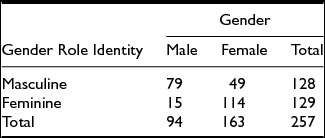
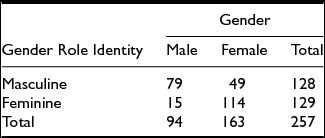
Individuals were classified according to their scores on the Bem Sex-Role Inventory as high or low in masculinity and femininity on the basis of a median split (Karniol, Reference Karniol2003; Kopper & Epperson, Reference Kopper and Epperson1991), then assigned to one of four gender role identities (‘masculine’, ‘feminine’, ‘androgynous’, or ‘undifferentiated’). Only data from participants who were classified as masculine or feminine were used in subsequent analyses. Inspection of cell sizes for comparisons of sex by gender role identity revealed unequal cell sizes; in particular, there were only 15 feminine male participants. The numbers of participants classified in both categories can be found in Table 1.
Cell Sizes for Classification of Gender Role Identity by Gender
Hypothesis Testing
Hypothesis 1: Gender role identity, but not sex, would significantly contribute to differences in trait anger
It was predicted that masculine participants would report greater trait anger than feminine participants but there would be no differences in trait anger between males and females. A two-way between groups ANOVA was conducted to explore the impact of sex (male vs. female) and gender role identity (masculine vs. feminine) on levels of anger, as measured by the Trait Anger scale. Levene's Test of Equality of Error Variances indicated that the homogeneity of variance assumption was violated (p < .05). As a result, a log transformation was performed on the measure of trait anger (Howell, Reference Howell2002), resulting in a non-significant effect on Levene's test. Because the subsequent analysis was conducted with transformed data, descriptive statistics reported are antilogs of those obtained to produce geometric means on the original measurement scale; confidence intervals (CIs) transformed to the original measurement scale refer to the ratios of geometric means rather than the difference between them.
There was a significant main effect for gender role identity, F(1, 253) = 12.65, p < .001, with a moderate effect size, η2partial = .05. As predicted, masculine participants, M = 20.66, exhibited significantly higher levels of trait anger than feminine participants, M = 17.73, ratio of geometric means = 1.17, 95% CIs (1.14, 1.32). The interaction effect was significant, F(1, 253) = 4.36, p = .04, η2partial = .02. While trait anger scores were similar for male participants regardless of whether they had a masculine, M = 20.10, or feminine, M = 19.05, gender role identity, females who had a masculine, M = 21.60, gender role identity exhibited higher trait anger scores than those with a feminine, M = 17.56, role identity, 95% CIs (0.74, 0.99). The main effect for sex was not significant, F(1, 253) = .02, p = .89.
Hypothesis 2: Gender role identity, but not sex, would significantly contribute to differences in self-predicted anger. Masculine participants would report more self-predicted anger when the intent of an anger-provoking incident was ambiguous
The second analysis sought to determine whether there would be an effect of sex, gender role identity and intent of provocation on self-predicted anger in the two anger-triggering events. Specifically, it was predicted that masculine participants would report greater self-predicted anger than feminine participants. Two three-way between-groups ANOVAs were conducted to explore the impact of sex (male vs. female), gender role identity (masculine vs. feminine) and provocation (ambiguous vs. unambiguous) on levels of situational anger, as measured by the Self-Predicted Anger scale, for the anger-triggering events. Second-order interactions and above were suppressed because of small cell sizes. Levene's Test of Equality of Error Variances again indicated that the homogeneity of variance assumption was violated for both anger-triggering events, p < .05. Log transformation was again employed on the two measures of self-predicted anger, resulting in a non-significant effect on Levene's test in each case. Geometric means and CIs of the ratios of geometric means are reported.
Car park scenario: The main effect for gender role identity was significant, F(1, 250) = 4.07, p = .045, although the effect was small, η2partial = .02. Participants with a masculine gender role identity reported greater self-predicted anger than those participants with a feminine identity, M = 17.68 versus M = 15.68, ratio of geometric means = 1.13, 95% CIs (0.96, 1.42). The main effect for intent was significant, F(1, 250) = 5.90, p = .02, η2partial = .02, with participants in the ambiguous condition reporting lesser self-predicted anger than participants in the unambiguous condition, M = 16.01 versus M = 18.16, ratio of geometric means = 0.88, 95% CIs (0.81, 1.04). The main effect for sex, F(1, 250) = .01, p = .95, and the interaction effects for gender role identity by intent, F(1, 250) = .42, p = .52, sex by gender role identity, F(1, 250) = .01, p = .94, and sex by intent, F(1, 250) = .05, p = .82, were not significant.
Bar scenario: The main effect for intent was significant, F(1, 250) = 7.99, p = .01, η2partial = .03, with participants in the ambiguous condition reporting lower self-predicted anger than those in the unambiguous condition, M = 12.10 versus M = 13.89, ratio of geometric means = 0.87, 95% CIs (0.80, 1.00). In contrast to prediction, there was no significant main effect for gender role identity, F(1, 250) = 2.22, p = .14, although the means were in the expected directions, Ms = 13.26 versus 12.04. There was also not a significant main effect for or sex, F(1, 250) < .001, p = .99, and no significant interaction effects for gender role identity by intent, F(1, 250) = 2.16, p = .14, sex by gender role identity, F(1, 250) = 2.17, p = .14, and sex by intent, F(1, 250) = 1.72, p = .19.
Discussion
This study investigated how masculine individuals might differ from feminine individuals in their anger experience and arousal, particularly in response to anger-eliciting events (provocations) of an ambiguous nature. Independently of sex, gender role identity exerted a significant influence on trait anger and in one potentially anger-arousing event. That is, those with a masculine gender identity had a tendency to score higher on the measures of anger. These findings are consistent with previous research that has found differential patterns of anger experience and expression as a function of gender role identity, rather than sex (e.g., Kopper, Reference Kopper1993; Kopper & Epperson, Reference Kopper and Epperson1991, Reference Kopper and Epperson1996; Milovchevich et al., Reference Milovchevich, Howells, Drew and Day2001).
The study also examined the effect of ambiguity of another person's intent on self-reported anger. For participants overall, self-predicted anger was greater, as expected, in response to unambiguous provocation. That is, when the provocation had a clear intention to achieve a negative outcome (indicated by the driver of the other car intentionally occupying the protagonist's car park, or by the bartender seeing but not serving the protagonist), regardless of sex or gender role identity participants predicted they would experience greater anger arousal. This finding was also consistent with previous research that has shown deliberate provocation to result in greater anger arousal (Hazebroek et al., Reference Hazebroek, Howells and Day2001), and clearly hostile intentions (rather than benign or ambiguous conditions) to result in verbal and behavioural hostility (Dodge, Reference Dodge1980). The interaction of gender role identity and intent is of most interest in the present study. Specifically, it was predicted that greater individual differences would be observed for masculine participants when presented with an ambiguous provocation. However, contrary to predictions, gender role exerted a general effect on anger scores, rather than being conditional on intent. That is, the effects of masculine or feminine gender role identity on how anger was experienced seemed to occur independently of whether there was ambiguity as to the intent behind the actions of another person. The unequal distribution of participant gender role identities may have been responsible for the lack of an effect. That gender role as a main effect was significantly predictive for one event (the car park scenario) only may suggest that gender role exerts a more powerful effect in situations that are more provoking (as witnessed by the significantly higher anger scores for this scenario), or that situations differ in their relevance to one's gender role identity.
These results provide some confirmation for the idea that gender role identity can be used to predict patterns of anger experience, and that individuals who are high in socially defined masculinity may experience or display angry behaviours and feelings. However, they require replication, given the limitations that are inherent in the design of this study. First, the vignettes were not counterbalanced; all participants viewed the car park scenario first and, upon viewing the second scenario, may have become ‘acclimatised’ to the provocation. The significant differences in anger scores between the two scenarios provide some support for this interpretation. Second, there may also have been age effects. There is evidence that anger decreases across the lifespan. For example, Phillips, Henry, Hosie, and Milne (Reference Phillips, Henry, Hosie and Milne2006) investigated the effects of ageing on emotional expression, emotional control, and rumination about emotional events. They reported that older adults expressed anger outwardly less often, and reported more inner control of anger using calming strategies compared to their younger counterparts. It is important to note that these age differences were not explained by the effects of social desirability. Age improvements in negative affect and anxiety were partly explained by age differences in anger regulation, and the authors emphasise the importance of anger management in good mental health among older adults.
These results do, however, have some potentially important implications for the further development of effective anger management programs. For example, gender role, and masculinity in particular, is a trait that could be routinely identified as a treatment target within anger management programs. There may also be scope for differential approaches for anger treatment based on classifications of gender role identity. Given evidence that gender role is strongly influenced by the immediate context (Bowers, Reference Bowers1999; Deaux & Major, Reference Deaux and Major1987; Smith, Noll, & Bryant, Reference Smith, Noll and Bryant1999), another possibility is to change exposure to situations in which masculinity becomes important. At least, it would appear that encouraging angry clients to consider how their masculinity shapes the way they interpret, classify and process people, behaviours, and attributions is a worthwhile treatment target.
Acknowledgments
This research was supported by a grant from the Australian Research Council (DP0452675).