Community resilience is vital for minimizing morbidity and mortality following a disaster, but can be negatively affected by the public’s response. Research indicates that the general public has unrealistic expectations of hospitals to provide non-medical resources during a disaster.Reference Charney, Rebmann, Esguerra, Lai and Dalawari 1 , Reference Charney, Rebmann, Esguerra, Lai and Dalawari 2 However, little is known about the general public’s expectations of the role that other response agencies play in disaster response. Understanding what value and trust the community places in which organizations for aid is key to organizing aid around those agencies, or in providing pre-planned redirection, if those agencies are incapable of providing the level of disaster care needed. This paper explores the general public’s perceptions and expectations of disaster response by community agencies, non-governmental organizations, as well as by the federal, state, and local levels of government in relation to disaster resource management, response collaboration, and leadership of community assistance centers.
Methods
This study was part of a larger project aimed at exploring racial disparities between white and African American individuals’ expectations and perceptions related to hospitals’ responsibility to provide non-medical resources to the uninjured during a disaster. No racial differences were identified; thus, all data were collated for final analysis. This study focused on the general public’s attitudes and beliefs regarding the government’s role and responsibility in disaster response related to resource management and distribution, and the public’s attitudes towards the management and use of community disaster assistance centers. Qualitative interviews were conducted with members of the general public in St. Louis, MO.Reference Charney, Rebmann, Esguerra, Lai and Dalawari 1 All interviews were conducted by T.R.; the interview was audio-recorded and then transcribed verbatim. Data were analyzed using content analysis to identify concepts and themes. Identified themes are outlined and described, including specific quotes that support these themes. The study was approved by the Saint Louis University institutional review board.
Results
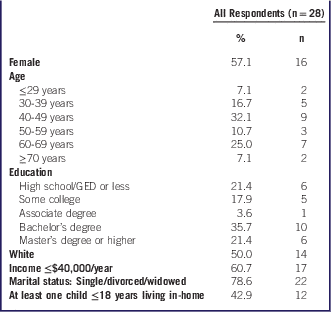
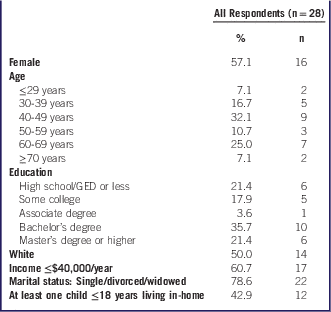
Demographic characteristics of the participants are outlined in Table 1. Over half of the participants reported that they or their immediate family members had experienced family separation (53.6%, n=15), property loss (57.1%, n=16), or physical injury (57.1%, n=16) resulting from a natural or man-made disaster or from a war or conflict. The participants identified multiple themes related to their perceptions of disaster management by community-based agencies, non-governmental organizations, as well as by the federal state, and local levels of government.
Participant Demographics
Trust Has Been Built or Hurt Because of Participants’ Past Experiences During Disasters
Multiple participants expressed the belief that they trust or have a lack of trust in response agencies and the government, based on those groups’ behavior during past disasters. Further, participants’ past experience with these organizations or agencies now influences their willingness to work with or seek out these groups if a future event should occur. As one participant stated, “Whenever I need anything, my instant reaction is to call United Way, because they always connect you with who has what.” Another stated, “I would turn to the Salvation Army, and the reason I say Salvation Army is that I know they do good work.”
In some cases these views were not from personal experience but based on the observation of the agency’s interactions with others. As one participant stated, “I have seen [the Salvation Army] provide.” Negative experiences resulted in less willingness to utilize resources provided by agencies in some cases. One participant stated, “I think I would still head for the hospital [for non-medical resources after a disaster] because I really don’t have a lot of confidence in the local government to coordinate those efforts. I mean, just based on the track record.” Another stated, “I just haven’t seen [the local government] demonstrate the proficiency that I would be comfortable with.”
Belief in the Importance of Local Agency Involvement
Participants expressed the belief that local response agencies and organizations are best suited to lead response efforts during disasters. This appears to stem from the belief that local organizations or groups are most familiar with the community’s needs. As one participant stated, “I think the locals [should be in charge] for things like [disaster response] that are probably better done at a local level, because they know the needs of their community.” Participants also expressed a preference for obtaining assistance or resources from local agencies and organizations versus getting it from those outside the local community because local responders would be better able to meet their needs. As one participant stated, “I would maybe choose local [to obtain assistance during a disaster] because they may have a better understanding of what my community really needs…because they’re more tied to the community and the knowledge of the people.”
Beliefs Regarding the Management of Community Assistance Centers
During the interview process, participants were told that community assistance centers would be put into place during disasters to provide minor medical care and non-medical resources such as shelter and food. Participants were asked the extent to which their decision to seek assistance from such community centers would depend upon the agency or entity who was leading the center. In general, participants did not express a preference. As one participant stated, “I think in the case of an emergency, the very fact that there’s any kind of a community center means the last thing I am thinking about is who’s running it.” Participants’ beliefs varied regarding the extent to which the local government should be involved in disaster response and/or managing community assistance centers. Some believed that the local government should have ownership of resource distribution in the community, because they are local and know the community.
Importance of Community Assistance Center Location Within the Community
Although the organization or agency managing the community assistance center was not a priority for most participants, the location of community centers was important. Many expressed the belief that proximity to their home was the highest priority. As one participant stated, “I’m probably going to just go wherever [is] closest to me or the most convenient for me to get to.” Participants also expressed the belief that there needs to be good communication during an event to alert community members regarding the location of these community assistance centers. As one participant stated, “If the local community center were running regular public service announcements/PSAs to let me know that they were prepared for this and how well they were prepared to take of it, the strategy that they could deal with this situation, well I’d head right over there.”
Belief that Local Government has a Financial Responsibility to be Involved in Disaster Response
Many participants expressed the belief that the local government has a financial responsibility to participate in disaster response. As one participant stated, “They have resources and we pay taxes.” Beyond taxes, some participants believed that the government had a basic responsibility to provide resources to the community during disasters. As one participant stated, “I [think] government has a responsibility to look out for people in times of disaster and provide them with things that they need to keep their lives going.”
Belief that Disaster Response Needs to be a Collaborative Effort
Almost all participants believed that disaster response – and, in particular, management of resource distribution through community assistance centers – needs to be a collaborative activity, regardless of which agency or organization leads the center. As one participant stated, “The local government could … talk to the local police and local fire department, local public utilities, to make sure that they’re all in sync and they’re all in coordination and all working together.”
Perceived Need for General Public Personal Disaster Preparedness
Interview questions posed to the participants did not address their attitudes and beliefs regarding personal preparedness. Despite this, many participants brought up this issue. Many participants expressed the belief that the general public needs to be planning for a disaster in terms of stockpiling food, water, and supplies. However, even among those who mentioned the importance of personal preparedness, most noted that they did not yet have much prepared or even the knowledge of exactly what or how many supplies were needed. Some expressed the belief that personal preparedness needed to be beyond stockpiling of supplies and should also include planning for family reunification. As one participant stated, “I think families should have a plan of where to meet in the aftermath of different types of disasters. I think that everybody should have an open space, like a park for some situations, a hospital for another and I would consider [deciding on the specific location ahead of time].”
Discussion
One of the primary goals of this study was to explore racial differences in regards to beliefs of disaster management by communities and governmental and non-governmental agencies. However, no racial disparities were observed; common themes of trust, local involvement, collaboration, and organizational and individual preparation were discussed by participants across races. Participants in this study reported the importance of trust, built from past experiences, in deciding where to go when help is needed during a disaster. Trust influences the public’s response to public health emergencies.Reference Eisenman, Williams, Glik, Long, Plough and Ong 3 The public’s lack of trust in public health officials and other governmental response agencies contributed to increased morbidity and mortality in some of the most vulnerable groups during the 2001 anthrax bioterrorism attack, Hurricane Katrina, and the 2009 H1N1 influenza pandemic.Reference Eisenman, Williams, Glik, Long, Plough and Ong 3 Lack of trust in the government was believed to have resulted in low antibiotic and vaccine use in vulnerable populations during the 2001 anthrax bioterrorism attack, as well as in low vaccine uptake rates during the H1N1 pandemic.Reference Eisenman, Williams, Glik, Long, Plough and Ong 3 Lack of trust in governmental agencies may also contribute to health disparities during disasters, if the distrust results in disregard of warnings and recommendations from authorities.Reference Andrulis, Siddiqui and Purtle 4 , Reference Bullard 5
Findings from this study indicate that the general public expects and prefers local agencies to be actively involved in disaster response. Notwithstanding the heavy reliance on the state and federal government for disaster management, local agencies are generally the first to respond within 72 hours of a disaster, and first responders are frequently members of the affected community.Reference Braun, Wineman, Finn, Barbera, Schmaltz and Loeb 6 Community organizations, such as churches and neighborhood councils can, therefore, improve disaster response by fostering teamwork and cooperation, creating partnerships among themselves and with governmental agencies, and by accurately assessing the needs of the community so as to facilitate equitable and efficient distribution of resources.Reference Andrulis, Siddiqui and Purtle 4 , Reference Patterson, Weil and Patel 7
Participants in this study expressed their expectation that response agencies collaborate in disaster response efforts. Organizational cohesiveness and collaboration among governmental and non-governmental organizations such as faith-based organizations and schools are likely to play a key role in the immediate, short-term, and long-term aftermath of a disaster. Disaster planning agencies should incorporate community-based participatory research in their efforts to enhance trust and build partnerships between response organizations and the communities they serve.Reference Crouse Quinn 8 , Reference Wells, Springgate, Lizaola, Jones and Plough 9 Before a disaster, community engagement exercises can be held to identify barriers, address community concerns, the local government’s response, communication issues, and increase the level of knowledge and preparedness within the community.
Individual interviews using qualitative methodology aided in the general public’s beliefs about management, leadership, and collaboration during disasters. However, because of inherent differences across communities in how the general public views disaster, this study’s findings may not be generalizable outside of the St. Louis region.
Conclusion
Although no racial differences were found, participants in this study reported trust in response organizations, local agency involvement, proximity of community assistance centers, and personal preparedness as important issues in disaster management. High levels of distrust must be overcome before a disaster occurs in order to maximize the public’s willingness to follow response agencies’ recommendations and protocols, which should lead to better outcomes. Enhancing collaboration between governmental, non-governmental, and community organizations, while empowering community members to be involved in the planning process, is essential in overcoming this distrust. Local and community initiatives to build partnerships should be planned in communities to help build resilience to disasters.