Introduction
In benthic communities, recruitment corresponds to the arrival, establishment and survival of new individuals to the substrate. It typically involves several pre- and post-settlement processes (Pineda et al., Reference Pineda, Reyns and Starczak2009; Émond et al., Reference Émond, Sainte-Marie, Galbraith and Bêty2015), being fundamental to the continuous replacement of organisms and playing an important role in the maintenance of community structure (Underwood & Fairweather, Reference Underwood and Fairweather1989; Pineda et al., Reference Pineda, Reyns and Starczak2009; Adjeroud et al., Reference Adjeroud, Kayal, Penin, Rossi, Bramanti, Gori and Orejas Saco del Valle2016). In general, recruitment is under the influence of environmental and/or biological factors, such as predation, spatial competition, fecundity rates, larvae availability and competence, substrate type, temperature, light, sedimentation, depth and precipitation (Anderson & Underwood, Reference Anderson and Underwood1994; Pineda et al., Reference Pineda, Reyns and Starczak2009; Rico et al., Reference Rico, Peralta and Gappa2009; Cavalcanti et al., Reference Cavalcanti, Skinner and Klautau2013; Émond et al., Reference Émond, Sainte-Marie, Galbraith and Bêty2015; Chase et al., Reference Chase, Dijkstra and Harris2016; Fuentes-Santos et al., Reference Fuentes-Santos, Labarta, Álvarez-Salgado and Fernândez-Reiriz2016; Sotelo-Casas et al., Reference Sotelo-Casas, Cupul-Magana, Solís-Marín and Rodríguez-Troncoso2016). The importance of each factor varies greatly among species and in space and time (Pineda et al., Reference Pineda, Reyns and Starczak2009).
Sponges are one of the main components of benthic communities and are widely recognized for their importance in providing environmental services (Bell, Reference Bell2008). Despite the relevance of recruitment as a fundamental process for the maintenance of populations, the number of studies on the recruitment of marine sponges is relatively small (e.g. Pronzato, Reference Pronzato1972; Zea, Reference Zea1993; Cavalcanti et al., Reference Cavalcanti, Skinner and Klautau2013; Padua et al., Reference Padua, Lanna, Zilberberg, Paiva and Klautau2013; Wulff, Reference Wulff2013; Dayton et al., Reference Dayton, Jarrell, Kim, Thrush, Hammerstrom, Slattery and Parnell2016, Reference Dayton, Jarrel, Kim, Parnell, Trush, Hammerstrom and Leichter2019; Stubler et al., Reference Stubler, Robertson, Styron, Carrol and Finelli2017). Regarding calcareous sponges (class Calcarea), recruitment knowledge is particularly scarce. They are commonly recognized as pioneers in the colonization of hard substrates, being subsequently overgrown by late colonizers such as demosponges (class Demospongiae), tunicates and bryozoans (Johnson, Reference Johnson1979; Vacelet, Reference Vacelet1980, Reference Vacelet1981; Pansini & Pronzato, Reference Pansini and Pronzato1981; Pierri et al., Reference Pierri, Longo and Giangrande2010; Cavalcanti et al., Reference Cavalcanti, Skinner and Klautau2013; Ribeiro et al., Reference Ribeiro, Padua, Paiva, Custódio and Klautau2016). Concise observations were reported on their recruitment over time (discussed in Vacelet, Reference Vacelet1980), and it was only during the 1970s and 1980s that the first accurate results became available (Pansini et al., Reference Pansini, Pronzato and Valsuani1974; Vacelet, Reference Vacelet1980, Reference Vacelet1981; Pansini & Pronzato, Reference Pansini and Pronzato1981). These former works showed that, among other reasons, the number of recruits may vary according to depth, composition and immersion time of the substrates (Pansini & Pronzato, Reference Pansini and Pronzato1981; Vacelet, Reference Vacelet1981). More recently, habitat selection and the influence of other factors were evaluated (Cavalcanti et al., Reference Cavalcanti, Skinner and Klautau2013; Padua et al., Reference Padua, Lanna, Zilberberg, Paiva and Klautau2013; Ribeiro et al., Reference Ribeiro, Padua, Paiva, Custódio and Klautau2016).
Most of the data on the recruitment of calcareous sponges came from studies developed in temperate regions, most specifically in the Mediterranean Sea (Pronzato, Reference Pronzato1972; Pansini et al., Reference Pansini, Pronzato and Valsuani1974; Vacelet, Reference Vacelet1980, Reference Vacelet1981; Pansini & Pronzato, Reference Pansini and Pronzato1981; Pierri et al., Reference Pierri, Longo and Giangrande2010) and the Pacific coast of California, USA (Johnson, Reference Johnson1979). It was only in the past few years that this topic was addressed in the tropics, in studies performed along the coast of Rio de Janeiro state, Brazil (Cavalcanti et al., Reference Cavalcanti, Skinner and Klautau2013; Padua et al., Reference Padua, Lanna, Zilberberg, Paiva and Klautau2013; Ribeiro et al., Reference Ribeiro, Padua, Paiva, Custódio and Klautau2016). Three species were used as models, the exotics Paraleucilla magna Klautau, Monteiro & Borojevic, Reference Klautau, Monteiro and Borojevic2004 and Sycettusa hastifera (Row, Reference Row1909), and the native sponge Clathrina aurea Solé-Cava, Klautau, Boury-Esnault, Borojevic & Thorpe, 1991. In the case of the former species, the influence of substrate orientation and exposure to light and hydrodynamics were revealed. For P. magna, data about the mortality of juveniles was also provided (Cavalcanti et al., Reference Cavalcanti, Skinner and Klautau2013; Padua et al., Reference Padua, Lanna, Zilberberg, Paiva and Klautau2013), while for C. aurea, the authors focused on the influence of benthic community in the abundance (recruits and adults) and lifespan (Ribeiro et al., Reference Ribeiro, Padua, Paiva, Custódio and Klautau2016). These works provided the first contributions for understanding the recruitment of tropical sponges belonging to Calcarea and further studies on this subject are needed.
The role of environmental parameters on the dynamics of recruits of calcareous sponges had never been tested. Johnson (Reference Johnson, Levi and Boury-Esnault1978) suggested that the seasonal recruitment of Clathrina blanca and C. coriacea from Santa Catalina island may be regulated by fluctuations in seawater temperature. This factor was identified as important for demosponges in the Caribbean, where increases in seawater temperature were correlated with a higher number of recruits (Zea, Reference Zea1993). Therefore, based on the observations raised by Johnson (Reference Johnson, Levi and Boury-Esnault1978) and the results obtained by Zea (Reference Zea1993), we hypothesized that the same may occur for calcareous sponges from other tropical regions. An argument to support this hypothesis is that variations in seawater temperature may trigger the reproduction of calcareous sponges (Lanna et al., Reference Lanna, Paranhos, Paiva and Klautau2015; Calazans & Lanna, Reference Calazans and Lanna2019). Then, it is expected that some effects may extend to their recruits. Depending on the target species, tides, photoperiod and abundance of bacterioplankton may also predict the reproduction, while the production of larvae may be related to the local precipitation (Lanna et al., Reference Lanna, Paranhos, Paiva and Klautau2015; Calazans & Lanna, Reference Calazans and Lanna2019). As for seawater temperature, their influence on recruitment needs to be evaluated.
Beyond the influence of the environment, the description of temporal patterns of recruitment is an essential step to understand benthic population dynamics and structure. Therefore, in the present work, the recruitment of calcareous sponges was monitored over two years, and the putative influence of three environmental parameters on the number of recruits over time was tested: seawater temperature and photoperiod were chosen due to their previously observed effects in the reproduction of some species (Lanna et al., Reference Lanna, Paranhos, Paiva and Klautau2015; Calazans & Lanna, Reference Calazans and Lanna2019), while precipitation was chosen because it can be related to larval production (Calazans & Lanna, Reference Calazans and Lanna2019) and due to the occurrence in the study area of marked dry (September–March) and rainy (April–August) seasons (Lessa et al., Reference Lessa, Cirano, Genz, Tanajura, Silva, Hatje and Andrade2009). Our study provides new insights on the recruitment dynamics of calcareous sponges from tropical areas, highlighting particularities of different species under the same environmental conditions.
Materials and methods
Study area
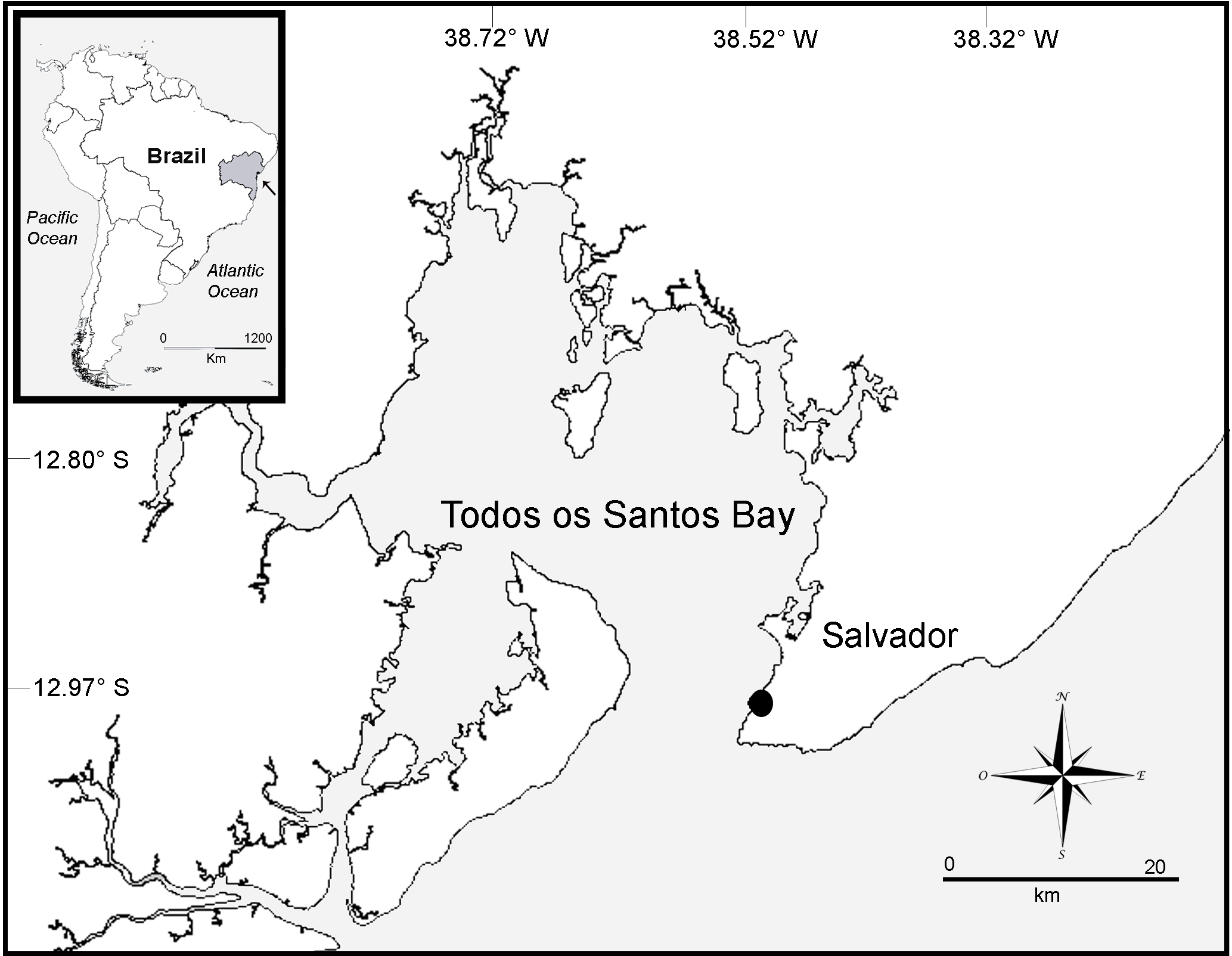
The study was performed in a recreational marina (Marina of the Nautical Tourist Terminal of Bahia; 12°58′19.9″S 38°30′55.8″W) in Salvador, Bahia state, north-eastern Brazilian coast (Figure 1). It is in the entrance of Todos os Santos Bay (TSB), one of the largest bays in Brazil, which is an important nautical route and contains several large harbours (Hatje & Andrade, Reference Hatje and Andrade2009).
South America and Brazil (in detail) showing the Bahia state (dark grey) and the location of the Todos os Santos Bay (arrow). The black dot in the large map indicates the study area, in Salvador city.

Recruitment plates
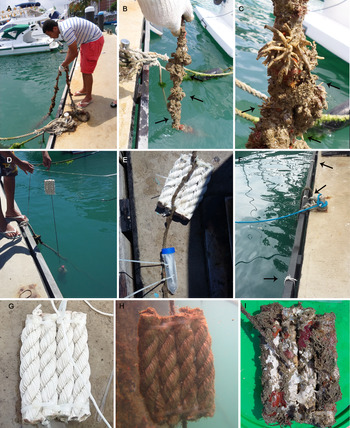
The local assemblage of calcareous sponges was sampled using artificial recruitment plates. Artificial plates are widely used mainly due to their relative ease of handling and to their non-destructive characteristics (Menge et al., Reference Menge, Gouhier, Freidenburg and Lubchenco2011; Ronowicz et al., Reference Ronowicz, Kukliński, Lock, Newman, Burton and Jones2014; South, Reference South2016; Sokołowski et al., Reference Sokołowski, Ziółkowska, Balazy, Plichta, Kukliński and Mudrak-Cegiołka2017). Based on the fact that the authors observed high abundances of calcareous sponges attached to marine cables in TSB (Figure 2A–C), the plates were prepared by attaching fragments of polyester nautical cables with cable ties to form plates of 15 × 10 cm (Figure 2D, E, G).
General view of the study area and the experiment in the field. (A) Cable originally used by the marina to dock the vessels being taken out of the water. (B) Calcareous sponges (arrows) and other fouling organisms on the cable. (C) A large specimen of Heteropia glomerosa and (arrows) smaller calcareous sponges. (D) One of the recruitment plates attached to the floating pier at the moment in which it was immersed. A PET bottle filled with sand was used to maintain the cable stretched. (E) Tube containing the datalogger used to record the seawater temperature attached close to one of the recruitment plates. (F) Cables (arrows) that held the recruitment plates tied to the floating pier. (G) Experimental plate formed after attaching the fragments of nautical cables using cable ties. (H) A plate after few days of immersion. (I) A plate after two months of immersion.

The study was performed from August 2015 to August 2017. The recruitment plates (10 replicates per month) were vertically submerged at 1 m depth, ~1.5 metres distant from each other, being attached to a floating pier (Figure 2D–F). A cable was used to hold the plates, being in touch with them. Therefore, only the side of the plates opposed to this cable was analysed (Figure 2E, H). All the plates were replaced bimonthly by new plates and the emerged plates were fixed in 80% ethanol. In the laboratory, they were analysed under a stereomicroscope. The calcareous sponges were removed from the plates, identified and counted. Recruits that could not be easily identified by their gross morphology and that were too small (<5 mm) for the preparation of microscope slides were grouped in a category named as ‘others’ and only considered in the analysis of the temporal variation of the total abundance.
Environmental factors
Seawater temperature (°C) was automatically recorded every hour over the entire period of the experiment using a datalogger DS1922E (+15°/+140°C), attached to one of the cables that held the recruitment plates (Figure 2E). Along the period of study, data on the photoperiod and precipitation in the TSB were also obtained. The daily values of the photoperiod were obtained from TuTiempo (http://www.tutiempo.net/brasil/salvador.html?datos=calendario, last accessed on September 2017). Precipitation data (accumulated values) was obtained from the database of the Brazilian Center for Weather Forecasting and Climate Studies/National Institute of Space Research (CPTEC-INPE; http://bancodedados.cptec.inpe.br/, last accessed on September 2017). Bimonthly averages were calculated for temperature and photoperiod, while for precipitation values are expressed as the accumulated rain, as previously used in Lanna et al. (Reference Lanna, Paranhos, Paiva and Klautau2015, Reference Lanna, Cajado, Santos-da-Silva, Da Hora, Porto and Vasconcellos2018).
Data analyses
Potential differences among bimesters in the number of recruits (total per plate and each of the seven identified species separately) and in the photoperiod and temperature data were investigated using one-way analysis of variance (ANOVA). When significant differences were found, it was followed by a Tukey post hoc test. Data were tested for normality and homoscedasticity. Total number of recruits of calcareous sponges, number of recruits of the most abundant species (Sycon avus Chagas & Cavalcanti, Reference Chagas and Cavalcanti2017), and the environmental parameters were under normal distribution. Data on recruits of the other six identified species were not normally distributed (Shapiro–Wilk, ɑ = 0.05, P < 0.05). Thus, Kruskal–Wallis tests were performed and where significant differences were observed, the Holm–Sidak post hoc test was applied. The statistical analyses were carried out using the software GraphPad Prism 6. Variations in precipitation were not tested as it was expressed as accumulated millimetres of rain in the two months of immersion of the plates. We applied Bonferroni correction for biological variables (α = 0.006) and for environmental variables (α = 0.025).
Multiple regression analyses were used to evaluate whether the number of recruits was related to variations in the seawater temperature, photoperiod and/or precipitation. These analyses were performed with each of the seven identified species separately and for the total number of recruits in each bimester, using the software PAST 3.25, and Bonferroni correction was also applied (α = 0.006). The results were graphically represented by GraphPad Prism 6.
Results
Recruitment of calcareous sponges
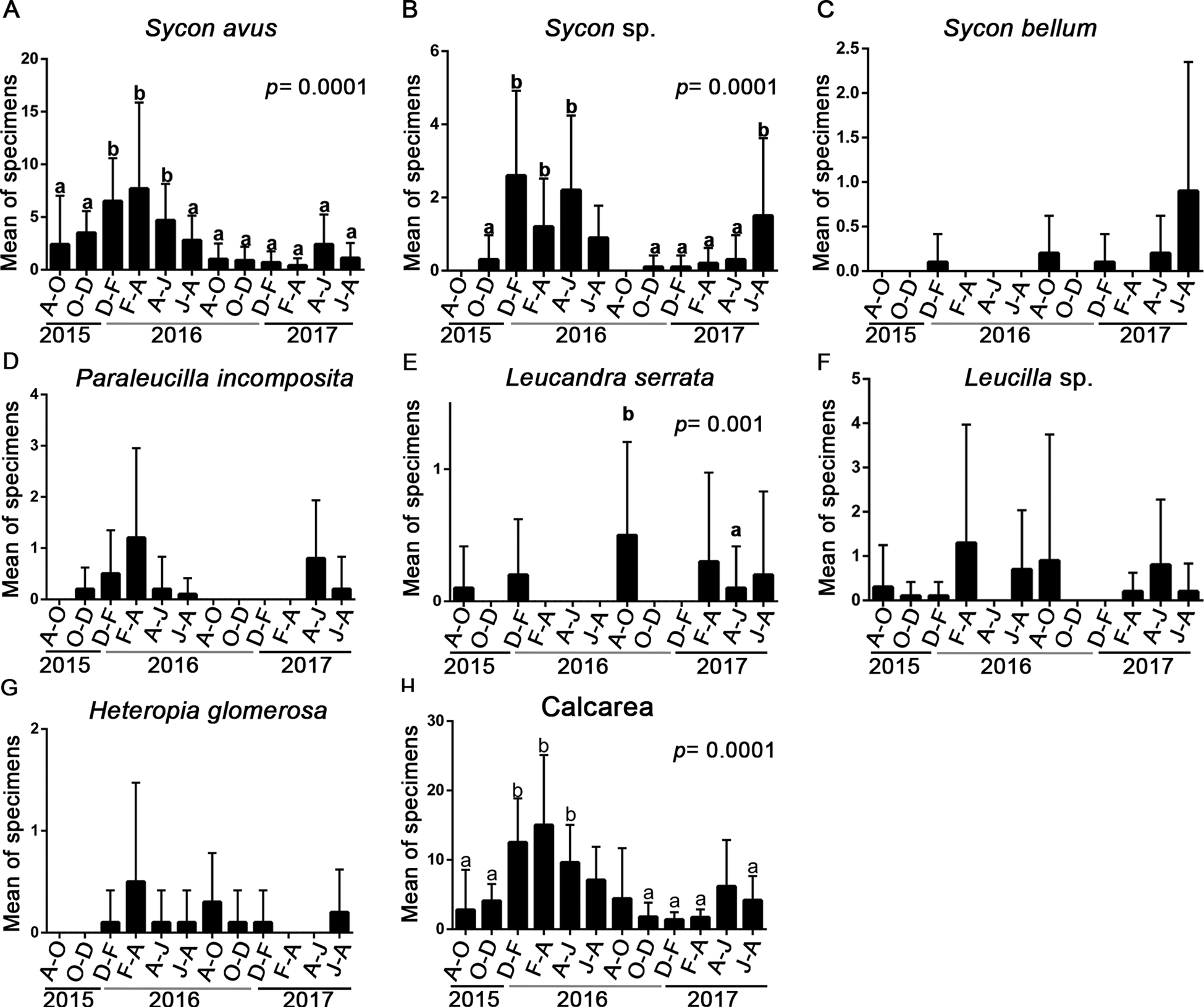
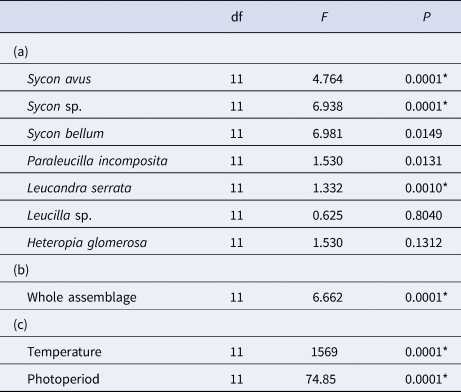
A total of 708 specimens were quantified on the plates. Most of them could be identified and only 111 specimens (16%) were classified as ‘others’. The identified specimens belong to the following calcaronean species (class Calcarea, subclass Calcaronea): Sycon avus, S. bellum Chagas & Cavalcanti, Reference Chagas and Cavalcanti2017, Sycon sp., Paraleucilla incomposita Cavalcanti, Menegola & Lanna, Reference Cavalcanti, Menegola and Lanna2014, Leucandra serrata Azevedo & Klautau, Reference Azevedo and Klautau2007, Leucilla sp. and Heteropia glomerosa (Poléjaeff, Reference Poléjaeff1883) (Figure 3). The most abundant species was S. avus, corresponding to 331 specimens (46.6%), which was the only species that recruited continuously over the two years (Figure 3A) and showed significant differences over time (F 11,108 = 4.764, P < 0.0001; Table 1). Significantly higher numbers of S. avus recruits were found from December 2015/February 2016 (6.5 ± 4.1 specimens per plate) to April/June 2016 (5.6 ± 2.6 recruits per plate) (Figure 3A).
Recruitment (mean and SE) over the experiment. (A) Sycon avus, (B) Sycon sp., (C) Sycon bellum, (D) Paraleucilla incomposita, (E) Leucandra serrata, (F) Leucilla sp., (G) Heteropia glomerosa, and (H) the whole assemblage of calcareous sponges. Letters a and b indicate significant differences. A–O = August – October; O–D = October – December; D–F = December – February; F–A = February – April; A–J = April – June; J–A = June – August. P-values reflect the results of ANOVA.

Results of ANOVAs for testing the effect of time on the number of recruits of each species separately (a), the whole assemblage (b) and on environmental parameters (c)

* Indicates significant values after Bonferroni correction for biological variables (α = 0.006) and for environmental variables (α = 0.025).
The Kruskal–Wallis tests showed that differences were detected in the temporal recruitment of Leucandra serrata and Sycon sp. (Figure 3B, E; Table 1). Paraleucilla incomposita was not recorded from August/October 2016 to February/April 2017 (Figure 3D), while Sycon sp. recruited during almost the entire period of the experiment (Figure 3B). No clear patterns were observed for Leucandra serrata, Leucilla sp., Heteropia glomerosa and S. bellum (Figure 3C, E–G).
The total number of recruits varied significantly among bimesters (Figure 3H; F 11,108 = 6.662, P < 0.0001; Table 1), even after reanalysing the data with the exclusion of S. avus (F 11,108 = 5.222, P = 0.002). Peaks in the mean number of recruits occurred from December 2015/February 2016 (12.5 ± 6.3 specimens/plate) to April/June 2016 (9.6 ± 5.4 specimens/plate) (Figure 3H).
In addition to calcareous sponges, colonial ascidians, demosponges and algal turfs (to which hydroids were possibly added) were commonly found. Solitary ascidians, barnacles and serpulids also colonized the plates, but were observed less often.
Environmental parameters
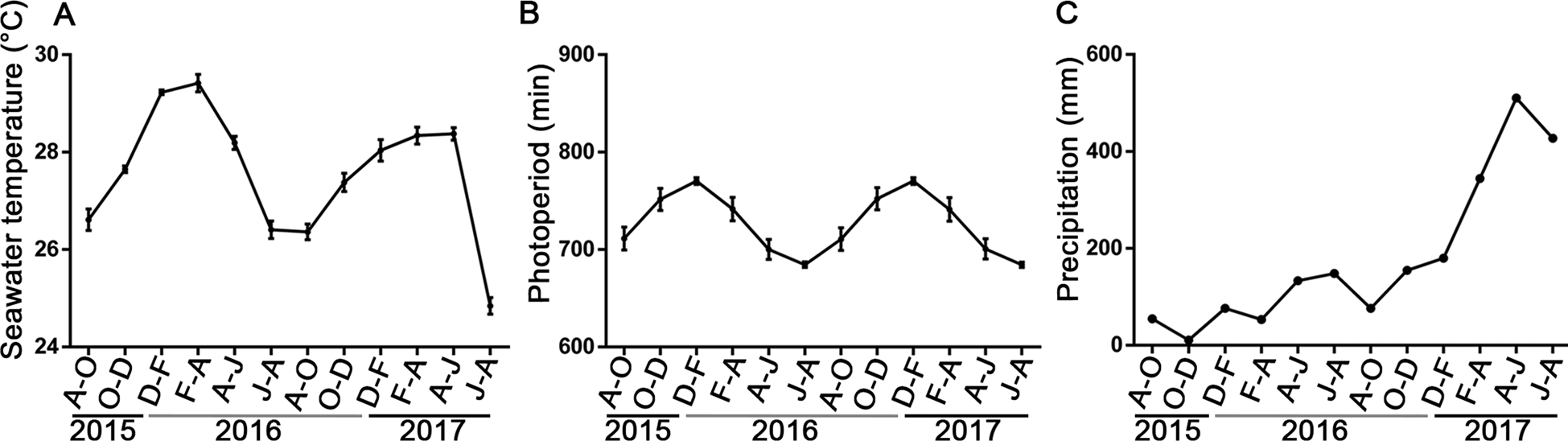
The seawater temperature varied significantly along the two years of experiment (Figure 4A; Table 1). Differences were observed among most of the bimesters, except between June/August 2016 and August/October 2016, and between February/April 2017 and April/June 2017. The minimum bimonthly average temperature was recorded in June/August 2017 (24.8°C ± 0.01), while the maximum occurred in February/April 2016 (29.4°C ± 0.01) (Figure 4A). Photoperiod varied significantly over time (Table 1) and the highest values occurred in December/February of both years of study (753 ± 2.52 and 760 ± 2.52 min of radiation, respectively), while in April/June 2016 and in June/August 2017 photoperiod was lower (684 ± 1.90 min of radiation; Figure 4B). Precipitation was mainly around 100 mm, but it increased at the end of the second year and reached the peak in April/June 2017 (510 mm; Figure 4C).
Temporal variations in the environmental parameters. (A) Average and standard deviation of the seawater temperature over time, (B) Average and standard deviation of the photoperiod over time, and (C) Bimonthly accumulated precipitation. A–O = August–October; O–D = October–December; D–F = December–February; F–A = February–April; A–J = April–June; J–A = June–August.

Influence of the environmental parameters on recruitment
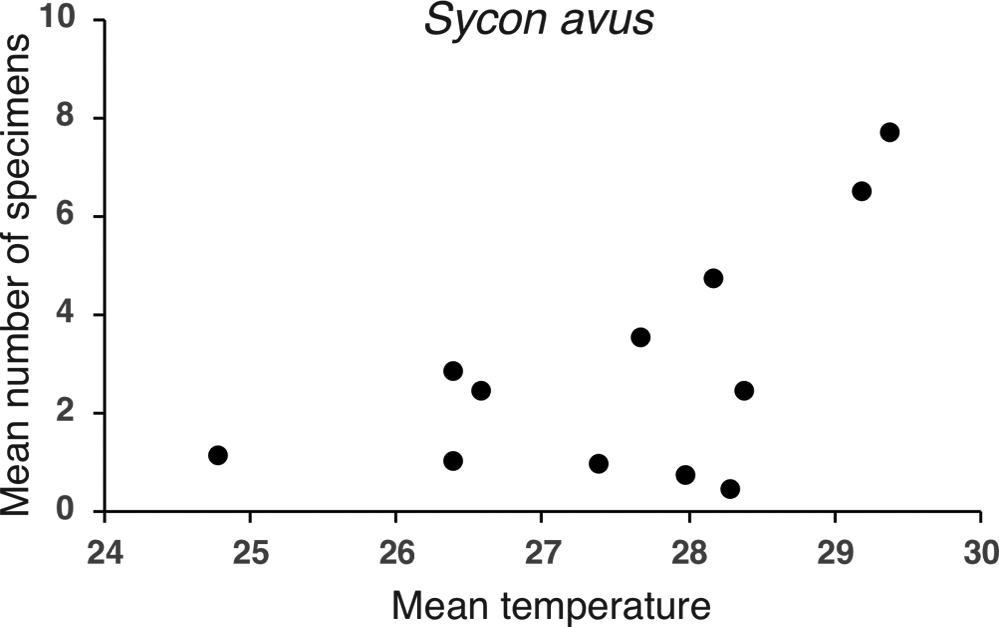
Data were log transformed before applying the multiple regression analysis to verify whether changes in the recruitment of calcareous sponges occurred according to the environmental parameters. None of the tested relationships was significant. It seems that there was a greater total number of recruits of Sycon avus (Figure 5) in warmer months but it was not significant.
Relationship between recruitment of Sycon avus and the seawater temperature (°C).

Discussion
Recruitment of calcareous sponges over time
In the present work, only sponges of the subclass Calcaronea were found on the plates and significant differences in the number of recruits over time were observed for three out of the seven identified species. No significant relationship with precipitation, temperature or photoperiod was observed despite the historical recognition that dry and rainy seasons are important biological drivers in the region.
Sycon avus, Paraleucilla incomposita, Leucilla sp. and Heteropia glomerosa showed the highest number of recruits at February/April 2016 (mostly within dry season; Figure 3). Recruitment peaks occurred at different bimesters for Sycon sp. (December 2015/February 2016; dry season), Leucandra serrata (August/October 2016, mostly within dry season) and for Sycon bellum (June/August 2017; rainy season). In comparison with other calcareous sponges from tropical areas, the results obtained here for Sycon avus, P. incomposita, Leucilla sp. and Heteropia glomerosa were similar to those previously reported to Paraleucilla magna, as its highest recruitment occurred in the middle-late summer (more specifically in January/April 2007) (Padua et al., Reference Padua, Lanna, Zilberberg, Paiva and Klautau2013). Another tropical species to which data are available is Clathrina aurea (subclass Calcinea). Ribeiro et al. (Reference Ribeiro, Padua, Paiva, Custódio and Klautau2016) monitored one of its populations in situ over 13 months and a clear seasonality was reported, with two peaks of abundance and coverage – in January 2013 and August 2013. They were explained by the recruitment of additional individuals, possibly resulting from two events of sexual reproduction (Ribeiro et al., Reference Ribeiro, Padua, Paiva, Custódio and Klautau2016). To the best of our knowledge, among the species studied in the tropics, the only exotics are P. magna and H. glomerosa, but number of specimens of H. glomerosa found on the plates were extremely low. Further studies on the recruitment over time are needed to elucidate if native and exotic calcareous sponges have different recruitment patterns.
Most of the previous studies on calcareous sponges were performed in temperate regions. The available data show that, as observed here, the period of peaks in the number of recruits varies among sympatric species (regardless of whether they belong to Calcinea or Calcaronea). In populations of Clathrina blanca (Miklucho-Maclay, Reference Miklucho-Maclay1868) and C. coriacea (Montagu, Reference Montagu1814) from Santa Catalina Island, for example, the highest number of recruits of these species was observed from March to May 1975 and from February to July 1975 (spring/summer), respectively (Johnson, Reference Johnson1979). Differences in the number of recruits were also reported by Pansini et al. (Reference Pansini, Pronzato and Valsuani1974) for several species from the Italian coast. Leucandra aspera (Schmidt, Reference Schmidt1862), the most abundant on the recruitment plates, recruited mainly from July to August (summer, year not provided), although recruits of other sympatric species were not found in this same period (Pansini et al., Reference Pansini, Pronzato and Valsuani1974). In the present work, the lack of a similar recruitment pattern to all the species composing the studied assemblage is reinforced by the results found for Sycon bellum, Paraleucilla incomposita, Leucilla sp. and Heteropia glomerosa, which did not vary significantly over time (Figure 3; Table 1).
An intriguing point of the present results is the rarity with which Heteropia glomerosa was found on the plates (up to 0.5 ± 0.4 specimens per plate; Figure 3G). This is an exotic species widely distributed along the Brazilian coast, occurring mainly in marinas and harbours along an extent of ~2900 km, and its reproductive effort is amongst the highest observed for sponges (Calazans & Lanna, Reference Calazans and Lanna2019; Klautau et al., Reference Klautau, Cóndor-Luján, Azevedo, Leocorny, Brandão and Cavalcanti2020). In the studied site in Todos os Santos Bay, it is easily found along the year, colonizing ropes and a plethora of surfaces composed of different types of artificial substrates (wood, plastic, concrete and so on; Chagas & Cavalcanti, Reference Chagas and Cavalcanti2017; Barros et al., Reference Barros, Almeida, Cavalcanti, Miranda, Nunes, Reis-Filho, Silva, Hatje, Dantas and Andrade2018). Differences in the abundance of H. glomerosa on the ropes used by the marina to dock the vessels and on the ropes used as experimental plates cannot be attributed to their composition/material as they are exactly the same kind of nautical cable. Nevertheless, time of immersion of the original ropes of the marina and that of the plates are probably different, the former potentially remained immersed for very much longer periods. Therefore, it seems that H. glomerosa, differently from most of the calcareous sponges, is not a pioneer in the colonization. Its recruitment may be hampered by the use of new/recently immersed substrates, with a preference for those sustaining a more developed/complex fouling community and/or a higher biofilm complexity. The ability for occupying colonized surfaces could facilitate the dispersion of H. glomerosa attached to artificial substrates. The need for longer periods of immersion of the substratum had already been reported for calcareous sponges living in the Mediterranean Sea. Vacelet (Reference Vacelet1981) compared plates immersed during 44 or 48 months and showed that the former were preferred by Amphoriscus chrysalis (Schmidt, Reference Schmidt1862) and Leucandra aspera (Schmidt, Reference Schmidt1862), while Sycon quadrangulatum (Schmidt, Reference Schmidt1868) recruited mainly on plates immersed for 48 months. In the Italian coast, the number of species on plates sunk for 47 months was two, three or five times higher than on those immersed for 26 months depending on the type of artificial substratum (Pansini & Pronzato, Reference Pansini and Pronzato1981). Further studies are needed to test this hypothesis of ‘higher biofilm/ fouling complexity’ and to provide a better understanding of the colonization and/or development capabilities of the exotic Heteropia glomerosa in Brazil. A putative competition between this species and Sycon avus, the most abundant on the plates, does not seem to be a plausible explanation as uncolonized areas were commonly observed. In the case of the remaining species, we could not evaluate whether their abundance on the plates over time agreed with their occurrence in the marina as, unlike H. glomerosa, they are not easily recognized in the field.
Environmental parameters and recruitment
The factors influencing the population dynamics of sponges remain poorly understood. For the calcareous sponges Sycon ciliatum, Paraleucilla magna and Sycettusa hastifera, abundance of recruits may depend on the substratum orientation (Vacelet, Reference Vacelet1981; Cavalcanti et al., Reference Cavalcanti, Skinner and Klautau2013), immersion time of the substrates (Pansini et al., Reference Pansini, Pronzato and Valsuani1974; Pansini & Pronzato, Reference Pansini and Pronzato1981; Vacelet, Reference Vacelet1981), depth (Vacelet, Reference Vacelet1981), light (Cavalcanti et al., Reference Cavalcanti, Skinner and Klautau2013; Padua et al., Reference Padua, Lanna, Zilberberg, Paiva and Klautau2013), or larval behaviour (Padua et al., Reference Padua, Lanna, Zilberberg, Paiva and Klautau2013). Reproductive cycles, sedimentation, seawater temperature and biological interactions have been discussed, but not tested, to explain differences in the recruitment of Clathrina blanca, C. coriacea, S. ciliatum, Leucosolenia variabilis and P. magna (Pronzato, Reference Pronzato1972; Johnson, Reference Johnson1979; Padua et al., Reference Padua, Lanna, Zilberberg, Paiva and Klautau2013).
During the development of the present work, some preliminary analyses were performed with data obtained after the first year of study. The results indicated that, for Sycon avus and the whole pool of recruits (i.e. the total number of calcareous sponges), recruitment would be regulated by changes in the seawater temperature. Nevertheless, after two years of the experiment, no significant results were found. It reinforces the relevance of continuing the experiment for more than one year to avoid erroneous generalizations about the temporal pattern of recruitment and its drivers.
Zea (Reference Zea1993) analysed the recruitment of demosponges in Santa Marta, Colombian Caribbean. In his work, the young sponges were not identified at the species level, but a significant and positive effect on the general number of recruits was found, although the seawater temperature varied little over time (from 24–26°C during the dry upwelling season to 27–28°C during the rainy out-welling season; Zea, Reference Zea1993). In the present work, we observed a greater variation of seawater temperature (from 24.6–29.2°C) but no correlation with recruits of calcareous sponges. Possibly, recruitment was driven mostly by biological processes related to the fecundity of each species, and/or by endogenous controls, but further studies are needed to test these hypotheses. The influence of juvenile predation and the incidence of light were not analysed, and we could not assume that they are irrelevant factors. Additionally, we cannot refute that the seawater temperature could be important for larval settlement (as for the demosponge Rhopaloeides odorabile; Whalan et al., Reference Whalan, Ettinger-Epstein and Nys2008) but not for recruits. This correlation could be masked by factors such as mortality (Pineda et al., Reference Pineda, Reyns and Starczak2009), and be undetectable when looking at the number of recruits. Recently, Calazans & Lanna (Reference Calazans and Lanna2019) showed that the reproduction of one of the species found here, Heteropia glomerosa, may be regulated by photoperiod. According to our results, this same factor was not correlated to the number of recruits of this species. Pineda et al. (Reference Pineda, Reyns and Starczak2009) argued that the lack of correlation sometimes observed between drivers of reproduction and those of recruitment may be caused by the mortality of larvae and juveniles, differences in the fecundity rate among the species, dependence on abiotic factors that may or may not be an environmental parameter, among others. The influence of seawater temperature, photoperiod and also other variables must then be investigated by experiments considering larval settlement and recruitment success.
Final considerations
The identification of recruits at the lowest taxonomic rank is important to evaluate the existence of patterns of recruitment among different species sharing the same habitat. As mentioned by Zea (Reference Zea1993), the difficulty linked to this task is the absence, in young sponges, of some of the morphological features used in taxonomic identification. In the present work, most of the recruits could be identified at the species level after the preparation of microscope slides. Our results contributed to improve the current knowledge on the dynamics of each species found on the plates and reinforced the general view that the pattern of recruitment varies greatly in Calcarea, even amongst sympatric species. It has been reported since the pioneer work by Pronzato (Reference Pronzato1972) and is evidenced here for tropical species.
Particularities of each species in the assemblage became evident, and drivers of their recruitment may not be the same, even though they live so close to each other in the substratum. Also, factors triggering the reproduction of the adults may not be the same as those regulating the initial steps of the benthic juveniles, but more work is needed particularly for Heteropia glomerosa as it is an exotic species for which data on its reproductive biology is now available (Calazans & Lanna, Reference Calazans and Lanna2019).
The integration of data about the production and settlement of the larvae with information on the recruitment of the same species would fill an important gap of knowledge on the biology and population dynamics of calcareous sponges. To the best of our knowledge, currently, these complementary data are available only for Paraleucilla magna and Clathrina aurea (Cavalcanti et al., Reference Cavalcanti, Skinner and Klautau2013; Padua et al., Reference Padua, Lanna, Zilberberg, Paiva and Klautau2013; Lanna et al., Reference Lanna, Paranhos, Paiva and Klautau2015; Ribeiro et al., Reference Ribeiro, Padua, Paiva, Custódio and Klautau2016). In this context, two of the species studied here could be used as models in future works aiming for a broader understanding on the biology and dynamics of Calcarea: Heteropia glomerosa, for which data on the reproductive biology are available (Calazans & Lanna, Reference Calazans and Lanna2019); and Sycon avus, as it was the most representative on the plates, a crucial feature for model species. Data on the reproduction and larval behaviour of S. avus would complement our understanding on its recruitment dynamics and elucidate whether the seawater temperature is an important driver.
Acknowledgements
We thank Socicam and the administration of the Nautical Tourist Terminal of Bahia for giving us access to the marina, Sergio Lobo (Socicam) for his help in the field; the staff of LABPOR/UFBA and LEBR/UFBA for the logistic support during the fieldwork; and Ulisses Pinheiro, Emilio Lanna and Guilherme Muricy for their comments.
Financial support
Research grants were obtained from the Brazilian National Research Council (CNPq; grant number 449070/2014-0), and from Fundação de Amparo à Pesquisa do Estado da Bahia (FAPESB; grant number JCB 0069/2016). CC received a scholarship from FAPESB and grants from PROAP-PPGDA/UFBA, being partly funded by the Coordenação de Aperfeiçoamento de Pessoal de Nível Superior – Brasil (CAPES; finance Code 001). FB was supported by CNPq (PQ 306332/2014-0; 304907/2017-0).