With the 2006 midterm election fast approaching, Democrats' chances of regaining control of the House of Representatives remain unclear. On the one hand, national political conditions appear to be more favorable for Democrats than at any time since the Republican takeover of the House in 1994. A pickup of only 15 seats would give Democrats control of the House in 2007 and, since the end of World War II the average midterm seat loss for the president's party is 24 seats. Moreover, when the president's approval rating is below 50%, the average midterm seat loss is 38 seats and, according to data compiled by pollingreport.com, George W. Bush's average approval rating during the month of June was only 37%.
Recent national polls also show Democrats with a strong lead in the “generic vote” for Congress. Between September 2005, and June 2006, 64 national polls asked Americans which party they preferred in the 2006 House elections. Democrats led in every one of these polls with an average advantage of about 10 percentage points among registered voters. In nine polls taken in June, the average Democratic advantage was 11 percentage points. This is the largest margin Democrats have enjoyed in the generic vote since the early 1990s, before the Republican takeover of the House.
So, if the national outlook for the Democrats is so rosy, why are many pundits and journalists skeptical about the Democrats' chances? The answer is that a midterm election is not just a national election. It is also a collection of 435 individual House and 33 individual Senate races, and right now the evidence from those individual races does not clearly point to big Democratic gains in November.
Because of the tremendous advantages enjoyed by incumbents in House elections, open seats generally present the best opportunities for opposition party takeovers. But so far only 18 Republican incumbents, along with nine Democratic incumbents, are not seeking reelection in 2006. And many of those retiring Republicans represent safe Republican districts.
Only 12 House Republicans won by a margin of less than 10 percentage points in 2004 and only 16 House Republicans represent districts that were carried by John Kerry. So, among Republican incumbents, there is relatively little low-hanging fruit for Democrats to pick. And thus far, Democrats have had limited success in recruiting top-tier challengers to run against potentially vulnerable GOP incumbents (Cook 2006).
The Generic Vote and House Elections
The Gallup Poll has included a variant of the generic vote question in at least one national survey prior to every congressional election since World War II except in 1948 and 1988.1
The exact wording of the generic vote question has varied somewhat over time. For several of the earlier elections in this series, respondents were asked which party they would vote for in the U.S. House election in their own state; for the more recent elections, respondents were simply asked whether they would vote for a Democratic or Republican House candidate. In two years, a split sample format was used with half of the sample given a standard question and half of the sample given a “secret ballot” to complete and place in a box. Since the results were almost identical regardless of whether the standard or “secret ballot” format was used, I combined the results for the two groups.
In a few years poll data from August or October were used because the generic vote question was not asked during September.

Predictive Accuracy of Generic Vote in U.S. House Elections
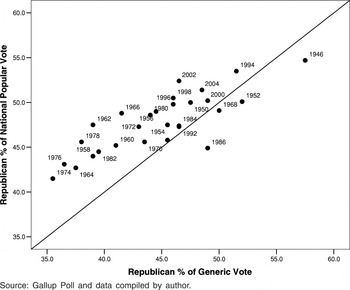
The data in Figure 1 show that the generic vote generally underestimates the Republican share of the national popular vote. This is true for 24 of the 28 elections since World War II, with an average underestimate of 3.1 percentage points. However, there is a strong positive correlation (r = .82) between the Republican share of the generic vote in early September and the Republican share of the national popular vote in November. The strength of the relationship between the generic vote and the national popular vote suggests that the generic vote question is a good measure of the national political climate and may therefore be a useful addition to a model explaining congressional elections.
National Conditions and Candidate Behavior: The Strategic Politicians Theory
A comprehensive explanation of congressional elections should include both national and local forces. One theory that incorporates both national political conditions and the behavior of local candidates is the strategic politicians theory proposed by Jacobson and Kernell (1983). According to this theory, the effects of national conditions on congressional elections are mediated by the actions of local congressional candidates. When national political conditions appear to favor one party over the other, incumbents from the advantaged party should be less likely to retire than incumbents from the disadvantaged party. As a result, the advantaged party should have more opportunities to pick up open seats than the disadvantaged party. In addition, the advantaged party should have more success than the disadvantaged party in recruiting quality challengers capable of defeating entrenched incumbents.3
For additional evidence concerning the strategic politicians theory, see Jacobson (1989), Abramowitz (1984), Lublin (1994), and Born (1986).
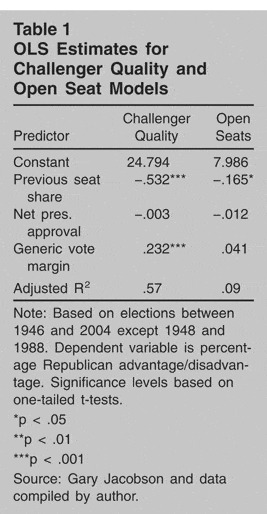
Do congressional candidates actually behave strategically? To answer this question, I examined the effects of national political conditions, measured by the incumbent president's approval rating and the generic vote, on the size of the Republican advantage or disadvantage in quality challengers and open seats in House elections since World War II. One additional independent variable, the Republican percentage of seats in the previous Congress, was included in the analysis to control for the relative level of exposure of the two parties in each election—the higher the percentage of Republican seats in the previous Congress, the greater should be the Democratic advantage in both open seats and challenger quality. The results of the two regression analyses are displayed in Table 1.
OLS Estimates for Challenger Quality and Open Seat Models

The results in Table 1 provide partial support for the strategic politicians theory. National political conditions, as measured by the generic vote question, had a substantial influence on the quality of Republican vs. Democratic challengers in House elections but little or no influence on the partisan distribution of open seats. According to these results the greater the Republican or Democratic advantage on the generic vote question, the greater the Republican or Democratic advantage in challenger quality. However, neither the generic vote nor the popularity of the incumbent president affected the partisan distribution of open seats. The only variable that had any influence on the partisan distribution of open seats was the level of exposure of the parties in the election as measured by the Republican percentage of seats in the previous Congress.
House Seat Change Model
In order to explain the outcomes of House elections, I create a model incorporating both national political conditions and candidate behavior. Pre-election Gallup Poll data on the generic vote and presidential approval are used to measure national political conditions and data on open seats and challenger quality are used to measure the behavior of congressional candidates. The model is tested with data on U.S. House elections between 1946 and 2004. A simpler model based only on national political conditions is tested with data on U.S. Senate elections from the same period.
The dependent variable in the House forecasting model is the change in the percentage of Republican seats in the House of Representatives. The model includes six independent variables. The percentage of Republican seats in the previous Congress is included to measure the level of exposure of Republicans compared with Democrats in each election—the larger the percentage of Republican seats in the previous Congress, the greater the potential for Republican losses. A variable for Republican vs. Democratic midterm elections is included to capture the effect of anti-presidential-party voting in midterm elections.4
This variable is coded −1 for Democratic midterms, 0 for presidential elections, and +1 for Republican midterms.
Data on presidential approval and the generic vote were taken from the first Gallup Poll after Labor Day in which these questions were asked. In a few cases, polls conducted during either August or October were used. Net presidential approval was recoded so that higher scores favored Republicans and lower scores favored Democrats.
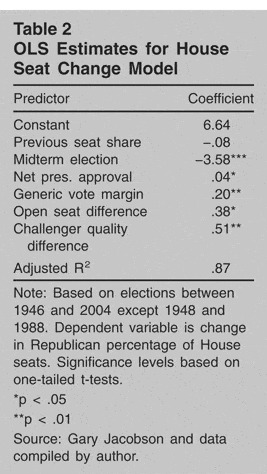
The results in Table 2 show that the model does a very good job of explaining the outcomes of past House elections—all of the independent variables except the percentage of Republican seats in the previous Congress have statistically significant effects and the model explains 87% of the variation in House seat swings since World War II. Even after controlling for presidential approval and the actions of strategic politicians, the generic vote variable has a substantial impact on the outcomes of House elections: a 10-point advantage in the generic vote produces a swing of approximately nine seats in the House with all other independent variables held constant.
OLS Estimates for House Seat Change Model

Conditional House Forecast
We can use the results in Table 2 to make conditional predictions about the outcome of the 2006 House elections. Based on a net approval rating for President Bush of −20, a Democratic advantage of 10 points in the generic vote, and a Democratic advantage of 2% in open seats, the model predicts a Democratic gain of 22 seats in the House of Representatives with no Democratic advantage in challenger quality. A modest 3-point Democratic advantage in challenger quality, which is consistent with recent district-level analyses, would increase the predicted Democratic gain to 28 seats.
Senate Seat Change Model
The dependent variable in the Senate model is the change in the number of Republican Senate seats. The independent variables are the number of Republican seats at stake in the election (a measure of exposure), a variable for Republican vs. Democratic midterm elections, net presidential approval in early September, and the difference between the Republican and Democratic percentage of the generic vote in early September. Variables measuring candidate behavior are not included in the Senate model because data on challenger quality is not available for Senate elections and relative numbers of Republican and Democratic open seats had no impact on the outcomes of Senate elections when it was added to the model.
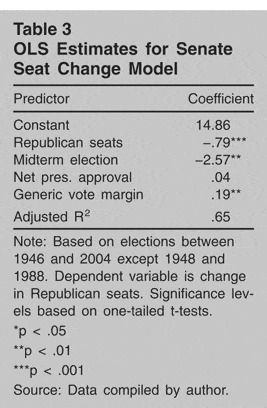
The results in Table 3 show that the Senate forecasting model is not as accurate as the House forecasting model, explaining only 65% of the variance in the outcomes of Senate elections since World War II. This is not surprising since the model does not include any variables measuring candidate behavior. Moreover, Senate seat swings are probably influenced more by chance because there are far fewer contests in each election and a larger percentage of these contests are competitive.
OLS Estimates for Senate Seat Change Model

Despite the limitations of the Senate model, however, the results indicate that three of the five independent variables have significant effects. In the Senate model, in contrast to the House model, seat exposure is the single strongest predictor of outcomes. This is consistent with the results of previous models of Senate election outcomes (Abramowitz and Segal 1986). According to the results in Table 3, for every additional seat that the Republican Party has to defend in a Senate election, it loses an additional 0.8 seats.
While the effects of the presidential approval variable are not quite significant at the .05 level, the generic vote variable does have a statistically significant, and substantively important, impact on the outcomes of Senate elections despite the fact that the question asks about voting in House elections. The results in Table 3 indicate that an advantage of 10 points in the generic vote produces a swing of about two seats in the Senate with all other independent variables held constant.
Conditional Senate Forecast
We can use the results in Table 3 to make conditional predictions about the outcome of the 2006 Senate elections. Democrats need a gain of six seats to take control of the Senate. Based on a net approval rating for President Bush of −20 and a Democratic advantage of 10 points in the generic vote, the model predicts a Democratic gain of 2.2 seats in the 2006 Senate elections. The main reason why the predicted Democratic gain is relatively small is that only 15 Republican seats are being contested this year.
Conclusions
Both national conditions and the behavior of candidates influence the outcomes of U.S. House elections. President Bush's low approval ratings and especially the large advantage that Democrats currently enjoy in the generic vote suggest that Democrats have a serious chance to regain control of the House of Representatives in November. However, the size of Democratic gains in the House will depend on how successful Democrats are in recruiting quality challengers to run against potentially vulnerable Republican incumbents as well as on national political conditions. Democratic gains are also likely in the Senate but it will be difficult for Democrats to pick up the six seats that they need to take control of the upper chamber because only 15 of the 33 seats up for election in 2006 are currently held by Republicans.
Author Bio
Alan I. Abramowitz is the Alben W. Barkley Professor of Political Science at Emory University in Atlanta, Georgia. He received his B.A. from the University of Rochester in 1969 and his Ph.D. from Stanford University in 1976. Abramowitz has authored or coauthored four books, dozens of contributions to edited volumes, and more than 40 articles in political science journals dealing with political parties, elections, and voting behavior in the United States. His most recent book, Voice of the People: Elections and Voting Behavior in the United States, was published in 2004 by McGraw-Hill.