Introduction
Early and highly proficient bilingual children who acquire a second language (L2) from home or social community benefit from enhanced cognitive development compared to monolingual peers (Bialystok, Reference Bialystok1999; Bialystok & Martin, Reference Bialystok and Martin2004; Carlson & Meltzoff, Reference Carlson and Meltzoff2008; Kovacs & Mehler, Reference Kovacs and Mehler2009; Martin-Rhee & Bialystok, Reference Martin-Rhee and Bialystok2008; Poulin-Dubois, Blaye, Coutya & Bialystok, Reference Poulin-Dubois, Blaye, Coutya and Bialystok2011). More specifically, a bilingual advantage has been shown in tasks which tap executive control skills such as selective attention, flexibility and interference inhibition. The positive influence of bilingualism on executive control is presumably due to the fact that both of bilinguals’ languages remain constantly active when they are using either one of them (e.g., Brysbaert, Reference Brysbaert1998; Gollan & Kroll, Reference Gollan, Kroll and Rapp2001; Kroll & Dijkstra, Reference Kroll, Dijkstra and Kaplan2002). Bilinguals thus have to continuously monitor their two languages, to assure fluency in speech production in the relevant language while actively inhibiting the interfering and non-relevant language (Paradis, Reference Paradis1984; Kroll & Stewart, Reference Kroll and Stewart1994; Bialystok, Reference Bialystok2001; Abutalebi & Green, Reference Abutalebi and Green2007; Martin-Rhee & Bialystok, Reference Martin-Rhee and Bialystok2008). They also need to switch flexibly between languages if the situation requires. Thanks to this intensive practice in controlling attention, keeping one language in mind while suppressing the other and switching between the two, proficient bilingualism may lead to more efficient executive control skills (Carlson & Meltzoff, Reference Carlson and Meltzoff2008; Prior & MacWhinney, Reference Prior and MacWhinney2010).
However it is not yet clear whether this cognitive advantage conferred by highly proficient bilingualism acquired early from home or social community can also be conferred by a different L2-acquisition situation involving less early and intensive exposure to the second language, such as an L2-immersion education. L2-immersion school programs are characterized by the fact that a foreign language, unknown by the children when they start the program, is directly used to teach a part of the academic subjects and not taught as an academic subject itself. Despite the increasing success of this L2-acquisition method, only a few studies have so far dealt with potential cognitive benefits of this bilingual experience. Thereby a previous study showed no cognitive benefits in kindergarteners attending an L2-immersion school program for only 6 months, probably because their degree of bilingualism was not of a sufficiently high level (Carlson & Meltzoff, Reference Carlson and Meltzoff2008). This hypothesis tends to be confirmed by Bialystok and Barac's (Reference Bialystok and Barac2012) results showing that executive control performance (measured with tasks assessing interference inhibition) improved with length of time in an L2-immersion program. Furthermore, Nicolay and Poncelet's (Reference Nicolay and Poncelet2013) findings suggested some cognitive benefits in sequential and unbalanced bilingual 8-year-old children enrolled in an L2-immersion school program from the age of 5. More specifically, a positive influence of 3 years of L2-immersion education was observed on children's reaction times on tasks assessing selective attention, divided attention, alertness, and mental flexibility. Given that the children in this study were still unbalanced bilinguals and were not yet fluent in L2, it has been argued that greater attentional control was likely to be required each time they were taught new academic subjects in a second language that they did not handle fluently and automatically (Segalowitz & Hulstijn, Reference Segalowitz, Hulstijn, Kroll and de Groot2005). The L2-immersion education situation might thus be viewed as a form of daily training of certain attentional/executive skills, leading to sharpened cognitive functioning, at least during the first years of the immersion program. Overall, the results of Nicolay and Poncelet's study showed that a 3-year L2-immersion school experience also leads to a positive impact on certain attentional/executive functions in sequential and unbalanced bilingual children. The children in the immersion and monolingual groups were matched for age, verbal and nonverbal intelligence as well as for socioeconomic status. Despite these controls, the unlikely but possible hypothesis that the differences observed between the immersed children and monolinguals were due to greater cognitive development in the immersion group before they were enrolled in the immersion program could not be ruled out. The aim of the present study was to further explore the previous findings and reexamine them using a longitudinal design in which a group of children about to begin an L2 immersion program and a control group of monolingual children, well matched for age, verbal and nonverbal intelligence, SES and cognitive development, were tested at the age of 5 years and then again 3 years later.
Method
Participants
A total of 101 French-speaking pre-schoolers, drawn from two different linguistic school programs, participated in this longitudinal study. At the initial testing (Time 1, or T1), the immersion group consisted of 51 children (20 boys and 31 girls) with a mean age of 5;3 years (range: 57–69 months) starting an English-immersion school program; the monolingual group consisted of 50 children (23 boys and 27 girls) with a mean age of 5;4 years (range: 60–72 months) enrolled in a traditional monolingual French-speaking school program. An additional six participants were not included in the second group due to poor (outlier) performance on the attentional/executive tasks at T1.
Three years later (Time 2, or T2), the same children were tested again during the second term of the third grade level of elementary school. The immersion group's mean age at T2 was 8;7 years and that of the monolingual group was 8;8 years.
All the children were recruited from 3 immersion schools (immersion group) and 5 traditional monolingual schools (monolingual group) in the area of Liège, in Belgium. The immersion educational curriculum was exactly the same in the three schools: in kindergarten, first and second grade, academic subjects were taught in English during 75% of classroom hours, and in third grade, during 50% of classroom hours. The children lived in monolingual French-speaking families and a French-speaking community, and spoke English only during school activities.
Parental consent was obtained for each child. Parents also responded to a questionnaire confirming that the children's native language was French, that their auditory acuity was normal, and that they had no learning disabilities or language impairments.
At T1, the two groups were matched on measures of attentional/executive skills. They were also matched on verbal and nonverbal abilities, as well as socioeconomic status (SES) since these factors may also influence cognitive development (see Results section below).
Materials and procedure
A longitudinal between-participant study with testing over 2 waves (T1/T2) was designed. At T1, attentional/executive measures and verbal and nonverbal intelligence measures were administered to ensure the comparability of the two groups. At T2, the same measures were administered to allow comparisons between the groups. Although the tasks were exactly the same as those used in our previous study (Nicolay & Poncelet, Reference Nicolay and Poncelet2013), each of them is described again here for the sake of clarity.
T1 - Attentional/executive measures
-
Attentional/Executive Skills were assessed with the Test for Attentional Performance in Children (KITAP: Zimmermann, Gondan & Fimm, Reference Zimmermann, Gondan and Fimm2002), a computerized standardized test battery. The assessed skills were alerting, selective and divided attention and flexibility.
-
Alerting was investigated with the KITAP subtest “The Witch.” The children were asked to press a key as quickly as possible when a visual stimulus (a witch) appeared on the screen.
-
Auditory Selective Attention was investigated using the KITAP dual-task subtest “The Owls.” The auditory component of the task was administered alone first. In this single-task version, the children had to listen to a sequence of sounds wherein squeaky and deep owl screeches were presented one at a time in regular alternation. The children were required to press a key as quickly as possible each time they detected an irregularity in the sequence.
-
Divided Attention was again investigated using the KITAP dual-task subtest “The Owls,” this time administered as a dual task, to investigate the children's ability to divide attention between auditory and visual targets. Again the children had to listen carefully to an auditory sequence wherein squeaky and deep owl screeches were presented one at a time in regular alternation. These owls were not visible, but at the same time, the children had to watch another owl in the middle of the screen. They were required to press a reaction key as quickly as possible each time they detected an irregularity in the auditory sequence, and also each time they saw the visible owl closing its eyes.
-
Mental Flexibility was investigated with the KITAP subtest “The Dragons’ House.” This task investigates ability to switch attention in response to situational demands. In this self-paced task, the children had to alternate between two target stimuli. A blue and a green dragon appeared simultaneously on the screen, one on the right side and one on the left side. The children had the option of pressing two reaction keys, one with the left hand and the other with the right hand. On the first trial, they were asked to press the reaction key on the side where the green dragon was located; on the next trial, they had to press the reaction key on the side where the blue dragon appeared; and so forth. The side where the next target stimulus would appear was unpredictable.
T1 – SES, verbal and nonverbal intelligence measures
Socioeconomic Status - Each group of children was divided, according to the mother's educational level as reported on the parent questionnaire, into ‘low’ (no educational qualifications at all), ‘medium’ (elementary school qualifications, up to the age of 16), ‘high’ (higher school qualifications, up to the age of 18) and ‘Bachelor's degree or above’ strata.
Nonverbal Intelligence - The Raven's Coloured Progressive Matrices (Raven, Court & Raven, Reference Raven, Court and Raven1998) were administered as a measure of general nonverbal reasoning abilities. Raw scores were used.
Verbal Intelligence was tested using two measures of French vocabulary knowledge to ensure the two groups were equivalent in this respect as well:
-
French Productive Vocabulary Knowledge was measured using the NEEL (Nouvelles Epreuves d’Examen du Langage: Chevrie-Muller, Simon, Le Normand & Fournier, Reference Chevrie-Muller, Simon, Normand and Fournier2001), a picture naming task. Raw scores were used.
-
French Receptive Vocabulary Knowledge was measured using the EVIP (Echelle de Vocabulaire en Images Peabody: Dunn, Thériault-Whalen & Dunn, Reference Dunn, Thériault-Whalen and Dunn1993), a French adaptation of the Peabody Picture Vocabulary Test (Dunn & Dunn, Reference Dunn and Dunn1981). Normalized scores were used.
T2 – Attentional/executive, verbal and nonverbal intelligence measures
The same measures were administered at T2 as at T1 to allow comparisons between the two groups on attentional/executive skills as well as on verbal and nonverbal intelligence after a 3-year period.
T2 – English vocabulary measures
In addition, and only with the immersion group, two further standardized tests were used to assess English Lexical Development in order to compare immersed French-speaking children's L2 vocabulary knowledge with native English-speaking children's vocabulary knowledge:
-
English Productive Vocabulary Knowledge was measured using the EOWPVT (Expressive One-Word Picture Vocabulary Test, 3rd Edition: Gardner, Reference Gardner2000), a picture naming task. Raw scores were used.
-
English Receptive Vocabulary Knowledge was measured using the BPVT (British Picture Vocabulary Test: Dunn, Dunn, Whetton & Pintilie, Reference Dunn, Dunn, Whetton and Pintilie1982). The children were required to select drawings corresponding to English words. The total number of correct responses among the 75 first items was scored.
General procedure
The children were seen individually in their respective schools. Two one-hour sessions were required for each child at T1 and again at T2. The tasks were administered in a fixed order in each session. In the first session the children performed all the attentional/executive tasks, and in the second they were given the French vocabulary knowledge and nonverbal intelligence tasks, as well as the English vocabulary knowledge tasks for the immersion group at T2.
Results
Presentation of results
The results are presented to echo the categories of the previous sections of this paper.
T1 – Attentional/executive measures
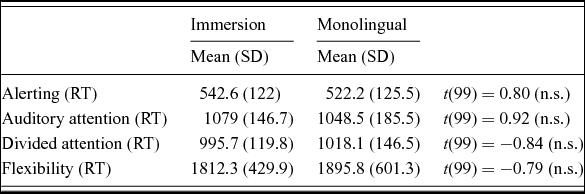
Descriptive statistics and mean comparisons between the immersion group and the monolingual group for the attentional/executive measures are presented in Table 1. Performance was balanced on all tasks, with neither marked floor nor ceiling effects.
Descriptive statistics and mean comparisons for attentional/executive measures at T1

Note. RT, reaction times (in milliseconds); n.s., not significant.
A series of t-tests on reaction times from each of the attentional/executive tasks showed no difference between the groups on any of these measures, confirming that the two groups’ attentional/executive skills were equivalent at T1.
T1 – SES, verbal and nonverbal intelligence measures
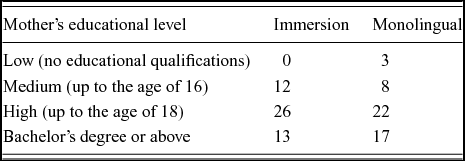
Socioeconomic Status - Table 2 presents the numbers of families classified into four SES according to mother's educational level for the immersion and monolingual group respectively. A chi-square test showed that the two groups’ SES was similar, χ2 (3) = 7.27, ns.
Socioeconomic status in the immersion and monolingual groups

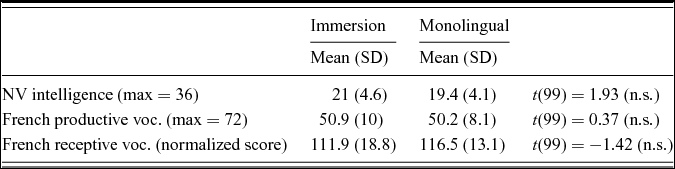
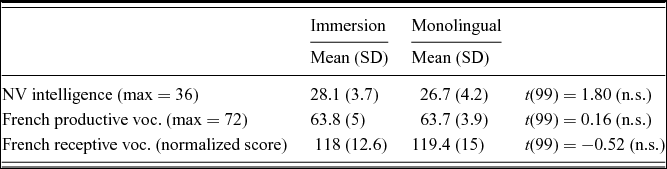
Verbal and Nonverbal Intelligence - Descriptive statistics and mean comparisons between the immersion group and the monolingual group are presented in Table 3. Performance was balanced on all tasks, with neither marked floor nor ceiling effects.
Descriptive statistics and mean comparisons for verbal and nonverbal intelligence measures at T1

Note. NV, nonverbal; n.s., not significant.
A series of t-tests showed no difference between the groups on any of these measures, confirming that the nonverbal and verbal reasoning skills of the two groups were equivalent.
T2 - Attentional/executive measures
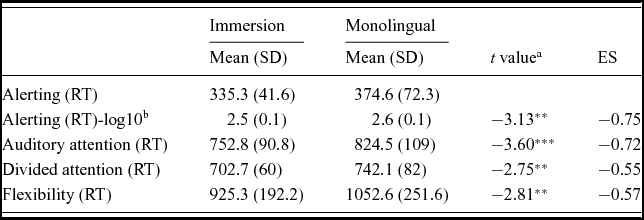
Descriptive statistics and mean comparisons between the immersion group and the monolingual group for the attentional/executive measures are presented in Table 4. Performance was balanced on all tasks, with neither marked floor nor ceiling effects, except the Alerting task: scores from this task were transformed using a LOG procedure to meet normality requirements.
Descriptive statistics and mean comparisons for the attentional/executive measures at T2

Note. ES, effect size (Cohen's d); RT, reaction times (in milliseconds).
**p<.01; ***p<.001
a df = 99
b Variables transformed using a LOG procedure to meet normality requirements. Transformed scores are reported.
A series of t-tests on reaction times from each of the attentional/executive tasks showed that the immersion group reacted faster than the monolingual group on the tasks assessing alerting, t(99) = -3.13 (p < .01), auditory attention, t(99) = -3.60 (p < .001), divided attention, t(99) = -2.75 (p < .01), and flexibility, t(99) = -2.81 (p < .01), as expected.
T2 – Verbal and nonverbal intelligence measures
Descriptive statistics and mean comparisons between the immersion group and the monolingual group for the measures of verbal and nonverbal intelligence are presented in Table 5. Performance was balanced on all tasks, with neither marked floor nor ceiling effects.
Descriptive statistics and mean comparisons for verbal and nonverbal intelligence measures at T2

Note. NV, nonverbal; n.s., not significant.
A series of t-tests showed no difference between the groups on any of these measures, confirming that the nonverbal and verbal reasoning skills of the two groups remained equivalent.
T2 – English lexical development
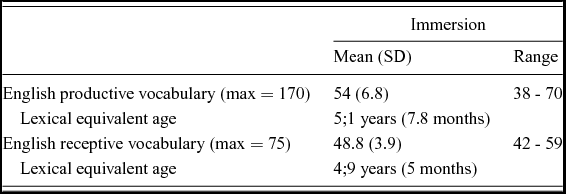
Descriptive statistics for the immersion group are presented in Table 6. After a 3-year L2-immersion school experience, these 8-year-old children's English—productive and receptive—vocabulary knowledge were equivalent respectively to those of 5;1-year-old (SD = 7.82 months) and 4;9-year-old (SD = 5 months) native English-speaking children. Given that their L1 lexical development was within the normal range for their age, they were thus unbalanced bilingual speakers.
Descriptive statistics for English lexical development in the immersion group

Discussion
In literature, bilingual cognitive benefits have been almost unanimously recognized in children raised in a bilingual environment from birth or nearly. However, other L2 acquisition situations, less early and less intensive, could also enhance cognitive skills, such as L2-immersion school programs.
Indeed a recent research reported advantages in some attentional/executive skills in unbalanced bilingual 8-year-old children enrolled in an L2-immersion school program for three years, in comparison with monolingual peers (Nicolay & Poncelet, Reference Nicolay and Poncelet2013).
The present study aimed at replicating these previous findings within a longitudinal design, once again recruiting an immersion group, this time about to begin an L2 immersion program at the age of 5 years, and a monolingual group. The two groups were matched not only for age, verbal and nonverbal intelligence and SES, but also for attentional/executive skills at the beginning of the study.
Three years later, results confirmed that the immersion children outperformed the monolinguals in several attentional/executive tasks, even though they were sequential and still unbalanced bilinguals.
Because of their lack of fluency and automaticity in L2 (Segalowitz & Hulstijn, Reference Segalowitz, Hulstijn, Kroll and de Groot2005), it could be assumed that each time school instruction takes place in that less-dominant language, immersion children have to compensate by drawing on a greater attentional control. The very demanding immersion school situation itself, i.e., simultaneously learning new academic subjects and acquiring a second language, could strengthen several components of the attentional network. At least during the first years of the L2 acquisition process in an immersion program, children have to develop their L2 comprehension abilities. This could explain more precisely the boosting observed in this study in auditory and divided attention, alerting and flexibility skills: to be able to process lessons taught in L2, children have to intensively focus their attention on L2 auditory messages and potentially at the same time on visual supports; they have to maintain readiness for effortful processing in L2; they have to switch every day between the two languages used at school. In this case, the auditory attention enhancement observed in L2-immersion children is consistent with prior works showing that developmental improvements in auditory attention seem to be primarily attributable to higher cognitive processes, such as motivation and voluntary direction of attention (Gomes, Molholm, Christodoulou, Ritter & Cowan, Reference Gomes, Molholm, Christodoulou, Ritter and Cowan2000). Moreover, the alerting enhancement in L2-immersion children could be supported by prior works showing that highly proficient multilinguals better detect and react faster to target stimuli than their less proficient multilingual peers (Videsott, Della Rosa, Wiater, Franceschini & Abutalebi, Reference Videsott, Rosa, Wiater, Franceschini and Abutalebi2012). As a corollary, we could deduce that less proficient bilingual immersed children react faster than their monolingual peers since linguistic competence may play a decisive role in the alerting skill according to the same authors. Finally the mental flexibility enhancement in L2-immersion children is consistent with prior works showing better mental flexibility skills in early highly proficient bilinguals trained to switch very often between the two languages (e.g., Costa, Hernández & Sebastián-Gallés, Reference Costa, Hernández and Sebastián-Gallés2008).
Conclusions
The results of the present study support our previous findings and, using a longitudinal design, strongly confirm that after three years in an L2-immersion program, non-fully balanced bilingual children outperform monolinguals on several attentional/executive skills. In other words, although children attending an L2-immersion school experience less early and intensive exposure to a second language than the early bilingual children described in the literature, this formal demanding bilingual school experience seems nevertheless to lead to an enhanced attentional/executive control network.
However, since our previous results did not show any interference inhibition benefit among the other cognitive benefits (see Discussion in Nicolay & Poncelet, Reference Nicolay and Poncelet2013), this skill was not reexamined in the present study. In the future, interference inhibition skills should be assessed in older and more experimented L2-immersion children in comparison with monolinguals, in the light of Bialystok and Barac's findings (Reference Bialystok and Barac2012) showing a positive relation between interference inhibition and length of time in an L2-immersion program.