Implications
Rotation breeding systems provide the Dutch organic pig sector with its own replacement gilts. Within rotation breeding systems, animals from conventional Yorkshire and Landrace sow lines with the highest genetic merit for desirable traits for organic pig production are selected. Two-breed rotation systems with Yorkshire and Landrace breeding stock currently offer the best combination of economic profitability and usability for Dutch organic pig producers.
Introduction
In 2008, the turnover of organic food in The Netherlands was €583 million, corresponding to a market share of 2.1% (Biomonitor Jaarrapport, 2009). Within the European Union (EU), highest turnovers in 2008 were achieved in Germany (€5850 million), France (€2591 million), United Kingdom (€2440 million) and Italy (€2000 million). The turnover of organic meat in The Netherlands in 2009 was €94.5 million. In 2009, the market share of organic pig meat from total organic meat in The Netherlands was 11.5% (€10.9 million; Biomonitor Jaarrapport, 2009). The size of the organic pig industry in The Netherlands is small compared to the conventional pig industry. In 2007, there were around 60 organic pig herds with a total of around 5000 sows compared to around 8700 conventional pig herds with a total of more than 1 million sows (Hoste et al., Reference Hoste, Ducro-Steverink and Bosma2007).
The Dutch organic pig herds use breeding stock of conventional origin. Sows are replaced both by purchasing gilts from conventional pig breeding herds and by on-farm (own replacement) breeding. Both strategies have obvious limitations. First, sow replacement rates on Dutch organic herds often average more than 30% of the total number of sows present, whereas EU regulations on organic livestock farming (2092/91) require that replacement rates from conventional origin do not exceed 20% of present stock on an annual basis. Second, many Dutch organic herds are too small for successful on-farm breeding to produce their own replacement stock. Therefore, there is a clear need for alternative breeding strategies to provide the Dutch organic pig producers with replacement gilts.
In a feasibility study of Hoste et al. (Reference Hoste, Ducro-Steverink and Bosma2007), various breeding structures that can provide the Dutch organic pig sector with replacement gilts were compared. Among these structures, organic breeding herds that specialise in F1 gilt production, the setup of a purebred organic sow line with on-farm sow replacement, and a rotation breeding system were suggested to have the highest potential for the Dutch organic pig sector.
In this study, economic and genetic modelling studies were performed in order to evaluate these three potential breeding structures with various combinations of conventional genetic lines for the Dutch organic pig sector. As sow and litter performance of purebred sow lines and some crossbred lines were not available in an organic production environment, performance of these lines had to be simulated, based on performance in a conventional production environment. This approach assumes the absence of genotype–environment (G × E) interactions for sow and litter performance traits such as litter size, preweaning mortality, weaning to oestrus interval and sow culling rate. To our knowledge, G × E interactions for reproductive performance traits in an organic and conventional production environment have not been investigated before. If present, G × E interactions may affect the choice for the most economically profitable breed and breeding structure for organic pig production. For fattening traits, weak to significant G × E interactions have been found in conventional and organic pig production environments (Boelling et al., Reference Boelling, Groen, Sørensen, Madsen and Jensen2003; Wallenbeck et al., Reference Wallenbeck, Rydhmer and Lundeheim2009a; Brandt et al., Reference Brandt, Werner, Baulain, Brade and Weißmann2010). Nevertheless, breeds that performed best in a conventional environment also did so in an organic environment (Brandt et al., Reference Brandt, Werner, Baulain, Brade and Weißmann2010).
The objective of this study was to identify the most suitable breed and breeding strategy to provide the Dutch organic pig production sector with adequate replacement gilts.
Material and methods
Data
In 2006 and 2007, a survey on sow and litter performance was performed on commercial organic and conventional piglet producing herds in The Netherlands. In 2006, data were collected on 11 organic herds (total 1514 sows) and 589 conventional herds (2 17 653 sows). In 2007, in total 14 organic herds (2386 sows) and 633 conventional herds (2 55 317 sows) were included in the survey. Organic herds had on average 150 sows in production (80 to 250), whereas conventional herds had on average 360 sows (60 to 2000). Sow and litter performance data included farrowing rate, percentage of first farrowings, total number of piglets born per litter, number of live born piglets per litter, number of stillborn piglets per litter, lactation length, percentage mortality until weaning, number of weaned piglets per litter, days from weaning to oestrus, number of litters/sow per year, number of weaned piglets/sow per year, and percentage of sow cullings per year.
All organic herds were certified by Skal, which is the inspection body for organic production in The Netherlands in accordance with the public law, based on EU-Regulations 834/2007 and 889/2008. Organic herds did not mix conventional and organic pigs within the same herd. All sows on conventional and organic herds were inseminated with semen from the Dutch AI organisation K.I. Nederland, The Netherlands. In organic herds, gestating sows were group-housed indoors (minimum 2.5 m2/sow), with access to an outdoor area (minimum 1.9 m2/sow) and additional access to pasture. Indoor pens had deep straw bedding and outdoor areas had concrete floors. In conventional herds, gestating sows were housed individually (minimum 1.0 to 1.3 m2/sow) or in groups (minimum 2.25 m2/sow). Flooring was partly slatted and partly concrete. Organic sows farrowed indoors in individual pens (minimum 7.5 m2) with deep straw bedding and without crates. They had access to an outdoor area (minimum 1.9 m2/sow) with concrete floors. Conventional sows farrowed indoors and were housed individually in crates on partly slatted floors (minimum 1.0 to 1.3 m2/sow). Suckling piglets were kept on closed floors (minimum 0.6 m2/litter). Generally, small organic herds (<100 sows) used 3-weekly batch farrowing, whereas in larger organic herds (>100 sows) sows farrowed weekly. Conventional herds used either 3-weekly batch farrowing or weekly farrowing. Farrowings were generally not supervised both in organic and conventional herds. Both in organic and conventional herds, male piglets were castrated after birth. In conventional herds, piglets were tail docked and teeth were clipped, whereas in organic herds these procedures are not allowed. Piglets in organic herds were weaned at a minimum of 40 days, whereas in conventional herds the average weaning age was around 25 days. Organic feed contained ingredients of at least 80% organic origin and feed did not contain animal meal, synthetic amino acids, genetically modified materials and antimicrobial growth promotors. Conventional herds used a variety of standard commercially available feeds. For organic herds, sow feeding levels averaged 3.0 to 3.5 kg/day near the end of gestation and around 7.0 kg/day near the end of lactation. For conventional herds, sow feeding levels were on average 2.3 to 2.4 kg/day near the end of gestation and 5.5 to 6.0 kg/day near the end of lactation. Approximately 1 week to 10 days after birth, both organic and conventional piglets were fed additional solid creep feed.
All of the breeding stock included in this survey originated from the TOPIGS breeding company, Vught, The Netherlands. The sow lines were commercially available TOPIGS sow crosses: Dutch Landrace × Yorkshire (L1Y); T-line × Finnish Landrace (TF); Landrace2 × Dutch Landrace (L2L1); and Landrace2 × Yorkshire (L2Y). F is a Finnish Landrace line; L1 is a Dutch Landrace line; L2 is a sow line that was set up 35 years ago from various Landrace lines; T is a sow line that originated from the Saddleback and Schwäbisch–Hällisches breeds; Y is a Yorkshire (i.e. Large White) line. The organic herds included in the survey used L1Y or TF crosses and replaced sows either by purchasing L1Y and TF gilts from conventional breeding herds or by rotational breeding. The conventional herds used all of the aforementioned sow lines. They replaced sows by purchasing replacement gilts, purchasing grand parent stock to breed on-farm replacement gilts or by rotational breeding. Conventional herds used TOPIGS P-line (Piétrain), E-line (Yorkshire) and D-line (Duroc) as terminal boar lines, whereas organic herds exclusively used a TOPIGS P-line. Sow and litter performance reported in this study include only results of the matings of sow lines to TOPIGS P-line.
Methods
Sow and litter performance data collected on organic and conventional herds were used as input to simulate performance of various combinations of sow lines and three breeding structures in an organic production environment. The breeding structures were: (i) organic breeding herds producing F1 gilts (OrgBS). In OrgBS, a limited number of specialised organic breeding herds produce F1 gilts for all organic commercial herds. These commercial herds produce F2 slaughter pigs by mating the F1 gilts with a TOPIGS P-line as terminal boar; (ii) flower breeding system (FlowerBS). In this system, a dedicated organic sow line is developed based on data of a large number of organic herds with purebred sows for both replacement breeding and production of slaughter pigs. The purebred sows are mated to a terminal AI boar to produce F1 slaughter pigs; (iii) two-line rotation breeding system (RotBS). This is a closed breeding structure consisting of two conventional sow lines. Conventional AI boars of two different lines are used in alternate generations and crossbred females are retained for maternal stock.
The model of De Vries (Reference De Vries1989) was used to simulate economic performance of the various combinations of breeding structures and sow lines under organic conditions. The model was applied to the Dutch situation. Efficiency of production was calculated as total net costs per kilogram offspring output (kg carcass weight) minus adjustment of price for carcass quality. Total net costs were defined as sow costs minus returns for culled sows plus costs for offspring. Performance of the sow lines under organic conditions and the cost price calculation for the Dutch organic pig producers (Hoste, 2009) were used as input for the model. The actual performance data under organic conditions were available only for two sow lines (L1Y and TF). Therefore, performance of all four crossbred sow lines under organic conditions was simulated as follows. At first, performance of purebred lines (F, L1, L2, T, Y) for sow and litter performance traits was simulated under organic conditions, according to the formula: Simulated purebred performance organic = purebred performance conventional + (crossbred performance organic-crossbred performance conventional). The values for purebred performance under conventional conditions were obtained from TOPIGS breeding company. Values from crossbred performance organic and crossbred performance conventional were collected as part of the survey on sow and litter performance. Sow and litter performance traits included: number of total piglets born per litter, number of stillborn piglets per litter, number of live born piglets per litter, percentage mortality until weaning, number of weaned piglets per litter, number of litters/sow per year and number of weaned piglets/sow per year. Second, the performance of the four crossbred sow lines was calculated using the genetic distance between the lines for each cross (i.e. 70% of maximum heterosis for the L1Y cross and 100% of maximum heterosis for the TF, L2L1 and L2Y crosses) and the heterosis percentages for the sow and litter performance traits: live born piglets per litter: +7%; stillborn piglets per litter: −7%; mortality until weaning: −7%; interval weaning to oestrus: −3%. Heterosis percentages were obtained from the TOPIGS breeding company (unpublished data). Subsequently, the model was used to calculate economic values of reproduction (litter) traits for organic pig production, based on the simulated performance of the sow lines. The sow and litter performance traits were the same as used in the abovementioned simulations of purebred organic performance. On basis of these economic values, margins per sow place (in euro) were calculated for various combinations of breeding structures and sow lines.
The selection response was predicted using the software SelAction (Rutten et al., Reference Rutten, Bijma, Woolliams and Van Arendonk2002). Two scenarios were analysed: (i) a conventional breeding scenario where genetic progress is determined by progress made in a conventional breeding programme. This scenario applies to the breeding structures RotBS and OrgBS which use conventional genetics. (ii) An organic breeding scenario where genetic progress is determined by progress made in a separate organic breeding programme. This scenario applies to FlowerBS which uses a purebred sow line selected in an organic production environment. For the organic breeding scenario, three options were calculated. The first option assumes an optimal breeding structure with 5000 sows and individual registration of piglet birth weight, mortality until weaning and crossfostering. The second option assumes a sow population size of 5000, but without individual registration of piglet birth weight, mortality until weaning and crossfostering. The third option assumes individual registration of piglet birth weight, mortality until weaning and crossfostering, but the sow population size is reduced to 2000. The economic values of the reproduction traits as derived from the model of De Vries (Reference De Vries1989) and variance components (i.e. genetic parameters) were needed as input for SelAction. Variance components were estimated under conventional conditions.
Genetic lag was defined as the time needed for genetic progress made in the breeding nucleus to reach the slaughter pigs and was calculated for each of the three breeding structures.
Results
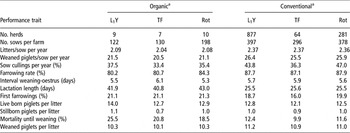
The survey data collected on Dutch organic and conventional piglet producing herds during 2006 to 2007 were first analysed to compare the average sow and litter performance of different crosses in the two farming systems. The results for each farming system and each cross are given in Table 1.
Average sow and litter performance of crossbred sows on organic and conventional herds during 2006 to 2007

aL1Y = Dutch Landrace × Yorkshire; TF = T-line × Finnish Landrace cross; Rot = rotational cross using L1, F, T and Y lines.
The farrowing rate was lower and the number of live born piglets per litter was higher on organic herds compared to conventional herds. Mortality until weaning was considerably higher on organic herds compared to conventional herds. On average, the organic herds weaned one piglet less per litter than conventional herds. Line L1Y had the largest litters and highest mortality until weaning on both organic and conventional herds. Rotational sows had the lowest mortality until weaning on organic herds, whereas line TF had lowest mortality on conventional herds.
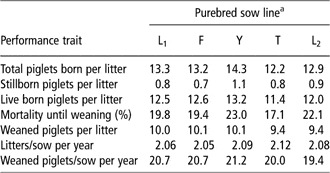
The simulated performance of purebred sow lines under organic conditions is given in Table 2.
Simulated sow and litter performance of purebred sow lines under organic conditions

aL1 = Dutch Landrace; F = Finnish Landrace; Y = Yorkshire; T = sow line that originated from the Saddleback and Schwäbisch-Hällisches breeds; L2 = sow line that was set up from various Landrace lines.
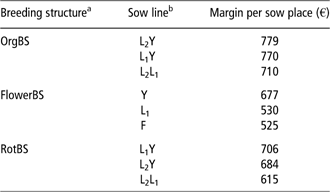
Results of the economic model analysis are shown in Table 3. The breeding structure OrgBS, which is a specialised organic breeding herd producing F1 gilts, had the highest margins per sow place, followed by the rotation breeding system (RotBS) and then followed by the purebred organic sow line (FlowerBS). The cross with the Yorkshire (Y) line attained a higher margin compared to the other lines within all the three breeding structures.
Margin per sow place for the different breeding structures and sow lines
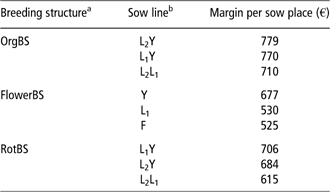
aOrgBS = Organic breeding herds producing F1 gilts; FlowerBS = Organic purebred sow line with on-farm sow replacement; RotBS = two-line rotation breeding system.
bL2Y = Landrace × Yorkshire; L1Y = Dutch Landrace × Yorkshire; L2L1 = Landrace × Dutch Landrace; Y = Yorkshire; L1 = Dutch Landrace; F = Finnish Landrace.
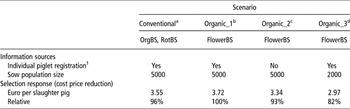
Table 4 shows the predicted selection response for the conventional and organic breeding scenarios. Both the OrgBS and RotBS used conventional genetics and therefore genetic progress was determined by progress achieved with the conventional breeding scenario. The FlowerBS used a purebred organic sow line and therefore genetic progress was determined by progress achieved with the organic breeding scenario. For the organic breeding scenario, three options were analysed.
Predicted selection response for conventional and organic breeding scenarios

1Individual registration of piglet birth weight, mortality until weaning and crossfostering.
aUsing conventional genetics.
bUsing dedicated organic breeding programme with individual piglet registration and a sow population size of 5000.
cUsing dedicated organic breeding programme without individual piglet registration and a sow population of 5000.
dUsing dedicated organic breeding programme with individual piglet registration and a sow population of 2000.
The highest cost price reduction (€3.72/slaughter pig) was predicted for Organic_1 breeding scenario, which uses a dedicated organic breeding programme with individual piglet registration and a population size of 5000 sows. When individual piglet registration of birth weight, mortality until weaning and crossfostering was omitted (Organic_2) or sow population size was reduced to 2000 (Organic_3), the cost price reduction decreased with 7% and 18%, respectively. The cost price reduction was 4% lower with the conventional breeding scenario than with the organic breeding scenario.
The genetic lag was shortest for the FlowerBS (2.3 years), intermediate for OrgBS (2.8 years) and longest for RotBS (3.1 years).
Discussion
In this study, breeding structures and sow lines were evaluated by economic and genetic simulation studies in order to evaluate their suitability to provide the Dutch organic pig sector with replacement gilts. The breeding structures included (i) organic breeding herd specialised in producing F1 replacement gilts (OrgBS); (ii) flower breeding system in which a dedicated purebred organic sow line is selected under organic conditions (FlowerBS); (iii) two-line rotation breeding system (RotBS). In total, four crossbred sow lines (L1Y, TF, L2L1 and L2Y) originating from five purebred lines (F, L1, L2, T and Y) were evaluated. All lines were bred by the TOPIGS breeding company, Vught, The Netherlands.
Analysis of the data (Table 1) shows that organic herds had lower farrowing rates, more live born piglets per litter and higher preweaning mortality rates compared to conventional herds. Other studies have also reported larger litter sizes at birth and higher preweaning mortality rates in organic compared to conventional environments (Edwards, Reference Edwards1994; Mortensen et al., Reference Mortensen, Ruby, Pedersen, Smidth and Larsen1994). The larger litter size at birth of sows under organic conditions can be explained by the mandatory longer lactation length (6 weeks) in organic systems compared to relatively shorter period (4 weeks) in conventional systems (Xue et al., Reference Xue, Dial, Marsh, Davies and Momont1993; Dewey et al., Reference Dewey, Martin, Friendship and Wilson1994; Le Cozler et al., Reference Le Cozler, Dagorn, Dourmad, Johansen and Aumaître1997). The biological mechanisms explaining the relationship between litter size at birth and lactation length are still mostly unknown. It has been suggested that longer lactation lengths lead to higher ovulation rates and/or reduced embryonic mortality (Xue et al., Reference Xue, Dial, Marsh, Davies and Momont1993).
The higher preweaning mortality rates in organic herds compared to conventional herds reported in this study are confirmed by other authors (Marchant et al., Reference Marchant, Rudd, Mendl, Broom, Meredith, Corning and Simmins2000; Wallenbeck et al., Reference Wallenbeck, Gustafson and Rydhmer2009b). Higher mortality rates in organic production environments are caused by various factors. These include loose housing conditions of sows in the farrowing pen, which makes piglets more at risk to be crushed by the sow (Honeyman and Roush, Reference Honeyman and Roush2002; Wallenbeck et al., Reference Wallenbeck, Gustafson and Rydhmer2009b), less possibilities of herdsmen to supervise and care for piglets in a group-housed and outdoor lactation environment (Wallenbeck et al., Reference Wallenbeck, Gustafson and Rydhmer2009b), sometimes colder temperatures causing a higher number of deaths due to hypothermia (Marchant et al., Reference Marchant, Rudd, Mendl, Broom, Meredith, Corning and Simmins2000; Wallenbeck et al., Reference Wallenbeck, Gustafson and Rydhmer2009b), a higher number of weak piglets at birth related to larger litter sizes in organic herds (Marchant et al., Reference Marchant, Rudd, Mendl, Broom, Meredith, Corning and Simmins2000; Bonde and Sørensen, Reference Bonde and Sørensen2006), and a possibly lower milk output in sows, which might be related to the composition of feeds used in organic herds (Bonde and Sørensen, Reference Bonde and Sørensen2006). The lower farrowing rates on the organic herds have not been reported before in literature.
As survey data on organic reproductive performance included only between 11 and 14 organic herds (in 2006 and 2007, respectively) and three crosses (i.e. L1Y, TF and a rotational cross), economic and genetic simulation studies were performed to compare breeding structures and genetic lines. Results of the economic simulations showed that a breeding structure where one or two organic breeding herds produce F1 replacement gilts for the whole organic pig sector in The Netherlands (OrgBS) achieved the highest margins per sow place for all three sow lines (Table 3). This structure was followed by a two-line rotation breeding system (RotBS) and lastly by a flower breeding system (FlowerBS). The smaller degree of heterosis in RotBS and especially in FlowerBS, explains the lower economic performance of these breeding structures compared with OrgBS. Although economically favourable, implementation of a breeding structure such as OrgBS may have practical disadvantages in The Netherlands. First, organic breeding herds may have difficulties in selling the F1 replacement gilts, if organic piglet producing herds produce less slaughter pigs due to reduced market demand. Second, the relative high density of pig herds in the Netherlands may give problems in case of disease outbreaks where transport of animals is prohibited. Finally, discussions with Dutch organic herdsmen made clear that for health security reasons they preferred a ‘closed’ breeding structure as opposed to an ‘open’ structure like OrgBS. A rotation breeding system like RotBS is an example of such a ‘closed’ system with on-farm sow replacement. Once the rotational programme is established, the herd remains closed and only AI semen needs to be purchased for production of replacement gilts or slaughter pigs. In rotation breeding systems, breeding stock originates from a conventional breeding programme, but replacement gilts are selected in an organic environment which gives advantages in terms of environment-specific adaptation. Furthermore, AI boars that are used to produce replacement gilts may be ranked according to an organic selection index where more emphasis is given to traits important for organic production, such as piglet vitality and mothering ability. Rotation breeding systems are fairly simple to follow once the herdsman chooses two or three breeds (Buchanan et al., Reference Buchanan, Luce and Clutter2004). Taken together, these factors make the RotBS an attractive breeding structure to provide the Dutch organic pig sector with replacement gilts.
The genetic model analysis showed that organic pig production using an organic breeding scenario (as in FlowerBS) should lead to the highest selection response in terms of cost price reduction (€3.72/slaughter pig per generation). This assumes that sow population size is optimal (5000 breeding sows) to reach genetic progress comparable with progress for the conventional system, including collection of data with regard to individual piglet birth weight, mortality and crossfostering on all participating organic herds. If sow population size is suboptimal (2000 sows) or if individual piglet data are not registered, the cost price reduction by an organic breeding scenario can decrease by 7% and 18%, respectively. Organic pig production using a conventional breeding scenario (as in OrgBS and RotBS) had a 4% lower cost price reduction than the organic breeding scenario with optimal sow population size and individual piglet registration.
Although FlowerBS may represent the ideal breeding structure in terms of genetic progress, the practical implementation of such a breeding structure is currently not feasible in The Netherlands. Total sow population size on all Dutch organic herds is around 5000 sows, which implies that every organic herd would need to participate in data collection. This seems unlikely, since many Dutch organic herds operate on a small scale, do not have any experience with administrative breeding procedures and sometimes do not even have a pig management software system. Furthermore, the set up and maintenance of a dedicated organic breeding programme is expensive. Nevertheless, if the organic pig sector in The Netherlands increases substantially in size and degree of professionalisation in the future, FlowerBS remains a viable alternative and can be initiated from an existing rotational breeding system.
Regarding the choice of a suitable crossbred sow line for the Dutch organic sector, the results in this study show that both on organic and conventional herds the Landrace × Yorkshire (L1Y) cross and the rotational cross weaned the highest number of piglets per litter (Table 1). It must be noted that the higher preweaning mortality of the L1Y cross compared to the other lines might be considered less ideal in organic production systems. However, the limited number of organic herds per sow line in the survey does not allow to draw firm conclusions about the best breed choice for organic systems. Results of the economic simulation studies showed that the combination of a Yorkshire line (Y) with a Landrace type (L1 or L2) was most profitable for both OrgBS and RotBS. Also in FlowerBS, the Y-line had the highest margin per sow place compared to other lines (Table 3). The good performance of the Y-line can be explained by its high prolificacy (Table 2). Blair (Reference Blair2007) reviewed the suitability of genotypes for organic production and suggested that traits important for a good outdoor sow include prolificacy, good conformation, strong vigour, good maternal behaviour including ease of handling. In climates with extreme temperatures, cold or heat stress resistance are other important traits for outdoor pig production. The sows used in Europe for commercial outdoor production are commonly Saddleback, Landrace, Large White (Yorkshire) and Duroc crosses. In The Netherlands with its temperate maritime climate, organic production mainly occurs indoors with pigs having access to outdoor areas. Indoor reared organic pigs experience less extreme environmental temperature ranges than outdoor pigs and therefore traits related to cold or heat resistance are less important. Otherwise, traits for indoor organic production are largely similar to outdoor production, including maternal abilities, piglet vitality and sow longevity. Next to desirable traits of breeds for organic production, Kelly et al. (Reference Kelly, Browning, Day, Martins, Pearce, Stopes and Edwards2007) concluded that the choice of breed should also depend on the ability of the herd to manage prolific sows. Therefore, based on results of this study, the choice for a Yorkshire sow line either as part of a cross in OrgBS and RotBS or as a purebred line in FlowerBS, might be a good option for the Dutch organic sector, provided that organic farmers are able to handle the larger litters that this line produces.
As pointed out before, in the economic and genetic model analyses of this study, we did not account for genotype–environment (G × E) interactions for sow and litter performance traits. The reason for this is that no survey data were available of performances of purebred sow lines in an organic environment. If such G × E interactions do exist and result in reranking of purebred lines between environments, the results regarding breeding strategy and breed choice will be affected. Nevertheless, the similar ranking of crossbred lines on conventional and organic herds for the trait number of piglets weaned/sow per year (Table 1), reassuringly suggests at least the absence of strong G × E interactions for this important economic trait.
In conclusion, the breeding structure where one or several organic breeding herds produce replacement gilts for the whole organic sector is economically the most viable option for the Dutch organic pig producers. However, this structure has clear disadvantages in terms of risks for disease transmission and market demand. A separate breeding programme for the organic sector would render the fastest genetic progress, but is currently not feasible due the limited sow population size on organic herds in The Netherlands and limited experience of Dutch organic herdsmen with administrative breeding procedures. A rotational breeding structure might be a viable alternative, especially in combination with AI boars that are ranked according to an organic selection index. Regardless the choice of breeding structure, the Yorkshire sow line had the highest prolificacy and gave the highest economic returns. This line might be a good choice for the Dutch organic sector, provided that management conditions on the organic herds are adequate to handle this highly prolific sow line.
Acknowledgements
This research was financed by Dutch Ministry of Agriculture, Nature and Food Quality. The authors would like to thank the Dutch organic pig farmers for their participation. The authors also thank TOPIGS breeding company (Vught, The Netherlands), De Groene Weg (Groenlo, The Netherlands) and Pramod Mathur for their help in this research.