Occupational exposure to milk powder is recognised as a risk factor for impaired lung function (Sripaiboonkij et al. Reference Sripaiboonkij, Phanprasit and Jaakkola2008). Dairy plant workers could also be exposed to lactic acid bacteria (LAB) that are used as additives in dairy industries because they are thought to be beneficial to health when they are ingested (Snydman, Reference Snydman2008) and are generally recognised as safe (GRAS) in food. However, workers of dairy food industries are exposed to airborne LAB, and when they do not wear respiratory masks they report more symptoms of irritation than workers using protection. Moreover, it has been shown that an occupationally exposed group is more sensitised (precipitins and IgG investigations) against LAB than a control group (Zeilfelder et al. Reference Zeilfelder, Chouanière, Reboux, Vacheyrou, Milon, Wild and Oppliger2012), which could reflect a delayed immunological response considered as an exposure proof. However, specific allergic sensitisation (immediate immunological response) against these frequently used probiotic strains has not been tested yet and, to our knowledge, no allergic effect concerning the inhalation of LAB has been reported. The aim of this study is to evaluate the level of specific IgE anti-LAB using a new technique.
Materials and methods
Study population
The study site and worker population have previously been described in Zeilfelder et al. (Reference Zeilfelder, Chouanière, Reboux, Vacheyrou, Milon, Wild and Oppliger2012). Briefly, we investigated dairy industry strains of Lactobacillus johnsonii, L. paracasei, L. rhamnosus, Bifidobacterium lactis, B. longum. and Streptococcus thermophilus. Fifty workers were initially recruited, and 44 of them each gave a blood sample. Twenty-seven individuals worked in the factory (production site) and 17 in the laboratory or pilot plant (research and development areas). Thirty-one sera of non-exposed participants were also tested as a control group. All participants signed consent waivers before the study started. In addition, all methods were approved by Institute for Work and Health Institutional Review Board.
Experimental design
Dissociation-Enhanced Lanthanide Fluorescent immunoassay (DELFIA®) allows the measurement of specific IgE (Barrera et al. Reference Barrera, Richaud-Thiriez, Rocchi, Rognon, Roussel, Grenouillet, Laboissiere, Dalphin, Reboux and Millon2016). This technique has been used to dose specific IgE. It is recognised as sensitive and makes it possible to adapt the panel of antigens when they are not commercially available. Preparation of antigen protein extract was obtained by culture of the 6 different strains on Mueller Hinton medium. Then bacteria were sonicated and lyophilised as described by Zeilfelder et al. (Reference Zeilfelder, Chouanière, Reboux, Vacheyrou, Milon, Wild and Oppliger2012). The lyophilised powder was suspended in distilled water, and proteins were purified by the SDS-PAGE clean-up Kit (GE Healthcare, USA) according to the supplier's recommendations to obtain a purified protein extract of each strain. DELFIA® was performed as previously described by Barrera et al. (Reference Barrera, Richaud-Thiriez, Rocchi, Rognon, Roussel, Grenouillet, Laboissiere, Dalphin, Reboux and Millon2016). Briefly, antigens were coated on a 96-well plate with 0·1 µg/ml of purified protein extract. Then the sera were incubated at a dilution of 1/100 in an assay buffer, before being revealed by further steps inducing the fluorometric reaction. The plate was read using the Victor 2 multilabel counter (Perkin Elmer®, Waltham, MA, USA). Each serum sample was tested six times. Unreliable count values were avoided, and the median of the replicates of each serum was calculated and then divided by the median of all sera count values. The resulting index was considered positive when at least greater than 10% of the background. Different levels of sensitisation were defined when index values were greater than 10, 20, 30, 40 and 50% of the background value. Variance analysis was performed with R software version 3.3.2.
Results
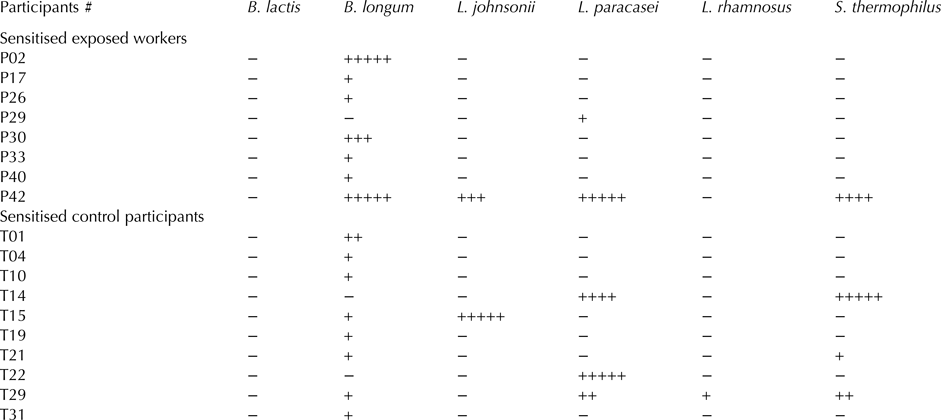
On the whole, levels of specific IgE were low and no difference was observed between the exposed workers group and the control group (P-value >0·05). Eight exposed participants (18%) and 10 controls (32%) were considered as positive for at least one species, and none of the study population had a positive result for B. lactis (Table 1). Only one control showed a weakly positive level of sensitisation for L. rhamnosus. B. longum was the species that presented a positive result most often in both populations, and the level of sensitisation was higher in the exposed group. Only one exposed worker was highly sensitised to four antigens (Table 1). This multisensitised worker presented work-related nasal and eye irritation and was already working in the factory when the personal protective equipment was implemented. A second worker, weakly sensitised to only one LAB strain, also declared work-related symptoms. He worked in the pilot plant but had also been exposed before the introduction of protective measures. The remaining IgE sensitised exposed workers did not present any irritating symptoms. No correlation was made between specific IgE response and occupational characteristics (time of employment, type of exposure, exposure before or after introduction of protective measures).
Level of sensitisation in participants that were sensitised to at least one species

−: index value equivalent to the background.
+: index value >10% of the background.
++: index value >20% of the background.
+++: index value >30% of the background.
++++: index value >40% of the background.
+++++: index value >50% of the background.
Discussion
Immediate allergic response estimated by the level of specific IgE was low in our exposed population. Only eight workers out of 44 were sensitised to at least one of the six LAB strains tested, and one of them proved to be multisensitised. B. lactis and L. rhamnosus induced a weak or no exacerbation of the specific IgE level. Few participants were sensitised to L. johnsonii, L. paracasei and S. thermophiles, but the associated specific IgE level could be high. However, the majority of the sensitised participants were sensitised to B. longum but in most cases with only a weak specific IgE level. To be exposed does not mean to become allergic to LAB and probably depends on individual factors, but we can also suggest factors that could explain the global lack of immediate allergic response :
• a healthy worker effect
• an efficient implementation of personal protective equipment
• an absence of allergic mechanisms to account for the self-reported irritative symptoms
It was reported that exposure to LAB (Zeilfelder et al. Reference Zeilfelder, Chouanière, Reboux, Vacheyrou, Milon, Wild and Oppliger2012), carbohydrates (Zeilfelder et al. Reference Zeilfelder, Chouanière, Reboux, Vacheyrou, Milon, Wild and Oppliger2012) and milk powder (Sripaiboonkij et al. Reference Sripaiboonkij, Phanprasit and Jaakkola2008; Zeilfelder et al. Reference Zeilfelder, Chouanière, Reboux, Vacheyrou, Milon, Wild and Oppliger2012) increased the risk of developing irritating eye and nasal symptoms or adverse effect on lung function. Apart from all these considerations, our study proved the usefulness of the DELFIA® technique, that was sufficiently sensitive to detect low levels of specific IgE and have the advantages to test all antigenic extracts.
Conclusion
To conclude, no allergic reaction due to exposure to airborne LAB was demonstrated, only an irritative effect was observed. These results must be confirmed with a greater study population of dairy workers from several production sites to better understand environmental, occupational and individual factors that explain the occurrence of symptoms. Levels of specific IgE against milk compounds such as caseins, α-lactalbumin and β-lactoglobulin could be also measured as confounding factors. Moreover, it is well known that occupational exposure to dust in general and/or microorganisms is often deleterious to health (Roussel et al. Reference Roussel, Reboux, Millon, Parchas, Boudih, Skana, Delaforge and Rakotonirainy2012; van Kampen et al. Reference van Kampen, Deckert, Hoffmeyer, Taeger, Brinkmann, Brüning, Raulf-Heimsoth and Bünger2012; Dorribo et al. Reference Dorribo, Wild, Pralong, Danuser, Reboux, Krief and Niculita-Hirzel2015; Bittner et al. Reference Bittner, Garrido, Harth and Preisser2016; Paris et al. Reference Paris, Herin, Penven, Thaon, Richard, Jacquenet, Barbaud and Poussel2016). We recommend the implementation of technical and/or organisational preventive measures to avoid or reduce this exposure (both exposure to milk powder and LAB).
We received funding to realise specific IgE measurement from ZAAJ: ‘Zone Atelier de l'arc Jurassien’ (University of Bourgogne Franche Comté, France).
Conflict of interest
None declared.