INTRODUCTION
Polybranchia orientalis, a sea slug belonging to the gastropod family Caliphyllidae and order Sacoglossa, is distributed in the Indo-West Pacific (Rudman, Reference Rudman1999; Jensen, Reference Jensen2007). Members of the family have numerous leaf-like dorsal processes (cerata), which are usually opaque, beige or pale brown to orange in colour and some species are brilliantly coloured (Marshall & Willan, Reference Marshall and Willan1999). They possess rolled oral tentacles and bifid rhinophores at the tips, with eyes at the base. The cerata produce sticky secretions from the skin, and in some species, like Polybranchia orientalis, distasteful milky secretions from glands along the edge of the cerata (Satyamurti, Reference Satyamurti1952; Rudman, Reference Rudman1999). This species, originally described by Kelaart (Reference Kelaart1858) from Ceylon as Proctonotus orientalis, was later renamed by Satyamurthi (1952) as Polybranchia orientalis while recording the species from the Gulf of Mannar region. Jensen (Reference Jensen2007) established the biogeography of the sacoglossans worldwide. The genus Polybranchia has about 8 valid species (Caballer & Bouchet, Reference Caballer and Bouchet2013). Katharina & Heike (Reference Katharina and Heike2007) studied the phylogenetic relationship of sacoglossans. In the Indian subcontinent Polybranchia orientalis was previously recorded from the Lakshadweep Islands (Apte, Reference Apte2009, Reference Apte2012), Gulf of Mannar along south-east coast of India (Satyamurti, Reference Satyamurti1952) and from the Andaman and Nicobar Islands (Sreeraj et al., Reference Sreeraj, Sivaperuman and Raghunathan2012).
In the present paper, the first record of Polybranchia orientalis (Kelaart, Reference Kelaart1858) from the south-west coast of India is highlighted.
RESULTS
SYSTEMATICS
Order SACOGLOSSA Ihering, 1876
Suborder PLAKOBRANCHACEA
Superfamily LIMAPONTIOIDEA Gray, 1847
Family CALIPHYLLIDAE Tiberi, 1881
Genus Polybranchia Pease, 1860
Polybranchia orientalis (Kelaart, Reference Kelaart1858)
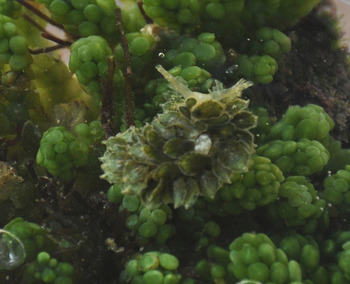
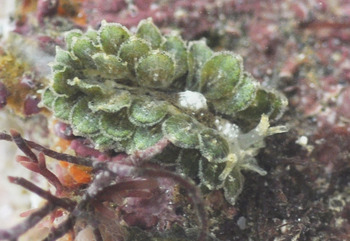
(Figures 1 & 2)
Polybranchia orientalis associated with algal mats of Caulerpa peltata.

Polybranchia orientalis on rock surface.

MATERIALS EXAMINED
Seven live specimens (average length 13–18 mm, width 4–5 mm) collected from Vizhinjam (08°22′N 76°59′E), Kovalam (08°23′N 76°58′E) and Thirumullavaram (08°54′N76°30′E) by snorkelling and from a depth of 0.3 m to 1 m. The animals were found on the green algal mats of Caulerpa peltata. The three specimens are deposited in the museum collections of the Department of Marine Biology, Microbiology and Biochemistry, School of Marine Sciences, Cochin University of Science and Technology, Kochi—682016, Kerala, India (Accession number DMB-CUSAT/GAS 10-12).
The material was identified following descriptions provided by Kelaart (Reference Kelaart1858), Satyamurti (Reference Satyamurti1952), Baba & Hamatanp (Reference Baba and Hamatanp1971) and Yonow (Reference Yonow2008).
DESCRIPTION
Body elongated with a somewhat flattened dorsal surface and angulate dorso-lateral margins. Anterior tentacles short, conical and placed at the anterior extremity of the dorsal surface. Rhinophores long, cylindrical, folded longitudinally and placed distantly from each other. Cerata flat, large, numerous, cauducous, ovate with toothed margins, uneven with long footstalks and dark green in colour. Foot elongate, ample broader in the anterior part and tapered in the posterior region, white spot on the dorsum with slight swelling indicating the region of heart.
REMARKS
This species was originally recorded from Sri Lanka by Kelaart (Reference Kelaart1858). Subsequently it has been recorded from the Gulf of Mannar by Alder & Hancock (Reference Alder and Hancock1864) and Satyamurti (Reference Satyamurti1952), New Caledonia (Pruvot-Fol, Reference Pruvot-Fol1933), Sagami Bay (Baba & Hamatanp, Reference Baba and Hamatanp1971), Red Sea (Yonow, Reference Yonow2008), Lakshadweep Islands (Apte, Reference Apte2009), south-east Queensland, Australia (Vantier et al., Reference Vantier, Williamson and Willan2010) and Andaman andNicobar Islands (Sreeraj et al., Reference Sreeraj, Sivaperuman and Raghunathan2012). The record of this species from the Kerala coast confirms the distribution of this species on the south-west coast of India.
ACKNOWLEDGEMENTS
The authors thank the Centre for Marine Living Resources and Ecology (CMLRE), Ministry of Earth Science, Government of India for their financial support of the project. The authors are also thankful to the Head, Department of Marine Biology, Microbiology and Biochemistry, School of Marine Sciences, Cochin University of Science and Technology (CUSAT), Kochi.