1. HISTORICAL STUDIES AND INTERPRETATION
There has been little historical research in Italy on the subject of poor relief systems in the rural parts of the peninsula.Footnote 1 The majority of studies have focused on urban contexts, because of the importance of towns within the former Italian city states and also because of difficulties in finding historical sources for rural areas. Key studies are those of the principal towns of Northern Italy: Milan, Turin, Genoa, Brescia, and Venice. Various aspects of poor relief have been covered by these studies:Footnote 2 the analysis of separate relief activities, such as hospitals;Footnote 3 orphanages or distribution of bread to the poor; the study of social support networks, including free exchange among neighbours; the investigation of connections between political and religious institutions and relief practices; the examination of the role of intermediate bodies, such as parishes, confraternitiesFootnote 4 and trade corporations, in organising relief.
In contrast, in rural areasFootnote 5 such themes have been little studied, despite ‘the poor’, that is to say, those who for various reasons were forced to become recipients of poor relief, representing the greater part of the population during this period.Footnote 6 Our examination of poor relief systems in the diocese of Tortona throughout the eighteenth century hopes to remedy this lack of historical research. The aim of this research, as well as describing the main welfare activities across the entire territory of the diocese of Tortona, is to demonstrate how demographic structures, political-institutional structures, the social and religious profile of the clergy, and the farming and land-ownership structures worked to determine systems of welfare provision in the countryside, and are the reason why this system was so complex. Our aim is to offer a new point of view in the historical debate over the development of relief and charity systems, prior to the introduction of the welfare state, in which such activities were managed in increasing measures by the government. This study also addresses a question that is relevant today, given the withdrawal of the state from welfare provision and the significant role, in the area of relief activities, of the many intermediate bodies that structure society today.Footnote 7
The territory of the diocese of Tortona covered different overlapping political and religious jurisdictions, as described later. This composite administrative make-up makes it an excellent case study for understanding the close connections in rural areas between socio-economic and political structures and the development of certain relief systems: hospitals; monti di pietà (‘mount of piety’)Footnote 8 and grain stores; schools; pious bequests for distribution of bread and clothing; or dowries for poor girls.Footnote 9 In addition to differences in forms of political organisation, a very important role in determining the nature of relief practices was played by the local church structure, that is, the form in which the church was present in the community. This aspect was strictly linked to the form of pastoral activity of the clergy. The main sources consulted, described in more detail later, were the parish reports that priests, in compliance with the rulings of the Council of Trent, were required to draw up for the bishop's pastoral visit. Bishops were required to visit all the parishes within their dioceses at regular intervals in order to monitor the activities of the parish priests, to inspect the state of church buildings and to ensure that the different types of parish records and accounts were properly kept, among other concerns. Though their main concern was with religious matters, the reports noted all relief activities carried out within the parish, no matter by whom they were organised.
2. THE DIOCESE OF TORTONA IN THE EIGHTEENTH CENTURY
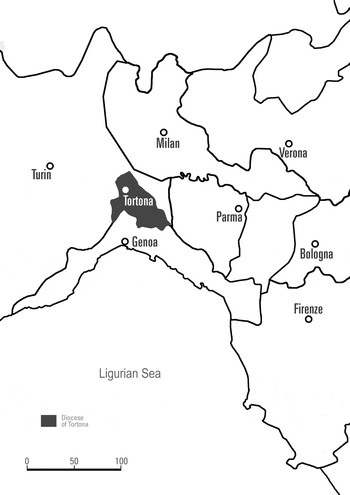
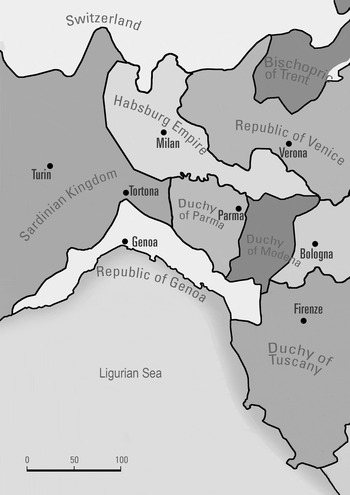
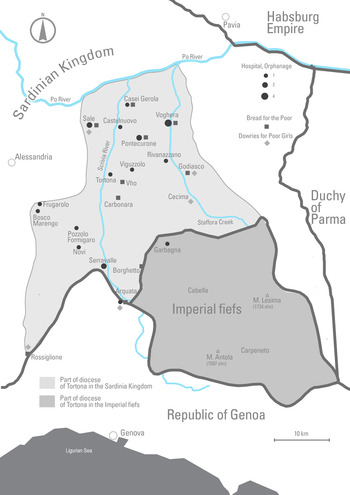
The diocese of Tortona is situated in north-west Italy (see Figure 1). During our period, the diocese was divided into eight ecclesiastical regions with very different geographical and political-institutional characteristics. Tortona had recently undergone great political changes. In 1738, following the Peace of Vienna that had ended the war of Polish succession, it had passed under the dominion of Carlo Emanuele III, King of Sardinia.Footnote 10 The Voghera and Valle Staffora areas came under the control of the Kingdom of Sardinia in 1748, following the Treaty of Aix-la-Chapelle in 1748. The parishes from Rossiglione in the west to Monte Penna in the east were part of the Republic of Genoa. In the period covering the visits under consideration, therefore, the diocese of Tortona was divided into three different political parts: the Kingdom of Sardinia, the Austrian Hapsburg EmpireFootnote 11 and the Republic of Genoa (see Figure 2). Moreover, in the southern part of the diocese, on the border with the Republic of Genoa, there were some Imperial fiefdoms, political areas that up until the end of the eighteenth century were enclaves independent of the states in which they found themselves.Footnote 12 To this political and ecclesiastical complexity must be added the geographical and socio-economic diversity of the diocese in the mid-eighteenth century. An analysis of the parish reports shows that the total population of the diocese was 129,882, for a surface area of about 2,228 km2. Part of the diocese covered a flat terrain, between the River Po in the north and the areas of Voghera and Tortona. Another portion occupied the area that extended from the hills of Oltrepò Pavese to the hills of Tortona and Ovada. The remainder was in the Apennines, between the upper Valle Scrivia, Val Trebbia, Val d'Aveto and Valle Staffora.Footnote 13
The location of the diocese of Tortona within north-west Italy in the eighteenth century. Sources: Atlante Storico De Agostini (Novara, 2011), 87. Authors' production (graphic designer Graziano Bertelegni).

The political divisions of north-western Italy in 1748. Sources: Atlante Storico De Agostini (Novara, 2011), 87. Authors' production (graphic designer Graziano Bertelegni).

The flat zone was the most densely populated and very fertile, like the whole alluvial area of the lower Lombardy plain. It had a variety of types of property and of farming systems. In this area, even communities a short distance from one another varied in terms of farm sizes, the greater or lesser existence of lease contracts and the different effects of aristocratic and ecclesiastical property. This situation further illuminates the socio-economic complexity within which relief – more evident here than in other parts of the diocese – took shape.
By contrast, due to their geomorphology and climate, the Apennine territories were less fertile than the alluvial terrain of the Po Plain. The Apennine territories developed an ownership structure, farming system and land usage that were very different from those of the plains. Here, in the Apennines, where land tenure was chiefly the prerogative of the feudal families, the most common system of farm management was the emphyteutic lease. Emphyteusis was a long-term or even perpetual lease. It was common for ecclesiastical or feudal properties in various areas of Mediterranean Europe. According to the priest of Pregola in his parish report: ‘Many of the inhabitants of the parish do not reside there permanently because, the place being mountainous, with the exception of those who manage the feudal owners’ lands under emphyteutic lease, many migrate towards the more fertile territory around Milan, where some remain about half of the year and others even ten months, returning to their parish only in summer’.Footnote 14
The special political-institutional profile of the territories in the southern part of the Tortona diocese, on the border with the Republic of Genoa, in the Apennines, appeared to play a role of considerable importance in the unusual socio-economic configuration of the zone. In that part of the diocese in the Apennines, where the Imperial fiefdoms were found, there were practically no ‘social support networks’ and the few relief activities carried out seemed to depend entirely on the local feudal family, in other words: what can be described as a top-down system of relief. This prevented the development of an awareness of identity and a sense of belonging to a community, in contrast to parishes in the lowland area of the diocese.Footnote 15 For example, the confraternities were not as active in offering social support in this territory as they were in the flat lands, where the link between these social bodies and their territory seemed much stronger. This relative lack of relief and of community bonds might also have contributed to the high seasonal emigration described by the parish priest of Pregola above, with the heads of household in summer moving to the flat territory of the diocese or of Lombardy to sell their labour.Footnote 16
3. THE HISTORICAL SOURCES
Among the questions to be answered by the priest when writing his reports in preparation for the pastoral visit were some regarding poor relief activities carried out within the parish. Apart from these specific questions (total population numbers, number and composition of clergy, number of pious bequests), the reports contain other information directly connected to relief and charitable practices. The replies given to the question regarding bequests are particularly useful. From the type of activity carried out and from the social actor promoting it, we can obtain information regarding the role of the parish and the parish priest and that of the various actors within the parish, who were involved in various ways in the development of poor relief systems.
Unlike the decrees written by the bishop following the pastoral visit, documents expressing a point of view ‘from above’, the parish reports tell the story ‘from below’, therefore providing a valuable insight into the sense of identity of the communities in which they were produced. The reports permit us to map relief activities, both those organised by religious and those by lay actors, at a diocesan level, and to paint a precise picture regarding the types of social support on offer.
These sources reveal various protagonists of charitable work. They may be divided into two macro-categories: lay actors on the one hand and religious ones on the other. The lay actors include the state through its social policies, the local communities, the guilds, families and single individuals. In the category of ‘religious actors’ were the diocese, parishes, religious orders and confraternities. However, though this distinction is necessary to highlight the varied origin of relief activities, it should be emphasised that, in reality, it is less clear-cut than one may think. Distinguishing civil from religious actors is, for the ancien régime, an arbitrary and methodologically inappropriate operation. Among the various patrons of relief existed clear points of encounter that, in some cases, became authentic fusion.
In this regard, for example, the confraternities were bodies that were part of the category of religious actors, in terms of their devotional aims, but were made up of laymen from the local community.Footnote 17 Moreover, in many cases the families that provided the priors and leaders of the confraternities were those from whom the local administrators of towns and villages were drawn. This led to an intertwining of links between religious and lay actors that profoundly marked the dynamics of charitable activities at the local level.Footnote 18
In order to limit our analysis, we have decided to confine this present research to the parish reports written by the priests of Tortona for two pastoral visits. The first visit in 1741 was by Giulio Resta, Bishop of Tortona from 1701 to 1743 and the second in 1743, by the Dominican Giuseppe Lodovico Andujar, Bishop of Tortona from 1743 to 1782. For Resta's visit, which never took place owing to the bishop's precarious state of health, out of a total of 218 parishes, 210 reports have survived, or 96.3 per cent. Studying Andujar's visit is more problematic, as only 87 reports out of a total of 218 parishes survive, about 40 per cent. Nonetheless, the data are very interesting, as they complete the gaps in the earlier reports, since the documentation prepared for the visit of the Dominican bishop was more detailed than that prepared for his predecessor.Footnote 19
In addition to the parish reports, we have examined records of disputes and legal documents written by other social actors involved in charitable activities. Widening the investigation was essential, since analysis of the parish priests’ reports shows that, in the Tortona area, poor relief activities were not the exclusive competence of the parish. On the contrary, strong commitment came from the confraternities, social bodies that, though formally subject to the authority of the priest, were often managed completely autonomously. This situation led to more than a few legal battles that should be kept in mind if we want to understand the dynamics of poor relief within parishes. A case in point is the dispute over the management of the grain store and hospital of Voghera that lasted from the seventeenth well into the eighteenth centuries, described in section 7.
4. ECCLESIASTICAL STRUCTURES AND POOR RELIEF
While political-institutional and geomorphological aspects played a key role in the development of relief practices in the diocese of Tortona, equally important in this regard were aspects relating to ecclesiastical structure. To understand the complex dynamics underlying relief practices, we must pay particular attention to the clergy. This fundamental component of the ancien régime class structure had an important spiritual function deriving from its pastoral mission, but it also – albeit in different ways in the various Italian regions – had a considerable lay and social function.Footnote 20
A report, titled Status Sanctae Derthonensis Ecclesiae drawn up by the bishop's office in 1759 informs us that there were 1,578Footnote 21 clergy in Tortona for a population of 129,483.Footnote 22 The clergy-population ratio was therefore 82 inhabitants per priest. Equally importantly, the same source highlights the considerable heterogeneity of the Tortona clergy in the eighteenth century across the diocese. The clergy displayed notable differences regarding not only the religious functions they carried out in the local community but also – and this is the point on which we intend to focus – in terms of their perception of their own pastoral function. In some areas the clergy were highly sensitive towards the socio-economic problems weighing on parish life, and perceived the pastoral function as a mandate comprising many varied duties. Yet in other areas, generally with different geographical and political-institutional characteristics, this mentality was completely non-existent.
Also essential here is an understanding of the interaction that, in certain diocesan regions, developed between the clergy and the lay institutions of the parish. Among those institutions that, at least formally, operated under the supervision of the priest, a key role, as mentioned above, was played by the confraternities and religious companies. In addition to their involvement in the religious life of the community, they played an essential role in poor relief, for example, assisting the sick, paying the teachers at the parish primary schools and providing dowries for the poorer girls in the community, whose families were unable to ensure them an acceptable place on the marriage market.
For this purpose the diocese can be divided into two large areas, with different geographic, socio-economic and political-institutional features. Differences in the role of the clergy and the confraternities are particularly marked when comparing the Imperial fiefdoms with the remaining area, the greater portion of the diocesan territory (see Figure 2). The system for recruiting clergy in the Imperial fiefdoms was principally based on lay patronage and the priest having been nominated by the local feudal family, whereas on the plains, recruitment was only partly based on lay patronage.Footnote 23 These different patterns of recruitment had considerable influence on how the Tortona clergy perceived the pastoral function. Apart from a few exceptions, priests in the Imperial fiefdoms were not involved in any relief and charitable activities, restricting themselves to carrying out a purely spiritual function. In this regard, the comment written in 1743 by the priest of Rovegno is particularly interesting. Describing the work of the clergy under his control, he states that ‘in assisting the dying they are nearly all negligent, for some believe that after giving the last rites to the sick their work is ended’.Footnote 24 Similarly, the confraternities active in parishes in the Imperial fiefdoms appear to have carried out no notable function of social support, in contrast to the lowland area of the diocese, where the confraternities played a key role both in religious and in socio-political circles.
5. POOR RELIEF SYSTEMS IN RURAL AREAS
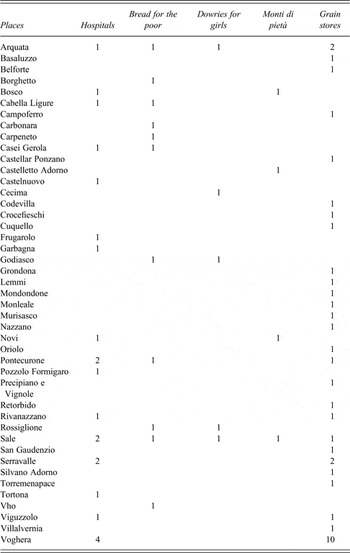
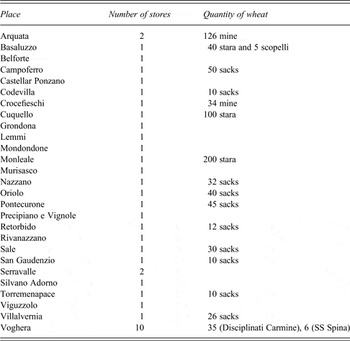
The more widespread relief practices in the territory studied were the following: hospitals, monti di pietà, grain stores, schools, pious bequests for distribution of bread and clothing or dowries for poor girls. Table 1 provides an overview of the various relief activities mentioned in the reports. Of the poor relief strategies found, that of the grain stores was one of the most important. In the report written in 1741 for the visit of Bishop Resta, there was a total of 37 grain storesFootnote 25 registered in 27 of the 210 parishes (12.9 per cent). Some places had more than one store: Arquata Scrivia had two, Serravalle two and Voghera ten. The grain stores are discussed in more detail in the next section.
Types of relief activities in the diocese of Tortona in 1741 and 1743 according to the parish reports

Source: Archivio Storico Diocesano Tortona (ASDT), Visite pastorali, visita Mons. Andujar; ASDT, Visite pastorali, visita Mons. Resta F. 41, f. 2, cc. 184–90.
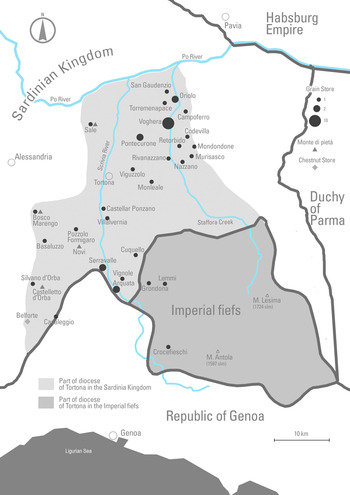
Less common in the diocese of Tortona were the monti di pietà, institutions that lent moneyFootnote 26 (Figure 3). In the reports prepared for Bishop Resta only one monte di pietà is noted at Sale,Footnote 27 managed by the confraternity of the Disciplinati, founded in 1606 at the behest of Pietro Trovamala and approved in 1678 by the then bishop of Tortona, Carlo Settala. At the time of the reports, the institution's capital totalled 1,859.10 liras, to be used for the needy poor of the parish, who were obliged to repay the sum received with modest, fixed interest. The report prepared for the Andujar visit also mentions this monte and gives further information. Between 1716 and 1730 the monte grew by 614.13 liras thanks to donations received. The capital amounted to 3,076.60 Milan imperials, 2,225.15 of which were distributed within the local community according to the regulations of the monte and 850.12 were used as a fund for managing the monte. The report tells us that this monte was managed by the Trinità nell'Oratorio di S. Sebastiano ‘to lend to the poor with a pledge to be paid after the agreed date. The interest is fixed by decree of the bishop of Tortona.’Footnote 28
The monti di pietà and grain stores in the diocese of Tortona in the eighteenth century. Sources: Archivio Storico Diocesano Tortona (ASDT), Visite pastorali, visita Mons. Andujar; ASDT, Visite pastorali, visita Mons. Resta.

The reports prepared for the Andujar visit mention another four monti di pietà, one managed by a confraternity and the other two founded on the initiative of the Church. At Castelletto Adorno there was a monte di pietà run by administrators elected annually and by officers of the Disciplinati;Footnote 29 at Bosco Marengo, there was a monte di pietà founded by Monsignor Giorgio Pagliari, endowed with 4,000 Genoa liras.Footnote 30 The money from the monte di pietà of Bosco Marengo however was ‘deposited in the Monte di pietà of Alessandria, 3,000 Milan liras’, due to the wars; lastly, at Novi Ligure, the priest reports
There is here a Monte di pietà with house attached, left by the deceased Mr Giorgio Paleari, notary, doctor of law in Pavia. Now the keeper of this Monte is Mr Giuseppe Paleari, who resides in the house where the monte is located. The superintendence of the Monte belongs to the Magnificent Community. It is administered by 12 noblemen of Novi and doctors of law who decide when to call the meetings. Four of these doctors are fixed: the reverend archpriest, the provost, the guardian of San Francesco and the prior of the Carmine. Every Saturday two of the above gentlemen receive and collect the loan payments in the presence of the cashier.Footnote 31
Another type of relief described in the parish reports written for Resta's visit was hospitals, hospices for pilgrims and shelters (see Figure 4). Seventeen such structures were recorded in 12 parishes out of the 210 for which reports survive, or 5.7 per cent. In some places, there was more than one. In Sale there were two, in Serravalle two and in Voghera four. The reports also give the following information: six hospitals were managed by the community; two by religious orders; one by a lay person; one by the parish and three by confraternities. In four cases there is no certain indication of who the patrons were. In the reports prepared for Andujar there were 12 hospitals in 10 of the 87 parishes for which reports survive, or 11.5 per cent. Again, three hospitals were managed by confraternities, two by the parish, two by religious orders, two by lay foundations and for three there is no certain indication of who the patrons were.
The hospitals, the distribution of bread and the dowries for the poor girls in the Diocese of Tortona in the eighteenth century. Sources: ASDT, Visite pastorali, visita Mons. Andujar; ASDT, Visite pastorali, visita Mons. Resta.

As pointed out by the numerous studies into the function of hospitals in the ancien régime, between the fifteenth and sixteenth centuries in the towns a great transformation took place concerning both the patrons of these types of structure and their function. From being places of hospitality and assistance to pilgrims or the poor, they began to be transformed into places of shelter and care for the sick.Footnote 32 In the towns, this process was accompanied by the creation of a few large hospitals, such as the Ospedale Maggiore in Milan or the San Matteo in Pavia, which managed by the community or by the state, replaced the many smaller hospital centres managed by religious bodies. In smaller centres and rural areas, however, the hospitals continued to have mainly a relief and ‘political’ function, regarding social control, rather than health.Footnote 33 In the diocese of Tortona, a mostly rural area, the type of assistance was what, in the large cities, would be considered ‘out of date’.Footnote 34 The parish reports mention relief structures whose function was often limited to simple shelter for pilgrims. These structures were frequently managed by various actors – such as the confraternities, the village communities and the parishes – who in many cases argued among themselves.
The hospital in Serravalle, dedicated to San Giuliano, was one such example. It came under the jurisdiction of the community, which had the right to nominate two lay ‘regulators’ to administer it.Footnote 35 The parish report of 1741 reads: ‘[The hospital] will have an income of … liras that is distributed annually to the poor of this community and to poor pilgrims, as well as to illegitimate children.’ Similarly, the Hospital of San Giacomo di Castelnuovo Scrivia, managed by lay deputies, admitted and cared for the sick poor, distributing medicine and food.Footnote 36 The hospital had eight beds, four for men and four for women. There were another two rooms for women who were not sick. The hospital's assets totalled 200 scudi per year, derived from invested capital.
As with the monti di pietà and grain stores, the parish priests had the right to supervise the activities of the hospitals, without having an active role in their management. In the parish report written for Resta, a large hospital is mentioned in the parish of San Matteo di Tortona, run by four ‘decurions’, members of the local administration.Footnote 37 In Voghera, one of the most important settlements of the diocese, the situation was more complex, with four hospital structures.Footnote 38 These included the Ospedale del Carmine, managed by the confraternity of the Disciplinati, funded by proceeds from the grain store managed by the same confraternity, a clear example of the strong interactions that existed between the various forms of poor relief.
Pious legacies also contributed to the formation of relief systems in rural areas. The pastoral visit reports record the main legacies left to the parish or to the confraternities, both for masses and, of particular interest in our case, for pious works. These individual bequests therefore became part of charitable giving in rural as well as in urban areas of Europe.Footnote 39 In Italy, they took the form of dowries for poor girls, bread, money and clothing for distribution to the poor, though the main form of bequest in our analysis of the parish reports was that for celebration of masses for the soul of the testator. In the reports for Bishop Resta's visit, pious legacies are recorded in only 7 parishes out of 210, or 3.3 per cent.
The distribution of bread and charity to the poor, widespread since mediaeval times, was carried out both by the confraternities and charitable institutions, as well as by the executors of bequests.Footnote 40 In discussing this charitable activity, Angelo Torre has devoted particular attention to demonstrating how, alongside a clearly spiritual component, there was also a social element, that of an affirmation of the prestige of some, wealthier, classes in the eyes of society.Footnote 41 In some cases, the distribution was only made to certain persons, who not only had to fall into the category of the so-called ‘poor’, but also had to belong to the community. In the ancien régime it is difficult, if not impossible, to conceive of the action of a single individual within his community, unless as part of a social class or hierarchical structure. The individual expressed himself through his actions and thereby consolidated his identity within the class structures that made up the community, be it the family, the parish or the confraternity. Charitable actions thus can be seen as combining religious devotion with statements of political and economic identity. At Godiasco, the nobleman Don Giovanni Aizaga ordered in 1628 ‘that half a sack of bread be given to the poor on every Sunday between the feast of St John the Evangelist and that of the birth of St John the Baptist’. This bequest, concerning the distribution of food for the period between 27 December and 24 June, that is, at a time when there was no harvest, highlights the dual purpose underlying the will drawn up by Aizaga: through an act which, marked by reference to two of the leading saints of the Christian calendar, namesakes of the testator, had as its objective social support for the poorest fringes of the local community, while strengthening the social profile of a family that was not originally from Godiasco. This example confirms the strong mingling of religious and lay aims underlying the social support networks.Footnote 42
6. THE GRAIN STORES
As mentioned earlier, the organisation of poor relief systems is a privileged viewpoint for understanding the relationships, in ancien régime society, between political, economic and religious aspects. The complexity of poor relief emerges very clearly when looking at the grain stores, one of the principal relief systems. The management system of the grain stores in this diocese was based on the loan of a quantity of seed grain given in autumn, to be returned in a slightly larger quantity after the harvest.Footnote 43 The survival and functioning of these institutions was therefore dependent upon the restitution of the seed lent, with some interest (the amount varied from one grain store to another), which ensured growth of the capital stock held by the store. There are also records of grain stores sponsored by a benefactor. In this case, the stores were truly performing a charitable act, because no interest was required on the seed lent, which had merely to be returned in the same quantity as had been received. Unlike other areas of northern Italy, in the diocese of Tortona no grain pawn-stores were found, where a quantity of seed was lent against consignment of an object of value.Footnote 44
Although control of these institutions was a responsibility of the priest, often the stores were managed by other local figures. The parish reports show that 17 grain stores were run by confraternities, 1 by the community, 4 by the parishes and 1 by a lay person. For 14 stores the administrators are unknown, as the priest's report simply mentions the existence of the store without giving further information. For 23 grain stores, that is 62 per cent of the total, the quantity of assets is indicated in the reports (Table 2). In most cases, the unit is the sack of wheat, but in other cases it is the staro or mina (bushel), or, though not in Table 2, the copello of wheat. In Tortona, a copello weighed 1.03 kg, a staro (or staio or mina) 16.5 kg, while a sack was equivalent to 99 kg.Footnote 45
Grain stores in the diocese of Tortona in 1741 according to the parish reports

Source: ASDT, Visite pastorali, visita Mons. Resta.
Of those stores lending grain with interest, some were managed by the confraternities. In the report of the priest of Villarvernia we read: ‘in the parish church there is the grain store, part of the benefice of this church. The store is endowed with 26 sacks of grain, from which the priors of the SS. Sacramento get 12 copelli of grain for each sack’,Footnote 46 an interest rate of 12.5 per cent. In Pontecurone, a populous parish, with different poor relief activities, the store was managed by the Compagnia del Suffragio and consisted of 45 sacks of grain. Every year, two-thirds of the sacks were lent to ‘the poor’, with the borrowers being obliged to pay ‘2 copelli for each staro in August’,Footnote 47 again, an interest rate of 12.5 per cent. In Silvano AdornoFootnote 48 the grain store was managed by officers of the confraternity of San Sebastiano. It was not fully functional and, moreover, part of its income had been used to build the new oratory.
In other parts of the diocese the store was managed directly by the parish. This was the case of Crocefieschi,Footnote 49 where there was a store founded in 1606, situated beside the rectory. There were two stores managed directly by the community, a judicial body that under the ancien régime was one of the many intermediate bodies existing between the individual and political state authority.Footnote 50 The first was the store of Arquata Scrivia, managed by two deputies who remained in office for one year and were nominated by the great council of the municipality.Footnote 51 This store held 126 mine of wheat. The second was the store of Rivanazzano, which is a classic example of the disputes that often arose regarding management of the grain stores. The priest said that, as long as the store had come under the parish, it had carried out a useful socio-economic function, but upon passing under the management of the community, it had ceased activity. The Rivanazzano priest wrote: ‘Within the confines of this land was the grain store, where grain was collected and divided into hundreds of sacks. Originally the store was managed by the priest and his deputies, but subsequently the community claimed the right to manage it and the store went bankrupt.’Footnote 52
One case is particularly interesting, as it differs from the general panorama of the Tortona diocese. This was in the parish of BelforteFootnote 53 where the local store was managed by a layman, a situation that provoked criticism from the priest, undoubtedly antagonised by the impossibility of directly controlling the store's activity, all the more so because we learn from the report that in the past the local store had been directly managed by the priest. The unusual nature of the Belforte store lay not only in its management system but also in the product distributed. This was not wheat, as in all the other diocesan stores, but sweet chestnuts, a fundamental raw material for the subsistence of rural populations in the ancien régime, whether eaten directly or made into flour.Footnote 54 The chestnuts were given out in winter with the obligation to return in autumn. Another store managed by layman Giovanni Pietro Maiola was found in Oriolo. Here too the priest complained of poor management, saying the institution was managed ‘without ever being accountable to anyone’. The contents of this store were sacks of wheat obtained from the gleaning carried out on non-working days.Footnote 55
The grain stores of Arquata Scrivia and Sale appeared to have different aims from these previous examples. Their function seemed to be more charitable than one of relief, since the return of the loaned wheat was not expected. In Arquata ScriviaFootnote 56 one of the two stores was managed by two deputies nominated by the council of the Confraternity of the Disciplinati and had a capital of 65 liras. The store of Sale,Footnote 57 managed by the Disciplinati of the Oratory of St Stephen, lent the wheat without asking for interest. This institution had 30 sacks of wheat and had been founded by Count Costanzo Maria d'Adda.
The complexity of the management of the relief systems is further illustrated by the store in Campoferro, described in much greater detail in the parish report for the visit of Andujar than for that of his predecessor. The priest and the prior of the Compagnia del Rosario jointly managed this unusual institution, which loaned out beans as well as wheat seed. As the report says: ‘The entrance to this grain store has two keys. One is kept by the priest, the other by the prior.’Footnote 58 Possession of the key signified legal jurisdiction over the institution. More than one key to gain access indicates that several social actors were involved in its administration.
The location of the grain stores is significant. They were found mostly in the flat lands and hills, along the north-south and east-west routes crossing the diocese of Tortona. One fact, however, stands out: analysis of the parish reports shows a complete absence of grain stores in some of the diocese's largest settlements, such as Tortona,Footnote 59 Novi,Footnote 60 Varzi, Pozzolo Formigaro and Castelnuovo Scrivia. An issue that cannot be answered with certainty based on the sources, is whether the communities without a grain store might have been served by the store in the next parish. Nonetheless, the greater density of grain stores in the flat terrain of the diocese of Tortona is striking. This greater density should be seen in the light of the important socio-economic activity the grain stores carried out in an area with a large number of small landholders and much division of property. Alongside the small and medium landholdings, lease holding and sharecroppingFootnote 61 were common. In these areas, therefore, it was vital for small landholders to have a social support system for sowing. In a type of agriculture where many farmed independently, failure to sow meant no harvest – a disaster that affected not only the farming family but also the entire community. The grain stores were thus not direct support for an individual, that is, the grain was not for consumption, but instead provided support for the main economic activity of the community. Finally, both the grain stores and the monti di pietà were a protection against the growth of usury and a support for farming practices penalised by the constant passage of troops which, throughout the eighteenth century, crossed the northern part of the Italian peninsula.Footnote 62
7. THE SOCIAL FUNCTION OF THE GRAIN STORES OF VOGHERA
An emblematic case of the structuring of relief activities through grain stores is documented for Voghera, which had ten grain stores according to the reports, two documented in the reports for Bishop Resta (see Table 2), and a further eight in the reports for Bishop Andujar. In addition, we have a series of legal documents from the 1750s, created as a result of a long-running dispute since the seventeenth century between the confraternity of S.S. Nome di Gesù, the Dominican friars and the pro tempore bishop of Tortona, over the management of the grain store and hospital of the S.S. Nome di Gesù, both located at the church of Sant' Enrico.Footnote 63 These documents indirectly provide much useful information on the workings of the grain store and its endowment over a longer period of time than the snapshot provided by the reports.
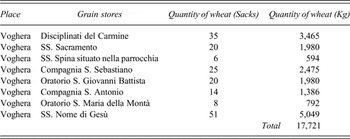
The documents show that in 1754, the grain store of the S.S. Nome di Gesù had about 306 mine of wheat, equivalent to 51 sacks, or 5,050 kg.Footnote 64 From the data in the parish reports for the visits of Resta and Andujar in 1741 and 1743, we can deduce the quantity of wheat held by another seven of the twelve grain stores in Voghera (Table 3). The most important question is what such assets signified in terms of the land that could be sown and the extent of grain cultivation in Voghera. A calculation of the amount of seed grain needed for a hectare of land, at that time considered to be around 195 kg, shows that the total amount of seed in the eight grain stores out of twelve in Voghera would allow for the sowing of 89 hectares of land, a not inconsiderable amount, taking into account the land ownership situation in the area under study.Footnote 65 The land register of Piedmont, dating from the 1750s, gives the extent of cultivatable land around the town of Voghera as 5,218 hectares.Footnote 66 Aristocratic estates accounted for 12.96 per cent, non-aristocratic property for 58.80 per cent and ecclesiastical property for 21.56 per cent. Alongside some large aristocratic and ecclesiastical estates, in Voghera there were many medium-sized (non-aristocratic) estates, particularly growing grain. The non-aristocratic property accounted for about 3,130 hectares, so the grain store assets would cover about 3 per cent of that. However, we can assume that not all non-aristocratic landowners would need to borrow grain. Moreover, the grain stores were not intended to cover the entire agricultural production of Voghera. Rather, they were only one component of the available social support networks, albeit a particularly crucial one given their role in supporting production.
Quantity of wheat held by eight grain stores in Voghera, 1741–1743

Source: ASDT, Visite pastorali, visita Mons. Andujar, F. 45, f. 2; ASDT, Visite pastorali, visita Mons. Resta F. 41, f. 2, cc. 184–90.
8. CHARITABLE PRACTICES IN THE IMPERIAL FIEFDOMS
As noted above, the development of poor relief systems was very different in the area of the Imperial fiefdoms, located in the southern part of the diocese, bordering the Republic of Genoa. The Imperial fiefdoms were political entities, of varying sizes and importance, which maintained their autonomy from their neighbour states. These political entities were each controlled by a feudal lord who, as a direct vassal of the Holy Roman Emperor, administered justice, minted coinage and raised armies. This socio-political situation, together with the geomorphology and climate, hindered the development of small landholdings – the most common system of farm management was the emphyteutic lease – a condition closely connected with the restricted spread of effective relief systems.
From a study of parish reports, we can deduce that the population of the Imperial fiefs in the diocese of Tortona, distributed across 70 parishes, was 37,843 inhabitants and 340 clergymen.Footnote 67 The clergy-population ratio was therefore 111 inhabitants to every priest. In the 70 parishes analysed, there are practically none of the relief activities carried out in the other areas of the diocese by intermediate bodies such as the communities, the parishes, the guilds, the confraternities, the kinship groups and individuals. Where such activities were found, they were sponsored by the feudal lord and therefore imposed from above.Footnote 68 Both for political-institutional reasons and due to widespread poverty, in these areas the local communities do not appear to have been able to act effectively when it came to welfare provision. This distinguishes the situation in the Imperial fiefdoms of Tortona from other mountain areas, which, despite greater poverty and fewer favourable social structures than the plains, nonetheless saw the development of relief systems led by the intermediate bodies.
There are various examples of top-down poor relief provision in the Imperial fiefdoms. At Cabella, a parish of 1,400 inhabitants and 11 priests, there were two social support activities. The first was the ‘Opera di carità o suffragio dei poveri’ left by the Centurioni Spinola family for the distribution of sacks of grain for making bread. The second was the hospital, built by Duke Pallavicino, endowed with six beds, a doctor, surgeon, apothecary and chaplain. Cabella is also a good illustration of how priests in the Imperial fiefdoms perceived their duties to the community, a point discussed earlier. In describing the poor relief activities in his parish, the priest says ‘by the grace of God there is no Monte di pietà’.Footnote 69 The implication is that the priest was grateful not to have to manage such an institution.
This phrase confirms the contrast in the perception of the clergy's role in the fiefdoms, compared with that in other parts of the diocese where managing the social support networks was often one of the priest's pastoral duties. This difference was principally due to the institution of lay patronage in the fiefdoms, whereby the feudal lord had the right to nominate the priest in parishes under his jurisdiction. This legal institution prevented the priests from developing their independence in pastoral practice, which in turn discouraged them from developing a constant, effective commitment to their parishioners over and above the simple administration of the sacraments.
An interesting example of how feudal control worked is the case of Carpeneto, a parish of 304 inhabitants and one priest, where there was a bequest for the poor, undated but probably close to when the parish report was written, for 50 Genoa liras. The benefactor, who died without male heirs, belonged to the Carpeneto family. The report highlights the role of the feudal prince in organising the social support networks and the degree of control that he was able to exercise over them, in that Prince Doria, the local lord, gave possession of the fund to his daughters, with a requirement to invest in order to increase the capital and devolve it to the ‘poor souls’.Footnote 70 The feudal lord's involvement in the relief field was just one element of a broader policy of socio-political control.
The absence in the Imperial fiefdoms of relief systems similar to those in other parts of the diocese was, however, counterbalanced by the presence of different social support systems. A classic example is the permission granted by the feudal lord to some of his people to exploit pastures and woods under his jurisdiction. Common lands were chiefly used for gathering chestnuts that, in these mountain areas, as mentioned above, were one of the main sources of sustenance, either eaten immediately or made into flour.Footnote 71 Another equally important use of woodlands was as a source of firewood and leaves and as grazing for animals.
A classic example of the importance of common rights for relief purposes is found in the legal dispute that arose over ownership of woodland situated between Bertone and Belnome, communities situated on opposite slopes of Monte Alfeo.Footnote 72 On 26 May 1770, some inhabitants of Bertone advanced over the top of Monte Alfeo towards Belnome, in order to gather wood. When the inhabitants of the two parishes met, fighting broke out. Following this action, the feudal lords intervened, claiming the right to begin legal proceedings.Footnote 73 The issue of right of usage of the wood involved four key players: Prince Giambattista Centurione, feudal lord of Bertone, Campi and Gorreto; Antonio Giuseppe Malaspina and Giovanni Carlo Pallavicino, joint lords of Belnome; and Girolamo Fieschi, lord of Savignone, nominated by the other parties in 1772Footnote 74 as ‘giudice remissario’ that is, as an arbitrator chosen to settle the dispute between the parties, by clearly defining the legal boundaries of the wood.
The sources created by the dispute show that the wood was subject to common rights, for the communities of Bertone and Belnome, of grazing and gathering firewood.Footnote 75 The importance of this aspect is clear in that Fieschi, on passing sentence in 1783, focused on usage of the wood, in deciding the exact jurisdictional boundaries on the top of Monte Alfeo. For our purposes, what should be highlighted is that the common resources in question constituted an important relief system, necessary for the socio-political order of the communities, as has been shown elsewhere in Italy.Footnote 76
Another, different response from local communities to the lack of widespread relief systems was migration, already highlighted above. In the fiefdoms, migration flows were much higher than those in other parts of the diocese. The difficult economic situation in these areas forced almost all men of working age to migrate to the Duchy of Milan or Republic of Genoa.Footnote 77 The reports prepared in advance of the pastoral visit of Bishop Resta are particularly valuable in providing examples of this poverty-induced migration. The priest of Santa Margherita denounced a situation that was to the detriment of the parish, saying:
Due to the poverty of these places, most of the inhabitants migrate for a good part of the year across the Pò to work and, consequently, there they die, there they are born, without any profit for their priest.Footnote 78
Similarly, confirming the principal direction of the migration flows, Luigi Mangini, priest of Fontanarossa, wrote:
The income of the clergy is 40 stare of grain, paid as ‘first fruit’ by every head of household. However, many of them, owing to widespread poverty and scarce harvests, in winter migrate to Lombardy and only render to the priest half of the amount required. The clergy can either accept this situation, or argue with the heads of household. In the past, 50 or 54 families could be counted upon to pay but, since many of these have passed their goods to inhabitants of other parishes, or they reside out of the parish for most of the year, they now say they ought not to pay the priest anything.Footnote 79
9. CONCLUSION
Our research shows how the support practices of the diocese of Tortona in the eighteenth century generated a socio-economic impact that went beyond the objective of mere subsistence of the poor and needy fringes of society. Italian historians have given little attention to the rural environment. Yet here, as in the towns, poor relief was a fundamental factor in determining community wellbeing, before the growth of systematic social policies emanating from central government. This question is of particular interest, given the increasing presence of various bodies within relief in order to compensate for state inefficiency in this sector.Footnote 80 Our research has enabled us to highlight the complexity of poor relief in terms of the various actors involved in social support networks, the variety of charitable actions, as well as the impossibility of categorically determining the lay or religious, individual or collective motives underlying these actions.
Our comparative analysis has revealed differences in the nature of poor relief practices in areas with different geographical, political and socio-economic characteristics. The case study of the diocese of Tortona clearly shows the close connection that existed during the old regime between on the one hand, political-institutional structures, distribution of farmland, demographic structures, the social characteristics of the clergy, and the development of certain forms of welfare activities on the other. A classic example of this is the spread of grain stores and hospitals in the lowland area of the diocese.
In general, wherever one finds small and medium farms in Tortona, more socially active confraternities, a social structure made up of several intermediate bodies – each with its own identity, encouraging a more flexible system of relationships and of giving – and clergy involved not only in the spiritual, but also in the civil sphere, meant that welfare activities were more widespread. But wherever, as in the case of the imperial fiefdoms, the social structure was less flexible and the political-institutional structure was driven by feudal dynamics, the welfare system was much less developed and the few activities were organised directly by the feudal lord.
Through our comparative focus, we have been able to understand the close connection between the relief activities that made up these social support networks and the development of a local identity. In other words, where social support networks were widespread and sponsored by the intermediate bodies that structured the local community, community identity seemed to be much more developed compared with other areas, such as the Imperial fiefdoms, where these networks were less developed, and thus migration out of the area was much higher. In other words, political, economic, social and religious aspects, in all their variety, must be looked at together in order to understand the complex mechanisms underlying the formation of relief practices in the countryside.
ACKNOWLEDGEMENTS
This work is the result of joint archival research and analysis of the data; however, sections 1, 5, 6 and 7 were written by Luciano Maffi, and sections 2, 3, 4, 8 and 9 by Marco Rochini.