Introduction
Nematodes of the genus Rotylenchus Filipjev, Reference Filipjev1936 are obligate and migratory ectoparasites of various wild and cultivated plants. They use moderate to strong stylets to penetrate surface root tissues and cause cell necrosis. Rotylenchus spp. are widely distributed all over the world and have been recorded from all continents with 103 valid species to date (Castillo & Vovlas, Reference Castillo and Vovlas2005; Vovlas et al., Reference Vovlas, Subbotin, Troccoli, Liébanas and Castillo2008; Atighi et al., Reference Atighi, Pourjam, Pedram, Cantalapiedra-Navarrete, Palomares-Rius and Castillo2011, Reference Atighi, Pourjam, Ghaemi, Pedram, Liébanas, Cantalapiedra-Navarrete, Castillo and Palomares-Rius2014; Cantalapiedra-Navarrete et al., Reference Cantalapiedra-Navarrete, Liébanas, Archidona-Yuste, Palomares-Rius and Castillo2012, Reference Cantalapiedra-Navarrete, Navas-Cortés, Liébanas, Vovlas, Subbotin, Palomares-Rius and Castillo2013; Aliramaji et al., Reference Aliramaji, Pourjam, Álvarez-Ortega, Pedram and Atighi2015; Noruzi et al., Reference Noruzi, Asghari, Atighi, Eskandari, Cantalapiedra-Navarrete, Archidona-Yuste, Liébanas, Castillo and Palomares-Rius2015; Talezari et al., Reference Talezari, Pourjam, Kheiri, Liebanas, Aliramaji, Pedram, Rezaee and Atighi2015; Golhasan et al., Reference Golhasan, Heydari, Álvarez-Ortega, Meckes, Pedram and Atighi2016; Nguyen et al., Reference Nguyen, Trinh, Couvreur, Singh, Decraemer and Bert2019; Singh et al., Reference Singh, van de Vossenberg, Rybarczyk-Mydłowska, Kowalewska-Groszkowska, Bert and Karssen2021). This large number of species complicates the identification process, where polytomous keys comprise a useful and practical tool for species identification (Castillo & Vovlas, Reference Castillo and Vovlas2005). In any case, since several cryptic species have been identified within Rotylenchus, integrative taxonomy is essential for species identification (Cantalapiedra-Navarrete et al., Reference Cantalapiedra-Navarrete, Navas-Cortés, Liébanas, Vovlas, Subbotin, Palomares-Rius and Castillo2013; Palomares-Rius et al., Reference Palomares-Rius, Cantalapiedra-Navarrete and Castillo2014; Singh et al., Reference Singh, van de Vossenberg, Rybarczyk-Mydłowska, Kowalewska-Groszkowska, Bert and Karssen2021). For these reasons, the development of molecular methods using different fragments of nuclear ribosomal and mitochondrial DNA gene sequences have to be used in DNA barcoding during the last years, leading to an accurate species diagnosis, clarifying phylogenetic relationships and species delimitation under the genus Rotylenchus (Vovlas et al., Reference Vovlas, Subbotin, Troccoli, Liébanas and Castillo2008; Atighi et al., Reference Atighi, Pourjam, Pedram, Cantalapiedra-Navarrete, Palomares-Rius and Castillo2011, Reference Atighi, Pourjam, Ghaemi, Pedram, Liébanas, Cantalapiedra-Navarrete, Castillo and Palomares-Rius2014; Cantalapiedra-Navarrete et al., Reference Cantalapiedra-Navarrete, Liébanas, Archidona-Yuste, Palomares-Rius and Castillo2012, Reference Cantalapiedra-Navarrete, Navas-Cortés, Liébanas, Vovlas, Subbotin, Palomares-Rius and Castillo2013; Aliramaji et al., Reference Aliramaji, Pourjam, Álvarez-Ortega, Pedram and Atighi2015; Noruzi et al., Reference Noruzi, Asghari, Atighi, Eskandari, Cantalapiedra-Navarrete, Archidona-Yuste, Liébanas, Castillo and Palomares-Rius2015; Talezari et al., Reference Talezari, Pourjam, Kheiri, Liebanas, Aliramaji, Pedram, Rezaee and Atighi2015; Golhasan et al., Reference Golhasan, Heydari, Álvarez-Ortega, Meckes, Pedram and Atighi2016; Tzortzakakis et al., Reference Tzortzakakis, Archidona-Yuste, Liébanas, Birmpilis, Cantalapiedra-Navarrete, Navas-Cortés, Castillo and Palomares-Rius2016; Nguyen et al., Reference Nguyen, Trinh, Couvreur, Singh, Decraemer and Bert2019; Singh et al., Reference Singh, van de Vossenberg, Rybarczyk-Mydłowska, Kowalewska-Groszkowska, Bert and Karssen2021).
The bacterial genus Cardinium Zchori-Fein et al., Reference Zchori-Fein, Perlman, Kelly, Katzir and Hunter2004 comprises cyto-endosymbionts that are widely present in approximately 7–9% of arthropods (Weeks et al., Reference Weeks, Velten and Stouthamer2003; Zchori-Fein et al., Reference Zchori-Fein, Perlman, Kelly, Katzir and Hunter2004). The genus Cardinium gained major interest as they have evolved to modify their host reproduction through at least three reproductive manipulations, viz., parthenogenesis, feminization and cytoplasmic incompatibility. In phylum Nematoda, Cardinium has been recovered primarily from the root-lesion nematode Pratylenchus penetrans (Cobb, Reference Cobb1917) Filipjev & Stekhoven, 1941 (Denver et al., Reference Denver, Brown, Howe, Peetz and Zasada2016; Brown et al., Reference Brown, Wasala, Howe, Peetz, Zasada and Denver2018) and Heterodera avenae Wollenweber, 1924 in transcriptome analysis (Yang et al., Reference Yang, Chen, Liu and Jian2017) and also from Heterodera glycines Ichinohe, 1952 (Endo, Reference Endo1979; Noel & Atibalentja, Reference Noel and Atibalentja2006; Showmaker et al., Reference Showmaker, Walden, Fields, Lambert and Hudson2018).
In the present study, two populations of the genus Rotylenchus were isolated, and subsequently characterized based on molecular and morphological analyses. Through Illumina genome sequencing we also reported the presence of Cardinium in the newly described species and its phylogeny was discussed.
Materials and methods
Nematode sampling and morphological analyses
The nematodes were extracted from soil using a modified Baermann tray method (Whitehead & Hemming, Reference Whitehead and Hemming1965). The extracted fresh nematodes were fixed in 4% formalin solution at 60°C, and gradually transferred to anhydrous glycerin for permanent slides (Sohlenius & Sandor, Reference Sohlenius and Sandor1987). Specimens were examined, photographed and measured by an Olympus BX51microscope equipped with an Olympus DP72 camera (Olympus Corporation, Tokyo, Japan).
DNA extraction and genome sequencing
About 2000 individual nematodes were manually picked up and morphologically examined before processing for DNA extraction. The extraction started with three repeats of freeze–thaw to break the cuticle, followed by DNA isolation using the Ezup Column Animal Genomic DNA Purification Kit (Sangon Biotech, Shanghai, China). The quantity and quality of acquired DNA were checked using the Qubit® 1× dsDNA HS Detect Kit (Yeasen Biotech, Shanghai, China) on the Qubit® 3.0 Fluorometer. The genomic library preparation was performed using the Illumina TruSeq DNA Sample Preparation Kit (Personalbio, Shanghai, China). The Illumina Nova Seq 2 × 150 base pairs (bp) paired-end sequencing was performed at Personalgene Corporation (Personalbio, Shanghai, China).
Assembly and extraction of nematode barcoding genes
The obtained raw reads from sequencing were first filtered by FastQC (https://www.bioinformatics.babraham.ac.uk/projects/fastqc/), then high-quality reads were aligned with the nematode rRNA and mitochondrial genome using the NextGenMap (Sedlazeck et al., Reference Sedlazeck, Rescheneder and von Haeseler2013). The aligned reads were extracted by SAMtools (Li et al., Reference Li, Handsaker, Wysoker, Fennell, Ruan, Homer, Marth, Abecasis and Durbin2009), subsequently assembled in Novoplasty (Dierckxsens et al., Reference Dierckxsens, Mardulyn and Smits2017). The resulting contigs were mapped to available National Center for Biotechnology Information (NCBI) references (rRNA: MZ327998, MZ328000-MZ328003 and Mitogenome: MZ333433, MZ333435-MZ333439) to locate internal transcribed spacer (ITS), 18S rRNA, 28S rRNA and mitochondrial COI sequences by using Geneious 7.13.
To validate the Illumina assembled genes and to acquire additional sequences, the traditional polymerase chain reaction (PCR) and Sanger sequencing pipeline was also applied. The 18S rRNA was amplified with primer pairs G18S4 and 18P (Blaxter et al., Reference Blaxter, De Ley and Garey1998). The D2–D3 region of 28S rRNA was amplified with newly designed forward primers XQ-D2F (5′- TGG AAA CGG AYA GAG CYA GC-3′), XQ-D2R (5′- GTG TTT CAA GAC GGG TCG GA-3′), XQ-D3F (5′- TCC GAC CCG TCT TGA AAC AC-3′) and universal reverse primer D3B (Nadler et al., Reference Nadler, Felix, Frisse, Sternberg, De Ley and Thomas1999). Briefly, the DNA from a single individual nematode was extracted using worm lysis buffer (Singh et al., Reference Singh, Nyiragatare, Janssen, Couvreur, Decraemer and Bert2018) and used as the template. The PCR reaction was carried out in a total volume of 25 μl (7.5 μl double-distilled water, 2 × 2 μl for primers, 12.5 μl of Ex Taq DNA polymerase mix and 1 μl of DNA template). The thermal cycle program was as follows: an initial step of 95°C for 4 min; 35 cycles of 95°C for 30 s; 54°C for 30 s; 72°C for 2 min; and finished at 72°C for 10 min. The amplified products were purified and subsequently sent for sequencing by Sangon Corporation (Sangon Biotech, Shanghai, China).
Phylogenetic analyses
The sequences of the new species were compared with those of related species available in GenBank using the Basic Local Alignment Search Tool homology search program. Since the genus Rotylenchus is well defined within the family Hoplolaimidae, only species of this taxa were included in the analysis (Nguyen et al., Reference Nguyen, Trinh, Couvreur, Singh, Decraemer and Bert2019; Singh et al., Reference Singh, van de Vossenberg, Rybarczyk-Mydłowska, Kowalewska-Groszkowska, Bert and Karssen2021). Multiple alignments for rRNA genes were built using the G-INS-i algorithm of Multiple Alignment using Fast Fourier Transform v. 7.205 (Katoh & Standley, Reference Katoh and Standley2013), and the COI gene was aligned using TranslatorX (Abascal et al., Reference Abascal, Zardoya and Telford2010) under the invertebrate mitochondrial genetic code. To infer phylogenetic trees, Bayesian inference (BI) and maximum likelihood (ML) analyses were performed on the CIPRES Science Gateway (Miller et al., Reference Miller, Pfeiffer and Schwartz2010) using MrBayes 3.2.7 (Ronquist et al., Reference Ronquist, Teslenko and van der Mark2012) and RAxML8.1.12 (Stamatakis et al., Reference Stamatakis, Hoover and Rougemont2008), respectively. For BI analysis, the GTR+I+G model was selected. The Markov chains were set with four independent chains for 10 × 106 generations, sampled every 100 generations, and 25% of the converged runs were discarded as burn-in. For ML analysis, 1000 bootstraps (BS)’ replicates were included under the GTRCAT model.
Amplification of 16S rRNA in endosymbiont Cardinium
In the process of assembling the R. zhongshanensis sp. nov. genome, we found a short sequence belonging to the 16S rRNA gene of a new strain of endosymbiont Cardinium. To obtain the full length of the 16S rRNA gene, PCR amplifications were conducted with the DNA template extracted from 2000 individual nematodes mentioned above using two primer pairs. The forward primer 8F (Vandekerckhove et al., Reference Vandekerckhove, Willems, Gillis and Coomans2000) and a newly designed reverse primer CARR1 (5′- TTT TAC GGC CAC TGT CTT CAA GCT CT-3′) were used to amplify the 655 bp anterior part of 16S rRNA. The posterior 758 bp was amplified by newly desgined forward primer CARF1 (5′- CAG CGG GAC ACT TCG GTG TTG YC-3′) and the universal reverse primer 1541R (Vandekerckhove et al., Reference Vandekerckhove, Willems, Gillis and Coomans2000). The obtained Cardinium 16S rRNA gene sequences were submitted into the GenBank, and compared with those from different host species downloaded from GenBank. The phylogenetic relationship was analysed in the same pipeline of nematode barcoding genes.
Results
Rotylenchus zhongshanensis sp. nov. (The specific epithet refers to Zhongshan Mountain at Nanjing, China, the region from where the new species was recovered.)
Description (Nanjing Agricultural University (NAU) type population)
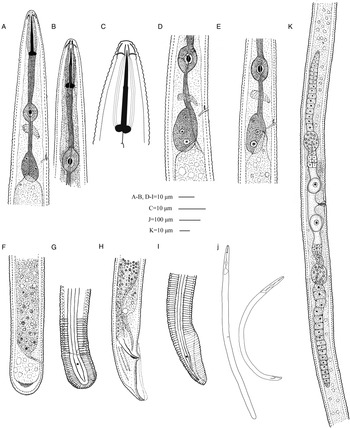
Line drawing of Rotylenchus zhongshanensis sp. nov. (NAU population). (a–c): female anterior body region; (d, e): gland overlap; (f, g): female tail region; (h, i): male tail region; (j): female (left) and male (right) body outline; (k): female reproductive system.

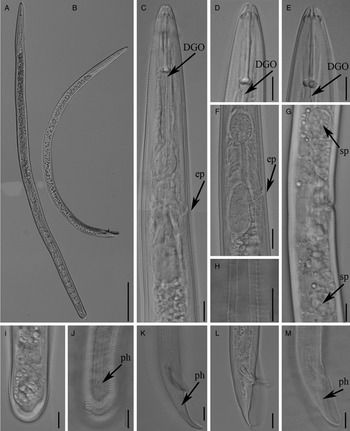
Light micrographs of Rotylenchus zhongshanensis sp. nov. (NAU population). (a): female body habitus; (b): male body habitus; (c): pharynx; (d, e): female body anterior end; (f): glands; (g): vulva region; (h): lateral field; (i, j): female tail region; (k–m): male tail region (scale bars: a, b = 100 μm; c–m = 10 μm). Abbreviations: DGO = dorsal gland orifice; ep = excretory pore; ph = phasmid; sp = spermatheca.

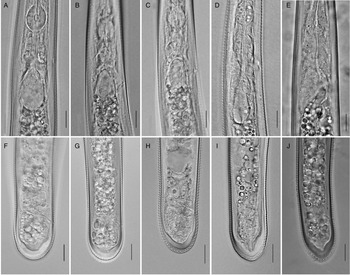
Light micrographs of Rotylenchus zhongshanensis sp. nov. (NAU population). (a–e): pharyngeal region of different individuals showing the variations of dorsal pharyngeal overlapping; (f–j): female tail regions in different individuals (scale bars = 10 μm).

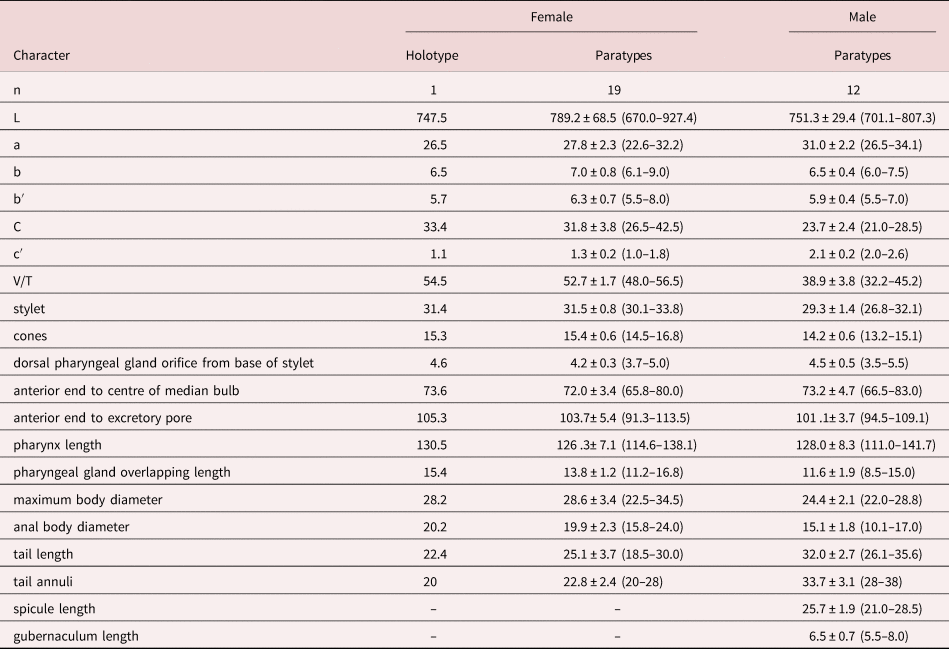
Morphometrics of Rotylenchus zhongshanensis sp. nov. All measurements are in μm and in the form: mean ± standard deviation (range).

Female. Body cylindrical and relatively small, slightly ventrally curved upon fixation. Lateral field with four smooth equidistant lines, slightly areolated across body. Lip region 6.8 ± 0.4 (6.3–7.7) μm broad, 4.7 ± 0.4 (4.1–5.8) μm high, conoid, truncate and continuous, with four or five annuli, framework sclerotization strong, outer margin extending for 2–3 annuli posteriorly into the body. Stylet robust with rounded basal knobs, conus occupying 47.2–51.8% of total length. Dorsal pharyngeal gland orifice (DGO) located at 3.7–5.0 μm from stylet base. Procorpus of pharynx cylindrical, median bulb well developed, broadly ovate. Isthmus slender, encircled by nerve ring at mid-point. Excretory pore usually posterior to the level of nerve ring and anterior to pharyngo-intestinal junction. Hemizonid distinct, 2–3 body annuli long, just anterior to excretory pore. Pharyngeal glands elongate to sacciform with three nuclei (two anterior smaller nuclei and one bigger posterior), overlapping intestine dorsally for 11.2–16.8 μm. Reproductive system didelphic–amphidelphic, genital branches equally developed, at right side of intestine, outstretched ovaries with a single row of oocytes; spermatheca mostly rounded or oval, axial, 13.2 ± 1.4 (12–16.8) μm long, 12.7 ± 1.1 (10.3–14.4) μm wide. Sperm spherical with nucleus occupies the whole cell volume. Vulva 48.0–56.5% of body length from anterior end. Epiptygmata and vulva flap indistinct. Phasmids pore-like, 4–6 annuli posterior to level of anus. Tail short, hemispherical, with 20–28 annuli, terminus cuticle intensified.
Male. Less abundant than females. Morphology is similar to females, except for the following characters: body curved ventrally to open C-shaped when heat-killed. Pharyngeal overlapping slightly shorter than that of females. Testis single, anteriorly outstretched, 260–332 μm long. Spicules ventrally arcuate. Gubernaculum protrusible. Phasmid pore-like, 11–17 annuli posterior to cloacal aperture. Tail conoid, 26.1–35.6 μm long or nearly 1.8–2.5 times of cloacal opening diameter. Bursa 39.3–54.5 μm long, completely surrounding tail.
Type host and locality
Type population of R. zhongshanensis sp. nov. was recovered from the rhizosphere soil of several types of grasses including Digitaria sanguinalis, Cynodon dactylon and Erigeron acer located at the campus of Nanjing Agricultural University, Nanjing, China (Global Positioning System (GPS) coordinates: 32°02′17″N, 118°51′07″E, NAU population).
Other locality
An additional population was found in Zhongshan Mountain of Nanjing, China (GPS coordinates: 32°03′15″N, 118°51′46″E, Zhongshan, ZS) population) in the soil of deciduous forest. This population was only used for molecular study since only a few juveniles were recovered.
Type material
Three female paratypes, in one slide, was deposited at the Ghent University Museum, Zoology Collections, collection number UGMD 104438. Holotype female, paratype males and females and juveniles (20 females, 12 males and three juveniles in five slides) are deposited in the collection of the Nematology Laboratory of Nanjing Agriculture University. ZooBank identifier: 9231E061-2E22-4819-AB76-FEC82FAC21D7.
Diagnosis and relationships
Rotylenchus zhongshanensis sp. nov. (NAU population) is an amphimictic species characterized by having a conoid rounded lip region with four annuli, lateral field with four lines, stylet 30.1–33.8 μm long, vulva at 48.0–56.5%, rounded tail with thickened cuticle and bearing 20–28 annuli. According to Castillo & Vovlas (Reference Castillo and Vovlas2005), R. zhongshanensis sp. nov. receives the matrix code as A3, B3, C7, D4, E2, F2, G2, H2, I2, J1, K2.
Based on the number of lip annuli, distance of DGO to stylet base, female vulva position and tail shape, R. zhongshanensis sp. nov. is closed to a few Rotylenchus species including Rotylenchus bialaebursus Van den Berg & Heyns, Reference Van den Berg and Heyns1974, Rotylenchus goodeyi Loof & Oostenbrink, Reference Loof and Oostenbrink1958, Rotylenchus impar (Phillips, Reference Phillips1971) Germani et al., Reference Germani, Baldwin, Bell and Wu1985, R. incisicaudatus (Phillips, Reference Phillips1971) Germani et al., Reference Germani, Baldwin, Bell and Wu1985, Rotylenchus mabelei Van den Berg & De Waele, 1989 and Rotylenchus minutus (Sher, Reference Sher1963) Germani et al., Reference Germani, Baldwin, Bell and Wu1985. However, R. zhongshanensis sp. nov. differs from R. bialaebursus by the labial region shape (conoid vs. rounded), stylet length (30.1–33.8 vs. 26.1–28.7 μm in female), phasmid position (4–6 annuli posterior to anus vs. 9–12 annuli anterior to anus) and gubernaculum length (5.5–8.0 vs. 11.8–13.2 μm); from R. goodeyi by the female lip region shape (conoid vs. hemispherical), phasmid position (4–6 annuli posterior to anus vs. 1–11 annuli anterior to anus) and gubernaculum length (5.5–8.0 vs. 13–15 μm); from R. mabelei by lip region shape (conoid, continuous with body contour vs. hemispherical and slightly set off from body), stylet length (30.1–33.8 vs. 27.0–29.5 μm), body diameter (22.5–34.5 vs. 23–27 μm), a ratio (22.6–32.2 vs. 35.4–44.2), pharyngeal gland (a very short overlapping not forming a lobe, but abutting in an almost basal bulb-like pharyngeal gland vs. a pharyngeal overlapping lobe), female tail (hemispherical vs. dorsally convex–conoid), spermatheca (rounded to spherical vs. not developed) and presence of males (vs. absence); from R. minutus by the female body length (670.0–927.4 vs. 550–670 μm), lip region shape (conoid vs. hemispherical), stylet length (30.1–33.8 vs. 21–25 μm in female) and phasmid position (4–6 annuli posterior to anus vs. 3 annuli anterior to anus); from R. impar and R. incisicaudatus both by the stylet length (30.1–33.8 vs. shorter than 30 μm in female), dorsal pharyngeal gland overlapping (11.2–16.8 vs. 21.0–30.9 μm), phasmid position (4–6 annuli posterior to anus vs. well anterior to anus) and presence of males (vs. absence). Besides, the new species has conoid lip region, while R. impar and R. incisicaudatus have truncate and rounded labial regions, respectively.
In addition, R. zhongshanensis sp. nov. can be separated from the genetically related species by the following characters: different fromRotylenchus conicaudatus Atighi et al., Reference Atighi, Pourjam, Pedram, Cantalapiedra-Navarrete, Palomares-Rius and Castillo2011 by DGO (3.7–5.0 vs. 6–11 μm), pharyngeal glands overlapping (11.2–16.8 vs. 19–33 μm), tail shape (hemispherical vs. conoid-rounded) and phasmid position (4–6 annuli posterior to anus vs. 5–12 annuli anterior to anus); different from Rotylenchus fragaricus (Maqbool & Shahina, Reference Maqbool and Shahina1986) Atighi et al., Reference Atighi, Pourjam, Ghaemi, Pedram, Liébanas, Cantalapiedra-Navarrete, Castillo and Palomares-Rius2014 by the lip region shape (conoid vs. truncate), DGO (3.7–5.0 vs. 7–9 μm), pharyngeal glands overlapping (11.2–16.8 vs. 41–58 μm), vulva position (48.0–56.5 vs. 59.5–64.0%), presence of males (vs. absence) and phasmid position (4–6 annuli posterior to anus vs. 6–18 annuli anterior to anus); different from Rotylenchus montanus Vovlas et al., Reference Vovlas, Subbotin, Troccoli, Liébanas and Castillo2008 by the lip annulation (4 annuli vs. 6 annuli), lip region shape (conoid vs. hemispherical), presence of males (vs. absence), and phasmid position (4–6 annuli posterior to anus vs. 2–9 annuli anterior to anus); and different from Rotylenchus sardashtensis Golhasan et al., Reference Golhasan, Heydari, Álvarez-Ortega, Meckes, Pedram and Atighi2016 (closely related species in ITS phylogeny), by the lip region shape (conoid vs. hemispherical), stylet length (30.1–33.8 vs. 26–30 μm), tail shape (hemispherical vs. rounded with ventral mucro), V ratio (48.0–56.5 vs. 67.0–77.0%), presence of males (vs. absence), and phasmid position (4–6 annuli posterior to anus vs. 10–23 annuli anterior to anus).
Molecular characterization and phylogeny
We assembled the full length rRNA gene of R. zhongshanensis sp. nov. from the NAU population, and extracted its barcoding regions to infer the corresponding phylogenies. This assembly and extraction yielded 1661 bp 18S sequences (GenBank accession OK256171), 787 bp for D2–D3 domain of 28S and 229 bp for ITS2 (OK157524). The reads mapping to mitochondrial genome reference yielded 1381 bp for partial COI gene (OK236012). Additional sequences were obtained through PCR amplification for 18S (OM480710 and OM480711) and 28S (OM480731, OM480732 and OM510443). In comparison with most relevant species in NCBI, the 18S sequence (OK256171) had 95.0% identity with that from Rotylenchus sp. (AY284608), differing by 83 nucleotides. For 28S sequence, the NAU population (OK157524) differs from R. conicaudatus (HQ700698) by 93 nucleotides (88.0% identity). For ITS sequence, the new species (OK157524) differs from that of Rotylenchus sp. (KY484816) by 74 nucleotides (78.0% identity). For COI sequence, the new species (OK236012) differs from that of Rotylenchus sp. (MN782382) by 63 nucleotides (83.0% identity, 299 out of 362 aligned nucleotides) and from that of R. montanus (MN782383) by 68 nucleotides (82.0% identity, 324 out of 392 aligned nucleotides).
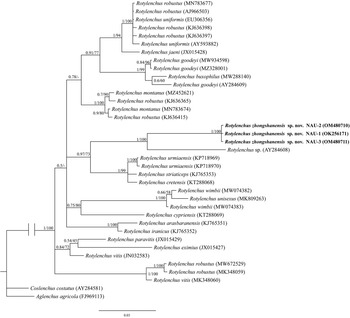
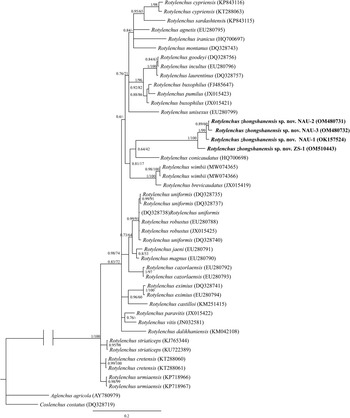
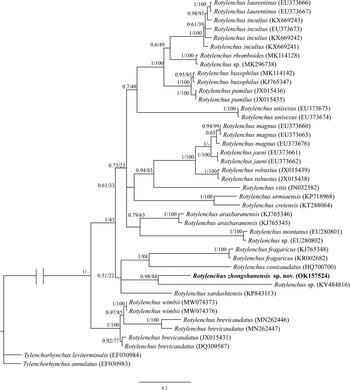
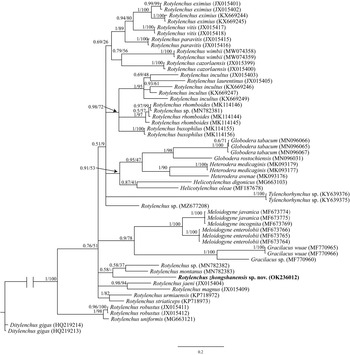
Phylogenetic relationships of R. zhongshanensis sp. nov. were determined by BI and ML analyses using four markers. In the 18S tree (fig. 4) the new species grouped with an unidentified Rotylenchus sp. (AY284608), forming a well-supported clade (posterior probability (PP) = 1, BS = 100). Intraspecific variation among the 18S gene of the new species are 3–6 nucleotides (99.3–99.7% identity). The 28S phylogeny (fig. 5) grouped the new species with R. conicaudatus (HQ700698) in a weakly supported clade (PP = 0.64, BS = 42). Intraspecific variation of 28S gene in NAU population are 6–15 nucleotides, and the representative of NAU population (OK157524) has 30 nucleotides (96.0% identity), which is different from that of ZS population (OM510443). No morphological difference was observed between ZS and NAU populations. In the ITS tree (fig. 6), the new species is sister to an unidentified Rotylenchus species (KY484816) (PP = 0.98, BS = 88), but the placement of this clade is unresolved within a less supported clade (PP = 0.51) including R. conicaudatus, R. fragaricus and R. sardashtensis. In the COI tree (fig. 7), R. zhongshanensis sp. nov. clustered with an unidentified Rotylenchus sp. and R. montanus, forming a weakly supported clade (PP = 0.58).
Bayesian 50% majority-rule consensus tree of Rotylenchus zhongshanensis sp. nov. and other related nematodes inferred from 18S rRNA gene. Dataset aligned with G-INS-i implemented in Multiple Alignment using Fast Fourier Transform. The values at clade node indicate as posterior probability/bootstrap. Newly obtained sequence is indicated in boldface type. The scale bar indicates expected changes per site.

Bayesian 50% majority-rule consensus tree of Rotylenchus zhongshanensis sp. nov. and other Hoplolaimidae species inferred from 28S rRNA gene. Dataset aligned with G-INS-i implemented in Multiple Alignment using Fast Fourier Transform. The values at clade node indicate as posterior probability/bootstrap. Newly obtained sequence is indicated in boldface type. The scale bar indicates expected changes per site.

Bayesian 50% majority-rule consensus tree of Rotylenchus zhongshanensis sp. nov. and other Hoplolaimidae species inferred from ITS2 region of rRNA genes. Dataset aligned with G-INS-i implemented in Multiple Alignment using Fast Fourier Transform. The values at each clade node indicate as posterior probability/bootstrap. Newly obtained sequence is indicated in boldface type. The scale bar indicates expected changes per site.

Bayesian 50% majority-rule consensus tree of Rotylenchus zhongshanensis sp. nov. and other related species inferred from mitochondrial COI gene. Dataset aligned TranslatorX under the invertebrate mitochondrial genetic code. The values at clade node indicate as posterior probability/bootstrap. Newly obtained sequence is indicated in boldface type.

Phylogeny analysis of Cardinium
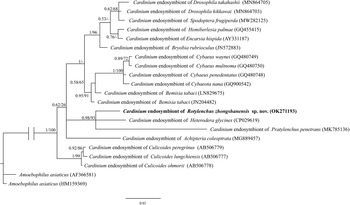
In the process of assembling the R. zhongshanensis sp. nov. genome, we found a short sequence (350 bp) belonging to the 16S rRNA gene of a new Cardinium endosymbiont strain. The subsequent PCR amplification using two primer pairs resulted in a 16S rRNA fragment of 1285 bp (OK271193). The phylogeny analysis (fig. 8) placed the new Cardinium strain of R. zhongshanensis sp. nov. within the well-supported clade containing H. glycines and P. penetrans (PP = 0.98, BS = 93). The 16S rRNA of new Cardinium strain differs from the Cardinium endosymbiont in H. glycines (CP029619) and P. penetrans (MK785136) by 51 nucleotides (96.0% identity, 1232 out of 1283 aligned sequences) and 35 nucleotides (93.0% identity, 457 out of 492 aligned sequences), respectively.
Bayesian 50% majority-rule consensus tree of the new Cardinium strain of Rotylenchus zhongshanensis sp. nov. and other related Cardinium strains inferred from 16S rRNA gene. Dataset aligned with G-INS-i implemented in Multiple Alignment using Fast Fourier Transform. The values at clade node indicate as posterior probability/bootstrap. Newly obtained sequence is indicated in boldface type.

Discussion
Rotylenchus zhongshanensis sp. nov. was morphologically and molecularly characterized in this study. The new species fits the typical generic character of genus Rotylenchus in family Hoplolaimidae Filipjev, Reference Filipjev1934, including the conoid lip region, very short pharyngeal glands overlapping, phasmids 4–6 annuli posterior to level of anus, and was further characterized by abnormal cuticle thickening in female tail terminus. Unlike other Hoplolaimidae species with distinct pharyngeal glands overlapping, the pharyngeal glands of R. zhongshanensis sp. nov. are bulb-shaped with very short overlapping, thus it was preliminarily identified as a member of the controversial genus Pararotylenchus Baldwin & Bell, Reference Baldwin and Bell1981. The separation of Rotylenchus and Pararotylenchus was based on several characters, perhaps the most important one being that the pharyngeal glands in Pararotylenchus are enclosed in a terminal bulb rather than overlapping the intestine (Baldwin & Bell, Reference Baldwin and Bell1981). However, Brzeski and Choi (Reference Brzeski and Choi1998) rejected the importance of that distinction and proposed the Pararotylenchus as a synonym of Rotylenchus, but no molecular data on Pararotylenchus spp. is currently available for further discussion. In our case, the new species has conoid-rounded lip region, bulb-shaped pharyngeal glands, phasmids near anus and broadly rounded tail, which are similar traits to that of Pararotylenchus belli Robbins, Reference Robbins1983. However, after the careful morphological comparison together with the phylogenetic analyses, we confirmed R. zhongshanensis sp. nov. as a new taxon in genus Rotylenchus. Therefore, the combination of morphological and molecular approaches is warranted to address the limitations of each approach in the identification of Rotylenchus species, or plant-parasitic nematodes in general. Nevertheless, additional molecular studies are needed to clarify the validity of the genus Pararotylenchus as well as its phylogenetic relationships with Rotylenchus spp. for validating or rejecting the proposed synonymy by Brzeski and Choi (1998).
In this study, the partial genome of R. zhongshanensis sp. nov. was obtained using the Illumina genomic sequencing technique, and the sequences of rRNA as well as COI genes were extracted from the assembled genome. Compared to standard PCR amplification with primer pairs, the used technique is more convenient without amplification, more accurate and less costly. Sometimes, the marker genes of one taxon are difficult to be amplified and the quality of sequences obtained by Sanger sequencing is not high. As the cost of high-throughput sequencing decreases, the genome sequencing may become the common method for acquiring more comprehensive and accurate gene information from nematodes.
A short sequence of a new Cardinium strain was also discovered from the R. zhongshanensis sp. nov. genome. The bacterial cyto-endosymbionts are critical players in many ecosystems for a number of reasons (Gotoh et al., Reference Gotoh, Noda and Ito2007; Nakamura et al., Reference Nakamura, Yukuhiro, Matsumura and Noda2012). They may provide novel biosynthetic capabilities to help supplement nutrients that are limited in their hosts (Brown et al., Reference Brown, Wasala, Howe, Peetz, Zasada and Denver2018). The genus Cardinium has already recovered from root lesion nematode P. penetrans (Denver et al., Reference Denver, Brown, Howe, Peetz and Zasada2016) and cyst nematodes belonging to genera Globodera and Heterodera (Shepherd et al., Reference Shepherd, Clark and Kempton1973; Endo, Reference Endo1979; Walsh et al., Reference Walsh, Lee and Shepherd1983a, Reference Walsh, Shepherd and Leeb; Yang et al., Reference Yang, Chen, Liu and Jian2017). Other endosymbiont bacteria reported from nematodes belong to the genera Xiphinematincola pachtaicus, Wolbachia and Xiphinematobacter (Haegeman et al., Reference Haegeman, Vanholme, Jacob, Vandekerckhove, Claeys, Borgonie and Gheysen2009; Palomares-Rius et al., Reference Palomares-Rius, Cantalapiedra-Navarrete and Castillo2014, Reference Palomares-Rius, Gutiérrez-Gutiérrez and Mota2021). During the present study, the endosymbiosis of a Cardinium sp. was recovered/proposed for the newly described species of Rotylenchus through the Illumina sequencing and subsequent PCR amplification.
Financial support
This research was supported by the National Natural Science Foundation of China (Grant number 32001876).
Conflict of interest
None.
Ethical approval
The conducted research is not either related to human or animals use.