The set of potential social identities is broad and ever-changing, but in most modern societies, including in the United States, partisanship is among the most relevant for politics. Partisanship is especially important when technology and culture produce greater polarization, intensifying associations with political parties. As with other cultural questions, effects have not been identical everywhere. People react to those around them, and social environments will prime partisan identities more than others. Where the identities are important, behaviors are likely to be explicitly expressive, consciously signaling political identity to the world (Hillman Reference Hillman2010).
Naming children is a very powerful signal, relatively irrevocable, and highly visible. Names potentially impose costs on a child for whom the parents care because others will constantly judge and react to the child based on his or her name (Christopher Reference Christopher1996). As costly signals, names credibly illuminate deep social concerns, such as unequal group opportunity (Fryer and Levitt Reference Fryer and Levitt2004; Varnum and Kitayama Reference Varnum and Kitayama2011) and how cultures change (Berger et al. 2012; Disdier, Head, and Mayer Reference Disdier, Head and Mayer2010).
Political scientists have barely exploited namesFootnote 1 despite many names’ apparent political leanings. At the extreme, naming a child for a communist or fascist dictator shows attitudes toward both social conventions and ideology. More commonly, children get names associated with mainstream, yet still partisan, political figures. This sort of politically charged name can easily redound to the child’s disadvantage in a divided society, suggesting that parents would use political names less in contexts of political division. Yet division makes partisanship more salient as a dimension of identity and, hence, a more appealing consideration when selecting baby names: it offers a satisfyingly strong marker of in-group identity when out-groups lurk nearby. By this logic, political names should be more common where there is polarization and political division.
This article explores these ideas using the propensity of American parents to name their newborn daughters “Reagan” from 1976 to 2011. While it seems likely that places where a larger share of the mass public is Republican will have a larger proportion of girls named “Reagan,” the question is how this relationship is modulated by the proportion of the local population who identify as Democrats. In practice, having more Democrats around intensifies the relationship between Republican population and newborns receiving the name “Reagan.” As might be expected from social identity theory, being near a larger partisan out-group increases’ parents desire to express their own in-group identity via their child’s name, although the size of that out-group is likely to make the partisan name more disadvantageous for the child.
REPUBLICANS IN NAME ONLY
Names, like identities, often emerge from the social networks in which parents find themselves (Mateos, Longley, and O’Sullivan 2011) and reflect those parents’ cultural context (Aceto Reference Aceto2002). As a result, names and identity tend to be tightly linked. Indeed, parents often consciously consider identity signals when deliberating over names for their children (Edwards and Caballero Reference Edwards and Caballero2008). Thus, names point to particularly important or emphatic parts of parental identity, and partisanship is apt to enter into naming choices when it is an important part of identity.
When measuring identity, children’s names have the additional advantage of being a much costlier signal than, say, stated partisan identification in a survey. An unfortunate choice of name is associated with everything from lower perceived likability (Laham, Koval, and Alter Reference Laham, Koval and Alter2012) to higher propensity for crime (Kalist and Lee Reference Kalist and Lee2009), to say nothing of years of schoolyard harassment. Scholars from across the social sciences have found that names measurably associate with people’s self-identity—and, in consequence, factors such as happiness or education (e.g., Aura and Hess Reference Aura and Hess2010; Becker Reference Becker2009). To the extent parents care about their children’s success and happiness, then, the choice of name has higher stakes than would potential embarrassment for giving a socially unwanted answer to a survey-taker. These stakes are useful for an inquiry into the sending of signals rooted in partisan identity.
Although the majority of names send few if any discernible political signals, several names derive from the names of prominent—and partisan—politicians. Many politics-related names have experienced at least brief fads: for example, “Palin” emerged as an occasional name for girls in 2008. Of course, not all politicians’ names mark any political intention on the part of parents. Any particular name may be purely of significance to the family, or have other antecedents: “Clinton” and “Carter” were both common boys’ names before the associated presidents assumed office, for instance, and indeed both dropped markedly in use during their namesake presidents’ tenure (although “Carter” subsequently recovered with a vengeance). This historical use makes them problematic signals of partisan identity. Other politically redolent names have the opposite problem; “Bush,” perhaps because of its alternative meanings, has not caught on as a name even with two presidents to associate with, and “Obama” has also not captured new parents’ imaginations, at least as of 2011.Footnote 2 Nor did distinctive monikers like “Adlai” or “Estes” ever capture the popular fancy, at least as names to impose on children.
Thus, names point to particularly important or emphatic parts of parental identity, and partisanship is apt to enter into naming choices when it is an important part of identity.
Some names have proved popular even with a political association and did not emerge until after the eminence of their associated politician. The most promising example may be “Reagan.” By 2012, “Reagan” had become one of the hundred most popular names for newborn girls (and one of the thousand most popular names for newborn boys). Yet it was virtually unknown before President Reagan’s tenure in office, despite his prior fame as a movie star and California governor. Notably, Reagan the politician has a sharply partisan cast in public memory, so that many parents are likely to be aware of the name’s political implications. Even those who are not explicitly conscious of the link to the former president may have their attitudes to the name shaped by subconscious partisan associations (Whissell Reference Whissell2006). While children of both sexes are named “Reagan,” the name appears much more frequently for girls, following the usual tendency in the United States for girls’ names to show more variation and innovation (Barry and Harper 2010). For consistency, the empirical analyses here only focus on girls; substantively similar results hold when looking at newborn boys or combining both sexes.
The Social Security Administration provides data on birth names. The data used here, measured as Reagans per 100,000 births of a particular state-year-sex, runs from 1976 (the start of the partisanship data) to 2011. This data set is a near-census of all newborn names. The largest exception to the data’s completeness during is that the Social Security Administration censors for privacy reasons state-year-sex combinations with fewer than five observations. That is, observations go unreported in the data if they have anywhere from zero to four births for a particular name. All such state-year-sexes are treated here as entries of zero. Reported results also include alternative spellings, such as “Regan” and “Raegan.” These could have independent antecedents (although it is not obvious that many new parents would know or admire King Lear’s Regan, perhaps the most prominent instance of that nameFootnote 3), and accordingly may add more noise to the measurement, especially as the censorship of low-frequency names occurs separately for each potential spelling. Running reported models without these variants does not change the tenor of the results.
To measure the distribution of partisan affiliations among the local population, the models here use fractions of the population that self-identify as Republicans and as Democrats. The primary source for this is Wright, McIver, and Erikson (Reference Wright, McIver and Erikson2007), which covers state-years in the continental United States from 1976 to 2003, deriving their information from a series of polls from CBS News and the New York Times. For more recent observations, data from Gallup provides analogous information from 2004 to 2011 (except for 2007).Footnote 4 The Gallup data not only has a different survey provider; it also measures state partisanship slightly differently, including as partisans those who identify as independents but lean toward one party or the other. To account for this difference, for the dramatic secular shifts in name popularity over time, and for any more minor changes in the wording of questions from survey to survey, all models presented include year fixed effects.
Besides the disadvantages of survey-based measures previously noted, these measures have other potentially objectionable characteristics. By including the total state population, the variables may not reflect the distribution of new parents’ political leanings, because substantial portions of the state population (e.g., those over the age of 60) are relatively unlikely to have newborn children. This difficulty will be further addressed by control variables, but the issue may not be a large one, as those who are not themselves potential parents can influence choices by providing the partisan backdrop to which new parents react. Similarly, the possible drawback of using a measure that (mostly) ignores independent leaners is ameliorated by the focus here on identity: insofar as people who identify as independents neither have nor trigger the desire to drape themselves in partisan signals, they are irrelevant to the research question here.
MODELING MASS PARTISANSHIP AND BABY REAGANS
As with most observational analyses, control variables are necessary. One such variable is the income of the state concerned. Lower-socioeconomic-status populations often choose distinctive baby names (Bloothoft and Onland 2011) and also have distinctive patterns of partisanship. Thus, income effects could create the false appearance of a relationship between partisanship and names. Here, income is measured as the natural logarithm of the state-year’s (constant-dollar) median household income, as reported by the US Bureau of the Census; this information is available beginning in 1984. Using current-dollar estimates or those without the logarithmic transformation produces similar results. In addition to income, there may be constant features of particular states that predispose them to different naming patterns. To check for this possibility, some models include state-level fixed effects.
State effects and their income reflect overall state populations; as mentioned above, this may not match the local population of new parents who are choosing names. Fortunately, the Centers for Disease Control and Prevention (CDC) provide data specifically relating to mothers of newborns by state-year, allowing more purchase on the most relevant parts of the population. Maternal characteristics are also relevant for their own sake because mothers’ experiences and demographic features influence their naming choices.Footnote 5 Ethnic and cultural factors, for instance, have a large influence on naming practices (Fryer and Levitt Reference Fryer and Levitt2004). To consider these potentially confounding effects, the models presented include three relevant variables. Two give the proportion of the new mothers for a state-year who identify as white and black, respectively. The third is the analogous measure for Hispanic ethnicity for those identifying with any race.Footnote 6 Even within racial and ethnic groups, mother’s ages, particularly for very young mothers, matter. Hence, the models include the proportion of new mothers for a state-year who were teenagers at the time of childbirth and a second variable measuring the proportion of new mothers between 20 and 29 years old (inclusive). The CDC data is generally available from 1990 to 2010.
One final implication of the expressive use of names as identity signals is that names with Republican overtones and those with Democratic ones might be found in the same places; if names are partly a response to people of one partisanship feeling surrounded by those of another, all parties in divided places will give their children political names. This possibility is especially likely because cues of alien partisans tend to be especially salient (Goren, Federico, and Kittilson 2009). Thus, one cause—and consequence—of Republican signals is neighbors’ Democratic signals: the two parties’ affiliates feed into each other’s explicitly political identity. This outcome may be especially true for a Republican name like “Reagan,” given the widespread perception that America’s political polarization has been asymmetrical in recent decades (with Republicans exhibiting more intense attachment to their party than Democrats: Ura and Ellis 2012).
One final implication of the expressive use of names as identity signals is that names with Republican overtones and those with Democratic ones might be found in the same places; if names are partly a response to people of one partisanship feeling surrounded by those of another, all parties in divided places will give their children political names.
Exploring these potential asymmetries requires a name with a Democratic aura to mirror “Reagan.” Perhaps the likeliest candidate is “Kennedy”: also a surname of a president revered among part of the population and not a traditionally common first name but latterly relatively widespread, especially for girls. While the parallel is necessarily imperfect, and other factors could drive use of both names—such as a general fashion for adopting Irish surnames as names—the durable Kennedy dynasty and the ongoing invocation of Reagan in American political debates gives both names continued partisan resonance. The presence of baby girls named “Kennedy” is measured analogously to how the incidence of “Reagans” was measured, including in the inclusion of variant spellings (e.g., “Kenedy,” “Kennady”). Reported results are robust to these variants’ exclusion.
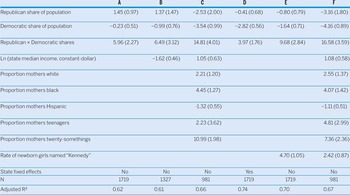
Number of Newborn girls per 100,000 Named “Reagan” or Variants, by State-Year. Standard Errors, Clustered by State, are in Parentheses. All Models Include Year Fixed Effects

Table 1 displays the model results. In all cases, the key interaction term has a positive coefficient at the usual standards of statistical significance: even accounting for other factors, having more stated Democratic partisans in a state increases the relationship between the presence of Republicans and having more daughters named “Reagan.” The corollary test using the rate of girls given the name “Kennedy” provides evidence in the same direction. More Kennedys born in a state associates with more Reagans, as one would expect if partisans showed their colors more aggressively in response to opposition signals.
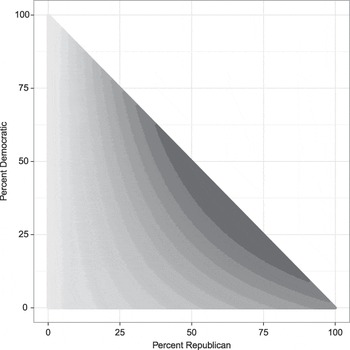
Of course, interaction terms can be difficult to interpret. To illustrate what the table’s key results look like in practice, figure 1 shows the first column of the table’s implied distribution of probability of naming a child “Reagan” for every feasible state partisanship distribution. The darkest areas on the figure occur not along the bottom edge, where there are many Republicans but no Democrats, but instead along the hypotenuse, where the entire population expresses a partisan identity. This pattern again implies that it is not simply being in a safely Republican area that triggers the choice of a partisan name, but being in a place where there are Democrats around to spur the partisan identity. The pattern of results also argues against another possible theory: people who are interested in politics—and hence more likely to have a partisan affiliation—are more likely to pick an arbitrary politics-related name without regard to its partisan content, signaling only general political interest. In that case, figure 1 would have grown equally dark as one moved in a Republican or Democratic direction.
Predicted Probability of Naming a Daughter “Reagan,” by State Partisan Distribution, According to Table 1’s Column A Model Darker shades indicate higher likelihood.

Several control variables also have substantial effects on states’ rate of birthing Reagans. States with more new mothers recorded as white or black saw more people naming their daughters “Reagan,” while a higher proportion of Hispanic mothers had the opposite effect. A larger proportion of younger mothers tend to associate with more children named “Reagan,” although the effect is stronger for mothers who are in their 20s rather than still in their teens. As always with aggregate data, these findings do not necessarily reflect naming behaviors of individual members of the groups involved. It is possible, for example, that having more blacks around may induce feelings of racial threat, and therefore partisan responses, among the white population.
CONCLUSION
Scholars have long clamored for more analysis of the politics of everyday life, often unstudied but nevertheless the bulk of most people’s experience of politics (Ginsborg Reference Ginsborg2005; Schwartz Reference Schwartz1974). This analysis approaches that problem by way of baby-name choices. Besides reflecting random fashions, these choices can also show the local political environment and people’s political identities. In particular, partisan-associated names are likely to be most popular in areas having larger concentrations of the relevant partisanship—as well as larger concentrations of opposing partisan factions.
This result has several implications. It points to a behavioral manifestation of identity that has seen little attention in political science despite the acknowledged centrality of identity to a wide range of topics of scholarly interest. Substantively, it suggests a self-sustaining dynamic to partisan polarization, where one person’s expression of (and hence reinforcement of) political identity can trigger opponents’ own identity signals. Finally, it points to several paths for future research. One obvious extension is to use individual-level data, rather than the aggregate information considered here, to look at determinants of politically charged name choices. The dimensions of political identity examined also offer scope for expansion; names can show deeply groups have assimilated into the broader population or, conversely, how willing individuals are to accept foreign influences (and hence, perhaps, international exchange or immigration). Identity signals potentially offer valuable clues about political motivations across many political questions.
R. Urbatsch is an associate professor in the department of political science at Iowa State University. He can be reached at rurbat@iastate.edu.