In the Timaeus Plato says that, among the infinite number of right-angled scalene elementary triangles, the best (τὸ κάλλιστον) is that
ἐξ οὗ τὸ ἰσόπλευρον ἐκ τρίτου συνέστηκε.Footnote 1
Apart from few exceptions to be mentioned shortly, the translations of the Timaeus, which I am aware of spanning the period from the second half of the nineteenth century up to recent times, have usually rendered this passage as meaning that such an elementary triangle is that which, when two are combined, the equilateral triangleFootnote 2 forms as a third figure.Footnote 3 For instance, Bury and Zeyl respectively translate:
out of which, when two are conjoined, the equilateral triangle is constructed as a third.Footnote 4
and
from [a pair of] which the equilateral triangle is constructed as a third figure.Footnote 5
I shall refer to this sort of translation as the Prevailing Translation (hereafter PT).
At variance with the PT, Fraccaroli, Giarratano and Reale equally translate that the equilateral triangle arises not from just two elementary triangles—as the PT runs—but from an unspecified number of them.Footnote 6 The latter sort of translation has remained apparently unnoticed, and the aforementioned three scholars did not even remark its difference from the PT, nor did they discuss how such a difference relates to the construction of the equilateral triangle that Plato gives elsewhere, and in which he says that the equilateral triangle forms from six elementary triangles.Footnote 7 Here I argue that the PT is untenable on two counts:
1) firstly, the verb συνίστημι means ‘set together’, ‘unite’ (and the like) some objects, the number of which is not specified,Footnote 8 that is, the meaning involved in the translations by Fraccaroli, Giarratano and Reale.Footnote 9 By way of contrast, the PT associates συνέστηκε with two scalene triangles, though the term two does not occur in our passage. To my knowledge, neither Plato nor EuclidFootnote 10 (the latter of whom systematized the mathematics of current usage inside the Academy)Footnote 11 associated the number two with συνίστημι.Footnote 12 What is even more important, a little before our passage Plato uses the verb συνίστημι merely in the same form as used in our passage, and says that ‘the rectilineal plane is composed of (συνέστηκε) triangles’.Footnote 13 Note that here Plato makes no reference to two triangles alone, nor do scholars imply such a reference in their translations (PT or otherwise). One is, then, forced to conclude that there is no reason for believing that Plato associates συνέστηκε with two scalene triangles in our passage either;
2) secondly, it would be strange if in our passage Plato meant that the equilateral triangle results from the combination of two scalene triangles—as the PT goes—whereas he himself elsewhere says that it forms from six (ἐξ ἓξ) such triangles.Footnote 14
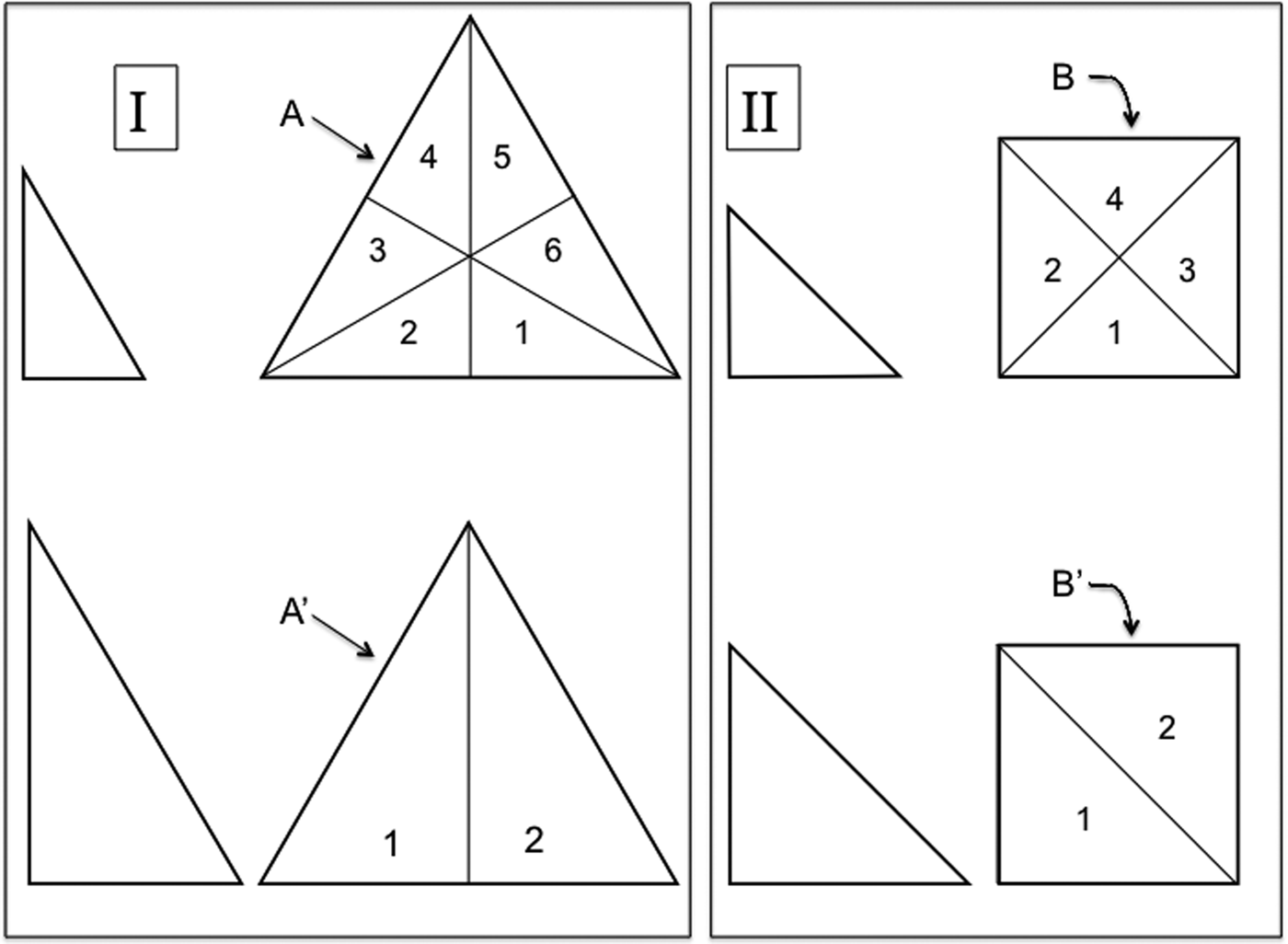
I am not implying that the PT is geometrically incorrect. Indeed, an equilateral triangle of a given area, say S, arises either from the combination of two elementary scalene triangles, the area of each being
 $\displaystyle{S \over 2}$
(as the PT implies), or from six such triangles, the area of each being
 $\displaystyle{S \over 6}$
(as Plato says in his ‘authorized’ construction);Footnote
15
see Fig. 1, panel I. An equilateral triangle of area S can be constructed even as the combination of smaller equilateral triangles, for example four or nine such triangles with areas of
 $\displaystyle{S \over 4}$
and
 $\displaystyle{S \over 9}$
respectively.Footnote
16
These constructions, however, do not comply with Plato's prescription that the ‘smaller’ elementary triangles must always be right-angled.Footnote
17
The two triangles involved in the PT of our passage comply both with the equal-area requisite of two of them and of the triangle which they form
 $(2 \times \displaystyle{S \over 2} = S)$
, and with the shape requisite, since the two triangles are right-angled. Now, these two requisites are necessary but not yet sufficient to comply fully with Plato's intentions. Indeed, he is interested not just in the geometrical properties of elementary triangles but also in the number of them, which make them the principle of fire and the other bodies (ταύτην δὴ πυρὸς ἀρχὴν καὶ τῶν ἄλλων σωμάτων) of the universe,Footnote
18
since the demiurge endeavoured to make the latter as beautiful and as good as possible, by shaping and arranging it by means of figures and numbers.Footnote
19
According to Plato, it is only by using the specific number of elementary triangles, that is, six (and not the two triangles involved in the PT of our passage), that the demiurge accomplishes his task.Footnote
20
I also note that for Plato the propositions of mathematical reasoning are fully intelligible only with the aid of the philosophical principle νοητὰ μετὰ ἀρχῆς.Footnote
21
Indeed, for him geometers are unable to give an account of the hypotheses on the basis of which they conduct their work,Footnote
22
whereas the dialecticians use hypotheses of which they are fully aware, and conduct their investigation by reasoning only through Forms, and they complete it with Forms.Footnote
23
As a consequence, with our passage Plato is not contemplating the possibilities of how an equilateral triangle can be formed using different numbers of a given elementary triangle. He is only informing us that the right-angled scalene triangle is the element of the equilateral triangle, and he will give specific details about such an elementary triangle elsewhere.Footnote
24
In other words, in our passage Plato does not commit himself to a specific number of elementary triangles, particularly not to the number two, as the PT does.Footnote
25
Right-angled elementary triangles and the faces produced by them which, according to Plato, bound the bodies of the four genera of the universe (fire, air, water and earth):
Panel I, the scalene elementary triangle and the equilateral triangle, obtained using six of them (A) and two of them (A’).
Panel II, the isosceles elementary triangle and the square, obtained using four of them (B) and two of them (B’).

One could object that the phrase ἐκ τρίτου (as a third figure), which Plato attaches to the equilateral triangle in our passage, means that the other two figures are just the two scalene elementary triangles implied in the PT.Footnote 26 My response would be that the equilateral triangle is a third figure in the series of the types of triangles contemplated in Euclid's Elements.Footnote 27 Indeed, our passage, in which the equilateral triangle is introduced for the first time, occurs later than the passage in which Plato introduces the isosceles triangle and the scalene triangle.Footnote 28 What is also important, while the number ‘two’ does not appear in our passage (though the PT implies that it does), Plato had already referred just the same number to the pair formed by the isosceles triangle and the scalene triangle:
τὰ δὲ τρίγωνα πάντα ἐκ “δυοῖν” ἄρχεται τριγώνοινFootnote 29
and
τοῖν δὴ “δυοῖν” τριγώνοιν τὸ μὲν ἰσοσκελὲς […], τὸ δὲ πρόμηκεςFootnote 30
I argue that the PT has in some ways hindered our understanding of Plato's construction of the equilateral triangle, because it conveys the confusing notion that he conceived two different ways to accomplish that task: the first, according to the PT, involves two ‘large’ elementary triangles, and the second, which Plato himself follows, involves six ‘small’ elementary triangles; see Fig. 1.
Taylor, one of the scholars who adopted the PT, remarks that the scalene elementary triangle is half as great as an equilateral triangle. He calls it the ‘half-equilateral’ triangle, and claims that it is the best among the right-angled scalene triangles because the ratios between its various angles are the simplest of all ratios—that is, 1:2:3, except those relevant to the isosceles elementary triangle, that is, 1:1:2.Footnote 31 While (again) his definition of the elementary scalene triangle is correct, I propose that it relates to the PT, according to which the equilateral triangle is twice as great as that elementary triangle. However, Taylor's statement that this elementary triangle has the primacy among all right-angled scalene triangles relies on an argument—that is, it possesses the aforementioned angle ratios 1:2:3—which is mere speculation, because there is nothing in the Timaeus or in Plato's philosophy that supports it. Taylor goes on to relate our passage to a fragment of Speusippus that deals with Pythagorean mathematics,Footnote 32 and is concerned with various types of triangles which are classified in decreasing order of equality and unity, that is, as a function of their likeness to the One:
the first triangle is the equilateral triangle which has […] only one side and one angle […] second is the half-square (τὸ ἡμιτετράγωνον), for, as it has only one difference […] of sides and angles, it may be discerned in the number 2 […] Third is the […] half-triangle (τὸ ἡμιτρίγωνον) for it is unequal in every detail […] and the all in its case is three.Footnote 33
Taylor remarks that the terms ἡμιτρίγωνον and ἡμιτετράγωνον also occur in Proclus’ commentary on Euc. 1, and that Proclus intended to use them in view of his commentary on the Timaeus.Footnote 34 Note that the ἡμιτετράγωνον is the right-angled isosceles triangle, which is of a single nature,Footnote 35 and is the element of the square,Footnote 36 which in turn is the face of the cube—the shape of the genus earth, the fourth of the best bodies of the universe.Footnote 37 As is the case with the ἡμιτρίγωνον for the construction of the equilateral triangle, this introduces the additional option that the square, too, can be thought of as arising from two constructions, that is, not only from the four ‘small’ isosceles elementary triangles that we read about in Plato's construction of that faceFootnote 38 but also, with the sense of the PT, from two ‘large’ ἡμιτετράγωνον triangles; see Fig. 1.
Taylor's enthusiasm about the notion that by mere duplication the ἡμιτρίγωνον and the ἡμιτετράγωνον triangles produce the equilateral triangle (just as the PT indicates) and the square, that is, the faces bounding the best bodies of the universe, makes him think that these ἡμι-triangles offer an interpretative key to unveil the principles on which the cosmogony of the Timaeus relies, also in light of Speusippus’ aforementioned fragment and Proclus’ interest in them. Taylor apparently assumes that Speusippus’ One-related ranking of the ‘best’ triangles,Footnote 39 in which the two aforementioned ἡμι-triangles score the second and third place, bears witness to Plato's thought. I argue that, although Speusippus was a member of Plato's Academy, as well as his nephew and successor as director of it,Footnote 40 he is not necessarily a suitable spokesman of his uncle's doctrine of the ontological status of mathematical objects.Footnote 41 In fact, ‘Speusippus’ One is something prior to Being and Intellect which owes nothing to the Timaeus’.Footnote 42 Even Taylor's heavy emphasis on the allegedly Pythagorean character of cosmogony of the Timaeus Footnote 43 is at variance both with Plato's doctrine that the Forms, and not the mathematical objects, were the pattern at which the demiurge looked to arrange the coming into being of the Universe,Footnote 44 and with Plato's views of ‘dialectic’ (that is, philosophy)Footnote 45 and mathematics, and of the hierarchy that he establishes between the two.Footnote 46
In view of all this, I propose that, although it is true that an equilateral triangle results from the combination of two scalene elementary triangles, such a geometric proposition is not sufficient by itself to conclude that the equilateral triangles that bound the bodies of the three kinds of the universe form through the above combination, because what really matters to Plato are the philosophical principles underpinning his account of the generation of the universe.
Going now back to Taylor's interpretation, it should be borne in mind that neither in our passage nor anywhere else in the Timaeus or in any other of his writings does Plato use the terms ἡμιτρίγωνον and ἡμιτετράγωνον. His detailed constructions of the equilateral triangleFootnote 47 and the squareFootnote 48 show that he did use scalene and isosceles elementary triangles not because just two of them suffice to make up those faces—this is what the PT emphasizes for the former elementary triangle, and Taylor for both—but for some other reason. The main outcome of Taylor's and other scholars’ keen interest in these two ἡμι-triangles were apparently the pointless puzzlesFootnote 49 explaining why not to use just two scalene ἡμιτρίγωνον triangles to construct the equilateral triangle, and just two isosceles ἡμιτετράγωνον triangles to construct the square instead of using the six and the four triangles respectively that we read about in Plato's actual construction of the two faces; see Fig. 1. In other words, if Taylor's bold interest in the ἡμιτετράγωνον and ἡμιτρίγωνον triangles had a basis in Plato's alleged view that they possess the special geometrical properties that Taylor assigns to them, one wonders why Plato took the trouble to offer the (apparently) problematic alternative constructions of those two faces which we read about in the Timaeus;Footnote 50 see Fig. 1.
To conclude, a correct translation of our passage should run like this:
from which the equilateral triangle forms as the third (type of triangle).
Indeed, both the Greek and the context of the Timaeus indicate that in this passage Plato anticipates the identity of the elementary triangle of the equilateral triangle, and not that he is offering an alternative route to construct that face.

 2×αi = 90°
 αi = 45°. Conversely, the right-angled scalene triangle, which involves α1 ≠ α2, can be of as many types as are the combinations that fulfil the following conditions: α1+α2 = 90°, and 0°<αi<90°.