INTRODUCTION
Most research on factors that maintain cognition in aging comes from cohorts with relatively high educational attainment. For populations with low educational attainment, the literature has not widely examined factors that promote cognitive resilience in the face of age and dementia risk. In this study, our goal was to identify cognitive resilience factors among people with very few years of school.
Previous literature has established educational attainment, defined as years of formal education and credential, as a major protective factor for cognitive decline, risk of developing dementia, and clinical expression of dementia in the face of neurodegeneration (Albert et al., Reference Albert, Jones, Savage, Berkman, Seeman, Blazer and Rowe1995; Amieva et al., Reference Amieva, Mokri, Le Goff, Meillon, Jacqmin-Gadda, Foubert-Samier, Orgogozo, Stern and Dartigues2014; Meng & D’Arcy, Reference Meng and D’Arcy2012; Prince et al., Reference Prince, Bryce, Albanese, Wimo, Ribeiro and Ferri2013; Stern, Reference Stern2009). However, its impact on episodic memory is not always clear. While education influences baseline episodic memory performance, its effect on memory trajectories is inconsistent (Zahodne et al., Reference Zahodne, Glymour, Sparks, Bontempo, Dixon, MacDonald and Manly2011).
Beyond education, studies show other demographic factors such as sex/gender, race/ethnicity, and occupation, as well as biological factors such as cardiovascular health and genetic risk factors impact memory performance and, potentially, decline among older adults. A recent study shows that older women have lower rates of episodic memory decline compared with older men, in a highly educated sample (Lundervold, Wollschläger, & Wehling, Reference Lundervold, Wollschläger and Wehling2014). Whites tend to obtain higher baseline episodic memory scores compared to African Americans and Hispanics even after controlling for age, gender, and self-reported years of education (Early et al., Reference Early, Widaman, Harvey, Beckett, Park, Farias and Mungas2013; Wilson, Capuano, Sytsma, Bennett, & Barnes, Reference Wilson, Capuano, Sytsma, Bennett and Barnes2015). Using longitudinal data, some studies report no racial differences in rate of episodic memory decline (Wilson et al., Reference Wilson, Capuano, Sytsma, Bennett and Barnes2015) while others suggest faster rates of cognitive decline among the African Americans when compared with Whites in the face of educational disparities across race in the United States of America (USA) (Early et al., Reference Early, Widaman, Harvey, Beckett, Park, Farias and Mungas2013; Sachs-Ericsson & Blazer, Reference Sachs-Ericsson and Blazer2005). Some investigators suggest that socioeconomic factors, such as family income and poverty status, account for racial differences in memory decline (Sachs-Ericsson & Blazer, Reference Sachs-Ericsson and Blazer2005; Sisco et al., Reference Sisco, Gross, Shih, Sachs, Glymour, Bangen, Benitez, Skinner, Schneider and Manly2013). Having a cognitively demanding occupation is related to better cognitive performance in highly educated subjects (Foubert-Samier et al., Reference Foubert-Samier, Catheline, Amieva, Dilharreguy, Helmer, Allard and Dartigues2012) even in the face of neurodegeneration (Stern, Reference Stern2012). Lower family income and financial inadequacy are associated with increased dementia risk and may act mechanistically through reduced access to educational, financial, and health resources, amplifying physiological stress that can lead to multisystem biological dysregulation (Yaffe et al., Reference Yaffe, Falvey, Harris, Newman, Satterfield, Koster and Health2013).
In terms of biological factors, hypertension is associated with cognitive impairment in older adults, even in the absence of dementia or stroke history (Knopman et al., Reference Knopman, Boland, Mosley, Howard, Liao and Szklo2001). Hypertension confers higher risk for developing Alzheimer’s disease (Bermejo-Pareja et al., Reference Bermejo-Pareja, Benito-Leon, Louis, Trincado, Carro, Villarejo and de la Camara2010), potentially by affecting the brain’s vascular integrity. Furthermore, hypertension is more strongly correlated with poor episodic memory performance compared to the other cognitive domains such as attention and language, even when controlling for education (Gifford et al., Reference Gifford, Badaracco, Liu, Tripodis, Gentile, Lu and Jefferson2013). APOE-ε4 is the best-known and most robust genetic risk factor for Alzheimer’s disease, but it has been a weak predictor for African Americans and Hispanics, and its association with older adults’ cognitive performance in cross-sectional data has been inconsistent (Foster et al., Reference Foster, Albrecht, Savage, Lautenschlager, Ellis and Maruff2013). There is longitudinal evidence that relates the presence of the ε4 allele to a faster episodic memory decline, even in nondemented older adults (Albrecht et al., Reference Albrecht, Szoeke, Maruff, Savage, Lautenschlager and Ellis2015). The available literature on risk and protective factors in older adults with low education is limited as most of these studies were based on highly educated samples and little is known about how these factors function in older adults with lower education.
As the brain ages, it is possible that non-memory cognitive abilities help to compensate for memory decline, particularly among people with few years of school who lack other potential sources of resilience such as high-level occupational status or income. In recent studies, executive function and verbal knowledge were the domains most related to memory functioning (Bouazzaoui et al., Reference Bouazzaoui, Fay, Taconnat, Angel, Vanneste and Isingrini2013; Hertzog, Dixon, Hultsch, & MacDonald, Reference Hertzog, Dixon, Hultsch and MacDonald2003; Rast, Reference Rast2011). Better cognitive performance on verbal knowledge may be related to superior learning of verbal information, while better executive function may facilitate efficient retrieval of the stored material (Bouazzaoui et al., Reference Bouazzaoui, Fay, Taconnat, Angel, Vanneste and Isingrini2013; Hertzog et al., Reference Hertzog, Dixon, Hultsch and MacDonald2003; Rast, Reference Rast2011). There is a lack of literature examining cognitive resilience and its possible mechanisms such as non-memory cognitive compensation in older adults with low levels of education (<5 years of schooling). Research among individuals with low literacy shows that they are more likely to recruit parietal areas during cognitive tasks than those with high literacy (Julayanont & Ruthirago, Reference Julayanont and Ruthirago2016; Petersson, Silva, Castro-Caldas, Ingvar, & Reis, Reference Petersson, Silva, Castro-Caldas, Ingvar and Reis2007; Petersson, Reis, & Ingvar, Reference Petersson, Reis and Ingvar2001). In response to cognitive aging, individuals with low levels of education may recruit and rely on cognitive domains in different ways than individuals with more formal schooling (Manly et al. Reference Manly, Jacobs, Sano, Bell, Merchant, Small and Stern1999).
The majority of research on protective factors in memory decline comes from samples with at least 12 or more years of education, and most cohorts have an average of 15 years of school or higher. The main aim of this study is to examine whether risk and resilience factors for memory decline differ across educational groups when participants with less than a high school education are included. We hypothesized that older adults with low education would be more likely to recruit language and executive skills as compensatory resources than better educated participants. Therefore, we expected that despite having lower baseline language and executive function scores, these skills would be stronger predictors of memory trajectory in lower educated older adults than among higher educated adults.
METHOD
Participants
We included data from 2573 ethnically diverse and initially nondemented participants from the prospective, community-based Washington/Hamilton Heights Inwood Columbia Aging Project (WHICAP) in Northern Manhattan, New York City. At each visit, participants underwent a medical interview and comprehensive neuropsychological evaluation, performed in English or Spanish. After each WHICAP visit, a consensus group of neuropsychologists and neurologists utilize DSM-III criteria to determine dementia diagnosis. WHICAP recruitment initially occurred in two waves (1992 and 1999), and follow-up visits occur every 18–24 months. We included participants who had at least two and up to five assessments. The Institutional Review Board at Columbia University Medical Center approved the recruitment, informed consent, and study procedures.
Independent Variables
Age at time of assessment was determined via self-reported date of birth. Gender and race/ethnicity were self-reported using the 2000 US census format. Income was categorized dichotomously at the median by annual family income (<$9000 and ≥$9000). Occupation was classified dichotomously as manual labor/housework or having a skilled career, including skilled trade/craft, clerical/office worker, manager business/government, or professional/technical.
Hypertension was coded as present if the participant self-reported the condition during a medical interview or if they reported taking any medication prescribed to lower high blood pressure. Presence of at least one APOE-ε4 allele was determined by standard genotyping (Mayeux et al., Reference Mayeux, Ottman, Maestre, Ngai, Tang and Ginsberg1995).
We assessed baseline cognitive functioning with a comprehensive neuropsychological battery, with comparable English and Spanish measures, described previously (Siedlecki et al., Reference Siedlecki, Manly, Brickman, Schupf, Tang and Stern2010; Stern et al., Reference Stern, Andrews, Pittman, Sano, Tatemichi, Lantigua and Mayeux1992). The WHICAP neuropsychological measures have demonstrated measurement invariance across English and Spanish speakers, as well as across racial/ethnic, sex/gender, and racial/ethnic by sex/gender subgroups (Ávila et al., in preparation; Siedlecki et al., Reference Siedlecki, Manly, Brickman, Schupf, Tang and Stern2010). Measurement invariance analyses were conducted to ensure construct comparability across educational groups in the current study. Results from invariance analyses suggested that full scalar invariance held across the groups.
We calculated composite scores by grouping the neuropsychological tasks by domain, as represented in the factor analysis of the battery performed by Siedlecki et al. (Reference Siedlecki, Manly, Brickman, Schupf, Tang and Stern2010). Individual test scores were first standardized to a z-score metric based on sample means and standard deviations at baseline. Z-scores for each test within each cognitive domain resulted in four composite measures: episodic memory, language, executive, and visuospatial functioning. Episodic memory composites were derived at baseline and each follow-up assessment.
Total recall, delayed recall, and delayed recognition trials from the Selective Reminding Test (Buschke & Fuld, Reference Buschke and Fuld1974) comprised the episodic memory composite score. Tests of naming, repetition, and comprehension measured language ability. Correctly spontaneously recognized objects from a modified 15-item Boston Naming Test (Kaplan, Goodglass, & Weintraub, Reference Kaplan, Goodglass and Weintraub1983) assessed naming ability. Subtests of the Boston Diagnostic Aphasia Examination (Goodglass, Reference Goodglass1983) evaluated repetition and comprehension. Tasks of abstract reasoning, categorization, and letter fluency assessed executive function. A similarities subtest of the Wechsler Adult Intelligence Scale – Revised (Wechsler, Reference Wechsler1981), and the total score on the Identities and Oddities subtest of the Mattis Dementia Rating Scale (Mattis, Reference Mattis1976) evaluated abstract reasoning and categorization. Letter fluency consisted of the total of named words beginning with three specific letters (C, F, L for English-speakers or P, S, V for Spanish-speakers). Finally, the total number of correct items from a task of matching and recognition of figures from the Benton Visual Retention Test (Benton, Reference Benton1955) and the copying of five visual designs from the Rosen Drawing Test (Rosen, Reference Rosen1981) determined visuospatial ability.
Statistical Analysis
We used episodic memory composite scores for baseline and each follow-up visit to determine memory trajectories. Sample sizes for the five episodic memory assessments were 2573, 2556, 1988, 1405, and 898. We conducted a multiple-group latent growth model (LGM) to identify the baseline predictors of initial memory performance (intercept) and rate of memory decline (slope) across the groups.
The model (Figure 1) was specified considering the influence of demographic (age, gender, race/ethnicity), socioeconomic (occupation and income), biomedical (hypertension status and APOE-ε4 status), and baseline cognitive (language, executive function, and visuospatial) variables on the intercept and the slope of memory trajectory. Additionally, we included age squared in the model to account for the nonlinear effect of age with the independent variables. Assumptions of the model, including linear versus quadratic slope, variability of intercept and slope within the education subgroups and constancy of residuals, and use of between-person predictors to explain the variance in memory intercept and slope, were tested and are reported in the supplementary material.
Model specification for multiple-group comparisons.

We divided participants into three educational attainment groups, based on self-reported years of schooling (Appendix A describes how educational level was coded in WHICAP): low (≤5 years), medium (6–11 years), and high (≥12 years). We based these cut points on the sample distribution and the arrangement of grades as primary, secondary, and completed high school or more, and these cut points are also consistent with education quartiles of this sample. We conducted descriptive statistics and group comparisons in SPSS version 23. We compared educational groups with ANOVA for continuous variables with Bonferroni post hoc tests, and categorical variables were compared using chi-square tests.
We performed multiple-group LGM analyses in MPlus Version 7.31 [Muthén & Muthén, Reference Muthén and Muthén1998–2012, Los Angeles, CA] to examine trajectories across education groups. We used the full information maximum likelihood missing data method, using all available data to estimate the model. The constrained model was built with all regression parameters to the intercept and slope fixed between educational groups. We tested improvement of the model fit by freeing a single regression path for a potential memory predictor per model, while all the others remained fixed. This approach allowed us to test the equal-fit hypothesis for each of the 10 predictors of memory trajectory. We compared the Akaike information criteria (AIC), the Bayesian information criteria (BIC), the sample-size adjusted BIC (aBIC), and the likelihood ratio test (LTR) of each model to the fully constrained model. Considering that the BIC penalizes models with added complexity (additional degrees of freedom), we prioritized decreases in AIC, aBIC, and LTR when comparing hierarchically nested models.
We additionally conducted an age-adjusted model examining the composite scores corrected for age by regressing baseline memory composite score on baseline age. The regression constant and slope were used to adjust baseline and follow-up composite scores for all time points. The age-adjusted model did not result in different results (data not shown). We also conducted a joint modeling combining LGM with discrete-time survival model to examine attrition due to death. The results from the joint discrete time survival and the growth model in the overall sample indicated that the risk of death was not related to memory performance. Separate joint models were estimated for each education group. The risk of death was only associated with a slope for the high education group [OR = 5.63 (1.13, 10.13)], suggesting that individuals in this group who demonstrated less cognitive decline over time were less likely to die during the study (data not shown).
RESULTS
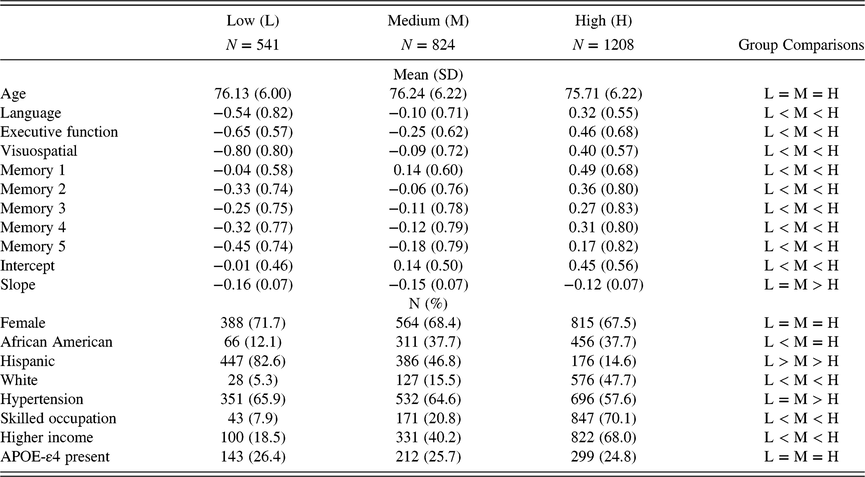
The descriptive characteristics of the sample are shown in Table 1. Educational groups did not differ by age, gender distribution, or frequency of APOE-ε4 carriers. The low education group had more Hispanics, fewer African Americans and Whites, fewer participants with skilled occupations and higher income, and had a lower cognitive performance at baseline in all three nonmemory domains and episodic memory when compared with the medium and high education groups. The medium education group also had more Hispanics, fewer participants with skilled occupations and higher income, and lower baseline cognitive scores when compared with the high education group. The high education group had fewer participants with hypertension when compared with the other two groups. The intercept and slope of memory also differed across groups, with one exception: the low and medium educated groups showed similar slopes (Table 1).
Descriptive and comparison of the three educational attainment groups

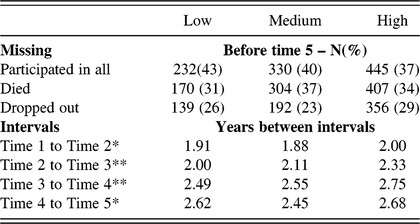
Table 2 displays the dropout and death rates, as well as assessment time interval differences between groups. The high education group had a longer time lapse between visits compared to the low and medium groups for intervals between time 2 and 3 and time 3 and 4.
Dropout and death rates, and interval differences between groups

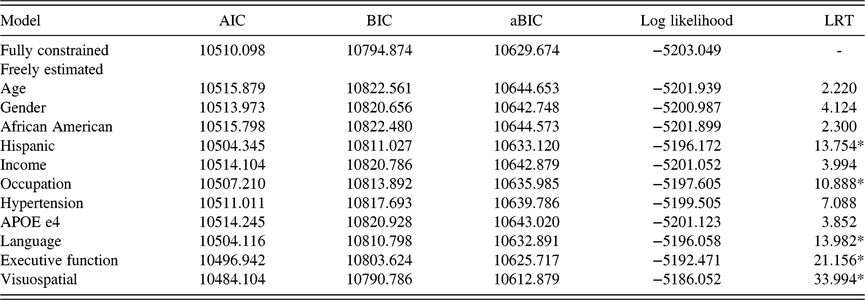
In the full-constrained model (Table 3), the low education group demonstrated a steeper decline in memory compared to the high education group. The groups were similar in baseline memory performance in this model.
Multiple-group latent growth models for three group comparisons

* p < 0.05.
Multiple-Group Comparisons
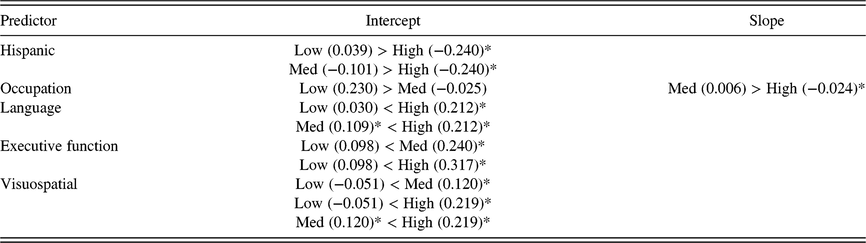
The multiple-group models revealed that, when freely estimated separately, executive function, language, visuoconstruction, occupation, and being Hispanic improved model fit compared to the fully constrained model (Table 3). Table 4 shows fit statistic values for each group for each of the freely estimated parameters.
Constrained model estimates

Med: Medium; *Significantly related.
Higher scores on executive function and visuospatial ability at baseline were stronger predictors of baseline memory performance for the medium education group than for the low education group. No differences were found for predictors of episodic memory decline across the low and medium education groups.
Comparing low and high education groups revealed that being non-Hispanic and having higher non-memory performance at baseline (executive function, language, and visuospatial abilities) were important predictors for the high education group (Table 4). No free estimated predictor distinctly influenced episodic memory decline between these two groups.
Comparing the medium and high education groups revealed that being non-Hispanic was a predictor of memory intercept only for the high educated participants. Better language and visuospatial cognitive performances at baseline were predictors of memory intercept in both medium and high education groups. Having a skilled occupation was associated with less decline in memory only in the highly educated group.
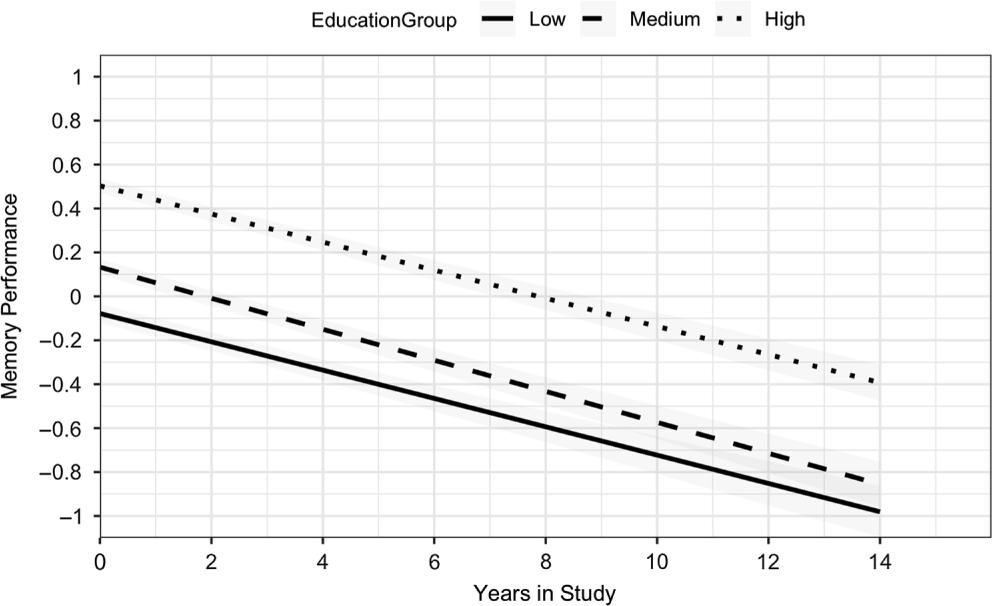
The differences in predicted trajectories for the groups are illustrated in Figure 2.
Differences in episodic memory predicted trajectories for the groups. Y-axis accounts for the episodic memory composite score, X-axis accounts for the years in the study. Low education group in solid line, medium education group in dashed line, and high education group in dotted line.

DISCUSSION
In this study, we aimed to determine if risk and resilience factors for episodic memory trajectory differed across educational strata. In this diverse cohort of older adult residents of the Washington Heights neighborhood of New York City, for many participants, early childhood rural residence, nonexistent or unenforced compulsory school laws, and governmental neglect of schools led to a lack of opportunity to attend school during childhood. This educational diversity allowed us to create three educational strata: less than 5 years, 6–11 years, and 12+ years of school. We found that memory trajectories within the three educational groups differentially related to potential demographic, socioeconomic, biomedical, and cognitive factors of risk and resilience. Overall, we found a higher number of factors that influenced memory trajectory in the medium and high education groups than in the low education group.
Contrary to our expectations that language and executive function would be better predictors of memory trajectory in the low educated group, visuospatial ability at baseline was a consistent predictor of initial memory performance only for the medium and high education groups. Our hypothesis was based on research showing that illiterates recruit more parietal areas compared to literates during cognitive tasks (Julayanont & Ruthirago, Reference Julayanont and Ruthirago2016; Petersson et al., Reference Petersson, Silva, Castro-Caldas, Ingvar and Reis2007). Also, prior research has shown that retrieval of episodic information and forced-choice recognition are related to parietal cortex function (Buckner & Wheeler, Reference Buckner and Wheeler2001; Wagner, Shannon, Kahn, & Buckner, Reference Wagner, Shannon, Kahn and Buckner2005). However, our results suggest that the executive and visuospatial skills do not provide a unique resource for maintaining memory function for older adults with low education.
Executive function and language performance at baseline predicted the initial memory performance for the high-education group, but not the low-education group. The memory task used is a verbal list learning measure, and thus, the association between language skills such as semantic retrieval and generative fluency and initial memory performance (but not decline) is unsurprising. The availability of a superior verbal knowledge system is related to an increased capacity for learning words by relying on an existing network and using categorization strategies (Bouazzaoui et al., Reference Bouazzaoui, Fay, Taconnat, Angel, Vanneste and Isingrini2013; Rast, Reference Rast2011). Executive function may also predict memory performance by increasing the efficiency of the recall process and by monitoring the already recalled information (Hertzog et al., Reference Hertzog, Dixon, Hultsch and MacDonald2003; Rast, Reference Rast2011). Tasks that tap frontal lobe function are also related to efficient memory recall and encoding, and lesions in these brain areas are capable of resulting in clinical memory deficit (Buckner & Wheeler, Reference Buckner and Wheeler2001). The frontoparietal control network was associated with successful memory performance (Franzmeier et al., Reference Franzmeier, Hartmann, Taylor, Araque-Caballero, Simon-Vermot, Kambeitz-Ilankovic and Ewers2018) in a sample with high education. Our results suggest that integrated connectivity may be present in participants with high level of education, but not in those with low education.
Perhaps integrated cognitive systems are tied to literacy acquisition, which is related to visual processing improvement, ventral occipito-temporal pathway reorganization, and better fractional anisotropy of the left arcuate fasciculus, leading to a reinforcement of the left temporo-parietal connections (Julayanont & Ruthirago, Reference Julayanont and Ruthirago2016; Petersson et al., Reference Petersson, Silva, Castro-Caldas, Ingvar and Reis2007; Thiebaut de Schotten, Cohen, Amemiya, Braga, & Dehaene, Reference Thiebaut de Schotten, Cohen, Amemiya, Braga and Dehaene2014).
Independent of performance in nonmemory cognitive domains, not being Hispanic was also a strong predictor of better initial memory performance for the high education group when compared to the low education group. 15% of the participants from the high education group identified as Hispanic, and from these, 90% were educated in their birth countries before immigrating to the USA. Distinct educational quality may impact initial memory performance in Hispanics compared with Whites and African Americans highly educated in the USA. Socioeconomic and legal systems related to education may account for a discrepancy in educational quality between Hispanics and other ethnic groups. Educational quality can impact cognitive performance more than the self-reported years of school attendance (Manly, Jacobs, Touradji, Small, & Stern, Reference Manly, Jacobs, Touradji, Small and Stern2002; Sisco et al., Reference Sisco, Gross, Shih, Sachs, Glymour, Bangen, Benitez, Skinner, Schneider and Manly2013). It is possible that the quality of education has an impact on the brain network organization, leading to a distinct cognitive compensatory mechanism for those with higher educational quality.
Our study also had several limitations. One limitation of our study is the absence of an education quality measure. This is a methodological challenge considering the diversity of educational experiences present in the current sample, many of whom were educated in strikingly dissimilar contexts across the USA, or for 90% of our cohort of Hispanics who received their primary education outside the USA. Due to this broad linguistic, geographic, and cultural variety, the development and validation of a single or psychometrically equivalent measure of education quality across our cohort remains a difficult task. Another limitation was our assessment of hypertension. We defined hypertension through self-report or use of medication prescribed to lower high blood pressure. This may result in some uncertainty about the current level of hypertension. Furthermore, our study did not include neuroimaging variables as baseline predictors given that neuroimaging data were not available for the majority of participants in this sample. Future studies should do so given structural brain imaging research showing potential cognitive trajectory predictors (e.g., greater baseline gray and white matter volume) (Carmichael et al., Reference Carmichael, Mungas, Beckett, Harvey, Tomaszewski Farias, Reed and Decarli2012).
Several biomedical, socioeconomic and demographic factors predicted memory trajectory in the overall model (all education groups included), but when comparing education groups, only Hispanic ethnicity differed as a predictor of baseline memory score. Furthermore, the predictors that differed across groups influenced initial memory performance only, but not longitudinal change. Our results are in accordance with other studies that, despite identifying multiple demographic predictors of baseline cognitive performance, identified only a few predictors of cognitive trajectory (Early et al., Reference Early, Widaman, Harvey, Beckett, Park, Farias and Mungas2013; Farias, Mungas, Hinton, & Haan, Reference Farias, Mungas, Hinton and Haan2011). This finding may be partially explained by the fact that distinct rates of cognitive decline are not consistently found across educational groups (Zahodne et al., Reference Zahodne, Glymour, Sparks, Bontempo, Dixon, MacDonald and Manly2011).
In conclusion, this study tested a unified model of predictors of memory trajectory among older adults with a broad range of educational backgrounds. Given that most previous research assessing longitudinal memory and cognitive trajectories relies on highly educated participants, predictors of trajectory generated from those studies may not be applicable to people with low educational attainment. Considering that older adults with low educational level are at higher risk for developing dementia and the high prevalence of low education among older adults around the world, there is a critical need for researchers to determine if there are unique risk and resilience factors for cognitive decline in this group. The goal of this line of research within observation studies is to point to potential modifiable sources of protection or risk for cognitive decline that could be incorporated into interventions to maintain cognitive function with aging. Our results suggest that if causal relationships were established, interventions on social, medical, and biological factors would equally benefit memory performance (but not memory decline) across educational groups.
ACKNOWLEDGMENTS
This work was supported by the National Institutes of Health (NIA AG R01 AG037212 and RF1 AG054023).
CONFLICTS OF INTEREST
The authors have nothing to disclose.
SUPPLEMENTARY MATERIALS
To view supplementary material for this article, please visit https://doi.org/10.1017/S1355617719000717.
APPENDIX A: EDUCATIONAL LEVEL WHICAP CODING
The WHICAP coding for educational level combines self-reported years of formal academic education and credential and the final number range from 0 to 20. This coding system does not consider partial years.
If the participant did not receive a high school degree or equivalent degree (e.g., GED), their education level is coded from 0 to 11. This number represents the highest grade completed.
If the participant received a high school diploma as a terminal degree, 12 years is coded regardless of number of years required to complete it. If the participant received an equivalent degree (e.g., GED) as a terminal degree, the actual number of years of formal education is coded.
If the participant attended college and did not graduate, their education level is coded from 13 to 15, based on the number of years completed. If the participant received an Associate’s degree, 14 years is coded. If the participant received a Bachelor’s degree, 16 years is coded, regardless of the number of years required to do so. If the participant attended a trade or technical school, these years are counted toward years of education.
If the patient received a Master’s degree, 18 years is coded. If the participant received a JD degree or attended three or more years of education (e.g., PhD, MD, and DDS) for a doctoral degree, 19 years is coded. If the participant received a doctoral degree, 20 years is coded. If a participant has multiple graduate degrees including a doctorate (e.g., MS and MD), their education level remains coded as 20 years.