Implications
The role of n-3 fatty acids is relevant for many physiology activities; however, well-defined dietary recommendations for animals are not yet provided. Dietary n-3 could be supplied by precursors (e.g. vegetal source of α-linolenic acid (ALA)) and/or by long-chain polyunsaturated fatty acids (LCP) (fish oil rich in EPA, dosapentaenoic acid (DPA) and DHA). This paper clearly shows that the enrichment of diets with n-3 PUFA (both as precursor or LCP), improves the reproductive performance of rabbit does mainly during critical phase of production (primiparous). This better performance is obtained without hormonal treatment or intensification of reproductive rhythm, thus consistent with the general principles of animal welfare.
Introduction
The extent of linoleic acid (LA, C18:2n-6) and ALA (C18:3n-3) conversion into LCP (⩾20 carbons) greatly depends on expression and activity of desaturase and elongase enzymes, which are the same for both n-3 and n-6 fatty acid series (Barceló-Coblijn and Murphy, 2009; Gregory et al., Reference Gregory, Gibson, Cook-Johnson, Cleland and James2011). Elongase (2 and 5) lengthens the carbon chain, whereas delta 6- (Δ6d) and delta 5-desaturase (Δ5d) introduce double bonds and are encoded by FADS2 and FADS1 genes, respectively (Nakamura and Nara, Reference Nakamura and Nara2004). The Δ6d is considered to be the rate-limiting enzyme in the synthesis of arachidonic acid (AA; 20:4n-6), EPA (20:5n-3) and DHA (22:6 n-3) acids from their precursors (Cho et al., Reference Cho, Nakamura and Clarke1999). The ability to convert precursors into LCP also depends on animal species (Dal Bosco et al., Reference Dal Bosco, Castellini, Bianchi and Mugnai2004; Oliveira et al., Reference Oliveira, Baião, Cançado, Grimaldi, Souza, Lara and Lana2010) and, within the same species, it is affected by sex, hormonal status, intestinal biota, genetic strain and feed (De Meester et al., Reference De Meester, Watson and Zibadi2012).
Several studies have demonstrated that many animal species are rather poor EPA and DHA synthesisers (Muskiet et al., Reference Muskiet, Fokkema, Schaafsma, Boersma and Crawford2004), despite LCP being especially abundant in the brain, retina, reproductive tissues and gametes and having a relevant role in many physiological pathways and pathological disorders, such as cardiovascular disease, depression and reproductive dysfunction (Simopoulos, Reference Simopoulos1991). In particular, high levels of dietary n-3 LCP during critical periods, that is, fecundation and the first phase of pregnancy, has positive effects on fertilisation and early embryo development, probably by modulating the main hormonal pathways (Diskin and Morris, Reference Diskin and Morris2008). In rabbit does, Rebollar et al. (Reference Rebollar, García-García, Arias-Álvarez, Millán, Rey, Rodríguez, Formoso-Rafferty, De la Riva, Masdeu and Lorenzo2014) showed that dietary enrichment with n-3 LCP improves the endocrine function of the corpora lutea, increasing weight and size of kits and reducing mortality rate. The same dietary protocol increased plasma leptin and oestradiol in primiparous does (Rodríguez et al., Reference Rodríguez, García-García, Arias-Álvarez, Formoso-Rafferty, Millán, López-Tello, Lorenzo, González-Bulnes and Rebollar2017), implying better body condition and sexual receptivity.
Standard feeds are imbalanced in terms of the n-6/n-3 ratio, with a low proportion of the latter (De Meester et al., Reference De Meester, Watson and Zibadi2012). Polyunsaturated fatty acid are relevant constituent of the reproductive tissues, then the fatty acid profile appear to be strongly affected by ingredients rich in ALA (vegetables sources), EPA and DHA (fish oil), that can be included in animal diets to balance dietary PUFA (Maranesi et al., Reference Maranesi, Zerani, Leonardi, Pistilli, Arruda-Alencar, Stabile, Rende, Castellini, Petrucci, Parillo, Moura and Boiti2015). However, the ALA effect has been poorly investigated (Rosero et al., Reference Rosero, Boyd, McCulley, Odle and van Heugten2016), and no results are available on the rabbit reproductive system. Moreover, it is supposed that the LCP synthesis (including enzyme activity, messenger RNA (mRNA) expression) is tissue-specific (Broughton et al., Reference Broughton, Bayes and Culver2010) and much of their activity depends on the metabolic destination (e.g. liver, reproductive organs). Based on these findings, this study analysed the effect of n-3 fatty acids (provided by flaxseed or fish oil dietary supplementation) in rabbit does and, in particular, their distribution in milk, plasma, liver and ovaries, and the expression of Δ6 desaturase in liver and ovarian tissue.
Material and methods
Materials
Deoxyribonuclease I (DNAase I Amp. Grade), Superscript III Reverse Transcriptase (Superscript III First-Strand Synthesis System) and DNA ladders were purchased from Life Technologies Italia (Monza, Monza Brianza, Italy). Reagents for the isolation and purification of total RNA (TRIzol), Taq DNA polymerase (Platinum), RNAse-free tubes, deionised water, deoxyNTPs, primers for 18S RNA, corresponding competimers (QuantumRNA 18S Internal Standards) and FADS2 were also acquired from Life Technologies. NucleoSpin Gel and PCR cleanup were from Macherey-Nagel Inc. (Bethlehem, PA, USA). Chloroform, methanol and ethanol were purchased from Carlo Erba (Milan, Italy).
Polyunsaturated fatty acid-2 fatty acid methyl ester standards were purchased by Matreya (Pleasant Gap, PA, USA). Enicosenoic acid methyl esters (C21:0) was purchased by Sigma-Chemical Co. (St. Louis, MO, USA).
Animals and diets
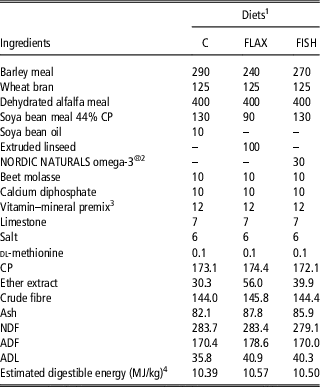
The experimental protocol for this trial was carried out according to the Spanish Policy for Animal Protection D53/2013 and assessed and approved by the Animal Ethics Committee of the Community of Madrid (Ref. PROEX 302/15). Sixty nulliparous New Zealand White does were followed for four consecutive reproductive cycles and the performance traits were recorded. Rabbits were housed in the experimental farm of the Polytechnic University of Madrid. Temperature in the building was in the range 18°C to 23°C, air circulation (15 air changes/h) and humidity (50±5%); these conditions were maintained throughout the trial. Each treatment group consisted of 20 rabbits with each group receiving a different diet (Table 1) as follows:
∙ control group was fed ad libitum with the control diet containing soya bean oil as the main source of fat;
∙ FLAX group was fed the control diet, substituting 10% of the soya bean oil with extruded flaxseed;
∙ FISH group was fed the control diet, substituting 3% of the soya bean oil with fish oil (NORDIC NATURALS omega-3®, Watsonville, CA, USA).
Formulation, chemical composition (g/kg) and nutritional value of rabbit diets

1 C = control diet containing soya bean oil as the main source of fat; FLAX = control diet substituting 10% of the soya bean oil with extruded flaxseed; FISH = control diet, substituting 3% of the soya bean oil with fish oil (NORDIC NATURALS omega-3®).
2 NORDIC NATURALS omega-3® = purified deep sea fish oil (from anchovies and sardines) containing EPA 330 mg/100 g, DHA 220 mg/100 g, other n-3 long-chain polyunsaturated fatty acids 140 mg/100 g+α-tocopherol for preservation.
3 Amount per kilogram: vitamin A 11.000 IU; vitamin D3 2.000 IU; vitamin B1 2.5 mg; vitamin B2 4 mg; vitamin B6 1.25 mg; vitamin B12 0.01 mg; vitamin E 200 mg; biotine 0.06 mg; vitamin K 2.5 mg; niacine 15 mg; folic acid 0.30 mg; d-pantotenic acid 10 mg; coline 600 mg; Mn 60 mg; Cu 3 mg; Fe 50 mg; Zn 15 mg; I 0.5 mg; Co 0.5 mg.
4 According to Maertens et al. (Reference Maertens, Moermans and De Groote1988).
The dietary formulation was established according to previous experiments (Dal Bosco et al., Reference Dal Bosco, Castellini, Bianchi and Mugnai2004; Rebollar et al., Reference Rebollar, Pérez-Cabal, Pereda, Lorenzo, Arias-Álvarez and García-Rebollar2009 and Reference Rebollar, García-García, Arias-Álvarez, Millán, Rey, Rodríguez, Formoso-Rafferty, De la Riva, Masdeu and Lorenzo2014) and in respect of rabbit requirements. To avoid PUFA peroxidation, all diets were supplemented with 200 mg/kg α-tocopheryl-acetate.
Sexual receptivity was recorded at artificial insemination (AI) by examining the vulva (Castellini and Lattaioli, Reference Castellini and Lattaioli1999); in particular, does with a red and turgescent vulva were considered to be sexually receptive. No oestrus synchronisation was performed and the reproductive rhythm was 42 days, with AI taking place at 11 days after kindling. Ovulation was induced by intravaginal inoculation with 10 µg of GnRH (Receptal®, Intervet International B.V., AN Boxmeer, Netherlands). Non-pregnant does were re-inseminated 21 days after the previous AI, according to the dual band management system. On the day of AI, all does were submitted to ultrasound scanning (ALOKA model SSD-500; Hitachi Europe, Milano, Italy) of the perirenal area (close to the 2nd to 3rd lumbar vertebrae) after shaving the area with a hair trimmer. Scapular fat thickness was measured on the left and right side. Perirenal fat (g) was estimated using a regression curve, as reported in a previous paper (Dal Bosco et al., Reference Dal Bosco, Castellini and Mugnai2003). The number of live-born pups and weaned rabbits were also registered, and no adoption was performed. Feed intake of pups (until weaning) and pre-weaning mortality and milk production (difference in weight of does before and after lactation) was evaluated daily; whereas the litter weight was recorded weekly. After 21 days of lactation, milk samples were manually collected from the mothers, using a moulded glass tube, after an injection of 2 IU of oxytocin (Schley, Reference Schley1975).
Blood samples were taken from the ear-vein and stored in tubes contained Na2-EDTA; plasma was obtained after centrifugation at 3000×g for 15 min. At the end of the experiment, 10 rabbit does (n = 10/group) were sacrificed in accordance with the guidelines and principles on the care and use of research animals; specifically, animals were euthanised with an overdose of barbiturate (30 mg/kg of pentothal; Dolethal, Lab, Vetoquinol, Madrid, Spain). The ovaries and the liver were then promptly removed and thoroughly washed with saline. Within a few minutes, tissue samples were cut into appropriately sized pieces (30 mg) and either rinsed with RNAse-free water and frozen at −80°C for subsequent evaluation of gene expression (Maranesi et al., Reference Maranesi, Zerani, Leonardi, Pistilli, Arruda-Alencar, Stabile, Rende, Castellini, Petrucci, Parillo, Moura and Boiti2015) or stored at −20°C for subsequent analysis of moisture, protein, total lipid, ash and fatty acid composition.
Chemical analysis and fatty acid profile
The chemical composition of the diets was determined in triplicate, according to the methods of the Association of Official Analytical Chemists (1995). Lipid extraction of feed, milk, plasma, liver and ovary tissues was performed according to Folch et al. (Reference Folch, Lees and Sloane-Stanley1957) and esterification was performed according to Christie (Reference Christie1982). The trans-metilation procedure was conducted using enicosenoic acid methyl esters (Sigma Chemical Co.) as the internal standard. The recovery rates of internal standard were 92±3%, 98±2%, 89±4%, 75±3% and 63±2% in feed, milk, plasma, liver and ovary tissues, respectively. The fatty acid composition was determined using a Varian gas-chromatograph (CP-3800) equipped with a flame ionisation detector and a capillary column of 100 m length × 0.25 mm × 0.2 μm film (Supelco, Bellefonte, PA, USA). Helium was used as the carrier gas with a flow of 2 ml/min. The split ratio was 1 : 80. The oven temperature was programmed at 40°C and held for 1 min, then increased up to 163°C at a rate of 2°C/min, held for 10 min, increased up to 180°C at a rate of 1.5°C/min, held for 7 min, increased up to 187°C at a rate of 2°C/min held for 2 min, and then increased up to 230°C at a rate of 3°C/min and held for 25 min. The injector and detector temperatures were set at 270°C and 300°C, respectively. Individual FAME were identified by comparing the relative retention times of peaks in the sample with those of standard mixture (FAME Mix Supelco; 4 : 0 to 24 : 0) plus cis-9, cis-12 C18:2; cis-9 cis-12 cis-15 C18:3; cis-9 cis-12 cis-15 C18:3 (all from Sigma-Aldrich). Fatty acids were expressed as % of total fatty acids. The average amount of each fatty acid was used to calculate the sum of the total saturated fatty acid (SFA), monounsaturated fatty acid (MUFA) and PUFA.
RNA extraction and expression analysis
Total RNA was extracted from ovary and liver samples from each rabbit (n = 5) as described by Maranesi et al. (Reference Maranesi, Zerani, Leonardi, Pistilli, Arruda-Alencar, Stabile, Rende, Castellini, Petrucci, Parillo, Moura and Boiti2015). Five micrograms of total RNA were reverse transcribed in 20 µl of Superscript III First-Strand Synthesis System using random hexamer according to the protocol provided by the manufacturer. Genomic DNA contamination was checked by developing the PCR without reverse transcriptase. The multiplex PCR amplification was performed as previously described (Maranesi et al., Reference Maranesi, Zerani, Leonardi, Pistilli, Arruda-Alencar, Stabile, Rende, Castellini, Petrucci, Parillo, Moura and Boiti2015) with the use of 1 µl of complementary DNA as a template for FADS2 primers (Supplementary Table S1).
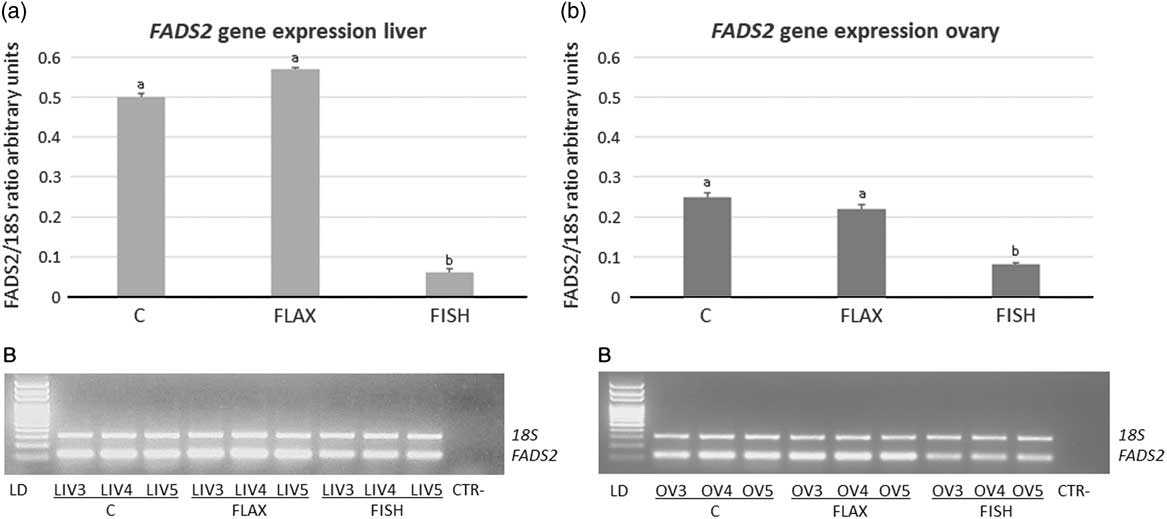
Cycling conditions consisted of an initial denaturising cycle at 94°C for 75 s, followed by 30 cycles for each target gene at 94°C for 15 s, 60°C for 30 s, 72°C for 45 s and a final extension step at 72°C for 10 min. Within each experiment, the complete set of samples was processed in parallel in two different PCR (2 samples/group in the first, 3 samples/group in the second), using aliquots of the same PCR master mix. The amplified PCR-generated products (18 of 25 µl total reaction volume) were analysed by electrophoresis on 2% agarose gel using ethidium bromide staining (Figure 1a and b).
Expression of FADS2 messenger RNAs (mRNAs) in liver (a) and ovary (b) collected from rabbits belonging to control (C), flaxseed (FLAX) and fish oil (FISH) groups. The lower panels (B) show a representative photograph of a 2% agarose ethidium bromide-stained gel used to analyse the PCR products (three of the five animals per group). The sizes of the amplified products are shown on the right of the gel. LD is the 100-bp DNA ladder and CTR− is the negative control. The other lanes identify the corresponding organs: LIV = liver, OV = ovary. The upper panels (a) shows the data derived from densitometric analyses of the gels. For each organ, the values (means±SD) combine the results from five different rabbits and are reported in arbitrary units of FADS2 mRNA relative to that of 18S used as internal standard. a,bDifferent letters above the bars indicate significantly different values (P < 0.01).

Analysis of amplification products was carried out as reported elsewhere (Maranesi et al., Reference Maranesi, Zerani, Leonardi, Pistilli, Arruda-Alencar, Stabile, Rende, Castellini, Petrucci, Parillo, Moura and Boiti2015). The amount of the FADS2 mRNA was expressed in arbitrary units as the ratio of each PCR product for target gene normalised against the 18S coamplified product.
The amplified products, collected from the agarose gel after electrophoresis, were purified with NucleoSpin Gel and PCR cleanup, and their identity confirmed by DNA sequencing with Sanger’s method.
Statistical analysis
Statistical analysis of reproductive data (sexual receptivity, live born, weaned rabbits, litter weight, milk production, feed intake, perirenal fat) was performed using a mixed model (SAS, 1990) with the fixed effect of parity, dietary group (Control, FLAX and FISH) and the interaction (parity × dietary group). According to preliminary analysis, the parity was grouped into two classes (primiparous: n = 1; and pluriparous: 2⩽n⩽4). The same effects (parity and diet) on fertility and mortality rate (categorical data) was analysed by means a χ 2 test (proc CATMOD). The chemical composition of milk, the fatty acids profile of feed, milk and tissues (plasma, liver and ovaries) and gene expression were analysed at the end of experiment with a one-way linear model (ANOVA) and the significance was assessed by Bonferroni’s t-test. Data are reported as Least Square mean and the level of statistical significance was set at P⩽0.05.
Results
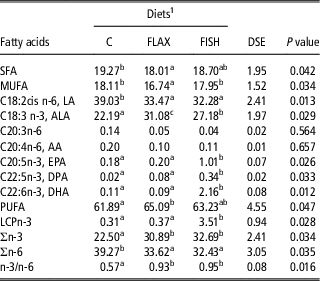
The fatty acid composition of diets (Table 2) showed lower SFA, MUFA and n-6 PUFA (C18:2 n-6) content in the n-3 enriched groups. Both n-3 enriched diets showed higher total n-3 fatty acid values compared to the control diet (30.89% and 32.69% v. 22.50% in FLAX and FISH v. Control groups, respectively); accordingly, the n-3/n-6 ratio was also higher.
Main fatty acids (% of total fatty acids) of experimental diets administered to the rabbits

DSE = difference of standard error; SFA = saturated fatty acids; MUFA = monounsaturated fatty acids; LA = linolenic acid; ALA = α-linolenic acid; AA = arachidonic acid; DPA = docosapentaenoic acid; PUFA = polyunsaturated fatty acids; LCP = long-chain polyunsaturated fatty acids (⩾20C).
Each value is the mean of three replicates.
1 C = control diet containing soya bean oil as the main source of fat; FLAX = control diet substituting 10% of the soya bean oil with extruded flaxseed; FISH = control diet, substituting 3% of the soya bean oil with fish oil (NORDIC NATURALS omega-3®).
a,b,cMeans in the same row with different letters differ significantly (P < 0.05).
Compared to the control diet, flaxseed supplementation mainly increased ALA (31.08% v. 22.19%) and the n-3/n-6 ratio (0.93 v. 0.57). As expected, the percentage of EPA and DHA and total n-3 LCP were higher in the FISH group.
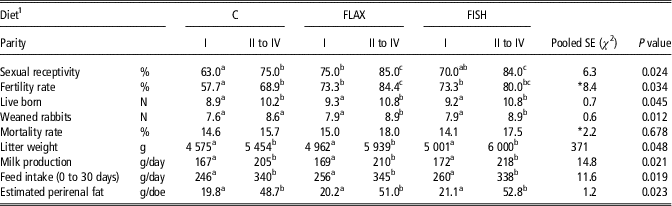
The reproductive performance of does is reported in Table 3. The whole group of nulliparous does had the same high fertility (95%; data not shown). Many of these traits were affected by the dietary treatments and parity order. In particular, the traits of economic relevance (fertility rate and number of weaned rabbits) improved with n-3 dietary supplementation. Feed consumption and milk production were not affected by the feeding regime.
Effect of different dietary supplementations on productive and reproductive performance of does and mortality of young rabbits (n = 20/group)

1 C = control diet containing soya bean oil as the main source of fat; FLAX = control diet substituting 10% of the soya bean oil with extruded flaxseed; FISH = control diet, substituting 3% of the soya bean oil with fish oil (NORDIC NATURALS omega-3®).
χ 2 value for non-parametric traits, where P < 0.05.
a,b,cValues within a row with different superscripts differ significantly at P < 0.05.
As expected, does at first parity showed the lowest reproductive results, but the administration of n-3 reduced the gap between primiparous and multiparous does. Primiparous does fed n-3-enriched diets showed the same perirenal fat depots, which increased in the following kindling.
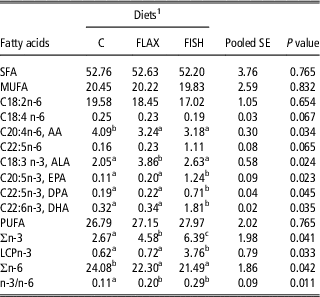
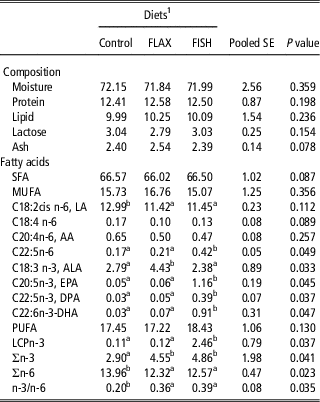
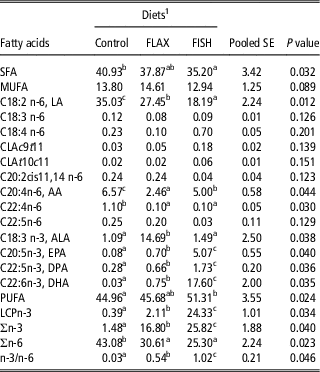
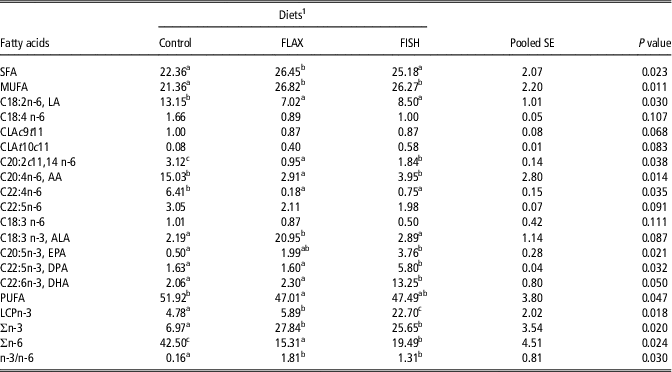
Blood (Table 4) and milk (Table 5) showed low levels of n-3 LCP, whereas liver (Table 6) and ovaries (Table 7) were the main sites of n-3 accumulation. The FISH group generally had the highest values of n-3 LCP, whereas the FLAX group showed lower values, suggesting that endogenous synthesis was low. Compared to the control group, blood plasma of the FLAX group showed higher values of ALA, total n-3 and the n-3/n-6 ratio, whereas AA and total n-6 were lower. The FISH group showed the highest amount of n-3 LCP (e.g. EPA, DHA and DPA) in blood plasma.
Effect of different dietary supplementations on fatty acid composition of blood plasma (% of total fatty acids) in rabbit does (n = 10/group)

SFA = saturated fatty acids; MUFA = monounsaturated fatty acids; LA = linolenic acid; ALA = α-linolenic acid; AA = arachidonic acid; DPA = docosapentaenoic acid; PUFA = polyunsaturated fatty acids; LCP = long-chain polyunsaturated fatty acids (⩾20 C).
1 C = control diet containing soya bean oil as the main source of fat; FLAX = control diet substituting 10% of the soya bean oil with extruded flaxseed; FISH = control diet, substituting 3% of the soya bean oil with fish oil (NORDIC NATURALS omega-3®).
a,bValues within a row with different superscripts differ significantly at P < 0.05.
Effect of different dietary supplementations on proximate composition (%) and fatty acid profile of milk (% of total fatty acids) in rabbit does (n = 10/group)

SFA = saturated fatty acids; MUFA = monounsaturated fatty acids; LA = linolenic acid; ALA = α-linolenic acid; AA = arachidonic acid; DPA = docosapentaenoic acid; PUFA = polyunsaturated fatty acids; LCP = long-chain polyunsaturated fatty acids (⩾20C).
1 FLAX = control diet substituting 10% of the soya bean oil with extruded flaxseed; FISH = control diet, substituting 3% of the soya bean oil with fish oil (NORDIC NATURALS omega-3®).
a,bValues within a row with different superscripts differ significantly at P < 0.05.
Effect of different dietary supplementations on fatty acid composition of liver (% of total fatty acids) in rabbit does (n = 10/group)

SFA = saturated fatty acids; MUFA = monounsaturated fatty acids; LA = linolenic acid; ALA = α-linolenic acid; AA = arachidonic acid; DPA = docosapentaenoic acid; PUFA = polyunsaturated fatty acids; LCP = long-chain polyunsaturated fatty acids (⩾20C).
1 FLAX = control diet substituting 10% of the soya bean oil with extruded flaxseed; FISH = control diet, substituting 3% of the soya bean oil with fish oil (NORDIC NATURALS omega-3®).
SE: standard error.
a,b,cValues within a row with different superscripts differ significantly at P < 0.05.
Effect of different dietary supplementations on fatty acid composition of ovaries (% of total fatty acids) in rabbit does (n = 5/group)

SFA = saturated fatty acids; MUFA = monounsaturated fatty acids; LA = linolenic acid; ALA = α-linolenic acid; AA = arachidonic acid; DPA = docosapentaenoic acid; PUFA = polyunsaturated fatty acids; LCP = long-chain polyunsaturated fatty acids (⩾20C).
1 FLAX = control diet substituting 10% of the soya bean oil with extruded flaxseed; FISH = control diet, substituting 3% of the soya bean oil with fish oil (NORDIC NATURALS omega-3®).
a,b,cValues within a row with different superscripts differ significantly at P < 0.05.
The fatty acid profile of the liver showed significant changes, mainly in PUFA and SFA profiles, with a trend similar to that already observed in blood plasma. Flax administration increased ALA content and, to a lesser extent, n-3 LCP (EPA and DPA). Administration of fish oil dramatically increased the concentration of n-3 LCP in the liver (24.33% v. 2.11% and 0.39% in FISH, FLAX and control groups, respectively), mainly of DHA.
Experimental diets did not affect the chemical composition of milk, whereas major changes occurred in the PUFA profile. Flax administration mainly improved ALA and reduced LA content, whereas fish oil enriched n-3 LCP levels (about 20 times higher than in control).
Dietary supplementation with n-3 also modified the FA profile of ovarian tissue. In the FLAX group, the amount of ALA in ovaries was enormously increased (approximately 10 times higher than control and FISH groups) and, to a lesser extent, n-3 LCP; at the same time, LA and AA decreased (0.13 and 0.24 times lower than in the control and FISH groups, respectively). The FISH group had about five times more n-3 LCP in the ovaries than the control group, particularly DPA and DHA.
RNA expression of FADS2 encoding Δ6d (Figure 1) in the liver and ovaries showed a downregulation with fish oil supplementation, whereas in the FLAX group (P < 0.05) this was slightly lower than in the controls. Messenger RNA for FADS2 was expressed in all the tissues examined, with the same trend in the experimental groups. The highest levels of FADS2 mRNA were detected in the liver (Figure 1a) and ovaries (Figure 1b) of control and FLAX groups, with no significant differences between the two groups. Fish oil supplementation downregulated FADS2 mRNA expression in both the liver and ovary, with a fivefold (P < 0.01) decrease in the former and a twofold (P < 0.01) decrease in the latter compared to control and FLAX groups.
Discussion
The main finding of this study was that dietary supplementation with n-3 fatty acids, either as a precursor (FLAX) or derivative (FISH), affected fatty acid metabolism in rabbit does and improved their reproductive performance. Although the higher accumulation of n-3 LCP in different body sites was recorded when they were directly administered (FISH group), flaxseed produced an increased ratio of n-3 PUFA reducing AA and total n-6 in all the sites examined. In rats, ALA-enriched diets increased ALA, EPA, and DPA content in plasma, liver, heart and brain (Ayalew-Pervanchon et al., Reference Ayalew-Pervanchon, Rousseau, Moreau, Assayag, Weill and Grynberg2007).
Of particular interest was the fatty acid profile of ovarian tissue; flax administration increased the amount of ALA in the ovaries 10 times and also, but to a lesser extent, the amount of n-3 LCP. The FISH group had about five times more n-3 LCP than control, mainly DPA and DHA.
However, the present study showed that the effect of precursors, compared with derivatives, on LCP synthesis was not particularly high and that dietary n-3 supplementation modulated FADS2 mRNA expression. In particular, administration of fish oil significantly reduced FADS2 mRNA expression, whereas flax induced a slight downregulation (P > 0.01).
Published literature confirms an inhibitory effect of EPA and DHA, and possibly ALA (Cho et al., Reference Cho, Nakamura and Clarke1999; Nakamura and Nara, Reference Nakamura and Nara2004) on ALA conversion, which may be due to the downregulation of Δ6d activity (Tang et al., Reference Tang, Cho, Nakamura and Clarke2003). The same authors showed that PUFA lower the hepatic abundance of FADS2 mRNA by inhibiting the rate of its gene transcription and they proposed a molecular mechanism by which dietary n-3 fatty acid modifies ALA desaturation and elongation.
To our knowledge, this is the first study that has demonstrated Δ6d expression in rabbit ovarian tissue; the presence of FADS2 mRNA expression in the ovary confirms its role in LCP metabolism. Indeed, the eicosanoids derivatives of LCP (mainly prostaglandin E2, PGE2) have an active role in modulating reproduction, regulating the ovulation and fertilisation processes (Weems et al., Reference Weems, Weems and Randel2006).
Δ6d metabolism is widely modified by feed, substrate competition, body tissue and genetic strain. Indeed, although ALA is the preferred substrate for Δ6d (Portolesi et al., Reference Portolesi, Powell and Gibson2007) with an affinity two to three times greater than for LA, the excess LA, which is typical of standard animal diets, leads to its certain conversion into AA. Further, it has been reported that Δ6d affinity for different precursors is also dependent on genetic strain, with fast-growing rabbit strains having a higher preference for n-6 PUFA than n-3 (Castellini et al., Reference Castellini, Dal Bosco, Mattioli, Davidescu, Corazzi, Macchioni, Rimoldi and Terova2016).
Nevertheless, independent of dietary n-3 supplementation, a better reproductive performance (Table 3), particularly in primiparous does, was shown. Primiparous does generally have low reproductive performance, partly due to poor body condition during lactation (Rebollar et al., Reference Rebollar, Pérez-Cabal, Pereda, Lorenzo, Arias-Álvarez and García-Rebollar2009). Indeed, during the first kindling, the rabbit doe has a low feed intake which does not compensate for the high-energy output of milk production, resulting in a severe energy deficit (Xiccato et al., Reference Xiccato, Bernardini, Castellini, Dalle Zotte, Queaque and Trocino1999). It is widely known that this imbalance affects the nutritional and hormonal status of females (Fortun-Lamothe, Reference Fortun-Lamothe2006).
The reason for the improvement in sexual receptivity, fertility rate and numbers of live-born pups is not clear, and it is probably related to an improved hormonal status. There is extensive evidence that dietary PUFA influence biosynthetic pathways involved in prostaglandin synthesis and steroidogenesis that have multiple roles in the regulation of reproductive function. Rodríguez et al. (Reference Rodríguez, García-García, Arias-Álvarez, Formoso-Rafferty, Millán, López-Tello, Lorenzo, González-Bulnes and Rebollar2017) reported that dietary administration of n-3 increased oestradiol and leptin throughout lactation and progesterone during the pre- (Rebollar et al., Reference Rebollar, García-García, Arias-Álvarez, Millán, Rey, Rodríguez, Formoso-Rafferty, De la Riva, Masdeu and Lorenzo2014) and post-implantation phases of gestation (Rodríguez et al., Reference Rodríguez, García-García, Arias-Álvarez, Millán, Febrel, Formoso-Rafferty, López-Tello, Lorenzo and Rebollar2018). This higher progesterone concentration could improve implantation and placentation, the survival of foetuses and consequently the reproductive efficiency in primiparous female rabbits.
Dietary PUFA affect the blood concentrations of their metabolites and modulate growth factors in the ovaries, follicular fluid, oviduct and uterus (Webb et al., Reference Webb, Garnsworthy, Campbell and Hunter2007). In laying hens, Eilati et al. (Reference Eilati, Small, McGee, Kurrey and Hales2013) showed that dietary administration of fish or flax oils significantly reduced COX1 and COX2 and, consequently, PGE2 and prostaglandin F2α (PGF2α).
Prostaglandin F2α and PGE2 have a crucial role in the control of female reproductive processes, including follicular development, ovulation, lifespan of corpora lutea, pregnancy and parturition (Weems et al., Reference Weems, Weems and Randel2006). In particular, the reduction of PGE2, the most pro-inflammatory prostaglandin, reduces the inflammation associated with ovulation, whereas the inhibition of endometrial PGF2α results in an anti-luteolytic effect and enhances embryo survival (Mattos et al., Reference Mattos, Guzeloglu, Badinga, Staples and Thatcher2003; Wathes et al., Reference Wathes, Abayasekara and Aitken2007).
According to the available information, the improved reproductive performance of does in n-3 supplemented groups could be explained as follows:
∙ the reduction of AA, which is partly due to downregulation of FADS2 and stronger competition ALA/LA, which in turn is the precursor of inflammatory eicosanoids;
∙ the probable inhibition by AA of PGE2 (by downregulation of COX1 and COX2);
∙ the increase in steroidogenesis, which improves ovarian cell functions.
The second way in which mammals can benefit from n-3 PUFA supplementation of the mothers is when the litters consume milk containing high concentrations of n-3 LCP (Lin et al., Reference Lin, Anderson and Connor1991). Our results showed that the dietary treatments modified the PUFA profile of milk (Table 5), whereas MUFA and SFA were similar in all experimental groups. The n-3 supplemented does had n-6 and n-3 levels in milk that were lower or higher, respectively, than the Control animals. Flax administration mainly improved ALA content of milk, while fish oil greatly increased the n-3 LCP levels.
Other studies reported similar changes in the PUFA profile of rabbit milk. Rodríguez et al. (Reference Rodríguez, García-García, Arias-Álvarez, Millán, Febrel, Formoso-Rafferty, López-Tello, Lorenzo and Rebollar2018) showed that the amount of n-3 LCP in milk, such as EPA, DPA and DHA, increased when the diet was enriched with fish oil.
However, in our study, the improvement of milk profile did not significantly affect the performance of litters at weaning. In this regard, further studies on the possible epigenetic effect of n-3 addition in pups would be desirable.
Conclusions
Based on the results of this study, dietary n-3 PUFA enrichment could be considered as a good strategy to physiologically improve the reproductive performance of rabbit does. In the present study, improved performance was obtained without exogenous treatment (hormones) or any intensification of reproductive rhythm, thus consistent with the principles of animal welfare. Furthermore, although the liver is confirmed to be the main metabolic centre for LCP synthesis, reproductive tissues (i.e. ovaries) have a prominent role in LCP generation, which is probably linked to ovary own requirement. Further studies are needed to evaluate in detail the effects of n-3 dietary administration on the hormonal status of does and, accordingly, of rabbit offspring (e.g. epigenetic modifications).
Acknowledgements
The research was partially funded by ‘Ricerca di base 2017’ University of Perugia, by ‘Fondazione Cassa di Risparmio di Perugia’ (Project Number: 2015.0373.021) and the Community of Madrid (Project S2013/ABI-2913). The authors thank Giovanni Migni, Osvaldo Mandoloni and Cinzia Boldrini for their support in animal handling. The authors also thank the Proof-Reading-Service for the English editing.
Declaration of interest
The authors declare no potential conflicts of interest associated with this research.
Ethics statement
The work carried out for this research was according to the Spanish Policy for Animal Protection D53/2013 and assessed and approved by the Animal Ethics Committee of the Community of Madrid (Ref. PROEX 302/15).
Software and data repository resources
None of the data were deposited in an official repository.
Supplementary materials
To view supplementary material for this article, please visit https://doi.org/10.1017/S175173111900020X