INTRODUCTION
Species spectrum and abundances in the Black Sea apparently have undergone profound and rapid changes in recent years. The reasons for this may be diverse: fishery, eutrophication, introduction of non-indigenous species and climatic changes (Mediterranization). The objective of the present study is to give a report of the new ophiuroid species record off Sinop on different types of sediment.
RESULTS
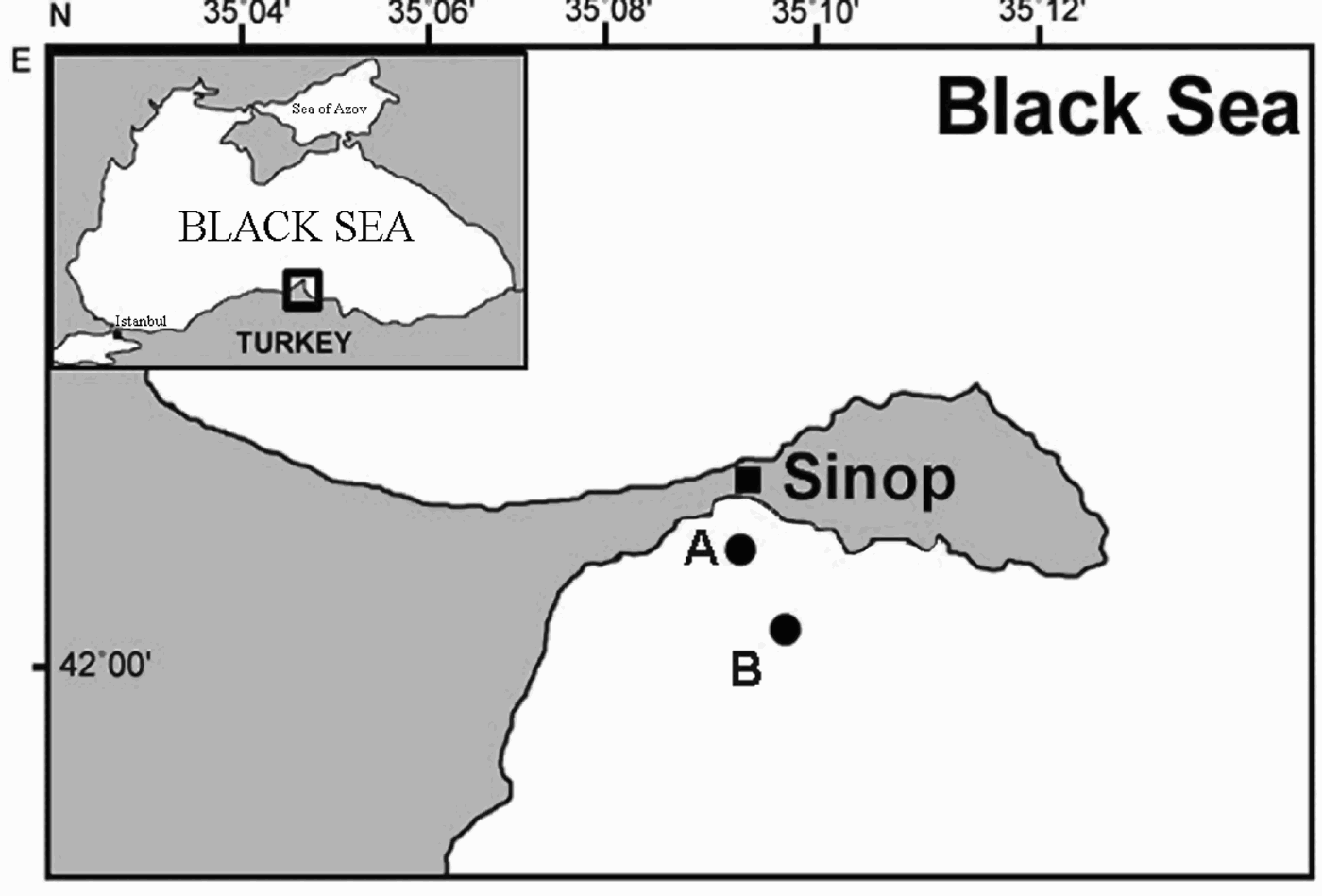
Samples were taken in January and February 2009 at the Sinop coast (Black Sea, Turkey) (Figure 1) from soft substrates at depths ranging from 10 to 50 m. Samples were collected by dredging and SCUBA diving. The brittle stars were gently rinsed and picked out from the sediments with forceps. Immediately after collection samples were preserved in 95% ethanol and subsequently measured in the laboratory, including species identification. In addition, water temperature and salinity were measured in the water column with a YSI 6600 V2-2 Multiparameter Water Quality Sonde. Observations and measurements were made using an Olympus dissecting microscope. Specimens were photographed with an Olympus dissecting microscope fitted with an Olympus Camedia digital camera. The identification and description of the specimens was based on the morphological descriptions provided by Mortensen (Reference Mortensen1927). All specimens have been deposited in the Collection of Marine Biology and Ecology Laboratory (Sinop, Turkey) (CMBEL).
Map of the study area with the location of sampling stations (depths in Station A: 15 m; and Station B: 50 m).

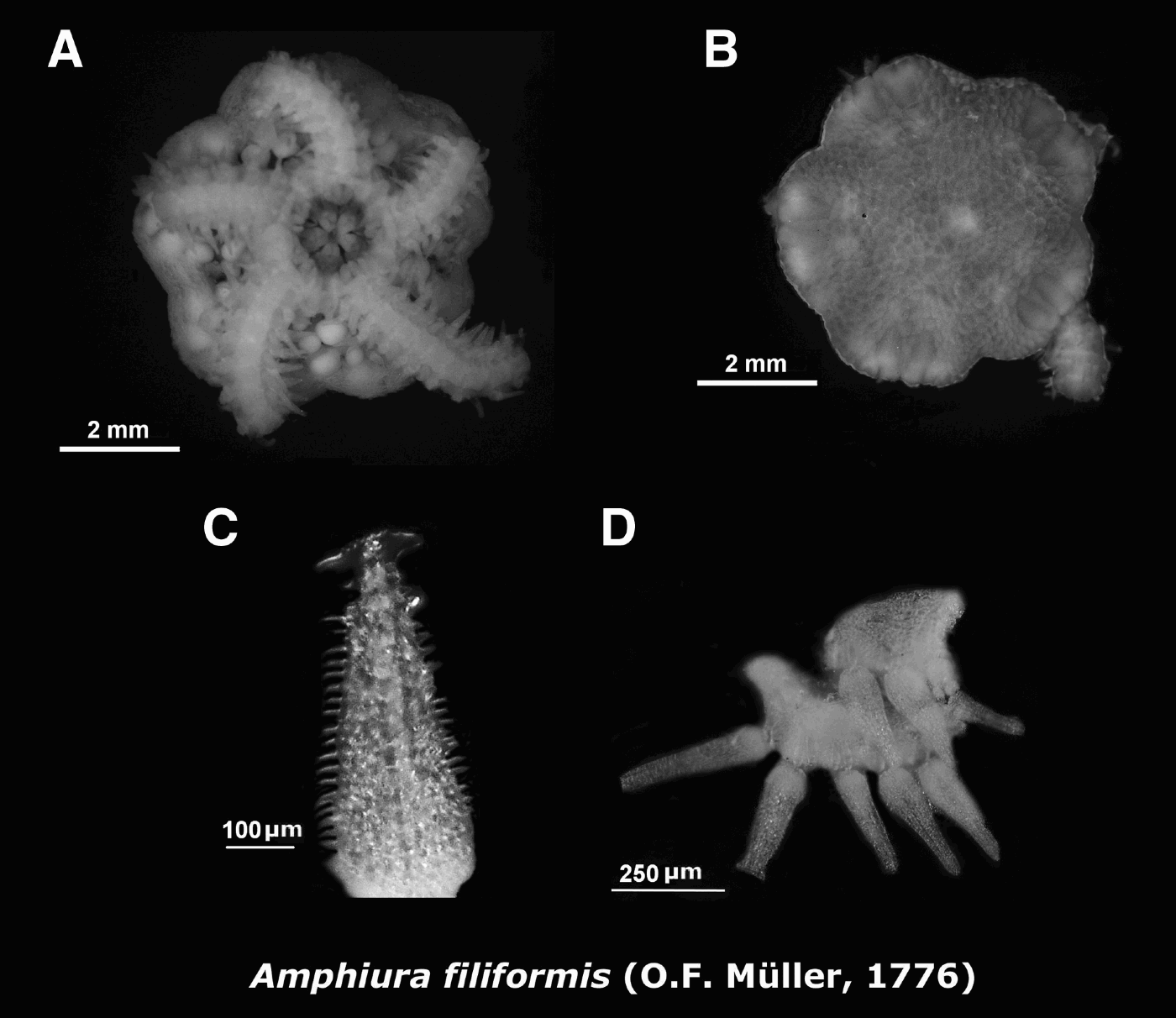
During both surveys at the Sinop coast, the presence of Amphiura filiformis (O.F. Müller, 1776), together with Amphiura chiajei Forbes, 1843 and Amphipholis squamata (Delle Chiaje, 1828), has been confirmed, which is the first record of this species in the Black Sea (Figure 1).
Amphiura filiformis. (A) Dorsal view; (B) ventral view; (C) details of the second arm spine; (D) details of the arm spines.

MATERIAL EXAMINED
12 specimens. Coordinates and locality: Station A: 42°01′15″N–35°09′00″E, Station B: 42°00′21′N–35°09′32″E, Sinop coast (Figure 1); depth 15 m and 50 m, January and February 2009, collected in sandy and muddy habitats. Disc diameter size-range = 4.9–5.3 mm.
DIAGNOSIS
A small brittle star, disc up to 8–10 mm in diameter, with very long arms, which lives buried in muddy sand. The dorsal side of the disc is covered with fine scales, but the ventral side is naked. It is reddish or greyish-brown in colour. Amphiura filiformis extends its arms vertically 3–4 cm into the water current to feed, in contrast to the deposit feeding A. chiajei with which it is often found. Amphiura filiformis provides an important link between the benthic and pelagic environments, because it seems to be important in the diets of many fish and invertebrates. These predators do not generally consume the entire brittle star but crop only the arms, which are later regenerated (Mortensen, Reference Mortensen1927).
ECOLOGY
Specimens of A. filiformis were obtained from muddy and sandy habitats, from two stations, in Sinop Bay. The average surface water temperature at that time was 9.9°C, and salinity 17.8 PSU in Station A and 17.6°C, 8.9 PSU in Station B. Generally, this species is found on muddy sand where it burrows about 5 cm into the bottom, from depths of about 5–1200 m. Its life span may be up to 20 years (Mortensen, Reference Mortensen1927; Buchanan, Reference Buchanan1964; O'Connor et al., Reference O'Connor, Bowmer and Grehan1983). The species must reach a certain size to be able to burrow down into the sediment for it must, using its serpentine arms, keep contact with the sediment surface (O'Connor et al., Reference O'Connor, Bowmer and Grehan1983). Amphiura filiformis is a suspension feeder, collecting mixed micro-plankton, resuspended bottom material and detritus.
DISTRIBUTION
An Atlanto-Mediterranean species known from all over the Mediterranean and the Atlantic regions (Mortensen, Reference Mortensen1927; Mortensen & Steuer, Reference Mortensen and Steuer1937; Tortonese, Reference Tortonese1965; Caspers, Reference Caspers1968; Cherbonnier, Reference Cherbonnier1969; Zavodnik, Reference Zavodnik1972, Reference Zavodnik1981; Pancucci & Zenetos, Reference Pancucci and Zenetos1989, Reference Pancucci and Zenetos1990; Özaydin et al., Reference Özaydin, Katağan and Ünsal1995). This species is reported for the first time from the Black Sea.
DISCUSSION
The specimens examined are morphologically in accordance with the existing description of Mortensen (Reference Mortensen1927). However, the specimens found in this study do not reach the maximum disc size of the description, i.e. 8–10 mm: specimens collected here are somewhat smaller than non-Mediterranean material. This can be explained through the specific ecological and hydrological peculiarities (i.e. salinity, temperature and food) of the Black Sea compared with the Atlantic Ocean. The limited supply of nutrients at the collecting location may contribute to the animals reaching a smaller size. According to Koukouras et al. (Reference Koukouras, Sinis, Bobori, Kazantzidis and Spyridon Kitsos2007) the ophiuroid fauna of the Mediterranean Sea consists of 36 species. Before the present study, the review of the relevant literature showed that, up to the present, four valid ophiuroid species (Ophiothrix fragilis (Abildgaard, in O.F. Müler, 1789), Amphiura stepanovi Djakanov, 1954, Amphipholis squamata (Delle Chiaje, 1828) and Amphiura chiajei, Forbes, 1843) were known from the Black Sea (Tortonese & Demir, Reference Tortonese and Demir1960; Caspers, Reference Caspers1968; Tortonese, Reference Tortonese1979; Koukouras et al., Reference Koukouras, Sinis, Bobori, Kazantzidis and Spyridon Kitsos2007). By the present study this value is increased to five. Lowered salinity and temperature, comparatively narrow habitable upper layer and the development of hydrogen sulphide in its deeper layers are the main factors preventing the Mediterranean fauna from settling in the Black Sea (Tortonese & Demir, Reference Tortonese and Demir1960; Zenkevitch, Reference Zenkevitch and Botcharskaya1963). Amphiura filiformis may be included among the new immigrants from the Mediterranean to the Black Sea. Also, continuous migration of new forms from the Mediterranean can be observed in other invertebrate groups. It is quite likely that A. filiformis has a wider distribution, but it may have been previously overlooked, due to its superficial resemblance to other ophiuroids that occur in the same geographical region.