Introduction
The remarkably high biodiversity observed in the tropics is one of the most compelling mysteries in ecology (Brown Reference Brown2014). Diverse communities in the tropics are often characterised by multiple, similar species, apparently contradicting the process of natural selection and the expectation that one should outcompete the other (Hardin Reference Hardin1960). For decades, studies have found that similar species that co-occur often specialise on different microhabitats of their environments, partitioning spatial, or food resources in a way that facilitates their coexistence (e.g., MacArthur Reference MacArthur1958, Chapman & Rosenberg Reference Chapman and Rosenberg1991, Jepsen et al. Reference Jepsen, Winemiller and Taphorn1997). Such research continues today in an attempt to provide an understanding of community function in taxa ranging from trees to carnivorous mammals (Kamath & Losos Reference Kamath and Losos2017, Álvarez-Yépiz et al. Reference Álvarez-Yépiz, Búrquez, Martínez-Yrízar, Teece, Yépez and Dovciak2017, Vogel et al. Reference Vogel, Somers and Venter2019).
In some communities, species co-occurrence has been found not to be due to different species performing better in different microhabitats, but instead to be the result of an interaction between competitive and environmental factors. In Connell’s (Reference Connell1961) famous study on barnacles, the co-occurrence of Balanus balanoides and Chthalamus stellatus in an intertidal zone was found to be due to a combination of the ability of Balanus to outcompete Chthalamus in the lower, wetter regions of the zone, and the ability of Chthalamus to survive in the harsher upper region where Balanus could not survive. Research on other communities has found similar competitive/environmental interactions. Crain et al. (Reference Crain, Silliman, Bertness and Bertness2004) found that plant distributions along an estuarine salinity gradient were driven by an interaction between competitive ability and the ability to survive osmoregulatory stress, and not because each species occurs where it grows best. How pervasive such competitive/environmental interactions are in structuring species distributions across different communities remains unknown.
An excellent example of a taxon in which microhabitat partitioning has been observed repeatedly is class Diplopoda, the millipedes. O’Neill (Reference O’Neill1967) found that seven millipede species differentially occupied seven different microhabitats in central Illinois, USA. Enghoff (Reference Enghoff1983) found similar specialisation across both macrohabitats and microhabitats in 20 species in the monophyletic genus Cylindroiulus thought to have undergone adaptive radiation on the island of Madeira. In Puerto Rico, Murphy et al. (Reference Murphy, González and Belén2008) found four taxonomic orders differentially distributed in different ground layers including litter, humus, superficial soil, and deeper soil, and density of order Glomeridesmida varied with topography, with individuals being most common in valleys, rarer on slopes, and nearly absent on ridges. Semenyuk & Tiunov (Reference Semenyuk and Tiunov2019) found a different form of niche partitioning in Thyropygus carli and Orthomorhpa sp. in Vietnam. The two species were not segregated spatially, but they budgeted their time differently throughout the daily cycle. Similar patterns have been observed in the closely related class Chilopoda, the centipedes (Summers & Uetz Reference Summers and Uetz1979).
No studies have yet determined if co-occurrence of millipede species is maintained by microhabitat preferences or by competitive/environmental interactions. Millipedes possess an anterior head region that includes several structures specialised to identify their surroundings (Dalton & Lomvardas Reference Dalton and Lomvardas2015). A fused maxilla called the gnathochilarium possesses chemosensory receptors and tactile receptors (Blower Reference Blower, Kermack and Barnes1985), two elbowed antennae have sensory cones at the tips that sense physical surroundings, and Tömösváry organs on the head most likely function to detect humidity and light levels (Lewis Reference Lewis2008, pp. 110–111, but see Moritz & Koch Reference Moritz and Koch2020). Such anatomical structures could allow millipedes to evaluate different microhabitats and choose to occupy those in which they have evolved to perform better.
In this study, we investigated microhabitat partitioning, microhabitat preference, and interference competition in two millipedes prevalent at La Selva Biological Station in Costa Rica, Nyssodesmus python (Peters, 1864) and a round-backed millipede identified to order Spirobolida. As detritivores, millipedes feed on decaying matter such as leaves and wood, which ubiquitously cover the forest floor. Rocks are ubiquitously present on the forest floor as well. Thus, we investigated how these two species interact with these materials. We performed three analyses. (1) We tested the hypothesis that N. python and Spirobolida occur in different microhabitats in the wild. We observed both species and recorded the microhabitat type (wood, leaves, or rocks) occupied by each individual. We predicted that the two species would be differentially distributed among the three microhabitats. (2) We tested the hypothesis that the two species each prefer a different microhabitat type. We performed choice tests in the laboratory and predicted that the two species would choose to inhabit the same microhabitat types in which each one was predominantly found in the wild. (3) Finally, we tested the hypothesis that one species would competitively exclude the other from its preferred microhabitat type. We conducted additional choice tests, but this time with both species present, and we predicted that each species would choose a different microhabitat and that the choice of one of the species would be different than the preference it demonstrated in analysis (2).
Methods
The study was conducted at the Organization for Tropical Studies’ La Selva Biological Station (10°26′N, 83°59′W). La Selva is set in a tropical lowland rainforest near the city of Puerto Viejo de Sarapiqui in northeastern Costa Rica (McClearn et al. Reference McClearn, Arroyo-Mora, Castro, Coleman, Espeleta, García-Robledo, Gilman, González, Joyce, Kuprewicz, Longino and Kappelle2016).
N. python are polydesmid millipedes common in Central America (Hoffman Reference Hoffman1999, p. 379), although little is known about their biology (Gandhi Reference Gandhi2005, Adolph & Geber Reference Adolph and Geber1995). They have brown, white, and yellow-striped exoskeletons characterised by a flat dorsal surface and typically reach lengths around 10 cm. Millipedes of taxonomic order Spirobolida are also common in Central America (Hoffman et al. Reference Hoffman, Golovatch, Adis and Wellington de Morais1996). However, they are quite speciose (around 500 species in all; Shear Reference Shear2011) and not easily identified in the field. The Spirobolida observed in this study were characterised by long, cylindrical, brown exoskeletons and were smaller than N. python, only around 4 cm long. We identified them to taxonomic order by the presence of only one pair of legs on the fifth segment (Hopkin & Read Reference Hopkin and Read1992), and by the presence of a median suture line on the front of the head, extending upward from labrum (Hoffman et al. Reference Hoffman, Golovatch, Adis and Wellington de Morais1996). The exoskeletons of N. python and Spirobolida consist of chitin interspersed with calcium carbonate, creating a hard protective shell (Barnes Reference Barnes1982, Borrell Reference Borrell2004). When threatened, both species curl into a spiral ball, encasing themselves in the exoskeleton.
(1) To determine if N. python and Spirobolida might tend to occupy different microhabitats in the wild, we sampled 50 m transects at three different sites at La Selva during both daytime and night-time conditions. On each of 3 days in January 2020, a separate 50 m transect was chosen on each of three different trails, SAZ, SHO, and CCC, and sampled once between 12:00–14:00 h and then again between 19:00–21:00 h. The transects ran parallel to each trail, and on each trail we set the transects at the same meter-markers: 450–500 m, 500–550 m, and 550–600 m. The elevations of the transects differed among trails, and we designated SAZ as low, SHO as medium, and CCC as high (Table 1). The higher trails seemed to be dryer than the lower trails. Furthermore, the trails differed in both soil type and plant community (Table 1). All N. python and Spirobolida observed between the trail and the tree line were noted and the microhabitat occupied by each one (wood, leaves, or rocks) was recorded. Out of 905 millipedes observed, only 13 were seen on rocks (all N. python), so we considered rocks not to be a preferred microhabitat and excluded those 13 observations from our analyses. We then constructed a generalised linear mixed model in SPSS 26 using Poisson distribution with log link function. Model fit was assessed by relative size of Akaike Corrected Information Criterion and Bayesian Information Criterion. Fixed effects included species, microhabitat, site, and time of day, as well as species*microhabitat interaction and species*site interaction. Date was included as a random factor to control for repeated observations of transects during the day and then again at night.
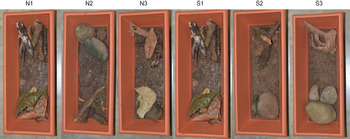
(2) We also performed a choice test in the laboratory to determine if any microhabitat association observed in the wild was due to preferences on the part of the millipedes and not due to some other unknown factor. Choice tests were conducted from 29 December 2018 to 8 January 2019 and then again on the same dates the following year, from 29 December 2019 to 8 January 2020. Trials were conducted in plastic boxes measuring 30 cm wide × 100 cm long × 30 cm high and filled 2.5 cm deep with soil. The area occupying 15 cm from each end of each box was covered with additional microhabitat: wood (sticks), leaves, or rocks, which was stacked specifically in a manner that created crevices in which the millipedes could hide. In each trial, at least three containers were established for each species, with each one presenting the subject with a choice between either wood and leaves, wood and rocks, or leaves and rocks (Figure 1). Locations of the treatments within the room were alternated over the course of the experiment. Specimens of each species were then collected after dark and each placed alone in the centre of one of the boxes. At 07:00 h the next morning, the location of each specimen within each box was observed and specimens were released back into the wild. Prior to each nights’ trials, soil was stirred and sticks, leaves, and rocks were replaced. Soil was completely replaced every 2 days. For each species, we ran 12 replicates in each of the three alternative choice paradigms, for a total of 72 replicates. To determine if the two species preferred different microhabitats for each choice paradigm (e.g., wood vs. rocks), we compared between the two species the number out of 12 individuals that chose each microhabitat using Fisher’s exact tests according to McDonald (Reference McDonald2014).
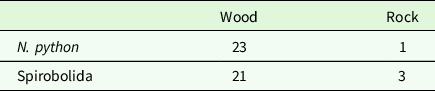
(3) Finally, to determine if one species may influence choices made by the other species, we also performed 24 choice tests in which one individual of each species was placed into the same box at the same time with the expectation that the limited space inside the box would force the two individuals to interact. These competitive exclusion choice tests were conducted between 29 December 2019 and 8 January 2020. Based on the results of (2) our initial choice tests (see below), each replicate offered a pair of alternative microhabitat types (wood and rocks) for which we expected both species to prefer the same side (wood). In each of the 24 replicates, both individuals in the box were expected to choose wood unless the presence of the other millipede prevented them from inhabiting the wood. Other than the presence of two individuals in each box, the trials were performed as in (2) the original choice tests. To test whether both individuals chose to cohabitate in the wood more often than would be expected by chance, we conducted a chi-square goodness-of-fit test according to McDonald (Reference McDonald2014), comparing the alternative outcomes of two individuals choosing the same side vs. choosing opposite sides (in no replicates did both species choose the non-preferred side), while setting our expected values to 12 and 12, respectively.
Elevation, soil type, and plant community present at the three field sampling sites.

Choice tests presented to N. python (N) and Spirobolida (S). N1 and S1 show choices between wood and leaves, N2 and S2 show choices between wood and rocks, and N3 and S3 show choices between leaves and rocks. The positions of the microhabitats and the treatments were alternated across trials.

Results
(1) A total of 905 millipedes were observed over a period of 3 days at three sites at La Selva Biological Station (Table S1). Overall, several factors affected the occurrence of the millipedes (corrected model: F8,63 = 111.834, P < 0.001). There was no effect of species (F1,63 = 0.771, P = 0.383), indicating that both species were similarly abundant. There was a strong effect of microhabitat on the presence of millipedes (F1,63 = 16.569, P < 0.001), but inspection of the data revealed that the overall numbers of millipedes (of both species) found on wood (n = 403) was not remarkably different than the number found on leaves (n = 489). There was also a strong effect of site on the presence of millipedes (F2,63 = 249.476, P < 0.001), with individuals being most common at SAZ, secondly most common at site SHO, and rare at CCC. Importantly, there was a strong interaction between species and microhabitat (F1,63 = 287.755, P < 0.001), indicating that N. python typically occurred on wood and Spirobolida typically occurred on leaves (see Table S1). There was also a significant interaction between species and site (F2,63 = 3.775, P = 0.028), but inspection of the data revealed similar patterns in the distributions of the two species: both species were most common at site SAZ, uncommon at site SHO, and almost completely absent from site CCC. There was also a strong effect for time of day (F1,63 = 84.865, P < 0.001); millipedes were more abundant at night than during the day (see Table S1).
(2) Our lab experiments found that the tendency of N. python to occur on wood and Spirobolida on leaves in the wild was specifically due to behavioural preferences for those microhabitats (Table 2). N. python primarily preferred wood and secondarily preferred rocks. Spirobolida primarily preferred leaves and secondarily preferred wood.
(3) Finally, our cohabitation experiment found no evidence of interference competition between the two species (Table 3). When one individual of each species were placed together into a test chamber in which both species were expected to prefer wood, typically both individuals chose to cohabitate in the wood instead of one species choosing wood and the other species being relegated to the less preferred microhabitat (rocks).
Microhabitat preferences observed in choice tests administered on isolated millipedes of two species. Fisher’s exact test: wood vs. rock: P = 1.0; wood vs. leaf: P = 9.61 × 10⁻⁶; rock vs. leaf: P = 6.44 × 10⁻⁴

Microhabitat preferences observed in choice tests in two millipede species when tested together in the same box. Both species cohabitated in wood in 20 of the 24 trials. They never cohabitated in rock. Chi-squared goodness of fit test: χ21 = 12.042; P = 0.0005

Discussion
(1) Our study found that two millipede species partition microhabitats within a tropical rainforest. In the wild, our analysis found that N. python and Spirobolida were similarly abundant. Importantly, though, our analysis revealed an interaction between species and microhabitat that indicated that N. python occurred significantly more often on wood and Spirobolida occurred significantly more often on leaves. The microhabitats observed to be significant are similar to those found to be important in previous studies, particularly the different parts of logs and the leaf litter reported by O’Neill (Reference O’Neill1967), the logs vs. litter reported by Enghoff (Reference Enghoff1983) and Summers & Uetz (Reference Summers and Uetz1979), and the litter vs. soil reported by Murphy et al. (Reference Murphy, González and Belén2008).
Our analysis also indicated an effect of site on the presence of millipedes in general, with millipedes of both species being by far most common at SAZ, secondly most common at site SHO, and very few millipedes occurring at CCC. This distribution showed an inverse association with elevation: SAZ was the lowest elevation (35–40 m), SHO was of intermediate elevation (40–50 m), and CCC was the highest elevation (60–65 m). This pattern mirrors that observed by Murphy et al. (Reference Murphy, González and Belén2008), who found that millipedes in Puerto Rico varied with topography, with individuals being most common in valleys, rarer on slopes, and nearly absent on ridges. In our study, lower elevations seemed to provide wetter conditions, but other factors, such as more litter accumulation in valleys compared to ridges (Murphy et al. Reference Murphy, González and Belén2008) may have influenced the relationship we observed between millipede density and elevation. Soil type and plant community also differed among sites (Table 1), but neither characteristic had an obvious effect on millipede distribution. The site with the most millipedes, SAZ, was characterised by undetermined soil type, compared with alluvial soil at SHO, and volcanic soil at CCC. All the sites were characterised by lack of disturbance, ranging from long-abandoned plantation at SAZ to forest in decades-long stages of succession to old-growth forest and ecological reserve.
Both species were more prevalent at night, and they did not seem to partition their habitat temporally. Although we did not measure activity in this study, the day/night pattern of occurrence we observed seems to contrast that seen in two sympatric millipedes in Vietnam, in which one species, T. carli, spent the largest portion of its time searching for food consistently throughout a 24-hour period, while another species, Orthomorpha sp., exhibited circadian rhythm characterised by large portions of time resting during the day and feeding at night (Semenyuk & Tiunov Reference Semenyuk and Tiunov2019).
(2) In the lab experiment, N. python showed a preference for wood, a secondary preference for rocks, and avoided leaves. Spirobolida preferred primarily leaves, secondarily wood, and avoided rocks. The preference for wood observed in N. python is consistent with previous reports that it favours wood as a food source (Heisler Reference Heisler and Janzen1983), but it is unknown if Spirobolida’s preferred food is leaves. The secondary preference of N. python for rocks is surprisingly inconsistent with our observations in the wild in which it was observed secondarily on leaves and almost never on rocks. This is likely because the rocks in the wild were not stacked in a way that provided crevices whereas the rocks used in the choice experiment were specifically stacked to provide crevices in which the millipedes could hide. In contrast, Spirobolida avoided rocks in both the wild and in the lab. The difference between the two species in their tendencies to climb into a pile of rocks might be attributed to the difference in the shape and size of the species’ exoskeletons. The exoskeletons of polydesmid millipedes such as N. python are characterised by a flat dorsal surface (Heisler Reference Heisler and Janzen1983), which might make it easier and/or safer to climb into a pile of heavy rocks. On the other hand, Spirobolida are much smaller than N. python and have a cylindrical exoskeleton, which might make it more difficult or more dangerous to climb into a pile of rocks.
(3) In the cohabitation experiment, we found no evidence of one species competitively excluding the other in a choice paradigm in which both species preferred the same microhabitat. When faced with a choice to occupy either wood or rock, they both chose to occupy wood, which they had previously been found to prefer over rock, even though that meant cohabitating with the other millipede, a potential heterospecific competitor. This shows that the occupation of different microhabitats by N. python and Spirobolida in the wild is not a result of interference competition between the two species (Connell Reference Connell1961), but is a result of specific behavioural preferences intrinsic to each species. Rather than one of the species driving the other one out of a microhabitat preferred by both, the two species may have evolved the sensory capabilities necessary to identify the specific microhabitat, wood or leaf, in which they perform best (Blower Reference Blower, Kermack and Barnes1985, Lewis Reference Lewis2008, Dalton & Lomvardas Reference Dalton and Lomvardas2015).
The microhabitat partitioning observed in this study shows how N. python and Spirobolida are able to co-occur in the same environment. Both species are very common at La Selva, which could be due to both species having adapted to separate niches. This would reduce competition over resources, resulting in increased biodiversity, and in turn making one small contribution to the high biodiversity observed in the tropics. Millipedes serve an important role as decomposers in tropical forests, but have been little studied. In addition to contributing to an understanding of the mechanisms underlying species co-occurrence, this study provides a valuable contribution to the knowledge of the largely overlooked biology of millipedes.
Acknowledgments
We thank the OTS La Selva Biological Station and Costa Rican government for allowing this research to be conducted (MINAE Collecting licence # SINAC-ACC-PI-LC-304-2019 and Research permit # SINAC-ACC-PI-R-120-2019). Bernal Matarrita Carranza and Kenneth Alfaro Gonzalez provided access to the lab and assisted with logistics. Wagner López Vargas provided geographic elevation data. Dean Snelson and Kaitlin McCormick aided in collection of microhabitat materials for the choice tests. Jean Burns commented on an early draft of the article.
Financial support
This research received no specific grant from any funding agency, commercial, or not-for-profit sectors.
Competing interests
The authors declare none.
Ethical statement
The authors assert that all procedures contributing to this work comply with applicable national and institutional ethical guidelines on the care and use of laboratory or otherwise regulated animals.
Supplementary material
To view supplementary material for this article, please visit https://doi.org/10.1017/S0266467421000365