

Introduction
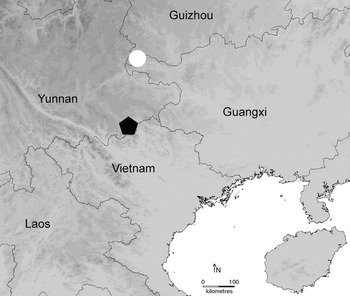
In the most recent classification of the Gesneriaceae (Weber, Reference Weber, Kubitzki and Kadereit2004) four informal major groups were recognised. Of these the palaeotropical didymocarpoids include 85 genera, 58 of which are found in China. During an expedition to Guizhou province, China, in 2007, specimens of a new species were collected (Fig. 1) which also proved to belong to a new genus. In reference to its simple stigma the genus is named Litostigma Y.G.Wei, F.Wen & M.Möller. The species is named Litostigma coriaceifolium Y.G.Wei, F.Wen & M.Möller. Subsequently, it was discovered that material of a species morphologically very similar to Litostigma coriaceifolium had been collected in 2002 in Malipo, Yunnan (Fig. 1), and cited as ‘Petrocosmea crystallina’ Y.M.Shui & W.H.Chen in Shui & Chen (Reference Shui and Chen2006). This name was not validly published under the International Code of Botanical Nomenclature (McNeill et al., Reference McNeill, Barrie, Burdet, Demouline, Hawksworth and Marhold2006) as there was no Latin diagnosis or description. This plant was placed in Petrocosmea Oliv. due to the form of the peduncle and its anther indumentum. In some species of Petrocosmea and in ‘Petrocosmea crystallina’ the peduncles bend back in order to place the capsule into rock crevices and thus the seeds into a suitable position for seedling establishment (Shui Yu-Min, pers. obs.).
Map showing the collection localities of Litostigma coriaceifolium Y.G.Wei, F.Wen & M.Möller (○) and L. crystallinum Y.M.Shui & W.H.Chen ( ). Drawn with DIVA GIS 5.2 (http://www.diva-gis.org).

Generic delimitations in Gesneriaceae are often difficult due to large overlaps in characters between genera (Burtt, Reference Burtt1963, Reference Burtt1977). For this reason we undertook a combined phylogenetic–morphological approach. We attempted to determine the phylogenetic position of Litostigma among the Old World didymocarpoid Gesneriaceae, specifically in relation to Petrocosmea and other morphologically similar genera. In addition to the molecular analysis a detailed morphological comparison was made.
Materials and Methods
Phylogenetic analysis
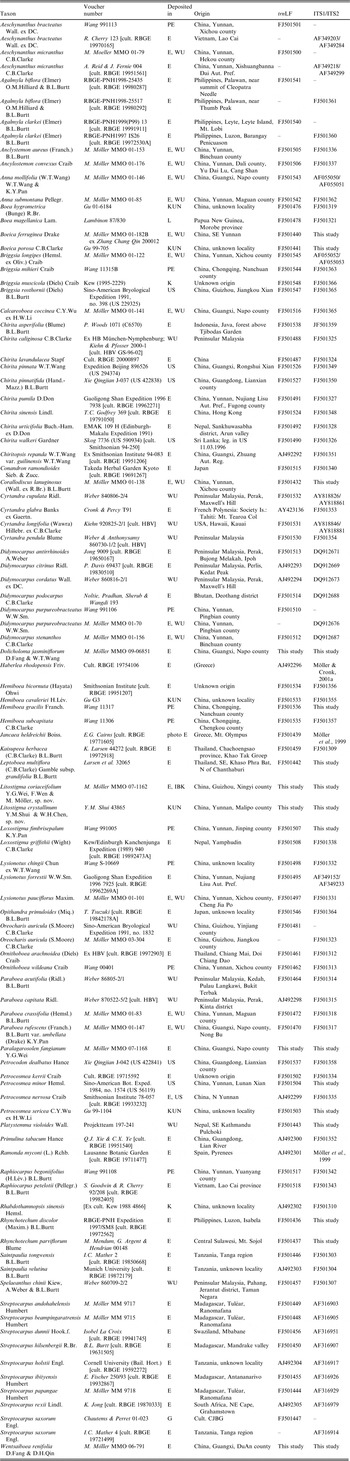
A data matrix was assembled consisting of 1952 molecular sequence characters (trnLF = 1054 characters, and ITS = 898 characters) that included 90 taxa across the Old World didymocarpoids. Sequence data were either taken from Möller et al. (Reference Möller, Pfosser, Jang, Mayer, Clark and Hollingsworth2009) or acquired using methods explained therein. Twenty-one sequences (16 ITS and 5 trnLF) were newly acquired here, two were included from previous publications (Jancaea heldreichii Boiss., Ramonda myconi (L.) Rchb., Möller et al., Reference Möller, Clokie, Cubas, Cronk, Hollingsworth, Bateman and Gornall1999), and one retrieved from GenBank (Haberlea rhodopensis Friv., Möller & Cronk, Reference Möller and Cronk2001a). The ingroup samples included Litostigma coriaceifolium, ‘Petrocosmea crystallina’ and four species of Petrocosmea proper (Table 1). A partition homogeneity test and the parsimony and branch support analyses were conducted following Möller et al. (Reference Möller, Pfosser, Jang, Mayer, Clark and Hollingsworth2009). The phylogenetic tree was rooted on Corallodiscus Batalin as one of the most basal lineages in Old World didymocarpoids, as suggested in Möller et al. (Reference Möller, Pfosser, Jang, Mayer, Clark and Hollingsworth2009).
Details of 92 didymocarpoid taxa included in the phylogenetic analysis, including voucher number (information in square brackets refers to the accession number of living material grown on from the specimen cited – where there is only a living accession number given it has been vouchered into the herbarium with the same number), deposition of voucher, origin and GenBank sequence information. RBGE = living collection at the Royal Botanic Garden Edinburgh, Scotland, UK; HBV = living collection at the Botanic Garden, Vienna, Austria

Scanning electron microscopy
Materials for SEM were fixed in FAA (5% acetic acid, 5% formaldehyde, and in 50% ethanol). The fixed material was dehydrated in an ethanol series and acetone, critical point dried in CO2 with an Emitech K850 critical point dryer (Ashford, UK), coated with platinum in a peltier cooled Emitech K575X sputter coater (Ashford, UK) and then examined with a LEO Supra 55VP scanning electron microscope at a working distance of 11 mm and 4.8 to 5 kV.
Results and Discussion
Comparison with morphologically similar genera
Litostigma has the characteristic morphological features of relatively large diandrous flowers in comparison to the small leaves and stature of the plant, with petiolate, slightly revolute leaf margins, uniflowered cymes, undivided stigma and untwisted narrowly ovoid capsules, dehiscing loculicidally and septicidally.
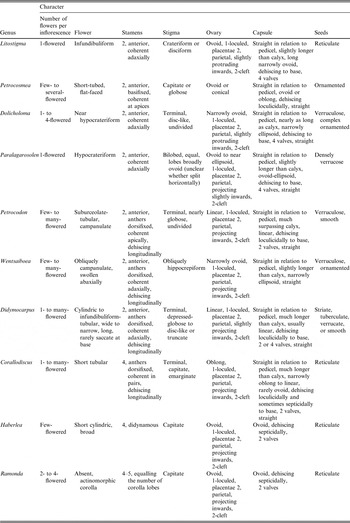
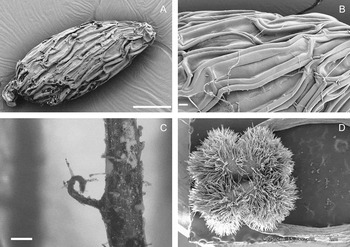
Among Weber’s (Reference Weber, Kubitzki and Kadereit2004) Old World advanced Asiatic and Malesian didymocarpoid genera there are some morphological similarities between Litostigma and straight-fruited advanced genera such as Didymocarpus Wall., Dolicholoma D.Fang & W.T.Wang, Paralagarosolen Y.G.Wei, Petrocodon Hance and Wentsaiboea D.Fang & D.H.Qin. The similarities are often in individual characters that are, however, shared with several other genera, such as a ± capitate stigma (Didymocarpus, Dolicholoma, Petrocodon, Wentsaiboea), small elliptic leaves, ovoid ovary and capsule (Dolicholoma, Paralagarosolen, Wentsaiboea), and 1-flowered cymes (Dolicholoma, Paralagarosolen). However, these genera differ from Litostigma in other characters (Table 2). For example, most of them have verruculose and/or ornamented seed testa cells (Table 2; Beaufort-Murphy, Reference Beaufort-Murphy1983), very unlike Litostigma (Fig. 3A–B).
Morphology of selected Gesneriaceae genera superficially resembling Litostigma or implicated in molecular studies (compiled from Beaufort-Murphy, Reference Beaufort-Murphy1983; Wang et al., Reference Wang, Pan, Li and Wang1990, Reference Wang, Pan, Li, Weitzman, Skog, Wu and Raven1998; Wei, Reference Wei2004; Weber, Reference Weber, Kubitzki and Kadereit2004; and Weber & Skog, 2007 onwards)

Litostigma differs from Petrocosmea most notably through the latter’s short tube and flat-faced corollas, and its strongly ornamented seeds (Table 2). Petrocosmea flowers are also distinctly bilabiate, with the lobes of the upper lip often nearly completely fused.
Phylogenetic position of Litostigma
The partition homogeneity test suggested that the two sequence matrices were highly congruent (P = 0.74). Analysing the two genes individually did not alter the position of Litostigma and Petrocosmea proper in the phylogenetic trees (data not shown).
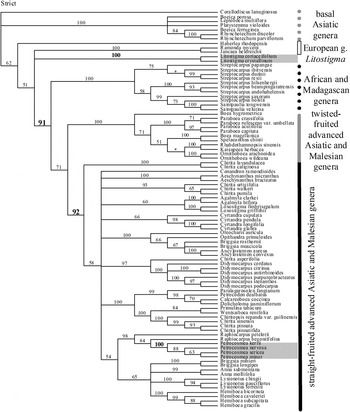
The maximum parsimony (MP) analysis on the combined sequences resulted in 156 most parsimonious trees of 3957 steps (CI = 0.4079, RI = 0.6363). The topology recovered here is congruent with that in Möller et al. (Reference Möller, Pfosser, Jang, Mayer, Clark and Hollingsworth2009). Here we focus on the positions of Litostigma and ‘Petrocosmea crystallina’ in particular.
The MP strict consensus tree shows the new genus Litostigma and ‘Petrocosmea crystallina’ (in Fig. 2 as L. crystallinum) in a strongly supported sister relationship (BS = 100%). Their genetic distance is 0.36% in the trnLF and 3.7% in the ITS data, indicating their close relatedness. Intrageneric ITS distance levels in other Gesneriaceae genera are much higher than those observed between Litostigma and ‘Petrocosmea crystallina’ (e.g. Aeschynanthus Jack: 16.9%, Denduangboripant et al., Reference Denduangboripant, Mendum and Cronk2001; Agalmyla Blume: 14.1%, Chapman, Reference Chapman2003; Streptocarpus Lindl.: 23.5%, Möller & Cronk, Reference Möller and Cronk2001a, Reference Möller and Cronk2001b) and thus support a treatment of ‘Petrocosmea crystallina’ as a species of the new genus Litostigma (described as L. crystallinum below).
Strict consensus tree of 156 most parsimonious trees based on trnLF and ITS sequences, highlighting the position of Litostigma coriaceifolium, L. crystallinum and Petrocosmea, falling in two very distantly related clades. Numbers along branches are bootstrap values. Asterisks denote branches that received less than 50% branch support.

In the present phylogeny the clade with Petrocosmea proper (with 4 out of c.27 species included in the analysis – representing all three sections recognised in the genus) was highly supported (BS = 100%) and is sister to a grade of Raphiocarpus begoniifolius (H.Lév.) B.L.Burtt and R. petelotii (Pellegr.) B.L.Burtt with high branch support (BS = 98%). The Litostigma clade is far from Petrocosmea proper, near the base of the didymocarpoids, on a polytomy with the European Ramonda Rich./Jancaea Boiss. clade. This suggests that the true affinities of Litostigma do not necessarily lie directly with the European genera.
Though some branches in the phylogenetic tree between Petrocosmea proper and Litostigma are not well supported, two were highly supported – one leading to the straight-fruited advanced Asiatic and Malesian clade (BS = 92%), the other supporting the monophyly of the former clade plus the two twisted-fruited clades, the African/Madagascan and the twisted-fruited advanced Asiatic and Malesian clade (BS = 91%). This makes a closer relationship between Petrocosmea proper and Litostigma highly unlikely.
The genera with some morphological similarities to Litostigma, namely Dolicholoma, Paralagarosolen, Petrocodon, Wentsaiboea and Didymocarpus, are all distant from the new genus in a mixed clade (BS = 100%) (first four genera), or in a separate clade with Chirita asperifolia (Blume) B.L.Burtt (BS = 97%) (Didymocarpus), among the straight-fruited advanced Asiatic and Malesian genera (BS = 95%), and on a polytomy with the clade containing Petrocosmea.
Litostigma as a morphological link
Litostigma is a new genus, currently with just two species. A relationship to the basal Asiatic and European genera of Old World Gesneriaceae is suggested by molecular data. A loose association with Ramonda and Jancaea is indicated, but there is no obvious similarity in gross morphology. Apart from its overall smaller size, Litostigma has strongly petiolate and glabrous leaves, very unlike Ramonda and Jancaea. Furthermore, the corolla of Litostigma is strongly tubular and bilabiate, with two fertile stamens, while Ramonda has a 5-merous, actinomorphic and flat-faced flower with five stamens, and Jancaea has a 4-(rarely 5-)merous, subactinomorphic and campanulate flower with 4 (rarely 5) stamens.
Among the basal didymocarpoid lineages Weber (Reference Weber, Kubitzki and Kadereit2004) does not list any genera with morphological similarities to Litostigma; in fact it is the only genus with two fertile stamens in this group, all others having four or five (an exception is Tetraphyllum which includes species with both four and two stamens; Weber, Reference Weber, Kubitzki and Kadereit2004). Apart from tetrandry, the basal didymocarpoids are characterised by the possession of seeds without testa cell ornamentation, straight fruits (Weber, Reference Weber, Kubitzki and Kadereit2004; Möller et al., Reference Möller, Pfosser, Jang, Mayer, Clark and Hollingsworth2009) and septicidal (Haberlea Friv., Jancaea and Ramonda) or septicidally and loculicidally (Boeica C.B.Clarke, Corallodiscus and Leptoboea Benth.) dehiscing capsules. These seed, fruit shape, and capsule dehiscence (septicidally and loculicidally) characters are also found in Litostigma (Fig. 3, Table 2).
Litostigma. A–C: Litostigma coriaceifolium. A, SEM micrograph of seed (scale bar = 100 μm). Magnified in B (scale bar = 10 μm). C, single bract subtending the single flower (scale bar = 200 μm). D: Litostigma crystallinum, SEM micrograph of anthers (scale bar = 1 mm).

A major morphological progression has taken place between basal didymocarpoid lineages and the African, Madagascan and advanced Asian and Malesian lineages: the evolution of twisted fruits (found in a major clade of the advanced Asian and Malesian clade) and a change to diandry (Weber, Reference Weber, Kubitzki and Kadereit2004; Möller et al., Reference Möller, Pfosser, Jang, Mayer, Clark and Hollingsworth2009). The diandrous infundibuliform corolla of Litostigma is remarkably similar to those of some species in the African genus Streptocarpus and the only difference of this genus to Litostigma is the ovoid ovary and straight fruit of the latter. Such fruits are found in some African genera, such as Saintpaulia Wendl. and Acanthonema Hook.f., and represent cases of parallel convergent evolution within the genus Streptocarpus (Möller et al., Reference Möller, Pfosser, Jang, Mayer, Clark and Hollingsworth2009). Several other advanced Asiatic and Malesian genera possess an infundibuliform diandrous corolla (some Chirita Buch.-Ham. ex D.Don, Didymostigma W.T.Wang, some Lysionotus D.Don species, Pseudochirita W.T.Wang, some Raphiocarpus Chun species and the twisted-fruited Rhabdothamnopsis Hemsl.), suggesting some convergence for this character in the evolution of didymocarpoid Gesneriaceae.
In the present study the molecular data are the strongest support for the new genus status of Litostigma. The morphological characters describing the species would individually not make such a strong case, due to many overlaps with other genera. Only the combination of a range of floral (infundibuliform flowers, diandry, uniflowered inflorescence, undivided stigma, not twisted loculicidally and septicidally dehiscing fruit) and vegetative (petiolate leaves with revolute leaf margin) characters provides a unique definition of the genus.
The phylogenetic placement of Litostigma and the combination of ancestral and derived characters within the didymocarpoid Gesneriaceae makes this genus a very important morphological link between the ancestral basal Asiatic and European and derived African, Asian and Malesian genera. The addition of further, as yet possibly undiscovered, genera, particularly those in basal lineages, may help place Litostigma more precisely. Further additions may also help stabilise phylogenetic relationships among the basal and derived didymocarpoid lineages and help form a better understanding of the morphological transitions involved in the evolution of the majority of the Old World Gesneriaceae.
Taxonomic Treatment
Litostigma Y.G.Wei, F.Wen & M.Möller, gen. nov. (subfam. Didymocarpoideae Endl., tribe Didymocarpeae Endl.).
Petrocosmea Oliv. affinis a qua cyma 1-flora, stigmate crateriformi vel disciformi, differt. A Dolicholomate D.Fang & W.T.Wang forma floris et seminibus reticulatis (in Dolicholomate verruculosis et ornamentatis) differt.
Herbae perennes acaules rhizomatosae. Folia basalia petiolata. Cymae axillares uniflorae, unibracteatae et bibracteate. Calyx actinomorphus. Sepala 5. Corollae tubus infundibularis, abaxialiter paulo ventricosus, limbus bilabiatus, labio adaxiali 2-partito eo abaxiali 3-lobo omnibus cum lobis orbiculari-ovatis. Stamina 2 ad laterem abaxialem corollae tubi adnata; filamenta linearia; antherae cohaerentes ellipticae, subtilis puberulae (ampliare c.40×). Staminodia 3 ad laterem adaxialem corollae tubi adnata, linearia. Discus annularis. Pistillum inclusum; ovarium anguste ovoideum, uniloculare, placentis duabus parietalibus intrinsecus projectis bifidis; stylus elongatus ovario fere 4-plo longior; stigma simplex, crateriforme vel disciforme. Capsula ovoidea valvis quatuor dehiscens. – Typus generis: Litostigma coriaceifolium Y.G.Wei, F.Wen & M.Möller.
Perennial, stemless, rhizomatous herbs. Leaves basal, distinctly petiolate. Cymes 1-flowered, 1-bracteate. Sepals 5. Corolla zygomorphic, infundibuliform, adaxial lip 2-parted, abaxial lip 3-parted, all lobes divided nearly to the base, orbicular-ovate. Stamens 2, staminodes 3. Disc annular, ovary ovoid-ellipsoid, 1-loculed; placentae 2, parietal, intrusive, bifid. Stigma crateriform or disciform. Fruit narrowly ovoid, glabrous, dehiscing into 4 valves. Seeds reticulate, with raised testa cell walls.
Distribution. Southern China.
Etymology. The generic name is derived from Greek litos, meaning plain or simple, and stigma in allusion to the uncomplicated structure of the stigma.
Litostigma coriaceifolium Y.G.Wei, F.Wen & M.Möller, sp. nov.Figs 1,3A–C,4.
Haec species Litostigmati crystallino Y.M.Shui & W.H.Chen similis, sed foliis majoribus 1–2.1 cm longis (in illa minoribus 4.5–6 cm longis), sepalis 3–4 mm (nec 7 mm) longis, antheris glabris (nec dense pilosis) et stigmate crateriformi (nec disciformi) differt. – Type: China, Guizhou province, Xingyi county, Maling gorge, 1186 m, 24 iv 2007, Y.G. Wei & F. Wen 0701 (holo IBK!; iso PE!).
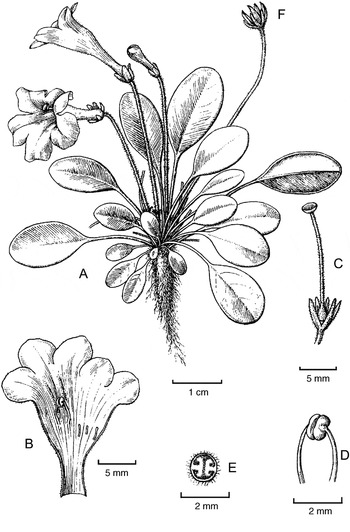
Litostigma coriaceifolium Y.G.Wei, F.Wen & M.Möller. A, habit; B, corolla open with stamens and staminodes; C, stamens, calyx and pistil; D, capsule; E, ovary; F, capsule and calyx. Drawn by Shun-Qing He.

Small perennial, stemless herb. Rhizome subterete, 1–1.5 cm long, 1–2 mm in diameter. Leaves 10–15, basal; leaf blade coriaceous, elliptic, 1–2.1 cm long, 0.6–1.1 cm wide, apex rounded, base obtuse to acute, margin entire, slightly revolute, glabrous, 3–4-nerved on each side, lateral nerves not distinct when dried; petiole 0.4–2.5 cm long, sparsely pubescent. Cymes 1–4, 1-flowered; peduncle 1.5–2 cm long, together with pedicel pubescent; 1-bracteate, lanceolate-linear, 1.5–2 mm long, margin entire, pubescent on each side; pedicel 1–4 cm long. Sepals 5, lanceolate to narrowly ovate, 3–4 mm long, 1–1.5 mm wide, pubescent outside, glabrous inside. Corolla light bluish-purple to pink, 1.2–2.1 cm long, pubescent outside, glabrous inside, tube infundibuliform, with undilated proximal part 0.8–0.9 cm long and dilated distal part 0.5–0.6 cm long, 1.5–1.7 cm in diameter at the orifice, 4–6 mm in diameter near the base; adaxial lip 4–5 mm long, 2-parted nearly to the base, abaxial lip 4–5 mm long, 3-parted nearly to the base, with lobes all orbicular-ovate. Stamens 2 (in anterior position), inserted at 5–7 mm from corolla tube base; filaments linear, slightly arcuate, 3–4 mm long; anthers elliptic, 1–1.5 mm long, finely pubescent (at 40×), coherent adaxially. Staminodes 3, glabrous, inserted at 4–6 mm from corolla tube base, lateral 2 c.2 mm long, median c.1 mm long. Disc annular, c.1 mm high. Pistil c.1.5 cm long; ovary ovoid-ellipsoid, c.2 mm long, c.1 mm in diameter, narrowly ovoid with style pubescent, style c.1.3 cm long. Ovary 1-loculed; placentae 2, parietal, intrusive, bifid. Stigma crateriform, c.2 mm in diameter. Fruit 5–6 mm long, narrowly ovoid, glabrous, dehiscing into 4 valves. Seeds reticulate with raised testa cell walls, 0.43 × 0.16 mm.
Distribution and habitat. As far as known endemic to Guizhou (Fig. 1). Found in the Maling gorge, Xingyi county, Guizhou province, China, growing on rocky slopes. Because of the wet limestone habitat, chalk grains cover the surface of the leaves.
Etymology. The epithet is derived from the coriaceous leaf blades in living material.
Conservation assessment. In 2006, the species was collected for the first time. In 2007 this locality was destroyed by a landslide. In 2008, a new locality was found about 38 km distant from the first, with about 3000 plants.
Proposed IUCN status. Critically Endangered, CR B1ac(iii).
Litostigma crystallinum Y.M.Shui & W.H.Chen, sp. nov.Figs 1,3D,5.
Haec species Litostigmati coriaceifolio Y.G.Wei, F.Wen & M.Möller similis, sed foliis majoribus 4.5–6 cm longis (in illa minoribus 1–2.1 cm longis), sepalis 7 mm (nec 3–4 mm) longis, antheris dense pilosis (nec glabris) et stigmate disciformi (nec crateriformi) differt. – Type: China, Yunnan province, Malipo county, Tianbao village, 850 m, 4 v 2005, Y.M. Shui, W.H. Chen & M.D. Zhang 53856 (holo KUN!).
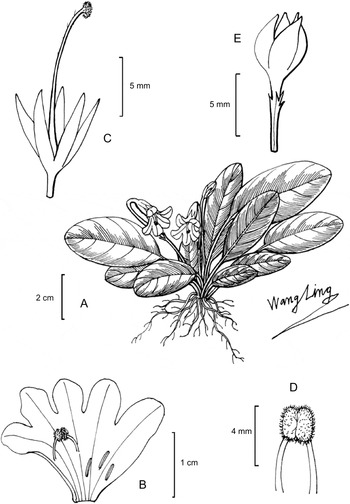
Litostigma crystallinum Y.M.Shui & W.H.Chen. A, habit; B, corolla open with stamens and staminodes; C, calyx and pistil; D, stamens; E, capsule. Drawn by Wang Ling.

Perennial herb, stemless. Rhizome subterete, 3–5 mm long, 2–3 mm in diameter. Leaves 11–13, basal; leaf blade thickly papery, elliptic, 4.5–6 cm long, 3–4 cm wide, apex rounded, base broadly cuneiform, margin entire, slightly revolute, glabrous, green above, greyish green beneath; lateral nerves distinct, 5–6 on each side, concave above, convex beneath; petiole 4–11 cm long, glabrous. Cymes 1–2, 1-flowered; peduncle 3–9 cm long, pubescent; 2-bracteate, small, lanceolate, 3 × 0.8 mm; pedicel 2.5 cm long, pubescent. Sepals 5, lanceolate, c.0.7 × 0.2 cm, pubescent outside, glabrous inside. Corolla purple, infundibuliform, 1.5–1.7 mm long, slightly pubescent outside, glabrous inside; corolla tube 0.7–1 cm long with short proximal undilated part; adaxial lobes 2, rather oblong, 0.7 × 0.6 cm, abaxial lobes 3, oblong or obovate, 0.7 × 0.6 cm. Stamens 2 in anterior position, adnate to 3 mm above base of corolla tube; filaments linear, slightly erect, c.4 mm long; anthers elliptic, c.2 mm long, pilosous, coherent adaxially. Staminodes 2, 1–2.5 mm long, glabrous, adnate to c.2–3 mm above corolla base. Disc annular. Pistil c.1.2 mm long; ovary ovoid-ellipsoid, c.1.5 mm long, c.1 mm in diameter, 1-loculed with 2 parietal and intrusive placentae; style c.9.5 mm long, pubescent. Stigma disciform, c.0.5 mm in diameter. Fruit 4–5 mm long, narrowly ovoid, glabrous, dehiscing into 4 valves. Seeds ovoid, obliquely reticulate with raised testa cell walls, 0.3 × 0.1 mm.
Paratypes. China. Yunnan: Malipo county, Tianbao village, 850 m, 19 ix 2002, dry fruit, Y.M. Shui & D.G. Wang 21814 (KUN); ibid., 1 ii 2005, Y.M. Shui & W.H. Chen 43865 (KUN).
Distribution and habitat. The new species is endemic to SE Yunnan, China (Fig. 1). It grows on a cliff at the entrance of a limestone cave at c.850 m elevation. Because of its close proximity to Vietnam, the species may occur there as well.
Etymology. The epithet crystallinum alludes to its habit (i.e. growing on crystalline limestone).
Conservation assessment. The species was first found in November 2002, growing on moist rock surfaces at the mouth of a limestone cave near a waterfall. The cave occupied an area of c.2.5 × 2 m. Only 18 mature individuals and about 180 juvenile plants were observed. In February 2005, only 16 mature and about 160 young plants were found. In 2008, the status of the population was 14 mature and 130 immature individuals, showing a slow but steady decline.
Proposed IUCN status. Critically Endangered, CR B1ab(v)+C2a(i)+D.
Acknowledgements
We thank Prof. Wen-Tsai Wang (Chinese Academy of Sciences) for his comments on the paper; Shun-Qing He, Botanical Institute of Guangxi, Academia Sinica, for Fig. 4; Wang Ling, Kunming Institute of Botany, Chinese Academy of Sciences, for Fig. 5; Carmen Puglisi (E) for providing SEM images; and particularly Dr R. Mill (Royal Botanic Garden Edinburgh) for taxonomic and editorial input. We should also like to thank the two anonymous reviewers for their constructive comments on the manuscript. The National Geographical Society is thanked for their financial support to S.Y.M. (NGS 8288-07). W.Y.G. received financial support from the Royal Horticultural Society and the Sibbald Trust of the RBGE. The RBGE is supported by the Scottish Government Rural and Environment Research and Analysis Directorate (RERAD).