


Introduction
The research explores the perceived impact of a pilot supervision training programme on cognitive therapy (CT) supervisors’ practice. The primary researcher, a BABCP-accredited cognitive therapist, developed an interest in supervision while undergoing CT training, and was one of the cohort completing the CT supervision training. This paper outlines the research methodology of a pilot study, provides a brief synopsis of the findings and makes links to relevant literature in the Discussion section. Furthermore, it is hoped that the conclusions will contribute to the debate about supervision in the field of CT and inform future training.
Supervision is a requirement for accreditation with BABCP, which now offers supervisor accreditation for therapists who have at least 3 years of accredited experience and 18 hours supervision training. There are, however, no stipulations regarding what training must entail and BABCP does not yet accredit supervision training, therefore there are great variations in training duration and quality (Milne, Reference Milne2009). At the time of the training only one therapist in Northern Ireland was accredited as a supervisor with BABCP.
Supervisors have a complex role with a range of formative, normative and restorative responsibilities (Proctor, Reference Proctor, Marken and Payne1986), which vary depending on whether the context is educational or clinical. It is now recognized that specific supervision training is desirable (Townend et al. Reference Townend, Iannetta and Freeston2002; Falender & Shafranske, Reference Falender and Shafranske2004; Milne, Reference Milne2007a).
We would never dream of turning untrained therapists loose on needy patients, so why would we turn untrained supervisors loose on untrained therapists who help those needy patients? (Watkins, Reference Watkins1997, p. 604).
There is an expectation, within a clinical governance framework, that supervision of cognitive therapists, both during training and post-qualification, is necessary. While supervision is not specifically legislated for, it occurs within a framework of legal, ethical and professional standards, policies and codes of practice.
With the expansion of psychological therapies in Northern Ireland, the need to set supervision standards is recognized [Department of Health and Social Services and Public Safety Northern Ireland (DHSSPSNI), 2010]. Although the importance of supervision is being increasingly recognized, with an improving literature on what constitutes good supervision (Bambling et al. Reference Bambling, King, Raue, Schweitzer and Lambert2006), it remains little understood (Lombardo et al. Reference Lombardo, Milne and Proctor2009). Scaife (Reference Scaife2009, p. 345) recommends that ‘Research efforts may be focused on any of the links in the chain between supervisor and client.’
There is a need to establish if supervision training impacts on perceived effectiveness or ability to fulfil the role of supervisor, as a first step in the chain, assuming a connection between perceived effectiveness of supervisory role and patient outcome. It is argued that comparison lies at the heart of any good research design, qualitative or quantitative, although each research paradigm has different objectives (Bechhofer & Paterson, Reference Bechhofer and Paterson2000). The aim of the current qualitative research study was to understand rather than measure the difference made by supervision training for the participants (Ritchie & Lewis, Reference Ritchie and Lewis2003). The objectives were to establish:
(1) Participants’ previous supervision practice.
(2) Participants’ views on the impact of the training on current supervision practice.
(3) Participants’ views on supervision training.
Definition of supervision
Supervision does not have a universally agreed definition. However, Milne (Reference Milne2007b, p. 440) has developed a working definition, following a systematic review of 24 empirical studies of clinical supervision, mainly from the learning disability field:
The formal provision, by approved supervisors, of a relationship-based education and training that is work-focused and which manages, supports, develops and evaluates the work of supervisees.
Milne (Reference Milne2007b) defines the functions of supervision as quality control, maintaining and facilitating supervisees’ competence and capability and helping supervisees work effectively. It is assumed that supervision supports and maintains supervisees’ skills, ensures competent treatment for patients and reduces liability for organizations although this has not been definitively proven (Cape & Barkham, Reference Cape and Barkham2002; Wheeler & Richards, Reference Wheeler and Richards2007; Trinidad, Reference Trinidad2007; White & Winstanley, Reference White and Winstanley2010). Milne (Reference Milne2009, p. 162) highlights that there: ‘appears to be a huge gulf between the complex, stressful role of the supervisor and the kind of training that is usually provided within healthcare systems’.
Guidelines suggest that if therapists are to achieve outcomes similar to that of CT research trials, it is essential to apply the same standards of training and supervision (Roth et al. Reference Roth, Pilling and Turner2010).
The evidence base for CT supervision is fraught with methodological limitations and is poor in comparison to that of CT, with much of the literature consisting of consensus statements (Ellis & Ladany, Reference Ellis, Ladany and Watkins1997; Roth & Pilling, Reference Roth and Pilling2008; Milne, Reference Milne2010). The definitive ‘acid test’ of supervision would be proving supervision's assumed impact on patient outcomes, but this has been difficult due to the inevitable complexities of the supervisor–supervisee–patient triad (Ellis & Ladany, Reference Ellis, Ladany and Watkins1997; Lee, Reference Lee2005; Scaife, Reference Scaife2009).
Theoretical models of CT supervision have been described but a definitive model is not prescribed or universally accepted (Armstrong & Freeston, Reference Armstrong, Freeston and Tarrier2006; Bennett-Levy & Thwaites, Reference Bennett-Levy, Thwaites, Gilbert and Leahy2007).
Although there is no agreed supervision model, there is growing evidence that supervision is beneficial in enhancing skills and improving competency. Milne & James’ (Reference Milne and James2000) systematic review of 28 empirical studies described a pyramid of potential influence from supervisory consultant to supervisor to supervisee to patient, but, with dilution of effect. Other findings demonstrated transfer of CT skill from supervisory consultant to therapy (Milne et al. Reference Milne, Pilkington, Gracie and James2003).
Mannix et al. (Reference Mannix, Blackburn, Garland, Gracie, Moorey and Reid2006) found that both CT skills and confidence were reduced following CT training when staff received no ongoing supervision. Those with access to supervision demonstrated improved competence and maintained confidence. Heaven et al. (Reference Heaven, Clegg and Maguire2006) demonstrated similar effects of supervision on nurse communication skills maintenance. Ng (Reference Ng2005) reported improvements in therapist competence [Cognitive Therapy Scale – Revised (CTS-R; Blackburn et al. Reference Blackburn, James, Milne and Reichelt2001)] and patient outcomes [Beck Depression Inventory (BDI; Beck et al. Reference Beck, Steer and Brown1996); Beck Anxiety Inventory (BAI; Beck & Steer, Reference Beck and Steer1988)] with CT supervision in a small uncontrolled trial. Moreover Sholomskas et al. (Reference Sholomskas, Syracuse-Siewert, Rounsaville, Ball, Nuro and Carroll2005) showed improved CT competence in therapists who had supervision in addition to either training and/or a manual. Maunder et al. (Reference Maunder, Milne and Cameron2008) also demonstrated a statistically significant change in GPs’ knowledge and use of CT skills following a brief CT training programme by experienced supervisor/trainers; however, there was no follow-up so it is not known if this was sustained.
The growing body of evidence that clinical supervision has a positive effect on therapist competency means much more attention is being paid to what makes supervision effective and also how we can disseminate good supervisory practice to all supervisors. Until recently, there was an expectation that supervisors used implicit skills from therapy in CT supervision (Townend et al. Reference Townend, Iannetta and Freeston2002). Townend et al. (Reference Townend, Iannetta and Freeston2002) surveyed 170 BABCP-accredited therapists and found that 64% had some supervision training, although often before accreditation as therapists and usually via workshops (41%). Only 17% had completed a formal supervision course and 54% provided supervision with no supervision support for that role.
Studies of medical education and allied fields showed training had a positive effect for supervisors or their practice (Kilminster & Jolly, Reference Kilminster and Jolly2000; Spence et al. Reference Spence, Wilson, Kavanagh, Strong and Worrall2001). There was noted to be a surprising lack of supervision training and standards in a consensus review of psychology supervision (Falender et al. Reference Falender, Cornish, Goodyear, Hatcher, Kaslow, Leventhal, Shafranske and Sigmon2004). Recommendations focused on the development of supervision competences, the training of supervisors, using a didactic and experiential approach and the use of learning contracts and supervisor evaluations by coursework and documented supervisee feedback.
A supervision competences framework (Roth & Pilling, Reference Roth and Pilling2008) has been devised but there is no definitive tool for assessing competency in CT supervisors, although initial studies of Supervision: Adherence and Guidance Evaluation (SAGE; Milne et al. Reference Milne, Reiser, Cliffe and Raine2011) look promising. Interestingly, the CT competences framework (Roth & Pilling, Reference Roth and Pilling2007), in comparison to the supervision competences framework, is much more detailed, probably reflecting the relative lack of knowledge in the CT supervision arena.
The issue is ensuring that those competencies are taught effectively and that good effective supervision techniques are disseminated to all those responsible for ensuring high standards of practice.
Milne & James (Reference Milne and James2002) concur and report that competence in CT supervision requires training. Bambling et al. (Reference Bambling, King, Raue, Schweitzer and Lambert2006) have evaluated manualized CT supervisor training by demonstrating better outcomes in patients whose therapists received supervision by trained supervisors compared to therapists with no supervision in a randomized controlled trial (RCT).
In a large RCT seeking to demonstrate a causal relationship between trained supervisor support for mental health nurses and patient outcomes, no such link could be demonstrated. However, supervisees rated trained supervisors significantly better for trust/rapport and importance/value domains on the Manchester Clinical Supervision Scale, a validated supervisee-rated supervision evaluation tool used in nursing, based on Proctor's (Reference Proctor, Marken and Payne1986) normative, restorative and formative elements (Winstanley, Reference Winstanley2000; White & Winstanley, Reference White and Winstanley2010). Higher rated supervision was also associated with lower burn-out in supervisors. The authors concluded that failure to prove causality does not mean absence of linkage and report obstacles, e.g. attitudes to supervision by management and poor resources.
Culloty et al. (Reference Culloty, Milne and Sheikh2010) proposed a fidelity framework to evaluate CT supervision training which addresses trainer competence, training delivery and design, participants’ learning and clinical outcomes. In an extensive literature review spanning 20 years only one study, on supervision in multi-system therapy with delinquent adolescents (Henggeler et al. Reference Henggeler, Schoenwald, Liao, Letourneau and Edwards2008), addressed all these factors and demonstrated a link between supervisor training and patient outcomes.
Most studies addressed participants’ learning or training design and not trainer competence or clinical outcomes. Culloty et al. (Reference Culloty, Milne and Sheikh2010) applied the fidelity framework to supervision training of 17 supervisors and reported that six had incorporated aspects of their training in supervision practice. They had criticized other studies for not making links from supervision training to patient outcomes, but unfortunately they did not address this either, demonstrating the inherent difficulty of showing causality.
Milne (Reference Milne2007a) developed an ‘Evidence-Based Clinical Supervision’ (EBCS) programme based on available evidence in supervision. He demonstrated improved supervisee learning following EBCS training. Milne (Reference Milne2010) undertook a national pilot study of effectiveness of EBCS with 256 novice psychology supervisors and showed 77% satisfaction, 86% acceptability and 64% learning on a Training Acceptability Rating Scale. This population may not, however, be typical of CT supervisors and Milne recognizes that there could have been an element of ‘grateful testimonial’.
Intuitively, supervisors and therapists are aware of the utility of supervision, so it is the most highly rated method of developing competence for supervisors and supervisees (Lucock et al. Reference Lucock, Hall and Noble2006). However, in this era of resource constraints and increasing demand for evidence base, we need to continue to strive for evidence that supervision training is effective. Only by investigating the impact of training on supervisor competency and behaviour can we continue to justify the need for ongoing supervisor training. This research will investigate the first link in the chain by specifically exploring the perceived impact of training on supervisors (Scaife, Reference Scaife2009).
Methodology
An explorative qualitative methodological approach was used to examine the perceptions of the research participants regarding their views on the training received via the CBT supervisor training programme (Pope & Mays, Reference Pope and Mays2000). A purposive sample of seven participants was interviewed between November 2010 and February 2011 from a cohort of nine supervisors, practising in Northern Ireland, who had completed the pilot supervision course (Sarantakos, Reference Sarantakos1998). One supervisor was no longer working and one did not respond.
Semi-structured interviews were conducted, based on the work of Berry (Reference Berry1999) and Doyle (Reference Doyle2006). A specific schedule compiled by the researcher and checked by an independent peer-reviewer was comprised of a number of questions, including how practice had changed as a result of the training programme and participants’ views on changes in levels of their skills, knowledge, competence and confidence. The open-ended questions were used to gather in-depth qualitative responses, which provided the participants’ views on the set questions posed as well as eliciting views on other related topics.
Interviews were audio-recorded and verbatim transcription by the researcher enabled close data scrutiny and maintained confidentiality (Bryman, Reference Bryman2008). Data was analysed using thematic content analysis (Burnard, Reference Burnard1991) in an iterative, cyclical process.
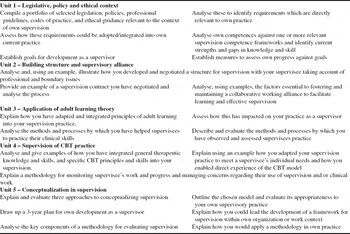
Training was based on Milne's (Reference Milne2007a, Reference Milne2009) EBCS and Roth & Pilling's (Reference Roth and Pilling2008) supervision competences. Training consisted of five modules delivered as sequential 1- to 2-day workshops over 5 months and included didactic teaching, group discussion, watching therapy videos, role-play, practice implementation and reflective assignments (Table 1).
Course content

Ethical considerations
The primary researcher, being a new CT supervisor and participating in the training, was in a unique position of being able to understand the process from a participant's viewpoint. Potential bias was minimized by being explicit, producing verifiable records, participant checks, conducting dual independent analysis of data with the research tutor and employing a reflexive approach to the research methodology and process (Mays & Pope, Reference Mays and Pope1995; Fleming et al. Reference Fleming, Spiers, McElwee and O'Gorman2001; Bryman, Reference Bryman2008).
Principles of autonomy, beneficence, non-maleficence, confidentiality, trust and informed consent were adhered to within the research. Research proposal peer-review, University ethical approval and written consent from NICTT and the participants were obtained prior to the commencement of fieldwork.
Findings
The participants
All participants were experienced mental health professionals, with post-graduate CT training, who provided CT supervision in at least one of: clinical practice, private practice or training organizations, for, on average, 8 years. The majority of participants were nurses; however, medicine and social work were also represented. Although the majority had received some supervision training in their primary profession, none had received any CT supervision training until after they started providing CT supervision.
Participants’ previous supervision practice
The majority of participants had received some prior CT supervision training before undergoing the recent training, mainly in the form of workshops, with just over half of participants having completed at least 18 hours of supervision training.
No one reported using a specific supervision model prior to the recent training, including those who had previous training covering supervision models. Two participants reported basing their previous supervision provision on CT alone, one on CT and their own CT supervision experience, one on their own supervision experience or ‘apprenticeship model’ alone and two reported using no model to guide their supervision.
Certainly in terms of the model I had never really thought, ‘Have I a model?’ and I would have just modelled it on CBT itself and how I had supervision.
Only one participant made reference to basing supervision on previous training, which was in combination with their own supervision experience. He was the only supervisor to use a contract in supervision prior to the studied training. Only one participant cited their previous profession and its influence as important. Prior to the supervision training the most common component was case discussion, particularly in clinical settings with trained therapists:
Well mainly through case discussion and case presentation and that would have tied in with the fact that who I was supervising was a qualified cognitive therapist.
All supervisors of trainees in both training and clinical placement settings reported using video and/or audio tapes in supervision. Just over half of supervisors reported using this method with trained therapists; however, less often than with trainees. This was associated with rating scales such as CTS-R only being used with trainees. Live observation, modelling or role-play was mainly reported by those supervisors providing supervision to trainees in clinical placements and this was related to having sufficient time for interaction.
Additionally, supervisors reported that they found supervision of trained therapists was generally more challenging than that of trainee therapists, particularly if the therapist was experienced, when there was apprehension about relative experience and not knowing if they were ‘doing it right’. The ability to maintain focus within supervision was also problematic.
Relationship issues and the impact of the work on the supervisee were relatively neglected areas, with only two supervisors paying attention to them, and to varying degrees.
Participants’ views on the impact of the training on current supervision practice
All participants reported that they had either learned about contracts for the first time or revised their knowledge about contracts. Five participants, who had not previously used contracts, had started to implement them and one was in the process of doing so. In addition, two participants had either implemented or discussed a supervision policy in their work:
So there is a contract now and that will be reviewed every year. It forced us to write a supervision policy at work . . . It is now part of our operational policy.
Participants reported that an explicit contract helped to: set the overall focus for the episode of supervision from the outset, based on a needs assessment; set ground rules; clarify expectations; prevent assumptions; improve collaboration; deal with relationship issues and was particularly useful for experienced staff where there was no ‘curriculum laid out’.
All reported an increased awareness of the supervisor and supervisee roles and responsibilities, particularly the issue of ‘vicarious liability’, which had been drawn into ‘sharp focus’. As a result they were less likely to make assumptions and more likely to ask questions to ascertain competency, request ‘evidence’, such as videoed therapy sessions or notes, including with trained staff, and improve record-keeping.
All participants reported that they now used a model of supervision, with six choosing the Hawkins & Shohet (Reference Hawkins and Shohet2006) process model and one choosing the Newcastle model (Armstrong & Freeston, Reference Armstrong, Freeston and Tarrier2006). There was unanimous agreement that using a model of supervision helped them take a ‘broader view’, but also helped focus what needed to be addressed within supervision sessions. The majority also reported that model use made supervision ‘more disciplined and structured’. All supervisors reported paying attention to supervisees’ learning styles and relationships. Most now reported considering the emotional impact on supervisees of the work, although only one linked this to potential effects on patients:
That learning style helped me look at style of supervision then that I applied. What works best with this particular supervisee? I would probably just have applied the same with everyone before.
Participants’ views on supervision training
All supervisors reported benefits of training including perceived improvements in knowledge, competence, confidence and the majority reported improvements in skill. Most associated the improvement in knowledge with self-directed learning and experiential aspects of the training, e.g. role-play. All thought the training was applicable to and improved their supervision practice. It was also apparent throughout the interviews that the training had resulted in all supervisors reflecting extensively on their own practice and that of other supervisors.
The main drawback of the training cited by six participants was the time commitment involved, particularly in relation to the written work, although some reported it had helped them develop useful supervision resources.
Although supervisors had expected to have their supervision evaluated using a rating instrument, e.g. Teacher's PETS (Milne et al. Reference Milne, James, Keegan and Dudley2002), it had not been. One supervisor reviewed supervision sessions videos following training and described them as having ‘more structure, more focus’. Two supervisors reported thinking patient outcomes were better but had not evaluated it. One participant considered video-recording supervision sessions as a research project ‘to measure the quality of supervision’ in the future.
I probably haven't actually sat down with my supervisee and looked at pre and post training. . . That's something for the future I could be mindful of working on . . . evaluating patient outcomes.
The main factors cited for not evaluating their supervision since training included: the perception of the time it would take; anxiety about potential negative feedback; lack of supervision consultation structures; lack of accurate feedback, due to anonymity issues, and reported evaluation fatigue.
No one reported receiving formal supervisory support. Five supervisors commented that they thought it would be beneficial to receive this to bring objectivity, accountability and help keep them up-to-date, motivated and maintain skills.
Discussion
There are a number of limitations to this research, many of which are common to qualitative research. The utilization of a purposive sampling technique and the lack of representation of all professions in the group (e.g. psychology) limit generalizabilty of findings. Additionally, the study population was small and therefore unlikely to reach data saturation (Bryman, Reference Bryman2008), although no new themes emerged in later interviews.
Participants’ most common influence for supervision was the CT therapy model (Padesky, Reference Padesky and Salkovskis1996) or their own supervision experience (Townend et al. Reference Townend, Iannetta and Freeston2002; Falender & Shafranske, Reference Falender and Shafranske2004) suggesting that no specific supervision model tends to be used, even for those with prior CT supervision training. This has implications for providing specific CT supervision training at an appropriate stage in the supervisor's development (Townend et al. Reference Townend, Iannetta and Freeston2002) and assessing the long-term impact as there is a ‘tendency to return to baseline’ following training (Miller & Mount, Reference Miller and Mount2001).
Before training, CT supervisors were more likely to use case discussion methods with trained therapists and live supervision methods with trainee therapists. BABCP expects all therapists to use live methods, as there is a tendency to over-rate competency (Miller & Mount, Reference Miller and Mount2001). Milne et al. (Reference Milne, Leck and Choudhri2009) described safety behaviours in supervision, where both parties avoid challenge and moving to experiential learning, e.g. therapy videos. This may explain the issues described by participants supervising trained therapists, which could possibly be addressed by supervisor training.
The perceived benefits were mainly for supervisors, with dilution of effect as consideration was given to perceived benefits for supervisees and patients (Milne & James, Reference Milne and James2000). As in Lee's (2005) study, the majority of supervisors reported implementing contracts and a supervision model following training, although Culloty et al. (Reference Culloty, Milne and Sheikh2010) found a much smaller proportion of supervisors made practice change.
Increased awareness of role and responsibilities had made supervisors more likely to request therapy videos/notes, including with trained staff, and to improve record keeping. This is likely to improve supervision through increased opportunities for supervisees’ experiential learning and prevents supervisees over-rating competence (Milne & James, Reference Milne and James2002; Brosan et al. Reference Brosan, Reynolds and Moore2008). Culloty et al. (Reference Culloty, Milne and Sheikh2010), similarly, discovered that supervisors were more likely to consider learning styles, particularly reflection, and encourage experiential learning following training.
It is interesting that participants mainly chose the Hawkins & Shohet (Reference Hawkins and Shohet2006) model, as in Lee's (Reference Lee2005) study, although Townend et al. (Reference Townend, Iannetta and Freeston2002) had been surprised that any CT therapists were using a process model. Perhaps this illustrates that a simpler model has more utility, as it provides structure and reminds supervisors of the processes they need to attend to during supervision itself, rather than conceptualizing following supervision, as has been suggested with the Newcastle model (Armstrong & Freeston, Reference Armstrong, Freeston and Tarrier2006).
It is recognized that there are difficulties in demonstrating the effect of supervision on patient outcomes. However Roth & Pilling (Reference Roth and Pilling2008) observed that supervisors made less use of objective measures of patient outcomes than would be expected, as in this research. Supervision evaluation tools have been criticized for being too prescriptive (Lee, Reference Lee2005), unreliable (Roth & Pilling, Reference Roth and Pilling2008) and time-consuming, which was one of the main obstacles cited by participants.
Experts recognize the importance of support for the stressful role of being a supervisor, with ultimate responsibility for both the patient and the supervisee (Milne, Reference Milne2009; Scaife, Reference Scaife2009). Stirman et al. (Reference Stirman, Bhar, Spokas, Brown, Creed, Perivoliotis, Farabaugh, Grant and Beck2010) have recommended that consultation structures need to be built into CT training programmes to prevent therapeutic drift. Participants welcomed the opportunity for support and thought that supervision would help them maintain skills. This is supported by the literature which demonstrates skill and confidence loss without supervision (Miller & Mount, Reference Miller and Mount2001; Mannix et al. Reference Mannix, Blackburn, Garland, Gracie, Moorey and Reid2006; Heaven et al. Reference Heaven, Clegg and Maguire2006).
Therefore, there needs to be urgent consideration of development of a user-friendly tool, which involves supervisee feedback, observation measures (Falender et al. Reference Falender, Cornish, Goodyear, Hatcher, Kaslow, Leventhal, Shafranske and Sigmon2004), and patient outcomes within a supervision consultancy framework to support supervisors.
Training included self-directed learning (SDL) and had common features with problem-based learning (PBL), where a facilitator sets problems to be tackled through group collaboration and SDL. The majority of the sequential tasks involved practice implementation followed by reflective writing. In systematic reviews of medical education Davis et al. (Reference Davis, Thompson, Oxman and Haynes1995) demonstrated that learning opportunities had most impact when they were delivered sequentially with practice implementation and Koh et al. (Reference Koh, Khoo and Wong2008) showed PBL improved competence and communication skills.
The training was in keeping with Knowles et al.'s (Reference Knowles, Holton and Swanson2005) adult learning theory, where adults are thought to learn best when: self-directed, using resources from life experience, motivated by problem-centred tasks required for their role and when they understand the utility of the learning. This may explain the high rates of reported improvements in knowledge, competence, confidence, skill and practice change in this group.
Summary
The conclusions from the study highlight a number of issues which, while they may not be generalizable to the wider population, nevertheless provide a snapshot of the views of participants on a supervisory programme similar to many which are implemented throughout the UK currently. As a ‘first step’ in investigating the supervisor–supervisee–patient triad, this study suggests supervision training appears to positively impact on supervisors’ ability to fulfil their role (Scaife, Reference Scaife2009). Participants had little or no prior relevant training to prepare them for supervision, so relied mainly on therapy models or their own supervision experience to guide supervision practice. CT supervisors should have specific CT supervision training at an appropriate career stage and the long-term effects assessed to establish when updates are required.
Even experienced CT supervisors benefited from training – it improved their perceptions of their own knowledge, competence, skill and confidence. Training made participants more aware of their role and responsibilities which resulted in practice change, e.g. use of contracts, specific supervision models, better relationship focus and attention to supervisee learning. Sequential self-directed learning, implementation and reflection were associated with practice improvement. Development of a user-friendly supervision evaluation tool with increased emphasis on patient outcomes should be a future research priority.
Declaration of Interest
None.
Acknowledgements
The authors thank Mr David Bolton, Mr Peter Armstrong, Professor Kate Gillespie and NICTT, who provided the training.
Learning objectives
(1) Training improved supervisors’ understanding of roles and responsibilities.
(2) Training resulted in practice change – use of contracts, supervision models, attention to learning and relationships.
(3) CT supervision training needs to focus on evaluating patient outcomes.



Comments
No Comments have been published for this article.