Disclaimer
The information contained within is not intended to diagnose or treat a patient. It is provided for educational purposes only and is not intended to be a substitute for professional medical advice, diagnosis, or treatment. The authors are not responsible or liable for any advice, course of treatment, diagnosis, or service.
Currently, New York, Illinois, Mississippi, and San Bernardino County (California) USA allow ambulance transport of injured law enforcement K9s (LEK9s) providing no human needs the ambulance at that time. It is essential that Emergency Medical Service (EMS) personnel be familiar with their state laws before transporting a LEK9.
For a comprehensive review of the nuances of the legalities of first responders treating working dogs, the authors direct readers to a review of this topic.Reference Hanel, Palmer and Baker 1 Real-time updates on changes in laws affecting EMS LEK9 transport or treatment can be found at www.workingdogHQ.com.
Injured, conscious LEK9s may pose a serious health risk to the personnel working around them. These dogs may exert bite forces up to 800psi and are trained to bite with all of their teeth until their handler commands a release.Reference Bodnar 2 The risk of injury to human personnel can be significantly reduced by the correct placement of a basket muzzle. No attempt at naloxone administration, transport, or first aid should be rendered to a working dog until a basket muzzle is in place. Unconscious LEK9s administered naloxone may wake in a temporarily aggressive state.
When approaching the scene of a suspected opioid overdosed LEK9, providers should wear personal protective equipment (PPE), including gloves, to prevent contact with potent opioids. Mouth-to-snout ventilation should NOT be attempted in these situations to avoid human harm or death from residual substances in or around the nose and mouth.
Introduction
Recently, several states and one county have enacted legislation allowing specific working dogs (eg, any dog owned or used by a law enforcement department or agency in the course of the agency’s work; LEK9s) to be transported by an EMS provider to a veterinary facility if the dog is injured in the line of duty. All such legislation stipulates that humans are treated/transported first, and injured LEK9s can only be transported if there is no human needing assistance. 3 – 6 Illinois, New York, Mississippi, and San Bernardino County (California) USA allow an ambulance to transport LEK9 officers injured in the line of duty to a veterinarian, but there is no provision for emergency care, except in San Bernardino County. 3 – 6 The Model Veterinary Practice Act, which most states adopt, stipulates that non-veterinary professionals cannot provide life-saving care to companion animals if they are being compensated, and emergency responders risk legal recourse if they treat a LEK9 officer. Exceptions include pet owners and LEK9 handlers, as well as good Samaritans (who are not being paid or performing these duties as part of a job). Several US states (Ohio, Colorado, Maryland, Wisconsin, and California) have legalized prehospital emergency treatment of LEK9s (and companion animals) by non-veterinary professionals. 7 – 11
There is no requirement for mandatory reporting of LEK9 deaths, and it is likely that voluntary reporting is an under-representation of actual deaths. There were 34 reported LEK9 deaths in 2016, according to the Officer Down Memorial Page. 12 From 2016 through July 17, 2018, there have been 68 reported LEK9 deaths. The majority died of trauma (blunt, penetrating, or drowning), and heat stroke killed 21 (31%); however, there is no category for reporting deaths related to opioid exposure.
Law enforcement K9s work to keep the public and their handler safe, and access to emergency medical assistance when injured may be life-saving. The newly enacted laws are a great first step in providing the transport needs; however, they have created significant knowledge and logistical gaps. Most EMS personnel are not trained to restrain and muzzle an injured LEK9. Transporting the LEK9 is also a dilemma as most EMS agencies do not have ready access to the nearest, appropriately equipped veterinary emergency facility. Having that information in advance of an emergency situation may be invaluable. In addition, while human EMS treatment protocols have existed for decades, no such guideline exists for injured LEK9s. The authors have partnered to create this transport protocol to ensure all EMS providers have the essential information needed to safely transport an injured LEK9.
Before Transport – Available Veterinary Facilities
Veterinary clinics and veterinary emergency facilities differ significantly in the scope of emergency care they can offer and the days/hours they are open. Many veterinary clinics may not have the equipment or the expertise to treat a severely injured LEK9, and not all are open continuously. The EMS medical director should create a list of local and regional veterinary emergency facilities, their location and hours of operation, and should establish a relationship with the veterinary medical director before an injured LEK9 requires transport. Ideally, a board-certified veterinary criticalist and a board-certified veterinary surgeon would be available continuously. In the absence of specialists, experienced emergency veterinarians and veterinary surgeons should be contacted. Transporting a LEK9 with severe trauma to a veterinary clinic that is not equipped to handle this type of care will prolong the time until necessary interventions, and may increase patient mortality. Establishing a relationship with a regional veterinarian equipped to handle these cases is ideal, and in several instances, veterinarians have provided a cell phone number for after-hours calling for these emergencies.
In human medicine, the “golden hour” may be referred to as the period of time following a traumatic injury during which there is the highest likelihood that prompt medical and surgical treatment will prevent death.13 Although this has not been evaluated in veterinary medicine, the same principle applies: the patient should be transported as quickly as possible to the facility most-equipped to deal with their injuries.
A prior agreement should be in place so that finances do not have to be discussed by EMS personnel at the veterinary facility (Appendix A; available online only). Law enforcement K9s are paid for by the specific agency that technically owns the dog, but costs must be approved by the commander. The veterinary facility would need access to the names of the handler, the specific agency in charge of the LEK9, and the commander for approval of the cost estimate. Pre-registration for each LEK9 at the veterinary clinic would save time and resources during a resuscitation. Emergency Medical Service personnel should be versed in safe restraint and safe application of an appropriate muzzle. Proficiency in prehospital emergency care for LEK9s is ideal (The Carle-Illinois [Urbana, Illinois USA] Treatment Protocol for LEK9s: Guidelines for Emergency Medical Service; Prehospital and Disaster Medicine: In Press, 2019), as it is likely that more states will exempt EMS personnel from the Veterinary Practice Act allowing them to provide prehospital emergency care.
Before Transport – Essential Equipment
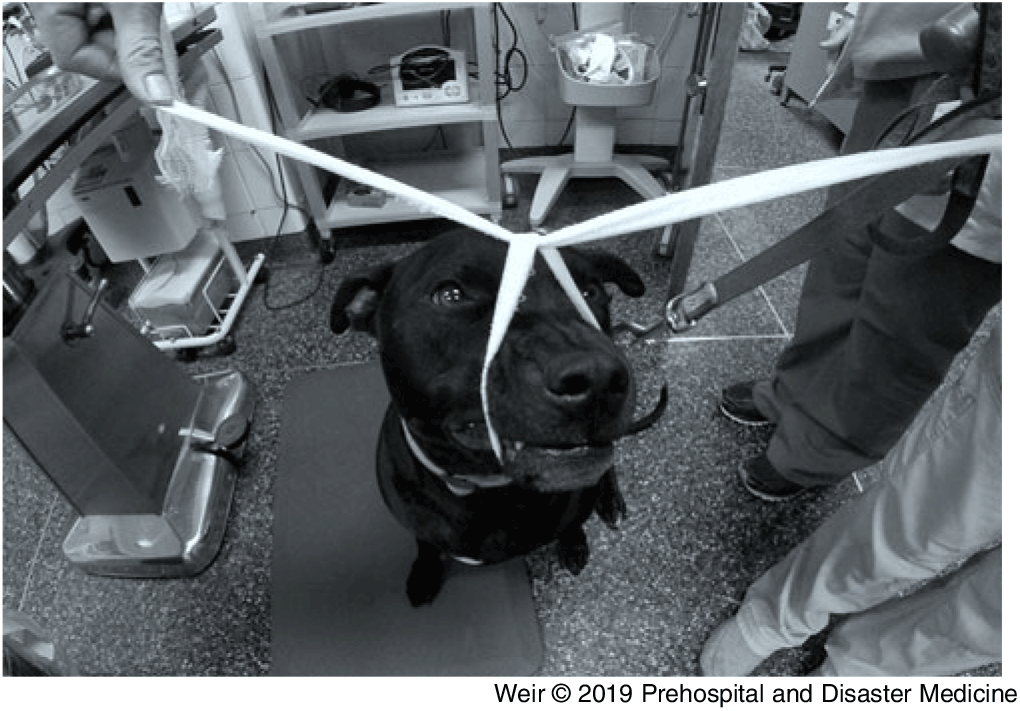
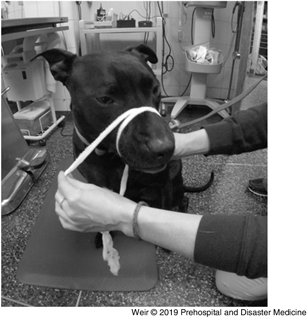
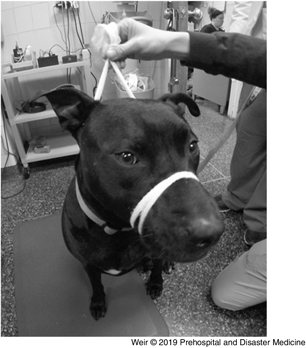
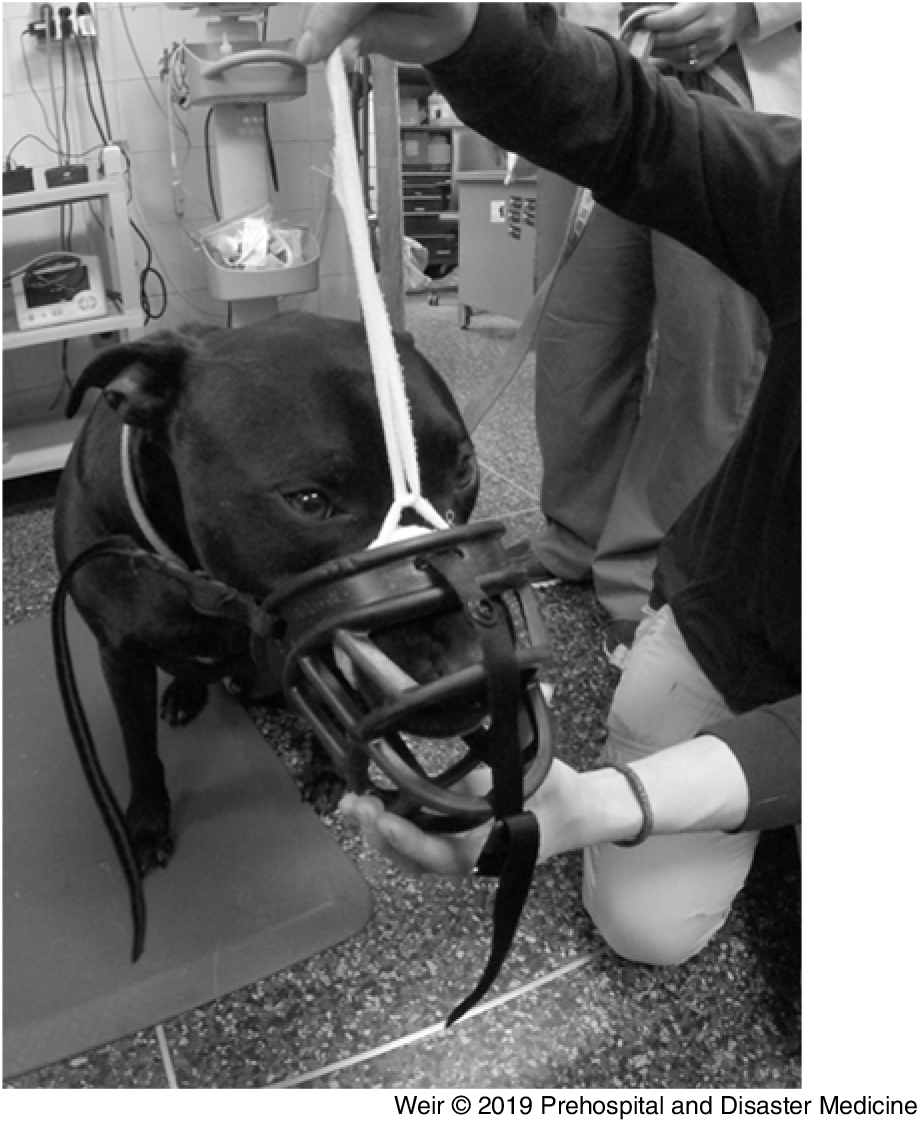
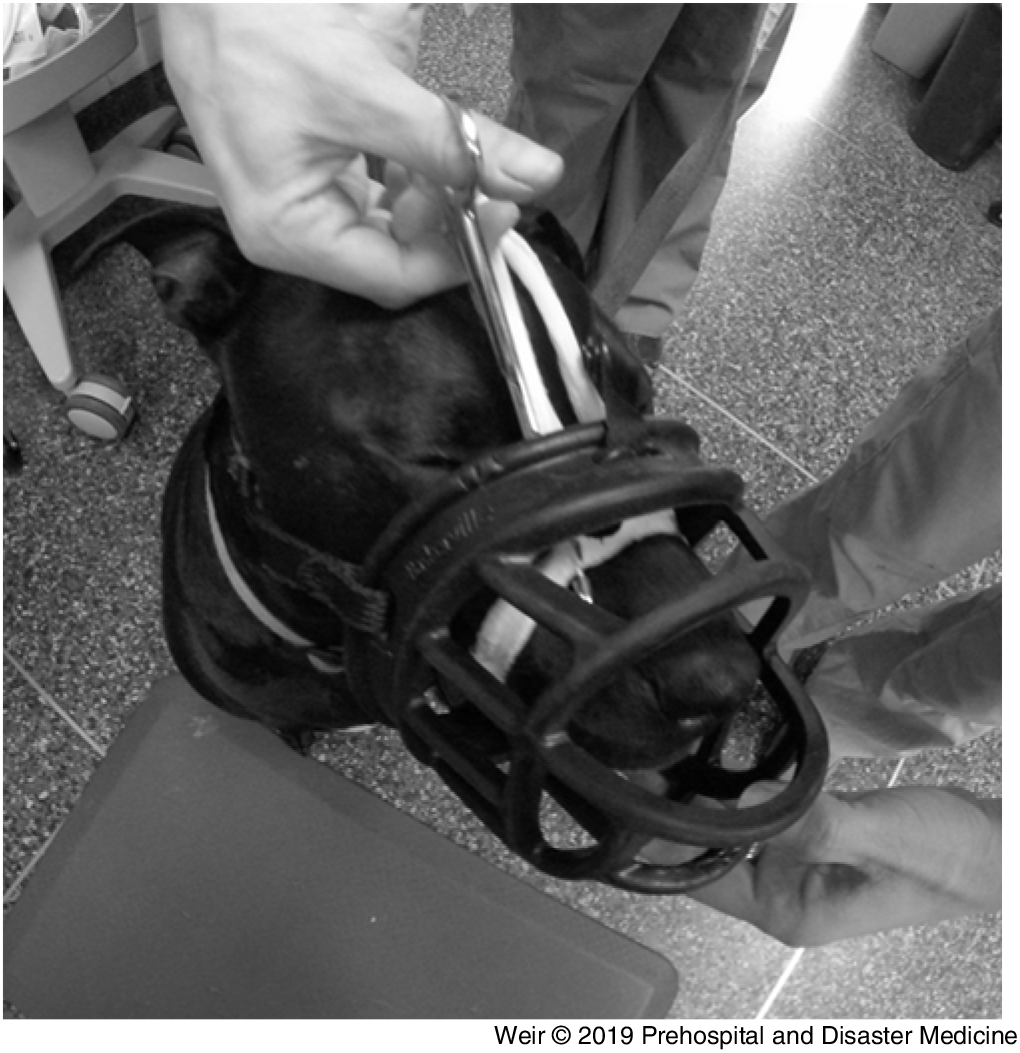
Most LEK9s are strong and potentially dangerous dogs. When injured or protective (eg, their handler is injured), they can be unpredictable. Even when unconscious (eg, opioid overdose), the dog can have violent outbursts, particularly after naloxone administration. A basket muzzle is essential to have on-hand and is the only type of muzzle recommended. Basket muzzles allow the dog to pant, an essential cooling mechanism for preventing heat-related conditions. Muzzles that prevent panting (eg, tight-fitting cloth muzzles) can lead to death from hyperthermia, particularly in dogs that are prone to high-anxiety states or are thrashing around. In cases where a cloth muzzle must be placed first, the basket muzzle should be placed as soon as possible, and the gauze muzzle removed once the basket muzzle is in place (Figures 1–7).
Temporary Placement of a Gauze (Soft Cloth) Muzzle on a Conscious Dog, Step 1.

Temporary Placement of a Gauze (Soft Cloth) Muzzle on a Conscious Dog, Step 2.

Temporary Placement of a Gauze (Soft Cloth) Muzzle on a Conscious Dog, Step 3.

Temporary Placement of a Gauze (Soft Cloth) Muzzle on a Conscious Dog, Final.

Placement of Basket Muzzle Over Gauze Muzzle.

Securing Basket Muzzle Over Gauze Muzzle.

Careful Removal of Gauze Muzzle After Basket Muzzle is in Place, Using Blunt Scissors, While One Person Restrains the K9.

A facemask should be dedicated to an average sized LEK9 (approximately 25-35kg; Large Canine or Size 5) and can be used to administer oxygen (eg, smoke inhalation or oxygen deficiency state). In an apneic LEK9, the facemask may be used to artificially ventilate the dog until arrival at a veterinary emergency room. This is the only exception to muzzling before treatment. In order to ventilate with the facemask, a tight seal must be created between the mask and the dog’s snout. Creating a seal, if needed, can be done by stuffing the edges of the mask with gauze. Exposure to opioids (eg, fentanyl or carfentanil) can cause respiratory depression and the need for artificial respiration while awaiting the effects of naloxone reversal. Mouth-to-snout rescue respiration should never be attempted in a LEK9 that may have been exposed to opioids. Carfentanil is 10,000 times as potent as morphine, and a very small amount of the powder (eg, in or around the nose of the LEK9) can be lethal to humans.
Having a dog toy such as a rawhide, a tennis ball, or a Kong (Kong Company; Golden, Colorado USA) can be helpful to distract an injured LEK9. Many LEK9s are calmed by these “treats,” and they can make a significant difference in a stressful situation.
At the Scene
As with all EMS calls, scene safety and PPE use are paramount. After any/all human injuries have been assessed and treated, the injured LEK9 can be assessed. The handler or their agent should always be the first point-of-contact in triaging an injured LEK9. Handlers are highly trained to restrain and muzzle their LEK9. In the event the handler is unavailable, another trained LEK9 handler is the next best option.
The remainder of this protocol assumes that no trained LEK9 handler is available to assist with the injured LEK9.
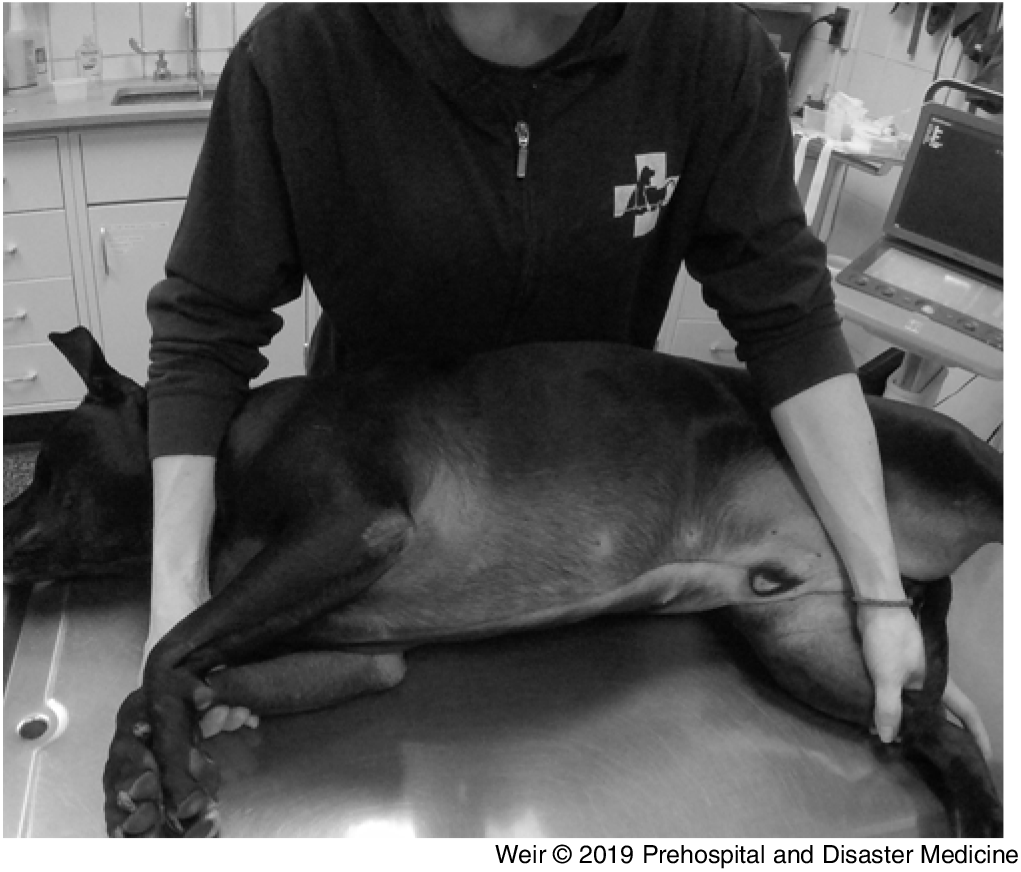
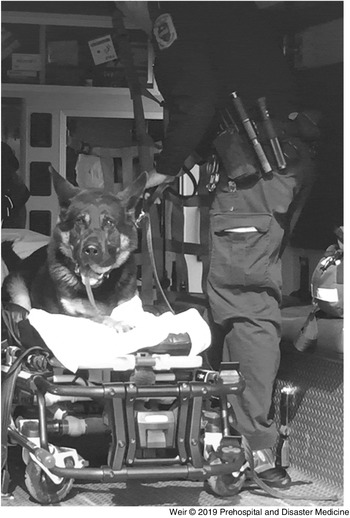
If the dog is extremely sedated or unconscious, a basket muzzle should be carefully placed if one is not already in place. If the dog is awake and/or flailing due to injuries, the dog will need to be carefully restrained by a minimum of two people before muzzle placement. No attempt at transport or first aid should be rendered to an awake LEK9 until a basket muzzle is in place, with the exception of the apneic LEK9. There are two methods of muzzle placement, depending on the state of the LEK9. For an approachable LEK9, one person will place one arm around the neck and hold the head in place while the other person places the basket muzzle (Figure 8 and Figure 9). In cases with an unapproachable LEK9 (eg, attempting to bite or very aggressive), again – all attempts should be made to get an experienced handler to the scene or a veterinarian who can administer sedatives. When this is not possible, a temporary muzzle (eg, gauze muzzle) should be placed, then the dog should be restrained and a basket muzzle placed over the gauze muzzle (Figures 1–6). Finally, the gauze muzzle is carefully removed using blunt bandage scissors while someone restrains the dog (Figure 7). Distracting the dog with a toy (a rawhide, a tennis ball, or a Kong) can sometimes be very helpful as this is the reward system used by many law enforcement handlers. In a recent training exercise, a LEK9 willingly laid on the stretcher in an ambulance after he got his tennis ball (Figure 10).
Restraint of K9 Sitting.

Restraint of K9 Lying Down.

Law Enforcement K9 in Ambulance with Tennis Ball in His Mouth.

Once a muzzle is in place, the dog should be carefully placed (eg, protect C spine) on a back board/stretcher and strapped in place. In transport, oxygen can be administered via a face mask over the muzzle or by flow through the muzzle. If all supplemental oxygen administration attempts seem to provoke anxiety in the LEK9, it may need to be withheld. All LEK9s should be transported with their handler unless the handler is critically ill/injured. In such a case, another handler or an officer should be transported with the LEK9. Life-saving first aid is covered in The Carle-Illinois (Urbana, Illinois USA) Treatment Protocol for LEK9s: Guidelines for Emergency Medical Service; Prehospital and Disaster Medicine: In Press, 2019.
At the Veterinary Facility
All EMS personnel should be prepared to relay handler information and, if possible, the contact information for the law enforcement commander who is responsible for approval of all medical/surgical costs. If a prior relationship has been set up between law enforcement and the veterinary facility, the EMS personnel do not have to discuss finances. Responsibility of the injured LEK9 is under EMS personnel until the care is transferred to a veterinary facility with a licensed veterinarian on-site. Hand-off should be documented and the form sent to the law enforcement commander (Appendix B; available online only).
After Transport
Standard decontamination (eg, Cavicide [Metrex Research LLC; Orange, California USA] or similar wipes) of the vehicle should be sufficient. Contagious diseases (eg, zoonotic) are possible but unlikely in a previously healthy working LEK9. The exception is possible contamination with potent illicit opioid powders (eg, fentanyl or carfentanil) if the dog was a drug search LEK9. If there is any potential for this possibility, the current National Institute for Occupational Safety and Health (NIOSH; Washington, DC USA) recommendation of a N100 mask, safety glasses, nitrile gloves, and long sleeves should be utilized.
Conclusion
Law enforcement K9s are extremely valuable from multiple perspectives, including the lives they save, the protection they provide, and the time and financial investment in their training. It is likely that the legislation started in New York, Illinois, Mississippi, and San Bernardino County (California) will be followed by other states, and it is the authors’ hope that this transport protocol will provide a framework for the EMS crew to safely transport injured LEK9s to an appropriate veterinary hospital.
Acknowledgments
The authors would like to acknowledge the Carle EMS providers and the K9 handlers involved in the training; Drs. Cindy Otto, Christopher Byers, and Caroline Tonozzi; the ER technicians who helped with the images; and the wonderful LEK9s they had the privilege of working with.
Conflicts of interest
none
Supplementary Material
To view supplementary material for this article, please visit https://doi.org/10.1017/S1049023X1900445X