1. Introduction
The concept of thermal maturation has been described as the heat budget that is necessary to sustain long-lived magma reservoirs (e.g. Annen et al. Reference Annen, Blundy, Leuthold and Sparks2015; Alasino et al. Reference Alasino, Larrovere, Rocher, Dahlquist, Basei, Memeti, Paterson, Galindo, Macchioli Grande and da Costa Campos Neto2017; Karakas et al. Reference Karakas, Degruyter, Bachmann and Dufek2017). In particular, upper crustal reservoirs are fed from deeper levels, where magma is generated in extensive lower crustal mush zones (e.g. Solano et al. Reference Solano, Jackson, Sparks, Blundy and Annen2012; Karakas et al. Reference Karakas, Degruyter, Bachmann and Dufek2017). The heat supply that allows partial melting in these zones is provided by mantle upwelling or mafic underplating/intraplating of mafic magmas at the base of the crust (Solano et al. Reference Solano, Jackson, Sparks, Blundy and Annen2012; Annen et al. Reference Annen, Blundy, Leuthold and Sparks2015; Alasino et al. Reference Alasino, Larrovere, Rocher, Dahlquist, Basei, Memeti, Paterson, Galindo, Macchioli Grande and da Costa Campos Neto2017; Dahlquist et al. Reference Dahlquist, Alasino, Basei, Morales Cámera, Macchioli Grande and da Costa Campos Neto2018). The generated melts then ascend and are emplaced in the upper crust, causing mass and heat transfer from deeper to shallow levels (Read, Reference Read1962; Petford et al. Reference Petford, Cruden, McCaffrey and Vigneresse2000; Annen et al. Reference Annen, Blundy, Leuthold and Sparks2015; Cruden & Weinberg, Reference Cruden, Weinberg and Burchardt2018). In consequence, the formation of magmatic systems has direct thermal implications for the surrounding crust: they change the local geothermal gradient and modify the response of the host rock to local magma emplacement (Yoshinobu et al. Reference Yoshinobu, Okaya and Paterson1998; Paterson et al. Reference Paterson, Okaya, Memeti, Economos and Miller2011). At the onset of magmatic activity, emplaced magma encounters a relatively cold environment, with an undisturbed geotherm (Karakas et al. Reference Karakas, Degruyter, Bachmann and Dufek2017). The advective heat provided by successive magma emplacement makes the crust thermally mature, and thus the ascent and emplacement of following pulses are now facilitated by dike–diapir interactions (Cao et al. Reference Cao, Kaus and Paterson2016; Alasino et al. Reference Alasino, Larrovere, Rocher, Dahlquist, Basei, Memeti, Paterson, Galindo, Macchioli Grande and da Costa Campos Neto2017). This means that prolonged magmatic activity modifies the thermal maturation of the crust with time, driving changes in emplacement style from tabular-subhorizontal to diapiric-vertical nested intrusions (Alasino et al. Reference Alasino, Larrovere, Rocher, Dahlquist, Basei, Memeti, Paterson, Galindo, Macchioli Grande and da Costa Campos Neto2017; Macchioli Grande et al. Reference Macchioli Grande, Alasino, Rocher, Larrovere, Uran, Reinoso Carbonell and Moreno2019), or to incrementally nested sheeted intrusions (Hines et al. Reference Hines, Paterson, Memeti and Chambers2018). This creates a magma pathway which connects lower crustal levels, where magma is generated, to upper crustal reservoirs (Alasino et al. Reference Alasino, Larrovere, Rocher, Dahlquist, Basei, Memeti, Paterson, Galindo, Macchioli Grande and da Costa Campos Neto2017; Cashman et al. Reference Cashman, Sparks and Blundy2017; Karakas et al. Reference Karakas, Degruyter, Bachmann and Dufek2017).
Furthermore, the thermal conditions reached in the lower crust may exert control on the composition of the successive magma batches (Annen et al. Reference Annen, Blundy and Sparks2006; Melekhova et al. Reference Melekhova, Annen and Blundy2013). Most of the processes that shape the resulting geochemical composition of magmas are achieved in the lower crustal source, and are mostly limited to source compositions and melting temperatures, as well as pressure conditions and water content (e.g. Patiño Douce, Reference Patiño Douce, Castro, Fernández and Vigneresse1999; Annen et al. Reference Annen, Blundy and Sparks2008; Solano et al. Reference Solano, Jackson, Sparks, Blundy and Annen2012; Gao et al. Reference Gao, Zheng and Zhao2016b). In a thermally mature lower crustal mush, higher temperatures would lead to higher melt fractions, changing the composition of subsequent melts. However, the geochemical changes driven by thermal maturation are hard to identify in most magmatic systems, since most magma reservoirs are indeed open systems, and therefore compositional differences respond to interaction of magma with mantle-derived and/or crustal magmas, or to interactions with the local surrounding crust (Alasino et al. Reference Alasino, Larrovere, Rocher, Dahlquist, Basei, Memeti, Paterson, Galindo, Macchioli Grande and da Costa Campos Neto2017; Hines et al. Reference Hines, Paterson, Memeti and Chambers2018). Closed (or nearly closed) magmatic systems evolve without interactions with other melts during magma chamber construction, and are the best examples for testing the effects of thermal maturation in the petrological and geochemical evolution of an intrusive complex (e.g. Annen et al. Reference Annen, Blundy and Sparks2006). In these cases, the isotopic composition of the magma reflects the nature of the source, which does not change during the growth and evolution of the magmatic system (e.g. Gao et al. Reference Gao, Zheng and Zhao2016a).
In our view, the Huaco Intrusive Complex in the Sierras Pampeanas of NW Argentina is a clear example of this kind of nearly closed system. In this paper, we present new geochemical, isotopic and geochronological data to test this hypothesis. Based on these results, and in integration with a previous structural model in which a change in the emplacement style occurs within time (Macchioli Grande et al. Reference Macchioli Grande, Alasino, Rocher, Larrovere, Uran, Reinoso Carbonell and Moreno2019), we propose that thermal maturation was achieved concomitantly in both the lower and upper crust during the evolution of this intrusive complex, and so it affected the complete magmatic column.
2. Geological background
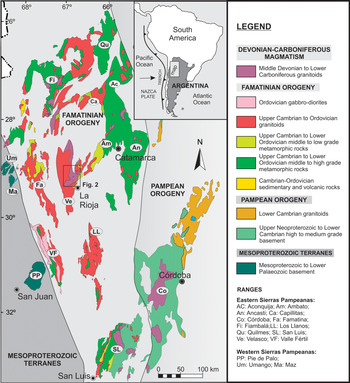
The Sierras Pampeanas in NW Argentina are a group of mountainous ranges that comprise the broken foreland of the active Andean orogeny, which completed their major uplift from Cretaceous to Miocene times (e.g. Jordan & Allmendinger, Reference Jordan and Allmendinger1986; Löbens et al. Reference Löbens, Bense, Wemmer, Dunkl, Costa, Layer and Siegesmund2010; Bense et al. Reference Bense, Löbens, Dunkl, Wemmer and Siegesmund2013) (Fig. 1). They record three main magmatic events of Palaeozoic age: Early Cambrian (Pampean Orogeny), Ordovician (Famatinian Orogeny) and Late Devonian – Carboniferous (Achalian – Early Gondwanan Magmatism) (e.g. Casquet et al. Reference Casquet, Dahlquist, Verdecchia, Baldo, Galindo, Rapela, Pankhurst, Morales, Murra and Fanning2018; Dahlquist et al. Reference Dahlquist, Alasino, Basei, Morales Cámera, Macchioli Grande and da Costa Campos Neto2018, Reference Dahlquist, Macchioli Grande, Alasino, Basei, Galindo, Moreno and Morales Cámera2019; Rapela et al. Reference Rapela, Pankhurst, Casquet, Dahlquist, Fanning, Baldo, Galindo, Alasino, Ramacciotti, Verdecchia, Murra and Basei2018; Weinberg et al. Reference Weinberg, Becchio, Farias, Suzaño and Sola2018).
Schematic geological map of Sierras Pampeanas, NW Argentina, modified from Larrovere et al. (Reference Larrovere, de los Hoyos, Willner, Verdecchia, Baldo, Casquet, Basei, Hollanda, Rocher, Alasino and Moreno2020). The limits between older Mesoproterozoic terranes with both Late Neoproterozoic to Early Cambrian Pampean Orogeny and Late Cambrian to Ordovician Orogeny are represented.

Achalian – Early Gondwanan magmatism is well preserved in the Sierras Pampeanas within three groups: (i) intracontinental, metaluminous and strongly peraluminous A-type Middle to Upper Devonian batholiths; (ii) metaluminous to peraluminous A-type Carboniferous (Lower Mississippian) isolated plutons and large complexes to the east; and (iii) metaluminous I-type Carboniferous (Lower Mississippian) isolated plutons and large complexes to the west (including Frontal Cordillera) (Dahlquist et al. Reference Dahlquist, Alasino, Basei, Morales Cámera, Macchioli Grande and da Costa Campos Neto2018). Group (ii) rocks formed in a retro-arc setting, whereas group (iii) rocks were generated in an arc setting (Alasino et al. Reference Alasino, Dahlquist, Pankhurst, Galindo, Casquet, Rapela, Larrovere and Fanning2012; Dahlquist et al. Reference Dahlquist, Alasino, Basei, Morales Cámera, Macchioli Grande and da Costa Campos Neto2018).
Metaluminous to peraluminous retro-arc A-type granites are particularly well represented in the Sierra de Velasco (Fig. 1). The San Blas Intrusive Complex covers most of the northern part of this range, with three units (Asha, San Blas and Hualco) with ages that range between 346 ± 6 and 340 ± 7 Ma (Alasino et al. Reference Alasino, Larrovere, Rocher, Dahlquist, Basei, Memeti, Paterson, Galindo, Macchioli Grande and da Costa Campos Neto2017). The complex formed from multiple non-consanguineous magma intrusions that utilized the same magmatic plumbing system during downward transfer of host materials. As the plutonic system matures, the ascent of magmas was governed by the viscoelastic flow of host rocks, which for younger batches include older hot magma mush (Alasino et al. Reference Alasino, Larrovere, Rocher, Dahlquist, Basei, Memeti, Paterson, Galindo, Macchioli Grande and da Costa Campos Neto2017). In addition, the strongly peraluminous A-type La Costa pluton intrudes the Asha unit of the San Blas Intrusive Complex with a crystallization age of 342 ± 8 Ma (Dahlquist et al. Reference Dahlquist, Alasino, Basei, Morales Cámera, Macchioli Grande and da Costa Campos Neto2018). Geobarometric empiric calculations yielded emplacement pressures of 2 kbar, corresponding to depths of 5–7 km (Alasino et al. Reference Alasino, Dahlquist, Galindo, Casquet and Saavedra2010). Notably, this unit also yielded an inherited Late Devonian (Famennian) age of 371 ± 7 Ma (Dahlquist et al. Reference Dahlquist, Alasino, Basei, Morales Cámera, Macchioli Grande and da Costa Campos Neto2018). The centre of the range comprises outcrops of the Huaco Intrusive Complex with an extended range of ages between 358 ± 5 Ma and 345 ± 1 Ma (Grosse et al. Reference Grosse, Söllner, Báez, Toselli, Rossi and de la Rosa2009), which is the focus of the present work. This complex of batholithic dimensions exhibits an emplacement history that includes ascent of magmas and emplacement at upper crustal levels, which involved a switch in the emplacement mechanisms from brittle to brittle-ductile, and also in the overall pluton geometry, switching from older subhorizontal tabular to funnel-shaped bodies, to younger subvertical piercing diapirs, reflecting a change in thermal conditions (Macchioli Grande et al. Reference Macchioli Grande, Alasino, Rocher, Larrovere, Uran, Reinoso Carbonell and Moreno2019).
The Huaco Intrusive Complex, compared to other Carboniferous A-type plutons in the Sierras Pampeanas, is intruded by penecontemporaneous alkaline mafic dykes that are classified as back-arc basalts (Alasino et al. Reference Alasino, Dahlquist, Pankhurst, Galindo, Casquet, Rapela, Larrovere and Fanning2012). The host rocks of this intrusive complex are composed of Ordovician granites comprising a range from undeformed to ultramylonitic with a NNW overall strike under amphibolite facies conditions, named the Antinaco Complex (Rossi et al. Reference Rossi, Toselli and López1999; Larrovere et al. Reference Larrovere, Alasino and Baldo2016), and subordinate Ordovician metasedimentary rocks of the La Cébila Metamorphic Complex (Verdecchia et al. Reference Verdecchia, Baldo, Benedetto and Borghi2007; de los Hoyos et al. Reference de los Hoyos, Willner, Larrovere, Rossi, Toselli and Basei2011; Grosse et al. Reference Grosse, Bellos, de los Hoyos, Larrovere, Rossi and Toselli2011) (Fig. 1).
3. Analytical methods
A total of 40 samples were collected for petrography in the Huaco Intrusive Complex, 20 from the Huaco unit (HU) and 20 from the Sanagasta unit (SU), from which six samples (three per unit) were selected for electron microprobe analyses of plagioclase and biotite. Another six samples were collected for whole-rock O isotope composition (Table 6, further below): two from the HU (VEL-3155 and VEL-3156), two from the SU (SAN-103 and SAN-104) and two from mafic dykes (HUA-200 and HUA-201). HUA-200 has an aphanitic texture whereas HUA-201 shows vesicles filled with secondary calcite, i.e. an amygdaloidal texture. One of the granitoids belonging to the SU (SAN-103) was also analysed for whole-rock (major and trace elements) geochemistry, Nd isotopes and U–Pb zircon geochronology.
Whole-rock major and trace elements of sample SAN-103 were measured using a ThermoARL sequential X-ray fluorescence spectrometer, following the procedure described by Johnson et al. (Reference Johnson, Hooper and Conrey1999). The results are shown in Table S1 in the Supplementary Material available online at https://doi.org/10.1017/S0016756820000692. Precision is reported at http://cahnrs.wsu.edu/soe/xrf_precision/. Trace element compositions were determined using an Agilent 7700 ICP mass spectrometer, according to the procedure and precision described at https://environment.wsu.edu/facilities/geoanalytical-lab/technical-notes/icp-ms-method/.
Mineral chemistry was determined on representative rock samples using a JEOL JXA 8230 microprobe equipped with three tuneable wavelength-dispersive spectrometers at the Electronic Microscopy and X-Ray Analysis Laboratory (LAMARX) of the Córdoba National University (Córdoba, Argentina). Absolute abundance for each element was determined by comparison with standards. The following operating conditions were applied: acceleration voltage of 15 keV, probe current of 10 nA and beam diameter of 5 µm. An online ZAF program was used.
Sr and Nd isotopic analysis of whole rock sample SAN-103 was carried out at the Geochronology and Isotope Geochemistry Center at the Complutense University (Madrid, Spain) using an automated multicollector TIMS-Phoenix®. Errors are quoted throughout as two standard deviations from measured or calculated values. Analytical uncertainties are estimated to be 0.01 % for 87Sr/86Sr, 0.006 % for 143Nd/144Nd, 1 % for 87Rb/86Sr and 0.1 % for 147Sm/144Nd. Replicate analyses of the NBS-987 Sr-isotope standard yielded an average 87Sr/86Sr ratio of 0.710246 ± 0.000011 (n = 9), and La Jolla Nd-isotope standard yielded an average 143Nd/144Nd ratio of 0.512106 ± 0.000006 (n = 6). 87Sr/86Sr and 143Nd/144Nd were normalized to 86Sr/88Sr = 0.1194 and 146Nd/144Nd = 0.7219, respectively.
Oxygen isotope analyses of powdered samples SAN-103, SAN-104, VEL-3155, VEL-3156, HUA-200 and HUA-201 were performed at the Institute of Earth Surface Dynamics (IDYST) of the University of Lausanne (Lausanne, Switzerland). Between 0.5 and 2 mg of sample was loaded onto a small Pt sample holder and pumped out to a vacuum of 10−6 mbar. After preflourination of the sample chamber overnight, the samples were heated with a CO2 laser in 50 mbar of pure F2. Excess F2 is separated from the O2 produced by conversion to Cl2 using KCl held at 150°C. The extracted O2 is collected on a molecular sieve (5 A) and subsequently expanded into the inlet of a Finnigan MAT 253 isotope ratio mass spectrometer. Oxygen isotope compositions are given in the standard notation, expressed relative to V-SMOW in per mil (‰). Replicate oxygen isotope analyses of the standard used (LS_1 quartz; n = 3) have an average precision of ±0.119 ‰ for 18O. The accuracy of 18O values is better than 0.2 ‰ compared to accepted δ18O values for LS_1 of 18.1‰.
Zircon geochronology methods follow those reported in Dahlquist et al. (Reference Dahlquist, Alasino, Basei, Morales Cámera, Macchioli Grande and da Costa Campos Neto2018). Zircon grains were separated following the classic method. Approximately 3 kg of rock was crushed and sieved. The <140 mesh fractions were separated using hydraulic processes to obtain heavy mineral pre-concentrates, which were further separated in bromoform and then methylene iodide to obtain a fraction enriched in zircons. This was followed by an electromagnetic separation with Frantz Isodynamic equipment when necessary. The final selection of crystals, mounted in 2 cm diameter epoxy resin and polished, was examined under a binocular microscope. The grains were photographed in reflected and transmitted light, and cathodoluminescence (CL) images were produced in order to investigate the internal structures of the zircon crystals as well as to characterize different populations.
Laser ablation – multicollector – inductively coupled plasma – mass spectrometer (LA-MC-ICP-MS) U–Pb analysis of SAN-103 (renamed SAB-103 at the laboratory) sample was carried out at the Geochronological Research Center, São Paulo University, Brazil, using a 193 nm excimer laser (Photon Machines) coupled to a Neptune multicollector, double-focusing, magnetic sector ICP-MS. Operating procedures and parameters are discussed by Sato et al. (Reference Sato, Basei, Ferreira, Sproeser, Vlach, Ivanuch and Onoi2011). Fractionation in the plasma was corrected by normalizing to the U/Pb and Pb/Pb ratios of zircon standard GJ 1 (206Pb/238Pb age by isotope dilution thermal ionization mass spectrometry (ID-TIMS) = 599.8 ± 2.4 Ma).
A database of 35 already reported whole-rock geochemistry samples and 20 analyses of Nd isotopic composition for the Huaco Intrusive Complex from Grosse et al. (Reference Grosse, Söllner, Báez, Toselli, Rossi and de la Rosa2009) and Dahlquist et al. (Reference Dahlquist, Alasino, Eby, Galindo and Casquet2010) were used for the petrogenetic discussion, in addition to new data collected in this study.
4. The Huaco Intrusive Complex
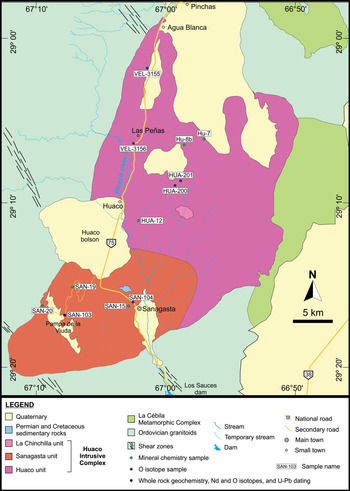
The Huaco Intrusive Complex is a large plutonic body of batholithic dimensions which covers an area of 1140 km2 in the centre of the Sierra de Velasco, NW Argentina (Fig. 2). It is composed of three main units defined by Grosse et al. (Reference Grosse, Söllner, Báez, Toselli, Rossi and de la Rosa2009), which are, from older to younger: Huaco (HU), with a zircon U–Pb LA-ICP-MS age of 354 ± 4 Ma (Söllner et al. Reference Söllner, Gerdes, Grosse and Toselli2007), Sanagasta (SU), with a monazite U–Pb TIMS age of 353 ± 1 Ma (Grosse et al. Reference Grosse, Söllner, Báez, Toselli, Rossi and de la Rosa2009) and 353 ± 5 Ma (this work), and La Chinchilla (LCU), with a monazite U–Pb TIMS age of 345 ± 1 Ma (Grosse et al. Reference Grosse, Söllner, Báez, Toselli, Rossi and de la Rosa2009), all of Early Mississippian (Tournaisian) age. LCU comprises a small body (2 km2) intruding the HU with a separate evolution (Macchioli Grande et al. Reference Macchioli Grande, Alasino, Rocher, Larrovere and Dalhquist2015), and therefore will not be addressed in this work.
Geological sketch map of the central region of the Sierra de Velasco, showing the outcrops of the Huaco Intrusive Complex and the samples analysed for whole rock geochemistry, Nd and O isotopes, U–Pb geochronology and mineral chemistry.

The HU covers an area of 900 km2, with a subcircular to slightly elongated shape in aerial view (Fig. 2). It is a porphyritic monzogranite with K-feldspar (microcline) megacrysts 5–10 cm long in a megacryst:matrix proportion of 60:40. The matrix is coarse- to medium-grained and the proportion varies along with the grain size from porphyritic to slightly porphyritic textures (with phenocrysts 1 cm long) and even equigranular, finer-grained ones, mainly near the contacts. The main mineral association of the matrix is Qz–Mc–Pl–Bt–Ms (mineral abbreviations after Whitney & Evans, Reference Whitney and Evans2010). The unit exhibits low to medium angle-dipping contacts with the Ordovician host rocks. Besides, contacts are locally sharp, with stepped patterns, and xenoliths with sharp edges are common near such contacts, which indicate that HU was emplaced accompanied by brittle deformation in the host rocks, at upper crustal levels (Macchioli Grande et al. Reference Macchioli Grande, Alasino, Rocher, Larrovere, Uran, Reinoso Carbonell and Moreno2019). No contact metamorphism and/or ductile deformation were recognized.
The SU is a subcircular to ellipsoidal body of 140 km2, which crops out in the southwestern region of the HIC (Fig. 2). It is a porphyritic monzogranite, with megacrysts of Mc 10 cm long, in a megacryst:matrix proportion of 70:30. Matrix is coarse- to medium-grained and its mineral association is Qz–Pl–Mc–Bt. Often Mc megacrysts exhibit Pl mantles, which define a rapakivi texture. They are frequently accompanied by Pl crystals of 3 × 2 cm with a sieved texture. The contacts between the SU and its host rocks are regionally subvertical and gradational with local foliation deflections which involved both brittle and ductile deformation (Macchioli Grande et al. Reference Macchioli Grande, Alasino, Rocher, Larrovere, Uran, Reinoso Carbonell and Moreno2019). These authors argue for a piercing-diapir emplacement mechanism, at upper crustal levels as well.
Mafic dykes intrude the HU. They are black, 1–5 m wide and have a NE strike with a vertical dip. They have lobate contacts and sometimes show incorporated granite fragments. They show a porphyritic texture due to the presence of phenocrysts of Afs, Qz and Bt in an aphyric groundmass. Some samples exhibit vesicles filled with carbonates. One sample of these dykes was classified as trachyandesite by Dahlquist et al. (Reference Dahlquist, Alasino, Eby, Galindo and Casquet2010), with a SiO2 content of 57 wt %.
Felsic dykes and microgranular enclaves are a common feature in both the HU and SU. They have mostly the same mineralogy as the host granitoid (Qz–Mc–Pl–Bt ± Turm) and are thus granitic in composition. Mafic enclaves are scarce, and their mineralogy is composed of Bt–Qz–Fsp, with Bt being the dominant phase. Grosse et al. (Reference Grosse, Söllner, Báez, Toselli, Rossi and de la Rosa2009) classified them as tonalites and quartz-diorites. Finally, schlieren (i.e. biotite-rich bands) can also be found in both units.
5. Results
5.a. Petrography
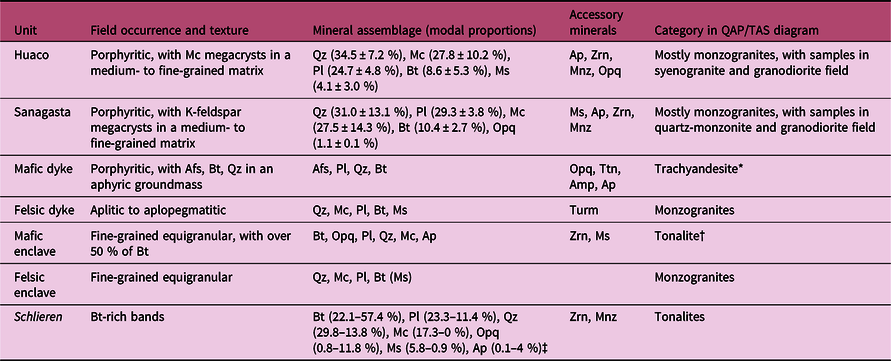
Petrographic characteristics of the igneous units are summarized in Table 1. In this section, we include extensive description of the two main units of the intrusive complex (HU and SU) as well as the mafic dykes.
Summary of petrological characteristics of the igneous units from Huaco Intrusive Complex

* Classified as trachyandesite by Dahlquist et al. (Reference Dahlquist, Alasino, Eby, Galindo and Casquet2010).
† Modal proportions from Grosse et al. (Reference Grosse, Söllner, Báez, Toselli, Rossi and de la Rosa2009).
‡ Data from two samples, Hu-8b from HU, and SAN-19 from SU, shown as (Hu-8b – SAN 19).
HU samples are dominantly monzogranites, to syenogranites, with few samples in the granodiorite field (Fig. S1 in Supplementary Material available online at https://doi.org/10.1017/S0016756820000692). The matrix mineral assemblage consists of Qz (34.5 %), Mc (27.8 %), Pl (24.7 %), Bt (8.6 %), Ms (4.1 %), and Ap, Zrn, Mnz and Opq as accessory phases (modal proportions of seven samples). Qz is anhedral, coarse- (8 × 6 mm) to fine-grained (0.5 × 0.5 mm), with occasionally undulatory extinction. Pl is observed in three main subtypes: Pla is coarse- (6 × 3 mm) to fine-grained (1 × 0.7 mm), anhedral, with disequilibrium textures and oscillatory and patchy zoning; some crystals exhibit sericite-altered cores; Plb crystals are smaller (1.2 × 0.8 mm), subhedral, tabular, with polysynthetic twinning, and exhibit neither zoning nor alteration; Plc is fine-grained (0.7 × 0.35 mm), tabular and occurs as inclusion in Mc. Mc is coarse- (10 × 5 mm) to fine-grained (0.7 × 0.3 mm), tabular, perthitic; the largest crystals contain inclusions of Pl, Qz and Bt. Bt forms clots of crystals, medium- (3 × 1 mm) to fine-grained (0.35 × 0.05 mm), tabular, subhedral, with pleochroism from light to dark brown; they include accessory phases such as Ap, Zrn and Mnz, and it is frequently replaced by secondary Ms; basal sections are anhedral, frequently altered to oxides and do not exhibit pleochroism. Ms is mainly of a secondary origin, replacing Bt, or primarily occurring as small euhedral crystals.
The samples of SU are mostly monzogranites, with one sample plotting in the quartz-monzonite field and another one in the granodiorite field (Fig. S1 in Supplementary Material available online at https://doi.org/10.1017/S0016756820000692). The matrix mineral assemblage is composed of Qz (31.0 %), Pl (29.3 %), Mc (27.5 %), Bt (10.4 %), Opq (1.1 %) and Ms, Ap, Zrn and Mnz as accessory phases (modal proportions of four samples). Qz is coarse- (8 mm) to fine-grained (0.8 mm), anhedral, equidimensional, with undulose extinction, and contains inclusions of Bt, Zrn and Mnz. Pl can be found in three subtypes: Pla is medium-grained (4 × 2 mm), tabular, anhedral, with oscillatory and patchy zoning; it can be highly altered and usually contains inclusions of Ap and Opq. Plb is medium- to fine-grained (1.2 × 0.9 mm), tabular, subhedral, with polysynthetic twinning and unzoned, and contains inclusions of Bt, Ap and Opq. Plc appears as inclusions in Mc, and is euhedral to subhedral, with normal zoning. Mc is coarse- (8 mm) to fine-grained (1 × 0.3 mm), tabular, subhedral, with tartan twinning and perthitic exsolution textures; large crystals contain inclusions of Plc, Bt, Qz and scarce Opq. Bt can be found as clots of medium- (5.0 × 2.2 mm) to fine-grained (0.3 × 0.2 mm) crystals, with tabular and subhedral form, with dark brown to light brown pleochroism and inclusions of Ap, Zrn, Mnz and Opq. It is usually replaced by secondary Ms, and basal sections lack pleochroism, and are altered to oxides, giving them a brownish-red colour. Opq appear as equant, acicular or prismatic crystals with euhedral to subhedral shapes, included in Bt and Pl. Energy-dispersive spectrometry (EDS) analyses indicated Mt and Ilm as the dominant opaque phases.
Mafic dykes are composed of Pl–Qz–Bt with Ap–Opq–Ttn–Amp as accessories, in a fine intergranular matrix. Pl can be found in three varieties: Pla appears as anhedral to euhedral, tabular phenocrysts, some partially resorbed showing embayments or sieve texture; they show polysynthetic twinning. Plb is subhedral, coarse-grained, irregular in form with unaltered cores and altered edges. Plc comprises the intergranular matrix and it is euhedral, fine-grained, tabular and with polysynthetic twinning. Qz is anhedral to subhedral, and appears in three varieties as well: Qza occurs as irregular phenocrysts with embayments and resorbed edges. Qzb is coarse-grained, with inclusions of Pl and also corroded edges. Bt is anhedral, tabular and is contained in the matrix; it has inclusions of Opq minerals (oxides) and is frequently altered to chlorite.
5.b. Mineral chemistry of plagioclase and biotite
5.b.1. Plagioclase
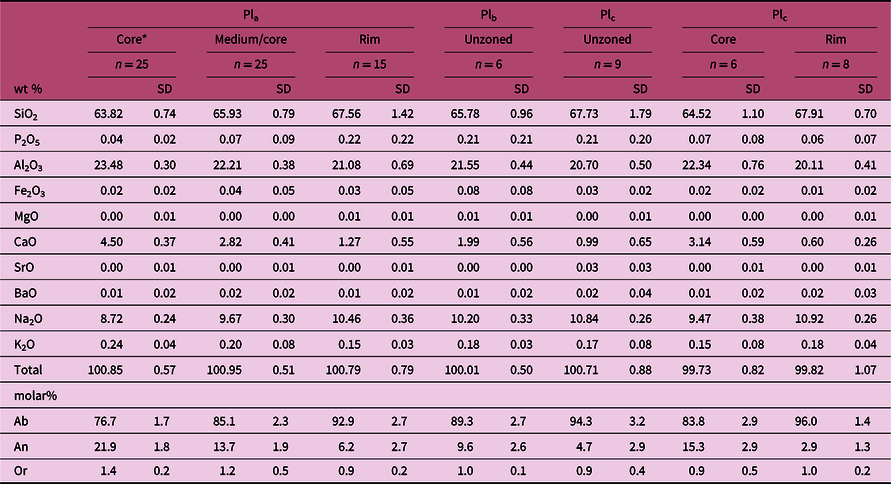
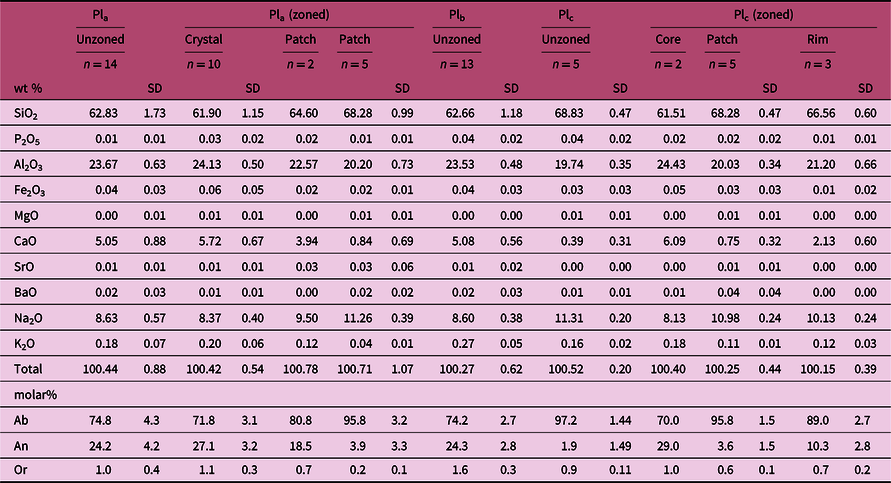
Mineral composition of plagioclase was analysed in the textural varieties described above. Average contents with their respective error range are displayed in Tables 2 and 3. For a classification according to the An–Ab–Or diagrams, see Figures S2 and S3 in the Supplementary Material available online at https://doi.org/10.1017/S0016756820000692.
Representative composition of plagioclase of the Huaco unit from electron microprobe. Averages from samples HUA-12, Hu-7 and HU-8b

* Data of one crystal from sample HUA-12.
Representative composition of plagioclase of the Sanagasta unit from electron microprobe. Averages from samples SAN-15, SAN-19 and SAN-20

In HU studied samples, Pla exhibits cores that range from An14 to An22 and albitic rims (An6). Plb type shows an average content of An10. On the one hand, Plc type has crystals of an overall albitic composition (An5), with minor variations within the error range; conversely, other crystals exhibit normal zonation, with cores of An15 and rims of albite (An3).
In the SU studied samples, crystals of Pla variety showed different composition patterns: unzoned crystals, with average compositions ranging from An27 to An17. Plb varieties have compositions that range from An29 to An23. Finally, Plc type exhibits albitic compositions (An2), and normal zonation patterns, with cores of An29, and a rim of An4, containing patches of An10.
5.b.2. Biotite
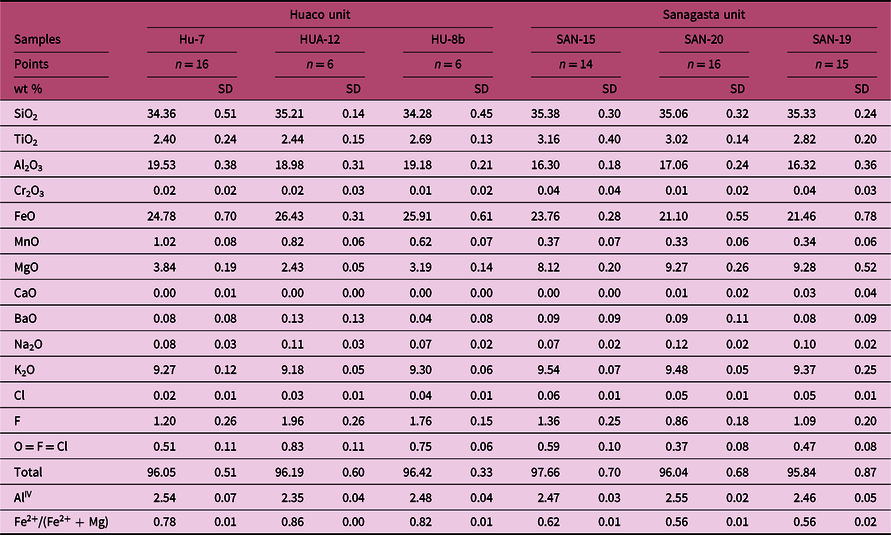
Biotite compositions of both units are shown in Table 4. Biotites of the HU are siderophyllites–annites according to the feal–mgli diagram of Tischendorf et al. (Reference Tischendorf, Förster, Gottesmann and Rieder2007) (Fig. S4 in the Supplementary Material available online at https://doi.org/10.1017/S0016756820000692), with an average content (n = 28) of AlIV = 2.46 ± 0.09 a.p.f.u., and average Fe2+/(Fe2+ + Mg) = 0.81 ± 0.03). They have high F (average F = 1.48 ± 0.4 %) and medium Ti contents (average TiO2 = 2.47 ± 0.23 %).
Representative composition of biotites from the Huaco and Sanagasta units from electron microprobe

On the other hand, biotites of the SU are close to the annite–phlogopite series of the feal–mgli diagram (Fig. S2 in the Supplementary Material available online at https://doi.org/10.1017/S0016756820000692), with average (n = 45) contents of AlIV = 2.49 ± 0.05 a.p.f.u., and average Fe2+/(Fe2++Mg) = 0.58 ± 0.03. They have relatively high F (average F = 1.09 ± 0.29 %) and medium Ti contents (average TiO2 = 3.00 ± 0.30 %).
5.c. Whole-rock geochemistry
5.c.1. Major and trace element chemistry
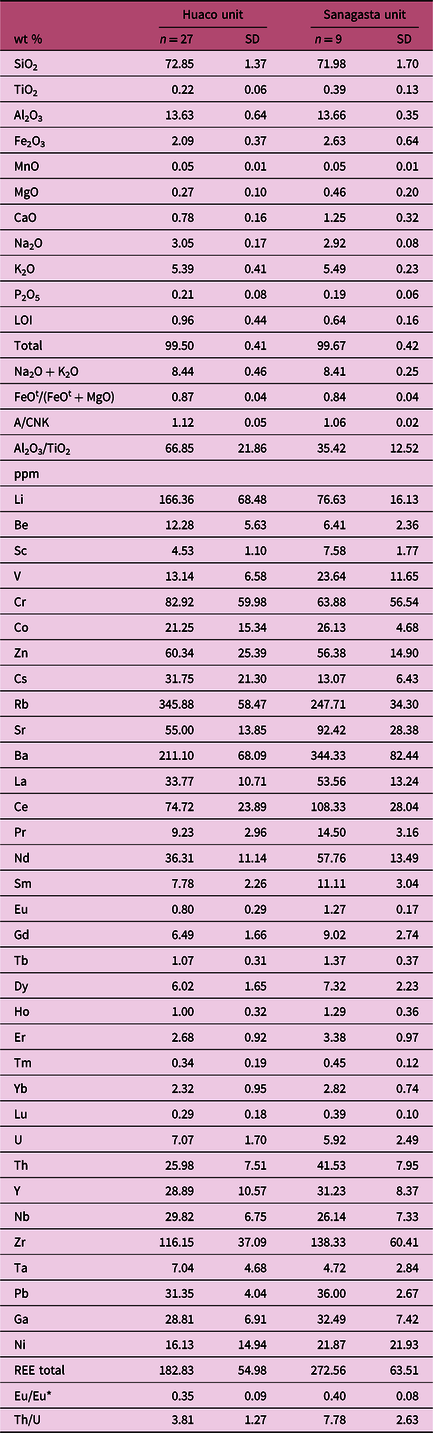
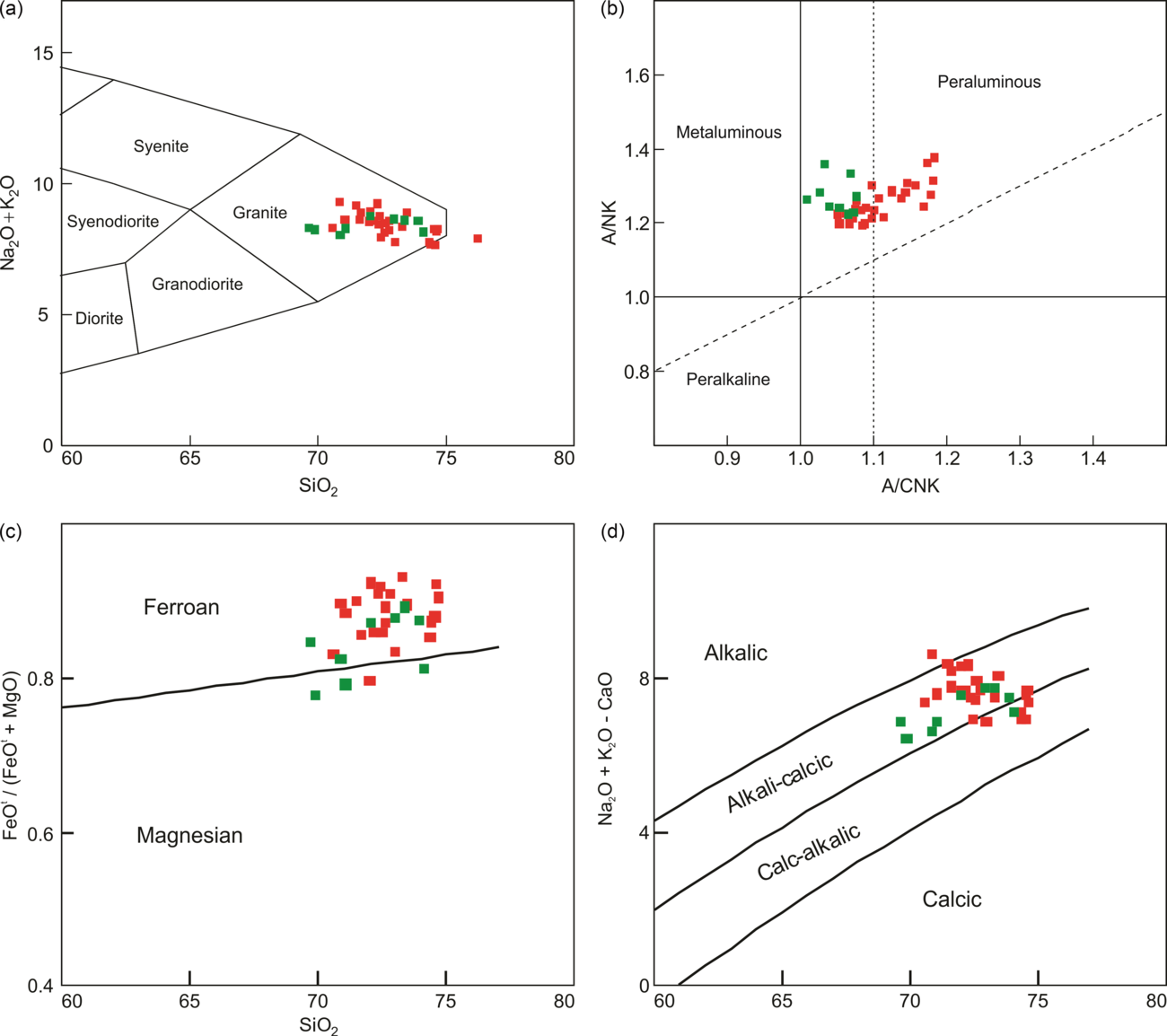
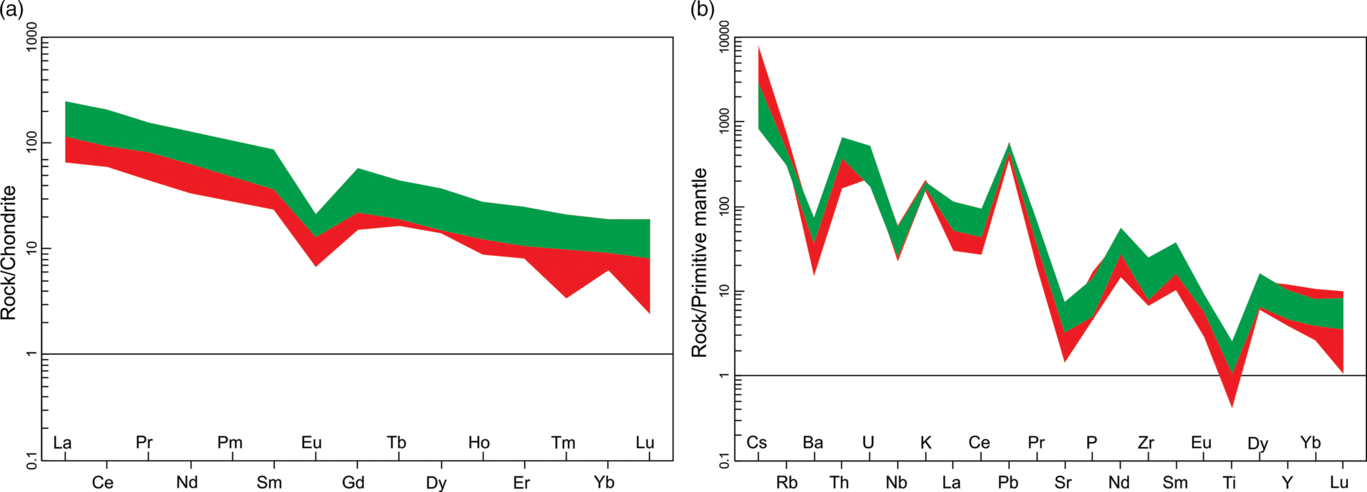
Average whole-rock chemistry of both the HU and SU is shown in Table 5. HU (n = 27) has SiO2 contents of 72.85 ± 1.37 wt %, and their samples are mostly classified as mid-alkaline granites (monzogranites) in the total alkali silica (TAS) diagram of Middlemost (Reference Middlemost1985) (Fig. 3a). Furthermore, samples are slightly peraluminous to peraluminous, with A/CNK (molar ratio of (Al2O3/[CaO + Na2O + K2O]) = 1.12 ± 0.05 (Fig. 3b). They are moderately enriched in total alkalis (Na2O + K2O = 8.44 ± 0.46 wt %), with low contents of CaO (0.78 ± 0.16 wt %) and high FeOt/(FeOt + MgO) ratios (0.88 ± 0.04), and so they are mainly ferroan (Fig. 3c) and alkali-calcic (Fig. 3d) according to diagrams of Frost et al. (Reference Frost, Barnes, Collins, Arculus, Ellis and Frost2001). The samples have medium abundance of rare earth elements (REE), ranging from 69 to 278 ppm. The chondrite-normalized REE diagram (Fig. 4a) exhibits a slight enrichment in light REE (LREE) relative to heavy REE (HREE), with a [La/Yb]N = 3.17–15.29 and negative Eu anomaly (Eu/Eu* = 0.23–0.55). The primitive-mantle normalized spider diagram shows marked negative Ba, Nb, Sr, P, Zr, Eu and Ti anomalies and significant enrichment in Cs, Rb, Th, U and Pb (Fig. 4b). The samples are depleted in HREE and Y.
Major and trace element whole rock data of the Huaco and Sanagasta units

(a) SiO2 vs Na2O + K2O, wt % variation diagram of Cox et al. (Reference Cox, Bell and Pankhurst1979) for Huaco (red squares) and Sanagasta (green squares) units. (b) A/CNK vs A/NK of Shand (Reference Shand1943). (c, d) Classification diagrams of Frost et al. (Reference Frost, Barnes, Collins, Arculus, Ellis and Frost2001): (c) FeOt/(FeOt + MgO) vs SiO2 and (d) Na2O + K2O − CaO vs SiO2.

(a) Chondrite-normalized (Boynton, Reference Boynton and Henderson1984) REE plots of Huaco (red shade) and Sanagasta (green shade) units. (b) Primitive-mantle-normalized (Sun & McDonough, 1989) spider diagrams of samples from the Huaco and Sanagasta units.

Samples from the SU (n = 9) have SiO2 contents of 71.98 ± 1.70 wt %, and are also classified as mid-alkaline granites (monzogranites) in the TAS diagram of Middlemost (Reference Middlemost1985) (Fig. 3a). The samples are slightly peraluminous, with A/CNK = 1.06 ± 0.02 (Fig. 3b), and have a moderately high content of total alkalis (Na2O + K2O = 8.41 ± 0.25 wt %), with relatively high contents of CaO (1.25 ± 0.31 wt %). According to diagrams of Frost et al. (Reference Frost, Barnes, Collins, Arculus, Ellis and Frost2001), the FeOt/(FeOt + MgO) ratio of 0.84 ± 0.04 classifies these rocks as magnesian (Fig. 3c) and alkali-calcic (Fig. 3d). This unit has a medium to high abundance of total REE, with values that range from 186 to 370 ppm. The chondrite-normalized diagram reveals enrichment in LREE relative to HREE (Fig. 4a), with [La/Yb]N = 10.4–15.8, and shows a negative Eu anomaly (Eu/Eu* = 0.25–0.48). The primitive-mantle normalized spider diagram displays marked negative Ba, Nb, Sr, P, Zr, Eu and Ti anomalies and significant enrichment in Cs, Rb, Th, U and Pb (Fig. 4b). The samples are depleted in HREE and Y.
5.c.2. Radiogenic and stable isotope geochemistry
A sample (SAN-103) from the SU was analysed for its Nd isotope composition. ϵNdt was calculated for the inferred crystallization age (t = 353 Ma, reported in the next section), yielding a value of −3.8. Available radiogenic isotopic data for both the HU and SU (Grosse et al. Reference Grosse, Söllner, Báez, Toselli, Rossi and de la Rosa2009; Dahlquist et al. Reference Dahlquist, Alasino, Eby, Galindo and Casquet2010) show average ϵNdt values of −3.1 ± 0.7 for the HU and −3.4 ± 0.6 for the SU (Table S2 in the Supplementary Material available online at https://doi.org/10.1017/S0016756820000692).
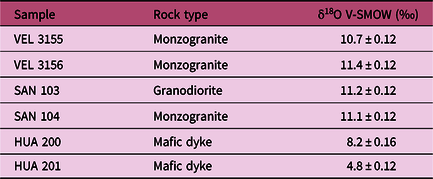
We present new bulk rock data of O isotope composition of the HU and SU (Table 6). Both units yielded similar results, with δ18O values of +10.7 ± 0.12 ‰ and +11.4 ± 0.11 ‰ for the HU, and +11.2 ± 0.12 ‰ and +11.1 ± 0.12 ‰ for the SU. Additionally, δ18O values of +8.2 ± 0.16 ‰ (HUA-200) and +4.8 ± 0.12 ‰ (HUA-201) were obtained for two mafic dikes intruding HU.
Bulk rock oxygen isotope data of samples from the Huaco and Sanagasta units, and two mafic dykes intruding the Huaco unit

5.d. U–Pb LA-ICP-MS zircon geochronology of the Sanagasta unit
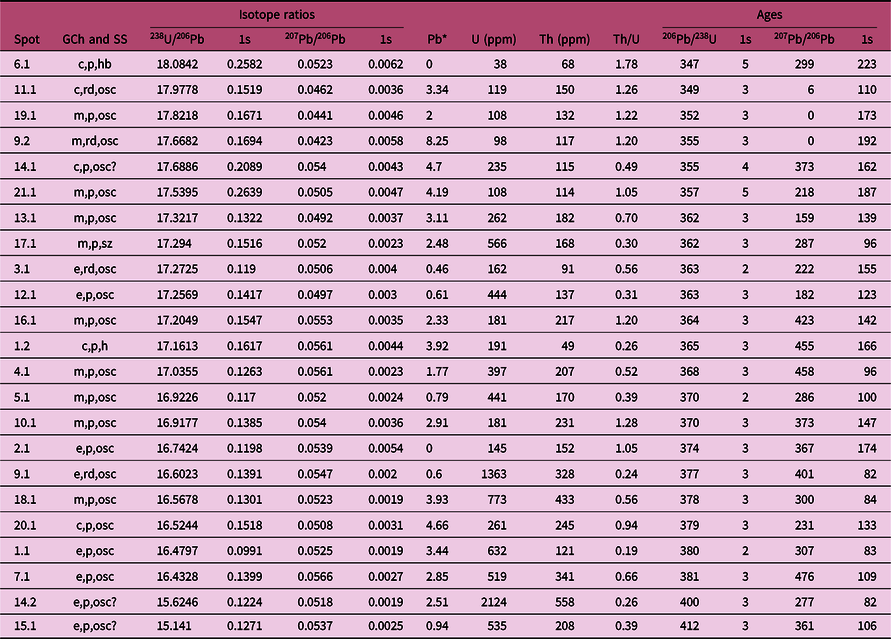
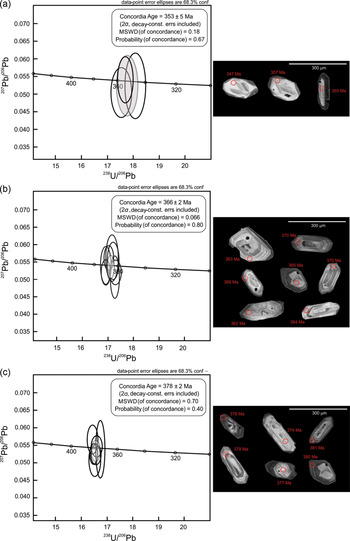
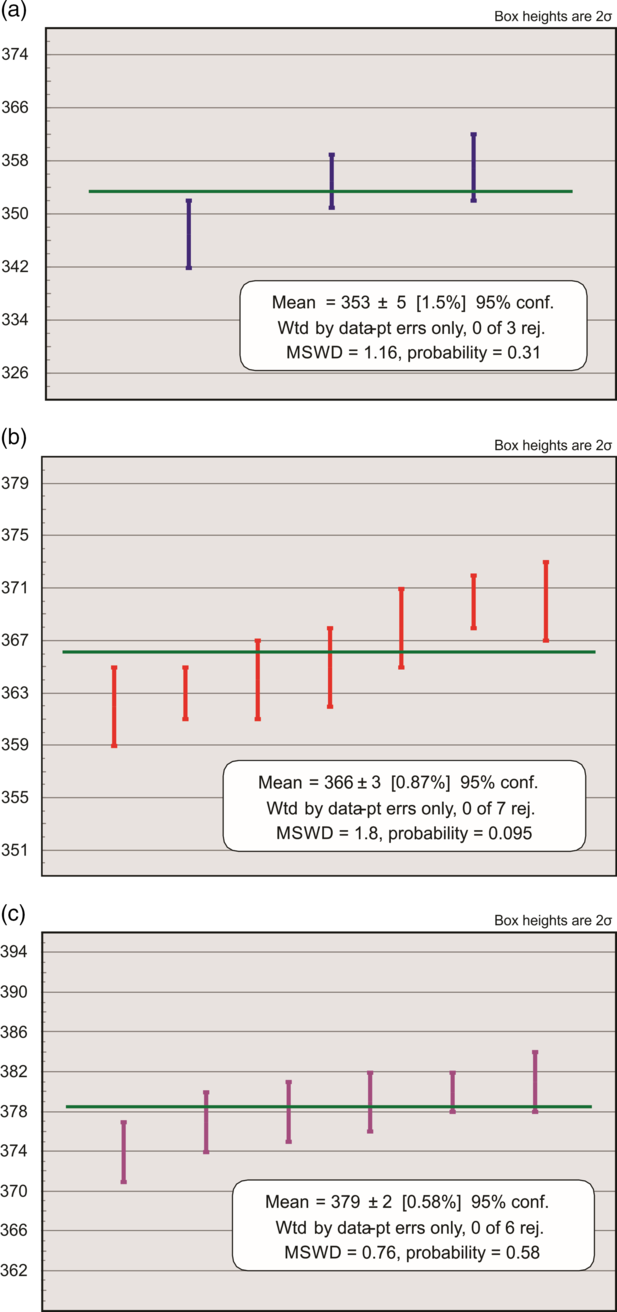
The dated sample SAN-103 is a biotite porphyritic granodioritic sample from the SU. Zircons are mostly prismatic, although a few of them have rounded shapes, all with oscillatory zoning. Details of morphology and description of zircons based on CL images together with the geochronological data are reported in Table 7 and Figure 5. Sixteen data points yielded a wide spectrum of zircon age distributions, ranging from 347 to 381 Ma (30 Ma). These data points yielded a Tera–Wasserburg concordia age (Isoplot/Ex 4.15, Ludwig, Reference Ludwig2008). However, a detailed analysis of the data based on a weighted mean diagram (Fig. 6) revealed three distinct age populations (outside error limits): 353 ± 5 Ma (n = 3), 366 ± 2 Ma (n = 7) and 378 ± 2 Ma (n = 6) (Table 7; Fig. 5a, b, c), which could be considered to represent three crystallization events.
LA-MC-ICP-MS zircon U–Pb analytical results from sample SAN-103 of the Sanagasta unit

Grain characteristics (GCh) and site of the spot (SS): Site of the spot: e = end or edge, m = middle, c = core. Habit of the grain: p = prism, rd = round. CL images: osc = oscillatory zoning, h = homogenous,hb = homogenous bright, sz = sector zoning.
Pb* = Pb total common %.
U–Pb LA-MC-ICP-MS zircon geochronology of sample SAB-103 from a biotitic porphyritic granodiorite from the Sanagasta unit. The Tera–Wasserburg plots show analyses, and the inset shows the calculated concordia ages. The analysed zircons are also displayed. Three groups of ages were identified: (a) 347–357 Ma; (b) 362–370 Ma; and (c) 374–381 Ma.

Weighted mean diagrams for the three groups of ages. (a) 347–357 Ma; (b) 362–370 Ma; and (c) 374–381 Ma.

6. Discussion
6.a. Interpretation of Sanagasta unit crystallization ages
The LA-ICP-MS-MC U–Pb zircon data of sample SAN-103 yielded a Carboniferous (Early Mississippian – Tournaisian) crystallization age of 353 ± 5 Ma. Other analyses yielded older Late Devonian ages of 378 ± 2 Ma (Frasnian) and 366 ± 2 Ma (Famennian). Similar Devonian ages have been documented for the HU (Söllner et al. Reference Söllner, Gerdes, Grosse and Toselli2007, Reference Söllner, Grosse, Gerdes, Toselli and Rossi2009; Dahlquist et al. Reference Dahlquist, Pankhurst, Gaschnig, Rapela, Casquet, Alasino, Galindo and Baldo2013) and for other igneous bodies in the Sierra de Velasco, such as the La Costa pluton (Dahlquist et al. Reference Dahlquist, Alasino, Basei, Morales Cámera, Macchioli Grande and da Costa Campos Neto2018). These older ages may suggest recycling of antecrystic zircons during successive magma injections within the construction of a long-lived magma reservoir (e.g. Miller et al. Reference Miller, Matzel, Miller, Burgess and Miller2007; Shea et al. Reference Shea, Miller, Miller, Bowring and Sullivan2016; Dahlquist et al. Reference Dahlquist, Macchioli Grande, Alasino, Basei, Galindo, Moreno and Morales Cámera2019). Moreover, Zr saturation can occur at relatively high temperatures in granitic melts, and these magmas could carry high amounts of early crystallized zircons, which can survive processes of transport and reheating, and can be incorporated in subsequent magma batches (Barboni et al. Reference Barboni, Annen and Schoene2015).
In particular, Söllner et al. (Reference Söllner, Gerdes, Grosse and Toselli2007, Reference Söllner, Grosse, Gerdes, Toselli and Rossi2009) reported Ordovician, Devonian and Early Carboniferous ages for the HU. Ordovician ages (477 Ma) were found in the core of zircons and were interpreted as derivate from the source. Late Devonian (369 Ma) and Early Mississippian (350 Ma) ages were found in the rim region and were interpreted as two crystallization events.
Notably, the dated sample of the SU did not yield Ordovician inherited ages. The same observation was pointed out by Söllner et al. (Reference Söllner, Grosse, Gerdes, Toselli and Rossi2009) for this unit. Thermal modelling performed by Macchioli Grande et al. (Reference Macchioli Grande, Alasino, Rocher, Larrovere, Uran, Reinoso Carbonell and Moreno2019) suggests that maximum temperatures of c. 860°C were reached for the SU. Therefore, ‘hot’ magmas of the SU with minimal inheritance could indicate higher crystallization temperature, which leads to Zr undersaturation in the source following dissolution of incorporated Ordovician zircons (e.g. Miller et al. Reference Miller, McDowell and Mapes2003). Moreover, relatively high temperatures could also explain the scarce Early Mississippian ages in sample SAN-103 compared to the more abundant Late Devonian ages.
6.b. Sources of the Huaco and Sanagasta units
In addition to the population of antecrystic zircons, inherited zircons of Ordovician age have been reported for the HU (477 Ma; Söllner et al. Reference Söllner, Gerdes, Grosse and Toselli2007), suggesting that Famatinian rocks could be the main source of the Huaco Intrusive Complex. Ordovician crustal rocks are a common source for Early Mississippian magmatism in the Sierra de Velasco: inherited cores of similar age as well as xenocrystic zircons occur both in the San Blas Intrusive Complex and La Costa pluton, in the northern part of this range (Alasino et al. Reference Alasino, Larrovere, Rocher, Dahlquist, Basei, Memeti, Paterson, Galindo, Macchioli Grande and da Costa Campos Neto2017; Dahlquist et al. Reference Dahlquist, Alasino, Basei, Morales Cámera, Macchioli Grande and da Costa Campos Neto2018). This suggests that during the Late Devonian (378 to 366 Ma), mantle-derived magmas could have interacted with an Ordovician lower crust, generating a hot zone at depths of 35–40 km (cf. Alasino et al. Reference Alasino, Larrovere, Rocher, Dahlquist, Basei, Memeti, Paterson, Galindo, Macchioli Grande and da Costa Campos Neto2017). In fact, ϵNdt values of the HU and SU (−3.2 on average, n = 20; see Table S3 in the Supplementary Material available online at https://doi.org/10.1017/S0016756820000692) are slightly less radiogenic than the Ordovician host rocks (−6.9 on average at t = 354 Ma, n = 16; see Table S3 in the Supplementary Material available online at https://doi.org/10.1017/S0016756820000692), which supports mixing with a juvenile component to reach such difference (Fig. S5 in the Supplementary Material available online at https://doi.org/10.1017/S0016756820000692).
The δ18O values of the HU and SU are also similar between them, and notably high (+11.2 ‰ ± 0.3 on average; n = 4) (Table 5). Such values indicate sources rich in δ18O, such as metamorphic rocks (e.g. Hoefs & Emmermann, Reference Hoefs and Emmermann1983). δ18O compositions of Ordovician metasedimentary rocks comprise a range of δ18O from +10 to +14 ‰ (Alasino et al. Reference Alasino, Casquet, Galindo, Pankhurst, Rapela, Dahlquist, Recio, Baldo, Larrovere and Ramacciotti2020), and zircon δ18O values can reach +14.1 ‰ (Rapela et al. Reference Rapela, Pankhurst, Casquet, Dahlquist, Fanning, Baldo, Galindo, Alasino, Ramacciotti, Verdecchia, Murra and Basei2018). Integrating the results of both Nd and O isotopes, a proposed origin for these rocks is a hybridized source, with participation of both Ordovician crustal components and mantle-derived magmas. A mafic dike with δ18O values of +8.3 ‰ (sample HUA-200) is consistent with melts derived from a subcontinental lithospheric metasomatized mantle (e.g. Liu et al. Reference Liu, Wu, Chung, Li, Sun and Ji2014). Similar δ18O compositions (δ18O = +8) have been observed for mafic rocks from the Ordovician Famatinian arc (Alasino et al. Reference Alasino, Casquet, Pankhurst, Rapela, Dahlquist, Galindo, Larrovere, Recio, Paterson, Colombo and Baldo2016, Reference Alasino, Casquet, Galindo, Pankhurst, Rapela, Dahlquist, Recio, Baldo, Larrovere and Ramacciotti2020; Rapela et al. Reference Rapela, Pankhurst, Casquet, Dahlquist, Fanning, Baldo, Galindo, Alasino, Ramacciotti, Verdecchia, Murra and Basei2018), suggesting an invariable nature of δ18O composition for the sublithospheric mantle since at least Ordovician times. The anomalous δ18O value of +4.8 ‰ is not taken into account since it may be influenced by the presence of calcite-rich vesicles that resulted from circulation of water-rich fluids.
In order to assess the proposed mixing hypothesis, a simple calculation was performed following equation 9.1 of Faure (Reference Faure1986, p. 141). We considered the Nd averages mentioned above from Ordovician meta-igneous and metasedimentary rocks from Grosse et al. (Reference Grosse, Bellos, de los Hoyos, Larrovere, Rossi and Toselli2011) and Larrovere et al. (Reference Larrovere, de los Hoyos and Grosse2012) as the crustal end-member component. Based on the δ18O value of the mafic dyke, we believed that the other end-member component should be the lithospheric mantle. Since we lack Nd isotope composition data of the mafic dyke, we used in the calculations an average of Nd composition of the mafic enclaves contained in the HU and SU, reported by Grosse et al. (Reference Grosse, Söllner, Báez, Toselli, Rossi and de la Rosa2009), with an ϵNd = 0 (t = 354 Ma), which we consider to be equivalent to magmas derived from a subcontinental lithospheric mantle. The mixed component is the average of Nd composition of the HU and SU calculated at t = 354 Ma. Calculations can be found at Table S4 in the Supplementary Material available online at https://doi.org/10.1017/S0016756820000692. The result indicates that 41 % of mantle-derived magmas contributed to the generation of the HU and SU magmas.
Additionally, the similar values of both the HU and SU point to a previous isotopic homogenization in the source prior to magma generation (e.g. Shea et al. Reference Shea, Miller, Miller, Bowring and Sullivan2016). In fact, the older ages recorded in sample SAN-103 (378 ± 2 Ma and 366 ± 2 Ma) support the suggestion that such homogenization may have occurred in the Late Devonian. A similar evolution was proposed by López de Luchi et al. (Reference López de Luchi, Siegesmund, Wemmer and Nolte2017) and more recently by Dahlquist et al. (Reference Dahlquist, Macchioli Grande, Alasino, Basei, Galindo, Moreno and Morales Cámera2019) for Devonian plutons in the Sierra de San Luis. The reported Nd and Sr isotopes data are consistent with a continental source with probable participation of subcontinental lithospheric mantle, as was proposed for the monzogranites of the Las Chacras – Potrerillos and Renca batholiths by López de Luchi et al. (Reference López de Luchi, Siegesmund, Wemmer and Nolte2017) and Dahlquist et al. (Reference Dahlquist, Macchioli Grande, Alasino, Basei, Galindo, Moreno and Morales Cámera2019). Furthermore, the heat input supplied by the continuous differentiation and ascent of mantle-derived material can lead to accumulation of rhyolitic to dacitic residual melts (Annen et al. Reference Annen, Blundy and Sparks2006; Solano et al. Reference Solano, Jackson, Sparks, Blundy and Annen2012; Alasino et al. Reference Alasino, Larrovere, Rocher, Dahlquist, Basei, Memeti, Paterson, Galindo, Macchioli Grande and da Costa Campos Neto2017). In our case, low emplacement rates of mantle-derived materials could maintain a stable geotherm, and thus the deep crustal hot zone remained active until Early Mississippian times, when higher volumes of magma were extracted and ascended to the upper crust. This is consistent with the proposed tectonic setting for the Late Palaeozoic where the protracted Late Devonian – Early Mississippian magmatism is related to accretion/roll-back along the west Gondwana margin (Alasino et al. Reference Alasino, Dahlquist, Pankhurst, Galindo, Casquet, Rapela, Larrovere and Fanning2012; Dahlquist et al. Reference Dahlquist, Alasino, Basei, Morales Cámera, Macchioli Grande and da Costa Campos Neto2018).
6.c. Effect of temperature on melt composition
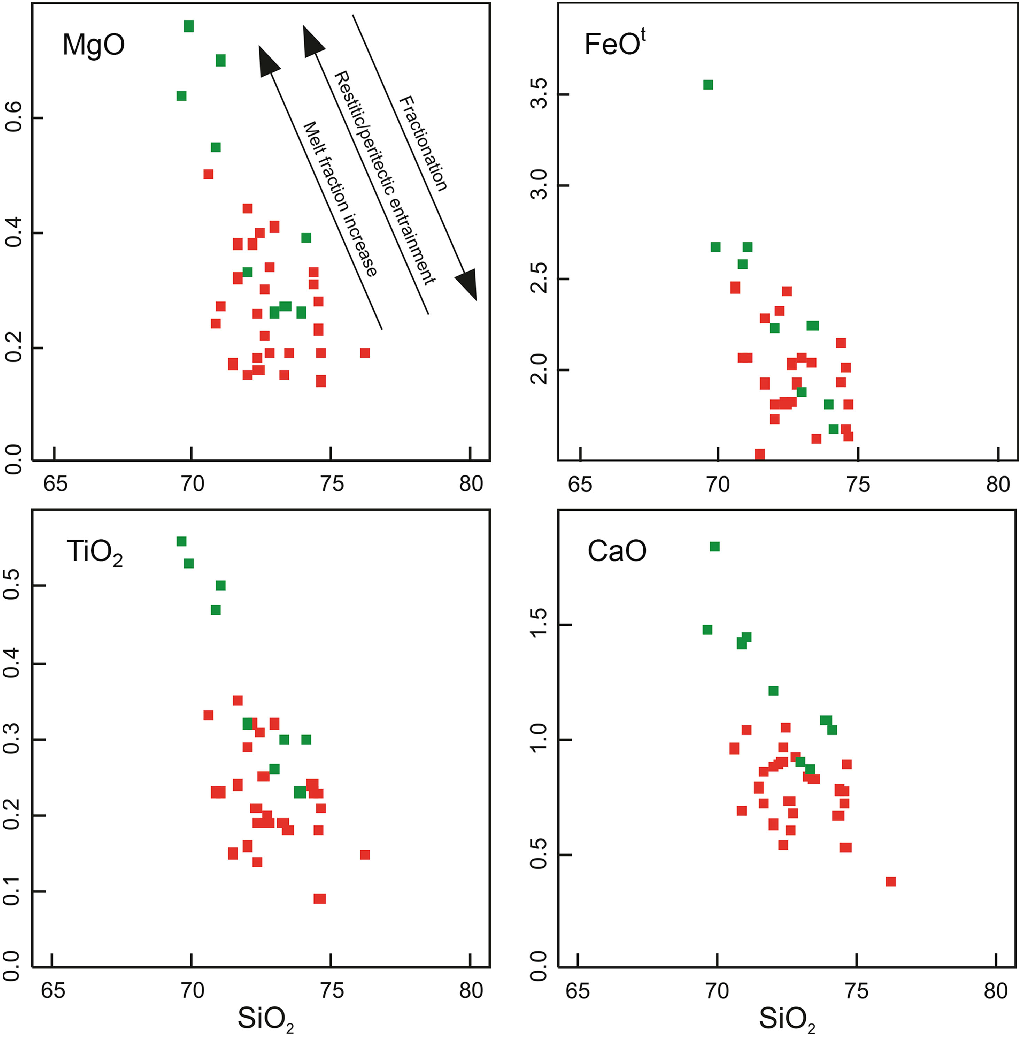
As was proposed in the previous section, the main units (HU and SU) of the Huaco Intrusive Complex originated from the same source rock. However, major element data indicate that changes occurred in the source during magma generation of both units, leading to slight differences in their compositions. For instance, Harker diagrams of major elements (Fig. 7) show an overall linear trend in which the SU has higher contents of MgO, FeOt, CaO and TiO2 than the HU. Although this could be interpreted as a direct fractionation of HU from SU, the younger (but close in time) age of SU, as well as their structural evolution (SU intrudes HU in a mingling contact), rule out this possibility. Other hypotheses that could account for the differences in composition between the two units are (i) incorporation of more mafic material within SU generation, as suggested by Grosse et al. (Reference Grosse, Söllner, Báez, Toselli, Rossi and de la Rosa2009); (ii) entrainment of residual/peritectic minerals in the SU magma; and (iii) an increase in the degree of partial melting in the source of the SU during magma generation. The first hypothesis is discarded by the isotopic evidence reported in the previous section since the SU should exhibit a less radiogenic composition than the HU.
Harker diagrams for MgO, FeOt, CaO and TiO2 for the Huaco (red squares) and Sanagasta (green squares) units. The arrows indicate possible petrogenetic evolution paths after Moyen et al. (Reference Moyen, Champion and Smithies2009).

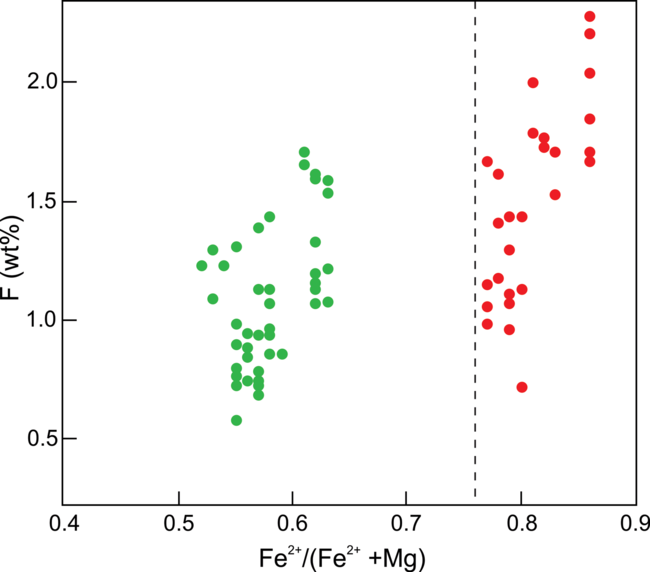
Mineral chemistry data reveal that plagioclase in the SU can reach a maximum content of An29, which is slightly richer in CaO than plagioclase in the HU, with a maximum of An22. In addition, biotite in the SU has higher MgO and lower F contents than those of the HU (Fe2+/(Fe2++Mg) = 0.58 and F = 1.09 for the SU, and Fe2+/(Fe2++Mg) = 0.81 and F = 1.48 for the HU; Fig. 8). Also, the higher proportion of oxides (mainly magnetite and ilmenite) in the SU explains the observed higher contents of FeOt and TiO2. Several authors claim that the differences in whole-rock geochemistry of both major and trace elements in units of the same intrusive complex are associated with variations in their source or in the entrainment of residual and/or peritectic minerals (e.g. Stevens et al. Reference Stevens, Clemens and Droop1997, Reference Stevens, Villaros and Moyen2007; Moyen et al. Reference Moyen, Champion and Smithies2009; Garcia-Arias & Stevens, Reference Garcia-Arias and Stevens2017). Magma generation by partial melting of crustal materials involves plagioclase, and breakdown of hydrous minerals, like micas or amphibole (Moyen et al. Reference Moyen, Champion and Smithies2009 and references therein). These reactions release water, which triggers melting of quartz and feldspar, leaving a solid residuum, mainly garnet, cordierite or pyroxene (Stevens et al. Reference Stevens, Clemens and Droop1997). When plagioclase melts, the liquid becomess enriched in sodium and the residual plagioclase is calcium-rich (Moyen et al. Reference Moyen, Champion and Smithies2009 and references therein); residual biotites also become enriched in magnesium (García-Arias & Stevens, 2017). Bearing this in mind, the differences in the MgO, FeOt, CaO and TiO2 contents in both units could be interpreted as the entrainment of residual plagioclase and biotite in SU magma. However, mineral chemistry did not reveal the presence of populations of calcic plagioclase or phlogopite in the analysed thin-sections of this unit, and we thus reject this hypothesis.
Fe2+/(Fe2+ + Mg) vs F (wt %) diagram containing mineral chemistry data from biotites of the Huaco (red circles) and Sanagasta (green circles) units. Dashed line represents a rough boundary for biotite crystallized from A-type granites, with higher Fe2+/(Fe2+ + Mg) ratios to the right, and lower Fe2+/(Fe2+ + Mg) ratios to the left.

Alternatively, melts generated by higher degrees of partial melting are usually more mafic, with lower concentrations of SiO2 and higher concentrations of FeO, MgO and CaO (Moyen et al. Reference Moyen, Champion and Smithies2009). The concentration of these elements increases progressively with the temperature of partial melting, as shown by experimental petrology results (Johannes & Holtz, Reference Johannes and Holtz1996; René et al. Reference René, Holtz, Luo, Beermann and Stelling2008). Furthermore, Dall’Agnol et al. (Reference Dall’Agnol, Scaillet and Pichavant1999) found an inverse relationship between temperature and Fe2+/(Fe2+ + Mg) ratios of biotites of the Jamon suite of the Paleoproterozoic A-type magmatism in Eastern Amazonian Craton. They suggested that biotites formed at higher temperatures have lower Fe2+/(Fe2+ + Mg) ratios.
Additionally, TiO2 contents vary with temperature in a similar way to FeOt, MgO and CaO, in biotite or two-mica granites (Reference Gao, Zheng and ZhaoGao et al. 2016b). For a fixed source, melts generated at higher temperature and melt fraction exhibit lower Al2O3/TiO2 ratios (Sylvester, Reference Sylvester1998; René et al. Reference René, Holtz, Luo, Beermann and Stelling2008). The average of this ratio is lower for the SU than for the HU (35 and 67, respectively) (Table 5), consistent with higher temperatures of formation for the SU. Another consequence of continuous heating is the release of water from hydrous phases of the source such as amphibole and micas, which contributes to an increase in melt fraction (Moyen et al. Reference Moyen, Champion and Smithies2009). These aqueous fluids would be related to amphibole and mica breakdown, which generate higher melt fractions with increase of temperature at fixed pressure and rock composition (Clemens & Vielzeuf, Reference Clemens and Vielzeuf1987). In agreement with this, biotites of the SU have lower F contents and thus higher water contents than those in the HU (Fig. 7), implying a higher proportion of water available during crystallization of the SU. Furthermore, experimental studies revealed that biotites that crystallized at higher temperatures have higher MgO and lower FeOt and F contents (Skjerlie & Johnston, Reference Skjerlie and Johnston1993), which supports what is proposed. On the whole, mineral chemistry of biotites indicates that the SU may have formed under higher temperatures.
Trace elements contents in HU and SU also reflect the control of temperature during partial melting. For instance, REE patterns of both units are parallel, but with a higher content of such elements for SU (Fig. 4), which is consistent with higher degrees of partial melting for the latter unit, with a strong control by accessory phases such as zircon and monazite (Villaros et al. Reference Villaros, Stevens, Moyen and Buick2009). The solubility of such phases in magmas with remarkably similar composition is strongly controlled by temperature, as reported by Johannes & Holtz (Reference Johannes and Holtz1996). This is also supported by relatively higher levels of Zr in the SU (138 ppm on average) with respect to the HU (116 on average), and Th (7.78 on average for SU and 3.67 on average for HU). Finally, the lack of difference between HREE and Y contents of the two units rules out an effect of pressure during magma generation of both units, supporting the role of temperature in melt composition.
6.d. Thermal maturation of the complete crustal column
Previous structural studies showed that the evolution of the Lower Mississippian intrusive complexes in the Sierra de Velasco reached thermal maturation through the incremental assembly of multiple magma pulse batches into the upper crust (e.g. Alasino et al. Reference Alasino, Larrovere, Rocher, Dahlquist, Basei, Memeti, Paterson, Galindo, Macchioli Grande and da Costa Campos Neto2017; Macchioli Grande et al. Reference Macchioli Grande, Alasino, Rocher, Larrovere, Uran, Reinoso Carbonell and Moreno2019). This led to a switch in emplacement style from tabular to vertically elongated bodies over time. The continuous addition of heat in the developing magmatic system led to an increase of the local geothermal gradient. This triggered the ascent and emplacement of the youngest pulses as vertically elongated bodies, in a thermally mature system, using the same magma pathway.
Figure 9 summarizes the magmatic and structural evolution of HU and SU. First, partial melting of the crust is driven by advective heat released from subcontinental lithospheric mantle-derived fluids. Such melts mix and then homogenize, as shown by the isotopic record. This process may have occurred in the Late Devonian epoch (Frasnian–Famennian), as suggested by older ages obtained from zircons (antecryst) both of the SU and the HU (see Section 6.a). Second, in Early Mississippian times (354 Ma), this previously homogenized source is melted, incorporating recycled (Late Devonian) antecrystic zircons, including inherited Ordovician cores from the source. Such pulses ascended via diking, and were emplaced in a rigid upper crust via stoping as subhorizontal tabular bodies, comprising the HU (Macchioli Grande et al. Reference Macchioli Grande, Alasino, Rocher, Larrovere, Uran, Reinoso Carbonell and Moreno2019). Shortly afterwards (353 Ma), the continuous heat supply increases the temperature at the source, leading to an increase in the thermal maturation of the surrounding crust. This caused higher degrees of partial melting, generating magmas more enriched in mafic minerals and with higher REE contents, and Zr undersaturation with subsequent dissolution of antecrystic zircons with inherited Ordovician cores. These pulses comprise the SU, which ascended as vertical piercing diapirs, in a thermally mature upper crust, and were emplaced by means of both ductile and brittle mechanisms. The fact that the SU has antecrystic zircons lacking Ordovician inherited cores implies that they were incorporated in higher levels of the crust (not at the source) by recycling processes from the older pulses.
Magmatic evolution of the Huaco and Sanagasta units from the Huaco Intrusive Complex (sketch modified from Alasino et al. Reference Alasino, Larrovere, Rocher, Dahlquist, Basei, Memeti, Paterson, Galindo, Macchioli Grande and da Costa Campos Neto2017). The depth (in km) is indicated at the left of the figure.

On the whole, the structural evolution of the Huaco and Sanagasta units records a change in the local geothermal gradient in the upper crust, and the geochemical evolution assessed by petrological, isotopic and geochronological data supports a model which involves a change in the thermal maturation in the lower crust, where the increase of temperature at the source leads to higher degrees of partial melting, changing the composition of subsequent melts.
7. Conclusions
An integrated petrological, geochemical, isotopic and geochronological study of the Huaco (HU) and Sanagasta (SU) units of the Huaco Intrusive Complex in NW Argentina indicates that the thermal conditions of the surrounding crust affected their petrogenesis and geochemical characteristics:
(1) Similar whole-rock radiogenic and stable isotope data (ϵNdt −3.2 ± 0.7 and +11.2 ‰ ± 0.3 ‰) suggest that both igneous units were generated from the same homogenized source, which formed by Ordovician crustal melts mixed with lithospheric mantle-derived fluids. Geochronological data for the SU points to initiation of melting of the crust, mixing with mantle-derived components, and later homogenization during the Late Devonian, and magma generation and emplacement during the Early Carboniferous.
(2) Mineral chemistry data show that plagioclase of the SU is richer in CaO compared to plagioclase from the HU, and biotite of the SU has higher contents of MgO and TiO2, and lower contents of F. This is consistent with whole-rock geochemistry data, as shown by Harker diagrams. Additionally, REE contents are higher in the SU, yielding parallel patterns for both units. The geochemical behaviour agrees with an increase in the degree of partial melting in the source for the origin of the SU over HU by an increase of the temperature.
(3) Geochronological data for the SU yielded three groups of ages: 353 ± 5 Ma (Early Mississippian – Tournasian), 366 ± 2 Ma (Late Devonian – Famennian) and 378 ± 2 Ma (Late Devonian – Frasnian). The first is considered the final crystallization age, similar to that previously reported and coherent with field evidence. The older Late Devonian ages could indicate recycling of antecrystic zircons formed during early magma crystallization during the construction of a long-lived magma reservoir.
(4) The thermally driven increase in the degree of the partial melting in the source was also accompanied by an increase in thermal maturation in the upper crust, which led to a change in the emplacement style from tabular subhorizontal (HU) to vertically elongated (SU) bodies.
The general conclusion is that long-lived magmatic systems may modify the thermal regime of the crust over time and reach thermal maturation involving the complete crustal column. This creates magma pathways that are continuously used, where pulses ascend and are emplaced in a softened and thermally mature upper crust. Furthermore, the formation of large upper crustal reservoirs can be sustained by a continuous magma flux fed by extensive lower crustal mush zones. This allows magma plumbing systems to evolve to highly dynamic environments favouring multiple physical and chemical processes such as mixing, mingling, fractionation, recycling and contamination.
Acknowledgements
This paper is part of the first author’s doctoral thesis. Funding was provided by Argentine public grants: PUE – 0125 (CONICET); PIP 0178 (CONICET); PICT 2016-0843 (FONCYT); SECyT (UNLaR); and Brazilian public grant: FAPESP 2018/06837-3. M.M.G. thanks Léa Leuzinger, Mariano Larrovere, Sebastián Rocher, Virginia Reinoso, Gimena Uran and Carlos Bustamante from the Geosciences group of CRILAR. He also acknowledges Dr Torsten Vennemann and Dr Benita Putlitz (IDYST–UNIL) for their collaboration, which made possible the oxygen stable isotope analyses. Barbara Ratschbacher is thanked for valuable comments and English editing. We are also grateful for the suggestions of Dr Eber Cristofolini and Dr Lucio Pinotti, which thoroughly improved the final version of the manuscript. We extend our appreciation to K. Goodenough for editorial handling.
Supplementary material
To view supplementary material for this article, please visit https://doi.org/10.1017/S0016756820000692