Introduction
The name of Joseph-René Bellot is well known to polar historians, but there is surprisingly little awareness of his background, or of the details of his career. This paper is aimed at filling this lacuna, relying in part on contemporary documents.
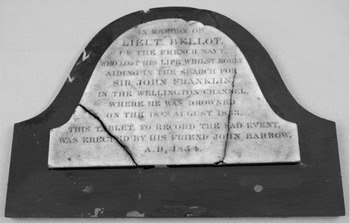
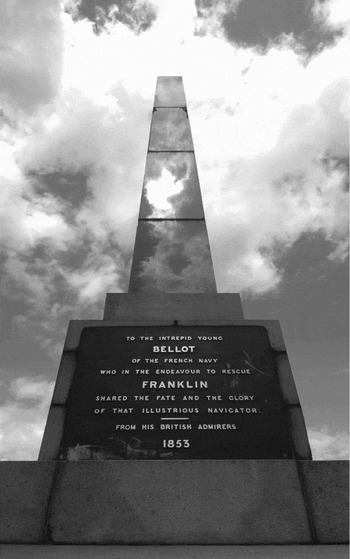
On 26 August 1854, H.M.S. North Star, Captain William Pullen, was about to sail from Beechey Island, overcrowded with 263 men (North Star's own crew plus those of H.M.S. Assistance, Pioneer, Resolute, Intrepid and Investigator, the first four abandoned in the Arctic on the orders of the squadron's leader, Captain Sir Edward Belcher) when, to the relief of all on board, two ships suddenly appeared around Cape Riley. They were H.M.S. Phoenix, Captain Edward Inglefield, towing the transport Talbot, Captain Robert Jenkins (De Bray Reference De Bray1992: 177). Once a redistribution of men between North Star and the newly arrived vessels had been made, all three ships started for home on the 28th. But before they did a party went ashore to hold a ceremony, to erect a marble tablet, dedicated to the memory of Lieutenant de vaisseau Joseph-René Bellot of the French Navy (Fig. 1). The party included Lieutenant de vaisseau Émile Fréderic de Bray, the only other French officer to participate in the Franklin search, who had just spent two years as supernumerary on board HMS Resolute. The memorial consisted of a white tablet on a black stone background with the inscription:
(De Bray Reference De Bray1992: 286, n.5; Forestier-Blazart, N. and J.-C. Reference Forestier-Blazart and Forestier-Blazart2011: 9)
The original plaque to Bellot's memory, commissioned by Colonel John Barrow and unveiled by Captain Sir Edward Belcher, Beechey Island, 26 August 1854. Photo reproduced courtesy of the Department of Culture and Heritage, Government of Nunavut.

The tablet was hoisted out of Phoenix’s hold, rowed ashore, and man-handled by a party of seamen to the Franklin memorial, near Northumberland House, the depot building which North Star's men had erected over the previous two years. This monument was an octagonal post, about 2 m high, which had been fashioned from the barrel of the capstan of the wrecked whaler McLellan which Belcher's squadron had encountered in Melville Bay on its way north on 7/8 July 1852 (De Bray Reference De Bray1992: 133). A lead plaque had been secured to each of the eight faces of the monument, in total listing all the names of the 32 men who had died during the Franklin search expeditions, including Bellot's name (Forestier-Blazart, N. and J.-C. Reference Forestier-Blazart and Forestier-Blazart2011: 8). The memorial to Bellot was attached to the Franklin monument, Belcher said a few words, three rifle volleys were fired, and the party members returned to the various ships.
Early career
Joseph-René Bellot was born on 18 March 1825 in Paris, the son of Adélaïde-Estelle Laurent and Étienne-Suzanne-Zacharie Brumaire Bellot, a farrier by trade (Forestier-Blazart, N. and J.-C. Reference Forestier-Blazart and Forestier-Blazart2011: 13). In 1831 the Bellots moved to Rochefort where Bellot Sr. continued to work as a farrier and also as a veterinarian. In 1833 Joseph-René was enrolled in the elementary school and soon showed himself to be a brilliant student. On the basis of his performance he was awarded a half scholarship offered by the municipality when he moved up to the secondary school in 1838. In his first year he won first prize in Latin composition and translation, Greek translation, and historical geography; and when he started learning English he won first prize for translation and second prize for composition. By this point Joseph-René had acquired three younger sisters, and although family finances were tight his parents were fully resolved that Joseph-René should continue his studies. The latter was well aware of this situation. Jules Lemer, editor of Bellot's arctic journal, relates a story which demonstrates Joseph-René's concern and generosity: having received 25 francs from a grateful parent for tutoring his son, he decided to spend 5 francs on ribbons for his sisters and gave 20 francs to his father for a planned trip to Paris which he had had to postpone for lack of money (Lemer Reference Lemer and Bellot1854: viii).
At the age of 15, with the encouragement of the municipality, Joseph-René sat the entrance exam for the Naval College (École Navale) at Brest, and was successful, being placed 20th. He entered the college on 10 November 1841 (Forestier-Blazart, N. and J.-C. Reference Forestier-Blazart and Forestier-Blazart2011: 27), and soon found himself on board the training ship, Borda. Academically his performance was excellent, but either he was something of a rebel, or the discipline on board Borda was quite draconian; he was punished eight times in just the first term of his first year. The fact that Émile de Bray, the only other Frenchman who would later take part in the Franklin search also accumulated frequent punishments at the college, would perhaps suggest that the latter was the case (De Bray Reference De Bray1992: ix). But over the course of his two years at the Naval College Bellot's punishments became less frequent, and when he graduated in September 1843, he was fifth out of a class of 80. Thereafter he served on board Suffren and then Friedland. On receiving his first salary he sent a portion of it home to his parents to assist with the education of his sisters, by then six in number.
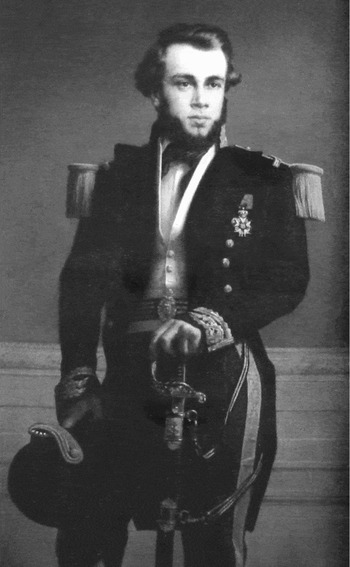
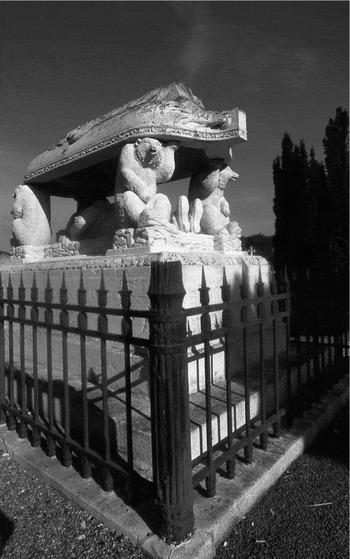
On 1 March 1844 Bellot joined the corvette Berceau, as an élève (cadet) and by 23 June she was bound for Île Bourbon (now Réunion) in the Indian Ocean (Forestier-Blazart, N. and J.-C. Reference Forestier-Blazart and Forestier-Blazart2011: 39). His first letter home was from Mayotte, in the Comoro Islands, an archipelago west of the tip of Madagascar. At this stage a monthly amount of 20 francs was still being withheld from his wages to be paid to his family. The reason for Berceau’s presence in the area was to collaborate with British forces in reprisals against the forces of Queen Ranavalona I for attacks on British and French nationals. A combined fleet of French and British ships bombarded the port of Tomataive (now Toamasina) and other ports on the east coast of Madagascar. Bellot appears to have been engaged in several actions on shore since in a letter to his parents dated 1 July 1845 he reported that he had received a bullet in the thigh; he made light of the wound, however, noting that ‘the bullet was extracted on the same day as the battle, and in two weeks at the outside I'll perhaps have trouble even finding the scar from the wound’ (Lemer Reference Lemer and Bellot1854: xxii). An official report suggests a more serious wound, however, praising him highly: ‘His post was wherever there was a fine example to be followed, and danger to be faced; he was only doing his duty but, nevertheless, I take this opportunity to identify him especially to your Excellency, as an élève worthy of esteem and interest. Capitaine Romain-Desfossés (Lemer Reference Lemer and Bellot1854: xxii). On 1 November 1845 he was promoted to Élève de première classe, and on 2 December was made Chevalier de la Légion d'Honneur for his bravery and he was still not 20 years old (Fig. 2). Still in the Indian Ocean, on 5 June 1846 he was transferred to the frigate Belle Poule, in charge of signals, but was also offering courses in geometry and navigation to sailors who wanted to become merchant captains. When he left Réunion to return home he carried with him an official letter of recommendation to the Naval Minister: ‘he is the most distinguished élève on the station, in terms of his great intelligence, his character and manners; he is good at everything and eager to tackle anything; for his age and rank he is superior in all respects’ (Archives de la Marine, Château de Vincennes; quoted in Forestier-Blazart, N. and J.C. Reference Forestier-Blazart and Forestier-Blazart2011: 40). He also received a glowing personal letter from his commander:
Dear Bellot
In a few days you will be facing your exam and will be undergoing a last test, which will be shortly followed by the rank of enseigne-de-vaisseau.
As we part I wish to provide you with a written testimonial as to my feelings for you. Throughout all the events of the long and arduous campaign that you have just completed, in every situation in which I have placed you, you have displayed not only steadfastness, energy and direction, but also great intelligence; through your character, your precocious maturity and the particular services you have rendered me as Sous-aide-major on the Madagascar station, you have earned my complete affection.
I will be happy to provide proof of this on any occasion.
You may make whatever use of this letter as you may think useful
(Archives de la Marine, Château de Vincennes; quoted in Forestier-Blazart, N. and J.-C. Reference Forestier-Blazart and Forestier-Blazart2011: 40)
Portrait of Bellot, aged 23, wearing the order of a Chevalier of the Légion d’ Honneur. Courtesy of the Centre National des arts Plastiques and the Musée d'Art et d'Histoire, Rochefort.

By 26 July 1847 Bellot had returned to Brest; on 1 September he joined the frigate Pandore, and on 18 September Triomphante. On 1 November he sat and passed his examination and was promoted Enseigne-de-vaisseau, at the age of 20.
On 18 July 1848 he rejoined Triomphante and on 23rd sailed aboard her for the Rio de la Plata, where hostilities between Uruguay and Argentina had been raging for years. In 1845 the Argentine fleet started to block access to Paraguay, so France and Britain were motivated to step in. French and British ships captured the Argentine vessels and began to blockade Buenos Aires. Bellot saw little action, however. Argentina negotiated peace with France in 1849 and with Britain in 1850.
Still with Bellot on board Triomphante headed for home in the summer of 1850. Also on board was a passenger, the journalist Xavier Marmier. The latter was greatly impressed by young Bellot and they spent long hours in conversation. Marmier talked excitedly about the voyages of Romanche, Capitaine François-Thomas, during her voyages to Iceland and East Greenland in search of the missing Lilloise, Lieutenant de vaisseau Jules de Blosseville (Forestier-Blazart, N. and J.-C. Reference Forestier-Blazart and Forestier-Blazart2011: 53), and also about his own experiences as historian on board the same ship under Jean-Jacques-Louis Fabvre, during her voyages in 1838–1840 to northern Norway and Svalbard with the Commission Scientifique du Nord (Marmier Reference Marmier1840, Reference Marmier1844–1847). Inspired by Marmier's stories Bellot developed an urge to try to reach the Arctic himself at the first opportunity. Like almost every other European naval officer he had been following as well as he could, the details of Sir John Franklin's expedition to search for the northwest passage and, after its disappearance into what is now the Canadian Arctic in 1845, the continuing search, not only by the Royal Navy, but also by an American expedition, and by private expeditions sponsored and largely funded by Lady Franklin. This saga strengthened even further Bellot's desire to go north.
Triomphante returned to Rochefort on 15 September 1850 and when the ship paid off Bellot once again received a glowing letter of reference from his commander:
Conduct and morals leave nothing to be desired. His varied training and persistent work habits will quickly make him conversant with steam navigation. He speaks English, Spanish and Portuguese. He has commanded a battery, a service to which he committed himself with unfailing zeal. He has worked at all matters pertaining to the Navy. His intelligence is such that, even today he gives hopes of becoming a distinguished officer.
Capitaine de frégate Vockel, commanding Triomphante. (Forestier-Blazart, N. and J.-C. Reference Forestier-Blazart and Forestier-Blazart2011: 56).
In Rochefort Bellot was awarded from 7 December 1850 leave of a month on half-pay. During this leave he travelled to Paris where he visited his friend Marmier and also purchased books and maps on polar exploration.
Efforts to join the search for Franklin
By this time he had become almost obsessed with the idea of somehow becoming involved in the search for Franklin. As a French officer his chances of taking part in the Royal Navy's expeditions seemed remote. His only chance, he no doubt decided, was as a member of a private expedition. Lady Franklin had dispatched just such an expedition, under Commander Charles Forsyth on board Prince Albert in 1850 (Stone Reference Stone1993a, Reference Stone1993b) but it achieved little and failed to over winter. Early in 1851, reports appeared in the French press to the effect that Lady Franklin was planning a second expedition on board Prince Albert, to depart in the summer of 1851 (Forestier-Blazart, N. and J.-C. Reference Forestier-Blazart and Forestier-Blazart2011: 64).
On 19 March 1851 Bellot wrote to his superior, Capitaine Sochet:
Commandant, a new expedition is being fitted out in England to go in search of Sir John Franklin in command of the ships Erebus and Terror. The glorious achievements of that brave man are certainly not the exclusive property of that nation, and the great family of sailors can justly claim a part of the honour acquired by one of its members. Nowhere more than in France has one been affected by the fate of this brave captain and the desire which I am about to express is incontestably shared by a large number of officers in our Navy.
I wish to be authorized to write to Lady Franklin to ask her to involve me in the glorious dangers of the searches which are about to be undertaken. My knowledge of the English and German languages, and the studies which I have undertaken, will no doubt allow me to bring a certain degree of usefulness and commitment to this enterprise. The honour of representing the sympathy of the French Navy, the great naval experience which I would acquire, the study of regions which our ships rarely if ever visit, and the numerous scientific observations which I could make, will ennoble my intellect and double my strength. Hence I beg, Commandant, that you request from the Naval Minister on my behalf, a leave of six months which I imagine will be sufficient. I have no hesitation in making this request, Commandant, because the present state of our ships, and the short time which has elapsed since my last cruise make me think that I will not be going to sea again in less than a year. Moreover, I believe that I can also serve my country by taking part in such an expedition. I am attaching to my request the letter which I have written to Lady Franklin, so that from the Naval Minister it can be dispatched to her, if the authorization which I am requesting is granted (Boiteau Reference Boiteau and Bellot1866: xxix).
Lady Franklin had already selected the captain for the expedition, William Kennedy. He was the most unlikely commander of any of the vessels involved in the Franklin search. He was born on 26 April 1814 at the Hudson's Bay Company's post at Cumberland House, Rupert's Land (now Saskatchewan), the son of Chief Factor Alexander Kennedy, an Orkneyman, and a Swampy Cree woman named Aggathas (Shaw Reference Shaw1970–1971, Reference Shaw1982). In 1825 Alexander Kennedy escorted William and his younger brother George back to the Orkneys for their education (Morton Reference Morton and Nuttall2005). Returning to North America, William joined the Hudson's Bay Company, serving initially at Fort Coulonge on the Ottawa River, where he soon learned fluent French. Then in 1838 he travelled north to Fort Chimo (now Kuujuaq), and later took charge of Fort Trial, then Fort Nascopie. In 1846 William Kennedy resigned from the Company in protest against its use of alcohol in the fur trade, and he moved to Canada West where he established a fishery on the Saugeen River, and for two years (1848–1850), commanded a vessel on Lake Huron. Deeply religious, he was a strict teetotaler. Intrigued by the continuing search for Franklin, he had volunteered his services to Lady Franklin.
Bellot had heard of Kennedy's appointment, and on 18 March he wrote to him, offering his services.
Sir, I am informed that you are about to command the Prince Albert. Since the inquiries about his (Sir John Franklin's) fate were begun, I always felt the greatest regret not to be in Europe to partake in the labours undergone by so many brave men that went in quest of the illustrious Lord Franklin. His Lordship's glory and success have made him a citizen of the world, and it is but justice that all seamen should take the most lively interest in his fate.
I would be peculiarly proud, Sir, to have your consent to serving under your orders in such an honourable expedition. I have been now some years in the French service, and if zeal and devotedness may be relied upon I can afford them to the greatest satisfaction of my wishes.
It would not be, for the first time, sharing fatigues and hard circumstances with English sailors, as I assisted to an action against the natives of Madagascar in 1848, in company of H.M. Frigate Conway; I was wounded there at the same time as Lieut. Kennedy, and wish he were a relative of yours. I wrote to our Navy Secretary for a leave of absence, and to Lady Franklin, but would not do so before warning you of it. I hope, Sir, there may be no objection to my being employed under your orders, and I beg of you to give communication of my letter to Lady Franklin.
Please believe me, Sir
Your most humble servant
J. Bellot
Lieut. French Navy, Knight of the legion of honour. (Kennedy Reference Kennedy1853a: 32–33).
A positive response
Bellot received a reply from Lady Franklin on 4 May, accepting his offer of services and inviting him to visit her in London (Forestier-Blazart, N. and J.-C. Reference Forestier-Blazart and Forestier-Blazart2011: 65) and also, on 1 May, one from Kennedy from London which, while not exactly declining his offer was not perhaps the most encouraging response:
Dear Sir,
Your letter of the 18th March, conveying the generous offer of your services to Lady Franklin, to assist in the search for her gallant husband, unfortunately did not reach me here (owing to its being detained a considerable time at Aberdeen), until all the arrangements for the fitting out of the Prince Albert, and the appointing of her officers and men, had been completed.
I should inform you that the present expedition, like that of last year, is a private one, fitted out partly by subscription, but chiefly on the strength of the remaining resources of Lady Franklin herself.
Our little vessel measures only 90 tons, and the complement of officers and men numbers only eighteen. If, however, after being made aware of these facts, you are still not entirely discouraged, and would like to witness our preparations, and to confer with me on the subject, you had better come over to England with the least possible delay. By inquiring at the Admiralty here for Mr. Barrow on your arrival, you would be instructed as to where to direct your steps.
In the enclosed document, which has been prepared and circulated by Lady Franklin's friends, with the view of promoting subscriptions in aid of her friends, you will find every information as to the means and objects of our contemplated undertaking.
I have much pleasure in forwarding you the accompanying number of the Morning Herald, one of the most respectable of our daily Journals, from which you will find that your gallant and generous offer has been duly recognized by the public sentiment of this country. As to myself I can only say with respect to it, that I look upon it as one of those noble deeds by which men alike distinguish themselves as individuals, and adorn the age in which they live, and that having enlisted you, a member of the Legion of Honour, your nation have indeed chosen un vrai Chevalier.
I have the honour to be etc.
Wm. Kennedy.
P.S. The vessel will sail from Aberdeen on the 15th of May. (Kennedy Reference Kennedy1853a: 34–35.)
Encouraged by Lady Franklin's somewhat more positive response, Bellot started packing and headed for London as soon as he could. On reaching England he was held up for some time by the Customs officials, because of the large numbers of books in his luggage. For the books in French, published in France he had to pay a fee of 7/6, while a volume by Byron was deemed to be illegal (Forestier-Blazart, N. and J.-C. Reference Forestier-Blazart and Forestier-Blazart2011: 65–66).
On reaching London, on 10 May Bellot called at Lady Franklin's home at 21 Bedford Place. Both she and her niece, Sophia Cracroft were greatly impressed by the young Frenchman, by his command of English and by his dedication to the mission. She was soon referring to him as my ‘fils français.’
Bellot also called at the Admiralty. An earlier reaction of Colonel John Barrow, Keeper of the Records and deeply interested in the search for Franklin was ‘I have no opinion of Frenchmen among ice!’ (Woodward Reference Woodward1951: 277). This somewhat jaundiced attitude was shared by many of the leading lights in the Navy. But after a few meetings Barrow mellowed and he and Bellot became good friends.
Soon he was northward-bound, by train, to Aberdeen. He arrived there on the afternoon of 15 May, but only after an embarrassing incident; when a ticket inspector appeared Bellot discovered that he had lost his ticket, but fortunately that morning's paper, the Morning Herald, (Morning Herald (London) 15 May 1851) had reported that a young Frenchman was expected to join Prince Albert, then lying in harbour. The inspector congratulated him and let him proceed (Forestier-Blazart, N. and J.-C. Reference Forestier-Blazart and Forestier-Blazart2011: 66). Bellot quickly made his way to the apartment that Lady Franklin was renting, and was immediately invited to move into his own room there. There was also the matter of his accommodation on board Prince Albert, which was already quite crowded. This problem was solved by Captain William Coppin, a Londonderry shipbuilder who had come to Aberdeen specially to supervise the fitting-out of the ship. He arranged for the ship's carpenter to convert a pantry, once the shelves were removed, into a suitable cabin for Bellot, whom Lady Franklin had appointed (with Kennedy's approval) as second-in-command. On learning that Bellot had no cold-weather gear Coppin mentioned this to Lady Franklin; they each contributed £5 to his wardrobe, and a further £5 for more books.
The expedition vessel, Prince Albert was relatively new, having been built at Cowes, Isle of Wight, in 1848, and until purchased by Lady Franklin for her expedition under Forsyth in 1850, had been engaged in the fruit trade between the Azores and Britain (Stone Reference Stone1993a: 133). At a length of just over 72 feet (22.25 m) and a beam of 17.5 feet (5.33 m), and at only 89.75 tons, she was one of the smallest vessels to engage in the Franklin search. She was rigged as a topsail schooner. She was strengthened with a sheathing of American elm, 2 1/2inches (6.35 cm) thick, from the keel to 2 feet (60 cm) above the water line, and a strip of sheet iron extending from the bow as far aft as the foremast while her bows and stern post were sheathed with wrought iron. To withstand ice pressures a system of cross-beams braced the interior (Kennedy Reference Kennedy1853a: 28).
She was provisioned for two years; most importantly the Admiralty, no doubt at Lady Franklin's request, had supplied 1 1/2 tonnes of pemmican. Following the example of Sir John Ross on his expedition on board Felix, then still in the Arctic (M.J. Ross Reference Ross1994: 327) there were six carrier pigeons on board. A special gift from the Prince Consort, Prince Albert to his namesake ship, was a barrel-organ. Bellot was touched and impressed by the fact that the tunes ‘La Marseillaise’ and ‘La Parisienne’ had been added to its repertoire.
The ice master was Captain John Leask, a whaling captain from the Orkneys. There had been a protracted correspondence between Lady Franklin, and William Kennedy and William Snow, who had played a major (if controversial) role in Prince Albert's 1850 expedition, as to his possible participation in the new expedition as second-in-command (at least in his own mind). Faced with seriously considering this possibility, Lady Franklin and Kennedy must have been delighted and relieved when Bellot offered his services (Stone Reference Stone1993b: 201–203).
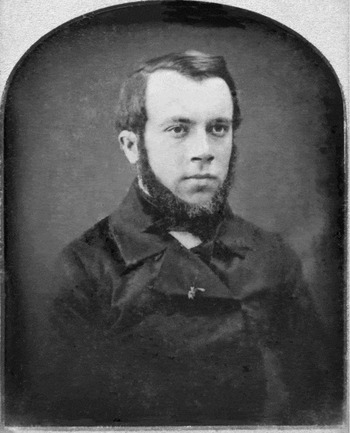
The ship's surgeon was Dr. Robert Cowie. The crew were all Orkneymen and Shetlanders, some with experience on whaling ships and others with the Hudson's Bay Company in Rupert's Land. One exception was John Hepburn, who had survived Franklin's first disastrous overland expedition in 1819–1821. Before the ship sailed Lady Franklin arranged for daguerreotypes to be made of officers and crew (Woodward Reference Woodward1951: 278). Bellot sent one photo of himself to Colonel John Barrow (Fig. 3).
Daguerrotype of Bellot, taken at Aberdeen, May 1851. Reproduced with the permission of the Royal Geographical Society.

Bound for the Arctic
Prince Albert put to sea on Thursday 22 May. The French vice-consul, the banker Mr. Arthur Thompson, had the consulate decorated with flags. The ship's departure was reported in a local newspaper as follows:
Around six o'clock on Thursday evening Prince Albert put to sea from our harbour for her second voyage. A considerable number of spectators had assembled on the quays to watch her leave. Prince Albert was towed out into the bay by Victory and received several rounds of cheering as she left the harbour from the crew of other ships and from the spectators on the breakwaters. It was a particularly fine afternoon, and at the same time it was an exciting scene, especially when combined with the sombre incertitude as to the success of the expedition.
Once out in the bay, all sail was set and gently heeling to starboard with a south wind, the vessel began her long, and we profoundly hope, fruitful voyage. (Aberdeen Journal 28 May 1851)
First port-of-call, on 25 May, was Stromness in the Orkneys, in part to repair some minor damage; in part to procure fresh provisions and water, and in part to wait for an improvement in the weather. Lady Franklin and Sophia had also travelled north by steamer to Stromness, and over the next few days visited the ship frequently. Kennedy took the opportunity to gain some experience in handling a metal kayak which he had had made, in Stromness harbour. Bellot enjoyed himself to the full; despite frequent heavy rain he went on trips by pony to Kirkwall Cathedral and to the many ancient sites near Stromness such as the Standing Stones of Stenness and the massive tumulus of Maes Howe. Nor was he slow to accept invitations to tea, or to dance with Miss Hamilton, the niece of Dr. John Rae, the Arctic explorer. ‘I admit that I am not at all indifferent to the charms of these young beauties and that Miss H., the white lily, and Miss W., the striking rose, are far from being strangers to the pleasures of this evening, not to mention Miss D.L., etc. . .’ (Bellot Reference Bellot1854: 16–17). During a visit to Rae's mother she gave him ‘a warm embrace for her son’, no doubt unaware of the immensity of the Arctic, or even of where her son was at the time. In fact he was on the western shores of Coronation Gulf, toward the close of his sledge trip along the southwestern shores of Victoria Island, several hundred kilometres from where Kennedy and Bellot would be searching over the following months.
On the morning of 3 June the wind changed and Prince Albert was able to put to sea, following an emotional parting from Lady Franklin and Sophia, as noted by the latter: ‘Our parting with our dear little French friend was really painful – he sobbed like a child as he took leave of my Aunt’ (Savours Reference Savours1999: 241). With the barrel-organ grinding out the melody ‘The girls we left behind us,’ Prince Albert weighed anchor and swung south and west, out through Hoy Sound into the open Atlantic.
For the first part of the voyage Prince Albert encountered gales and heavy seas, and many of those on board, especially Bellot, were severely seasick. On first seeing his bunk he had thought it too small, but now, at sea, he found it too wide, as he was thrown from side to side by the violent rolling of the ship. In due course the wind and seas abated and life on board returned to a more regular routine. Bellot had opted for the 8 p.m. to midnight watch, to leave the rest of the day free for his various projects (Forestier-Blazart, N. and J-C. Reference Forestier-Blazart and Forestier-Blazart2011: 174. His daily routine was as follows:
Getting up around 7 am Bellot would go on deck to make his ablutions and to take angle measurements to check the chronometers. At 8 am with the change of watch, there were prayers, then breakfast, tea or coffee and a few pieces of meat. He would then return to his cabin to work until noon when he would go on deck to take the shots for latitude. Lunch barely varied at all: soup, meat and potatoes. He then return to work in his cabin until 6 pm, tea-time. At 8 pm, the entire crew assembled for evening prayers and the final meal of the day; he would then stand his watch. He would not go to bed before 1 am after making an entry in his journal. (Forestier-Blazart, N. and J.-C. Reference Forestier-Blazart and Forestier-Blazart2011: 75)
Bellot was concerned about problems with his eye-sight; bright sunlight during the long northern days troubled his eyes and he retired to his cabin and work by candle-light. At one point he retired to his bunk for an entire day, and let Dr. Cowie bleed him, his first experience of this medical cure-all. Despite it, problems with his eye-sight troubled him throughout the expedition.
It would appear that Bellot found Kennedy's extreme piety and even religious intolerance rather irksome, but they evidently agreed to differ, respecting each other's views. Bellot was intrigued and entertained by Kennedy's Canadian French, which he had mainly learned at Fort Coulonge in the Ottawa valley, and which Bellot found ‘charmingly original.’ On occasion he asked Kennedy to sing some voyageur songs, and the latter was quite happy to comply.
On 23 June large numbers of birds appeared, an indication that they were nearing land, and next day the Greenland coast hove into view. Soon after they rounded Kap Farvel (Cape Farewell) the first ice floes appeared, and rapidly became more numerous and thicker. The crow's nest was sent up, while fog became rather frequent and persistent. When the first iceberg was sighted Bellot raced on deck to see it. Very soon he was able to report: ‘We are surrounded on all sides, and one may summarize our position as follows: icebergs ahead and astern; icebergs to port and to starboard’ (Forestier-Blazart, N. and J.-C. Reference Forestier-Blazart and Forestier-Blazart2011: 76). He was particularly fascinated by the sight of part of a berg collapsing, or of an entire berg capsizing, and was left spellbound by the endless variety of iceberg shapes.
By 4 July Prince Albert was abeam of Disko, but did not stop. Then on 8 July two whaleships were encountered, Pacific of Aberdeen, and Jane of Bo'ness. Visits were made and news exchanged between the three vessels. On 10 July Prince Albert reached Upernavik (Kennedy Reference Kennedy1853a: 49), where they were very welcomed by the governor, Mr. Kraftg; Bellot chatted with him readily in German. But he also took the opportunity to visit one of the Greenlanders’ houses. Having negotiated the low entrance tunnel, ‘a sort of drain with damp walls, where one's foot rested in a sort of mud softened by blood, water, oil and fat’, he reached the interior room, where he was almost overcome by the smell. ‘I felt suffocated; my nose, throat and eyes were all affected – but I wanted to see’ (Bellot Reference Bellot1854: 55). His reaction: ‘How can human beings live in such conditions?’ Before leaving Upernavik the expedition acquired six sledge dogs.
Just north of the Women's Islands Prince Albert was becalmed in superb weather, with a temperature of 12.8° C; several times boats were sent ashore, returning with 23 dozen eider eggs, which made a welcome addition to the menu. On 12 July, as the ship worked her way through relatively loose pack ice, she came up with a fleet of 12 whaleships. Several times visitors rowed over to Prince Albert, usually the whaleships’ young surgeons. And several times whales were spotted, pursued and killed within sight of Prince Albert, giving rise to mixed feelings on Bellot's part.
It was also on that day that Prince Albert came within sight of Advance and Rescue, the vessels of the first Grinnell expedition, an American expedition funded by the shipping magnate, Henry Grinnell, and also engaged in the search for Franklin (Kane Reference Kane1854). They had sailed from New York in May 1850 and had reached Beechey Island almost simultaneously with Horatio Austin's British squadron, which consisted of H.M.S. Resolute, Assistance, Pioneer and Intrepid, and which would winter off Griffith Island, just south of Cornwallis Island. Subsequently Advance and Rescue had become beset, had drifted north up Wellington Channel, back south again, east through Lancaster Sound and south down Baffin Bay. They were now trying to fight their way back north again for another attempt at searching for Franklin. For the following four days the ice prevented Prince Albert from closing with the Americans, but once she did there was a great deal of visiting between the three ships. Prince Albert under Forsyth had encountered the Americans near Beechey Island and, alerted by them, William Snow (the ‘Chief Officer’ of the expedition) had gone ashore at Cape Riley, and had seen the traces of the Franklin expedition discovered shortly before by Captain Erasmus Ommanney of H.M.S. Assistance; the Americans had also told him of the find of the graves of three members of Franklin's expedition and of various other relics on Beechey Island. Forsyth and Snow had brought this news back to England the previous autumn and it served as a useful excuse for their early return (Stone Reference Stone1993a: 141). But now, as Bellot and Kennedy listened to Kane and the other Americans, they gave further details of all the finds at Beechey Island. These details were thought to be sufficiently important that appropriate messages were attached to the legs of three pigeons; but when they were released they simply circled the ship several times and landed back aboard. During the night one of them was killed and eaten by the dogs. No further attempts were made.
In his journal Randolph Carter, Rescue's first officer, described Bellot as ‘an elegant, pleasant young man’ (Gill and Young Reference Gill and Young1998). Bellot was particularly impressed by Elisha Kent Kane, assistant surgeon on board Advance, and the two men got together daily. Then on 19 July they set off together on a seal hunt which turned out to be unsuccessful. On another occasion, when Kane and Bellot were progressing by jumping from floe to floe, Bellot fell into the water. Kane, who was nearby, ran toward him:
. . . I jumped along for some hundred yards more, and was soon near enough to see M. Bellot up to his neck, and Mr. Kennedy trying to fish him out with a boat-hook. When I got up to them, which I did by a process of ferriage, using little blocks of floe for a raft, M. Bellot's Arctic attire presented an appearance strikingly aquatic and uncomfortable (Kane Reference Kane1854: 440).
Kane and Bellot became close friends ‘and there wasn't a single subject of conversation with him, from which I could not draw some useful intelligence’ (Forestier-Blazart, N. and J.-C. Reference Forestier-Blazart and Forestier-Blazart2011: 82), their favourite topics of conversation being history, philosophy and politics. The fact that both men were freemasons must have strengthened the bond between them. Bellot had joined the ‘Accord Parfait’ Lodge in Rochefort on 1 July 1848, while Kane belonged to the Franklin Lodge in Philadelphia. Eventually the ice released the three ships, allowing them to go their separate ways.
Progress over the following month, as Prince Albert worked her way through the ice of Melville Bay, was painfully slow. At times the crew had to resort to ice-saws to cut a channel to the next lead or polynya; at other times they tried warping, that is sinking kedge-anchors into the ice ahead of the ship, then hauling in with the capstan, to move the ship slowly ahead; or yet again they would try tracking, with a party of men towing the ship bodily along a lead. On one occasion some target practice was organised, the target being located on a convenient iceberg. But this appears not to have improved the marksmen's aim: the first bear that approached the ship ran off unscathed despite a fusillade of shots. The next one to approach the ship was less fortunate; it was killed and hoisted aboard.
On 24 August, having successfully negotiated the ice of Melville Bay to reach the North Water, the ship swung west and south to reach Pond Inlet; as the ship approached land five kayaks approached and their occupants climbed aboard. Some limited trading began, probably limited by the fact that the Inuit had not expected to encounter a ship. But three days later, off Possession Bay (eastern Bylot Island) they came back aboard with numerous items to trade. They bartered bows and arrows, and narwhal tusks up to 2 m long, for saws, knives and barrel hoops. And when the barrel-organ was started up the officers and crew were greatly entertained by the delighted reaction of the Inuit: jumping, shouting, rolling and twisting.
Progress westward along Lancaster Sound was painfully slow due to persistent headwinds and heavy seas, with pouring rain. At one point the crew members, soaked and chilled, came aft to petition for a ration of brandy; despite his usual prohibition against alcohol, Kennedy approved this as a special dispensation due to the unusual circumstances.
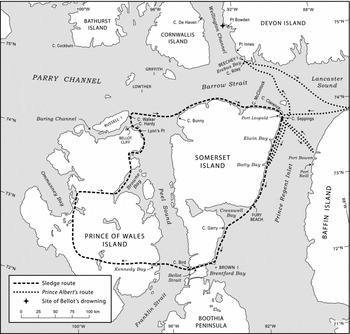
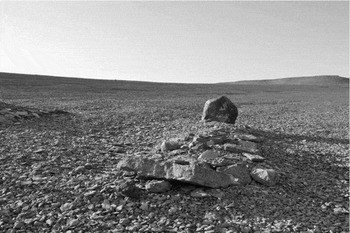
By 4 September Port Leopold (Fig. 4) was in sight. A boat was launched and Kennedy, Bellot and four men headed ashore. Hhaving wintered here in Enterprise and Investigator in 1848–1849 Sir James Clark Ross had left a depot of provisions and a steam launch here (J.C. Ross Reference Ross1850; Gilpin Reference Gilpin1850). Kennedy wanted to check the state of the depot and to see if any messages had perhaps been deposited by members of Franklin's expedition. But a wide belt of broken ice, impassable either by boat or on foot, prevented a landing. Next Kennedy ran south and, finding Elwin Bay, Batty Bay and Fury Beach blocked by ice headed across Prince Regent Inlet to Port Bowen, where Sir Edward Parry had wintered in Fury and Hecla in 1824–1825 (Parry Reference Parry1826). Kennedy and Bellot landed at the anchorage in the lee of Stoney Island on 5 September; the grave of John Cottrell, one of Fury's seamen (Kennedy Reference Kennedy1853a: 59), plus assorted debris, including a stove, a kiln, rusty nails and a piece of rope gave evidence of Parry's wintering here, but they found no messages or any other evidence that anybody had been here since then. Next day Bellot travelled by a Halkett boat, an inflatable rubber boat invented by Lieutenant Peter Halkett (Wilson Reference Wilson1955), to Port Neill, a little further south on the Baffin Island coast. Parry had called here briefly in Hecla after Fury had been driven ashore and abandoned at Fury Beach on the west shore of Prince Regent Inlet. On 6 and 7 September, Bellot searched the area around Port Neill; he investigated a cairn on a hill to the north, digging around it, but found no messages. He left his own message here, however. Returning to Port Bowen, in the evening he found a notice board with the word ‘Observatory’ and beneath it, under a heap of stones, and marked by a piece of whale bone, he found a cylinder with a note from Parry (Bellot Reference Bellot1854: 123).
Map of Kennedy and Bellot's sledge trip, March – May 1851.

Prince Albert remained lying at Port Bowen throughout 7 September which, being a Sunday, was deemed a day of rest. Getting under way next day she headed back across Prince Regent Inlet toward Port Leopold. But by noon large quantities of ice had drifted south from Lowther Island. The vessel worked her way slowly through it, but while still several miles from her goal was brought to a halt. At 4 pm Kennedy and four men headed ashore in a boat, working their way along leads too narrow for the ship. By 8 pm they had still not returned; they had taken no camping equipment and little food. But by the evening Prince Albert was completely beset in the ice and was drifting south with it. Bellot thus found himself in sole command. He consulted with the officers, and also with the men. John Smith, whose brother Gideon was with Kennedy, was especially concerned about the shore party. Bellot was fairly sure that Kennedy would have found the depot of provisions and equipment left by Ross and that he and his men were therefore in no immediate danger. For the moment, therefore he decided to simply let the ship drift with the ice, with the intention of getting under way at the first opportunity, of finding a secure wintering harbour, and only thereafter of sending a rescue party back to Port Leopold overland. That night he ordered some rockets fired, and was relieved to see some answering signals from shore.
Rescuing Kennedy
The ice soon slackened and, running south, by 8.30 pm Prince Albert had reached Batty Bay, about 80 km to the south; it was fortunately free of ice and offered a suitable sheltered wintering site. Having consulted with Leask, who would be left in charge of the ship, Bellot decided to hike north to Port Leopold, accompanied by three men, John Smith, Magnus McCurrus and William Miller. He decided not to take the dogs or a sledge (although he soon regretted this decision) offering the rather baffling reason that they had only one pair of snow shoes, and hence decided not to take any (Bellot Reference Bellot1854: 132). The party was to travel light without a tent and with only pemmican in terms of food. How Bellot hoped to assist Kennedy and his men, if they had been unable to find food or shelter at Port Leopold is a mystery.
Before leaving the ship Bellot wrote a rather dramatic letter to his family:
My dear, excellent friends!
If you receive this letter I will have ceased to exist, but in fulfilling a mission of peril and honour. You will see from my journal which is located among my baggage that, our captain and four men having been left behind in the ice in order to save the remainder; now we've had to think of going to rescue these brave men. Perhaps I don't have the right to endanger myself in this way, knowing how necessary I am to you in every respect but perhaps my death itself will attract to the various members of my family the esteem of man and the blessings of Heaven.
Farewell, until I see you again up above, if not down here. Have faith and courage.
I embrace you.
J. Bellot (Bellot Reference Bellot1854: 413).
The party set off at 3.30 am on 11 September, accompanied by Leask and four men as a support party. At 10.00 am Bellot sent Leask and his men back to the ship, afraid that with fog, a strong wind and drifting snow, they might be unable to follow their tracks if they waited any longer. A few miles south of Elwin Bay, in a strong wind and driving snow they decided to stop; since the snow was quite soft it took them three hours to erect a snow house. Using an alcohol stove they brewed some tea and chewed on pemmican. They lay on a buffalo robe, with another over them, and, using their boots as pillows, tried to sleep. Half awake, before he fell properly asleep Bellot was touched when he became aware of his men, in turn, checking to see that his feet were not freezing and that he was properly covered by the buffalo robe. Next morning, taking the advice of his much more experienced men, who advised that to persist would be suicidal, Bellot started back south. It took them until the afternoon of the 14 September to reach the ship, chilled and exhausted, having spent a further two nights in snow houses. Seen objectively, they were lucky to have survived what was an extremely foolhardy venture.
There followed several weeks of foul weather that strained the patience of Bellot and his men. The severe gales tested Prince Albert's anchors and anchor chains, even in the relative shelter of Batty Bay, but fortunately they held. By the end of the month the bay froze over; the dogs were let loose, and although initially they all disappeared, they soon returned. Next day they were harnessed to a toboggan (which, given his background, Kennedy had insisted upon, rather than a sledge with runners), and some of the men introduced Bellot to the art of dog-driving. This was the first time the dogs had been harnessed. In light of his background, Kennedy used a tandem-hitch, whereas the Greenland dogs were accustomed to a fan-hitch, and initially were uncooperative. Meanwhile the men were employed in making snowshoes, since Bellot planned to make a second attempt to reach Port Leopold at the first opportunity.
This time, however, he was much better prepared. He took a toboggan and four dogs, along with a tent, charcoal for fuel as well as the alcohol stove, and adequate food. He was accompanied by Cowie, in case any of Kennedy's party was in need of medical attention, and two seamen, Smith and McCurrus. Once again, Bellot left a ‘farewell’ letter, this time to Lady Franklin:
Prince Albert, Batty Bay
12th of October 1851
Madam,
Having failed in my first undertaking to rescue dear Mr. Kennedy and the absent party, I am to start again to renew our attempt, accompanied by the doctor and two hands. I am fully aware both of the hazard of such a trip at this time of the year, and of its consequences on the future prospect of the Expedition, should we be destined not to return. Whatever may be, I hope I need not make any apology of my motives; for being convinced of what importance is Mr. Kennedy's presence in our next operation, and remembering your strong recommendations [not] to hazard everything for any man's life, I think that in the present unforeseen circumstances, it would be grossly mistaking your Ladyship's intentions, not to obey the advices of our duty as ship-mates, and of humanity as fellow-men, even though we should perhaps risk the success of the chief purpose which we are sent out on, were it God's blessed will not to make fruitful endeavours. Being moved in all my determinations by the strongest wishes of not sparing any effort for your Ladyship's service, I beg you will consider me as your Ladyship's
Most respectful and devoted servant
J. Bellot. (Kennedy Reference Kennedy1853a: 70–71)
The party set off at 3 am on 13 October, the dogs making light of the load, to the point that the men had to trot to keep up. But suddenly, around 10 am Bellot, who was some distance behind, saw Smith, who was guiding the toboggan, disappear, as the ice broke beneath him and the toboggan. He shouted to warn Bellot and the latter leaped backward before he too fell into the water; the ice was dangerously thin and covered with a treacherous layer of snow. Fortunately the water was not very deep and Smith, although soaked, cut the traces to save the dogs and began rescuing items from the load on the toboggan. But before he had saved everything, the floe, with the toboggan partly riding on it, broke away with the rising tide and drifted out to sea, along with the tent, four buffalo robes, the stove and the doctor's case of instruments. Having cached everything they had salvaged Bellot and his men had no option but to start back to the ship, arriving there at 5 pm that same afternoon.
Undeterred, Bellot immediately started preparing for a third attempt, this time hauling a boat as a precaution. Leaving Leask, Cowie and 3 men to look after the ship, Bellot started north again with the mate, Henry Anderson and 7 men at 10 am on 15 October hauling a dinghy. By 4 pm they had reached the spot where the previous attempt had been abandoned. Fortunately the floe with the toboggan and everything still on it, had drifted only a few hundred meters northward. Having salvaged everything the party camped for the night. Next morning, having sent one man back with the news of the successful recovery of all the abandoned items, Bellot and his men pushed on north, still hauling the dinghy but, as a precaution, with Anderson walking ahead and testing the ice with a boat-hook.
They camped for the night about 6 km north of Elwin Bay, that is about 16 km south of Port Leopold. In the morning tracks revealed that a bear had approached to within about 30 m of the tent; it was suggested that it had been scared away by the loud snoring of some of the men. They reached Cape Seppings, at the southern entrance to Port Leopold around 3 pm. They fired their guns several times, but there was no reply. But as they approached what appeared to be a tent Kennedy and his men emerged, all in good health, after being marooned here since 9 September, that is for about five weeks. They had found the steam-launch left by Sir James Clark Ross, and had made it weather-proof by rigging a tent of sails over it (Kennedy Reference Kennedy1853a: 63). The ample cache of food, fuel and equipment left by Ross had been more than adequate for their needs. Kennedy had never doubted that Bellot would somehow come to their rescue; at the very worst, with the food and fuel on hand they could have survived a winter. Kennedy and his men were naturally delighted at the arrival of Bellot and his party. As Kennedy noted ‘I cannot refrain from recording my warmest thanks to Mr. Bellot, not only for this, but two other attempts which he had made to communicate to us the intelligence of the Prince Albert's position, and to bring us a supply of clothing’ (Kennedy Reference Kennedy1853a: 68–69).
For a week Bellot and his men rested and recuperated, taking full advantage of the abundant stores left by Ross. In the meantime a sledge was built, on which to haul the dinghy on the return trip. Having lashed the boat to the sledge and stowed all their gear in the boat, the combined party set off southward on 22 October. At Kennedy's suggestion a sail was hoisted on the boat and proved so effective that the men had to run to keep up. When they camped for the night they were faced with the problem of accommodating 13 men in a tent designed for six and measuring only 9ʹ (2.74 m) by 6ʹ (1.82 m). The solution: ‘It was arranged that we should sit down six in a row, on each side, which would leave us about three feet clear to stretch our legs. Mr Bellot, who formed the thirteenth, being the most compact and stowable of the party, agreed to squeeze in underneath them, stipulating only for a clear foot square for his head alongside the tea-kettle’ (Kennedy Reference Kennedy1853a: 75).
As darkness fell on the 25 October the party was still 13 km from the ship and snow conditions and rough ice were making progress very slow; it was decided to leave the sledge and boat and to walk to the ship, where they were warmly greeted by Leask and his men, The sledge and boat were retrieved on the 27th of the month.
The wintering
The expedition now settled down for the winter, in what had become a standard pattern for arctic expeditions. The ship was banked up with snow for insulation, with two impressive-looking ice staircases leading from the ice up onto the deck. Snow houses accommodating a powder magazine, a forge and a wash-house were built on the ice near the ship or on shore, while additional ventilators were installed to carry away the steam from the galley and the smoke from candles and lanterns. On 10 November, with the help of Gideon Smith, Bellot built a small observatory on a hill about 5 km from the ship and with a clear view to the south, with the aim of obtaining observations of the last appearances of the sun (Bellot Reference Bellot1854: 183). Several times he suffered severe pain when his eye-lids froze to the eye-piece of his sextant. Kennedy, somewhat unkindly, if amusedly, commented ‘Mr. Bellot makes daily pilgrimages to a hill in the neighbourhood, where he occasionally succeeds in getting a meridian observation of the sun, and always succeeds in getting his fingers frozen in the operation’ (Kennedy Reference Kennedy1853a: 87). By 12 November the sun had disappeared for the winter.
The crew engaged in a variety of activities; some tried trapping foxes, with only limited success. Especially until the sun disappeared, others went out to shoot hares and ptarmigan, with better success. No larger game was encountered, however. One activity that involved almost everybody, was making snowshoes, in preparation for the planned journeys; some of the men made the frames, others cut the thonging, while others, under Kennedy's direction, wove the webbing. While, with one exception the crew members could already read and write, some had little or no proficiency when it came to arithmetic and Cowie offered classes in this subject to those who were interested (Kennedy Reference Kennedy1853a: 83)
Communal readings were quite popular but there were no attempts at theatrical performances, so popular on the Royal Navy's expeditions. They were prohibited by Kennedy, and certainly he would never have permitted men playing women's roles, as happened on board the navy ships. Each day ended with communal prayer.
As a special dispensation on Christmas Day, Kennedy allowed the men to indulge in some alcohol, although no doubt only to a limited degree. And they were also allowed to have a game of soccer on the ice, that must have been challenging in the dark. The men were even allowed to play cards, while the barrel-organ presented by Prince Albert helped to heighten the festive mood.
With the arrival of the new year Kennedy and Bellot started to make plans for a trip south to Fury Beach to check the state of the provisions left there by Parry in 1825 before abandoning Fury (Parry Reference Parry1826). They knew that Sir John Ross and his men had consumed some of the provisions when they wintered here in Somerset House in 1831–1832 and 1832–1833 (J. Ross Reference Ross1835) but it would be useful to know how much was left. They had no expectation that they would find any sign of Franklin's men having been there since Lieutenant Frederick Robinson, of Sir James Clark Ross's expedition, had visited the site in June 1849 (J.C. Ross Reference Ross1850; Gilpin Reference Gilpin1850).
Accompanied by three men, John Smith, W. Miller and W. Adams, Bellot and Kennedy set off on 5 January; their four dogs hauled a toboggan with a tent and provisions. The weather was clear, with a temperature of –29°C. The sea ice was extremely rough and broken and after only 16 km they pitched the tent for the night; an unanticipated problem was the formation of rime on the tent canvas, which formed from the condensation and freezing of their breath, and which rained down on them whenever the canvas flapped in the wind. On the second day they covered about 19 km and that night they built a snow house. On the third day, after 12–13 km, they were brought to a halt in extremely chaotic ice at the foot of a sheer cliff. After resting for a few hours, leaving the toboggan and dogs with Miller and Adams, who built a snow house, Kennedy, Bellot and Smith continued south through a labyrinth of pinnacles and hummocks (Kennedy Reference Kennedy1853a: 100).
Scattered debris including broken boxes and chunks of iron, alerted them to the fact that they were close to their objective, John Ross's Somerset House. They found it to be relatively intact, although bears and the wind had ripped the canvas walls and it was full of snow. They did not really expect to find any sign of Franklin's people having been there. But even so they experienced some initial disappointment. But perhaps more importantly, even after the inroads which Ross and his men had made, a large proportion of the provisions left by Parry still remained relatively intact: ‘. . .high stacks of wooden and metal cases of every shape and every size; over there barrels of flour and of salt meat; further away anchors, ship's grapnels, then two partly stove boats, oars and boat masts; everything that a seaman, even of fairly limited experience would appreciate as being of inestimable value. . .’ (Bellot Reference Bellot1854: 218). They opened some cases at random and found that the cans of vegetables and meat smelled and tasted just as if they had been canned the previous day. Lighting a fire they thawed out a small keg of lime juice and found it still potable. The canned goods, and especially the lime juice represented an important addition to the provisions for the intended major sledge trip later.
The return trip to Batty Bay was an ordeal. They were heading into a north wind with temperatures of –30° and colder. They all suffered severely from frostbite on their faces, while their beards became masses of ice which froze to their clothes, and made undressing, unless they first waited for the ice to melt, or else cut themselves free with scissors, very painful. They were glad to get back to the warmth of the ship and to the comfort of a warm, dry bunk.
Over the next few days their frost-bitten faces slowly recovered, although the intermediate stages, with extensive scabs and sloughing skin, were not very attractive (Bellot Reference Bellot1854: 225). Bellot was pleased that he had been able to endure the hardships of the trip as well as any of the men.
Much thought was now given to the route of the main sledging trip. Some of the contemplated routes were quite improbably ambitious: at one point the furthest points being discussed were Montreal Island (in Chantrey Inlet, near the mouth of the Back River) and Pelly Bay (Bellot Reference Bellot1854: 230). And in the unlikely possibility of an early break-up of the ice, there was even some thought of hauling a boat from Fury Beach, or even Port Leopold southward, then over the Isthmus of Boothia, for use on the west coast of King William Island.
On 30 January and 13 February 1852 two depots were laid farther south in preparation for the main sledge trip (Kennedy Reference Kennedy1853a: 107). Returning from the second trip, heading into the wind, they again froze their faces badly. By the time they got back to the south side of Batty Bay (the ship lay near the north side) it was pitch-black. On reaching the north side, a mile away, they could not determine whether the ship lay to the right or to the left and ultimately it was only by releasing two of the dogs and following them, that they finally found the ship, five hours after leaving the south side of the bay.
On 15 February the full disc of the sun rose above the hills to the south after an absence of 108 days. With the increasing amount of daylight, on 20 February work began on hauling rocks for ballasting the ship, using an Inuit sledge. Then on 25th, as a preliminary to the main sledge trip, a party set off south to Fury Beach, picking up and forwarding the depots which had been cached earlier (Kennedy Reference Kennedy1853a: 114). After the first day Kennedy continued south, while Bellot returned to the ship to take charge of the rest of the party and to lead them south to Fury Beach (Bellot Reference Bellot1854: 243).
On 4 March, accompanied by 5 sailors (Magnus McCurrus, Andrew Linklater, Andrew Irvine, William Adamson and Kenneth Sutherland), the bosun Robert Grate, and mate Henry Anderson, and with two toboggans, Bellot set off southwards. They reached Fury Beach on the afternoon of the 7 March, to rejoin Kennedy and the advance party. They had already made some progress in making Somerset House habitable, and with the additional manpower the job was soon completed. A wall of snow-blocks helped to insulate the structure, while the abundant coal and firewood and two stoves kept the interior temperature quite comfortable. The canned vegetables, soups, flour, sugar, dried peas and lime-juice left by Parry provided a very welcome addition to the expedition's supplies. Unfortunately, however, there was no meat of any kind left in the depot and hence Kennedy decided to send Bellot back to the ship, accompanied by Smith, McCurrus, Webb, Grate and Linklater, with four dogs and two toboggans to fetch some salt meat, pemmican and biscuit, since the biscuit in the depot had become spoiled. They set off on 12 March, and were back at Prince Albert by 6 pm the next day. Back at the ship the four men left there (Leask, Cowie, Hepburn and the cook, James Glennie) had been busy drying out the cabins and the bunks. Having loaded their toboggans with the provisions for which they had come Bellot and party started back south on 17 March. They spent the night in a snow house, but were rudely awakened when one of the dogs, chased by the others, took refuge on the roof of the snow house; it collapsed, however, dropping the dog and a small avalanche of snow on the sleeping men (Bellot Reference Bellot1854: 257).
The next few days were spent in final preparations for the major sledge trip. These were interrupted on the 26 March by an amusing incident. A bear was spotted on top of a low cliff close to Somerset House. Two parties set off to try to shoot it, each approaching from a different direction. Only when they got close and when the animal fled did they realize that the ‘bear’ was an arctic fox; this is an excellent example of the difficulty of estimating size and distance in the Arctic. Smith raced after the fox and shot it.
Searching for Franklin
When the weather cleared around 4 am on 29 March, everyone started final preparations for departure. All 14 men set off, eight of them to act as a support party; they would turn back at Brentford Bay and head back to Batty Bay (Kennedy Reference Kennedy1853a: 122). From Brentford Bay it was planned that the main party would cross the isthmus believed to exist to the west of it, to the west coast of Boothia Peninsula, and then south to the Magnetic Pole which James Clark Ross had found near Cape Adelaide in June 1831 (M.J. Ross Reference Ross1994: 153–154). Bellot and Kennedy disagreed as to their course thereafter. Bellot wanted to continue south in hope of meeting Inuit: ‘For my part, I attached the greatest importance to interrogating them, since it is impossible that a party of Europeans, as reduced in number as one imagines they would be, would escape the explorations they [the Inuit] make along the coasts in the spring and summer, whereas we might pass very close to obvious signs without suspecting’ (Bellot Reference Bellot1854: 262). Kennedy had other ideas, but for the moment at least he agreed that they should continue south along the east coast of Boothia Peninsula, but ultimately he felt it important that they get to Cape Walker, as a specific point identified in Franklin's instructions.
In the meantime they made steady progress south; the five dogs hauled two toboggans while the men hauled another two, with Bellot pulling his weight: ‘Mr. Kennedy had given me no orders as to what I should do; but I voluntarily and cheerfully harnessed myself to one of the sledges, to show my good-will. I would have blushed to take advantage of my position and done nothing (Bellot Reference Bellot1854: 263). On the first night it took them almost five hours to build a snow house large enough for 14 men, and it was 1 am before they settled down for the night. Thereafter they built two smaller snow houses with an interconnecting door. On 31 March they crossed the mouth of Cresswell Bay and continued south past Cape Garry. Old Inuit camps, muskox tracks, and the first snow-bunting (Plectrophenax nivalis) helped to relieve the monotony.
By 6 April they had reached Brown Island, just east of the mouth of Bellot Strait; this was the island on which Sir John Ross raised the flag and claimed the land for Britain in 1829 and from his illustration (J. Ross Reference Ross1835: facing 116) and from Kennedy's description this was not the small island now bearing that name, but the larger island on which stands Fort Ross, the former Hudson's Bay Company post. The fatigue party started back north from here leaving a party of six: Kennedy, Bellot, Smith, Adams, Irvine and Webb, with five dogs (Kennedy Reference Kennedy1853a: 130). Of the men Smith was selected as being a good snow house builder; another was the best dog-driver, while a third was an excellent shot. Their supplies consisted of about 400 lbs (181.4 kg) of pemmican, 150 lbs (68.04 kg) of biscuit, some tea and sugar and 5 1/2 gallons (25.0 litres) of alcohol; total weight was about 600 lbs (272.16 kg). The load also included a blanket each, three buffalo robes, a rubberized groundsheet, a sextant, a Halkett boat, items for barter with the Inuit, three guns and ammunition and about 20 pairs of moccasins.
On the evening of the 5 April, on the north side of Brown Island they noticed an inlet which appeared to run straight west; it disappeared into a band of dense fog, from which they concluded there was open water there. The next day two men stayed in camp to dry the blankets, and while Bellot and Smith examined the east coast of the island, Kennedy and Adams headed west to see if there was indeed open water, and to reconnoitre a possible route across to the west coast of Boothia. On 7 April all six men started west, on the basis of what Kennedy had discovered:
Wednesday 7th. Started early, and took the northern channel, partly explored by myself yesterday, and continued along it until 6 p.m. when we reached its western extremity, a distance of not less than twenty miles, including its various windings. From a high hill near our encampment at this spot, we observed a broad channel running N.N.E. and S.S.W., true (variation 140), which was at first taken for a continuation of Brentford Bay, until its great extent convinced us that we had fallen upon a western sea or channel, and that the passage we had just gone through was in reality a strait, leading out of Prince Regent Inlet. It appears on the map of discoveries as Bellot Strait – a just tribute to the important services rendered to our Expedition by Lieutenant Bellot (Kennedy Reference Kennedy1853a: 131–132).
At the west end of the strait an important decision had to be made. Bellot was still convinced that they should now head south, in the hopes of encountering Inuit who might have information about the Franklin expedition. Kennedy, however, disagreed.
We had now arrived at a point where in the execution of a plan which I had had the privilege of submitting to Lady Franklin before leaving England, the future direction of our travel would be decided by the circumstances we might encounter on the spot. If the opening between Cape Walker and Cape Bunny [tht is Peel Sound] had indicated a channel opening onto Rae's Victoria Strait, our direction would have been southwards, based on the likelihood that Franklin would have taken it. (Kennedy Reference Kennedy1853b: 125)
But he reports that he saw to the north ‘a continuous barrier of land extending from North Somerset [Somerset Island] to an extensive land which we could distinguish on the other side of the channel, and which we have since ascertained to be the Prince of Wales Land of Captain Ommanney’ (Kennedy Reference Kennedy1853a: 134). Or, as he reported elsewhere we ‘. . . were not a little disappointed at finding that the sea before us, which we had hoped might, perhaps, prove continuous with the opening between Cape Walker and Cape Bunny, terminated apparently in a bay on our north. . . . We had in fact come out upon the northern extremity of the Victoria Strait of Rae [that is Franklin Strait]; and our western land proved to be the Prince of Wales’ Land of Captain Ommanney’ (Kennedy Reference Kennedy1852a: 30). Kennedy was thus committing an error reminiscent of Sir John Ross's ‘sighting’ of the ‘Croker Mountains’ blocking Lancaster Sound in 1818 (J. Ross Reference Ross1819: 174), and was lucky to have escaped comparable ridicule as a result. Puzzlingly, however, Kennedy identifies the cape at the north side of the western entrance to Bellot Strait, with James Ross's Cape Bird (Kennedy Reference Kennedy1853a: 132). Ross had followed Peel Sound south as far as there, and could see it. ‘still bearing nearly south (true), the land thus trending for Cape Nicolai, the northernmost point which I had reached during my journey from the “Victory” in 1832 (sic in fact 1831), and which I hoped to have attained on this occasion, as well as to have revisited the Magnetic Pole in its immediate vicinity. . .’ (J.C. Ross Reference Ross1850: 61–62). This, of course, is totally incompatible with Kennedy's insistence that he saw land extending from Somerset Island to Prince of Wales Island, a short distance north of the west entrance to Bellot Strait. On that basis he deduced that Franklin could not have come south via Peel Sound and Franklin Strait, and hence there was no point in heading south; instead he developed an almost obsessive drive to visit Cape Walker, as being a location specified in Franklin's instructions.
The irony is that this strait (Peel Sound, leading into Franklin Strait) was precisely the route which Sir John Franklin had taken in Erebus and Terror in 1846, only to become permanently beset in the multi-year ice off the northwest coast of King William Island. Had Kennedy and Belly turned south (as Bellot would have preferred), they might well have reached King William Island and discovered the various traces of the Franklin expedition which McClintock and Hobson, travelling by sledge from the east end of Bellot Strait, would find seven years later (McClintock Reference McClintock1859). But they continued west across Franklin Strait and into the interior of Prince of Wales Island
Unfortunately it is impossible to match Bellot's description of their route over the next few weeks with the party's route as indicated on Kennedy's map. Certainly one would never guess from Bellot's description that having crossed Franklin Strait to Kennedy Bay on the east coast of Prince of Wales Island they then crossed most of that island. For four days (14–17) April the party was storm-bound in a snow house. Soon thereafter, with rising temperatures, which meant soft snow and an increasing tendency towards snow blindness, they started travelling at night. Bellot was puzzled as to why they were travelling across land, rather than following the coast:
. . .I replied that if Sir John Franklin's expedition had penetrated to the head of this dead-end [presumably Peel Sound], we would find traces of its passage on the coast and not in the interior. ‘This is true,’ said Mr. Kennedy, ‘But for the moment I want to go to Cape Walker as soon as possible and the coast will be examined by boat during the summer.’ It remained only for me to defer to this, once I had established how I viewed the matter (Bellot Reference Bellot1854: 287).
On 21 April they swung north (Kennedy Reference Kennedy1853a: 142), although they had great difficulty in maintaining a course due to persistent fog and a sluggish compass. On the night of 24–25 April they reached the shores of Ommanney Bay. They were not to know that this west coast of Prince of Wales Island had been searched by Captain Erasmus Ommanney (Ommanney Reference Ommanney1852: 30–52) and Lieutenant Sherard Osborn (Osborn Reference Osborn1852b: 89–103) of Austin's squadron, the previous spring. But although they thought they were on an unexplored and unsearched coastline, diminishing supplies and signs of scurvy persuaded Kennedy that thorough exploration of this coast was simply not feasible (Kennedy Reference Kennedy1853a: 143). On the 26 April the temperature rose to 0°C for the first time and they slept in the open sheltered only by a snow windbreak. On the night of 26–27 April after following the shore line of Ommanney Bay for some distance northward, they then swung east, back across towards Browne Bay on the east coast of the island.
On the following night they spotted two caribou. Kennedy and Smith tried stalking them, holding their rifles horizontally at head height, in imitation of antlers (Kennedy Reference Kennedy1853a: 144), while the rest of the party held their arms in the air and hopped from one foot to the other. The caribou were not deceived, and fled.
On the night of 27–28 April they reached the sea again, on the shores of Browne Bay, and swung north. They were not to know this, but this east coast of Prince of Wales Island had been explored and searched by Lieutenant William Browne from Austin's squadron at Griffiths Island the previous spring (Browne Reference Browne1852: 65–75.) Then, late on 3 May they reached a headland from which Cape Walker could be seen to the north, while what seemed to be a bay extended off to the southwest (Bellot Reference Bellot1854: 302). Kennedy took possession of the land which they had been traversing for the past few weeks, in the name of Queen Victoria, and named it Prince Albert Land. The ‘bay’ between them and Cape Walker was named Grinnell Bay (in fact Baring Channel, between Russell Island, on which Cape Walker lies, and Prince of Wales Island), and the limestone headland on which they were standing, Cape Bellot. It is not clear whether this was Lyon's Point, Cape Hardy, or the high, prominent headland now named Bellot Cliff.
Kennedy and Bellot were quite disappointed that there was no sign of Franklin's expedition at Cape Walker, in that it was specifically mentioned in Franklin's instructions. Nor could they find any sign of any parties from Austin's squadron which had wintered off Griffith Island in 1850–51. To Bellot it was inconceivable that any such parties would not have left cairns and messages, had they been here. But in fact Bellot was mistaken. In April 1851 an entire cavalcade of man-hauled sledges, led by Captain Erasmus Ommanney, had arrived from the wintering ships off Griffith Island, the individual sledges commanded by Lt. William Browne, Dr. Charles Ede, R.V. Hamilton, F.K. Krabbé, Lt. G.F. Mecham, Captain Ommanney and Lieutenant Sherard Osborn. Their sledge crews must have totalled over 50 men. And later both Krabbé and Mecham made further trips to Cape Walker to meet and resupply the various other sledge crews as they returned from further south.
And, contrary to Bellot's statement, two cairns had been built at Cape Walker. On 23 April 1851 Ommanney's men had built a cairn at the base of the cliff where he had camped:
9h. Took formal possession of the land in the name of our gracious Sovereign and planted the “British flag” in the ground with three cheers . . . . A cairn was built, in which the proper official document was deposited, also some coins, and the two Halkett boats buried close to it, under a remarkable portion of the cliff which was detached at the entrance of a ravine and forms a prominent feature (Ommanney Reference Ommanney1852: 34).
And, as Krabbé reported of his second visit a month later:
Wednesday 28th [May]. . . proceeded with party to summit of cape to erect a cairn. . . Placed it about 200 yards [182.9 m] from edge of cliff, directly over the highest point, ten feet in diameter at the base. Found stones difficult to raise from the ground being frozen in . . .
Sunday 1st June. . . A.M. 0h 30 m, completed cairn, making it seven feet and a half [2.28 m] high, ten feet [3.04 m] in diameter at base, four feet [1.2 m] at summit with a bamboo staff and tin. Deposited medal of H.R.H. Prince Albert at tin cylinder containing record, two feet (60 cm) from the summit and union jack at the apex (Krabbé Reference Krabbé1852: 273).
Neither Kennedy nor Bellot climbed to the top of the cliffs at Cape Walker. Indeed Bellot (Reference Bellot1854: 305) specifically mentions that Kennedy and Smith searched the beach at the base of the cliffs while he himself walked some distance out onto the sea ice to see if he could spot any cairns on the cliff-top. Given that Krabbé's cairn was 200 yards (182.9 m) back from the cliff-top, and built of local rock, he may well have mistaken the cairn, if indeed he saw it, since he was still having problems with his vision, for a natural outcrop. At the same time Ommanney's cairn at the base of the cliffs may have been covered with snow, as Kennedy surmised on later learning of this cairn (Kennedy Reference Kennedy1853a: 148).
On the evening of 6 May they got under way again, heading across the mouth of Peel Sound; they estimated that they were 120 miles (190 km) from Port Leopold, the closest place where they could count on finding provisions, and all they had left was 60 lbs (27.22 kg) of pemmican for themselves and the dogs (Bellot Reference Bellot1854: 306). On 11 May they camped a few miles west of Cape Admiral McClintock, and finished the last of the pemmican. On reaching Cape McClintock they found a cache left by Sir James Clark Ross in 1849, as they learned from a note he had left. It contained biscuit, pemmican, sugar, chocolate and canned meat, as well as coal and firewood. The famished men and dogs did justice to this windfall and for three days did nothing but eat, drink and sleep. They started east again on the afternoon of the 14 May, and by the early hours of 15 May had reached Port Leopold (Kennedy Reference Kennedy1853a: 151). Before leaving this location the previous autumn, they had carefully closed up the boat in which Kennedy and his men had been living, but now, to their dismay, they found that a bear had slashed the canvas roof and the boat was filled with hard-packed snow. Resignedly they built a snow house as being a quicker solution than digging the snow out of the boat. They also improvised a tent from some sails and installed in it one of the stoves left by Ross, for heating and cooking.
By this point almost every member of the party was suffering from scurvy to a greater or lesser degree. During a short walk to Cape Clarence on 18 May everyone was hobbling along on crutches. Bellot reported: ‘My legs are badly swollen, especially below the knee, and the black patches have still not disappeared. Messrs Kennedy and R. Webb are the worst affected of all of us. . .’ (Bellot Reference Bellot1854: 316).
In light of this the party remained at Port Leopold for over a week, by which time the food and especially the lime juice which they had found either here or at the cache they had stumbled upon earlier, had greatly improved the general health and the signs of scurvy had started to recede. When open water appeared, extending south along the coast, they hit upon the idea of using a Halkett boat they had left here in the autumn, to sail south to Batty Bay. Finally, on 26 May they launched the boat and headed south. But unfortunately the open water ended after about 15 miles (24 km) and they were forced to unload everything and haul it to shore, where they camped for the night and the following day. Starting south on foot, they finally reached the ship at 5 am on 30 May, catching Leask and his companions completely by surprise.
This sledge journey, which covered 2024 km (1265 miles) has been hailed as one of the longest man-hauling trips in the history of the Arctic (for example Forestier-Blazart, N. and J.-C. Reference Forestier-Blazart and Forestier-Blazart2011: 111). While this claim is valid, in terms of the primary function of the expedition, namely searching for traces of the Franklin expedition, it achieved nothing. Almost without exception the coasts they searched had already been searched by earlier expeditions, and for a substantial part of the route, namely to and fro across Prince of Wales Island, they could not have expected to find any traces of the missing expedition. Even Bellot recognized their failure: ‘In short, we suffered more, travelled more, and endured more privations than any previous expedition, but our excessive labours will have produced no result’ (Bellot Reference Bellot1854: 337).
And, of course, had they swung south along the west coast of Boothia, as he had recommended, they would have certainly found traces of the Franklin expedition on King William Island, but, to Bellot's disgust, Kennedy had disagreed, and Bellot had felt that he must defer to his superior officer.
John Rae, as an extremely successful and efficient arctic explorer, was very critical of Kennedy. Writing on 19 November 1852 to Sir George Simpson, the Hudson's Bay Company governor in North America, while preparing for his fourth arctic expedition, during which he would learn from the Inuit details of the fate of the Franklin expedition, just as Bellot had hoped to do, Rae noted:
It is perhaps unnecessary for me to mention that Kennedy has done little; he and his party made a long journey, greater part of it over land, and traced only a few miles of new coast. Like a good fellow he just touched my [planned] furthest north point and then struck west, instead of doing what I would have done – divided my party and sent one portion of it southwards to the Magnetic Pole.
In the three primary objects of the expedition which he firmly asserted were easy of accomplishment by him (Kennedy) he signally failed, vizt. – the reaching Brentford Bay with his vessel, the examination of the coast on the west of Boothia as far south as the magnetic pole, and the finding of Franklin. All of which appeared to the sanguine gentleman mere child's-play. It appears now, by report of everyone employed on the Expedition that M. Bellot (the Frenchman) was the main-spring of the party, he alone being capable of taking the requisite astronomical observations (Rich Reference Rich1953: 231–235).
Unfortunately almost all the men who had remained with Prince Albert were severely affected with scurvy. Only Leask, Anderson, Grate, Smith and Linklater were unaffected. Cowie and Hepburn were the worst cases, their legs swollen, the skin on their lower legs bluish-black and their gums swollen. Their small stock of lime juice had been quickly exhausted.
An arctic spring
Bellot offered to lead a party back north to where they had abandoned the Halkett boat, in order to retrieve the kegs of lime juice which were left there. With the five dogs hauling an Inuit sledge the party set off on the evening of 2 June and reached its goal on the morning of the next day. Having loaded the sledge with the lime juice and as much of the other provisions as possible, they started back on the evening of the 4 June and were back at the ship by the morning of 6 June.
The scurvy patients were put on a regimen of lime-juice. The worst cases receiving 4–8 oz. (113–227 g) per day, and the convalescents 2 oz. (56.7 g) per day. They were also placed on a diet heavy on vegetables, fresh meat, rice, potatoes and dried fruit or berries in pies and puddings (Bellot Reference Bellot1854: 332–333). Cress was also grown in the galley and served to the convalescents. The results were encouraging and rapid in terms of the improvement in their health.
Spring was now making rapid strides: the first snow-buntings, geese, eider ducks and sandhill cranes were seen. The snow on both the land and the sea-ice quickly melted; the ice was soon a maze of meltwater pools. On 14 June the first rain fell. Geese, ducks and ptarmigan were shot by the hunters, to provide a welcome addition to the diet. On shore streams and rivulets were soon pouring down every gully and valley. Out in Prince Regent Inlet, by 12 July open water extended south to within 3.2 km (2 miles) of Batty Bay and right across to the Baffin shore, but Prince Albert was still embedded in ice over 5 feet (1.52 m) thick. During a cruise in the Halkett boat on 13 July Bellot watched a pod of beluga for some time; he also saw large numbers of black guillemots, but although he fired at them repeatedly was unable to hit any (Bellot Reference Bellot1854: 347). On 15 July, Kennedy, Bellot and eight men set off northwards to Port Leopold in the ship's jolly-boat to retrieve a boat left there by Sir James Clark Ross. They spent a couple of days readying that boat for the trip back south. On the 18 July Bellot took a stroll to the six graves of men from Enterprise and Investigator who had died during their wintering in 1848–1849. The headboards had all been knocked over and he carefully set them up again and buttressed them. On 21 July, recovering the Halkett boat that had been left south of Cape Seppings, they loaded it and the boat left by Ross, with provisions: 190 lbs (86.2 kg) of flour in the latter and in the former, 151 lbs (68.5 kg) of lime juice, 218 lbs (98.9 kg) of pickles, 130 lbs (58.9 kg) of salt pork, 65 cans of canned meat and vegetables (455 lbs – 206.4 kg) for a total of 1600 lbs (725.7 kg), plus four guns (Bellot Reference Bellot1854: 356).
Heading south among loose, drifting floes, and accompanied by beluga, they were forced by the ice to land about 5 km from the ship and to unload the provisions there; they reached Prince Albert at 4 am on 22 July. The provisions were hauled to the ship over the following three days, the task made more challenging by the pools of meltwater on the ice, and more hazardous by concealed seals’ breathing holes and by ever-widening cracks. On the 26 July the crew began sawing the ice with ice-saws, initially around the hull. By the 30 July the ship was again afloat, even if in a very restricted basin. As the men continued sawing a channel towards the nearest floe-edge, the formation of new ice half an inch (1.27 cm) thick on the night of 30–31 July gave notice that summer was nearly over. Then on the following night it started snowing; by 10 pm there was 6 inches (15.24 cm) of snow on the deck and by morning the entire landscape was snow-covered. The laborious work of sawing a channel continued, assisted by strategic blasting of the ice. On 4 August the first walrus they had seen was spotted at the floe edge near the ship, as well as a pod of beluga. Finally, on 6 August Prince Albert sailed down the sawn channel and out of Batty Bay (Bellot Reference Bellot1854: 373; Kennedy Reference Kennedy1853a: 162).
To Beechey Island and home
But there were still considerable amounts of drift ice in Prince Regent Inlet further north and when, on 9 August a northeast wind started packing it against the coast, the ship had to take shelter in Elwin Bay. Although she ran aground at low tide, at least she was sheltered from the driving ice. It was not until 14 August that the ship was able to escape from Elwin Bay, but found herself working through drift ice in an attempt to reach Barrow Strait, occasionally towing with the boats and sometimes drifting with the ice.
From 15 August until 2 September there is a gap in Bellot's journal, for which he left some blank pages, no doubt with the intention of filling the gap with information from rough notes later. For this period, therefore, we must rely on Kennedy's account, and on the reports of the various members of North Star's complement whom Kennedy and Bellot encountered at Beechey Island. On 17 August, Prince Albert reached the relatively open waters of Barrow Stait, and Beechey Island on the morning two days later (Kennedy Reference Kennedy1853a: 164). There she encountered North Star, with her men sawing her into winter quarters. Her arrival was reported by Thomas Pullen, North Star's master, as follows: ‘At 7 o'clock this morning to our delight the Prince Albert hove in sight in the offing and in the morning at 8 o'clock Mr. Kennedy, Lieut. Bellot of the French Navy landed and communicated with us. The latter gentleman a very intelligent person, I think’ (Pullen, T.C. Reference Pullen1854; I: 23–24).
Kennedy and Bellot learned from Thomas Pullen, and his brother the ship's captain, W.J.S. Pullen that their ship was only one unit of Captain Sir Edward Belcher's arctic squadron, and that Belcher, with H.M.S. Assistance and steam tender, Pioneer, had headed north up Wellington Channel where they would winter in Northumberland Sound (Belcher Reference Belcher1855a). Meanwhile the other two vessels of the squadron, H.M.S. Resolute and steam tender Intrepid, under Captain Henry Kellett, had headed west along Parry Channel, to where they would winter at Dealy Island off the south coast of Melville Island (Barr Reference Barr1992; McDougall Reference McDougall1857).
Commander Pullen handed Kennedy a letter from Lady Franklin, which she had entrusted to Belcher, ‘in which she requested me to place myself and her little vessel under Sir Edward Belcher's orders, if he desired it, and the health of the crew and the quantity of my remaining provisions permitted me to do so’ (Kennedy Reference Kennedy1853a: 165). In Belcher's absence Kennedy now offered his services to Pullen, ‘who felt himself, however, precluded by the general orders to the squadron from availing himself of it’.
It would appear that at this point Kennedy saw an opportunity of redeeming himself from his failure to head south from Bellot Strait, as Bellot had recommended. In a letter to Captain Pullen of North Star he wrote that: ‘being only able last year and this spring to search as far as Brentford Bay, Regent's Inlet, west from that about 100 miles, and up to Cape Walker, thereby only partly fulfilling the important object of our mission, viz. the complete search of Regent's Inlet and Boothia Felix’ (Kennedy Reference Kennedy1852b), since the majority of his crew had not fully recovered from the effects of the wintering and their sledge trip, he proposed that he and Bellot continued the search while Prince Albert was sent back to England with most of the crew under Leask. He further proposed ‘returning again to the “North Star” [for the winter] when compelled by the severity of the weather, recommencing operations again early next spring, when I hope to have connected the coast to Rae's furthest’ (Kennedy Reference Kennedy1852b). By ‘Rae's furthest’ he was alluding to Lord Mayor's Bay which Rae had reached in the spring of 1847. He therefore requested:
. . .that as two of my own men [John Smith and Kenneth Sutherland] have volunteered to remain out, one to accompany me in my further search, and the other, a carpenter, to remain in your ship, that you may be pleased to grant me the loan of three men, keeping my carpenter yourself in lieu of one, to enable me to carry out this great object (Kennedy Reference Kennedy1852b: 21).
Kennedy also requested the use of the yacht, Mary, which Sir John Ross had left at Beechey Island in the autumn of 1851.
Pullen agreed to this arrangement, even offering one of his mates, Alfred Alston, in addition to three men, but he insisted that any of Kennedy's men transferring to North Star would be ‘subject to the rules and regulations of the ship’ (W.J.S. Pullen Reference Pullen1852) and that Kennedy was ‘not to consider that they have any claim whatever on Her Majesty's Government for wages &c.’ He also agreed to let him have Mary in return for one of Prince Albert’s boats. But, on learning of the Admiralty regulations to which they would be subject on transferring to North Star (much more stringent than the discipline on board Prince Albert) Smith and Sutherland backed out, their excuse being that they would not be able to work with the ‘fresh men from England’ who would not be as tough as they. Kennedy and Bellot were therefore forced to abandon their plan and, instead, to take Prince Albert back to England.
Then, having bequeathed the Halkett boat, a considerable quantity of provisions and coal, the dogs and Prince Albert's organ to North Star, on 24 August Prince Albert sailed for home. Kennedy made two unsuccessful attempts to enter Navy Board Inlet to check the depot which had been left there in 1850 by Captain James Saunders of North Star (Cyriax Reference Cyriax1964: 317), but both attempts were foiled by ice. Prince Albert was delayed somewhat by ice in Baffin Bay, much to the disgust of Bellot, who wished he were with Belcher, somewhere in Wellington Channel where, he surmised, there must be open water, or with North Star where ‘at least our time would be employed in a useful fashion’ (Bellot Reference Bellot1854: 380). But on 8 September the ice slackened under the influence of a strong northwesterly wind, and pushing eastward Prince Albert raised the Greenland coast north of Upernavik. She did not call at any of the Greenland settlements, and by 21 September was passing Cape Farewell. By 3 October she was within sight of St. Kilda and, running through the Pentland Firth, she reached Aberdeen on 7 October (Kennedy Reference Kennedy1853a: 170).
Praise and honours
Even before heading south to London, Kennedy composed a report to the Admiralty, summarising the progress and achievements of the expedition. Two sections are worth quoting:
. . .here [at Brentford Bay] we found an opening [Bellot Strait] running in a general course of about S.W. and N.E. of about fifteen miles (24.15 km) to Cape Bird; on attaining Cape Bird crossed a bay [author's italics) of some twenty-five miles (40.23 km) in width, when we struck a low-lying beach. . . (Kennedy Reference Kennedy1853a: 180–181).
The ‘bay’ was in fact Franklin Strait, and hence, when the party continued west across the interior of Prince of Wales Island Kennedy must have thought he was crossing a western extension of Somerset Island. Significantly, too, it was via Peel Sound and Franklin Strait, that is through Kennedy's ‘bay’ that Franklin's ships, Erebus and Terror had sailed south in the summer of 1846, to become fatally beset off the northwest coast of King William Island.
In this official report Kennedy was generous in his praise of Bellot:
I cannot find words to express my admiration of the conduct of M. Bellot, who accompanied me throughout this trying journey, directing at all times the course by his superior scientific attainments, and at the same time taking an equal share with the men in dragging the sled, and ever encouraging them in their arduous labours by his native cheerful disposition (Kennedy Reference Kennedy1853a: 181).
To his delight, on reaching Aberdeen, Bellot discovered that he had been promoted to Lieutenant de vaisseau as of 3 February 1852. Before heading south to London he spent some time with Captain William Penny and his family, no doubt comparing notes about the Arctic. A veteran whaling captain, in 1849 in command of Advice, Penny had interrupted a whaling voyage to try to search for the Franklin expedition in Lancaster Sound (Goodsir Reference Goodsir1850) and then, in 1850–1851 had led an expedition in search of Franklin in Lady Franklin and Sophia (Sutherland Reference Sutherland1852).
On reaching London, in a letter to the Naval Minister, Theodore Ducos, Bellot stressed how well he had been treated by Kennedy and Prince Albert's crew, as well as by Lady Franklin and the British Admiralty:
May I be permitted, Monsieur le Ministre, to direct your attention to that fact? I could have easily forgotten that I was the first and only representative of the French nation in an arctic winter, but for the unremitting attention and the marked respect of my shipmates, which I must attribute to my quality of French officer.
The reception I experienced from Lady Franklin and from the Lords of the Admiralty will render me proud of that period of my career; and may I add to those testimonials the certainty of having responded to your expectations, Monsieur le Ministre and becomingly upheld by my conduct, the honour of our Navy.
Bellot, Lieutenant de vaisseau (The Times 26 October 1852: 5).
In London, at a meeting of the Royal Geographical Society before a very distinguished audience he received the thanks of Sir Roderick Murchison on behalf of the Society, and at a later meeting, on 8 November it was announced that the strait which the expedition had discovered, leading from Prince Regent Inlet to Peel Sound, had been officially named Bellot Strait, in his honour (Forestier-Blazart, N. and J.-C. Reference Forestier-Blazart and Forestier-Blazart2011: 120).
On 20 October Lady Franklin wrote to Ducos, in appreciation and praise of Bellot's achievements:
Sir
At a time when Lieutenant de vaisseau Bellot is returning to his country, whose traditions of honour he has so nobly represented on a perilous and very difficult expedition, I can only renew my expressions of gratitude for the powerful encouragement you have shown me in allowing that officer to serve the cause to which my life is entirely devoted. The heroic courage of Monsieur Bellot and his energy, in all circumstances were a match for the difficulties which he encountered. His scientific knowledge was of prime usefulness for the expedition; his likable and sympathetic character won the hearts of all his travelling companions. My personal feelings towards him are those of keen sympathy and a sincere affection. It would be a real pleasure for me if the expressions of approval and esteem which he has received from the Admiralty and his friends in England might be corroborated by the leaders under whose orders he is placed in his native country, and whose approval would represent the highest of rewards for him.
I have the honour of being. . . (Franklin Reference Franklin1852).
She also wrote to Bellot to express her gratitude and on 30 October, by which time he was back in France, Bellot responded:
No, I cannot forget either your Excellency or your family members, or the majority of the people whom I met during my short sojourn among your countrymen and in your noble country. I am very sorry to have spent only a few days in London, just sufficient time to accept the two prints offered me by your Excellency and Mme. Majendie; I shall always remember Great Britain in my mind's eye. I am a seaman, and a man who speaks frankly, your Excellency, and I have to admit that it was initially Franklin, the bold navigator and undeniable spirit who captured my devotion, but since I met you and those who surround you, it has been with all my feeling, all the warmth of filial duty that I embarked on this cause, for which I shall never cease to pray that He will make it successful. He who has succoured us so often, and that He will support you in this unprecedented series of efforts and painful tasks. . .
Believe me, dear Madame,
In my filial and affectionate sentiments,
Your devoted and respectful servant
J. Bellot. (Bellot Reference Bellot1852a)
Efforts to return to the Arctic
Bellot now found himself attached to the Dépôt des cartes et plans in Paris, to prepare a report on his expedition. On 4 January 1853, at the invitation of Rear-admiral Mathieu, President of the Société de Géographie, he gave a presentation to that society on his expedition. Speaking off the cuff without notes he talked for 90 minutes and impressed his listeners especially by his modesty ‘always effacing himself in order to stress the interest and the merits of what had been achieved by the leader of the expedition, a procedure too rarely observed in similar circumstances’ (Anon 1853).
Having learned from Penny that Dr. Elisha Kent Kane was in poor health, on 25 October 1852 Bellot had written to him to express his concern. Probably to his surprise Kane wrote back on 22 November with an invitation to join the arctic expedition on board Advance which he was planning:
In discussing your excellent expedition with Mr. Grinnell we concluded that you would be of valuable assistance to our group and I am writing immediately to learn whether you wish to join us. I can offer you the nautical command of my crew when we are at sea; you will be my second-in-command in terms of the general direction of our operations. Our common experience has convinced me that we could work together as friends with a single objective as our goal.
I shall make every effort to add to this a salary at least equal to that of your present position. It will not be a salary commensurate with your services, but a recognition of the sacrifice you would be making for the second time in experiencing the privations of an arctic cruise (Kane Reference Kane1852)
One might have expected that Bellot would have jumped at this opportunity but he declined Kane's invitation. He had hopes of persuading the French government to mount an arctic expedition that, he hoped, he would be invited to lead. Hence in replying to Kane he wrote
To address the main subject of your kind and considerate offer, in which you propose that I accompany you, I must right away tell you not to wait for me, and the best reason that I can give is that I myself have the intention to try to persuade our government to send an expedition either via Spitzbergen or by Bering Strait. And yet how pleasant it would be for the two of us to see each other again and to shake hands warmly in the arctic regions. Nonetheless, I can assure you, dear, excellent friend, that nothing could be actually more flattering for me than your compliments as to my efforts in the noble cause in which we are both involved (Bellot Reference Bellot1852b).
And even when Lady Franklin wrote to say that she was planning to dispatch another expedition on board Isabel via Bering Strait (Barr Reference Barr1998), and invited him to participate he declined her offer too, pleading grave family problems, because of which he was even contemplating leaving the Navy. This was partially true, certainly, but then, perhaps suffering from pangs of conscience he revealed his true reason for declining her invitation, that is his hopes of a French arctic expedition with him as leader. He even solicited her support:
If your Excellency were to approach the Emperor or the Empress, as you did in the case of the President of the US I guarantee success, but if I were to do it, as a subordinate officer, and without assistance, and if I were to fail due to reasons about which I have talked to you, I could not attempt anything further. I am all the more anxious, in that spring is almost here, and there is no time to lose (Bellot Reference Bellot1853a).
Unfortunately for Bellot the timing could scarcely have been worse, with regard to the chances of the French Navy mounting an arctic search expedition. In March 1854 France and Britain declared war on Russia, that is the Crimean War, and even by early 1853 both navies were preoccupied with the possibility of hostilities. This was one of the main reasons for Britain's Royal Navy refusing to mount any further Franklin search expeditions after the return of Belcher's squadron in the autumn of 1854.
Following Bellot's plea Lady Franklin even tried to influence Napoleon III, through the Empress, to dispatch a French expedition. In March 1853 she sent the Empress Eugénie a copy of Kennedy's book, with its numerous positive references to Bellot, accompanied by a letter:
. . .I know that your Majesty can only experience pride and pleasure in discovering from this book that a young French officer took part in a service so noble in its objective and so perilous in its execution. For me, as a loyal and devoted subject of the Queen of Britain, it is always a memory full of pride and gratitude to recall that the French flag was floating beside the British flag on board my ship in the arctic seas, and undoubtedly the honour of this illustrious tricolor flag was never more bravely assured than by this heroic young officer, whose country he was representing. There is still room for the glorious spectacle of another great nation taking part in the generous rivalry which has made rescuing the missing navigators the concern and the stimulus of an enterprise of both the New and Old worlds. (Franklin Reference Franklin1853).
Bellot had not been exaggerating when he pleaded family problems: his father was deeply in debt and his creditors were becoming increasingly impatient. As the eldest in the family Bellot felt it was his responsibility to try to clear these debts. In addition, to complicate the situation one of his sisters, probably the eldest, Adélaïde, was bed-ridden with a serious illness and required constant care. The family's financial problems appear to have been solved, however. One might speculate that given that both Bellot and his father were Freemasons, the brotherhood may have come to their aid (Forestier-Blazart, N. and J.-C. Reference Forestier-Blazart and Forestier-Blazart2011: 125–126).
Certainly by 20 March Bellot felt himself sufficiently free of that burden that he was able to write to Ducos, Ministre de la Marine to propose that France should mount an expedition in search of Franklin, and that, given his experience with Kennedy, he should lead it (Lemer Reference Lemer and Bellot1854: xliii–xlvii). Although not expressing the concept in detail he appears to have been supporting the widely held notion of an ‘open polar sea’, and that Franklin's ships had reached it, crossed it and become beset in the ice off the Siberian coast. He proposed that an expedition be dispatched either via Bering Strait, or via a route between Svalbard and Novaya Zemlya, with the aim of searching the Siberian coast. He was probably unaware that Lieutenant Bedford Pim, who also argued that Franklin's ships might have become beset somewhere off the Siberian coast, with the support of the Royal Geographical Society and Lady Franklin, had proposed mounting a small overland expedition to search for them. He had managed to get as far as St. Petersburg, but had been refused permission to travel any further east, possibly because, during an audience with the Tsar on 22 December 1851, he had tried to argue against the latter's reasons for prohibiting his expedition (Barr Reference Barr1992). It is significant that the Tsar had already sent word to as many Siberian communities as possible to watch out for any of Franklin's expedition members who might turn up on the arctic coast.
North again with Phoenix
Either Bellot had received an almost immediate negative response to his letter to Ducos, or he anticipated such a response; in either case he must have initiated an alternative plan in very short order. He had heard that Commander Edward Inglefield was about to put to sea, bound for Beechey Island, in H.M.S. Phoenix, escorting the transport Breadalbane. He knew that Inglefield had recently returned from the Arctic having searched Smith Sound and the eastern part of Jones Sound in Isabel in the summer of 1852 (Inglefield Reference Inglefield1853). Bellot had written to him and had accepted an invitation to come as supernumerary on board Phoenix, that is, he was determined to get to the Arctic in almost any capacity. On 1 March he wrote to Ducos, requesting authority to serve on board Phoenix (Lemer Reference Lemer and Bellot1854: xlvii), and next day wrote to Lady Franklin to inform her of his decision:
Madame,
I have unfortunately failed in my request, and now this is the decision at which I have arrived. I have asked for permission to go aboard Captain Inglefield's ship, to employ the remainder of the year usefully, and to participate in some manner in the work in the Arctic (Bellot Reference Bellot1853d).
On April 5 he received the authorization he had requested ‘to take part in a new expedition assigned to search for Lord Franklin’ (Forestier-Blazart, N. and J.-C. Reference Forestier-Blazart and Forestier-Blazart2011: 127). By 10 May he was in London, and was the guest of honour at a meeting of the Royal Geographical Society, as reported in the Times:
LIEUTENANT BELLOT, OF THE FRENCH IMPERIAL NAVY. This officer, who is about to proceed in the Arctic Expedition to Beechy (sic) Island, under the orders of Commander Inglefield, R.N., and who has distinguished himself in a former Polar expedition, particularly in a long sledge journey in company with the intrepid Kennedy, of the Prince Albert, was present at the meeting of the Royal Geographical Society on Monday evening last, and was complimented in a marked manner by the president, Sir Roderick Murchison. The geographers testified their warm approbation of the sentiments which were expressed by the president in respect of M. Bellot, as an officer who united the gallantry, promptitude, and skill of his own nation with the sturdy perseverance of a British seaman, and which further expressed the hope that a person so rich in scientific resources, and so endowed with good sense, might at no distant day be employed by his own Government as the chief of a separate survey. Adverting to other services of M. Bellot in French ships which co-operated with the British squadrons in the river La Plata and on the coasts of Africa, the President congratulated the meeting on the nomination of an officer as a corresponding member of the society who was beloved by all the Englishmen with whom he had served, and who was a perfect type of the right feeling which mutually prevailed in the naval service of the two countries. Lieutenant Bellot made a very suitable and effective reply, which was highly applauded (The Times 11 May 1853: 6).
On 18 May Bellot was on board the steamer H.M.S. Phoenix, a vessel of 320 hp, when she put to sea from Greenhithe, accompanied by the transport Breadalbane and the collier Diligence, the latter two vessels towed by the steamers Barracouta and Desperate. Having steamed the whole way from the Thames, Phoenix’s first port-of-call was Cork. This had given Inglefield a good opportunity ‘for testing the engines, and I have to report that they worked admirably well, though the consumption of coal, owing to the formation of the boilers, is rather more than expected. Average speed 7 knots’ (Inglefield Reference Inglefield1854). This was Bellot's first experience of serving on board a steamer, but unfortunately no record of his impressions has survived.
At Cork, Inglefield bought 20 sheep, in part for the use of Phoenix's and Breadalbane's crews; he hoped to still have five of them on reaching Beechey Island ‘for the use of the sick in the arctic squadron.’ Phoenix encountered some quite heavy weather and rough seas during the Atlantic crossing, and on 11 June her main topgallant mast carried away as a result of the ship rolling heavily.
She parted company from Breadalbane in a gale about three days before reaching Kap Farvel; the two tugs had turned back even earlier (De Bray Reference De Bray1992: 165). Then, off Sukkertoppen (Maniitoq) she lost contact with Diligence (Inglefield Reference Inglefield1855a). Phoenix reached Holsteinsborg (Sisimiut) on 27 June, and to everyone's relief was joined there by Diligence on 30 June, and by Breadalbane on 1 July.
After coaling and watering, and putting to sea again on 6 July, the small convoy reached Godhavn (Qeqertarssuaq) on Disko two days later. Along the way, on 7 July Inglefield had released a carrier pigeon with a message attached to a leg. It flew around the ships for the night, then flew away (Inglefield Reference Inglefield1855b: 7). At Godhavn the convoy found the whaler Rose of Hull, which had limped into harbour on 27 June in a sinking condition, having been nipped in the ice of Melville Bay; her captain Mr. Couldrey had beached her to save her from sinking. Deeming her irreparable, he had abandoned her and he and his crew were living in an old fishing shed. Inglefield, his mate, the carpenter and a caulker confirmed that she was beyond repair. He then took it upon himself to make arrangements for Captain Couldrey and his 45 crew members. His solution was to detach Diligence, which till then had been expected to continue to Beechey Island, and to offer the whaler's crew the option of working their passage in her back to England; they all jumped at the opportunity. First, however, they had to unload 100 tonnes of coal for the use of Phoenix and Breadalbane on their return voyage. Lieutenant Joseph Marryatt now took command of Diligence and Lieutenant James Elliott, who had commanded her thus far, transferred to Phoenix as second-in-command for the remainder of her voyage, in view of his previous arctic experience on board Assistance in 1850–1851.
Inglefield also took this opportunity to send back three invalids who needed hospital treatment ‘and a carpenter, whose utter uselessness and general bad conduct made him a burden to the expedition and an eyesore to my crew’ (Inglefield Reference Inglefield1855b: 7). They were replaced by volunteers from the whaler's crew.
Putting to sea again, with Breadalbane in tow Phoenix headed north to Upernavik where she arrived on 14 July, partly to buy some dogs and partly to tell the Inspector for North Greenland about the disposition of Rose and her crew. Two hours later the ships were under way again. Next day, experiencing a calm off Kap Shackleton, just south of Kraulshavn (Nûgssuaq), boats were sent inshore to shoot guillemots (murres) at a large nesting colony; they obtained enough birds to provide both ships’ crews with fresh meat for a day, plus enough for North Star's crew for ten days (Inglefield Reference Inglefield1855c: 11).
On 14 July the two ships encountered their first ice in Melville Bay; by the 18 July they were beset amongst heavy ice, with no leads visible from the masthead. Getting free again, for the next week Inglefield worked his way north, taking advantage of every possible lead, and by the 25 July had emerged from the ice into the open water of the North Water, off Kap York. Setting a southwesterly course for Cape Warrender at the north entrance of Lancaster Sound the two ships encountered dense fog for most of this distance; to Inglefield's surprise, having made allowance for a southerly set, when the fog cleared he found himself just off Cape Liverpool on Bylot Island, that is at the southern entrance to Lancaster Sound. Crossing to the Devon Island shore, the ships next encountered a solid barrier of ice extending right across Lancaster Sound.
Spotting several tents on shore about six miles (10 km) west of Cape Warrender, Inglefield went ashore and met a group of Inuit who had recently crossed from Baffin Island. These were Qitdlarssuaq and his group; this Baffin Islander had been forced to flee from his home area after committing several murders and, with a group of followers, including women and children, crossed first to Devon Island and then, considerably later, to Ellesmere Island, and ultimately to the Qaanaaq area of northwest Greenland, where they he and his followers settled down with the local Inughuit (Mary-Rousselière Reference Mary-Rousselière1991). Inglefield would encounter the same group again the following year at Dundas Harbour, as would McClintock at Cape Horsburgh, still on Devon Island, in July 1858 (McClintock Reference McClintock1859: 144).
On this first meeting Inglefield was surprised to find in their possession ‘preserved meat and potato tins, the former bearing Mr. Goldner's name; candle boxes, some spars, and other Government stores, which led me to fear that they had visited the depot at Wollaston Island’ (Inglefield Reference Inglefield1855c: 12). This depot, on Wollaston Island at the eastern entrance to Navy Board Inlet had been left by Captain James Saunders of H.M.S. North Star in August 1850, who had wintered in Wolstenholme Fiord, northwest Greenland (Cyriax Reference Cyriax1964: 317).
Inglefield next headed for the sheltered waters of Dundas Harbour to wait for an improvement in ice conditions. A week later, on 6 August he headed back south across Lancaster Sound, aiming to check the depot on Wollaston Island. But heavy ice foiled this attempt again, and he was forced to retreat back north to the Devon Island shore. Heading west, taking advantage of any slackening in the ice, he reached Beechey Island on 8 August.
Shortly before arriving there, off Cape Herschel, Bellot began a letter to Lieutenant de vaisseau Émile Fréderic de Bray, serving on board H.M.S. Resolute under Captain Henry Kellett, and at that point waiting impatiently at Dealy Island for the ice to break up to release his ship. They had missed each other by only four days at Beechey Island the previous summer. In his letter (De Bray Reference De Bray1992: 163–166) Bellot told De Bray that he had visited his mother and brother in Paris and assured him that they were well. He outlined the developments whereby he happened to be on board Phoenix, and summarised the events of her voyage from England. As the only other French officer serving with the Royal Navy in the Arctic Bellot wrote: ‘I hope that you have spent the winter in good health and the spring in delightful travels, and that you have found among your companions the same cordiality which I have encountered everywhere, both among officers of the British Navy and among individuals I have met in Scotland and England’ (De Bray Reference De Bray1992: 165). Bellot was assuming that De Bray would receive the letter when Resolute called at Beechey Island on her way home, possibly within the next few days, or that he might be able to deliver it in person. In fact as they worked their way east Resolute and her steam tender Intrepid would become beset for the winter in the ice off Cape Cockburn, Bathurst Island, and De Bray would not receive the letter until he reached Beechey Island on 25 May 1854, having sledged from Cape Cockburn (De Bray Reference De Bray1992: 169).
In Erebus Bay Phoenix and Breadalbane found North Star, still icebound in the fast ice, and with her men sawing a channel in the ice to free her. Captain Pullen had left the ship on 12 July, along with the Second Master and 10 men, heading north up Wellington Channel by boat and sledge, and aiming to locate Assistance and Pioneer and to report to Belcher on the arrival of Lieutenant Samuel Cresswell with all the news of the activities of H.M.S. Investigator, the first man to complete the northwest passage, as well as those of Resolute and Pioneer (T. Pullen Reference Pullen1852–1854 II: 18).
As Thomas Pullen (North Star's master) reported in his journal:
at 3.30 p.m. am surprised by a regular yell from the men at the Triangles [sawing the ice]: ‘A steamer, a steamer, coming round Cape Riley.’ What visions of letters & news from Home. Go out to the Floe edge & meet them. Found it to be Inglefield in Phoenix with the Breadalbane transport. (as he usually is: full of jaw, jaw, jaw &c) not until later in the evening does he give me a chance to look at a letter’ (T. Pullen Reference Pullen1852–1854 II: 25).
Phoenix and Breadalbane moored to the ice edge. Their officers were surprised to learn that as recently as the previous day there had been no water visible anywhere from Cape Riley (the southeastern cape of Erebus Bay). Bellot, like everyone else on board Phoenix was eager to learn all the news of Belcher's squadron: since Lt. Samuel Cresswell of H.M.S. Investigator had arrived at Beechey Island by sledge with a party of invalids, it was known that Resolute and Intrepid, had wintered at Dealy Island and that Lt. Bedford Pim of H.M.S. Resolute had made contact with Investigator, beset for two winters in the ice of Mercy Bay, Banks Island, and that Captain Robert M'Clure and his men, as a result had trekked across the ice of M'Clure Strait to the safety of Resolute and Intrepid. The whereabouts of Assistance and Pioneer under Captain Sir Edward Belcher, on the other hand, were somewhat of a mystery, apart from the fact that they had headed north up Wellington Channel in the summer of 1852. In fact they had wintered in Northumberland Sound, in northwestern Devon Island, but would be starting back south on 14 July, i.e. just a week after Phoenix reached Beechey Island.
Inglefield found himself in something of a dilemma. The distance from the floe edge where he was moored to North Star was about 1 1/2 miles (about 2.5 km), the intervening ice being rough and hummocky and with extensive deep pools of meltwater. Hence transporting the stores he had brought to North Star or to Beechey Island was scarcely feasible. He therefore decided to land them at Cape Riley, since it was accessible.
Somewhat concerned about the safety of Captain Pullen, who had been gone for almost a month, and whose provisions must have been almost exhausted if he had failed to locate Assistance and Pioneer, and also with the intention of delivering dispatches to Belcher, Inglefield set off northward by whaleboat, with Alfred Alston, North Star’s mate, on the morning of 10 August. He left orders with Lieutenant Elliott that ‘in case of any unforeseen casualty preventing my return to the ship by the time the transport was cleared [he was] to run no risk of the ship being caught for the winter but to proceed to England without me’ (Inglefield Reference Inglefield1855c: 13).
A tragic end
On the very next day (11 August) Captain Pullen returned, having reached Assistance and Pioneer near Cape Becher, northwestern Devon Island. Concerned that Inglefield, who had only four men with him, might be unable to find Belcher's ships, Pullen decided:
. . .to send at once to Sir Edward, more particularly as Commander Inglefield had not taken all the despatches.
As I had no officer to send with this party, I requested Mr. Elliott, the 1st Lieutenant, and in command of Phoenix pro tem., to furnish an officer; but being none acquainted with the ice travelling, he suggested that M. Bellot, the French Lieutenant now in the steamer, would undertake the service. Knowing this officer as I did, and his knowledge gained in these regions while in the Prince Albert, I considered he must be the most fitting person for the office; but being a foreigner, I felt a delicacy in sending him, or giving him orders. However, he came to me some little time after, and readily volunteered his services, when a party was forthwith prepared (W.J.S. Pullen Reference Pullen1855: 775).
Pullen's instructions to Bellot were as follows:
Her Majesty's ship North Star, Aug. 12, 1853.
Dear Sir, you having so gallantly volunteered to lead the party I propose sending on to Captain Sir E. Belcher, I gladly avail myself of the offer and, as time is short and of consequence, I do not enter fully into detail, merely giving you a few remarks and a light equipment. You are already acquainted with my views as to the probable spot in which you will find the Assistance and, Point Hogarth being a principal point of rendezvous, make for it as speedily as possible, keeping as much as you can the eastern shore on board, as I know it is Sir Edward's intention to travel this way if he cannot get on with the ship; it is, therefore, uncertain when he will leave.
There is nothing within a reasonable distance of the shore to prevent a light sledge getting on; keep a sharp look out and I hardly think he can pass you. You have one of Halkett's large boats; I have therefore no fear for your success, for the ice is still heavy in Wellington Channel, and I hardly think it will break out this month; at all events, should you see any signs to suppose such likely to happen, make for the shore, and use your own discretion as to advance or retreat. The boat will track well in shore. Captain Inglefield, it is possible, may cross you, but it can only be well to the northward. However, should such be the case, I advise you going on together, more especially should he have his large boat.
Provisions are en cache at Point Bowden and Point Rescue, but I trust you will reach the Assistance before you are out, and she will be approaching you. Pray show this to both Sir Edward and Captain Inglefield.
Wishing you God speed and every success,
I remain, yours faithfully,
W.J.S. Pullen (The Times 11 October 1853: 8)
Bellot set off at 10 pm on 12 August with four men: North Star's bosun's mate William Harvey, and three seamen: William Madden, William Johnson and David Hook. They were hauling a sled on which the Halkett boat was stowed (Lemer Reference Lemer and Bellot1854: xlix). Due to rough ice and numerous leads which necessitated frequent detours, they made quite slow progress, camping for the first night about three miles short of Cape Innes, while their second camp was just short of Port Bowden (W.J.S. Pullen Reference Pullen1855: 785). But on the night of the 17 August they found themselves cut off from shore by a wide lead. A southeasterly wind was rising and hence Bellot tried to cross the lead in the rubber boat. He made two attempts but was unable to make progress into the wind (Lemer Reference Lemer and Bellot1854: l). Harvey and Madden then tried, paying out a rope as they went, and were successful. They then bent on another line to the boat and began hauling it to and fro; after four trips everything except the tent, sledge and gear was on the landward side. But at that point the ice on which Bellot, Johnson and Hook were standing, broke away and started drifting out to sea. Bellot shouted to Madden to let go the line, which he did, so that Bellot and his companions would still have access to the boat. By then the wind was so strong that one could barely stand against it. Harvey and Madden climbed to a high spot on shore and watched their three companions drifting north down Wellington Channel until, after about two hours they disappeared in the driving snow. Harvey later reported: ‘As I lost sight of them, the men were standing near the sledge and Mr. Bellot on top of a hummock. They appeared to be on a very solid floe (Boiteau Reference Boiteau and Bellot1866: xli). Having waited about six hours, in case Bellot and his two companions had managed to get ashore further north, Harvey and Madden cached all their provisions and gear then, taking the dispatches, started hiking back south. At Point Bowden they found a depot which had been established earlier, helped themselves to some food, then lay down in the lee of a hummock to catch some sleep. Early next day they were wakened by the arrival of Johnson and Hook. But there was no sign of Bellot.
The new arrivals reported that initially they and Bellot had tried to shelter from the wind in the lee of the rubber boat, but that the wind was threatening to blow it away. They therefore dug out a sort of cave in the lee side of a hummock, with Bellot trying to reassure the two men that they would try to reach land as soon as the wind dropped. At 8.15am on 18 August Bellot walked off around the hummock to check on the weather and ice conditions. When he had not returned after four minutes Johnson went to check. There was no sign of Bellot but his stick was floating in a lead at the edge of the floe. The wind was blowing as strongly as ever, to the extent that although a large, heavy man, Johnson was almost blown over. He assumed that Bellot had been blown into the water and had drowned, hampered as he was by heavy sea boots and oilskins. Perhaps he had had a premonition: his last remarks to Harvey and Johnson were: ‘Nothing makes me more happy than to think that I am not on shore for, considering it to be the last duty of an officer to be at the post of danger, I would rather die here on the floe than be there, on the shore to be saved’ (W.J.S. Pullen Reference Pullen1855: 782).
By a remarkable coincidence, on 4 September, that is 2 1/2 weeks later, as Assistance and Pioneer were working their way south, warping through moderately heavy ice, the lookout in Assistance's crow's-nest spotted ‘something like a coal bag made fast by a line to one of the in-shore blocks of ice, and an uniform cap near it.’ The ‘coal bag’ was soon identified as a Halkett boat, and when Mr. Grove, mate, investigated, he found that the ‘uniform cap’ was in fact the bellows for inflating the boat. There was also a selection of other smaller items, including a tin case containing a copy of the Admiralty's arctic chart and a book of navigation tables, between the pages of which were two prayers, one printed, the other in Commander Pullen's handwriting (Belcher Reference Belcher1855b: 19). Belcher and his officers were, naturally, quite baffled as to the origin of these various items, but they had, of course been abandoned by Bellot's men after he had drowned.
With the southeasterly gale the ice was drifting quite rapidly to the northwest and, since they had earlier been involved in laying depots on the western (Cornwallis Island) shore Hook and Johnson tried to reach that coast. But within sight of shore, off Cape De Haven they were halted by a wide shore lead. They then headed back east to the Devon Island coast. Near that shore they encountered a grounded iceberg, but it was separated from shore by open water; they waited there for about six hours then when, on the night of the 19 August 1854 a drifting floe bridged the gap between them and the land they grasped the opportunity and raced across to shore, and started hiking south. Reunited with Harvey and Madden; all four men continued south but, exhausted by their efforts Johnson and Hook lagged somewhat. Thus Harvey and Madden were the first to reach Beechey Island; as Thomas Pullen reported: ‘On this day [20 August] at one o'clock two strangers were observed on the north shore of Beechey Island. Sent a boat for them. They proved to be Harvey (b.-m) and Madden (A/B), two seamen of Lieutenant Bellot's party. . . (T. Pullen Reference Pullen1852–1854 II: 27).
Having obtained at least some of the details of the sad news from Harvey and Madden Captain Pullen, on board North Star, informed Captain Inglefield, on board Phoenix, still with Breadalbane, unloading at Cape Riley, via an official letter:
Sir,
It is my melancholy duty to inform you that two of my men who left the ship with Lieutenant Bellot, have just returned with the sad intelligence of, I fear, his being drowned. The particulars of an examination of the two men I have entrusted to Lieutenant Cresswell, who was present at the time; it [Cresswell's report] is in a rough shape, but being anxious that you should be made acquainted with the sad event, I deemed it necessary to dispatch him immediately. . . (W.J.S. Pullen Reference Pullen1854: 19).
Lieutenant Samuel Cresswell of H.M.S. Investigator, having arrived with a party of invalids from Resolute and Intrepid at Dealy Island on 2 June, was a supernumerary on board North Star and was probably glad of the task of interrogating Bellot's men, if only to relieve the monotony. The transcripts of these interrogations were subsequently published in full in the Times (The Times 11 October 1853: 8).
But on the very next day after Bellot's men returned another event occurred in Erebus Bay, which overshadowed even the news of Bellot's death. Phoenix and Breadalbane were lying at Cape Riley and had almost finished unloading provisions and coal when, in the early hours of 21 August, disaster struck. Caught between the fast ice and rapidly driving floes Breadalbane was crushed ‘and in less than fifteen minutes she sank in thirty fathoms (54.8 m) of water, giving the people barely time to save themselves, and leaving the wreck of a boat only, to mark the spot where the iec had closed on her’ (Inglefield Reference Inglefield1854: 14).
With Breadalbane's men and Lieutenant Cresswell and his party of invalids on board, Phoenix got under way, homeward bound, on 24 August and after calling at Dundas Harbour, Godhavn, and Holsteinsborg, she ran through the Pentland Firth on 4 October and reached the Thames shortly afterwards.
Mourning and memorials
The news of Bellot's death provoked an emotional response among the British public. On 8 October, having published Inglefield's report to the Admiralty on the events of his voyage, including details of Bellot's death, the editor of The Times was moved to devote part of an editorial to the subject. It read in part.:
We should indeed be untrue to our duty if we did not express in the very strongest terms the sense entertained in this country of the humanity and courage of this gallant officer. The records of Arctic heroism can show no brighter name than that of BELLOT. We have been informed that he was endeared to all his English shipmates by every social quality, as well as by his unflinching valour and daring. We feel that we have a common loss with the French sea-service, and entreat them to be assured that the name of this distinguished man will not lightly pass from the recollections of Englishmen (The Times 6 October 1853: 6)
The Admiralty echoed these sentiments:
Lieutenant Bellot's generous devotion to the humane and honourable cause to which he had dedicated himself, his noble talent, his numerous and admirable natural aptitudes for such an arduous service, his likeable character and manners, combined with his manly courage and his energy in executing any mission that had devolved upon him, had assured for him the admiration of Their Lordships as well as the affectionate regard of his comrades and of all those with whom he sailed (Boiteau Reference Boiteau and Bellot1866: xxxix)
Over the next few days eulogistic articles, inspired by Bellot's death appeared in newspapers all over Britain, such as the Liverpool Mercury, Bristol Mercury, Leeds Mercury, Morning Chronicle, Examiner, and Daily News (Forestier-Blazart, N. and J.-C. Reference Forestier-Blazart and Forestier-Blazart2011: 132). And a week later the reports of Bellot's death provoked a letter to the editor of The Times, describing a chance meeting from the previous year:
Sir,
One morning in the autumn of last year, as I was travelling between Boulogne and Paris, I found myself seated in a carriage on the Amiens line by the side of a gentlemanlike young Frenchman.
We entered into conversation, and I learnt that he was in the naval service of France. I expressed to him the warm admiration and esteem which I felt for one of his brother officers, the gallant seaman who had joined the forlorn hope then happily just returned from the Arctic Seas, after a vain and dreary winter's search for poor Franklin and his crews. I asked whether he was acquainted with him.
The young man coloured and smiled, and quietly turning back the leaves of the book he had been reading, showed me on its flyleaf, written in a female hand, “To Lieutenant Bellot, from his grateful and affectionate friend, Jane Franklin.”
I need not say how eagerly I improved the opportunity chance had thus thrown in my way; and, if I had esteemed and admired the young Frenchman warmly before I had seen him, I assure you, Sir, that I did so doubly ere we parted at the terminus in Paris, never to meet again on this side of the grave.
The unaffected modesty with which he spoke of himself was only exceeded by the affectionate enthusiasm with which he described the conduct of the officers and seamen whose toils and dangers he had shared and survived.
He said, ‘I was not much surprised at the friendly and generous bearing of the officers towards me, but that the sailors should have treated me as they did, I own, astonished me. I really believe, Sir, that the circumstance of my being a Frenchman actually operated in my favour with them, and that in critical moments they endeavoured to show, if possible, more zeal and confidence in executing my orders than those of their own officers. When we parted the other day, at Aberdeen, there was not a dry eye among us.’
This brave and generous young fellow, Sir, took the earliest opportunity of again volunteering for the same desperate service, and of associating himself once more with the comrades whom he loved so earnestly, and who appreciated him so well. During the past week we have received the melancholy news of his death. Is there no vacant corner in St. Paul's or Westminster Abbey, where, among the bloody laurels which shade the tombs of British naval worthies, a peaceful garland might be becomingly wreathed to commemorate the gratitude of England to the memory of the Frenchman Bellot?
I am, Sir, your humble servant,
J.O. (The Times 15 October 1853: 7).
In fact, preliminary steps were soon being taken with regard to the establishing of a memorial to Bellot. Under the auspices of the Royal Geographical Society it was proposed that a public meeting be held to discuss the establishment of such a memorial. The subject was broached in a letter to the editor of the Times from Sir Roderick Murchison on 20 October:
Sir,
Having been requested by friends who unite with me in feeling the deepest interest in the character and fate of Lieutenant Bellot, to take the chair at a meeting to be held for the purpose of adopting measures to do honour to the memory of that gallant and noble-minded French officer, I willingly assented. . . . In anticipation, however, of the sentiments which will, I doubt not, be expressed at the meeting of the admirers of such heroic conduct, I beg to inform you that, without any solicitation on my part, I have received letters from Lord John Russell [variously a former Prime Minister, Leader of the opposition, and Secretary of State for Foreign Affairs], and the Earl of Ellesmere [a former president of the Royal Geographical Society] expressive of their cordial participation in the desire to record the sense which Englishmen must entertain of the devotion of Lieutenant Bellot.
I have also reason to know that the Marquis of Lansdowne and many other persons of distinction and influence will co-operate in this good cause.
Your very obedient servant
Roderick J. Murchison.
P.S. A committee will be formed speedily and a public meeting will be called as soon as the subject has undergone a preliminary discussion. (The Times 22 October 1853: 8).
News of these plans gave rise to a very positive response from France. Replying to a letter from H. Robertson, the British Naval Minister, about the plans for a memorial to Bellot, Theodore Ducos, the French Minster of Marine wrote as follows:
Compiègne, 19 October 1853
Sir,
I readily understand the sympathies to which the plans to erect a memorial to the French officer who met his death on a perilous enterprise, on which he had been happy to lend his assistance to the brave, worthy officers of the British Royal Navy, must have given rise in a great nation such as yours.
I thank you, on behalf of his brothers-in-arms, for having conveyed this idea, which promises to strengthen even more the bonds which link our two navies and our two nations, and I am happy to assure you that the Government of his Majesty the Emperor will facilitate by all the means in its power the realization of a wish which has undoubtedly been made to honour both those who have made it, and him who is the object of it.
Lieutenant de vaisseau Bellot, of such unfortunate memory, was born in Paris, but his family lives in Rochefort; it was to that port that he was attached from the start of his naval career. Hence it would seem to me that it is at Rochefort that the monument which you have done the honour of discussing, ought to be erected. If you require further information, I do not need to add, Sir, that you will always find me entirely disposed to supply it to you, and I seize this opportunity to offer you my feelings of sincere regard.
The Minister, Secretary of State for the Navy and Colonies
Theodore Ducos (The Times 22 October 1853).
On the following day Rear-Admiral Mathieu, President of the Société de Géographie wrote a letter to Bellot's father which probably gave the latter and the family greater, and certainly more immediate, comfort than any monument, wherever it was to be erected:
A great misfortune has just struck both the Navy, geography and especially a respectable family, deprived so fatally of one of its most noble members, of this young, generous sailor who lost his life while searching for traces of another bold navigator like himself! The Société de Géographie, keenly feeling this cruel loss and full of memories of this brave traveller, whom it had the good fortune to hear, in its headquarters, giving such a remarkable account of his first exploration in the arctic seas, has the painful duty of expressing to you, and your estimable family, its profound sympathy. It eagerly associates itself with the tributes that will be paid to one of France's most worthy children; at one of its formal sessions it will dedicate to him a biographical notice, and will be happy to contribute, through its testimonies of affection and gratitude for your unfortunate and unlucky son, to softening the bitterness of your too-legitimate pain.
Yours etc. . . (Mathieu Reference Mathieu1853)
In London the anticipated meeting to discuss the establishment of a monument to Bellot was held on 4 November at Willie's Rooms, King St., St. James's (The Times, 6 Nov. 1853) and was chaired by Sir Roderick Murchison. Some measure of the interest in the subject is provided by the fact that the Times devoted 3 full columns to the presentations and the resolutions reached. The very distinguished list of participants included the First Lord, Sir John Graham, Sir Edward Parry, Captain Edward Inglefield (who had been promoted captain on 15 October for his efforts on board Phoenix and also earlier on board Isabel) (The Times 17 October 1853: 12), Colonel Edward Sabine, Captain Robert Fitzroy, Captain Erasmus Ommanney, Captain W.A.B. Hamilton, Second Secretary at the Admiralty, The Naval Minister, H. Robertson, and Colonel John Barrow. Sir Roderick first summarised Bellot's career, stressing his contributions on the expedition with Kennedy, and the details of his untimely death. He then called upon the First Lord, Sir John Graham to present further details of Bellot's career and to propose a resolution concerning a monument to his memory, namely:
That this meeting of various classes of Englishmen, being anxious to mark their deep sense of the noble conduct of Lieutenant Bellot, of the French Imperial Navy, who was, unhappily, lost in the last Arctic expedition in search of Sir J. Franklin, resolves that their countrymen be invited to unite with them in promoting a general subscription for the purpose of erecting a monument to the memory of that gallant officer, to be placed at an appropriate spot at or near the Royal Hospital of Greenwich.
The resolution was seconded by Sir Edward Parry, and was adopted unanimously.
Sabine then moved That the surplus of this subscription, after defraying the cost of the monument, be invested for the benefit of the members of the family of Lieutenant Bellot’; seconded by Captain Fitzroy and adopted. Colonel John Barrow then proposed ‘That it is an instruction to the sub-committee to communicate with the municipal authorities of the other ports of the United Kingdom, and with the naval commanders-in-chief, in order to render the subscription general, and particularly among the seafaring population;’ seconded by Captain Inglefield and adopted unanimously. As moved by Captain Hamilton and seconded by Captain Ommanney, the sub-committee charged with erecting the monument would consist of Sir Robert Murchison (chair), the Earl of Aberdeen, Sir John Graham, Admiral Beaufort, Colonel Sabine and Captains Fitzroy, Ommanney and Inglefield, with the Rev. G.C. Nicolay and Dr. Norton Shaw as secretaries (The Times 5 November 1853: 10).
The subscription closed in April 1854, having raised £2,200 (Forestier-Blazart, N. and J.-C. Reference Forestier-Blazart and Forestier-Blazart2011: 132). The monument was designed by Philip Hardwick, and takes the form of an obelisk in Aberdeen granite about 7 m high, which stands on the Thames embankment behind the former Royal Naval College at Greenwich. The monument was unveiled in July 1854 (and restored in 1999) (Fig. 5). The inscription reads:
The monument to Bellot, Greenwich, unveiled July 1854. Forestier-Blazart collection.

After the cost of the monument and expenses had been deducted there still remained £1610 which was turned over for the benefit of Bellot's sisters (Forestier-Blazart, N. and J.-C. Reference Forestier-Blazart and Forestier-Blazart2011: 132). A street in Greenwich was also named after Bellot.
In Paris British residents in France contributed to a bilingual bronze plaque in Bellot's memory, to be installed at the Musée de la Marine, its inscription reading:
In addition to the funds which Bellot's sisters would receive from England, the Emperor Napoleon also granted Bellot's parents an annuity of 2000 francs, and also made arrangements under which Bellot's younger brother, Alphonse, then seven years old, was admitted free-of-charge to a state school (Forestier-Blazart, N. and J.-C. Reference Forestier-Blazart and Forestier-Blazart2011: 183). He too would make the Navy his career and would rise to the rank of Capitaine de vaisseau.
Despite Ducos's suggestion that a monument to Bellot should be erected in Rochefort, it was only after 10 years, and then through local initiatives, that such a monument was set up (Forestier-Blazart, N. and J.-C. Reference Forestier-Blazart and Forestier-Blazart2011: 166). In 1862 a committee chaired by Rochefort's mayor, M. Roy-Bry opened a subscription to raise funds for a memorial. It was designed by M. Bourgeat, a Rochefort architect, and sculpted by M. Sporrer. Carved in white marble the monument depicts Bellot lying beneath an overturned boat which is supported by four polar bears, and is located in Rochefort civil cemetery (Fig. 6). It was recently restored by the Association pour la Restauration du Centre et des Faubourgs de Rochefort. It is the only significant monument to Bellot in France, although a minor street in the 19th arrondissement in Paris is named after him.
Bellot's cenotaph, Cimetière civile, Rochefort. Forestier-Blazart collection.

But of course Bellot Strait, separating Boothia Peninsula from Somerset Island, which was discovered by Bellot and Kennedy, is undoubtedly the best known feature commemorating him. It represents an important link in one variant of the northwest passage.
As we have seen, in August 1854 a plaque to Bellot's memory, contributed by Colonel John Barrow, was set up on Beechey Island. In 1976 the original, a white marble plaque on a black background, was replaced by a replica in black marble; the original is preserved at the Prince of Wales Heritage Centre in Yellowknife (Forestier-Blazart, N. and J.-C. Reference Forestier-Blazart and Forestier-Blazart2011: 8).
Bellot's ‘grave’
But this was not the only memorial to Bellot set up on Beechey Island. On 30 August 1853, that is less than two weeks after his death, Thomas Pullen, Master of North Star, reported in his journal ‘Put up a Head Stone to poor Bellot's memory alongside of the others’ (T. Pullen Reference Pullen1852–1854: 30) (Fig. 7). By ‘the others’ he was referring to the graves of the three members of the Franklin expedition, John Torrington, John Hartnell and W. Braine. The ‘headstone’ on Bellot's ‘grave’ was remarked upon by George McDougall, Master of H.M.S. Resolute on reaching Beechey Island the following summer, and he even copied the inscription:
The ‘headboard’ from Bellot's ‘grave’, Beechey Island, shattered by bears or vandals. Now reassembled and held at the Prince of Wales Heritage Centre, Yellowknife. The Franklin expedition graves are in the background. Photo courtesy of the Canadian Conservation Institute.

Bellot's ‘grave’, Beechey Island, as it appears at present. Forestier-Blazart collection.

An identical version of this inscription was also recorded by W.T. Mumford, carpenter's mate from H.M.S. Resolute, who visited the ‘grave’ on 29 May 1854 (Mumford Reference Mumford1852–1854).
‘Mr. Bellot's Grave’ is also marked on the map of Beechey Island, which was surveyed by Captain William Pullen during his sojourn at Beechey Island on board North Star in 1852–1854 (Savours Reference Savours1999: 182). By 1875, however, it seems probable that the inscription on Bellot's ‘headboard’ was no longer legible. Visiting Beechey Island on board Sir Allen Young's Pandora in 1875 Januarius MacGahan, a reporter with the New York Herald noted: ‘Up nearly at the head of the bay, about three miles from Northumberland House, are the graves of three of the crews of Erebus and Terror, Franklin's ships, and two of North Star's crew. They stand in a row, and are marked by simple head-boards of oak about two inches thick, in which the names are cut, with the name of the ship, age and date of the death’ (MacGahan Reference MacGahan1876: 210). The two men from North Star were in fact Bellot, and Thomas Morgan, of H.M.S. Investigator, who had reached Beechey Island in a dying condition, having been hauled by sledge from Resolute off Cape Cockburn, and who had died on board North Star only hours after reaching her on 19 May 1854 (De Bray Reference De Bray1992: 171).
All five headboards were removed to the Prince of Wales Heritage Centre in 1975–1976, by which time Bellot's ‘headboard’ had been knocked over and broken up and its inscription was totally illegible (Fig. 6), and the others, (but not Bellot's) were replaced by epoxy resin replicas, produced by the Canadian Conservation Institute in Ottawa, and these were replaced again by further replicas in 1993 (Forestier-Blazart, N. and J.-C. Reference Forestier-Blazart and Forestier-Blazart2011: 144–145; Powell Reference Powell2006; 331). But no replica of Bellot's headboard was produced, and the original still languishes at the Prince of Wales Heritage Centre in Yellowknife. It would seem entirely appropriate that a replica be made of this ‘headboard’ also, and that it be installed on the empty ‘grave’ commemorating Bellot, the site of which is still clearly discernible (Fig. 7).
In August 2012 two of the authors, the Forestier-Blazarts, were on Beechey Island when a cruise ship arrived and tourists were observed unwittingly walking on Bellot's ‘grave’. Given the large number of cruise ships now visiting Beechey Island each year, this was probably not an isolated incident, and the result, in time, will inevitably be the deterioration of the ‘grave’. This adds considerable weight to the argument that, as with the graves of the members of the Franklin expedition, and of Thomas Morgan of HMS Investigator, a replica of Bellot's headboard be made and installed on what has become known as ‘Bellot's memorial grave.’