The adoption of farming practices focused on animal welfare is important for the dairy supply chain to meet consumer expectations. When good animal welfare practices are guaranteed in farms through an adequate and trustworthy certification system, consumers are more likely to pay more for these products (Spain et al., Reference Spain, Freund, Mohan-Gibbons, Meadow and Beacham2018). On the other hand, the consumer perception that farms are focused mainly on production leaving aside animal welfare brings negative impacts to this sector's image (Queiroz et al., Reference Queiroz, Domingues, Canozzi, Garcia, Ruviaro, Barcellos and Borges2018).
However, dairy farmers are cautious to discuss animal welfare topics and sometimes have a different opinion regarding suitable indicators of poor animal welfare (Sadiq et al., Reference Sadiq, Song-Lin, Ramanoon, Syed-Hussain, Mossadeq, Salisi and Manson2021). Their motivation to comply with welfare certification systems is not well established, especially in Brazil, where it is a new approach. Brazil is one of the largest dairy producers with more than 33 billion of litters produced and involving about 1176 million of farms. This research communication describes the perception of Brazilian dairy consumers and farmers regarding the implementation of welfare certification systems and the most common practices that negatively affect animal welfare on these farms.
Materials and methods
This cross-sectional study received approval (Number 46400921.1.0000.5380) from the Ethics Committee of the Centro Universitário Central Paulista (UNICEP), Brazil, meeting the ethical principles governing experimentation of the National Research Ethics Committee (CONEP/MS/Brazil).
Two semi-structured questionnaires were used in this study, and they were conveniently applied using Google Forms® during June 2021. The forms were developed using the Portuguese language after consulting related, previously published papers. Participants were contacted by our group through social media (such as groups on Facebook, Instagram profiles, and WhatsApp groups) and by collaborating dairy associations.
The first form was answered by 409 consumers and covered topics such as dairy consumption profile, knowledge about animal welfare in dairy farms, and perceptions regarding the sale of certified dairy products in grocery stores (online Supplementary file, questionnaire 1). The second questionnaire, answered by 158 dairy farmers, had questions regarding farm characteristics such as milking system, herd size, milk production, environmental hygiene and enrichment, animal health and husbandry and knowledge about animal welfare and systems for its certification in dairy farms (online Supplementary file, questionnaire 2). Descriptive statistics were used to summarize data as frequency distribution and percentages.
Results and discussion
Of the 409 consumers that consented to participate in this study, two did not identify their gender, 285 (69.7%) were female and 122 (29.8%) were male. Their age groups were distributed as follow: 2.7% less than 18 years, 41.6% 18–30 years, 28.4% 30–40 years, 13.2% 40–50 years, 7.1% 50–60 years and 2.7% more than 60 years. Regarding dairy consumption, 397 (97.1%) indicated consuming dairy while just 12 (2.9%) reported no consumption of dairy products. The most consumed products were cheese (92.2%), butter (84.8%), yogurt (80%), pasteurized or UHT milk (78.7%), milk cream (77.3%), condensed milk (73.6%), milk caramel (55.7%), powdered milk (46.7%), dairy beverages (42.8%), fermented milk (35.2%), and kefir (5.1%). Most of them reported consuming dairy products daily: 135 (33%) once, 130 (31.8%) twice, 38 (9.3%) three times per day, and 25 (6.1%) with a higher frequency, while 67 consumers reported consuming in one, two, three, or more meals during 1 week.
When consumers were asked if they have ever heard about ‘animal welfare,’ 383 (93.55%) stated ‘yes’ while 26 (6.45%) answered ‘no.’ A total of 247 (60.4%) consumers claimed to know how cows are raised in dairy farms, while 162 (39.6%) claimed they did not know how cows are raised in dairy farms. On the other hand, 169 (41.3%) had already visited at least one dairy farm, while 240 (58.7%) had never been to one. Most of the consumers (350; 85.6%) indicated concern about how cows are raised in dairy farms. Scheduling visits on dairy farms seems to be a good strategy to improve consumers' knowledge and partially address some concerns, although concerns involving practices that conflict with values on animal welfare might persist (Ventura et al., Reference Ventura, von Keyserlingk, Wittman and Weary2016).
An interesting result was obtained when consumers were asked ‘Do you think that cows suffer in dairy farms?’ and asked for their reasons. A set of 210 (51.3%) consumers stated ‘no’ while 199 (48.7%) stated ‘yes.’ Following the same understanding, Queiroz et al. (Reference Queiroz, Domingues, Canozzi, Garcia, Ruviaro, Barcellos and Borges2018) had shown that a high proportion of Brazilians considered animal welfare in dairy farms as very bad or bad. Some participants stated the reasons for previously answering ‘no’ in the following question. Their answers were grouped for better comprehension. The most mentioned practices considered to cause cows to suffer were movement restriction (mentioned 48 times), cow-calf separation (33 times), excessive production or reproduction (25), improper feeding (17), excessive or inadequate milking processes (16), and poor animal healthcare (11). Furthermore, other reasons less frequently mentioned were the use of hormones and/or antibiotics, physical aggression and pain, aggressive persons managing the animals, thermal stress and poor environmental hygiene. Brazilian consumers had previously mentioned that some factors, such as good animal health, proper feeding, clean facilities, the avoidance of the use of drugs, the avoidance of pain, frustration and suffering, and the ability of the animals to perform natural behaviors are key to influence their perception of the dairy supply chain (Cardoso et al., Reference Cardoso, von Keyserlingk and Hotzel2017). Additionally, early cow-calf separation is still widely performed in Brazilian dairy farms. Nowadays, there is opposition from consumers against this practice in other countries, suggesting that dairy industries must develop strategies to address this concern (Busch et al., Reference Busch, Weary, Spiller and von Keyserlingk2017).
The next questions approached welfare certification in dairy farms. Most consumers (257; 62.8%) stated to have heard about these systems, mainly through the internet, television, friends, or magazines and journals, and the majority (363; 88.8%) believe that there is a lack of welfare-certified dairy products in grocery stores. Surprisingly, 386 (94.4%) consumers demonstrated interest in buying welfare-certified dairy products, while 354 (86.6%) stated that they are willing to pay more for these products. Specifically, 130 (31.8%), 105 (25.7%), 76 (18.6%), and 27 (6.6%) consumers are content to pay an increase of up to 3, 5, 10%, and higher than 10%, respectively, in the price of dairies. Few participants mentioned ‘other values,’ such as ‘the minimum necessary to cover expenses in farms’ or ‘according to market.’ Spain et al. (Reference Spain, Freund, Mohan-Gibbons, Meadow and Beacham2018) detected a high number of eggs, meat, and dairy consumers in the US interested in the welfare on farms, as well as the need for a third party to validate the practices adopted. Furthermore, these consumers are willing to pay around 32–48% more for welfare-certified products. When consumers were asked about which practice would be key to their willingness to pay more for a welfare-certified dairy product, the most frequent response was lack of abuse (88.3%), good human actions during animal management (75.6%), calves adequate management (69.9%), good resting places (69.7%), absence of movement restriction (65.8%), and absence of thermal stress (63.1%).
In the second step of this research, 158 dairy farmers answered another form. The majority (130; 82.3%) of farm owners had less than 200 cattle in the herd. Nineteen farms (12%) had between 200 and 400 cows, 3 (1.9%) had between 400 and 600, 2 (1.3%) had between 800 and 1000 and 4 (2.5%) had more than 1000. Total farm milk production ranged from 12 to 34 000 l per day. Subsets of 29 (18.4%), 87 (55.1%), 34 (21.5%), and 8 (5.1%) farms produced <100, 101–1000, 1001–5000, and >5001 l daily, respectively. Most of the farms used mechanical milking in absence of calves (101; 63.9%), followed by mechanical milking in the presence of calves (27, 17.1%), manual milking in the presence of calves (22, 13.9%), robotic milking (4, 2.5%), and manual milking in the absence of calves (2, 1.3%). The two remaining farmers stated the use of mechanical milking in a few cows in the presence of their calves and ‘milking room’ without providing more information.
The animals were kept in semi-intensive systems using pasture and supplementary feed (68 farms; 43%), rotational grazing (33; 20.9%), compost barn (20; 12.7%), free-stall (17; 10.8%) and tie-stall (2; 1.3%). A few participants answered with combinations of these systems or answered incorrectly. Dairy consumers considered movement restriction as a serious concern, but the very low incidence of tie-stalls suggests that this is a misconception.
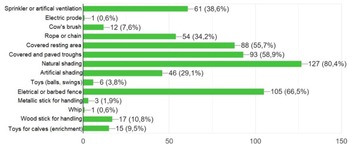
A set of 73 (46.2%) farms raise male calves for one year and later sell them to other farms, and at 46 farms (29.1%) any male calf is sold as soon as it is born. Cow-calf separation is a concern for consumers and the dairy production chain must consider this topic and identify better alternatives if possible (Busch et al., Reference Busch, Weary, Spiller and von Keyserlingk2017; Agenäs, Reference Agenäs2020). However, considering our results, farmers are not worried about it. Other answers obtained on this topic were the absence of male calves due to the use of sexed semen, donation for use as a breeder, slaughtering as soon as it is born, and fattening followed by slaughtering for self-consumption. The presence of equipment used for raising calves is shown in Fig. 1. Several farms have sprinklers or artificial ventilation, covered resting area, artificial and natural shading, while only a few use toys for calves, ropes or chains for environmental enrichment or a cow brush. On a positive note, our data show that only a few farms still use an electric prod, electrical or barbed wire fence, metal or wood stick for handling or whip, according to the farmer's answers. All the farmers stated that animals have regular access to enough good quality water, but we recognize that this question was subjective and the answers hard to interpret. Regarding animal health, 49 farmers (31%) reported that problems such as mastitis, and reproductive and foot disorders are frequent.
Equipment used in 158 Brazilian dairy farms that can affect cow's welfare.

Environmental hygiene and thermal comfort were also considered in this study. The most common frequency of removing dung and organic materials was once per day (62; 39.2%) whilst some farms practiced more frequent removal (twice per day 59; 37.3%, three times per day 11; 7%) but others were less frequent (once every week 15; 9.5%, once every 2 weeks 5, 3.2% and once per month 6; 3.8%). When farmers were asked ‘is it necessary to clean the animal's thorax, abdomen and udder before milking due to high amount of mud and feces?’, 24 people (15.2%) stated ‘yes,’ while 134 (84.8%) answered ‘no.’ A total of 38 farmers (24.1%) reported the use of udder cleanness score in the milking room, while 57 (36.1%) and 63 (39.9%) stated ‘no’ and ‘I don't know what udder cleanliness score is,’ respectively. Cleanliness is very important for animal health and welfare and depends mainly on management routines (Lundmark Hedman et al., Reference Lundmark Hedman, Andersson, Kinch, Lindholm, Nordqvist and Westin2021).
Regarding heat stress, 37 farmers (23.4%) perform thermal control of animals, using thermometers or breathing movements, while the remaining 121 (76.6%) do not control any temperature parameter. Respiratory rate is particularly important when monitoring welfare on dairy farms (Leliveld and Provolo, Reference Leliveld and Provolo2020), and farmers should know about this. In this study, consumers also showed a lower concern regarding heat stress and probably do not have knowledge about it, or they believe it to be less important than other listed aspects. An interesting result regarding the milking process is that oxytocin is still applied in 33 (20.9%) farms for milk ejection. Additionally, we investigated milking processes and we found practices that negatively affect cow's behavior (Leliveld and Provolo, Reference Leliveld and Provolo2020). A set of 7 (4.4%) farmers reported that the use of vocalization or physical contact of one sort or another are used for conducting the cows to the milking room and 19 (12%) stated that noises not related to milking commonly occur in these farms.
Regarding the awareness level of dairy farmers about animal welfare, 6 (3.8%) participants stated that they had never heard about animal welfare, while the rest had heard from distinct sources. A study conducted in Malaysia (Keningau, Sabah) found a higher proportion of farmers (33%) that had never learned about dairy welfare (Sadiq et al., Reference Sadiq, Song-Lin, Ramanoon, Syed-Hussain, Mossadeq, Salisi and Manson2021). In the present work, the main reported sources of welfare knowledge dissemination were veterinarians and animal scientists (73; 46.2%), internet and social media (41; 25.9%), magazines and journals (19; 12%), dairy cooperatives (10; 6.3%), family and friends (4; 2.5%), radio and television (3; 1.9%), and dairy plants (2; 1.3%). Curiously, when asked ‘How often is animal welfare discussed between the farm and the dairy industry?’ 57 (36.1%) farmers declared that this topic was never discussed with dairy plants. On the other hand, subsets of 39 (24.7%) and 17 (10.8%) farmers answered that the topic is discussed monthly or twice per month, while others mentioned that it is discussed annually, once during 3 or 6 months, sporadically, constantly, or when necessary. There is a need of establishing relationships with farmers to foster a better response regarding welfare training, but farmers expect it to be performed by experts in animal health and welfare, such as veterinarians and animal scientists (Croyle et al., Reference Croyle, Belage, Khosa, LeBlanc, Haley and Kelton2019).
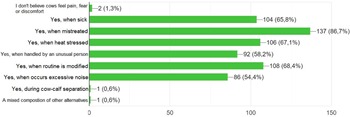
Figure 2 describes the frequency of answers obtained for the question ‘Do you think cows feel pain, fear or discomfort? If yes, in which situations?’. The concerns regarding animal health, routine management, and good human practices were much clearer than when heat stress and excessive noises were considered. Interestingly, when asked about the consequences of improper animal welfare, 67 farmers (42.4%) considered it to potentially cause death, while reductions in milk productivity (77.8%) and quality (61.4%) were more mentioned. Furthermore, an increase in the occurrence of diseases (71.5%), abnormal behaviors, and reduction of the farm's profit (76.6%) were recognized as its consequences.
Answers from 158 Brazilian dairy farmers regarding in which situations they believe cows suffer pain, discomfort or fear.

Among the dairy farmers, 43 (27.2%) had never heard about animal welfare certification systems but only 17 (10.8%) claimed they would not adhere to these programs. On the other hand, a set of 106 (67.1%) farmers would be interested in adhering because it could add value to their business, while 35 (22.22%) would be inclined to join if dairy industries paid a higher price for welfare-certified milk. Finally, when asked ‘What would motivate you to invest in improved animal welfare?’ the options with most answers were, respectively: best animal comfort (125; 79.1%), improvement of the farm's internal processes (90; 57%), adding value to the final product (89, 56.3%), a more positive perception from consumers (77; 48.7%), and dairy industries paying better remuneration for certified raw milk (71; 44.9%). In other areas, such as in the south-eastern United States, dairy producers also are concerned with cow care and welfare (Lee et al., Reference Lee, Schexnayder, Schneider, Oliver, Pinghetti, Petersson-Wolfe, Bewley, Ward and Krawczel2020) and this fact must be promoted to give rise to national improvements on dairy cows' welfare.
In conclusion, we found that consumers seem to be interested and willing to pay more for welfare-certified dairy products, while farmers are indeed interested in certifying their farms. To obtain the certification, improvements related to welfare aspects are required, which could be offset if dairy plants paid more for the certified raw milk. There is a need for stakeholders to recognize welfare and its certification importance, and to start making it a reality in the Brazilian dairy production chain.
Supplementary material
The supplementary material for this article can be found at https://doi.org/10.1017/S0022029922000024.