American conservatives and liberals disagree over how to respond to inequality. In recent decades, those on the left have been considerably more likely than those on the right to favor government policies that seek to remedy socioeconomic and racial inequality (Noel Reference Noel2013). This left-right difference over how to address inequality is accompanied by differences in the way those on the left and right explain inequality. Conservatives tend to make internal attributions, which blame individuals and, thus, justify opposition to government aid. Liberals tend to make external attributions, which—by blaming society—better justify governmental action (e.g., see Iyengar Reference Iyengar1991; Skitka et al. Reference Skitka, Mullen, Griffin, Hutchinson and Chamberlin2002).
Given this well-established pattern in the public at large, many infer that white conservatives are more likely than white liberals to adopt the controversial view that racial inequality is “natural,” i.e., due to inherited weaknesses, such as low intelligence.Footnote 2 This inference draws some support from the empirical literature. For example, at least two studies (Hunt Reference Hunt2007; Suhay and Jayaratne Reference Suhay and Jayaratne2013) find a positive relationship among whites only between conservatism (whether measured via policy support or self-identification) and the tendency to describe race-related characteristics as genetic in origin. However, the correlations are small in size, suggesting there may be heterogeneity at the individual level. Other research has called into question the association between a belief in the genetic determinism of racial differences and political ideology (e.g., Hochschild and Sen Reference Hochschild and Sen2015a).
In this article, we find room for both perspectives. We argue that the familiar “nature-nurture” debate that has at times pitted conservatives (arguing for nature) against liberals (arguing for nurture) does not dominate contemporary Americans’ thinking about socioeconomic and racial inequality. Today, genetic explanations for inequality offer less appeal to conservatives, and more appeal to liberals, than many researchers appreciate. However, we argue that the debate lies dormant and can easily reemerge. Following the literature on motivated reasoning and biased assimilation, we argue that white Americans on the left and right will diverge over whether racial inequality is “natural” when exposed to media messages that emphasize the egalitarian implications of genetic sameness and the inegalitarian implications of genetic difference. In other words, when offered a factual narrative that either justifies or undercuts important political goals, conservatives and liberals will gravitate toward the more “convenient” belief, in this case beliefs about what underlies racial inequality.
We test this intuition with two studies—one observational (Study 1) and one experimental (Study 2)—of white Americans’ explanations for black-white socioeconomic inequality. Both studies capitalize on a well-publicized scientific discovery: In 2000, researchers who had recently completed a first draft of the human genome announced that differences between traditional racial groupings were not reflected at the genomic level (NHGRI 2012). This information was widely disseminated and accompanied by a value frame that emphasized the egalitarian implications of this discovery.
Study 1 analyzes survey data collected shortly after the “race is not genetic” announcement. Study 2 analyzes experimental data in which treated participants were randomly assigned to read about the discovery. Both studies are consistent and support our theoretical framework: among white Americans not exposed to these media messages, conservatives and liberals do not differ in their tendency to view racial inequality as linked to biology; however, among those exposed to the messages, self-described liberals are considerably less likely than conservatives to say they believe racial inequality stems from biological differences between races. We discuss the implications in the section Discussion and Conclusion.
THEORETICAL FRAMEWORK
Internal versus External Explanations for Inequality
American conservatives and liberals tend to disagree about the causes of inequality. Generally speaking, conservatives tend to prefer explanations that are internal to individuals (also called “dispositional”). Liberals, on the other hand, tend to prefer external (or “situational”) explanations (Iyengar Reference Iyengar1991; Kluegel and Smith Reference Kluegel and Smith1986; Skitka et al. Reference Skitka, Mullen, Griffin, Hutchinson and Chamberlin2002). The accumulated evidence documenting this difference in attributional tendency between conservatives and liberals is so abundant that Skitka et al. have given it a name—the “ideo-attribution effect” (Morgan, Mullen and Skitka Reference Morgan, Mullen and Skitka2010; Skitka et al. Reference Skitka, Mullen, Griffin, Hutchinson and Chamberlin2002). This basic attributional difference between American conservatism and liberalism appears to be longstanding (Hofstadter Reference Hofstadter2006).
These differences are relevant to explanations for a number of different types of inequality, including (but not limited to) differences between blacks and whites in economic success, educational attainment, incarceration rates, etc. White conservatives are more likely than liberals to blame black Americans for poor life outcomes, and white liberals are more likely to blame discrimination or structural factors (Hunt Reference Hunt2007; Sniderman, Brody and Tetlock Reference Sniderman, Brody and Tetlock1991).
Why do conservatives and liberals disagree over what amounts to a factual question regarding the underlying causes of social inequality? Scholars argue that those on the left and right diverge over this question because different causes of inequality suggest different societal responses. Internal explanations for lack of success in life (e.g., lack of motivation) argue against government intervention, more in line with conservative preferences. External explanations (e.g., lack of access to jobs) justify government intervention, in line with liberal preferences. Government has a moral responsibility and pragmatic ability to solve problems caused by society, but this responsibility and ability diminish for problems caused by individuals (Brickman et al. Reference Brickman, Carulli Rabinowitz, Karuza, Coates, Cohn and Kidder1982; Iyengar Reference Iyengar1991; Suhay and Jayaratne Reference Suhay and Jayaratne2013).
While there is a logical relationship between many people's explanations for inequality and their political preferences, most scholars do not argue that different understandings of the causes of inequality (perhaps learned early in life) inform people's policy preferences. Rather, scholars tend to argue in favor of motivated cognition (Kunda Reference Kunda1990; Lodge and Taber Reference Lodge and Taber2013). That is, the attribution-politics link exists due to a kind of “backwards reasoning”: individuals seek to justify preexisting political preferences with congenial factual beliefs about the origins of inequality (Morgan, Mullen and Skitka Reference Morgan, Mullen and Skitka2010; Skitka et al. Reference Skitka, Mullen, Griffin, Hutchinson and Chamberlin2002).
Genetic Explanations for Inequality
Following recent scholarship on causal attributions (see especially Weiner, Osborne and Rudolph Reference Weiner, Osborne and Rudolph2011) and their associations with political attitudes (see, e.g., Suhay and Jayaratne Reference Suhay and Jayaratne2013), we emphasize the importance of unpacking the “internal” and “external” causal attribution categories to better understand their political implications. These two simple categories actually house a diverse range of explanations for inequality: the choices a person makes (internal); a person's biological predispositions (internal); the culture in which a person is situated (external); and social and structural discrimination (external).
This finer-grained examination makes clear that the political implications of the explanations within each category do not run cleanly in the same direction. The implications depend on who is blamed and who is best able to fix the problem. (See Brickman et al. Reference Brickman, Carulli Rabinowitz, Karuza, Coates, Cohn and Kidder1982; Iyengar Reference Iyengar1991; Weiner Reference Weiner1995.) While explanations that rest on choice align well with conservatism (the individual is blamed and able to remedy a lack of success) and explanations that point to discrimination align well with liberalism (society is to blame and able to remedy discrimination), genetic explanations are different.Footnote 3 Genetic explanations suggest no one is to blame—neither the individual nor society. And they suggest no one can easily solve the problem—because “genetic” characteristics are perceived to be immutable.Footnote 4 This suggests genetic explanations have both conservative and liberal implications. On the one hand, people are not to blame for their circumstances (liberal) (Dar-Nimrod and Heine Reference Dar-Nimrod and Heine2011; Weiner, Osborne and Rudolph Reference Weiner, Osborne and Rudolph2011). On the other hand, there is not much government can do to help (conservative) (Hofstadter Reference Hofstadter2006; Lewontin, Rose and Kamin Reference Lewontin, Rose and Kamin1984).
In other words, genetic explanations for inequality undermine conservatism to an extent. This is likely one reason why contemporary conservatives are far more likely to emphasize the role of personal responsibility (the choices a person makes) in one's success in life than inborn characteristics (see Brewer and Stonecash Reference Brewer and Stonecash2015). Further, the power of biology to “excuse” individuals for stigmatized characteristics helps to explain why those on the left are more likely than those on the right to make genetic attributions in some instances, including for homosexuality (Garretson and Suhay Reference Garretson and Suhay2016; Haider-Markel and Joslyn Reference Haider-Markel and Joslyn2008), obesity (Haider-Markel and Joslyn Reference Haider-Markel and Joslyn2017), and criminal behavior (Shen and Gromet Reference Shen and Gromet2015). Even with respect to racial inequality, there is potential for whites who believe genes are the cause to turn to paternalism, not antipathy—to “feel that blacks are simply incapable of improving their lot in life and, as a result, feel sympathy for them” (Brown et al. Reference Brown, Akiyama, White, Epstein Jayaratne and Anderson2009, 107).
Despite the above complications, relative conservatism and biological attributions for social inequality are in fact positively correlated among white Americans, if only modestly. Drawing on representative survey data from 2001, Suhay and Jayaratne (Reference Suhay and Jayaratne2013) find that white conservatives are about 10% more likely than white liberals to say that socioeconomic and racial inequality are due to genetic differences between groups. Analyzing General Social Survey data collected between 1985 and 2004, Hunt (Reference Hunt2007) also finds a relationship between conservatism and innate explanations for racial inequality among whites specifically.
Why these associations if the political implications of genetic explanations are so mixed? We argue that the on-average correlations between left-right political ideology and the belief that inequality is innate gloss over considerable heterogeneity in the American public.Footnote 5 We suspect that this heterogeneity stems in part from variation in exposure to media messages on this subject, messages that in recent years have tended to frame the nature-nurture debate in terms likely to divide left from right.
Scientific Communication about Genes and Race
Scholarly discussions about the causes of inequality have differed from discussions in the lay public in recent years. Academics have debated whether various types of inequality are due to “nature” and/or “nurture,” with little engagement with conservatism's core tenant of “personality responsibility” (see Segerstrale Reference Segerstrale2000). If blaming the individual or social group is not considered and the debate is restricted to blaming either nature or society, then the politics are simpler. If nature is an important causal force, then society (via government) has no obligation to solve inequality, nor would it be wise to try; if society is responsible, then government is morally obligated and able to provide a solution (Herrnstein and Murray Reference Herrnstein and Murray1994; Hofstadter Reference Hofstadter2006; Lewontin, Rose and Kamin Reference Lewontin, Rose and Kamin1984). Thus, among scholars, the argument that genes drive inequality has been understood as a conservative challenge to liberal policies.Footnote 6 The debate has been particularly heated surrounding the topic of race (Jacoby and Glauberman Reference Jacoby and Glauberman1995; Segerstrale Reference Segerstrale2000).
This debate took an important turn in 2000. In that year, upon “decoding” genomes of people from various racial groups, researchers discovered that genetic variation within each group far exceeded variation between the groups. Scientists concluded that race as commonly understood had no genetic basis. The scientists were not shy about publicizing these results and emphasizing what they perceived to be the egalitarian social and political implications (Bliss Reference Bliss2015). The findings were first announced at a White House press conference with President Bill Clinton and geneticists Dr. Craig Venter and Dr. Francis Collins. At the conference, Clinton said: “All of us are created equal, entitled to equal treatment under the law. After all, I believe one of the great truths to emerge from this triumphant expedition inside the human genome is that in genetic terms, all human beings, regardless of race, are more than 99.9 percent the same” (NHGRI 2012). The researchers echoed these egalitarian notions at the press conference and in follow-up interviews, stating explicitly that race was socially constructed and arguing that government policy should not be based on the faulty assumption that race differences are innate (e.g., McKie Reference McKie2001). The finding also generated an unusual amount of media coverage for a scientific topic, which we say more about in the empirical section. The dominant frame of the media coverage of this discovery followed the researchers’ lead: our skin color or racial lineage has nothing to do with our skills or talents (e.g., Angier Reference Angier2000). We are all born equal, after all.
Such value frames are common in science reporting and tend to be highly consequential with respect to how the public receives associated information (Conrad Reference Conrad, Asch, Beckwith, Conrad, Alper, Ard and Geller2002; Nisbet and Scheufele Reference Nisbet and Scheufele2009). However, such frames do not influence all members of the public equally. Value frames increase the likelihood that people will engage in “biased assimilation,” a type of motivated cognition whereby people filter new information according to their preexisting political beliefs and values (Kraft, Lodge and Taber Reference Kraft, Lodge and Taber2015; on biased assimilation generally, see, e.g., Kahan Reference Kahan2011; Lord, Ross and Lepper Reference Lord, Ross and Lepper1979). As a result, individuals are more likely to accept information they perceive to be in line with their political predispositions as compared with information that undermines them. Information that challenges predispositions can even lead to boomerang effects, as people devote mental resources to counterarguing the information and end up bolstering their priors (Hart and Nisbet Reference Hart and Nisbet2011). This framework suggests that white liberals—given their greater commitment to social equality—may have been more receptive to communications about the discovery that “race is not genetic” than white conservatives.
Our Studies
We focus, in two studies, on the beliefs and opinions of non-Hispanic whites.Footnote 7 We hypothesize that, among white Americans not exposed to media messages discussing scientists’ recent findings related to genes and race, there is no relationship between political ideology and genetic explanations for racial inequality (H1). Again, conservative rhetoric today argues in favor of personal responsibility—not genes—as a driver of unequal outcomes, and liberal rhetoric has increasingly made room for genetic influences (see above discussion). However, among those exposed to relevant media messages, we expect a left-right difference to emerge (H2): those on the left will be more likely than those on the right to find the egalitarian implications of genetic racial similarity attractive and to embrace scientists’ finding.
We carefully test these hypotheses by drawing on both observational and experimental data. In Study 1, we analyze survey data gathered several months after the “race is not genetic” discovery was announced. We investigate whether political ideology was correlated (in the expected direction) with genetic explanations for racial inequality only among those white Americans who reported paying attention to this topic. This first study possesses high external validity, demonstrating the relevance of our theoretical framework to real-world events. In Study 2, we follow-up with an experimental study in which American National Election Study (ANES) participants were randomly assigned to read one of the most prominent news stories covering the “race is not genetic” announcement. The controlled nature of this study complements the observational evidence by offering greater internal validity, i.e., a more rigorous test of the hypothesized causal relationship between media exposure and changing beliefs about race. Note that, to improve our ability to draw causal inferences regarding the role of the observed variables (media exposure and ideology in Study 1 and ideology in Study 2), we run many additional models with alternate specifications, including additional interaction terms. This allows us to be confident that the interactions we observe are not the result of a spurious association.
EMPIRICAL ANALYSES
Study 1
The initial announcement by genetic scientists that commonly used racial categories (African, Asian, Caucasian, etc.) did not map to corresponding genetic variation was made in June 2000. Despite the fanfare surrounding the announcement, it is possible that the discovery was not widely reported, as science topics tend to be underreported by media. In order to be sure that coverage of this event indeed reached a large portion of the public, we conducted an informal content analysis of newspaper coverage during the year following the announcement. See Appendix A for details. We find that significant related media coverage occurred in June and August/September of 2000 and again in February of 2001.
Study 1 analyzes cross-sectional survey data collected during the winter and spring of 2001. These data provide us with an unusual opportunity to test whether beliefs among Americans at the time were structured in the way we would expect if the assimilation of the scientific information available in the media was conditioned by political ideology.
Method
Sample
The study rests on a survey of Americans conducted in 2001 by researchers at the University of Michigan. We restrict our analyses to data from white participants (N = 600). The sample was obtained utilizing random-digit-dialing (RDD) methods, drawing from the continental U.S. (AAPOR Adjusted Response Rate 3 = 32%). Respondents were interviewed over the phone by professionally trained interviewers. Interviews averaged 40 min in length. Each respondent received $15 compensation (or $20 for refusal conversions). Within each household, adult respondents were randomly selected. Data are weighted for education and age (the sample is representative for gender).
Dependent Variable
The dependent variable focuses on participants’ explanations for stereotypical black-white differences that are commonly linked to socioeconomic inequality. Respondents were first asked to report whether they believe genetic differences play a role in explaining perceived racial differences (blacks versus whites) in drive to succeed. Respondents who answered “yes” were then asked to estimate how much of this difference is due to genetics. Responses to this pair of questions were recoded into five categories: “none” (0), “very little” (.25), “some” (.5), “a lot” (.75), or “just about all” (1). Respondents were then presented with three other pairs of questions, this time asking for their views about the role of genetics in explaining perceived racial differences in intelligence, mathematical abilities, and tendency toward violence. The resulting Genetic Attributions for Race Differences (GARD) scale represents the mean value of these four survey items (Cronbach's α = .85). In our sample, 565 respondents provided valid answers to all four questions. On average, GARD among our sample is relatively low (mean= 0.17; sd= 0.22). The exact wording of this and all other questions used in Study 1 is presented in Appendix C.
Independent Variables
Two independent variables are at the center of our attention. The first is a standard five-point political ideology scale with coding as follows: “very conservative” (0), “somewhat conservative” (.25), “middle of the road” (.5), “somewhat liberal” (.75), or “very liberal” (1). (We refer to political ideology—here as well as in Study 2—as liberalism to clearly indicate the direction of coding.) The second independent variable is a media exposure measure focused on the topic of genetics. Respondents were asked the following question: “Over the past few months, how often have you read or heard news stories about genetics in newspapers, magazines, or on TV?”Footnote 8 (Note that, in 2001, the internet had not yet emerged as an important news provider.) Response options were “often,” “sometimes,” “rarely” or “never.” Only 30 respondents answered “never.” We merge these respondents with those who chose “rarely” to form the low exposure group (n = 156). The respondents who answered “sometimes” are referred to as the moderate exposure group (n = 225), and those who said “often” are the high exposure group (n = 208). Our models use two dummy variables to distinguish the moderate and high exposure groups from the low exposure group. Note media exposure is not correlated with liberalism.Footnote 9
Controls
In this paper, we separate factual beliefs about the causes of perceived black-white differences from racial affect. In the contemporary United States, such factual beliefs are distinct both conceptually and empirically from a desire among whites for social distance from blacks as well as from racial resentment and symbolic racism (negative sentiment toward blacks justified by claims they disregard shared values) (Brown et al. Reference Brown, Akiyama, White, Epstein Jayaratne and Anderson2009). Even so, there is a modest relationship among these concepts (see Brown et al. Reference Brown, Akiyama, White, Epstein Jayaratne and Anderson2009; Jayaratne et al. Reference Jayaratne, Ybarra, Sheldon, Brown, Feldbaum, Pfeffer and Petty2006); thus, we control for racial prejudice in the models. Specifically, the full statistical models control for: social distance, which sums the answers to two questions asking respondents how bothered they would be if their son or daughter dated or married a black person; negative affect, which is measured by asking respondents how often they feel disgusted by blacks (see Banks and Valentino Reference Banks and Valentino2012); and contemporary prejudice, which is a seven-item additive scale (see Brown et al. Reference Brown, Akiyama, White, Epstein Jayaratne and Anderson2009) intended to gauge subtler forms of race prejudice (α = .74).
We also control for general knowledge about genetics, measured by summing the responses to four factual items. The full models also include standard demographic controls (religiosity, household annual income, education, age, and gender).
Note that all variables in the analyses have been re-coded to range from 0 to 1.
Results
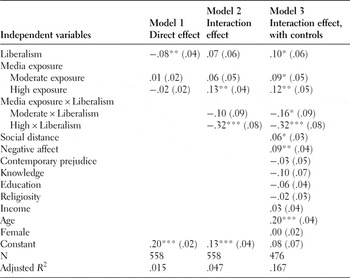
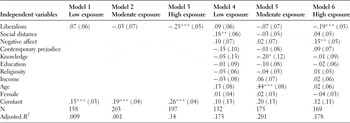
The three models in Table 1 “predict” respondents’ location on the GARD scale using OLS regression. Note that here, and throughout the paper, p-values are one-tailed, given the directional nature of the hypotheses. We begin with a simple model without any interaction terms or control variables. Model 1 assesses the main effects of political ideology (liberalism) and media exposure. The coefficient on liberalism is negative and statistically significant (β = −.08, p <.01), reflecting previous research. The coefficients for media exposure are not significant. Thus, on average, media exposure did not reduce genetic explanations for race differences.
Genetic attributions regressed on ideology, media exposure, and their interaction

Note: *p < .05;**p < .01;***p < .001, one-tailed tests. Unstandardized OLS regression coefficients. Standard errors are reported within parentheses.
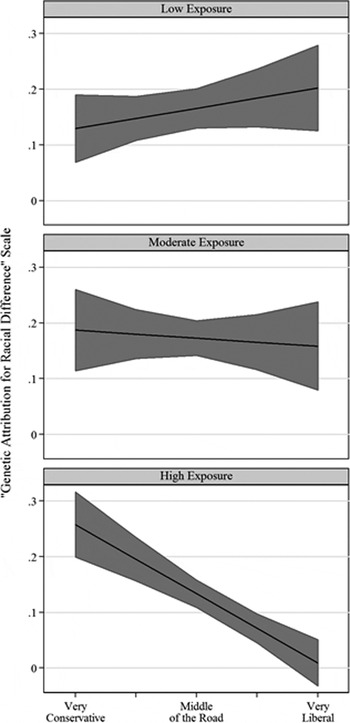
Model 2 presents the main tests of our hypotheses (without controls). Among those with low media exposure, there is no clear relationship between ideology and genetic beliefs, as hypothesized (see the nonsignificant coefficient on liberalism, assessed at media exposure = 0). However, the coefficient for high exposure × liberalism is negative, substantial in size, and statistically significant (β = −.32, p < .001). This model also reveals a positive and significant coefficient for high exposure (β = .13, p < .01), which is assessed at liberalism = 0 (i.e., among very conservative participants). This indicates that strong conservatives in the high exposure group scored higher on the GARD scale than strong conservatives in the low exposure group. This suggests a boomerang effect occurred among the very conservative who were exposed to the “race is not genetic” news. In sum, exposure to news about genetics influenced strong liberals and conservatives in opposite ways, reducing GARD among the former and increasing it among the latter.Footnote 10 Overall, these patterns support our hypotheses.
Figure 1 presents the predicted values derived from Model 2. It is clear from the figure that the direction and the strength of the association between ideology (relative liberalism) and GARD depends on one's level of exposure to news about genetics. Among the high exposure group in particular, the width of the gap that separates very liberal (.01) and very conservative (.26) is strikingly large and statistically significant (p < .001).
This figure presents the interaction between political ideology and self-reported recent exposure to news about genetics. Shaded areas represent 95% confidence intervals. Predicted values were derived from Model 2, Table 1.

We ran additional models to verify the robustness of these general patterns. Model 3 adds numerous control variables to the core model.Footnote 11 While several of the coefficients on these variables are signed as expected and reach statistical significance (in particular, social distance and negative affect), the coefficient on high exposure × liberalism is not weakened by the inclusion of the controls.Footnote 12 In addition, the negative coefficient on the term moderate exposure × liberalism now reaches statistical significance (β = −.16, p < .05). Thus, the interactive pattern observed in Model 2 persists even when controlling for racial attitudes, knowledge about genetics, as well as various sociodemographic variables. Also, this model presents further evidence of a boomerang effect among strong conservatives. Indeed, we now observe that the coefficient for the term moderate exposure (i.e., the effect of moderate exposure, compared with low exposure, among the very conservative) is also positive and statistically significant. Finally, we would be remiss to avoid pointing out that this last model reveals a positive, significant coefficient for liberalism. Thus, among the low exposure group, net controls, strong liberals have a higher average GARD score than strong conservatives. We are hesitant to say much about this finding, given that it arises only in this model; however, it certainly is consistent with our contention that white conservatives are not uniformly more likely than white liberals to argue in favor of genetic explanations for black-white inequality.
Study 1 Discussion
Results from Study 1 reflect our expectations. Survey data gathered shortly after the discovery in 2000 that traditional racial categories had little to do with human DNA reveal that liberals were less likely than conservatives to argue in favor of genetic explanations for perceived racial differences only if they were exposed to science reporting on the subject. The data are strongly suggestive of ideologically biased assimilation, including a boomerang effect among strong conservatives.
Although our findings are consistent with the theoretical framework we have advanced, they do not allow us to rule out certain alternatives. First, the media exposure variable captures attention to news about genetic advances in general, not attention to the specific set of messages we discuss. Thus, the ideological patterns we see could be due to liberals and conservatives consuming different media content. Although the date of the study precedes the extreme era of media polarization in which we now find ourselves, conservatives in the sample were probably more likely than others to tune into Fox News or conservative talk radio and, with this in mind, the mechanism at work may be selective exposure to politically biased media (see Stroud Reference Stroud2011) rather than biased assimilation of similar media content.
A second, slightly different, explanation for our findings is that conservative and liberal news consumers reacted as they did because they were simply following partisan cues (e.g., Zaller Reference Zaller1992). While media frames of scientific findings are more likely to reference politically relevant values than political parties or specific politicians or actors (Nisbet and Scheufele Reference Nisbet and Scheufele2009), the original “race is not genetic” announcement admittedly occurred at a White House news conference during a Democratic administration. Our review of the news coverage that followed this event suggests that egalitarian values were emphasized far more than partisan cues; however, it remains possible that the presence of a Democratic cue in some news reports played an important role in diverging reactions among conservatives and liberals.
Third, some research indicates that political liberals are somewhat more trusting of scientists than conservatives (Blank and Shaw Reference Blank and Shaw2015; Gauchat Reference Gauchat2012). While recent research has called into question the assumption that only conservatives deny science that undercuts their values (Kahan Reference Kahan2013; Nisbet, Cooper and Garrett Reference Nisbet, Cooper and Garrett2015), it remains possible that we have simply observed a disparity in willingness to accept new scientific arguments.
Study 2, which draws on data from a randomized experiment embedded within the ANES, allows for a second test of our hypotheses while addressing these counterarguments.
Study 2
In this study, participants were randomly assigned to read or not to read a news article presenting the “race is not genetic” argument. Thus, the experimental design ensures that any interaction between political ideology and media exposure is due to politically biased responses to similar media content rather than selective exposure to different media content. This experiment also allows a more stringent test of whether political ideology—as opposed to partisanship—is driving the patterns observed in Study 1. Not only is the Study 2 stimulus free of partisan cues, but the survey component of the study contains a measure of partisanship (not available in Study 1), allowing us to control for this measure. Finally, the study also includes measures of trust in science and trust in the news media, allowing us to control for these possible confounds as well.
Method
Sample
Data were collected as a part of the American National Election Study (ANES 2014) Web Panel of 2008–9. Americans were sampled through stratified list-assisted RDD of landline telephone numbers. Participants were paid $10 per month to complete web questionnaires. The entire panel has 21 waves. Ten of the waves covered political topics; the remaining 11 were about a wider variety of issues and were partly funded by independent researchers. All data are publicly available on the ANES website.
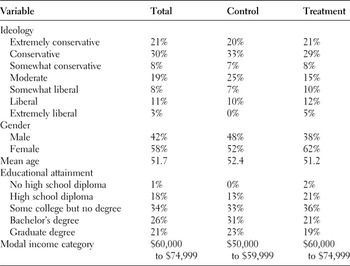
Wave 16, collected in 2009, includes an experiment designed by Phelan, Link and Feldman (Reference Phelan, Link and Feldman2013). We take advantage of the public availability of these experimental data, using them for a different purpose. We examine whether exposure to a “race is not genetic” news article leads white liberals and conservatives to differentially alter their genetic attributions for black-white socioeconomic inequality. Our analyses bear on the 197 non-Hispanic white respondents assigned either to the control group (no treatment) or the news article condition relevant to our research question. Note that participants were balanced across the experimental groups on ideology and basic demographics. A description of the sample is in Table A4.
Dependent Variable
The dependent variable is a scale made up of averaged responses to three questions that are similar to the GARD items in Study 1. An advantageous difference between these and the Study 1 questions however is that the Study 2 questions specifically ask whether innate differences in certain behavioral characteristics are the cause of black Americans’ lower socioeconomic status. The first two questions were preceded by the statement that black Americans on average have “worse jobs, income, and housing” than whites; respondents were then asked the extent to which they believed this is due to (1) “less in-born ability to learn” and (2) “less in-born drive to succeed” among African Americans. A third question asked whether (3) African Americans’ greater involvement with the judicial system is “due to genetic differences between blacks and whites in their tendency toward violence.” These questions had four response options: “not at all” (0), “not much” (.33), “some” (.66), and “very much” (1). They were combined into an additive scale (α = .82). We refer to this as the Genetic Attributions for Black Inequality (GABI) scale. Like the GARD scale, on average, people scored somewhat low on the GABI scale (mean = .20; sd = .25). Note that the question wording for all Study 2 variables is presented in Appendix D.
Treatment
One of the most important news articles covering the “race is not genetic” thesis was by science journalist Nathalie Angier (Angier Reference Angier2000). The article was published in The New York Times on August 22, 2000 and drove subsequent print and broadcast media coverage. This particular article did an excellent job summarizing the new scientific consensus regarding the lack of association between racial groupings and genes as well as the egalitarian implications. The ANES experimental treatment is an adaptation of this article.
The treatment includes statements, which are either identical or nearly identical to the original news article. According to the scientist cited in the treatment article, humans share 99.9% of their DNA and there exists greater genetic variation within racial groups than between them. Physical differences such as skin color are due to a small number of genes, which are sensitive to fast changing environmental pressures. In contrast, any genetic influences on complex social traits like intelligence involve thousands of genes interacting in complex ways. The scientist concludes: “This is why the differences that we see in skin color do not translate into widespread biological differences that are unique to groups and why (…) the standard labels used to distinguish people by ‘race’ have little or no biological meaning.” Note that the treatment article (see Appendix D) contains no mention of the White House news conference or of political elites’ positions on either side of the political aisle.
In our analyses, a treatment dummy variable is coded 1 for treatment group, and 0 for the control group. Those in the control group received no article.
Independent Variable
Ideology, measured in a previous panel wave, is a seven-point scale coded “very conservative” (0), “somewhat conservative” (.166), “leaning conservative” (.333), “Neither conservative nor liberal” (.5), “leaning liberal” (.666), “somewhat liberal” (.833), and “very liberal” (1).
Control Variables
Again, some of our models control for possible confounds to test the robustness of our findings. While controls are less important in a randomly assigned experiment than a survey, the addition of control variables here helps in three ways: (1) while the treatment is randomly assigned, ideology is not randomly assigned; thus, covariates with ideology are particularly suspect as confounds; (2) controls used in experimental analyses generally improve the efficiency of regression estimations (Bowers Reference Bowers, Kuklinski, Druckman, Green and Lupia2011); (3) we can test whether additional interaction terms alter the results from the original model.
We measured positive affect toward blacks by taking the mean of responses to two questions asking how often respondents feel sympathy and admiration for black people (Pearson's r = .27). Contemporary prejudice was measured with six questions (α = .761) that measure the same type of subtle prejudice as in Study 1 (see Neville et al. Reference Neville, Lilly, Duran, Lee and Browne2000). It is possible that participants’ reactions to news about genetics depend on their attitudes toward the source of the message; thus, we control for participants’ trust in scientists and trust in news.Footnote 13 We also control for the same socioeconomic variables (religiosity, education, income, age, sex) as in Study 1. Finally, we examine the influence of party identification (standard seven-point scale).
Again, all variables have been re-coded to range from 0 to 1.
Results
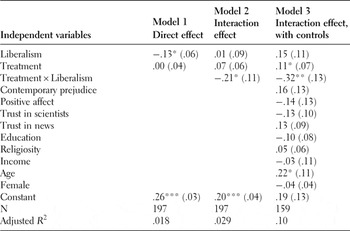
Table 2 presents three OLS regression models. Again, the statistical thresholds marked in the tables represent one-tailed tests. In Model 1 (direct effects), liberalism is negatively associated with the GABI scale (β = −.13, p < .05), but the treatment has no on average effect. In Model 2 (interactive effect), the coefficient on liberalism (reflecting participants in the control group) is equivalent to zero; however, the treatment × liberalism interaction term is negative, significant, and fairly large (β = −.21, p < .05). In other words, the on-average negative effect for liberalism in Model 1 is completely driven by the treatment group. These findings—the direct and indirect effects—mirror those from Study 1.
Effect of treatment & ideology on genetic attributions for black inequality
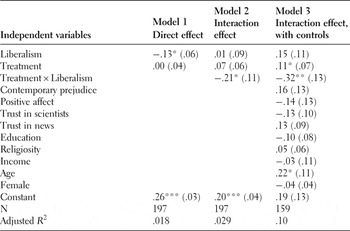
Note: *p < .05;**p < .01;***p < .001, one-tailed tests. Unstandardized OLS regression coefficients. Standard errors are reported within parentheses.
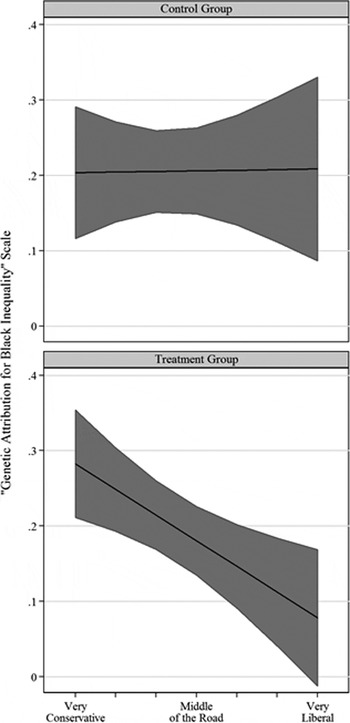
Figure 2 presents the predicted values derived from Model 2 (Table 2). Among the control group, the slope for ideology (relative liberalism) is flat; in contrast, for those in the treatment group, the slope is negative. Among those exposed to the race is not genetic experimental condition, the average score on the GABI scale for very conservative participants equals .28. The equivalent value for very liberal participants is .08. The difference between these two values is statistically significant (p <.01).
This figure presents the interaction between political ideology and exposure to the treatment news article. Shaded areas represent 95% confidence intervals. Predicted values were derived from Table 2, Model 2.

We again ran additional models to test the robustness of these results. We focus on Model 3, which adds control variables to the interactive model. Model 3 confirms that the key interactive relationship is robust to the addition of controls.Footnote 14 Indeed, the absolute value of the coefficient on treatment × ideology is larger in size in this model (β = −.32, p < .01). Further, the coefficient on the treatment variable alone (assessed at liberalism = 0) suggests another boomerang effect among the very conservative (β = .11, p < 05).Footnote 15
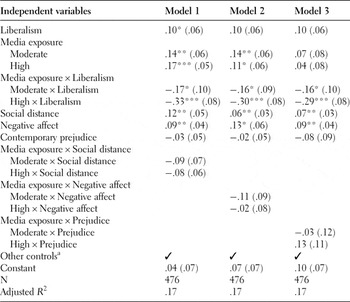
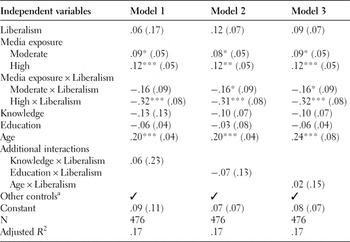
We provide additional tests of the robustness of the treatment × liberalism interactive effect by introducing additional interaction terms into the model. The models in Table A6 confirm that the effect of our key interaction term cannot be reduced to moderation by contemporary prejudice, positive affect towards blacks, trust in scientists, trust in news, education or age. In Table A7, we add an interaction between party identification and treatment exposure. Party identification has no significant effect on GABI in the control or treatment group, and the coefficients on our key ideology interactive term actually increases in size. In sum, the negative treatment × liberalism interactive effect is quite robust.
Study 2 Discussion
The aim of this study was to test our initial hypotheses in a more controlled environment. The results again support our two hypotheses. Without exposure to science reporting on race, relative conservatism among white Americans was not associated with genetic explanations for racial inequality; however, the expected ideological pattern emerged among those exposed to news on the “race is not genetic” finding.
Study 2 achieves this objective by manipulating the information presented to participants rather than relying on self-reported media exposure. Thus, the experiment suggests that the effects observed in Study 1 were not solely caused by ideologically driven selective exposure. The follow-up analyses also show that the observed patterns (A) are not driven by different levels of trust in science or the media, and (B) are driven by biased assimilation of information based on political ideology, not party.
DISCUSSION AND CONCLUSION
We argue that much heterogeneity underlies the correlation among U.S. whites between conservatism and genetic explanations for perceived racial differences and inequality. This heterogeneity is structured in a way that suggests an explanation for why conservatives and liberals differ on this question on average. In short, when exposed to media messages that associate genetic sameness with racial egalitarianism, white conservatives and liberals diverge over the import of “nature”: conservatives are more likely to embrace the idea that genes drive racial inequality and associated stereotypes, and liberals to reject it. Findings from two studies of random samples of U.S. whites—one observational and one experimental—support this framework and are robust to a variety of counterarguments, including selective exposure to media, differential trust in science or the media, and party cues.Footnote 16
We also demonstrate that ideology conditioned acceptance of the “race is not genetic” message regardless of whether or not we controlled for racial attitudes, including a desire for social distance from blacks, affect toward blacks, and contemporary racial prejudice. Thus, this article points to the utility of “unhooking” factual beliefs about the origins of racial differences (real and perceived) from measures of racial attitudes. Throughout our analyses, racial prejudice is indeed associated with genetic explanations, in line with previous scholarship; however, relevant media messages in conjunction with ideology also have a strong and consistent effect on genetic explanations that is independent of racial prejudice. In short, we propose that value differences between liberals and conservatives can lead to biased uptake of information about whether human differences are natural or socially constructed.
What are the implications? On the one hand, our article challenges some assumptions about political conservatives. Many scholars assume that white conservatives’ tendency to commit what some psychologists call the “fundamental attribution error” (blaming individuals for perceived deficiencies; see Ross Reference Ross and Berkowitz1977) also means that they will commit the “ultimate attribution error” (blaming outgroups’ genes for perceived deficiencies; see Byrd and Ray Reference Byrd and Ray2015; Pettigrew Reference Pettigrew1979). Our evidence suggests that, all else equal, this is not the case. Genes may be internal to the individual, but they also are understood by many as absolving individuals of blame for associated characteristics and behaviors. On average, this decreases their appeal to conservatives, and increases their appeal to liberals.
This said—in line with growing evidence for the biased assimilation of factual information with political relevance—white conservatives and liberals do diverge if exposed to media messages that mute this complicating aspect of genetic explanations, instead emphasizing their racially inegalitarian implications. The origin of this factual polarization is likely white conservatives’ and liberals’ sharp disagreement over the importance of using government action to address social inequality, perhaps racial inequality in particular. Given our argument that these patterns are not necessarily specific to beliefs about racial differences, similar patterns ought to emerge in response to comparable scientific messages about the origins of other types of inequality, such as differences between wealthy and poor or between women and men. But we cannot test this intuition with our data, leaving it for future research.Footnote 17
Even if these motivated reasoning patterns stem from a support for, or wariness of, egalitarian policy generally, there are obvious and important parallels to the way in which racial prejudice has evolved in the United States since the mid-twentieth century. Scholars describe a decline in “old-fashioned racism” (including its biological component) after World War II but a simultaneous increase in the notion that black Americans are morally inferior, choosing laziness over hard work (Kinder and Sanders Reference Kinder and Sanders1996). In the same way that we document attributional beliefs “moving around” in defense of political ideology, others argue they have moved around conveniently to defend racial hierarchy (e.g., Bonilla-Silva Reference Bonilla-Silva2014). Maybe this is a distinction without much of a difference, as even conservatism drained of the racial animus with which it is intertwined in the real world still supports socioeconomic hierarchy (Jost et al. Reference Jost, Glaser, Kruglanski and Sulloway2003). But, to us, the distinction is worth making: whatever its complicated origins, American conservatism has long emphasized personal responsibility, an idea that is not logically well-suited to genetic explanations for behavior, which undercut the whole notion of individual agency. To bring conservatism to genes requires a little work. We do not rule out the possibility that conservatism itself may change in the process.
With this in mind, it is important to acknowledge the contextual nature of our studies: we focus on reactions to a specific scientific message that was widely distributed in the wake of the decoding of the human genome around the turn of the millenium, and data from our studies were collected in 2001 and 2009. We encourage other researchers to examine more recent trends. For example, the ethno-nationalist movement sometimes referred to as the “alt-right” has become a powerful force on social media, emboldened in part by the explicit prejudice and xenophobia of Donald Trump's presidential campaign. There is no question that many members of the alt-right endorse the idea that black Americans (as well as many other groups) are genetically inferior to white Christians (Matthews Reference Matthews2016). As they mix conservative political rhetoric with these factual claims of natural inferiority, it is likely that such ideas will resonate with some political allies on the right. With this in mind, we would not be surprised if the association between conservatism (and, perhaps, Republicanism) and genetic explanations for perceived racial difference and inequality has grown in the last couple of years, particularly among those attentive to new media.
In sum, we argue that individuals’ political viewpoints drive their factual beliefs about the world much more than most care to admit, and this includes explanations for inequality. At the same time, it is important to recognize that ordinary citizens’ belief systems are not necessarily organized in a manner similar to political or scientific elites. However, citizens who are paying attention will tend to follow the lead of elites in terms of “what goes with what” (Converse Reference Converse and Apter1964; Zaller Reference Zaller1992). From a normative perspective, this should serve as a cautionary tale to elites who communicate scientific facts to the public. Even those who have the best of intentions when they point out egalitarian implications of new knowledge may contribute to political polarization.
ACKNOWLEDGEMENTS
We are grateful to Paul Appelbaum, Kevin Arceneaux, Matthew Green, Jen Lawless, Jan Leighley, Matt Levendusky, Tali Mendelberg, Hans Noel, and Richard Skinner for helpful comments and advice. Part of this work was supported by the National Human Genome Research Institute (HG01881 to T.E.J.).
Appendix A: Analysis of Media Coverage
To gauge the extent of media coverage of the Human Genome Project / Celera Genetics Corporation finding regarding race, we conducted a search of four media databases (Factiva, Infotrack Newsstand, Newsbank, and Google News) for newspaper articles using relevant keyword combinations (e.g., genetics, race, 99.9%, Craig Venter).Footnote 18 We focus on the year following the announcement (from June 25 2000 to June 30 2001). Each article was extracted and read by one of the authors to ensure that it addressed the “race is not genetic” finding; those that did not were excluded from the results.
During this time period, Americans were exposed to three waves of news related to this announcement. The first wave occurred in the days that followed the White House press conference. Reports in most major newspapers, such as The New York Times, The Boston Globe, and Chicago Sun-Times mentioned the finding about race. Many regional or local newspapers also covered the conference and the issue of genetics and race. The second wave of news occurred a few weeks later. On August 22, The New York Times published an influential news article entitled “Do Races Differ? Not Really, Genes Show.” Reporter Nathalie Angier interviewed several scientists and argued that “most of them are convinced that the standard labels used to distinguish people by ‘race’ have little or no biological meaning.” In the days that followed, at least 14 regional or local newspapers (e.g., The Denver Post (CO), Tulsa World (OK), St Louis Post-Dispatch (MO), The Star-Ledger (NJ)) quoted different parts of Angier's news article. A third wave began in February 2001 after the publication of two new research articles (in Science and Nature) supporting the “race is not genetic” finding and the holding of another public conference by the Human Genome Consortium. This finding received coverage in The Washington Post, USA Today, and The New York Times, among others.
Regression models by subgroups of media exposure (study 1)

Controlling for potential confounds of the political ideology term (study 1)

Controlling for potential confounds of the media exposure term (study 1)

Sample description (study 2)

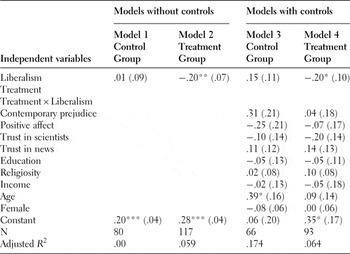
Regression models by experimental subgroups (study 2)

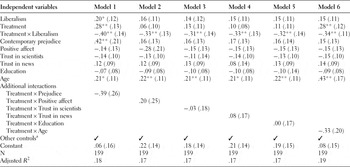
Controlling for other interactions (study 2)

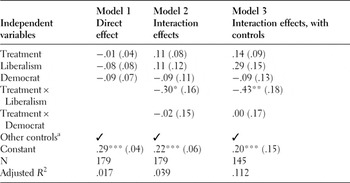
Ideology versus partisan identification (study 2)

Appendix B: Additional Tables
Appendix C: Study 1 Measures
Questions Used to Generate the GARD Scale
Some people think [A: whites TEND to differ from Blacks] [B: blacks TEND to differ from whites] in their DRIVE TO SUCCEED. Do YOU think their genes have ANYTHING to do with THIS difference?
Yes, No, No difference VOL
(if yes) How much of THIS difference between whites and Blacks do YOU think is due to their genes?
Very Little, Some, A lot, Just about all
Some people think [A: whites TEND to differ from Blacks] [B: blacks TEND to differ from whites] in how good they are in MATH. Do YOU think their genes have ANYTHING to do with THIS difference?
Same answers as above
(if yes) How much of THIS difference do YOU think is due to their genes?
Same answers as above
Some people think [A: whites differ from Blacks] [B: blacks differ from whites] in their TENDENCY TO ACT VIOLENTLY. Do YOU think their genes have ANYTHING to do with THIS difference?
Same answers as above
(if yes) How much of THIS difference do YOU think is due to their genes?
Same answers as above
Some people think [A: whites TEND to differ from Blacks] [B: blacks TEND to differ from whites] in INTELLIGENCE. Do YOU think their genes have ANYTHING to do with THIS difference?
Same answers as above
(if yes) How much of THIS difference do YOU think is due to their genes?
Same answers as above
Political Ideology
Compared with other people, do YOU generally think of yourself POLITICALLY, as very liberal, somewhat liberal, middle-of-the-road, somewhat conservative or very conservative?
Very liberal, Somewhat liberal, Middle of the road, Somewhat conservative, Very conservative
Media Exposure
Over the past few months, how often have you read or heard news stories about genetics in newspapers, magazines or on TV? Would you say…
Often, Sometimes, Rarely, Never
Social Distance
First, how bothered would you be if your son or daughter DATED a Black person?
Not bothered at all … to … very bothered
How bothered would you be if your son or daughter MARRIED a Black person?
Same as above
Negative Affect
Next, people have different feelings toward some groups in our society. I'm going to read you a list of groups and I'd like you to tell me how often you have certain feelings toward them. We're not asking your feelings about ANY SPECIFIC person in the group, but how you feel about the GROUP OF PEOPLE, IN GENERAL …
How about Blacks?
Often, Sometimes, Rarely, Never
Questions Used to Generate the Contemporary Prejudice scale
Again, please tell me if you STRONGLY AGREE, SOMEWHAT AGREE, SOMEWHAT DISAGREE or STRONGLY DISAGREE with the following statements.
-
• Society has reached the point where Blacks and Whites have equal opportunities for success. (reversed)
-
• Discrimination against Blacks is a serious problem in the United States.
-
• Whites have an unfair advantage in our society.
-
• Many groups of Americans overcame discrimination and made it on their own. Blacks should do the same. (reversed)
-
• If Blacks don't do well in life, they have only themselves to blame. (reversed)
-
• In this society, Whites have many more opportunities to get ahead than Blacks.
Knowledge about Genetics
When they're born, identical twins have exactly the same genes. (reversed)
Strongly agree, Somewhat agree, Neither agree/disagree VOL, Somewhat disagree, Strongly disagree
Single genes directly control specific human behaviors.
Same answers as above
On average, a person has half their genes in common with their siblings. (reversed)
Same answers as above
There are different types of genes in different parts of the body.
Same answers as above
Religiosity
Generally do you think of yourself as very religious, somewhat religious, not very religious or not religious at all?
Very religious, Somewhat religious, Not very religious, Not religious at all
Education
Derived from: What is the highest grade of school or year of college you've completed? What is the highest degree that you have earned?
Less than 12th grade, Graduated high school or equivalent, Some college, Associate's degree, Bachelor's degree, Master's degree, Professional or doctoral degree
Income
Now, including yourself and all family members in your household, what was your total family income for 2000 before taxes? For this question we just need a range. Stop me when I read the right category…
Less than $5,000, $5–10,000 [9,999], $10–20,000 [19,999], $20–30,000 [29,999], $30–40,000 [39,999], $40–50,000 [49,999], $50–60,000 [59,999], $60–70,000 [69,999], $70–80,000 [79,999], $80–100,000 [99,999], $100,000 or more
Age
Derived from: In what year were you born?
Appendix D: Study 2 Treatment and Measures
Treatment Article
Is Race Real? Genes Say ‘No’
Most people would agree it is easy to tell at a glance if a person is Caucasian, African or Asian.
But a recent study suggests that it is not so easy to make these distinctions when one probes beneath surface characteristics and looks for DNA markers of “race.”
Results of the study were published yesterday in the journal Nature Genetics. The study was conducted by Dr. Bruce Firman and other geneticists at Columbia University.
Analyzing the genes of people from around the world, the researchers found that the people in the sample were about 99.9 percent the same at the DNA level. “That means that the percentage of genes that vary among humans is around .01 percent, or one in ten thousand. This is a tiny fraction of our genetic make-up as humans,” noted Dr. Firman.
The researchers also found that there is more genetic variation within each racial or ethnic group than there is between the average genomes of different racial or ethnic groups.
Why the discrepancy between the ease of distinguishing “racial” groups visually and the difficulty of distinguishing them at a genetic level?
Traits like skin and eye color, or nose width are controlled by a small number of genes. Thus, these traits have been able to change quickly in response to extreme environmental pressures during the short course of human history.
But the genes that control our external appearance are only a small fraction of all the genes that make up the human genome.
Traits like intelligence, artistic talent, and social skills are likely to be shaped by thousands, if not tens of thousands of genes, all working together in complex ways. For this reason, these traits cannot respond quickly to different environmental pressures in different parts of the world.
This is why the differences that we see in skin color do not translate into widespread biological differences that are unique to groups and why Dr. Firman says “the standard labels used to distinguish people by ‘race’ have little or no biological meaning.”
Measures
Questions Used to Generate the GABI Scale
On average, black people in the United States have worse jobs, income, and housing than white people. There are many possible explanations for these differences. How much do you think these differences are …
because most African Americans have less in-born ability to learn?
Very much, Some, Not much, Not at all
because most African Americans have less in-born drive to succeed?
Same answers as above
African Americans are much more likely to be arrested, jailed and imprisoned in the United States than are whites. There are many possible explanations for these differences. How much do you think these differences are …
due to genetic differences between blacks and whites in their tendency toward violence?
Same answers as above
Political Ideology
When it comes to politics, would you describe yourself as liberal, conservative, or neither liberal nor conservative?
Liberal, Conservative, Neither liberal nor conservative
IF LIBERAL:
Would you call yourself very liberal or somewhat liberal?
Very liberal, Somewhat liberal
IF CONSERVATIVE:
Would you call yourself very conservative or somewhat conservative?
Very conservative, Somewhat conservative
IF NEITHER LIBERAL NOR CONSERVATIVE:
Do you think of yourself as closer to liberals, or conservatives, or neither of these?
Closer to liberals, Closer to conservatives, Neither of these
Party Identification
Generally speaking, do you usually think of yourself as a Republican, a Democrat, an independent, or what? (rotate 1 and 2)
Republican, Democrat, Independent, Something else
Would you call yourself a strong [Democrat/Republican] or a not very strong [Democrat/Republican]?
Strong [Democrat/Republican], Not very strong [Democrat/Republican]
Do you think of yourself as closer to the Republican Party or to the Democratic Party?
Closer to the Republican Party, Closer to the Democratic Party, Neither
Contemporary Prejudice
Racial problems in the United States are rare, isolated situations.
Strongly agree, Somewhat agree, Somewhat disagree, Strongly disagree
Talking about racial issues causes unnecessary tension.
Same answers as above
Racism is a major problem in the United States.
Same answers as above
It is important for public schools to teach about the history and contributions of racial and ethnic minorities.
Same answers as above
It is important for political leaders to talk about racism to help work through or solve society's problems.
Same answers as above
Racism may have been a problem in the past, it is not an important problem today.
Same answers as above
Positive Affect
How often have you felt sympathy for blacks?
Always, most of the time, about half the time, once in a while, or never?
How often have you felt admiration for blacks?
Always, most of the time, about half the time, once in a while, or never?
Trust
Please tell us how much confidence you have in the following groups and institutions in this country. In general, would you say you have no confidence at all, a little confidence, a moderate amount of confidence, a lot of confidence, or a great deal of confidence in:
-
• University scientists
-
• Newspapers
Religiosity
How often do you attend religious services, watch religious programs on television or listen to them on the radio, or visit religious websites?
Daily, Weekly, At least once a month, Now and then, Never
Education
Derived variable from the ANES 2008–2009 Panel Dataset
No high school diploma, High school diploma, Some college, no bachelor's degree, Bachelor's degree, Graduate degree
Income
Derived variable from the ANES 2008–2009 Panel Dataset
Less than $5,000, $5,000 to $7499, $7,500 to $9,999, $10,000 to $12,499, $12,500 to $14,999, $15,000 to $19,999, $20,000 to $24,999, $25,000 to $29,999, $30,000 to $34,999, $35,000 to $39,999, $40,000 to $49,999, $50,000 to $59,999, $60,000 to $74,999, $75,000 to $84,999, $85,000 to $99,999, $100,000 to $124,999, $125,000 to $149,999, $150,000 to $174,999, $175,000 or more
Age and Gender
Derived variables from the ANES 2008–2009 Panel Dataset