INTRODUCTION
In peninsular India, Vidarbha megaliths have one distinctive speciality, e.g., the presence of Cairn circles (Deo Reference Deo1982; Brubaker Reference Brubaker2000). The other noteworthy feature of these burials is that they are often found with remains of horses interred with humans (Deo Reference Deo1982). Megalithic monuments reveal great variations in their forms and structure, and especially in Vidarbha and central region of India they represent largely a homogeneous culture dominated by two elements: (i) use of iron tools and weapons and (ii) familiarity with a polished and well-fired pottery called Black and Red Ware (Rao Reference Rao1991, Reference Rao2000; Deo Reference Deo and Verma1998; Singh Reference Singh2008). In Southern India, the early Megalithic phase is before introduction of iron (Singh Reference Singh2008).
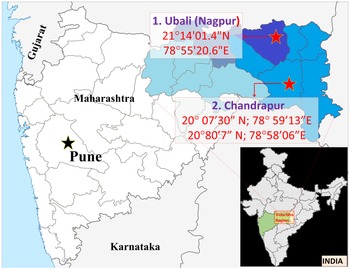
Several scholars have reported many anomalous encircling enclosures of monumental tomb structures in parts of Europe and the Indian subcontinent (Fergusson and Murray Reference Fergusson and Murray1872; Brandfield Reference Brandfield1873; Rivett Reference Rivett-Camac1879; Krishnaswami Reference Krishnaswami1949; Renfrew Reference Renfrew1973, Reference Renfrew1983; Leshnik Reference Leshnik1974; Barbara et al. Reference Barbara, Sue and Christopher1997). These European Megalithic structures have a close resemblance with South Indian Megalithic culture indicating uniformity in the burial characters, though a significant diversity exists in the mode of construction culminating in different types of Megalithic burials (Magli Reference Magli2016; Das Reference Das2018). Our present study focuses on Vidarbhan Megalithic burials (Figures 1 and 2). Owing to lack of well-preserved bones, which is not surprising from burials from the Megalithic, we utilized equine dental remains for absolute dating (Malou et al. Reference Malou, Karl-Göran and Jan2020).
Locations of the studied Megalithic burial sites in the Vidarbha region on the map of India.

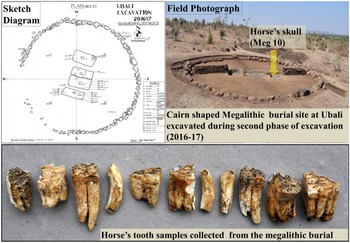
Field location and recovered tooth samples from horse’s jaw. Shown here, the upper and lower incisors, canines, premolars, and molars of horse (Equus caballus) collected near the Megalithic burial at Ubali.

Although bone collagen would be preferred for radiocarbon (14C) dating (Bronk Ramsey et al. Reference Bronk Ramsey, Higham, Bowles and Hedges2004; Brock et al. Reference Brock, Geoghegan, Thomas, Jurkschat and Higham2013; Calabrisotto et al. Reference Calabrisotto, Fedi, Cafrio and Mando2013; Higham et al. Reference Higham, Douka and Higham2015; Cersoy et al. Reference Cersoy, Zazzo, Rofes, Tresset, Zirah, Gauthier, Kaltnecker, Thil and Tisnérat-Laborde2017), in circumstances of poor bone preservation, the carbonate fraction of bio-apatite derived from tooth enamel is a suitable alternative material for radiocarbon dating (Saliège et al. Reference Saliège, Person and Paris1995). Bio-apatite derived dates should be cross-validated by other suitable means to minimize the confounding effect of secondary carbonates in tooth enamel (Hedges et al. Reference Hedges, Lee-Thorp and Tuross1995; Grün Reference Grün2006; Buchholz and Spalding Reference Buchholz and Spalding2010; Zazzo Reference Zazzo2014; Ventresca Reference Ventresca, Fernandes, Janzen, Nayak, Swift, Zech, Boivin and Roberts2018; Dury et al. Reference Dury, Lidén, Harris and Eriksson2021). As a cross-validation of bio-apatite dating, we also undertook 14C dating of organic food residue material derived from cooking pots among burials.
Hydroxyapatite derived from the skeletal remains of herbivores have also been used for reconstruction of palaeo-diet and interpreting palaeo-environmental conditions (Quade et al. Reference Quade, Cerling, Barry, Morgan, Pilbeam, Chivas, Lee-Thorp and Van der Merwe1992, Reference Quade, Cerling, Andrews and Alpagut1995; Koch Reference Koch1998; Kohn and Cerling Reference Kohn and Cerling2002; Zanazzi and Kohn Reference Zanazzi and Kohn2008). The δ13C value from hydroxyapatite can indicate C3 or C4 type of plants/crops and their consumers. Plants following the C3 photosynthetic pathway show distinct and depleted isotopic signatures (−20‰ to −35‰ with an average of −27‰; O’Leary Reference O’Leary1988; Farquhar et al. Reference Farquhar, Ehleringer and Hubick1989; Cerling et al. Reference Cerling, Hart and Hart2004) compared to those following C4 photosynthetic pathway (−9‰ to −17‰, with an average −13‰; van der Merwe and Medina Reference van der Merwe and Medina1991).
Many studies have inferred that skeletons of mammalian herbivores contained the isotopic signature(s) of vegetation and habitat (δ13C and δ18O values) in which they have lived (Cerling et al. Reference Cerling, Hart and Hart2004; Kohn et al. Reference Kohn, McKay and Knight2005; Ventresca et al. Reference Ventresca, Fernandes, Janzen, Nayak, Swift, Zech, Boivin and Roberts2018; Morandi et al. Reference Morandi, Frémondeau and Müldner2021; Sandhu et al. Reference Sandhu, Sathe, Chakarborty, Chakraborty and Chauhan2021). Thus hydroxyapatite from animal bone and tooth enamel are appropriate for isotopic analyses when skeletal remains are poorly preserved, and they retain a secure stable isotopic record for thousands of years (Schoeninger and DeNiro Reference Schoeninger and DeNiro1982; Thorp and van der Merwe Reference Thorp and van der Merwe1987; Wang and Cerling Reference Wang and Cerling1994). Around 14‰ fractionation for C isotopes is involved between structural carbonate in hydroxyapatite and the consumed diet (Wang and Cerling Reference Wang and Cerling1994; Cerling et al. Reference Cerling, Harris, Macfadden, Lea-key, Quade, Eisenmann and Eh-leringer1997).
The δ18O signatures of tooth enamel are controlled by environmental factors such as available drinking water, leaf moisture, physiological processes, dietary or drinking behavior and large body size. For instance, horses are obligate drinkers and their drinking water sources are mainly from precipitation (Koch Reference Koch1998; Wang and Deng Reference Wang and Deng2005). Hence, δ18O values of tooth enamel samples should reflect δ18O values of source water bodies and their physiology (Wang et al. Reference Wang, Kromhout, Zhang, Xu, Parker, Deng and Qiu2008). Plant leaves consumed by horses have normally enriched values of δ18O than the meteoric water, hence δ18O values of enamel could be expected to be enriched by ∼2−3‰ compared to that of contemporary meteoric value (Longinelli Reference Longinelli1984; Kohn Reference Kohn1996; Hoppe et al. Reference Hoppe, Amundson, Vavra, McClaran and Anderson2004; Hoppe Reference Hoppe2006).
In this study, we have generated a total of 15 14C dates from two Megalithic burials (Meg-10, Meg-33) and one geological site (three samples: WDH-2, Horse-1, Horse-5) which include radiocarbon dating on equine tooth-enamel samples and organic food remains recovered from cooking pots from the burial sites. To assess contemporary human diets, we also measured δ13CTOC and δ15N of these remains. Both megalith burials were found to belong to the early Historic period. On the other hand, out of three equines recovered from the geological site, two horses (Horse-1 and Horse-2) were found to be of modern age (Table 1). These two horse teeth samples of modern age were included in our study due to their close geographical proximity and thus similar climatic conditions especially for comparing isotope based hydro-climatic conditions. The Megalithic-age horses in these deposits may have been from sacrificial rituals, such as those recorded in Indian Megalithic sites (Thomas Reference Thomas1992b; Marak and Jangkhomang 2012).
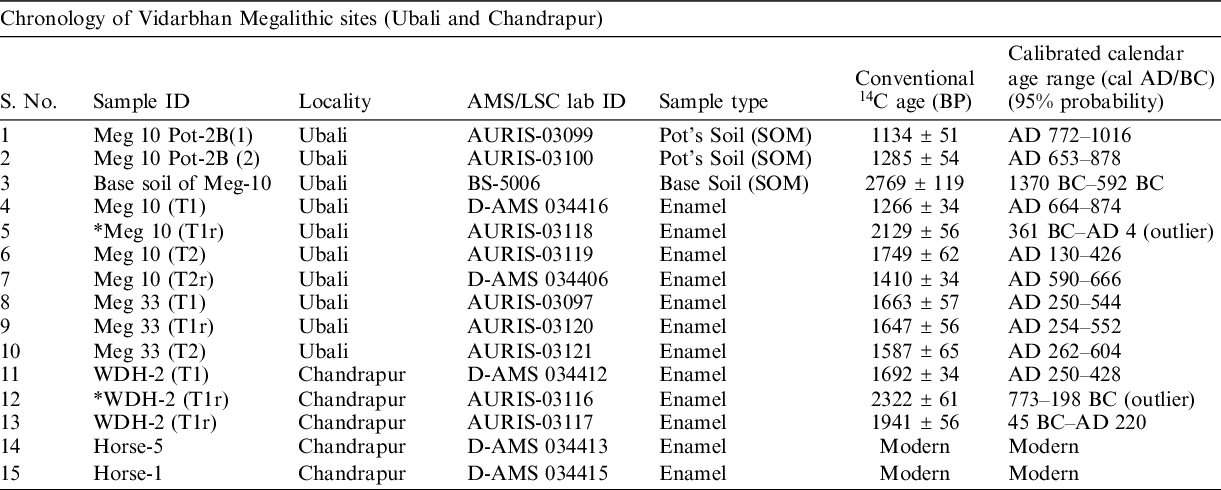
Calibrated AMS and conventional radiometric 14C dates (calibrated by Oxcal4.2) for the Megalithic burials of Vidarbha region. Calibrated 14C dates of pot soil’s organic matter and base soil are also given. (Note: T1 refers Tooth-1 and T2 refers Tooth-2 for individual equine skull; *denotes outliers; ‘r’ denotes replicate of preceding tooth sample).

ARCHAEOLOGICAL BACKGROUND OF THE STUDY AREA
Studies of Megalithic burials provide insights into diverse socio-political, economic and cultural life of ancient societies (Darsana Reference Darsana1998; Mohanty and Selvakumar Reference Mohanty and Selvakumar2002; Fuller Reference Fuller and Bellwood2014; Rajesh Reference Rajesh2017; Roy Reference Roy2018). The majority of studies focus on early agricultural communities and creation of complex polities (Renfrew Reference Renfrew and de Laet1976, Reference Renfrew1984; Kajale Reference Kajale1989; Marak and Jangkhomang 2012; Mane Reference Mane2013; Sánchez et al. Reference Sánchez, Malmström, Fraser, Girdland-Flink, Svensson, Simões, George, Hollfelder, Burenhult, Noble and Britton2019). Megaliths are found all across India including the Vidarbha region (central Indian part of Maharashtra state). The region comprises 11 districts: Buldhana, Akola, Amaravati, Yavatmal, Wardha, Nagpur (Ubali), Bhandara, Chandrapur, Godchiroli, Amravati (Kholapur), and Gondia. The majority of the Megalithic sites from the Vidarbha region are located in the Nagpur, Chandrapur, and Wardha districts. In general, these Megalithic sites often yielded wheat, lentil, pea, black gram, ragi (finger millet), and paddy (unmilled rice) during excavations indicating both kharif (summer crop viz. rice) and rabi (winter crop viz. wheat or barley) crops dominated agricultural practices (Kajale Reference Kajale1989). The faunal remains are predominantly cattle and horse, followed by sheep and goat (Thomas et al. Reference Thomas1992a, Reference Thomas1992b).
STUDY SITES
Megalithic Burial Site: Ubali (Nagpur): This site is situated on a hillock, which is located approximately 2 km away towards the northern outskirts of the present-day village of Ubali, on the north side of the Maharashtra state highway (248) leading to the village Mohpa. Within the radius of 30 km of Ubali are the Megalithic sites Junapani and Mahurjhari. The Ubali site yields substantial evidence of the typical Vidarbhan Megalithic culture of this area. The total area of the Megalithic site is 0.127 km2 and it is close to the dry bed of a tributary of the Chandrabhaga River. Among the many Megalithic burials, the site no 10 (Meg-10) and 33 (Meg-33) were considered for the study. We focused on these two sites to examine the robustness of the 14C chronology for tooth enamel samples within these archaeological contexts. Meg-10 is situated towards the eastern end of the hillock, closer to the present day Ubali village. The measurements of the stone circle with cairn filling were as follows (Figure 2):
-
Outer diameter: 21.00 m NS and 19.95 m EW
-
Inner diameter: 16.52 m NS and 16.40 m EW
At another excavated megalith No. 33 (2014–2015) one Megalithic boulder circle with cairn packing, having a radius of 9–11 m from the reference (center) peg, was taken up for excavation. The antiquities obtained from this excavation display the typical Vidarbha Megalithic material culture comprising of nail-parers, spearheads, chisels, bridle bits used for horses, a large number of aurum (archaic gold) micro disc beads, and semi-precious stone beads. The faunal remains here consisted mainly of horse bones and teeth.
Chandrapur: The site is located ∼140 km south of Ubali in the Chandrapur District. Vijay Sathe carried out a few excavations of the Quaternary deposits about 25 km from Warora (District Chandrapur) around Rangana and Jhola (20°07'30"N, 78°59'13"E and 20°80'7"N, 78°58'06"E, respectively) in 1995–1996. Sathe’s field collection included isolated equine remains in alluvium of Holocene age which were archived in the Deccan College Palaeontological repository (Bulletin: Indian Archaeology 1995–1996). From these, individual horse’s teeth were collected and included in the present work for better contextualization of regional climate. The Quaternary deposit stratigraphy reveals cemented sheets of sandy pebbly gravel, overlain by yellow-brownish compact clay and silt (Figure S1). This is further overlain by the younger alluvium of varying thickness, which is attributable to the agricultural practices along the banks of the river. Horse teeth collected from the younger alluvium below the Black Cotton Soil appeared on sight to be better preserved.
MATERIAL AND METHODS
The range of detailed analysis of sites Megalithic burial no. 10 (Meg-10) and Megalithic burial no. 33 (Meg-33) at Ubali (Nagpur) was to ascertain the chronology. Skeletal material was found to be badly degraded with negligible potential in terms of collagen yield; hence we utilized teeth from the intact equine skulls (n=02) from horse-burials (Meg-10 and Meg-33) for our accelerator mass spectrometry (AMS) 14C dating. There was a similar scenario for those three horses’ remains found in the Chandrapur area also, and so we defaulted to tooth enamel dates for this site. These horse teeth were collected from exposed geological horizons which also yielded fossilized skull, jaws, a large number of gastropods from the underlying cemented sandy pebble gravels, and yellow-brownish compact clay and silt on the right bank of the river Wardha.
As stated earlier, tooth enamel could be a suitable material in absence of bone collagen for 14C dating, as well as an assessment of palaeo-environmesnt using stable isotope proxies (Thorp and van der Merwe Reference Thorp and van der Merwe1987; Ayliffe et al. Reference Ayliffe, Chivas and Leakey1994). Enamel is composed of hydroxyapatite, which is the hydroxyl end member of the complex apatite group, where the OH-ion can be replaced by fluoride, chloride, and carbonate ions during eating or drinking. Therefore, we also measured stable C and O isotope values of these carbonates (CO3) along with 14C contents. Some secondary minerals might be precipitated within the fractures of tooth, which can affect the stable isotopic values as well as 14C contents (and hence obtained ages). The impact of diagenesis is much less for enamel (∼0.3%) than for dentine (∼5%) (Kohn et al. Reference Kohn, Schoeninger and Barker1999). Pretreatment of the samples was carried out to remove secondary contaminants in the microscopic fractures of teeth enamel (Balasse Reference Balasse2002 and Dunbar et al. Reference Dunbar, Cook, Naysmith, Tripney and Xu2016).
Pretreated and dried tooth enamel powders (∼1.0 to 1.5 mg) were reacted with 99.8% H3PO4 under vacuum at 72°C for acid hydrolysis to produce the CO2 from the interstitial CO3 fraction of tooth enamel. Stable δ18O and δ13C isotope measurements were carried out using Isotope Ratio Mass Spectrometer (IRMS; MAT-253) at Birbal Sahni Institute of Palaeosciences (BSIP), Lucknow using standard protocols (Ansari et al. Reference Ansari, Pandey, Sharma, Agrawal and Kumar2018). Isotopic data were checked using international carbonate standards NBS-18 and IAEA-603 in addition to in-house Carrara Marble. δ13C values are reported against Vienna PDB, while δ18O are reported Vienna SMOW (standard mean ocean water) with an overall precision of ±0.1‰ (1σ). Graphite targets were prepared using graphitization facility at the Radiocarbon Dating and Isotope Characterization Laboratory of BSIP. The 14C contents were measured using the AMS facility at PRL (AURIS; Physical Research Laboratory), Ahmadabad, and Direct AMS Laboratory (D-AMS), USA.
We dated burial soil associated with cooking pots found in the Meg-10 burial to compare teeth enamel ages with the ages of food remains from the cooking pots. For these samples, ∼200 g burial soil was pretreated with 10% HCl to remove inorganic fractions. This sample was then dated by conventional radiometric 14C dating using the liquid scintillation counter (LSC) at BSIP (Table 1). Details of chemical analyses for both conventional and AMS methods of 14C dating at BSIP are described in Agnihotri et al. (Reference Agnihotri, Gahlaud, Patel, Sharma, Kumar and Chopra2020).
We also examined stable isotopic data of organic food remains in the cooking pots from a Megalithic burial (Meg-10). These samples were treated with 10% HCl to remove all inorganic fractions (carbonates) to determine δ13CTOC values. We also measured stable nitrogen (δ15N) values using untreated soil materials. Stable δ13C and δ15N values were measured on an Elemental Analyser coupled IRMS at Radiocarbon Dating and Isotope Characterization Laboratory of BSIP. For mass-spectrometric analysis, about 20–30 mg of dried powder was weighed in clean tin cups and sealed into oval shaped pellets. Using the auto-sampler, these pellets were dropped into the reactor of the elemental analyzer (Isotope Vario select, Elementar Germany) interfaced with stable isotope mass spectrometer (Isoprime Precision, Elementar UK) in a continuous flow mode. Laboratory standards ACA (e-amino-n-caproic-acid) and sulfanilamide were used for primary calibrations. Overall, reproducibility was better than ±0.15 for the δ13C and ±0.20‰ for δ15N data.
RESULTS
14C DATING
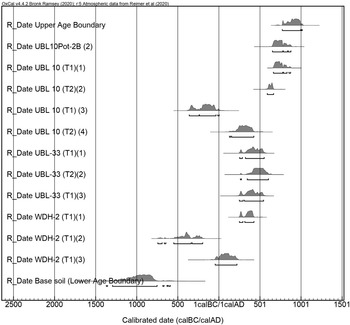
AMS dating of ancient tooth enamel is comprised of samples form Ubali (four samples from Meg-10 and three samples Meg-33 including their repeats), and Chandrapur ((WDH−2 (n=3), Horse-1 (n=1), Horse-5 (n=1)) were dated by AMS 14C dating. In this study, two equine tooth samples (Horse-1, Horse-5; post AD 1950, pMC values, 119.9 ± 0.43, and 106.16 ± 0.57, respectively) of Chandrapur region are included. The dates were calibrated using Oxcal4.4 software (Bronk et al. Reference Bronk Ramsey, Scott and van der Plicht2013) which utilizes IntCal20 dataset (Reimer et al. Reference Reimer, Austin, Bard, Bayliss, Blackwell, Bronk Ramsey, Butzin, Cheng, Edwards, Friedrich, Grootes, Guilderson, Hajdas, Heaton, Hogg, Hughen, Kromer, Manning, Muscheler, Palmer, Pearson, van der Plicht, Reimer, Richards, Scott, Southon, Turney, Wacker, Adolphi, Büntgen, Capano, Fahrni, Fogtmann-Schulz, Friedrich, Köhler, Kudsk, Miyake, Olsen, Reinig, Sakamoto, Sookdeo and Talamo2020). All radiocarbon and calibrated 14C dates are presented in Table 1 and Figure 3.
Calibrated age range of obtained 14C dates of tooth enamel of Megalithic horse burials along with ages of soil organic matter recovered pots from burial.

The obtained 14C dates for a buried Megalithic equine skull found at burial Meg-10 at 95% probability (±2σ) are AD 664–874 (D-AMS 034416), AD 590–666 (D-AMS 034406), and AD 130–426 (AURIS-03119). We have measured two teeth of Meg-10 with two replicates of each. The third date (AURIS-03119) is slightly older compared to rest of two age ranges. This older age can plausibly be explained due to poor preservation and/ or contaminations (during the extraction of enamel from a particular portion of a tooth) and hence it is not considered for assigning the age range for burial Meg-10. Thus, the assigned age range for burial Meg-10 is AD 590–874. This age range closely overlaps with the age range obtained by dating of burial Pot’s food remains i.e., cal AD 772–1016 (AURIS-03099) and cal AD 653–878 (AURIS-03100) (Table 1). 14C dates for another horse skull at burial Meg-33 (Ubali) are cal AD 250–544 (AURIS-03097), cal AD 254–552 (AURIS-03120), and cal AD 262–604 (AURIS-03121) (Table 1). We have measured two teeth of Meg-33 with one replicate of tooth T1 (Table 1). All of them are closely overlapping and yielding a combined age range between cal AD 250–604. The horse burial from Chandrapur (WDH-2) yielded 14C ages cal AD 250–428 (D-AMS 034412) and 45 cal BC–cal AD 220 (AURIS-03117). For this sample, we have conducted measurement on three replicates (Table 1). Age range obtained provides a contextual (temporal) support to Ubali burials (Meg-10 and Meg-33) although WDH-2 is not a megalithic horse.
It is thus evident that 14C dates obtained by horse-teeth of respective burials fall well within the age ranges obtained by dating organic food remains recovered from cooking pots obtained from Ubali burials. It is noteworthy here that measured 14C age of the base soil comes as 1370−592 cal BC (BS-5006; Table 1), which indicates that surrounding soil of Meg-10 burial is significantly older than the 14C age of organic food remains and soil carbon has not contaminated the material inside the cooking pots. As far as the general understanding of the age range of the Vidarbha Megalithic period is considered, excavations at Mahurjhari, Khapa (Deo Reference Deo1970), and Naikund (Deo and Jamkhedkar Reference Deo and Jamkhedkar1982) suggest the time window of ∼2nd century BC to ∼7th century AD. Amidst these expectations, the present study appears to distinctly bring out continuity of Megalithic practices in Vidarbha into the early centuries of the Christian era.
STABLE ISOTOPIC DATA
The skeletal remains (e.g., bones, teeth) from the Megalithic burial sites provide a dietary pattern including both agricultural produce as well as animal food (Lukacs Reference Lukacs1981; Singh Reference Singh2008; López and Alexander Reference López-Costas and Alexander2019; Knipper et al. Reference Knipper, Rihuete-Herrada, Voltas, Held, Lull, Micó, Risch and Alt2020; Choy et al. Reference Choy, Yun, Lee, Fuller and Shin2021). We made use of stable isotopic composition of light elements (e.g., δ13C, δ15N, δ18O) of horse teeth and pot-soils in the present study to gauge food habits and prevailing climatic conditions in the regional context (Kohn Reference Kohn1996; Thorp and Sponheimer Reference Thorp and Sponheimer2005; Koch Reference Koch, Michener and Lajtha2007; Fiorentino et al. Reference Fiorentino, Ferrio, Bogaard, Araus and Riehl2015). To achieve this, we measured C and O isotopes in tooth enamel samples and C and N isotopic values of pot soils. We assume that soil inside pots would have remnant of food items (grains/ seeds), hence stable isotopic results would provide important clues about contemporary agricultural practices and dietary patterns of the Megalithic people.
δ 13C and δ 18O of Tooth Enamel Samples
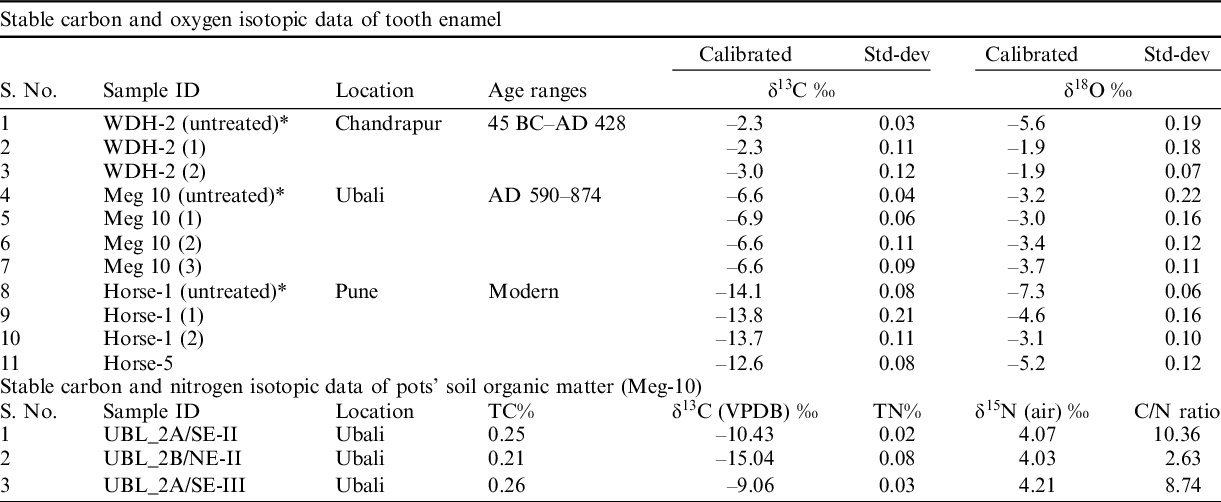
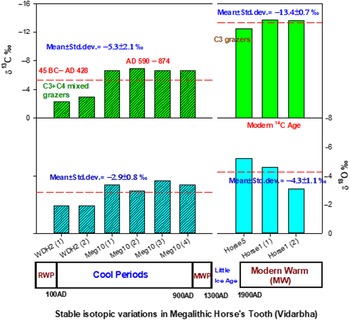
δ13C values of Megalithic horses vary between −2.3‰ to −6.9‰ with an average −5.3 ± 2.1‰. In contrast, δ13C values of modern buried horses were found to be varying in the range between −12.6‰ to −13.8‰ with an average −13.7‰ ± 0.7 (Table 2). These isotopic values indicate that modern horses were C3 type grazers (considering isotopic fractionation of ∼14‰; Cerling et al. Reference Cerling, Harris, Macfadden, Lea-key, Quade, Eisenmann and Eh-leringer1997). By contrast, the horses buried with Megalithic structures appear to be C3 and C4 mixed type of grazers. δ18O of Megalithic horses varied between −1.9‰ to −3.7‰ with an average of −2.9‰ ± 0.8, which is clearly enriched compared to those of modern horses ranging between −4.6‰ and −5.2‰ with an average of −4.3‰ ± 1.1 (Table 2). ∼2‰ enriched δ18O values of Megalithic horses compared to their modern counter parts indicate water stressed (drier) conditions prevailing during the discussed Megalithic culture. Figure 4 shows both δ13C and δ18O values of horse tooth enamels along with their respective radiocarbon ages.
Stable carbon and oxygen isotopic values of horse tooth enamel of Megalithic burial along with stable carbon and nitrogen values of pot’s soil sediments. These pots were unearthed from the Megalithic burial at Ubali (Meg-10) whereas in the UBL_2A and 2B denote burial Pit-2, sections A and B. The isotopic values of untreated tooth enamel is almost similar with treated tooth enamel, which implies that teeth were not diagenetically altered significantly. (Note: *untreated samples’ values were used only for reference only, i.e., these were considered for interpretation.)

δ13C and δ18O values of Megalithic equine teeth placed against their respective calendric 14C dates. Horse teeth corresponding to age range ∼100 to ∼700 AD (globally recognized cooler period/dark age) show significantly enriched values compared to those of modern horses’ teeth of central India. Rectangular bars showing durations of Roman warm period (RWP), cool periods, Medieval warm period (MWP), Little ice age (LIA) and modern warm (MW) were adopted from Bard et al. (Reference Bard, Raisbeck and Yiou2000), Agnihotri et al. (Reference Agnihotri, Dutta, Bhushan and Somayajulu2002), and Sicre et al. (Reference Sicre, Jacob, Ezat, Rousse, Kissel, Yiou, Eiriksson, Knudsen, Jansen and Turon2008).

δ 13 C and δ 15 N of Organic Food Remains Recovered from Megalithic Burial Pots
Stable δ13CTOC values of organic food remains recovered from three pots of a Megalithic burial (Meg-10) vary between −9.1‰ to −15.0‰ with an average of −11.5 ± 3.1‰; stable δ15N values showed overlapping values (4.0–4.2‰). TOC/TN (wt.) ratios of these remains ranged between 2.6 to 10.4 averaging at 7.3 ± 4.1‰ (Table 2). All the measured values of δ13CTOC, δ15N and TOC/TN ratios collectively indicate that pots indeed had contained food materials whose δ13CTOC values indicate domination of C4 type of crop material (most probably millet group cereals).
DISCUSSION
Chronological Assessment of Megaliths in Vidarbha
Problems of dating megaliths were brought out by Wheeler’s excavation in Brahmagiri (1944) in Karnataka (Wheeler Reference Wheeler1947–1948). Initially, Deo (Reference Deo1973a, Reference Deo1973b, Reference Deo, Agarwal and Gosh1973c, Reference Deo and Verma1998) was the first to provide a precise time frame using 14C dating for the Megalithic sites of Naikund, Bhagi Mohari village, and Khairwada. There are a total of 13 14C dates which assign these sites between 7th and 6th centuries BC. Some Megalithic sites such as in Salur (Andhra Pradesh), Porkalam (Kerala), and Brahmagiri (Karnataka) were dated to 2nd century BC−1st century AD (Deo et al. Reference Deo1982; Mohanty and Selvakumar Reference Mohanty and Selvakumar2002; Fuller et al. Reference Fuller, Boivin and Korisettar2015, Binodini Devi Reference Binodini Devi2017). Our examination of the sites reports new 14C dates to ascertain chronology of Vidarbhan Megalithic culture. In general, megaliths are believed to span between ∼1100–550 BC (early age megaliths) to ∼300−100 BC (late or younger megaliths). However, we here presented new AMS 14C dates of Megalithic culture in Vidarbha region by dating equine teeth enamel of Ubali burials (Meg-10 and Meg-33) and organic food remains recovered from burial cooking pots. The total age range for Ubali megaliths of the Vidarbha region is AD 250–1016 (see Figure 3; Table 1). Since tooth enamel contains a relatively lesser amount of datable carbon (∼0.3–0.4 %), it is better to include at least 2–3 numbers of replicates for ascertaining well-constrained 14C ages.
Climatic and Dietary Reconstruction
Isotope analysis provides imprints of herbivores’ diet and drinking behavior, which are essential indicators of inhabited ecology and climate (Longinelli Reference Longinelli1984; Kohn et al. Reference Kohn1996; Kohn and Cerling Reference Kohn and Cerling2002; Levin et al. Reference Levin, Cerling, Passey, Harris and Ehleringer2006). Compared to human diet, the diet of herbivores is more sensitive to changes in naturally grown vegetation/grass type (Tieszen Reference Tieszen1991). Here, it should be noted that vegetation patterns may vary according to prevailing climate i.e., warmer/wetter climate supports C3 type vegetation, whereas colder/drier climate favors C4 type of vegetation (Felstead Reference Felstead2012), which can traced by δ13C values of herbivores’ tooth enamel. Herbivores that consume C3 plants, generally show average enamel δ13C values ∼ −13‰, whereas C4 grazers have average δ13C values ∼+1‰ (Wang et al. Reference Wang, Kromhout, Zhang, Xu, Parker, Deng and Qiu2008). Mixed grazers (which consume both C3 and C4 type plants) generally display isotopic values between +1‰ and −13‰.
The 14C dates of Megalithic horses were consistent with the time range between 45 cal BC−874, which falls into an era of global cooling (Sicre et al. Reference Sicre, Jacob, Ezat, Rousse, Kissel, Yiou, Eiriksson, Knudsen, Jansen and Turon2008). Cool epochs of the Holocene have generally been reflected as poor monsoon periods in India (Agnihotri et al. Reference Agnihotri, Dutta, Bhushan and Somayajulu2002). Following this corollary, the Indian monsoon could be anticipated to be weaker (von Rad et al. Reference von Rad, Schaaf, Michels, Schulz, Berger and Sirocko1999) and the regional ecosystem of Vidarbha should have experienced water stressed conditions. This scenario is corroborated by the stable δ13C and δ18O values of equine tooth enamel. Measured δ13Ctooth values ranging between −2.3‰ to −6.9‰ with an average of ∼ −4.9 ± 2.2‰ supports this inference as they hint C4 type of vegetation from (Wang et al. Reference Wang, Kromhout, Zhang, Xu, Parker, Deng and Qiu2008). Imprints of this aridity can be further seen in δ18O values of herbivore (horse-) tooth enamel when they are compared with their modern counter parts (Figure 4). In central India, a clear seasonal cycle was detected in the intra-annual stable δ18O isotope variations in tree rings with amplitude of ∼6.8‰ (Managave et al. Reference Managave, Sheshshayee, Borgaonkar and Ramesh2010). Managave et al. (Reference Managave, Sheshshayee, Borgaonkar and Ramesh2010) demonstrated how the δ18O of tree cellulose varies with rainfall of the region (varying from ∼200 mm to ∼750 mm from March to July with average annual rainfall of ∼940 mm). Managave et al (Reference Managave, Sheshshayee, Borgaonkar and Ramesh2010) interpreted −2.7‰ of δ18O isotopic variations which can be correlated with ∼550 mm change in precipitation (rainfall) in central India. Using this simple analogy, i.e., ∼1.5‰ change in δ18O value can reflect a major change in precipitation of a region (equivalent to ∼100 mm rainfall deficit; Sengupta and Sarkar Reference Sengupta and Sarkar2006).
In the studied central Indian Megalithic sites, we found ∼ −1.4‰ of δ18O isotopic variation in Megalithic horse’s teeth compared to those of modern horse, which suggests that during early historic times (1st–7th century AD), the Vidarbha region was likely receiving significantly less rainfall (∼100−200 mm, based on simple empirical relationship reported by Sengupta and Sarkar Reference Sengupta and Sarkar2006 and Managave et al. Reference Managave, Sheshshayee, Borgaonkar and Ramesh2010) compared to today.
C4 type plants support millet based crops with δ13C values between −8.0 to −14.0‰ (Araus et al. Reference Araus, Amaro, Zuhair and Nachit1997; Wang et al. Reference Wang, Kromhout, Zhang, Xu, Parker, Deng and Qiu2008; Peukert et al. Reference Peukert, Bol, Roberts, Macleod, Murray, Dixon and Brazier2012; Styring Reference Styring, Ater, Hmimsa, Fraser, Miller, Neef, Pearson and Bogaard2016). In addition, δ15N values of these food remains (recovered from burial pot) would indicate soil dryness (aridity). We can expect increasing δ15N values with increasing aridity with higher TOC/TN ratios (Heaton Reference Heaton1987; Austin and Vitousek Reference Austin and Vitousek1998; Amundson et al. Reference Amundson, Austin, Schuur, Yoo, Matzek, Kendall, Uebersax, Brenner and Baisden2003). δ13C values (−9.1 to −15.4‰) of studied pot soils also indicated millet based (C4 type) grains/plants may have dominated (Cheng et al. Reference Cheng, Dong, Li, Zhang, Zhao, Zhao and Yong2015). This interpretation led us to surmise that Megalithic humans were likely using millet based subsistence that is affirmative with study carried out by Kajale (Reference Kajale1989).
For the Holocene epoch, palaeo-monsoon/palaeo-climate scenario of a particular region is generally reconstructed using natural repositories such as lakes, coastal sediments, speleothems, corals, etc. However, palaeo-climatic reconstruction using herbivore teeth and food grains (in this study) could be important for ground-teething of palaeo-monsoonal scenario and human-environment relationships.
CONCLUSIONS
-
1. We utilized “food organic remains recovered from pots found from the burial” for measuring their C and N isotopic data. The generated isotopic data clearly indicated crop-vegetation values (C4, millet type). This outcome prompted us to carry out AMS 14C dating of these materials. As expected, obtained ages were in context with those of tooth enamel.
-
2. New 14C dates provide a chronological range for the Ubali megaliths in the Vidarbha region spanning from cal AD 250 to 1016. For the first time, we brought out the temporal expansion of Megalithic people on the basis of Ubali Megalithic sites of Vidarbha.
-
3. Stable δ13C and δ18O isotopic values of horse tooth enamel have given useful information on the strength of past monsoonal status over the central India.
-
4. Stable δ15N and δ13C values of pot-soil sediments indicated the consumption and cultivation of C4 type of crops (plausibly millet type) by the Ubali Megalithic people.
-
5. This study also explores the environmental history together with expansion of mortuary practice that was prevalent among the Megalithic people of central India, which has been a matter of great interest among archaeologists. The antiquity of these megaliths has been traced back to the first millennium BC by archaeologists in the past and so far these burial practices continue to present times in some areas. As a future scope, we emphasize that more such Megalithic sites should be chronologically constrained to refine the timeframes of ancient societies and their adaptations with changing climatic conditions.
ACKNOWLEDGMENTS
We are thankful to the Director of BSIP, Lucknow (U.P.) for permission and encouragement to collaborate for multidisciplinary studies. NP is grateful to the University Grant Commission, New Delhi, for providing financial support as Junior Research Fellow. PT is thankful to RTM Nagpur University for support and funding for carrying out excavations at Ubali. VS is thankful to the authorities of Deccan College Postgraduate & Research Institute, Pune, for funding the field investigations in District Chandrapur.
Supplementary material
To view supplementary material for this article, please visit https://doi.org/10.1017/RDC.2022.47