Introduction
Recurrent vestibulopathy is a clinical syndrome first described in 1981 by Leliever and Barber.Reference Leliever and Barber1 It consists of multiple episodes of vertigo lasting for minutes to hours, without auditory or neurological signs or symptoms. The attacks are not provoked by changes in head position. The cause of recurrent vestibulopathy is unknown. A number of studies have claimed that episodic vertigo is causally related to migraine; other considerations include recurrent vestibular neuritis and a precursor of Ménière's disease.Reference Slater2–Reference Paparella and Mancini5 According to Rutka and Barber, 14 per cent of patients given a diagnosis of recurrent vestibulopathy subsequently develop Ménière's disease.Reference Rutka and Barber6 In the Apeldoorn Dizziness Centre, recurrent vestibulopathy is a frequent diagnosis and is clearly distinguished from Ménière's disease and migraine. In our Dizziness Centre, recurrent vestibulopathy is diagnosed almost twice as often as Ménière's disease.
The purpose of this study was to determine the natural course of recurrent vestibulopathy (e.g. how often does a patient with recurrent vestibulopathy develop Ménière's disease?). We also tried to identify prognostic factors that predict the course of the disease.
Methods
Study population
From December 2000 through December 2006, approximately 2000 patients were referred to the Apeldoorn Dizziness Centre. One hundred and twenty one patients were identified with a diagnosis of recurrent vestibulopathy. This diagnosis required the following criteria: multiple (i.e. more than two) vertigo attacks lasting from 5 minutes to a maximum of 24 hours, no associated hearing loss, no tinnitus or aural pressure sensation, and no provocation by changed head position.
The exclusion criteria were: presence of migraine (i.e. meeting the International Headache Society criteria), presence of unilateral sensorineural hearing loss, and abnormalities at neurological examination.7
At their first visit to the multidisciplinary Dizziness Centre, all patients were evaluated by a neurologist and ENT surgeon. All participants in the study underwent a full neurotological evaluation, including ocular motor testing, positional testing, caloric and rotational testing, and pure tone audiometry. Management was conservative in all cases, including an explanation of the disease with emphasis on the non-life-threatening nature of the condition. Patients were not given dietary advice, nor did they receive any medication.
Methods
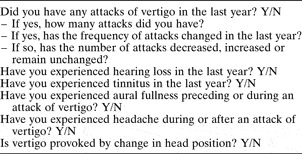
All included patients were approached by telephone a minimum of one year after their first out-patient department visit. The telephone interviews were conducted by two experienced technicians from the vestibular laboratory, using a standard questionnaire (see Table I).
Questionnaire
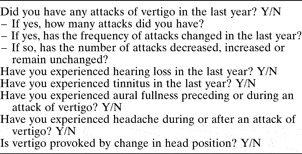
Y = yes; N = no
This method of follow up by telephone was validated in a small group of patients with recurrent vestibulopathy and persistent complaints who were evaluated in the out-patient department (n = 21). In cases of hearing loss or positional vertigo, the patient was seen in the out-patient department and pure tone audiometry and/or vestibular testing were performed.
Questionnaire results were scored as follows: 1 = inactive recurrent vestibulopathy (i.e. no attacks of vertigo in the last year); 2 = active recurrent vestibulopathy (i.e. a minimum of one vertigo attack in the last year); 3 = Ménière's disease (i.e. unilateral tinnitus and sensorineural hearing loss had developed); and 4 = other (i.e. benign paroxysmal positional vertigo or migraine).
For the diagnosis of migraine, we used the International Headache Society criteria, and for Ménière's disease we used the criteria developed by the Committee on Hearing and Equilibrium Guidelines.7, 8
Within the ‘active recurrent vestibulopathy’ group, we divided patients into three subgroups according to whether their frequency of vertigo attacks had decreased, increased or remained similar.
Statistical analysis
We statistically tested the effect on the disease course of: sex, age, symptom duration, frequency of attacks (in the period before the first out-patient department visit) and abnormal vestibular test results (i.e. ≥25 per cent unilateral caloric response reduction). Statistical analysis undertaken to compare the outcomes of the various patient groups, was performed using the chi-square test, t-test and Wilcoxon signed rank test.
Results
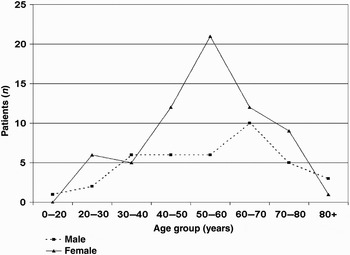
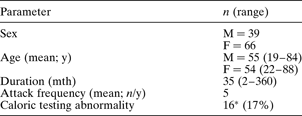
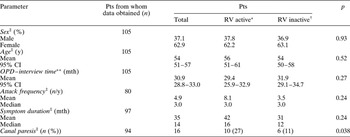
Of the 121 patients meeting the diagnostic criteria of recurrent vestibulopathy, 105 were enrolled in the study. Sixteen patients were lost to follow up. The median follow up was 31 months (range 12–62 months), calculated based on the first out-patient visit and the date of telephone contact. Table II summarises the patient data. There was a marked female preponderance; moreover, in women we found a peak in incidence in the fifth decade (Figure 1).
Age distribution of patients with recurrent vestibulopathy.

Patient data

*Of 94. M = male; F = female; y = years; mth = months
Of the 105 patients enrolled in the study, 21 required re-evaluation in the out-patient department because they had developed otological symptoms (hearing loss or tinnitus).
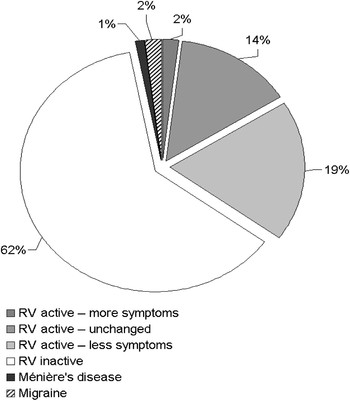
Figure 2 gives a schematic summary of patients' follow-up results. In short, after a mean follow-up period of 31 months, 62 per cent of patients were free of symptoms, whereas 35 per cent were still suffering vertigo attacks. In 2 per cent of patients the diagnosis had been changed to migraine, and in 1 per cent to Ménière's disease.
Summary of follow-up results for patients with recurrent vestibulopathy (RV).

We examined the association between recurrent vestibulopathy activity and such factors as sex, age, symptom duration, frequency of attacks, time interval between first visit and telephone interview, and unilateral caloric response reduction. These findings are summarised in Table III. The only difference between the patient group with ‘active recurrent vestibulopathy’ and the group with ‘inactive recurrent vestibulopathy’ was the presence of unilateral caloric response reduction: the patients with ‘active recurrent vestibulopathy’ more often had a canal paresis.
Patient data comparison: active vs inactive recurrent vestibulopathy
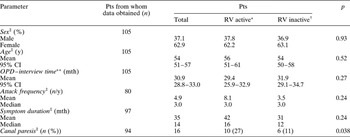
*n = 37 (35%); †n = 65 (62%);. ‡Data from first out-patient department visit; **data from telephone interview. Pt = patient; RV = recurrent vestibulopathy; y = years; CI = confidence intervals; OPD–interview time = time between first out-patient department visit and telephone interview; mth = months; canal paresis = left–right difference ≥25%
Discussion
We found the natural history of recurrent vestibulopathy to be relatively benign. Over a follow-up period of 31 months, 62 per cent of patients experienced spontaneous resolution of vertigo, while 19 per cent had fewer symptoms. In 16 per cent of patients, symptoms were similar or worse. Only one patient experienced conversion of their symptoms to those compatible with Ménière's disease.
Other authors too have observed a benign course for recurrent vestibulopathy. Rutka and Barber followed 63 patients with recurrent vestibulopathy for a mean period of 8.5 years.Reference Rutka and Barber6 They found that 63 per cent of patients showed resolution of vertigo, whereas 8 per cent still had symptoms, while in 14 per cent the diagnosis was changed to Ménière's disease. Kentala and Pyykkö studied 33 patients with benign recurrent vertigo, seven of whom had classic migraine.Reference Kentala and Pyykkö9 After a two to four year follow-up period, 60 per cent no longer suffered from vertigo, while 27 per cent still had vertigo attacks.
Our study found that unilateral caloric reduction was more often present in those patients who did not improve. This is in contrast to the study of Leliever and Barber, who found the exact opposite.Reference Leliever and Barber1
In the literature, patients with episodic vertigo have been given various diagnoses: vestibular migraine, migrainous vertigo, migraine-associated dizziness, vestibular Ménière's disease, episodic vertigo, benign recurrent vertigo and recurrent vestibulopathy. These diagnoses reflect the various causes that have been linked to the syndrome.
In patients with migraine (meeting the International Headache Society criteria) and episodic vertigo, the diagnosis is migrainous vertigo or vestibular migraine.Reference Dieterich and Brandt3 In all other cases of episodic vertigo, a diagnosis of vestibular migraine is questionable. The diagnosis ‘probable migrainous vertigo’ should not be used; this diagnosis is not described in the International Headache Society criteria, and suggests a relationship with migraine that cannot be substantiated.Reference Neuhauser and Lempert10 Other authors support this point of view.Reference Brandt11, Reference Olesen12 Our patient group showed clear epidemiological differences between recurrent vestibulopathy and migraine. The female/male ratio for the two conditions differs (migraine 4:1; recurrent vestibulopathy 1.7:1), as does the peak incidence (migraine in the third decade; recurrent vestibulopathy in the fifth decade).Reference Bigal, Liberman and Lipton13 Moreover, the benign course of recurrent vestibulopathy does not fit the picture of untreated migraine. Therefore, in our opinion, recurrent vestibulopathy is not similar to migraine, and a common aetiology has not yet been substantiated.
Some authors consider episodic vertigo without auditory symptoms to be a precursor of Ménière's disease (termed ‘vestibular Ménière's disease’).Reference Paparella and Mancini5 A substantial number of such patients is said to eventually develop the complete symptom complex of Ménière's disease. However, in our series (as well as Rutka and Barber's) only a few patients actually developed Ménière's disease. In 1995, the American Academy of Otolaryngology – Head and Neck Surgery rightly recommended that the term vestibular Ménière's disease be discarded.8
The presence of recurrent neuritis vestibularis is also unlikely. The mean frequency of vertigo attacks is relatively high (five per year). Also, caloric testing was normal in 83 per cent of patients.
Vertigo alone is rarely a symptom of vertebrobasilar insufficiency.Reference Grad and Baloh14 In this condition, other neurological symptoms (such as visual dysfunction, ‘drop attacks’, unsteadiness and dysarthria) are more commonly present.
• Recurrent vestibulopathy is a clinical syndrome of unknown aetiology characterised by episodic vertigo without auditory symptoms
• The natural course of this syndrome is relatively unknown
• This study found spontaneous resolution of vertigo in a majority of cases, and a small chance of developing migraine or Ménière's disease over subsequent years
In our opinion, in patients with recurrent, spontaneous episodes of vertigo without audiological or neurological symptoms, a diagnosis of recurrent vestibulopathy can be made. However, this is a diagnosis of exclusion, and several other disorders that can cause recurrent vertigo should be excluded. The American Academy of Otolaryngology – Head and Neck Surgery advocates use of the term recurrent vestibulopathy; it is also the most commonly used term in the vestibular literature.8, Reference Furman and Cass15, Reference El-Kashlan and Telian16
Conclusion
In our opinion, recurrent vestibulopathy should be considered as a clinical syndrome of unknown aetiology. It is a diagnosis of exclusion. The prognosis is good, and the chance of developing migraine or Ménière's disease is small. Patients with unilateral caloric response reduction have a higher probability of persistent vertigo attacks.