One peculiar phenomenon in the Korean Protestant churches today is that most churches, regardless of their size and denomination, assert that they are “evangelical.” By claiming to be evangelical, they want to display not simply their conservative theological stance but also continuity with their tradition. Self-acclaimed evangelical churches generally believe that the early Korean church in the late nineteenth and early twentieth centuries was also evangelical, and hence they are its true heirs. Moreover, in the mind of the self-consciously evangelical Korean Christians, “Puritanism” is something to be admired, a lost glory of which evangelicalism is the closest contemporary replica. A few progressive churches would distance themselves from this general tendency, but these churches are more often than not far smaller and less appealing to the average Christian. World-class megachurches and nearly all rank-and-file churches in Korea are “evangelical” churches. The matter in Korean Protestantism is more who is “really” evangelical rather than a competition between evangelicals and non-evangelicals.
It is obviously a historical misunderstanding to identify evangelical Christianity at the turn of the last century with today's evangelical Protestantism. In fact, it is a form of historical presentism when churches try to legitimize their theological traditionalism by evoking their spiritual ancestors and labeling them “evangelical.” Nevertheless, one notable characteristic of Korean Protestantism is its theological conservatism. Further, embedded in this conservatism is a revivalistic-evangelistic temperament. Korean Christians' religious gatherings are typically emotional and stirring. Nearly all Korean congregations across denominational lines observe the century-old tradition of annual and semiannual revival meetings that place a heavy emphasis on the Bible, conversion, and evangelism. It is no accident that the Korean church, with its 13,000 missionaries worldwide, is emerging as a vanguard for Protestant world missions in the twenty-first century.Footnote 1
While Minjung Theology, the Korean version of liberation theology, has fascinated the liberal-progressive theological mind of the world, it has not impressed many Korean Christians. Minjung Theology is perhaps the greatest theological contribution of Korean Protestantism to global Christianity. However, unlike some other regional varieties of praxis theology, Korean Minjung Theology has almost never enjoyed popular support and has remained within the coterie of intellectuals and activists. A few churches that embraced it in the 1970s and 1980s had to struggle for survival and practically disappeared before the end of the century.
Few will doubt that predominantly traditional theology and revivalistic practices have shaped the distinctive character of Korean Protestantism and effectively worked behind the rapid growth and astounding vitality of Korean congregations throughout the world. However, it is still not clear exactly how this came to be. Labels such as “Puritan,” “evangelical,” and “fundamentalist” have been applied, by both advocates and critics of theological conservatism, to contemporary Korean Protestantism as well as to western missionaries and the early Korean church without proper qualifications and historical sensitivity. If the history of Korean Protestantism deserves wide recognition, the formative stage of its theological-ethical-spiritual character needs to be accurately recorded and appropriately analyzed.
The discussions below will attempt to demonstrate that the American missionaries endeavored to transplant the evangelical-revivalistic version of American Protestantism in fertile Korean soil at the dawn of the twentieth century. More specifically, this article will show the theological, ethical, and spiritual nature of the Protestantism that American missionaries introduced to Korea, map out how such a religion was established in Korea, and suggest why such characteristics continue to determine the basic temperament of the Korean Protestant churches. Emphasis will be placed not only on missionaries and their religion but also on the peculiar historical and cultural situation of Korea and the Korean mind. As the Korean Protestant church at this period of time was more or less a direct reflection of the American Protestant missionaries' religion and worldview, the narratives will center around missionaries. As much as American missionaries had played a formidable role in making Korean Christianity, their theology and activities, as well as Korean adherents' responses, will provide ample insights pertinent for understanding Korean Protestant churches' present as well as their past.
I. American Missionaries' “Evangelical” Religion
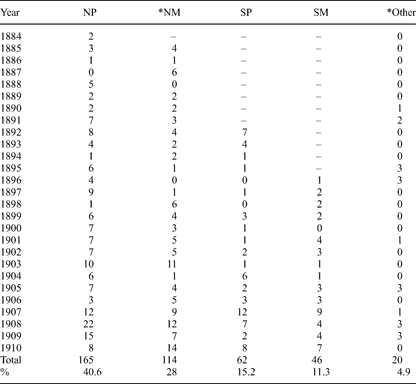
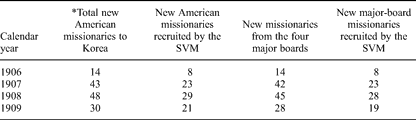
Korea was a mission field dominated by American Protestant missionaries. The Hermit Kingdom opened its door to Japan in 1876. But it was not until Korea made treaties with western powers that missionaries were permitted to enter the kingdom. The United States took the initiative in enticing Korea to sign a treaty in 1882, so American missionaries were the first to come and established themselves as the largest and most influential western community in Korea. Probably due to the limited size and importance of the land, four American mainline mission boards, namely, the northern and southern Presbyterians and their Methodist counterparts, constituted an oligopoly. No mission field, with the possible exception of Brazil, was so thoroughly dominated by America's mainstream Protestantism as was Korea.Footnote 2 More than two-thirds of Protestant missionaries who came to Korea in 1884–1910 were American (Table 1), and more than 95 percent of the American missionaries were the children of mainline denominations (Table 2). This interesting phenomenon also helped form the distinctive character of the American missionary community in Korea, which reflected America's middle-class values as well as “evangelical” religious beliefs.Footnote 3
The Total Number of Protestant Missionaries in Korea, 1884–1910Footnote 4

(*) indicates approximate numbers.
NP = Presbyterian Church (U.S.A.); NM = Methodist Episcopal Church; SP = Presbyterian Church (U.S.); SM = Methodist Episcopal Church, South; AP = Australian Presbyterian Church; CP = Canadian Presbyterian Church; CE = Church of England; Others include Salvation Army, Oriental Missionary Society, and Seventh Day Adventists.
The Number of New American Missionaries in KoreaFootnote 5
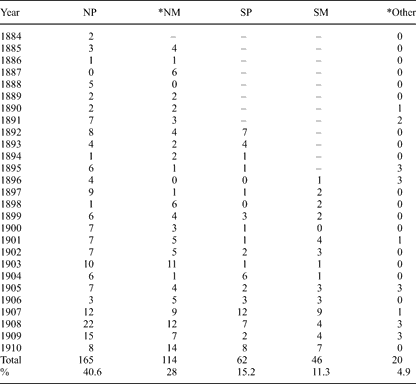
(*) indicates approximate numbers.
The American missionaries' influence on the Korean church was overwhelming. As Arthur J. Brown, secretary of the northern Presbyterian mission board, succinctly put it, “In Japan the [native] churches dominate the missionaries, and in Korea the missionaries dominate the churches.”Footnote 6 The Korea Mission Field, the monthly journal of missionaries in Korea, once cautioned the missionaries: “Our standard will be their standards. Our actions will be their actions. We are their Bible.”Footnote 7 The theology of Korean Protestant churches during this period was practically equivalent to that of the American missionaries, because they were the organizers, pastors, and teachers of churches.
The American Presbyterian churches accepted the Westminster Confession as their creed throughout the nineteenth century. It was only in 1903 that the Presbyterian Church (U.S.A.) revised the original Westminster formula in order to reflect changes in society and theology. However, the revision was limited to a small addition to the doctrine of the Holy Spirit and a stronger emphasis on the universality of salvation.Footnote 8 Likewise, the American Methodists had no other confessional formula than John Wesley's Twenty-Five Articles that they adopted at the “Christmas Conference” in Baltimore, Maryland, in 1784. At the beginning of the twentieth century, the force of the Articles was waning; however, the constitution of the Methodist Episcopal Church prohibited any change, alteration, or addition to the Articles themselves.Footnote 9
American missionaries transplanted their home church's confessional statements into Korean soil. The first Korean Methodist creed (1890) was a Korean translation of the Twenty-Five Articles of Religion, and the first confession of the Korean Presbyterian church (1907) was a summary of the Westminster Confession of Faith. It seems that the early Korean creeds revealed conservatism; the absolute truthfulness and authority of the Bible, Christ's virgin birth, his redemptive death, and bodily resurrection were all common ingredients.Footnote 10 However, the theological standards of early Korean churches simply reflected the traditional theological stance of American Protestantism before the Fundamentalist-Modernist controversy. American missionaries who came to Korea at the dawn of the twentieth century were born and educated in the final quarter of the nineteenth century, that is, when the “Evangelical Empire” had not yet met its demise. As people of generally evangelical environments before the theological crucible of the 1920s, they usually held to traditional Protestant theology, even across denominational lines.
American missionaries' theology was evangelical in its nineteenth-century sense. “Evangelical” at that time referred to all varieties of mainstream Protestantism rather than to theological conservatism. The Evangelical Alliance, the largest interdenominational organization of the period, covered most Protestant churches in Europe and North America. “Evangelical” in this sense was used to distinguish traditional Protestantism from Catholicism, Anglo-Catholicism, and untraditional communions such as the Unitarian Church. The Nine Articles (1846), the Evangelical Alliance's theological basis, was “a summary of the consensus of the various Evangelical Confessions of Faith.”Footnote 11 The “various Evangelical Confessions of Faith” included such traditional creeds as the Lutheran Augsburg Confession, the Reformed Westminster Confession, the Thirty-Nine Articles of the Anglican Church, and the Methodist Twenty-Five Articles of Religion.
American missionaries' “evangelical” character was demonstrated well by the fact that they formed the General Council of Evangelical Missions in Korea in 1905. Six out of seven Protestant missions in Korea participated in this council, and the Church of England, though not a member, was “in sympathy with the aim and objects” of it.Footnote 12 Of note is the fact that the organization was formed at a meeting of “all Protestant missionaries” that was called to establish “a Council of Protestant Missions.”Footnote 13 Here, “evangelical” was practically equivalent to “Protestant.” The stated aim of this council was to promote cooperation among various Protestant missions and ultimately to establish “one Protestant Christian Church” in Korea.Footnote 14 Although the experience of the mission field usually calls for a spirit of ecumenism, this sense of Protestant ecumenism seems to have been a key ingredient of “evangelicalism” at the turn of the century. By contrast, neo-evangelicalism in the 1940s grew out of fundamentalism and represented theological conservatism, and it was the beginning of “evangelicalism” in the present sense of the word.
Nevertheless, American missionaries' theological stance appears to have been peculiarly conservative within the wide theological spectrum of nineteenth-century evangelicalism. At the occasion of the fiftieth anniversary of the Korea Mission of the Presbyterian Church (U.S.A.) in 1934, Charles A. Clark revealed thirteen “secrets” of its success.Footnote 15 The number one secret of the marvelous success of the Presbyterian mission in Korea, according to Clark, was that “from the beginning, nearly all members of the Mission have held notably conservative views on theology.”Footnote 16 Some of the quoted evidence of their “conservative” theology included a strong emphasis on human sinfulness and salvation through the blood of Christ alone, the acceptance of the supernatural in the scriptures, and the belief in the finality of Christianity. Those who held “the modern view” in theology and biblical criticism, according to Arthur Brown, were few in Korea and had “a rough road to travel.”Footnote 17 It was particularly so among the Presbyterians. However, Methodists were not far away. After a visit to Korea in early 1895, northern Methodist bishop William X. Ninde reported to the board that he found Methodist missionaries to be “very conservative.”Footnote 18
Many observers saw that the typical American missionary, especially of the Presbyterian boards, during the first quarter-century after the opening of the Hermit Kingdom was “a man of the Puritan type.”Footnote 19 American missionaries' “puritan-type” religion manifested itself characteristically in their insistence on the high religious-ethical standards for Korean adherents. What distinguished most Korea missionaries from their fellow evangelical (that is, mainstream) Protestants at home was that the Korean environment gave them much wider latitude to practice their religion. They were in the Korean “wilderness.”Footnote 20 The missionaries came among the Koreans as people in possession of power. Their wealth, extraterritorial rights, and role as teachers put them in a position of superiority.Footnote 21 They lived in “an oasis in the desert” surrounded by comfort and the refinements of cultivated life, while their Korean neighbors were, to their eyes, sunk in poverty and ignorance.Footnote 22 These features would serve to emphasize the sense of racial superiority on the part of the missionaries, and they would be tempted to regard the strangeness and underdevelopment of Koreans as racial inferiority.Footnote 23 With all their good intentions and determination, missionaries were subject to the subtle temptation that came from the possession of power—the temptation of paternalistic minds.
II. American Missionaries' Religious-Ethical Rigorism
The “notably conservative” theology and “puritan-type” morals of American missionaries manifested themselves in many forms. To begin with, American missionaries generally maintained a high standard in accepting Korean converts into church membership. Despite the obvious fact that the fame of the Korea missions came mainly from the impressive number of converts they won, missionaries were careful in baptizing Korean converts. Both the Presbyterians and Methodists held it a rule that if a Korean adherent wanted to receive baptism, the person was first received as a catechumen. At a congregational meeting, the catechumens publicly declared their Christian convictions and entered the candidacy of baptism, which lasted at least six months. Missionaries often required a minimum of one year's good standing as a catechumen in order for a Korean adherent to be qualified for baptism. During this probation period, the catechumen had to demonstrate that he or she had met several religious and ethical standards, which was to be confirmed first by Korean leaders and finally by missionaries.Footnote 24 In addition, the candidate was required to read the Bible and to know the basics of the Christian doctrine. Finally, the candidate had to demonstrate the truthfulness of his or her conversion by providing the fruits of evangelistic works.Footnote 25
The single most important religious obligation that the candidate had to meet was to maintain an impeccable Sabbath observance record. He or she was to attend worship services and study the Bible with a complete cessation of labor and avocations. The Presbyterian Grisdosinmun [Christian News] warned that even thinking and talking about one's livelihood on Sunday violated the Sabbath observance.Footnote 26 Food and clothes for Sunday should be prepared on Saturday because cooking, sewing, and ironing were among the “works” that had to be ceased on the Sabbath. An editorial in the Methodist Sinhakwolbo [Theological Monthly] held that going sightseeing and picnicking, being angry, and fighting also violated the Sabbath.Footnote 27 The Sabbath observance was for American missionaries a yardstick for telling true Christians from those who were not. Woodbridge O. Johnson, for instance, asserted: “I might almost say ‘If a Korean observes Sunday, he is a Christian. If he does not, he is not.’ There is no halfway point.”Footnote 28
Some missionaries' behavior illustrates what it meant to keep the Sabbath. The Presbyterian medical missionary Cadwallader C. Vinton once confiscated tools from the Russian legation for the reason that they were used for work on Sunday. Only after the American diplomatic representative's threats and order did he reluctantly agree to return the tools.Footnote 29 Another Presbyterian, William M. Baird, had to struggle against his own desire. His gardening passion was such that Annie, his wife, once stated that his “forte seems to be a sort of combination between teaching and farming.”Footnote 30 Besides, he was not doing gardening just for fun; he tried to ease the financial burden of the board by being partly self-supporting. Once, in November 1900, winter had come earlier than usual with a snap one Saturday night. That caught all his celery butts and cabbages, requiring some immediate work to prevent more damage. But Baird “finally triumphed” and left them out another night in order to keep the Sabbath. Sabbath observation was, of course, not an exclusively Calvinist habit. Dalzell A. Bunker once left the Methodist mission to accept a more lucrative position at an American mining company in Korea. But as he soon found that he could not keep the Sabbath holy in that world of gold and money, he decided to return to the mission.Footnote 31
The candidate for baptism was also asked to abandon any form of “ancestral worship,” the traditional family ritual originating from the Confucian idea of filial duties for deceased ancestors. The ritual, in brief, was a national habit and a relic of the collapsing Confucian worldview, almost universally, and sometimes perfunctorily, performed by Koreans across class lines. It was generally conceived of, especially by the intellectual Confucianists, as a moral obligation rather than a religious rite. A typical ritual was to set up a table of specifically prepared food in front of the tablet of a deceased ancestor, invite the spirit of the ancestor, and present the feast. Some missionaries found that this service, especially in contrast to the fortune-seeking Chinese ancestral rite, was an expression of profound filial devotion.Footnote 32 However, most thought that Koreans performed the ritual to console spirits and receive their blessings.Footnote 33 American missionaries hated the simple idea of paying tribute to the dead by prostrating before the tablet, which they thought was a form of spirit-worship. No one who continued in the practice was knowingly baptized.
More interesting were the ethical requirements of baptism. They were intended primarily for social “uplift” but were enforced on religious terms. The candidate was required to avoid laziness and stop gambling. Further, no one living in any sort of polygamous relations received baptism.Footnote 34 In a similar vein, no one using alcohol or having anything to do with its manufacture or sale was eligible to be baptized. Missionaries aggressively educated Koreans that liquor was sinful, not to mention unhealthy, unethical, and uneconomical. A Methodist newspaper even warned that the souls of people who died alcohol-related deaths could not reach God.Footnote 35 Little wonder that both Methodists and Presbyterians officially forbade intoxication and sternly disciplined violators. A case in point is C. S. Kim's baptism. He appeared at one of the first meetings of the sessional committee at the Mokpo station of the southern Presbyterian mission in 1900 to ask for baptism. As it was revealed that he was a maker and seller of Korean wine, he was not received into the catechumen class but asked to wait and find some other means of livelihood. The session received him as a catechumen only when he had disconnected himself from the liquor business; he was finally baptized after a third examination.Footnote 36
Of special note is that American missionaries strongly discouraged their adherents from using tobacco. Some missionaries did not go as far as to include smoking in the roll call of sins. They launched a non-smoking campaign primarily for sanitary and economic reasons. However, many asserted that smoking defiled the believer's body, which was “the temple of God.” Anti-tobacco sentiment was particularly strong among Methodist missionaries who had inherited the anti-smoking tradition of John Wesley and Francis Asbury.Footnote 37 Rigorous missionaries even made smoking a religious misbehavior. Henry G. Appenzeller, the pioneer among the Methodists, counted, among the “work of the Devil,” tobacco, along with dancing, gambling, liquor traffic, and several social injustices.Footnote 38 Franklin Ohlinger, another Methodist leader, reported that when a self-acclaimed “Christian” smelled of tobacco, he was “prepared to tell him that he is not a Methodist.”Footnote 39 The northern Methodist mission decided in 1903 that the use of tobacco products by licentiates was “absolutely prohibited.”Footnote 40 It also decided to discourage church members from the use of tobacco or cigarettes “in every way possible.”
Anti-smoking polemics frequently appeared in Christian newspapers and journals. Reverberating hostility against tobacco gave a clear message to Korean adherents. Korean churches organized anti-tobacco-smoking societies. In fact, no smoking became an uncodified, but at the same time a standing, law for most Korean Christians that they would staunchly keep beyond the next century. Ancestral worship, liquor, gambling, and concubinage were “heathen” habits that America's foreign mission constituents at the turn of the twentieth century commonly expected missionaries to destroy in the mission fields.Footnote 41 However, outside the Korea missions, it is difficult to find among American missionaries such widespread hatred of tobacco. Missionaries' prohibitionist stance was shaped not only by their religious-ethical standards, but also by practical concerns about physical degeneration. Korea was certainly not the only mission field where smoking was widespread and doing much harm to people. The Woman's Christian Temperance Union established branches in Japan and China, as well as in Korea, and worked for the anti-smoking cause. However, Korea was the only place where Christians accepted anti-smoking as part of their Christian identity.
One way to understand American missionaries' religious-ethical rigorism is to think of it in relation to their desire to ensure the purity of the church. From the very beginning, Korea missionaries' primary concern was, to quote Henry G. Appenzeller, “not [with] the size, but the purity of the Church.”Footnote 42 Baptism and participation in the Lord's Supper did not automatically give the Korean convert a full church membership. American missionaries in Korea retained the full membership of their home church. A fully established Korean church needed Korean church officers. However, the Korean Presbyterian church that claimed nearly five thousand adult members in 1901 had only four Korean elders and no ordained pastor. Ministry and administration were solely in the hands of missionaries. The pastor practically meant the missionary—the first Korean ministers were ordained as late as 1907. The Methodist church appointed two local deacons in May 1901. However, they were only licensed to preach and baptize, and could not administer the Lord's Supper.Footnote 43 Baptized Korean Christians were not church “members” until Presbyterian missionaries established the first Presbytery in 1907 and Methodist missionaries organized the Korean Annual Conference in 1908. In his 1902 visitation report, Arthur Brown wrote that Korea missionaries made “an anomalous distinction between admission to the sacrament and admission to the church.” He added that the church should not be restricted to “perfected saints.”Footnote 44
III. Missionary “Teachers”and Korean Converts
American missionaries' imposition of high standards on Korean Christians was possible because they had such power and authority. In relation to a Korean preacher, according to Yun Chi Ho, a prominent Korean Methodist, missionaries were bosses to whom he had to “surrender … [his] freedom of opinion and of conscience.”Footnote 45 Furthermore, American missionaries considered themselves parents with regard to the “infant” Korean church, teaching what was right and wrong and admonishing when necessary. Fortunately, American missionaries in Korea were to incubate the church in the “heathen” wilderness, where they found a surprisingly friendly and receptive audience.
A peculiar phenomenon in the Korea mission field was Korean people's overwhelmingly amicable attitude toward westerners. On the whole, Koreans treated westerners, as Daniel L. Gifford wrote, “with great respect.”Footnote 46 He explained that when a foreigner got lost in one of Seoul's tortuous lanes, a Korean would immediately step forward and politely show him or her the proper road. Lillias H. Underwood similarly commented that foreigners were “most generously excused for all mistakes,” and Koreans were “models of kindness and politeness.”Footnote 47 Missionaries with experience in China could tell a fundamental difference of attitude toward westerners between the Chinese and the Koreans. The Chinese, wrote Horace N. Allen, a former missionary in Shanghai, had shown that westerners were not welcome in that land, where they went by the name “foreign devils.”Footnote 48 On the contrary, Allen found, Koreans treated westerners with the highest respect. “All foreigners,” as Samuel A. Moffett recollected, “including missionaries, were called [by the Koreans] ‘Tai in’ (great man).”Footnote 49 Not surprisingly, Homer B. Hulbert declared that the Koreans were “the pleasantest people in the Far East to live amongst.”Footnote 50
It came as a surprise to some missionaries when they discovered that the Korean people were bred to be polite. Korean culture had long considered it all but mandatory. But the true secret of Korean respect and politeness toward missionaries and adherence to their teachings was the profound Korean respect for scholars and teachers. Koreans commonly called missionaries “gyosa,” that is, teacher. The missionary, in the minds of Koreans, was, wrote James S. Gale, “the man with the book … a spiritual master of literature, a teacher, a guide, a model.”Footnote 51 The love of learning and respect for a scholar was one characteristic that American missionaries believed separated Koreans from their neighbors. The Koreans highly valued scholarship and deeply respected, according to George Heber Jones, “all members of the teaching profession.”Footnote 52 If a stereotypical Chinese was a merchant and a Japanese a warrior, the image of an ideal Korean that missionaries encountered was a scholar. So greatly were scholars honored that the common Korean title for a married man, Seobang, meant literally “writing-room” and really scholar. That every married man was titled a scholar revealed the universal desire to share in even the semblance of the glory that went with men of books.Footnote 53
The Korean respect for scholarship did not lead to open-ended inquiry. Koreans, under the influence of rigid neo-Confucianists, were infamous for their uncompromising adherence to traditional authority. From as early as Mencius, Confucianism tried to define itself by passing judgment on other philosophical and religious thoughts as “heterodoxy.” This propensity was intensified during the formative years of neo-Confucianism when it competed with such mighty rivals as Taoism and Buddhism from the eleventh century onward. As the Korean Yi (Joseon) Dynasty was established on neo-Confucian principles in the fifteenth century, it became a kingdom governed and led by scholar-politicians. Korean neo-Confucianists staunchly adhered to (neo-)Confucian tradition. Their identification with Confucian orthodoxy turned into an obsession when the Manchu Qing Dynasty overthrew the Chinese Ming Dynasty in 1644. As the “Little China,” the Korean neo-Confucianists were convinced, Korea became the single carrier of Confucian orthodoxy. Being the self-conscious defenders of Confucian orthodoxy, Korean neo-Confucianists would declare anathema whatever they thought was an unorthodox interpretation of tradition. New ideas were practically prohibited.
Traditional Koreans tended to think that those things that had been existent for a long time had a reason to survive—the longer they had been in existence, the more valuable they should be. Therefore, Koreans prized age and appreciated old things over and against innovations. They bestowed law-like authority on precedents. Combined with the devotion of neo-Confucian scholar-politicians to tradition, the Korean mind became so imbued with the tendency to glorify the past and copy it that such an attitude became an essential part of the Korean character. Korean adherence to tradition was particularly obvious in learning. Good scholarship practically depended on how much and how well one knew traditional authorities, and new thoughts and interpretations would be deemed perilous.
Therefore, it is understandable that Korean converts were determined to follow the steps of missionary-teachers faithfully. Once transmitted by the missionaries to Korean adherents, evangelical theology and practices became “the” tradition, and new developments such as higher criticism were not welcomed. Admitted to a missionary church, a sincere Korean Christian would more often than not become an ethical-spiritual overachiever. Korean Christians, with their profound respect for missionary teachers, endeavored to go beyond challenging requirements. The Korean Presbyterians voluntarily excluded anyone who was known to be a user of tobacco from the office of minister or elder, as “detracting from the spiritual influence of church leaders.”Footnote 54 Today it is still considered scandalous by most Protestant churches for church officers to smoke. The Korean Christians' hatred of liquor was such that the Korean church became virtually a “total abstinence temperance organization.”Footnote 55 Many Korean Christians ate “cold” rice on Sunday that was cooked on Saturday lest they should break the Sabbath.Footnote 56
Serious Korean Christians seem to have been determined to keep their Christian pledges. But maintaining alien religious-ethical principles such as Sabbath observation and abandoning time-honored customs put Korean converts at odds with their communities. To give up “ancestral worship,” in particular, was like denying one's whole relationship with family, relatives, and society.
Fundamentally a Confucian rite, “ancestral worship” was not a problem unique to the Korea mission field. China missionaries had faced exactly the same issue. Recognizing the difficulties related to the rite, some leading missionaries in China tended to ease the burden of Chinese converts. At the Shanghai missionary conference in 1890, American Presbyterian missionary William A. P. Martin, for instance, suggested that it be allowed selectively. John Ross of northern China supported Martin's proposal holding that the ritual, being free of supplication elements, should be understood as a rite rather than as a worship.Footnote 57 Ross was the Scottish missionary who pioneered the Korea mission by translating, publishing, and distributing the first Korean gospels while Korea was not open to westerners. However, his influence rapidly dwindled as American missionaries entered the Hermit Kingdom after the signing of the Korean-American treaty. As far as American missionaries in Korea were concerned, the ancestral rite was a heathen act. They concluded that it was abominable and evil, and thus the “most troublesome question” and the “greatest idol.”Footnote 58 It should be given up.
Concubinage was a problem of different proportions. If “ancestral worship” was a national custom, concubinage was a habit of the rich and powerful. In reality, it contained as many elements of the Confucian worldview as “ancestor worship” did. However, missionaries thought it to be primarily an ethical problem that violated the Christian principle of marriage as well as women's dignity. The question, of course, was not regarding the acceptability of the polygamous relationship. Rather, missionaries had to decide what they should do when a polygamous man or woman applied for admission to the church. Scripture, missionaries found, could be quoted on both sides. Moreover, missionaries in other polygamous societies and nearly all of the “old and well known names of ” China missions were found to be on the side of leniency.Footnote 59 But Korea missionaries were uncompromising. To them, the practice was clearly unethical and sinful. Admitting a polygamous person to the church should be out of the question.
The Methodists for the first time decided in 1894 not to baptize polygamous adherents, and Presbyterians soon followed suit. Missionaries continued to welcome polygamous people to church attendance and a Christian life but exhorted them to await baptism until they should be able to come to the church with a “regular” marriage relationship. This principle was applied equally to men and concubines. The baptism of a Christian concubine, if she were an acceptable candidate, was delayed until the legal wife died or she was left a widow, unless she was willing to leave her husband.Footnote 60
American missionaries' ethical demand went hand in hand with church discipline. When necessary, missionaries admonished, reprimanded, suspended, and even expelled from the church violators of the ethical code. The baptized members who did not keep the Sabbath holy by intentionally missing the service or being engaged in worldly affairs, for instance, were usually suspended from the communion table. Adherents who were found to have returned to the old habit of “ancestral worship,” that treacherous sin missionaries abhorred, could be excommunicated. A similar fate was reserved for those who drank alcohol or kept concubines. Child marriage and marriage with non-believers were also subject to disciplinary actions.Footnote 61 Suspension, excommunication, and other disciplinary measures were not uncommon. In Pyongyang and Seoncheon stations of the northern Presbyterian mission, for instance, 2.8 percent of the church membership and 8.1 percent of the catechumen received disciplinary actions during 1901–1902.Footnote 62 Sometimes church leaders, such as ruling elders, were excommunicated.Footnote 63
Missionaries did not agree on how strictly to administer discipline. Nevertheless, unless rigorous discipline led to a substantial decrease of membership, through unwavering application of disciplinary measures, missionaries could show who was in charge and what it meant to be a member in their churches. American missionaries' use of rigorous discipline was partly due to their suspicion about the sincerity of Korean converts. Winning converts in Korea eventually turned out to be relatively easy. Following the tribulations of the Sino-Japanese War (1894–1895), missionary churches were flooded with would-be Christians. The kingdom was collapsing, and people were craving for salvation, this-worldly as well as heavenly. As far as the purity of the church is concerned, the greatest obstacle was perhaps missionaries themselves—their desire to report more converts to the home base.Footnote 64
Koreans, like other church-goers anywhere in the world, came to the church for all sorts of reasons and motives. There were, of course, those who were genuinely interested in the teachings of a western religion and its spiritual power. However, the Christian religion that American missionaries introduced was widely recognized by the Korean populace as a religion of money and power. Therefore, it was American missionaries' impressive houses and comparatively luxurious lives, their extraterritorial rights, the English and western learning they taught, and rumors about their influence and prestige in the Korean court that initially attracted Korean inquirers.Footnote 65 As a result, the reasons for inquiry were as varied as the attractions American missionaries demonstrated.Footnote 66
Many Koreans joined churches for food, money, and medicine. A common question was: “Is there lots to eat in the Way?” or “How much do you pay me for believing in Jesus?”Footnote 67 In 1893 Franklin Ohlinger reported that three-fourths of the whole population would be baptized in one year if people were offered five dollars for baptism.Footnote 68 Isabella B. Bishop, a critical British observer of American missionaries, also attributed gainful hopes to the interest in church of “a large majority” of adherents.Footnote 69 She suspected that missionary reports about the Korean people's “craving for the Gospel” had no meaning, but rather that they craved money. Some Koreans supposed the missionaries' religion was a fine philosophy which, if adopted, would bring them in touch with rich and influential foreigners and find them speedy employment. Some were interested in the western education that missionary organizations offered. Since missionary compounds and institutions were out of the Korean government's jurisdiction, many also wanted to join the church to escape taxation and arrest or for protection from various forms of oppression.
When these “rice Christians” who entered churches in search of worldly benefits found out that missionaries had little to offer but the religious message, they would soon lose interest.Footnote 70 It is quite understandable that disappointing incidents made some missionaries distrustful. Lewis B. Tate of the southern Presbyterian mission, on receiving a request from a group that had begun to meet, confessed that “such news is always heard with fear and trembling, lest these seekers are actuated by merely worldly motives.”Footnote 71 American missionaries learned to be on guard in receiving converts and to be very cautious in investing them with responsibility. Taking the fan in their hands, they wanted to separate “the wheat from the chaff” even before the final day.Footnote 72
The “wrong motives” in coming to American missionaries were particularly visible in the earlier days when neither the true intention of missionaries nor the nature of their religion was widely understood among the Koreans.Footnote 73 American missionaries' countermeasures against this problem were discipline. In order to maintain the purity of the church, Henry Appenzeller wrote his board secretary, “We have discipline.”Footnote 74 Missionaries' endeavor to maintain an ethically demanding church effectively taught Korean adherents what Christianity was about. It strengthened Korean Christians' tendency to understand Christianity fundamentally in terms of a code of ethics rather than as a personal relationship with God, an idea alien to the Korean mind in a Confucian world. Therefore, ethical conservatism became one of the hallmarks of Korean Christians. There were, no doubt, drawbacks, backslides, or cases of insincerity, as in any human society, but such instances were “marvelously rare,” wrote Lillias Underwood, considering Korea's harsh and turbulent environment. The rigorous ethical system established by the first Protestant missionaries would persist, but it was enriched and complicated by the infusion of revivalistic Christianity in the early years of the twentieth century.Footnote 75
IV. Revivalistic, Bible-Centered Christianity
American missionaries were the children of nineteenth-century evangelical Protestantism. A key element of nineteenth-century American evangelicalism was revivalism. It seems no coincidence that the Korean Protestant churches that American missionaries gave birth to and nurtured came to have, and still maintain, a peculiarly emotional, Bible-centered, and evangelistic character. In this sense, it is necessary to understand the connection between the revivalistic religious milieu of the overseas missionary adventure and American missionaries in Korea in the late nineteenth and early twentieth centuries. A good place to see the connection is the Student Volunteer Movement for Foreign Missions. An understanding of the SVM is particularly pertinent for understanding American missionaries in Korea and some of the fundamental characteristics of the Korean churches they built.
Korea missionaries from the United States were not only actively involved in the SVM conventions and various SVM-affiliated missionary organs; but also, a great many American missionaries to Korea were SVM recruits.Footnote 76 According to an estimate, for instance, out of a total of 135 new American missionaries to Korea during the period of 1905–1909, 81 were SVM volunteers (Table 3).Footnote 77 As the table shows, virtually all SVM-recruited American missionaries belonged to four major mission boards in Korea. As the four American mainline boards practically monopolized the missionary enterprise in Korea during the period under consideration (see Table 1 and 2), it is safe to say that the SVM determined the character of Korea missionaries.
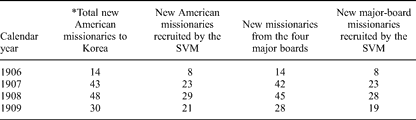
The beginning of the southern Presbyterian mission shows a classic example of how SVM meetings to promote foreign missions among college or seminary students affected Korea missions. The Inter-Seminary Alliance for Foreign Missions, a sister organ of the SVM for theological institutions, held a meeting in Nashville in October 1891. Horace G. Underwood, on his first furlough, was invited as a speaker, as was Yun Chi Ho, then a student at the Theological Department of Vanderbilt University. Underwood enthusiastically presented Korea as a virgin mission field, to which Yun added a challenging appeal for the evangelization of his homeland. Among the delegates were Lewis B. Tate, a senior at Chicago's McCormick Seminary, and William M. Junkin, Cameron Johnson, and William D. Reynolds, seniors at Union Seminary in Richmond, Virginia. These volunteers were thrilled by the fervent appeals of the two speakers and applied for Korea. But the southern Presbyterian board had neither the funds nor the interest to open a new mission in that little-known land and politely rejected the applications. Determined, the young seminarians launched a little campaign to convince the board and, with the financial help of John T. Underwood, brother of Horace, finally came to Korea.Footnote 79
Through thousands of its recruits, who made up more than half of all American Protestant missionaries during the period of its operation (1886–1969), the SVM became the greatest contributor to the burst of American interest in foreign missions since the late 1880s. A primary reason behind the SVM's success as a powerful machinery of foreign missionary enterprise was its ability to appeal to the souls of America's middle-class youths. The SVM leaders emphasized themes of the Keswick-Northfield version of the holiness movement popularized among the American middle class by Dwight L. Moody.Footnote 80 Central to this middle-class spirituality was a Bible-centered personal devotionalism and a Spirit-filled, consecrated life. The emotion-packed, revivalistic SVM meetings agitated the social and religious anxieties of many sensitive middle-class youths. The typical SVM missionary, as a result, was a person of revivalistic, Bible-centered Protestantism.
The characteristics of SVM meetings and volunteers were generally found in Korea missions and missionaries. Theological conservatism and the combination of individual salvation and social uplift, which typified America's Korea missions, were, in fact, a basic strategy of the SVM. More important, the SVM's influence was seen in American missionaries' heavy dependence on revivalistic methods of personal conversion and especially their emphasis on Bible study, individual pietism, and evangelism. From the beginnings, the scriptures occupied a prominent place in Korea missions, perhaps unparalleled by any other mission field in the world.Footnote 81 Scripture sales in Korea were an indicator. In the 1910s, the British and Foreign Bible Society, the largest Bible distributor in the world, sold more scriptures in Korea than in any other field of operation except for China. This fact is all the more impressive considering that Korea's population was among the smallest of its thirty-some fields. The scriptures were, in fact, the single most important contributor to the birth and growth of the Korean church. No wonder, then, that missionaries characterized Korean Christianity as a “Bible Christianity” and the Korean Christian as a “Bible-loving Christian.”Footnote 82
“The cornerstone” of the missionary work in Korea, wrote a contemporary scholar of foreign missions, “lies in the system of Bible Training Classes.”Footnote 83 These unique gatherings, originating in the earliest days of Korea missions, were not regular Sunday Bible classes, but rather annual Bible conferences lasting up to ten days. They were a replica of the Keswick and Northfield Conferences, with an added emphasis on the scriptures, prayer, and evangelism. Korea was honeycombed with these classes; there were numerous such conferences throughout the country at the national, local, and congregational level (practically every local congregation held these conferences). At large Bible conferences, sometimes more than one thousand Korean Christians gathered from long distances at their own expenses.Footnote 84 In these meetings, the themes emphasized were victory over sin, yielding to the divine will, the baptism of the Holy Spirit, and Christian service, especially evangelism—themes that missionaries repeatedly heard in the SVM and revival meetings in the United States.Footnote 85
Nowhere were the revivalistic elements of American missionaries' religion and their impact on the Korean Christians revealed in a more striking way than in the great revival movement in the first decade of the twentieth century. As far as the number of converts was concerned, the result of Korea missions was not disappointing when compared with missions in Japan and China, although there were initial frustrations and failures. However, missionaries were aware that Korean coverts, lacking the Christian idea of a personal God and inborn sin, generally understood Christianity as the rational acceptance of biblical teachings. They believed that the Korean Christians should experience a type of religion that “goes to the bottom of heart and life.”Footnote 86 Genuine conviction for sin, deep repentance, and surrender to the divine will, according to missionaries, were the signs of a true Christian. Methodist missionary Robert Moose, like many of his colleagues, was convinced that the solution lay in “a genuine old fashioned revival of heart felt religion.”Footnote 87 Bible classes were all right, but what the Korean church “needs just now more than any thing else,” he insisted, was “a REVIVAL.”
The revival movement began among the missionaries who were “in a state of intense longing and expectancy in the presence of God.”Footnote 88 They were concerned about their own spiritual condition and numerous difficulties that confronted them in their work. However, their first concern was for the religion of the Korean Christians. Led by Methodist missionary preachers, missionaries began holding special meetings to seek a deeper spiritual experience. As the revivals spread among the missionaries, they wanted to make the Korean Christians “sharers with them in a like precious experience.”Footnote 89 To missionaries' joy, after the trauma of the Russo-Japanese War (1904–1905) and the consequent Japanese protectorate over the Korean kingdom, there were signs of great spiritual agitation among the Korean populace. Life in the midst of the fierce imperialist rivalry over the falling dynasty was precarious and full of hazards for both Christians and others. As the nation underwent a tragic downfall, the people began to look heavenward. The general unrest and lack of something to which they might cling was causing the people to turn to the missionaries and their promise of salvation. American missionaries made deliberate efforts to harvest the ripening field. Under the influence of the news of great contemporary revivals in Wales and India, they began emotion-packed revival meetings for Koreans.
Missionaries' sermons at these meetings were of the most searching and soul-stirring kind. Central to their message was a call for the confession of sins and repentance. The phenomenon and result of these meetings at their height were such that witnesses could describe them only in reference to America's historic great awakenings or even the day of Pentecost. Much like those occasions, they were attended by extraordinary physical and mental manifestations. A peculiar feature of the Korean revival was the public confession of sins and the great mental agony through which most of the penitents passed. The scene of Pyongyang revival meetings in January 1907, for instance, was characterized by “shouts, groans, violent weeping, falling upon the ground, frothing at the mouth, and paroxysms of varying intensity, culminating in complete insensibility.”Footnote 90 Sometimes the excitement of public penitence was so sensational that even missionaries themselves became alarmed and tried to restrain it. “It was like hell uncovered,” Presbyterian Annie Baird, an eye witness of the Pyongyang revival, reported.Footnote 91
The intense public confession of sins and repentance, the most striking phenomenon of the revival movement, was a sign that the revival meetings provided to the Korean attendants a stage where they could pour out their emotions, created by great mental distress in the falling kingdom. It was no coincidence that the revivals paralleled Japan's final drive to annex Korea and the increasing panic it created among the Korean populace. After the establishment of the Japanese protectorate over Korea in 1905, the Office of the Resident-General forced resistant Emperor Gojong to abdicate the throne in 1907, making his invalid son a puppet monarch. The Japanese aggression finally culminated on August 29, 1910, in Emperor Sunjong's yielding up of his throne and kingdom under Japanese coercion. The populace was exasperated, which created a craving for spiritual and physical havens—an ideal atmosphere for revival meetings and evangelization.
The idea of “heart-felt” religion for personal salvation did not exist in the Confucian world. Neo-Confucianism in late Joseon Korea was not a religion of individual choice but was recognized as the all-encompassing principle of the universe. That is to say, neo-Confucianism, unlike Christianity, based on a super-rational relationship between God and an individual, found its identity in the national system, public order, and the social norm of Korean society. There was little room for a super-rational, personal religion in the rational, communal neo-Confucian world. During the five centuries of neo-Confucian dominance that upheld rationalism and moralism, emotional and super-rational religiosity had been greatly suppressed. That was the fundamental reason that the illiterate populace, especially women, relied on Shamanism and Buddhism for their religious needs, which the neo-Confucianists despised as irrational superstition. The Christian religion, likewise, was accepted mainly by women and the underprivileged. The revival meetings demonstrated that the missionary religion was as much an emotional religion of the heart as an intellectual religion of books, and thus enabled Koreans with backgrounds in Buddhism and other “irrational” religions to cross over to Christianity.
Accustomed to the rational and public world of Confucian society, it seems that the Korean converts did not fully understand the completely personal dimension of “faith” and “salvation.” To become a Christian meant for them to belong to the Christian community by accepting the doctrines and teachings of the missionary church and keeping the Christian code of ethics, rather than developing a personal relationship with God. Attending the revival meetings, many who were professing Christians, a Methodist missionary wrote, came to realize that “they had never known what it was to be saved from their sins.”Footnote 92 Missionaries regarded the agonizing public confession of sins and repentance as clear evidence that Korean adherents finally embraced the evangelical Christianity that they taught and experienced “complete salvation.”Footnote 93 The explosive response to revivals convinced missionaries that Koreans could be just as Christian as westerners. “With others,” confessed John Z. Moore, “I had said that the Korean would never have a religious experience such as the West has.”Footnote 94 However, the revivals taught him that the Korean Christian was fundamentally “at one with his brother of the West.”
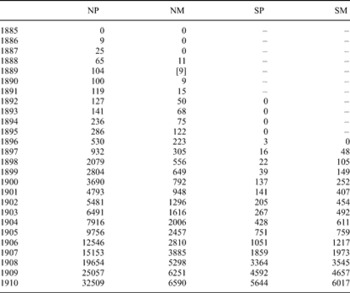
The manifestations of the Pyongyang revival were repeated in meetings throughout the Korean peninsula. Gifted missionary and Korean preachers itinerated to mission centers and held similar revival meetings. A general revival swept all over the country, and thousands were converted. In 1907 alone, thirty thousand applied for baptism—a dramatic increase for the Korean Christians, who had numbered less than 1,000 before the Sino-Japanese War (Table 4).Footnote 95 The revival was carried out across denominational boundaries. It was not so intense in the South as it was in the North, especially in the northwestern region. However, its effect was still felt everywhere.Footnote 96 The revival spread even to Manchuria and other parts of China, especially to the regions under the China Inland Mission and its associated societies.Footnote 97 Korea, heretofore a “forgivably small” and neglected mission field, suddenly emerged as a most decorated one.Footnote 98 In 1908, America's leading mission promoter, John R. Mott, predicted that “in the immediate future, Korea will be the first nation of the non-Christian world to become a Christian nation.”Footnote 99 Two years later, however, the ancient kingdom ceased to exist when it was annexed by Japan, and Christianity, like all other religions, had to exist under the divine emperor and national Shintoism.
The Increase of Korean Church MembersFootnote 101

Thirty-six suppressive years of Japanese occupation (1910–1945) created an environment in which Korean Protestantism could solidify its ethical-theological conservatism and revivalistic-evangelistic practices. Primary features of American missionaries' religion were personal spirituality and otherworldliness, which the Japanese rulers regarded as harmless. Their ultimate goal was the salvation of the Korean soul, not the nation. American missionaries were ready to welcome any political power, be it Korean or anti-Korean, that was favorable for that goal and to condemn any deterrent. They taught that Christians should “be subject to the powers that be.”Footnote 100 American missionaries were glad that Japan defeated China and Russia, believing that Japan would usher in “a new and better day” for their activities, as well as for the Koreans.Footnote 102 For most American missionaries, the Japanese were, at least, more civilized than the Koreans, and hence Japanese control of Korea was creating gratifying conditions. Missionaries wanted their adherents to accept Japanese rule, repent of their hatred of the Japanese, overcome their indignation and nationalist feelings with Christian demeanor and otherworldly hope, and concentrate their energy on saving the souls of the dead nation. Korean Christians' “evangelical” religion, internalized during the revival movement, led them to fulfill their missionary teachers' wishes.
V. Conclusion
The Christianity that American missionaries endeavored to transplant in Korean soil at the turn of the last century was perhaps the most unambiguous residue of the evangelical tradition of American Protestantism in that twilight of Protestant America. Missionaries from American “evangelical” denominations were successful in building the churches of an evangelical-revivalistic nature in the Korean “wilderness.” There is little doubt that this success owed much to the dedication, resources, and benevolence of missionaries who were self-conscious carriers of the “errand into the wilderness.” However, without the hopeless disarray of Korean society and the forceful Japanese seizure of the kingdom and the consequent spiritual yearning, Korea missionaries might have fared little better than their colleagues in Japan and China. Yet, the social, political, and economic circumstances do not fully explain the successful establishment of American missionaries' religion and its continuous impact on the Korean Christians. Religion, after all, consists of the convictions and practices of people.
The early Korean Christians must have found American missionaries' evangelical-revivalistic Christianity fundamentally fitting to their morality and temperament and reshaped it with their own aspirations. The revival movements during the volatile years of Korean history, in particular, just like the Great Awakenings of the United States at some of the most critical moments of its history, molded the character of Korean Protestantism and gave transplanted piety a distinctive Korean shape. The rapid growth and internalization of American Protestantism among the Korean Christians paradoxically led to the waning of missionary influence and the birth of Korean Protestantism. As a result, Korean Protestantism came to be both strikingly similar to and profoundly different from American missionary religion. A deep respect for missionaries as scholar-teachers, the admiration of missionary teachings as enlightened learning, and the ancient tradition of holding fast what they learned from teachers certainly contributed to the lasting influence of American missionaries' “evangelical” religion on Korean Protestantism. The legacies of American missionaries and the early Korean church remain powerful in the “Puritan” ethical standards, “evangelical” theological concerns, and revivalistic-evangelistic practices of the Korean Protestant churches in the early twenty-first century.