INTRODUCTION
The use of parasites as natural biological tags to delineate fish stocks in North American waters dates back to 1939, when the copepod Sphyrion lumpi was first used to distinguish populations of the golden redfish, Sebastes marinus, off the coast of northeastern North America (Herrington et al. Reference Herrington, Bearse and Firth1939; Nigrelli and Firth, Reference Nigrelli and Firth1939). On the Pacific side of the continent, the first published study was on sockeye salmon (Oncorhynchus nerka) in 1963 (Margolis, Reference Margolis1963). There have been approximately 90 publications on the topic, most dedicated to Atlantic and Pacific fisheries, including anadromous fishes, with some studies in the Arctic as well as in fresh waters (Table 1).
List of parasites used as biological tags, their hosts, basic results of the study and reference, organized by region, for North American fishes. Studies from Greenland are included only if they pertain to North American marine fishes or local anadromous fishes. Studies from the Pacific open seas are included only if they pertain to North American anadromous species. Scientific names have been updated to reflect changes in host and parasite taxonomy

The earliest studies in North American waters focused on parasites of commercial cosmetic concern in the North Atlantic (Herrington et al. Reference Herrington, Bearse and Firth1939; Nigrelli and Firth, Reference Nigrelli and Firth1939), for large, highly visible roundworms in fillets and huge crustaceans hanging off fish are not aesthetically appealing to consumers and processors alike. Moreover, they can result in damaged, unmarketable seafood products, requiring costly processing. Furthermore, food inspectors may reject a heavily infected batch resulting in additional economic losses (Sindermann and Rosenfield, Reference Sindermann and Rosenfield1954). The goal of early studies was thus to avoid harvesting fish populations in which these parasites were abundant and costly to process. Parasites involved included the above-mentioned S. lumpi on redfish and the notorious codworm or sealworm (Pseudoterranova decipiens) in Atlantic cod (Gadus morhua) (Templeman et al. Reference Templeman, Squires and Fleming1957). Removal of sealworm from Atlantic cod fillets cost the industry over $29 million (Cdn) in 1982, and $30 million for all species in 1984 in Atlantic Canada (Bowen, Reference Bowen and Bowen1990). However, it was quickly realized that the parasites could be equally useful to delineate stocks for fisheries management.
In contrast to the Atlantic, studies in the North Pacific were not a result of unsightly parasites, but an outcome of increased fishing efforts post-World War II and subsequent international competition for marine resources in the high seas of the North Pacific among Japan, Russia, the USA and Canada. A specific concern for Pacific salmonid stocks mixing in a high seas fishery resulted in extensive collaborative research programmes initiated in 1955 that included the use of parasites as biological tags. As other fisheries in the North Pacific grew, so did the need to examine origins of fish in mixed-stock fisheries and the exploration of parasites as potential biological tags.
The criteria for successful candidate parasites to be used as natural biological tags have been reviewed and discussed elsewhere (Kabata, Reference Kabata1963; Sindermann, Reference Sindermann1982; MacKenzie, Reference MacKenzie1987, Reference MacKenzie1993; Williams et al. Reference Williams, MacKenzie and McCarthy1992; MacKenzie and Abaunza, Reference MacKenzie and Abaunza1998). Advantages and disadvantages of the use of parasites have also been summarized previously (Sindermann, Reference Sindermann1982; Dick, Reference Dick, Johnson and Burns1984; Arthur, Reference Arthur, Flegel and MacRae1997; MacKenzie and Abaunza, Reference MacKenzie and Abaunza1998). Thus, it is not our intention to reiterate these herein. Rather, we intend to summarize the records of the use of parasites as biological tags of marine fishes in North American waters of the Atlantic, Pacific and Arctic Oceans. Furthermore, we examine their use for anadromous fishes in freshwater, estuarine and marine ecosystems, as well as freshwater fishes in large lakes and rivers. We concentrate on primary publications and only include government reports if the data have not been published elsewhere. The majority of studies (>50) feature Atlantic fishes, with a sizeable number (approximately two dozen) investigating Pacific fishes, and relatively few on fish from Arctic and freshwater ecosystems (Table 1). There is a distinct lack of studies from the Caribbean and Mexican tropical waters.
ATLANTIC WATERS
The majority of studies of parasites as biological tags in North America have been completed in Atlantic waters. Most studies pertain to fisheries in the northwestern Atlantic (Fig. 1), with relatively few off the eastern seaboard of the USA. Investigations cover a total of 30 species of fish belonging to 14 families, and one crustacean. The fishes include seven gadids and flatfishes each, as well as species of clupeids, salmonids, osmerids, redfishes, scombrids, among others (Table 1). The fish species attracting the most attention are Atlantic cod, Atlantic herring (Clupea harengus) and the redfishes (Sebastes spp.). Below, we focus on these species as they constitute long-term case studies with the most extensive historical records for Atlantic waters.
Map of the Northwest Atlantic showing the main geographic and bathymetric features, and fish stocks studies in each major area. Common names of fishes are presented in the legend. Scientific names can be found in Table 1.

Over half the studies include more than one species of parasite. Overall, parasites deemed useful as tags in Atlantic waters include examples from numerous taxa, including trypanosomes, microsporidians, myxozoans, nematodes, digeneans, cestodes, acanthocephalans, monogeneans and crustaceans. The most commonly utilized parasites in Atlantic waters have been the anisakid nematodes, used exclusively in 15 studies or in conjunction with other parasite species in 13 of those undertaken in the Northwest Atlantic region (Table 1). This is not surprising, given their previous recognition by MacKenzie (Reference MacKenzie1987) and Williams et al. (Reference Williams, MacKenzie and McCarthy1992) as potentially important indicators. Their usefulness derives from the fact that they are extremely abundant in marine fishes and relatively easily observed due to their large size.
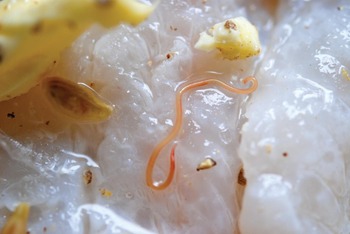
Investigations on the use of parasites as biological tags in Atlantic cod date back to the works of Scott and Martin (Reference Scott and Martin1957, Reference Scott and Martin1959), span the Northwest Atlantic from Greeenland and Labrador to New England, and include both inshore waters and offshore banks (Table 1; Fig. 1). Anisakid nematodes, in particular P. decipiens (Fig. 2), are most often employed as biological tags. Most studies focus on two areas, around Newfoundland and Labrador, or alternatively the southern Gulf of St Lawrence and Scotian Shelf off Nova Scotia (Table 1; Fig. 1). Studies generally support the existence of multiple stocks off Newfoundland, encompassing Labrador and northern Newfoundland, the northern Gulf of St Lawrence, various banks off southern Newfoundland, as well as the Grand Banks and Flemish Cap (Fig. 3; Templeman and Fleming, Reference Templeman and Fleming1963; Khan et al. Reference Khan, Murphy and Taylor1980; Bishop et al. Reference Bishop, Lear, Baird and Wells1988; Brattey et al. Reference Brattey, Bishop, Myers and Bowen1990; Brattey and Bishop, Reference Brattey and Bishop1992; Khan and Tuck, Reference Khan and Tuck1995). Most of these studies restricted themselves to the use of a single parasite species or taxon, including the copepod Lernaeocera branchialis (Templeman and Fleming, Reference Templeman and Fleming1963), the blood protozoan Trypanosoma murmanensis (Khan et al. Reference Khan, Murphy and Taylor1980), the anisakid larval nematode Anisakis simplex, also known as the herringworm or whaleworm (Brattey and Bishop, Reference Brattey and Bishop1992) and, of course, the sealworm P. decipiens (Bishop et al. Reference Bishop, Lear, Baird and Wells1988; Brattey et al. Reference Brattey, Bishop, Myers and Bowen1990). However, the most recent studies of cod in these waters expand the scope of study, making use of four to five different groups of parasites (Khan and Tuck, Reference Khan and Tuck1995).
Sealworm (Pseudoterranova decipiens) in the fillet of an Atlantic cod (Gadus morhua). Photograph by David J. Marcogliese.

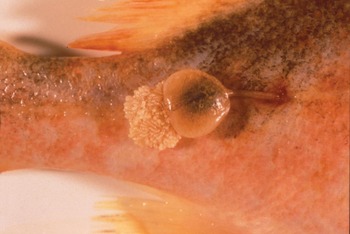
The copepod parasite Sphyrion lumpi, embedded laterally on a redfish (Sebastes sp.). Photograph courtesy of Jonathan D. W. Moran.

Further south, but still in Canadian waters, the most commonly used biological tag in Atlantic cod is the sealworm, sometimes utilized in conjunction with other anisakid nematodes. These were used to differentiate Atlantic cod from southwestern Nova Scotia, the offshore banks on the Scotian Shelf, and southeastern and southwestern Gulf of St Lawrence (Fig. 1). Studies also indicate fish migration in and out of the Gulf in addition to resident fish (Scott and Martin, Reference Scott and Martin1957, Reference Scott and Martin1959; McClelland and Marcogliese, Reference McClelland and Marcogliese1994). Again, the most recent study expands previous work to include other parasites as tags, such as the adult anisakid nematode Hysterothylacium aduncum, and the acanthocephalans Echinorhynchus gadi and Corynosoma strumosum, further supporting the differentiation of southwestern and southeastern stocks in the Gulf of St Lawrence (McClelland and Melendy, Reference McClelland and Melendy2011).
Research into stock discrimination of the redfishes is also principally divided among two geographic areas, the northern banks off Newfoundland and the region surrounding the Gulf of Maine (Fig. 1). Initially, most studies focused on the copepod S. lumpi (Fig. 3) as a biological tag (Nigrelli and Firth, Reference Nigrelli and Firth1939; Perlmutter, Reference Perlmutter1953; Templeman and Squires, Reference Templeman and Squires1960; Bakay, Reference Bakay1988). However, as with studies on Atlantic cod, many scientists subsequently incorporated other taxa such as the anisakid nematodes (Sindermann, Reference Sindermann1961b ; Bourgeois and Ni, Reference Bourgeois and Ni1984; Scott, Reference Scott1988; Marcogliese et al. Reference Marcogliese, Albert, Gagnon and Sévigny2003). Studies using parasites as biological tags show that redfish from the Gulf of Maine are distinct from all those caught further north in the Bay of Fundy, Brown's Bank and the Scotian Shelf (Nigrelli and Firth, Reference Nigrelli and Firth1939; Scott, Reference Scott1988). Still further north, deepwater redfish (Sebastes mentella) were differentiated from the eastern and western waters off Newfoundland using S. lumpi infection levels (Templeman and Squires, Reference Templeman and Squires1960). In a multispecies study where A. simplex, H. aduncum and S. lumpi are shown to have discriminatory power, deepwater redfish stocks are differentiated off Labrador, in the Gulf of St Lawrence, in the Cabot Strait-Laurentian Channel dividing the northern and southern Gulf of St Lawrence, and the Flemish Cap (Fig. 3; Marcogliese et al. Reference Marcogliese, Albert, Gagnon and Sévigny2003).
A potential confounding factor affecting studies on redfish is the difficulty in separating the three redfish species (S. marinus, S. mentella and Sebastes fasciatus) in the Northwest Atlantic. In many studies, separation is based on depth of capture and geographic distribution (Templeman and Squires, Reference Templeman and Squires1960), but it may prove that early parasite records are erroneous (Bourgeois and Ni, Reference Bourgeois and Ni1984). Differential infections by the copepods S. lumpi and Chondracanthus nodosus on S. mentella and S. fasciatus led Moran et al. (Reference Moran, Arthur and Burt1996) to suggest that these parasites could be used to aid in the identification of these two redfish species.
Atlantic herring is the pelagic species with the longest history of tagging studies, dating back to the 1950s and 1960s (Sindermann, Reference Sindermann1957, Reference Sindermann, Boyar, Dow, Larsen, Lozier, Scattergood, Sindermann and Watson1959, Reference Sindermann1961b ). Original studies centre on the distinction between Gulf of Maine populations and other stocks (Fig. 1). Using an assortment of parasites, including Ichthyosporidium hoferi, Kudoa clupeidae and anisakid nematodes, Sindermann (Reference Sindermann1961b ) discriminates herring in the Gulf of Maine from those in the Gulf of St Lawrence, and those off Nova Scotia from those on Georges Bank. He further separates herring from the eastern and western sections of the Gulf of Maine. Anisakis sp. was used to delineate fish from the Gulf of Maine, Nova Scotia and Georges Bank (Fig. 3; Boyar and Perkins, Reference Boyar and Perkins1971). In contrast, Lubieniecki (Reference Lubieniecki1973) could not discriminate herring collected from localities between Long Island and Chesapeake Bay off the east coast of the USA. More recently, herring were separated between the Gulf of Maine and Southwest Nova Scotia using the anisakid A. simplex as a biological tag (Chenoweth et al. Reference Chenoweth, McGladdery, Sindermann, Sawyer and Bier1986). In a novel approach, morphometric variation in the parasite A. simplex also was considered a potential tool to discriminate populations of Atlantic herring (Beverley-Burton and Pippy, Reference Beverley-Burton and Pippy1977).
Parasites also have been used as indicators of migration in herring. Inshore-offshore migrations are demonstrated using Anisakis sp. (Parsons and Hodder, Reference Parsons and Hodder1971), while McGladdery and Burt (Reference McGladdery and Burt1985) use various parasites, including two nematodes, three digeneans, one cestode and one protozoan to indicate migration and spawning behaviour. McGladdery (Reference McGladdery1987) further distinguishes between first and repeat spawners using Eimeria sardinae in the testes.
An examination of parasites as biological indicators in different fish species in the Northwest Atlantic repeatedly demonstrates the recurrence of certain geographical patterns. Separation of stocks among the Gulf of St Lawrence, the Breton Shelf and the Scotian Shelf is shown for Atlantic cod, Atlantic herring, American plaice (Hippoglossoides platessoides), yellowtail flounder (Limanda ferruginea), witch flounder (Glyptocephalus cynoglossus), winter flounder (Pleuronectes americanus) and redfishes (Scott and Martin, Reference Scott and Martin1957; Parsons and Hodder, Reference Parsons and Hodder1971; Scott, Reference Scott1975, Reference Scott1982; McClelland and Marcogliese, Reference McClelland and Marcogliese1994; McClelland et al. Reference McClelland, Melendy, Osborne, Reid and Douglas2005). More precise stock delineations between the southeastern and southwestern southern Gulf of St Lawrence are observed for Atlantic cod and American plaice (Scott and Martin, Reference Scott and Martin1959; McClelland et al. Reference McClelland, Misra and Marcogliese1983; McClelland and Marcogliese, Reference McClelland and Marcogliese1994; McClelland and Melendy, Reference McClelland and Melendy2007, Reference McClelland and Melendy2011). Distinct stocks of silver hake (Merluccias bilinearis), Atlantic herring, and redfish are observed in the Scotian Shelf, southwestern Nova Scotia and the Gulf of Maine (Perlmutter, Reference Perlmutter1953; Templeman and Squires, Reference Templeman and Squires1960; Boyar and Perkins, Reference Boyar and Perkins1971; Chenoweth et al. Reference Chenoweth, McGladdery, Sindermann, Sawyer and Bier1986; Scott, Reference Scott1987, Reference Scott1988; Marcogliese et al. Reference Marcogliese, Albert, Gagnon and Sévigny2003). Further distinctions are noted for haddock (Melanogrammus aeglefinus) and winter flounder between the Bay of Fundy and the Scotian Shelf (Scott, Reference Scott1981, Reference Scott1985a ). Redfish, Greenland halibut (Reinhardtius hippoglossoides) and capelin (Mallotus villosus) are shown to have distinct stocks in the Gulf of St Lawrence, Newfoundland and Labrador (Khan et al. Reference Khan, Dawe, Bowering and Misra1982; Bourgeois and Ni, Reference Bourgeois and Ni1984; Pálsson, Reference Pálsson1986; Arthur and Albert, Reference Arthur and Albert1993; Marcogliese et al. Reference Marcogliese, Albert, Gagnon and Sévigny2003). Distinct stocks of Atlantic cod, redfish and grenadiers are observed on the Flemish Cap and the Grand Banks (Templeman and Fleming, Reference Templeman and Fleming1963; Zubchenko, Reference Zubchenko1981; Bourgeois and Ni, Reference Bourgeois and Ni1984; Brattey and Bishop, Reference Brattey and Bishop1992; Marcogliese et al. Reference Marcogliese, Albert, Gagnon and Sévigny2003). These shared differences suggest that stock structure of these fishes is influenced and defined by oceanographic features, such as deep channels and the physical arrangement of banks on the continental shelf in the Northwest Atlantic Ocean.
NORTH PACIFIC WATERS
Turning westwards, tagging studies in this vast open region cover all spatial scales following the importance for mixed fisheries in open seas, geopolitical zones between neighbouring countries and neighbouring states within the USA. Documented in Table 1 and highlighted below are studies on 21 species of fish, marine mammals or invertebrates in North American waters of the Pacific Ocean that have been examined for the use of parasites as natural tags. The majority of studies have been conducted on the anadromous Pacific salmonids leading to the use of freshwater parasites for many studies. Other commercially important demersal and pelagic fishes studied include species of gadids, clupeids, scorpaenids, pleuronectids, an anoplopomatid and a pentacerotid as well three invertebrate species (Table 1).
As mentioned above, in contrast to the origin of the use of parasites as tags in Atlantic waters, the examination of parasites as tags in North Pacific waters originated with the need for stock identification in mixed stock fisheries after WWII. With Japan's subsequent increasing need for dietary protein, concerns of the USA and Canada regarding Japan's offshore catches of commercially important species such as Pacific salmon (Oncorhynchus spp.), Pacific halibut (Hippoglossus stenolepis), and Pacific herring (Clupea pallasii) in international waters (high seas), led to the International Convention for the High Seas Fisheries of the North Pacific Ocean and the formation of the International North Pacific Fisheries Commission (INPFC) in 1952 (Jackson and Royce, Reference Jackson and Royce1986). With its member nations (USA, Canada and Japan) the INPFC established a collaborative research programme with a key objective of determining the geographical line or lines that best separate Pacific salmon originating from North America and Asia (Burgner, Reference Burgner, Ishida, Nagasawa, Welch, Myers and Shershnev1992). This programme recognized parasites as biological tags on the high seas as a potential method for stock identification or determination of continent of origin. For this reason Pacific salmonids appear to be the first fish species in the North Pacific to be studied for the potential use of parasites as biological tags. The North American efforts in this research were pioneered by a Canadian federal fisheries scientist, Dr Leo Margolis (Fig. 4).
Dr Leo Margolis (1927–1997) of the Canadian Department of Fisheries and Oceans proudly displaying the Order of Canada, awarded in 1990 (courtesy of the Nanaimo Museum, Nanaimo, British Columbia).

An initial international collaborative effort between 1955 to 1959 yielded a sample size of close to 13 000 specimens of different life stages of sockeye salmon (O. nerka) from North American rivers, British Columbia coastal systems, Kamchatka (Russian Far East) and the high seas (Margolis, Reference Margolis1963). Juvenile (plerocercoid) stages of the tapeworm Triaenophorus crassus in muscle and the intestinal nematode Truttatedacnitis (Dacnitis) truttae, which seemed to persist throughout the life of the salmon, were considered good candidates to identify the ocean distribution of western Alaskan and Kamchatkan sockeye (Margolis, Reference Margolis1963). The presence of T. crassus indicated Western Alaskan (Bristol Bay) origin due to the occurrence of its definitive host, northern pike (Esox lucius) in lakes cohabited by pike and sockeye salmon. In this extensive and pioneering study, Margolis concludes that maturing Bristol Bay sockeye comprised a large proportion of the fish taken immediately south of the Aleutians in late May and early June and from those taken in the northwestern part of the Gulf of Alaska in early June (Fig. 5 upper image). Immature sockeye caught later in the summer occupy areas similar to mature salmon (Fig. 5 lower image). These results, later corroborated by artificial tagging studies, indicate a large overlap in the distribution of Kamchatka and Bristol Bay sockeye salmon in the Northeast Pacific high seas (Margolis, Reference Margolis, Ishida, Nagasawa, Welch, Myers and Shershnev1992).
High-seas locations of catch of Triaenophorus-infected and Dacnitis-infected sockeye salmon (Oncorhynchus nerka) from 1955 to 1959. Sampling locations where neither Triaenophorus nor Dacnitis were found are not shown. Upper chart = maturing sockeye; lower chart = immature sockeye. Reproduced from Margolis (Reference Margolis1963) with permission from the North Pacific Anadromous Fish Commission.

On a smaller spatial scale, freshwater myxosporeans, Henneguya salmincola and Myxobolus arcticus (previously identified as Myxobolus neurobius; Urawa, Reference Urawa1989) were used to distinguish returning sockeye salmon among lakes in British Columbia (Margolis, Reference Margolis and Meerovitch1982) and to estimate straying rates among five British Columbian populations (Quinn et al. Reference Quinn, Wood, Margolis, Riddell and Hyatt1987). The occurrence of this Myxobolus species was an effective tag for separating Alaskan from Canadian stocks of sockeye salmon, but unreliable for estimates of individual stocks (Wood et al. Reference Wood, Rutherford and McKinnell1989). Moles and Jensen (Reference Moles and Jensen2000) examined over 10 000 spawning sockeye salmon from 86 lakes and streams throughout Alaska to identify the potential of M. arcticus as a biological tag for mixed stock fisheries of Alaska. They found that the high prevalence of this myxosporean among eastern Gulf of Alaska stocks (primarily of lake origin) compared with an absence of the parasite from many western stocks (primarily from river systems), along with interannual stability of infection, provide opportunities for even small-scale stock separation.
In stream-type Chinook salmon (Oncorhynchus tshawytscha), which typically spend up to a year in fresh water before emigrating to the ocean, the myxosporean brain parasites M. arcticus and Myxobolus kisutchi were identified as potential biological tags for adult Chinook salmon caught in the North Pacific Ocean and Bering Sea. Freshwater baseline studies demonstrated an overall prevalence of 67·7% of M. arcticus in Chinook salmon originating from Asian rivers compared to 2·3% from North American rivers (reviewed in Myers et al. Reference Myers, Harris, Ishida, Margolis and Ogura1993; Urawa et al. Reference Urawa, Nagasawa, Margolis and Moles1998). In addition, M. kisutchi is recovered only from stocks from the Columbia River Basin of Oregon and Washington and vicinities (reviewed in Urawa et al. Reference Urawa, Nagasawa, Margolis and Moles1998, Reference Urawa, Harrell, Mahnken and Myers2006). Urawa et al. (Reference Urawa, Nagasawa, Margolis and Moles1998) used these parasites in Chinook salmon captured in the high seas in 1989–1990 to demonstrate that Asian Chinook salmon that harbour M. arcticus are widely distributed in the North Pacific Ocean, but prove rare in the Bering Sea.
In the 1970s the INPFC expanded its interest to anadromous rainbow trout, also known as steelhead (Oncorhynchus mykiss), which range from northern California to the north side of the Alaska Peninsula, mix in the high seas of the North Pacific Ocean and are difficult to distinguish from steelhead originating in Asia (western Kamchatka). Two freshwater digeneans, Plagioporus shawi (adults) and Nanophyetus salmincola (metacercariae), with distributions restricted by the distribution of their snail intermediate hosts, were examined for their potential to identify the ocean range of steelhead trout originating from the northwestern USA (Margolis, Reference Margolis1984, Reference Margolis1985). Studies conducted on steelhead caught in the central North Pacific in 1986 and 1987 provide evidence that steelhead from the northwestern USA make up a substantial proportion of the Japanese by-catch (summarized in Dalton, Reference Dalton1991). Identification of metacercariae of N. salmincola in additional steelhead samples from Japanese research vessels expands the known western range limit of North American steelhead (Myers et al. Reference Myers, Campbell and Burgner1991).
The last year of Japan's operation of a landbased salmon driftnet fishery on the high seas was 1991 (Myers et al. Reference Myers, Harris, Ishida, Margolis and Ogura1993). This reduced the need for monitoring the stocks of salmon in the high seas and the emphasis of salmon studies became more regional and the scale for detecting differences much smaller. As an example of this, Criscione et al. (Reference Criscione, Cooper and Blouin2006) show that the genotypes of P. shawi, collected from five freshwater locations in Oregon and Washington states, are four times more accurate than the genotypes of steelhead (using the baseline available at that time) in assigning fish to their river of origin. This derives from the fact that the digenean possesses a restricted freshwater life cycle (aquatic snail to fish) that subsequently limits dispersal among freshwater drainages. However, Criscione et al. (Reference Criscione, Cooper and Blouin2006) point out temporal limitations of the technique, in addition to infection restrictions, as P. shawi may not survive long enough in marine waters to provide information on adult steelhead. Despite these limitations, combining genetic assessment of host and parasite seems worthy of future efforts in steelhead stock analyses. Furthermore, a baseline of genotypes for the Myxobolus species mentioned above might prove to again add information on stock structure of salmonids given their parasites’ longevity in the host.
In addition to the Pacific salmon, the North Pacific Ocean supports other mixed stock fisheries including Pacific herring, Pacific halibut and other groundfish species, that remain important to those countries sending fishing fleets to the North Pacific Ocean. These studies and others are summarized in Table 1. In general, stock delineation studies have been conducted over large geographic areas for widely distributed marine species such as Pacific halibut (Blaylock et al. Reference Blaylock, Margolis and Holmes2003) and the neon flying squid (Ommastrephes bartrami) (Nagasawa et al. Reference Nagasawa, Mori, Okamura and Okutani1998). In contrast, studies have been conducted on smaller scales for Pacific herring, a few of the approximate 100 rockfish species (Sebastes spp.) and other species with demersal life stages. The use of natural tags in rockfishes that experience barotrauma and do not survive mark–recapture studies may be especially important. On very fine scales, studies on parasites were able to separate stocks of sablefish (Anoplopoma fimbria) at different seamounts off the Canadian coast (Kabata et al. Reference Kabata, McFarlane and Whitaker1988; Whitaker and McFarlane Reference Whitaker, McFarlane, Wilkins and Saunders1997) and identify new recruits to Hawaiian Ridge seamounts for North Pacific armorhead (Pseudopentaceros wheeleri) (Humphreys et al. Reference Humphreys, Crossler and Rowland1993).
To summarize findings in the Pacific, freshwater myxosporeans are shown to be the most useful of the parasites of salmonids. In marine hosts, gill monogeneans and parasitic copepods prove among the most reliable tags. In many cases parasite communities instead of individual parasites can differentiate regional differences. Most recently, and described further below, there has been promise of using genetic structure of parasite populations to more accurately identify stock structure or migration patterns of marine hosts.
ARCTIC WATERS
While few in number, almost all studies using parasites as biological tags confined exclusively to the Arctic have the goal of distinguishing between resident freshwater and anadromous Arctic charr (Salvelinus alpinus). Areas of study include Somerset Island, Baffin Island, Labrador and Greenland (Table 1). Of the studies conducted in the Northwest Atlantic, the only ones which include samples extending into Arctic waters are those on Greenland halibut and Atlantic cod (Templeman et al. Reference Templeman, Hodder and Fleming1976; Zubchenko, Reference Zubchenko1981; Khan et al. Reference Khan, Dawe, Bowering and Misra1982) and cod from Greenland (Boje, Reference Boje1987).
Few parasites stand out as potential indicator species in the Arctic. Dick (Reference Dick, Johnson and Burns1984) suggests that Bothrimonus sp. and Brachyphallus sp., among others, are good indicators of sea-run Arctic charr on Victoria Island. He further proposes that the freshwater origin of sea-run charr in estuarine or marine samples may be elucidated by the presence of Cystidicola sp., Eubothrium sp. and Crepidostomum sp. Numbers of these freshwater parasites are reduced but not eliminated in estuarine conditions. However, Dick (Reference Dick, Johnson and Burns1984) cautions that results are system-specific and that each fish population must be evaluated separately.
FRESH WATERS
Aside from anadromous fishes, very few studies use parasites as biological tags to discriminate stocks of freshwater fish and all of these are confined to the Great Lakes-St Lawrence Basin (Table 1). However, parasites are used frequently to determine river of origin for anadromous salmonids on both the Pacific and Atlantic coasts (Table 1). Furthermore, they are used to distinguish anadromous from resident fishes in freshwater ecosystems, as in Arctic charr (Eddy and Lankester, Reference Eddy and Lankester1978; Dick and Belosevic, Reference Dick and Belosevic1981; Bouillon and Dempson, Reference Bouillon and Dempson1989; Due and Curtis, Reference Due and Curtis1995; Table 1, and see above). Hare and Burt (Reference Hare and Burt1976) used parasites to determine tributary of origin for Atlantic salmon (Salmo salar) within the Miramichi River system in New Brunswick. In the nearby Tabusintac River, freshwater parasites indicate foci of infection in freshwater brook charr (Salvelinus fontinalis), whereas a decrease in prevalence of various marine parasites reflect approximate arrival time of anadromous fish from this river (Frimeth, Reference Frimeth1987). The distribution of other freshwater parasites suggests that brook charr move between estuaries (Frimeth, Reference Frimeth1987). Examination of the parasite fauna of American shad, Alosa sapidissima, led Hogans et al. (Reference Hogans, Dadswell, Uhazy and Appy1993) to infer that arrival and departure times in the Cumberland Basin of the Bay of Fundy vary among different local riverine populations. In Quebec lakes, parasites also discriminate between littoral and limnetic forms of brook charr more effectively than dietary differences or morphometrics (Bertrand et al. Reference Bertrand, Marcogliese and Magnan2008).
Clearly there is good potential here to apply these techniques to freshwater fisheries, especially in large lakes such as the Great Lakes, Lake Winnipeg and Lake Manitoba, and major fluvial systems such as the St Lawrence, Mississippi and Columbia Rivers, where commercial fisheries are well established. This is especially so given that the parasite fauna of commercial freshwater fish in North America is fairly well known (e.g. Margolis and Arthur, Reference Margolis and Arthur1979; McDonald and Margolis, Reference McDonald and Margolis1995; Muzzall and Whelan, Reference Muzzall and Whelan2011) and good baseline information already exists.
A PROGRESSION OF APPROACHES AND METHODS
Initially only single parasites were considered in tagging studies, but by 1961 Sindermann developed a multi-species approach hoping to prove more powerful and provide more discriminatory information (Sindermann, Reference Sindermann1961a ). His approach consisted of an analysis of frequency of occurrence of four different parasites from various areas off northeastern North America, to estimate the maximum degree of mixing between any two areas (Sindermann, Reference Sindermann1961a ). With the development of more advanced statistical methods and better computational capacity, analytical methods and multi-species approaches grew hand in hand, permitting more enhanced discriminatory ability using natural assemblages of parasites as tags. Among the most popular techniques used is stepwise parametric or non-parametric discriminate function analysis (DFA), which measures how accurately a given individual fish fits into one sample vs another (e.g. Arthur and Albert, Reference Arthur and Albert1993, Reference Arthur and Albert1996; Boje et al. Reference Boje, Riget and Koie1997; Blaylock et al. Reference Blaylock, Margolis and Holmes2003; McClelland et al. Reference McClelland, Melendy, Osborne, Reid and Douglas2005; Melendy et al. Reference Melendy, McClelland and Hurlbut2005; McClelland and Melendy, Reference McClelland and Melendy2007, Reference McClelland and Melendy2011). The coherence of different samples of fish from across a region can then be assessed using only parasites that significantly contribute to assigning fish to specific samples or areas. With the increasing use of DFA to discriminate stocks, the choice of parasite indicators is based more now on statistical evidence rather than choices made a priori, which were often based on observational data and ease of measurement. An examination of recent studies using DFA, however, does not reveal any consistent commonalities among the various North American studies except that anisakid nematodes, indeed, are often effective at aiding in stock discrimination in the Northwest Atlantic. In addition, although this is a multi-species technique, usually only a small subset of parasites tested proves informative. For example, Blaylock et al. (Reference Blaylock, Margolis and Holmes2003) ultimately used eight parasite taxa of 59 to discriminate Pacific halibut stocks. On the Atlantic side (Fig. 2), for Greenland halibut Arthur and Albert (Reference Arthur and Albert1993) found only five of 46 parasite taxa (see Arthur and Albert, Reference Arthur and Albert1994) to be discriminatory, while Boje et al. (Reference Boje, Riget and Koie1997) selected three of 21 taxa. For capelin, Arthur and Albert (Reference Arthur and Albert1996) selected three of 21 taxa (see Arthur et al. Reference Arthur, Albert and Boily1995). McClelland and Melendy (Reference McClelland and Melendy2007, Reference McClelland and Melendy2011) found two of 11 and four of nine parasites enumerated to be useful in delineating stocks of American plaice and Atlantic cod, respectively, in the Gulf of St Lawrence. Four of 17 parasite taxa proved discriminatory in a DFA of parasites of white hake (Urophycis tenuis) in the Gulf of St Lawrence (Melendy et al. Reference Melendy, McClelland and Hurlbut2005). Lastly, seven of 20 parasite taxa were informative regarding delineation of winter flounder stocks off Nova Scotia (McClelland et al. Reference McClelland, Melendy, Osborne, Reid and Douglas2005).
While variation in the physiology, morphology and genetics of the target fish species is used extensively to discriminate among fish stocks, few studies consider such variation within those particular parasite species that infect them. In an early study, Beverley-Burton and Pippy (Reference Beverley-Burton and Pippy1977) suggest that morphometric variation in length among the whaleworm A. simplex can be used to distinguish stocks of Atlantic herring and Atlantic salmon (S. salar) off eastern Canada. Beverley-Burton (Reference Beverley-Burton1978) further suggests that allele frequencies could be used to determine migration patterns of Atlantic salmon. More recently, an evaluation of genotype variation using microsatellites demonstrates that the populations of the digenetic trematode P. shawi varies more than those of its host, steelhead trout from five different rivers in Oregon (Criscione et al. Reference Criscione, Cooper and Blouin2006). In contrast, Baldwin et al. (Reference Baldwin, Rew, Johansson, Banks and Jacobson2011) could not identify migration patterns or stock structure of Pacific sardine (Sardinops sagax) based upon the population structure (assessed with the cytochrome c oxidase 2 mitochondrial DNA gene) of three species of larval Anisakis, but found a panmictic distribution of haplotypes from southern California to British Columbia. Beverley-Burton (Reference Beverley-Burton1978) was unable to distinguish North American and British Atlantic salmon among fish collected from Greenland using enzyme allele frequencies. However, use of molecular markers shows that Diplostomum spp. differ for the most part between North American and Eurasian freshwater fishes (Locke et al. unpublished). Hence, use of molecular barcodes can provide a further tool to discriminate between salmonids from North America and those from Europe or Asia in both the Atlantic and Pacific oceans. Indeed, a meta-analysis of molecular markers in digenetic trematodes shows that those with fully aquatic life cycles exhibit more genetic structuring than those infecting birds and mammals as final hosts (Blasco-Costa and Poulin, Reference Blasco-Costa and Poulin2013). These authors suggest that genetic differences among parasite populations reflect the mobility of their hosts. Thus, hosts with limited interchange among stocks can be infected with genetically distinct populations of a given parasite species.
Of course, information from biological tags should not be used in isolation (Begg and Waldman, Reference Begg and Waldman1999; Marcogliese, Reference Marcogliese, Afonso-Dias, Menezes, MacKenzie and Eiras2008; Catalano et al. Reference Catalano, Whittington, Donnellan and Gillanders2013), but rather should be considered in conjunction with the various other standard techniques currently used in fisheries management, including meristics, physical tagging, population genetics, growth data and otolith structure, to name a few. This is nothing new, and early North American studies that used parasites together with other methods include Templeman (Reference Templeman1953) and Sindermann (Reference Sindermann1957, Reference Sindermann, Boyar, Dow, Larsen, Lozier, Scattergood, Sindermann and Watson1959, Reference Sindermann1961b ). However, while few published studies actually incorporate multiple techniques, Sindermann (Reference Sindermann, Boyar, Dow, Larsen, Lozier, Scattergood, Sindermann and Watson1959) combined the use of parasites as biological tags with serological measurements to differentiate stocks of Atlantic herring from the Gulf of St Lawrence to the New Jersey coast. Templeman (Reference Templeman1953) incorporated parasitological data with vertebral counts, growth and maturation rates, and/or mark-recapture techniques in his review of stock structure of Atlantic cod and redfish in the Northwest Atlantic. Nyman and Pippy (Reference Nyman and Pippy1972) examined growth, allele frequencies and two species of parasite to distinguish North American and European Atlantic salmon at sea. Bishop et al. (Reference Bishop, Lear, Baird and Wells1988) included studies of meristic characteristics, growth and nematodes in fillets to differentiate Atlantic cod from different banks off southern Newfoundland. Off the coast of New England, Lux (Reference Lux1963) incorporated information from mark-recapture studies, fin ray counts and occurrence of blackspot metacercariae (Cryptocotyle lingua) to differentiate stocks of winter flounder (P. americanus). On the same host species, another excellent recent study combined parasites as biological tags with host population genetic studies using microsatellites to differentiate among four populations off eastern Canada (McClelland et al. Reference McClelland, Melendy, Osborne, Reid and Douglas2005).
Quinn et al. (Reference Quinn, Wood, Margolis, Riddell and Hyatt1987) also found electrophoretic differences at 23 loci among five wild British Columbian sockeye salmon populations, corroborating parasitological results. The occurrence of the myxosporean M. arcticus was also used in the mid-1980s in combination with allozyme variants and freshwater age at migration to help determine stock composition of sockeye salmon caught in fisheries of the northern boundary area of southern Southeast Alaska and northern British Columbia (Pella et al. Reference Pella, Masuda, Guthrie, Kondzela, Gharrett and Winans1998). This parasite (previously identified as M. neurobius) was also used in combination with five biochemical genetic markers and scale patterns to estimate the contributions of approximately 15 different groups of 51 stocks of sockeye salmon in a British Columbia and Southeast Alaska coast-wide mixed-stock fishery (Wood et al. Reference Wood, Rutherford and McKinnell1989).
The fishery of the Pacific sardine may be a prime example of a recent effort that can benefit from such an integrated assessment. This commercially and ecologically important coastal pelagic fishery crashed in the mid 1900s and experienced a recent resurgence in the late 1990s, as far north as Vancouver Island. Believed to be the northern limits of a migration from a southern California spawning stock, the recent fisheries have been managed as one stock. Thus, Baldwin et al. (Reference Baldwin, Banks and Jacobson2012) focused on this fish in a review of the approaches used to assess stock identity of marine fishes. This review includes a discussion of fish morphometrics, artificial tags, fish genetics, parasite community analyses and parasite genetics. Whereas fish genetics has not been able to provide information on stock structure, a study of the parasite communities sampled from southern California to Vancouver Island suggests, based on differences in the recovery of the digeneans Lecithaster gibbosus and Myosaccium ecaude, that the coast-wide migration described in the 1940s using artificial tags may not be the current migration pattern (see review by Baldwin et al. Reference Baldwin, Banks and Jacobson2012).
IMPORTANT LESSONS LEARNED (OR WHAT DID NOT WORK AND WHY)
Although we stated we would not address the criteria outlined in many other studies for what constitutes a ‘good’ tag for a parasite, we discuss some examples of studies that test some of the assumptions behind the various criteria. For example, using a long-term database (1962–1989) of infections of the copepod ectoparasite L. branchialis on artificially tagged Atlantic cod collected and recaptured off Newfoundland and Labrador, Jones and Taggart (Reference Jones and Taggart1998) tested whether some of the criteria for good biological tags were applicable to this host-parasite system. They found that there was latitudinal variation in infection rates, that infected fish had reduced survival compared with uninfected fish, and that prevalence varied with fish length. Thus, these authors conclude that using L. branchialis as a natural tag of cod populations can be problematic. They do acknowledge that the copepod may be useful to differentiate cod populations that overwinter (see also Templeman and Fleming, Reference Templeman and Fleming1963).
In the Pacific Ocean, the prevalence of the myxosporeans M. arcticus and H. salmincola in sockeye salmon was used to provide estimates of stock composition in British Columbia from 1977 to 1984, until an increase in Myxolobolus-infected sockeye salmon in one stock changed enough to result in a decline in the ability to differentiate among the three stocks (Beacham et al. Reference Beacham, Margolis and Nelson1998). Along similar lines, Margolis (Reference Margolis1998) cautions that although stable as a qualitative tag, annual variability of H. salmincola in steelhead limits the use of this parasite for quantitative estimates of stock composition. Such results caution that long-term infection dynamics may change so that the value of parasites as tags may not be consistent over time. The lifespan of several freshwater parasites in seawater was evaluated by Bailey et al. (Reference Bailey, Margolis and Workman1989). They found that four of their taxa (Diplostomulum sp. metacercaria, Eubothrium sp., Proteocephalus sp. and Neoechinorhynchus salmonis) survived as long in sockeye salmon reared in seawater as those reared in fresh water, demonstrating the importance of testing and validating assumptions of criteria used for the use of parasites as biological tags.
In addition, life histories of fish species may preclude the use of parasites as natural tags. In contrast to sockeye salmon, which typically spend 1–3 years rearing in freshwater lakes before migrating to the ocean, pink salmon (Oncorhynchus gorbuscha) spend only a few days to a few months rearing in fresh water before ocean entry. Thus freshwater parasites as natural tags for this salmon species are not an option. A few marine parasites were identified as having potential, but interannual variability from 1955 to 1957 discouraged further research efforts (Margolis, Reference Margolis1963). Similar to pink salmon, chum salmon (Oncorhynchus keta) also have an all too brief freshwater residency and thus the usefulness of parasites as any type of natural tag would have to rely solely on marine parasite species.
WHAT COULD WE LEARN FROM NON-TAGGING STUDIES?
An effective biological tag requires a parasite's distribution to be limited in one way or another by environmental conditions (Williams et al. Reference Williams, MacKenzie and McCarthy1992). Parasites are known to be good indicators of pollution (Khan and Thulin, Reference Khan and Thulin1991; MacKenzie et al. Reference MacKenzie, Williams, Williams, McVicar and Siddall1995; Marcogliese, Reference Marcogliese2004, Reference Marcogliese2005). While the guidelines for the selection of hosts and parasites as biological tags differ somewhat from those for the use of parasites as indicators of pollution, they are not necessarily incompatible (Williams et al. Reference Williams, MacKenzie and McCarthy1992; MacKenzie, Reference MacKenzie1993; MacKenzie et al. Reference MacKenzie, Williams, Williams, McVicar and Siddall1995). Indeed, if parasites indicate that fish samples from polluted and unpolluted environments are different, presumably we can assume that the stocks of fish are also different, with no or only limited inter-mixing. Thus, pollution studies that use parasites as indicators may also be used to differentiate among stocks of fish or migration patterns. For example, Siddall et al. (Reference Siddall, Pike and McVicar1994) attributes the lack of differences in parasite communities of long rough dab, also known as American plaice, from polluted and unpolluted habitats in the Firth of Clyde, Scotland, to mixing of fish between sites. In contrast, significant differences in the prevalence and abundance of certain parasites in common dab (Limanda limanda) between a dump and reference sites in the Firth of Clyde led the same authors to conclude that these fish do form temporally distinct local populations (Siddall et al. Reference Siddall, Pike and McVicar1994).
Communities of silver perch (Bairdiella chrysoura) differ among estuaries along the Florida coast, depending on their contaminant load (Landsberg et al. Reference Landsberg, Blakesley, Reese, McRae and Forstchen1998). While the data were not analysed to search for similarities or differences among the various estuarine parasite communities, the parasite communities in some estuaries clearly differed from others, suggesting that they are composed of different stocks of fish.
Using multivariate analyses of parasite communities, samples of spottail shiners (Notropis hudsonius) and johnny darters (Etheostoma nigrum) from different areas of the St Lawrence River in eastern Canada are quite different from each other (Marcogliese et al. Reference Marcogliese, Gendron, Plante, Fournier and Cyr2006; Krause et al. Reference Krause, McLaughlin and Marcogliese2010). Also, myxozoan communities in spottail shiners are quite different upstream and downstream of the island of Montreal in the same river (Marcogliese et al. Reference Marcogliese, Gendron and Cone2009; Krause et al. Reference Krause, McLaughlin and Marcogliese2010). Similarly, based on their parasite communities, estuarine and freshwater samples of mummichogs (Fundulus heteroclitus) prove quite different from each other in two New Brunswick rivers (Blanar et al. Reference Blanar, Marcogliese and Couillard2011). While the above studies do not concern commercial fishes, these species are important forage fishes and the information is certainly relevant if any fisheries employ a more comprehensive ecosystem approach or need to comprehend the resource base for a particular commercial fish species.
Nevertheless, if discriminating between stocks using results from a pollution study, caution must be taken regarding the choice of discriminating parasites. If environmental conditions are toxic to a parasite, then the absence of that parasite does not necessarily discriminate between fish stocks in and out of a contaminated area. In both tagging and pollution studies, it is advisable to know the environmental limits of the parasites in question (Williams et al. Reference Williams, MacKenzie and McCarthy1992; MacKenzie et al. Reference MacKenzie, Williams, Williams, McVicar and Siddall1995). Ultimately, we are advocating that data acquired from studies with other primary objectives may provide useful tagging information, analogous to the initial observations on the problematic sealworm and Sphyrion lumpi on Atlantic cod and redfish, respectively, in the Northwest Atlantic.
CONCLUSIONS
While a variety of pelagic and demersal fish have been studied on both the Pacific and Atlantic coasts of North America, emphasis has been on Atlantic cod, Atlantic herring and the redfishes in the Atlantic and on the salmonids in the Pacific. Also, close to four times the number of studies has been conducted in the Northwest Atlantic compared with the Pacific. We speculate that this is due to a number of reasons including a longer history of exploitation, more jurisdictional boundaries (e.g. Canadian provinces), and a relatively greater number of exploited species on the east coast.
While the reasons for the unbalanced number of studies remain conjecture, on first glance, partitioning of stocks also appears to be greater on the east coast. Differences in bathymetry, topography and hydrography off the two coasts may contribute to the relative disparity in fish stock distinctness between the North Atlantic and the North Pacific. Atlantic fish populations may be separated by deep channels between offshore banks as well as a very heterogeneous coastline with many disrupting features (e.g. the Gulf of Maine, the Gulf of St Lawrence, the island of Newfoundland). The deep ocean trenches, channels and similar hydrographic features that separate populations of Atlantic cod (Bentzen et al. Reference Bentzen, Taggart, Ruzzante and Cook1996) and haddock (Zwanenburg et al. Reference Zwanenburg, Bentzen and Wright1992), for example, in the northwestern Atlantic are lacking in the Northeast Pacific. Although deep channel fjord systems along the coasts of Southeast Alaska and British Columbia and Washington's Puget Sound, may separate groundfish and Pacific herring populations, the majority of commercially important Pacific populations may be most influenced by oceanographic currents, water temperature, and even freshwater outflow, which affect the distribution of pelagic and demersal fish species as well as their prey. For the same reason, parasites which prove useful as biological tags on the Atlantic coast, such as the anisakid nematodes, may have fewer barriers to dispersal in Pacific waters.
In contrast to Atlantic waters, myxosporeans appear to be excellent tags in the Pacific, especially for salmonids. However, they are rarely used on the Atlantic side of North America (but see Scott, Reference Scott1981). For those fishes where results from tagging studies are equivocal (e.g. Scott, Reference Scott1969, Reference Scott1987; Lubieniecki, Reference Lubieniecki1973; Pippy, Reference Pippy1980; Barse and Hocutt, Reference Barse and Hocutt1990), further studies using myxosporeans may prove fruitful.
Use of more powerful statistical approaches has expanded the range of taxa included in studies of parasites as biological tags. Other promising recent developments include the application of molecular tools to the parasites themselves as indicators of fish host population structure. In addition, the use of parasites as indicators of pollution holds the possibility of contributing to fisheries management because it provides complementary information.
Finally, few studies have been conducted off the eastern coast of the USA, and this remains an area open for future research. In addition, with the exception of preliminary work on some large pelagics (see Table 1), we know of no tagging studies in the Caribbean or the Gulf of Mexico. In summary, there are clearly more opportunities for parasites to contribute information on stock delineation and migration of North American fishes. Host genetic tools are replacing the usefulness of parasites for some species, but not all. Nevertheless, parasites have and can continue to provide much needed information on fish behaviour (e.g. migration patterns, habitat preference, nursery grounds) in concert with stock identification obtained through host genetics and other complementary techniques.
ACKNOWLEDGEMENTS
We would like to thank Cheryl Morgan of the Oregon State University Cooperative Institute for Marine Resources Studies for extensive and invaluable assistance with Table 1 and organization of the literature. Dr Kate Meyers also provided insightful discussion and commentary on Pacific salmon. Dr Jane L. Cook is graciously acknowledged for comments on the manuscript. We also are grateful to Andrée Gendron for preparing Fig. 1.