INTRODUCTION
Understanding the impacts of parasites in natural host-parasite systems is vital to conservation management (McCallum and Dobson, Reference McCallum and Dobson1995). However, investigating the effects of parasites on threatened species poses an ethical problem. Experimental manipulation of parasite loads directly measures the impact of parasites on host fitness indicators, such as behaviour (Main and Bull, Reference Main and Bull2000; Hoodless et al. Reference Hoodless, Kurtenbach, Nuttall and Randolph2002; Fenner and Bull, Reference Fenner and Bull2008), body condition and reproductive success (Merino et al. Reference Merino, Moreno, Sanz and Arriero2000; Neuhaus, Reference Neuhaus2003; Tomas et al. Reference Tomas, Merino, Moreno and Morales2007). However, for protected species, where legal or ethical considerations prevent any potentially harmful experiments, increasing parasite loads is rarely possible. Similarly, treating hosts with parasiticides to reduce parasite loads can cause host toxicosis or mortality (Széll et al. Reference Széll, Sréter and Varga2001; Neiffer et al. Reference Neiffer, Lydick, Burks and Doherty2005; Hunter and Isaza, Reference Hunter and Isaza2008), or kill non-target invertebrates in the ecosystem (Herd, Reference Herd1995; Spratt, Reference Spratt1997). Thus, for many protected species, studies are restricted to observational ‘snap-shot’ studies that test for negative correlations between infection and indicators of host fitness (Valera et al. Reference Valera, Hoi and Kristin2006; Bunbury et al. Reference Bunbury, Barton, Jones, Greenwood, Tyler and Bell2007, Reference Bunbury, Jones, Greenwood and Bell2008; Zhang et al. Reference Zhang, Daszak, Huang, Yang, Kilpatrick and Zhang2008). However, an observed negative relationship does not imply that parasites caused the reduced fitness. Immune responses are energetically demanding (Derting and Compton, Reference Derting and Compton2003), so individuals with lower fitness may mount a lower immune response, making them more susceptible to infection (Navarro et al. Reference Navarro, Marzal, De Lope and Moller2003; Ujvari and Madsen, Reference Ujvari and Madsen2005). Thus high parasite loads may be associated with low host fitness without causing it.
An alternative method to determine whether parasites influence host fitness is through mark-recapture studies that investigate temporal interactions between parasitism and indicators of host fitness. An association between high parasite load and a subsequent decline in indicators of host fitness suggests a parasite cost (Bull and Burzacott, Reference Bull and Burzacott2006; Burthe et al. Reference Burthe, Bennett, Kipar, Lambin, Smith, Telfer and Begon2008). Recapture studies also allow tests of the alternative hypothesis that lower fitness leads to increased susceptibility to parasites (Appleby et al. Reference Appleby, Anwar and Petty1999; Clobert et al. Reference Clobert, Oppliger, Sorci, Ernande, Swallow and Garland2000). However, relatively few studies have used temporal patterns to test both hypotheses (but see: Dawson and Bortolotti, Reference Dawson and Bortolotti2001; Beldomenico et al. Reference Beldomenico, Telfer, Gebert, Lukomski, Bennett and Begon2008). Studies that investigate sequential associations between infection and indicators of host fitness may also reveal the temporal nature of parasite impacts on hosts. Ectoparasitic ticks and mites (Acari) show seasonal patterns of attachment in temperate climates, with high levels of synchronous feeding over short periods of time (Oliver, Reference Oliver1989). Thus, the costs of ectoparasites to hosts are likely to be greatest when ectoparasite attachment and feeding is at a peak (Lourenco and Palmeirim, Reference Lourenco and Palmeirim2007). Conducting the study at biologically relevant periods not only allows effective testing of the hypotheses, but also provides insights into when the costs of parasites are likely to be greatest. Although these studies remain observational, and the trends may be affected by other co-varying factors, some level of causality can be inferred. They represent a compromise where experimental manipulations of parasites on hosts are ethically impractical.
We investigated interactions between ectoparasite infestation and body condition in the tuatara (Sphenodon punctatus). This host species is the only extant representative of the primitive reptilian lineage Rhynchocephalia (Hay et al. Reference Hay, Sarre, Lambert, Allendorf and Daugherty2009). Once widespread across mainland New Zealand, its extant natural range is now restricted to 32 island populations (Gaze, Reference Gaze2001). It is listed as ‘range restricted’ with the New Zealand Department of Conservation, and is legally protected (Gaze, Reference Gaze2001). Tuatara are infected by a host-specific tick (Amblyomma sphenodonti) (Dumbleton, Reference Dumbleton1943; Klompen et al. Reference Klompen, Dobson and Barker2002), and 2 species of trombiculid mites (Neotrombicula sphenodonti and N. naultini) (Goff et al. Reference Goff, Loomis and Ainsworth1987). Despite intense conservation management of the host species (Gaze, Reference Gaze2001), little is known of the impact of endemic parasites on tuatara. One survey of the health of tuatara prior to a translocation found no relationship between body condition and tick infestation (Burnham et al. Reference Burnham, Keall, Nelson and Daugherty2006) while a second survey reported a positive relationship (Ruffell, Reference Ruffell2005). Although these studies found no indication of a negative impact of ectoparasites on tuatara, the reported tick burdens were low. We expanded on the previous studies to explore interactions between host body condition and ectoparasite loads in a natural population of tuatara, when ectoparasite loads were at their highest and thus, likely to have the greatest impact on host fitness. We used both ‘snap shot’ observations and temporal patterns of ectoparasite infestation in recaptured individuals to test 3 inter-related hypotheses. Our first hypothesis (1) was that at the peak of parasite infestation there would be a negative relationship between parasite load and host body condition. This is the snap shot observation commonly used to infer an impact of parasites on hosts. However this negative relationship might result from less fit individuals being less resistant to infestation. Our second hypothesis (2) tested this by predicting that hosts with lower body condition before the peak would become infested by more parasites in the peak. Alternatively, the snapshot observation may be explained by parasites reducing host condition. Our third hypothesis (3) tested this by predicting hosts with higher loads in the peak would decline more in body condition after the peak. Thus our 3 hypotheses involved exploring trends, or relationships, over different times in a cycle of ectoparasite infection.
MATERIALS AND METHODS
Parasite species biology
Tuatara ticks develop from an egg into larva, nymph and then adult, and feed on tuatara blood during each stage (Heath, Reference Heath2006). After engorgement, each stage detaches from the host to moult into the next life-cycle stage, or if a female, to lay eggs (Heath, Reference Heath2006). Adult male ticks do not engorge, but remain on the host for mating. On Stephens Island, New Zealand, ticks are found attached to hosts at all times of the year (>97% tuatara infected), but vary seasonally in abundance. Tick loads are lowest over the austral summer, attachment increases over autumn (March–May) to peak by early spring (September) when tick feeding is triggered by warmer temperatures, and tick loads subsequently decline from September to November (Godfrey et al. Reference Godfrey, Bull and Nelson2008) (Fig. 1). Tuatara are less active over winter (June – August (Walls, Reference Walls1981, Reference Walls1983)), when tick development is suspended (Godfrey et al. Reference Godfrey, Bull and Nelson2008).
Mean body condition (grey circles, dotted line, right-hand axis), mean mite (Neotrombicula spp.) loads (open circles) and mean tick (Amblyomma sphenodonti) loads (filled circles) of tuatara (Sphenodon punctatus) among surveys (Table 1). Numbers indicate the hypotheses tested in our study; (1) the ‘snap shot’ correlation between body condition and ectoparasite loads during peak parasite infestation; temporal associations, comparing (2) body condition before the peak with subsequent changes in ectoparasite loads, and (3) ectoparasite loads during the peak with subsequent changes in body condition. Tuatara were infested by ticks year round, and mites in March 2006. These data were presented by Godfrey et al. Reference Godfrey, Bull and Nelson2008.

The 2 mite species are not easily distinguished during visual inspection of a host, so in this study we refer to them as mites. They have a similar life cycle to ticks, but are only parasitic in the larval stage. Free-living nymphs and adults are probably predatory, feeding on small invertebrates in the leaf litter and soil (Wharton, Reference Wharton1952; Sasa, Reference Sasa1961). The prevalence and intensity of mite infections are more seasonal than ticks, with larval mites appearing on hosts in summer (January), peaking in March, and declining in late autumn (May) (Godfrey et al. Reference Godfrey, Bull and Nelson2008) (Fig. 1).
Field study
We explored associations between ectoparasite loads and body condition in a mark-recapture study of tuatara on Stephens Island (Cook Strait, New Zealand, 40°40′, 174°0′). We surveyed tuatara 6 times from January 2005 to November 2006 (Table 1). Our surveys included the pre-peak, peak, and post-peak infection periods of each ectoparasite (Table 1, Fig. 1). Tuatara were captured within three 20 m diameter circular study plots in closed-canopy forest habitat. Each survey was conducted over 4 to 11 nights (mean 5·8, 1·2 SE). Each night, we searched plots for 2–8 h, depending on tuatara activity, and the number of tuatara already captured during the survey. Additional sampling took place during daylight on some days in the survey period. New animals were marked with a subdermal Passive Integrated Transponder (PIT) tag (Allflex, NZ). Individuals were captured once within a survey, and recaptures between surveys were identified by scanning individuals and reading the PIT tag number. At each capture, we recorded the size (snout to vent length (SVL, mm)), sex (male, female or subadult (SVL <170 mm)), mass (g) and the total number of ticks and mites attached. Ectoparasites were not removed from hosts. We also distinguished between the different tick stages (larvae, nymphs and adults), and determined the sex of adult ticks. Mite loads above 50–100 were derived by estimating the area of the host that contained 100 mites, and visually extrapolating this estimate across the entire infected area of the animal surface.
Number of adult males (N M), adult (non-gravid) females (N F), and total adult tuatara (Sphenodon punctatus) (N total) captured in surveys during the pre-peak, peak1 and post-peak infection periods for each ectoparasite, and the number of tuatara recaptured in both the pre-peak and peak parasite surveys2, the peak and post-peak surveys3, and over the whole sampling period for each ectoparasite
(Superscript numbers (1, 2 and 3) correspond with the survey periods shown in Fig. 1, and the data used to test our hypotheses; (1) at the peak of parasite infestation there would be a negative relationship between parasite load and host body condition (snap shot correlation); (2) hosts with lower body condition before the peak would become infested by more parasites in the peak; and (3) hosts with higher loads in the peak would decline more in body condition after the peak.)

Although tick loads may change over short periods (days) in some tick species (Oliver, Reference Oliver1989), the low temperatures on Stephens Island probably increased the feeding time of tuatara ticks on their ectothermic host. In March, larval and nymphal ticks remained attached for at least 10 days (S. Godfrey, unpublished data), and in another study, adult females remained attached for a minimum of 20 days (mean 57 days) (Heath, Reference Heath2006). Tick loads of individuals in spring (September) were closely correlated with those in the previous winter (June), indicating that infestation levels are highest before winter, ticks remain attached over winter, and loads decline after September (Godfrey et al. Reference Godfrey, Bull and Nelson2008). Thus, we considered that the measure of tick loads used in this study adequately represented actual tick loads.
We calculated an index of tuatara body condition from the residuals of a linear regression between log-transformed mass and log-transformed SVL. The use of mass-size residuals as an index of body condition has been criticized for generating spurious relationships between condition and other size-related measures, particularly where mass is not linearly related to body size (Green, Reference Green2001; Freckleton, Reference Freckleton2002; Schulte-Hostedde et al. Reference Schulte-Hostedde, Zinner, Millar and Hickling2005). However, with careful testing of assumptions, body condition indices are useful, non-destructive indicators of body mass relative to size (Stevenson and Woods, Reference Stevenson and Woods2006). This index of body condition has been used previously for tuatara (Hoare et al. Reference Hoare, Pledger, Keall, Nelson, Mitchell and Daugherty2006; Moore et al. Reference Moore, Hoare, Daugherty and Nelson2007), for other reptiles (Platenberg and Griffiths, Reference Platenberg and Griffiths1999; Lebas and Marshall, Reference Lebas and Marshall2001; Connolly and Cree, Reference Connolly and Cree2008) and widely in other taxa (Millán et al. Reference Millán, Gortazar, Martín-Mateo and Villafuerte2004; Birkhead et al. Reference Birkhead, Pellatt, Matthews, Roddis, Hunter, McPhie and Castillo-Juarez2006; Barnes et al. Reference Barnes, Hinds, Jenkins and Coleman2007; Püttker et al. Reference Püttker, Meyer-Lucht and Sommer2008). The index used in our study meets the assumption of linearity (r 2=0·90).
Statistical analyses
Ticks and mites differed in the time of peak infestation (Table 1, Fig. 1). For ticks, we used data from March 2006 (pre-peak), September 2006 (peak), and November 2006 (post-peak). For mites, we used data from January 2005 (pre-peak), March 2005 (peak), and May 2005 (post-peak). Note, we did not conduct surveys during the 2005 peak and decline period for ticks, or for periods immediately before or after the 2006 peak for mites. We omitted juvenile and subadult tuatara (n=6) and gravid females (n=4) from analyses.
(1) Associations between body condition and ectoparasite load
We used linear mixed effect models (lme) in R (R Core Development Team, 2007) to test for an association between body condition and ectoparasite load of tuatara when parasite loads were at a peak (ticks in September, mites in March, Table 1). Body condition was the dependent variable, sex was a fixed effect, and SVL and ectoparasite load were covariates. We log-transformed ectoparasite loads to normality. Individual hosts were nested within study plots as random effects. We began with a maximal model including all main effects, 2-way and 3-way interactions, and reduced the model by removing non-significant terms until further reductions resulted in significant changes in deviance. Changes in deviance between model reductions were tested in a likelihood ratio test with a χ2 statistic. Separate models were constructed for all ticks, for the different tick-feeding stages (larvae, nymphs, females), and for mites. We did not construct a model for male ticks in any analysis because males do not consume large quantities of blood and lymph like females, and are unlikely to have a direct impact on host condition.
(2) Effects of body condition on changes in ectoparasite load
We tested the hypothesis that poor body condition may reduce the resistance of individuals to parasites, leading to increased parasite burdens. We used a linear mixed effects model (as described above) to compare body condition in the survey prior to the peak in parasite load (ticks in March, mites in January, Table 1), with the subsequent change in ectoparasite load (Fig. 1). Change in ectoparasite load was calculated by subtracting ectoparasite load of each individual in the pre-peak survey from its ectoparasite load during the peak for individual hosts captured in both surveys. In this model, change in ectoparasite load was the dependent variable, sex was a fixed effect, and SVL and body condition in the prior survey were covariates. Individual hosts were nested within study plots as random effects. We log-transformed changes in nymph, female and mite loads, and square-root transformed changes in total tick load to normality. Separate models were constructed for all ticks, for the different tick stages (larvae, nymphs, females), and for mites. Since the predictor variables SVL and BC may be correlated, we also constructed the same models without SVL, to test if our results were affected by multicollinearity.
(3) Effects of ectoparasites on subsequent changes in body condition
We tested the hypothesis that high ectoparasite loads would reduce host body condition by comparing ectoparasite loads in the peak parasite survey with subsequent changes in body condition. Changes in body condition were calculated by subtracting body condition of each individual in the post-peak survey (ticks in November, mites in May, Table 1) from its body condition in the peak survey for individual hosts captured in both surveys. This analysis was similar to the previous analysis, but change in body condition was the dependent variable, sex was a fixed effect, and SVL and ectoparasite load in the peak period were covariates. Individual hosts were nested within study plots as random effects. Ectoparasite loads were log-transformed to normality.
RESULTS
(1) Associations between body condition and ectoparasite load
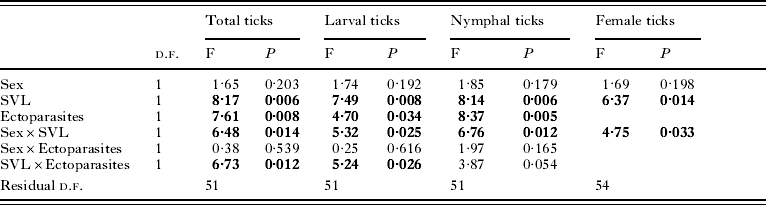
Tick loads were significantly negatively related to body condition of tuatara in September (Table 2). Individuals with more ticks were in poorer condition (Fig. 2). There was also a negative effect of SVL on body condition of tuatara (β=−0·0002); however, tick load explained more variation in body condition (r 2=0·052) than SVL (r 2=0·0006). There was a significant interaction between tuatara SVL and tick load on body condition. The negative relationship between tick load and body condition was stronger for larger individuals than smaller individuals (Fig. 2). Although there was no effect of sex on body condition, there was a significant interaction between SVL and sex. Female body condition was more strongly negatively related to SVL (β=−0·001, r 2=0·181) than male body condition (β=−0·0004, r 2=0·046).
Negative relationship between tick (Amblyomma sphenodonti) loads and body condition of tuatara (Sphenodon punctatus) in September 2006 (n=60) for small (SVL<200 mm, open circle, dotted line), medium (SVL>200 and <230 mm, grey circle, dashed line), and large (SVL>230 mm, black circle, solid line) tuatara.

Results of mixed model analyses testing the effects of tick loads (Amblyomma sphenodonti) (total ticks, larval ticks, nymphal ticks and female ticks), sex and size (SVL) on the body condition of tuatara (Sphenodon punctatus) during the peak parasite period (September 2006)
(Only terms remaining in the minimal model are shown, and terms in bold are significant (P<0·05). The model for mites is not shown because no terms remained in the minimal model.)

Both larvae and nymph loads in September were significantly negatively related to body condition of tuatara (Table 2), however the model for nymphs explained more variation (r 2=0·057) than the model for larvae (r 2=0·031). Female tick loads in September had no effect on the body condition of tuatara.
Mite loads were not related to body condition of tuatara in March. Host sex and SVL, and interactions among sex, SVL and mite loads had no effect on body condition of tuatara in March.
(2) Effects of body condition on changes in ectoparasite load
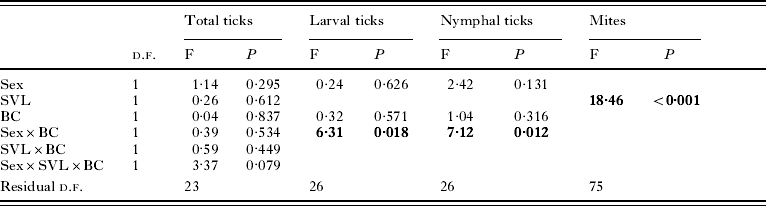
Body condition in March had no effect on subsequent changes in total tick load from March to September or on changes in any of the tick life-cycle stages (Table 3). No other factors or interactions influenced change in overall tick load.
Results of mixed model analyses testing the effects of sex, size (SVL) and body condition (BC) of tuatara (Sphenodon punctatus) in the pre-peak survey (March 2006 for ticks (Amblyomma sphenodonti), January 2005 for mites (Neotrombicula spp.)), on subsequent changes in ectoparasite load (total ticks, larval ticks, nymphal ticks and mites)
(Only terms remaining in the minimal model are shown, and terms in bold are significant (P<0·05). The model for female ticks is not shown because no terms remained in the minimal model.)

However, an interaction between body condition and sex had a significant effect on changes in larvae and nymph loads (Table 3, Fig. 3). This result remained robust when SVL was removed from the models to allow for possible multicollinearity. Male tuatara showed no relationship between body condition in March and changes in larvae (r p=−0·106, t=−0·490, d.f.=21, P=0·629) or nymphs (r p=0·012, t=0·055, d.f.=21, P=0·956). However, female tuatara in better body condition gained more larvae (r sp=0·6, S=48, n=9, P=0·096, Fig. 3a), and fewer nymphs (r sp=−0·616, S=194, n=9, P=0·085, Fig. 3b), than those in poorer body condition. The trends were only marginally significant and may have resulted from a much smaller sample size for females than males (Table 1).
Relationships between body condition of tuatara (Sphenodon punctatus) in March 2006 and subsequent changes in (a) larval tick (Amblyomma sphenodonti) load, and (b) nymphal tick load from March to September for male (filled circle, solid line, n=23) and female tuatara (open circle, dashed line, n=9). Change in larval and nymphal tick loads were calculated for each individual by subtracting its load in March from its load in September.

Body condition in January had no effect on changes in mite load between January and March (Table 3). Only SVL remained in the model, with larger individuals gaining more mites (β=0·006, r 2=0·171).
(3) Effects of ectoparasites on changes in body condition
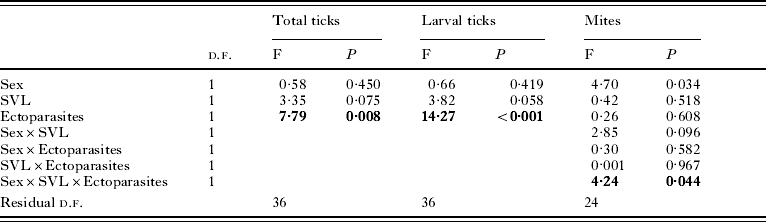
Both overall tick load and larval tick load in September had a significant effect on changes in body condition from September to November (Table 4). Tuatara with higher tick loads declined more in body condition (Fig. 4). Larval load explained more variation in body condition (r 2=0·191) than the model for total tick loads (r 2=0·074). The change in body condition between September and November translated into more than ±5% change in body mass. The other tick life-cycle stages had no significant effect on changes in body condition.
Negative relationship between (a) total tick (Amblyomma sphenodonti) loads and (b) larval tick loads in September 2006, and subsequent changes in body condition of tuatara (Sphenodon punctatus) from September 2006 to November 2006 (n=42). Change in body condition was calculated for each individual by subtracting its body condition in September from its body condition in November.

Results of mixed model analyses testing the effects of sex, size (SVL), and ectoparasite load (total ticks (Amblyomma sphenodonti), larval ticks and mites (Neotrombicula spp.)) in the peak parasite survey (September 2006 for ticks and tick life-cycle stages, March 2005 for mites) on subsequent changes in body condition of tuatara (Sphenodon punctatus)
(Only terms remaining in the minimal model are shown, and terms in bold are significant (P<0·05). The models for nymph and female ticks are not shown because no terms remained in the minimal model.)

Mite loads of tuatara in March had no main effect on subsequent changes in body condition between March and May, but there was a significant three-way interaction between sex, SVL and mite load (Table 4). Smaller males decreased in body condition if they had higher mite loads, but larger males did not (Fig. 5). There was no equivalent effect in female tuatara.
Relationship between mite (Neotrombicula spp.) load in March and subsequent change in body condition of tuatara (Sphenodon punctatus) from March 2005 to May 2005 for small (SVL<200 mm, open circle), medium (SVL>200 and <230 mm, grey circle, dashed line), and large (SVL>230 mm, black circle, solid line) male tuatara (n=34). Change in body condition was calculated for each individual by subtracting its body condition in March from its body condition in May.

DISCUSSION
In September, at the peak of tick infestation and feeding, tuatara with higher tick loads were in poorer condition, and those hosts declined further in condition between September and November. The relationship was particularly strong for larval ticks, which are the most abundant tick life-cycle stage on tuatara (Godfrey et al. Reference Godfrey, Bull and Nelson2008). Tick loads (particularly larvae) declined sharply between September and November as ticks engorged and detached (Godfrey et al. Reference Godfrey, Bull and Nelson2008). The decline in body condition associated with high total tick and larval loads probably resulted from the energetic demands associated with the synchronous feeding of many ticks over this short period. Leukocyte levels are elevated in tuatara with higher tick loads (Burnham et al. Reference Burnham, Keall, Nelson and Daugherty2006), thus additional energetic demands from an immune response to high tick loads may also contribute to the decline in condition.
When testing the alternate hypothesis, we found a marginal effect of body condition on changes in larval and nymphal tick loads of female tuatara. This could reflect differences in the timing of infestation periods, since larvae attach earlier (November–March) than nymphs (March–May) (Godfrey et al. Reference Godfrey, Bull and Nelson2008). Thus our measure of body condition may be more relevant to changes in nymph loads than larvae. Since the sample size for female hosts was small, more data are necessary to clarify whether body condition may affect the susceptibility of female tuatara to infestation by nymphal ticks.
Feeding by mites is highly synchronized in March (Godfrey et al. Reference Godfrey, Bull and Nelson2008), but we detected no overall effect of mite loads in March on subsequent changes in body condition from March to May. Mite loads in 2005 were the highest observed over a 3-year study (Godfrey et al. Reference Godfrey, Bull and Nelson2008), suggesting our finding did not result from unusually low mite loads. Nevertheless, we found an effect only among small males, where those with more mites lost more body condition. Ectoparasites could be more costly to smaller hosts since they harbour more parasites per unit body surface area than larger individuals with equivalent loads (Hart et al. Reference Hart, Hart, Mooring and Olubayo1992; Mooring and Hart, Reference Mooring and Hart1997; Hawlena et al. Reference Hawlena, Khokhlova, Abramsky and Krasnov2006). Also, smaller males are less socially dominant, and may be under greater social stress in March, when mating and territorial behaviour is at a peak (Moore et al. Reference Moore, Daugherty, Godfrey and Nelson2009).
These findings are consistent with the hypothesis that ectoparasites reduce the body condition of tuatara, and provide little evidence to suggest that host body condition affects susceptibility to infestation. Susceptibility to infection could be influenced on a seasonal level by seasonal changes in body condition or hormones. Body condition of tuatara declines between January and March (Moore et al. Reference Moore, Hoare, Daugherty and Nelson2007) in the same period when testosterone levels of males and breeding females peak (Cree et al. Reference Cree, Cockrem and Guilette1992). This period is just before tick infestation begins to increase, and coincides with the time when mite loads are highest (Godfrey et al. Reference Godfrey, Bull and Nelson2008). In reptiles, increased testosterone levels are associated with increased susceptibility to parasite infection (Klukowski and Nelson, Reference Klukowski and Nelson2001; Roberts et al. Reference Roberts, Buchanan and Evans2004; Cox and John-Alder, Reference Cox and John-Alder2007). Thus, on a seasonal level, either reduced body condition or increased hormone levels could enhance host susceptibility to ectoparasite infestation. However, other factors may influence individual variability in host susceptibility to ectoparasite infestation. Ectoparasite infection results from contact between hosts and free-living infectious stages, so host behaviour could influence individual exposure to ectoparasites, and consequently infestation patterns. Individual variation in hormone levels, particularly testosterone may then influence immunity to infection. These variable factors in transmission success require further research.
Our study highlights the advantage of temporal comparisons in understanding the causality of correlations between infection level and condition (ticks), and in detecting more subtle effects of parasites where correlations were not observed (mites). However, our study remains observational, and results could be affected by other co-varying factors. For example, if higher parasite prevalence coincided with poor quality habitats, then reduced body condition could result from restricted resources rather than parasite infection. However, our study was conducted across 3 closed canopy forest study plots that had similar microclimatic conditions and resource quality, thus environmental gradients are unlikely to confound our findings. Alternatively, if high tick loads are also associated with a form of physiological stress, then the stress may cause the decline in condition rather than, or in addition to, tick loads. However, we would expect a strong effect of body condition on changes in parasite loads if this were the case, which we did not detect. Over the period that body condition declined (September–November), tick loads also declined, suggesting that a decline in body condition is not coupled with an increased susceptibility to infection. Testing both alternate hypotheses at biologically meaningful intervals should reduce the chance that the results are confounded.
Impacts of parasites and conservation
Few studies of threatened species can explore the effects of endemic parasites through experimental manipulation, thus most are limited to observational datasets to infer the costs of parasites to hosts (Valera et al. Reference Valera, Hoi and Kristin2006; Bunbury et al. Reference Bunbury, Barton, Jones, Greenwood, Tyler and Bell2007, Reference Bunbury, Jones, Greenwood and Bell2008; Zhang et al. Reference Zhang, Daszak, Huang, Yang, Kilpatrick and Zhang2008). Since threatened species are often subjected to numerous sources of stress (Lafferty and Kuris, Reference Lafferty and Kuris1999), negative correlations between infection and body condition could have other causes. A dynamic approach, as demonstrated in this study, has shown that ectoparasites reduce the body condition of their protected hosts. Surprisingly, this approach has rarely been used (Dawson and Bortolotti, Reference Dawson and Bortolotti2001; Beldomenico et al. Reference Beldomenico, Telfer, Gebert, Lukomski, Bennett and Begon2008), but has the potential to provide important insights into the impacts of parasites in natural populations.
Our findings are consistent with observational (Amo et al. Reference Amo, Lopez and Martin2004; Irvine et al. Reference Irvine, Corbishley, Pilkington and Albon2006; Lourenco and Palmeirim, Reference Lourenco and Palmeirim2007), and experimental (Merino et al. Reference Merino, Moreno, Sanz and Arriero2000; Neuhaus, Reference Neuhaus2003; Tomas et al. Reference Tomas, Merino, Moreno and Morales2007) studies that suggest parasites can reduce the body condition of their hosts. Body condition is a non-destructive estimate of the energetic state of an individual (stored versus expended energy) (Schulte-Hostedde et al. Reference Schulte-Hostedde, Zinner, Millar and Hickling2005). Thus, energy deficits (negative body condition) can reduce the resources available for direct fitness-related traits, such as reproduction, growth and survival (Robb et al. Reference Robb, Martin and Hannon1992; Murray, Reference Murray2002; Wauters et al. Reference Wauters, Vermeulen, Van Dongen, Bertolino, Molinari, Tosi and Matthysen2007). Condition-mediated effects of parasites on host fitness have been observed in other taxa. Wild rabbits heavily infected with mxyoma virus and intestinal helminths had reduced body mass, while body mass was positively related to female fecundity (Lello et al. Reference Lello, Boag and Hudson2005). Similarly, female Columbian ground squirrels with experimentally reduced ectoparasite loads increased their body mass and had larger litters than females that were not treated (Neuhaus, Reference Neuhaus2003). Factors that influence the body condition of tuatara have implications for reproductive frequency in tuatara. Female tuatara held under captive conditions with high resource availability can reproduce in consecutive years (Moore et al. Reference Moore, Nelson, Keall and Daugherty2008). However, on North Brother Island, where resource availability is low, female tuatara reproduce on average only once every 9 years (Mitchell et al. Reference Mitchell, Allendorf, Keall, Daugherty and Nelson2009). Ectoparasites, with similar negative effects on body condition, could also reduce the frequency of tuatara reproduction. However, long-term studies are necessary to reveal the impacts of ectoparasites on direct fitness related traits of tuatara.
High tick loads were associated with a small reduction in tuatara body mass (~5%), therefore ticks are unlikely to have a detrimental effect on the large, stable population of tuatara on Stephens Island in the short-term. Thus, the value of our findings lies in the long-term conservation management of the species. Understanding the effects of parasites on tuatara, and the magnitude of these effects, will aid conservation management decisions if changes in host-parasite dynamics lead to increased ectoparasite burdens in this, or other populations of tuatara.
Since the survival of ticks and mites is partially dependent on the microclimatic conditions of their off-host environment (Needham and Teel, Reference Needham and Teel1991), factors that alter this environment may also alter the ectoparasite loads of hosts. Habitat deterioration is not a concern for tuatara since populations are located in protected reserves (Gaze, Reference Gaze2001). However, habitat restoration of open pastures on Stephens Island could change the microclimatic conditions of the off-host environment for ectoparasites, and subsequently their survival or transmission. Similarly, the developmental rate of acarids increases with temperature (Oliver, Reference Oliver1989), thus changes in climate could alter the life-cycle duration and the transmission dynamics of the ectoparasites. For example, increased temperatures in the Arctic have shortened the life cycle of parasitic nematodes, and altered the transmission dynamics of the parasite, leading to increased impacts on their wild bovid hosts (Kutz et al. Reference Kutz, Hoberg, Polley and Jenkins2005). Thus, monitoring host-parasite interactions is necessary to detect future changes in parasite loads. Understanding the current impacts of parasites will allow us to predict the implications of future changes in host-parasite associations. If predicted impacts pose a risk to the survival of tuatara populations, then parasite removal could be used as a conservation strategy.
However, maintaining ecological and evolutionary processes is a central aim of conservation management (Thompson, Reference Thompson1996; Altizer et al. Reference Altizer, Harvell and Friedle2003). Thus, unless parasites threaten the survival of these populations, it is important to retain natural host-parasite associations. Retaining parasites in host populations could maintain genetic diversity within these populations by enhancing selection pressure for fit genotypes (Altizer et al. Reference Altizer, Harvell and Friedle2003; Smith et al. Reference Smith, Acevedo-Whitehouse and Pedersen2009). This is particularly important where population densities are high, as they are on Stephens Island (Moore et al. Reference Moore, Hoare, Daugherty and Nelson2007), and a novel disease may spread quickly if genetic diversity is low. Since Stephens Island tuatara are frequently used as a source population for translocations, the maintenance of a genetically robust population is particularly important in the long-term success of translocations.
Similarly, it may be beneficial to retain these ecological and evolutionary processes in the establishment of new populations of tuatara, by translocating tuatara with their parasites. However, since the ectoparasites reduce tuatara body condition, parasites could pose a risk to the success of translocations. Tuatara usually gain weight following translocations (Nelson et al. Reference Nelson, Keall, Brown and Daugherty2002; Ruffell, Reference Ruffell2005; McKenzie, Reference McKenzie2007), which would offset any declines in body condition caused by ticks. Furthermore, during the early stages of a newly translocated population, ectoparasite loads remain at low levels (McKenzie, Reference McKenzie2007), since ticks are not present in the new environment to sustain infection in hosts as they would in a natural population. Thus, in the short-term, ticks are unlikely to have a significant negative effect on the success of tuatara translocations. However, the long-term consequences of translocating tuatara with their ectoparasites depends on the survival of the ectoparasites in the new environment and the transmission dynamics of the parasites, which will be the subject of further study.
The short-term negative effects of parasites involve a trade-off with long-term benefits, which should be considered in conservation management of tuatara. Careful monitoring of host-parasite interactions is required to ensure that parasites remain an important part of the ecology and evolution of the host species, and not threaten their survival.
ACKNOWLEDGEMENTS
Three anonymous reviewers provided constructive comments that improved the manuscript. We thank the Ngati Koata (Iwi for Takapourewa/Stephens Island) and the New Zealand Department of Conservation (DoC) for their support. This research was funded by grants awarded to N. J. N. by San Diego Zoo, Victoria University of Wellington Research Fund, Allan Wilson Centre for Molecular Ecology and Evolution, grants awarded to S. S. G. by the Holsworth Wildlife Research Endowment, Flinders University Overseas Field Trip Grant, Wildlife Disease Association (Australasian Section) and the Australian Society for Herpetology, and grants awarded to C.M.B. by the Australian Research Council. We also thank Susan Keall, Clare Allen, Jon deVries, Hilary Miller, Kelly Hare, Joanne Hoare, Katherine McKenzie, Jeanine Refsnider, and Kimberly Miller for assistance with field work, and Nicola Mitchell for comments on a previous version of this manuscript. This research was conducted under DoC research permits (LIZ0410, NM-16723-RES), and with Victoria University of Wellington animal ethics approval (permit #2006R12). S. S. G. was supported by an Australian Postgraduate Award. All procedures carried out in this study conformed to the current laws of New Zealand.