Introduction
Kristiansenite, Ca2ScSn(Si2O7)(Si2O6OH), silesiaite, Ca2Fe3+Sn(Si2O7)(Si2O6OH) and kozłowskiite, Ca4Fe2+Sn3(Si2O7)2(Si2O6OH)2, are three isostructural sorosilicate minerals that contain both protonated and normal disilicate anions. Kristiansenite was first found in an amazonite pegmatite at Heftetjern, Tørdal, Telemark, Norway, and described by Raade et al. (Reference Raade, Ferraris, Gula, Ivaldi and Bernhard2002). Its crystal structure was refined by Ferraris et al. (Reference Ferraris, Gula, Ivaldi, Nespolo and Raade2001) in the triclinic system with the unconventional space group C1.
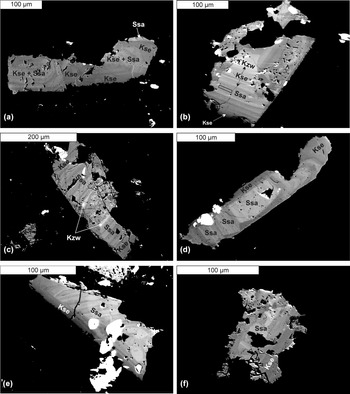
Silesiaite, ideally Ca2Fe3+Sn(Si2O7)(Si2O6OH), defined as a ferric analogue of kristiansenite, ideally Ca2ScSn(Si2O7)(Si2O6OH), was approved by the Commission on New Minerals, Nomenclature and Classification (CNMNC) of the International Mineralogical Association based on an intergrowth of two oscillatory zoned kristiansenite–silesiaite crystals, ~300 μm long, collected in a granitic pegmatite exposed in the Szklarska Poręba quarry, ~80 km southwest of Wrocław, Karkonosze granite massif, Lower Silesia, Poland (Pieczka et al., Reference Pieczka, Ma, Rossman, Evans, Groat and Gołębiowska2017). In the crystals, silesiaite occurred in the form of Fe-dominant bands, usually reaching only a few micrometres in thickness (Fig. 1a) and, therefore, making it practically impossible to manually extract material suitable for X-ray single-crystal measurements. The intergrowth was the only kristiansenite–silesiaite specimen found and stored in our collection until 2017 (see below). The unsuccessful extraction of suitable single-crystal fragments forced the search for better material for structural studies. Consequently, the surface of the sample was ground down by some tens of micrometres and this revealed the presence of several intensely zoned kristiansenite–silesiaite crystals suitable for single-crystal extraction using the focused ion beam (FIB) method. However, this delayed preparing the required documentation of this new mineral.
(a–f) Representative BSE images of zoned kristiansenite–silesiaite crystals from Szklarska Poręba (holotype # SP5). The narrow frame in figure (b) indicates the place of extraction of a single crystal for structural studies. Mineral name abbreviations: Kse – kristiansenite, Kzw – kozłowskiite, Ssa –silesiaite (Warr, Reference Warr2021). White inclusions are cassiterite or fersmite.

Until 2021 we were unaware that a similar sample had been collected in 1995 in Åland, Finland, by the mineral collector Ulf Nyberg (1948–2021). At that time the preliminary analyses (using scanning electron microscopy and energy dispersive spectroscopy) of the material gave no indication of Sc but only Fe3+; therefore the crystals were considered a probable Fe3+-analogue of kristiansenite, potentially a new mineral (U. Nyberg, pers. comm. to RK). Unfortunately, further investigation was put aside until 2017, when one of the authors (RK) obtained a few samples from Ulf Nyberg. Their true identity was quickly verified with electron-probe microanalysis by Dr. D. Nishio-Hamane (Institute of Solid State Physics, University of Tokyo). Around that time, the mineral from Szklarska Poręba in Poland was approved as the new mineral silesiaite (symbol Ssa) by the CNMNC (IMA2017-064, Pieczka et al., Reference Pieczka, Ma, Rossman, Evans, Groat and Gołębiowska2017). The mineral from Finland appeared to be identical to the type silesiaite from Poland. The interchange of information between RK and AP in 2021 resulted in a collaboration leading to the investigation of Sc-free silesiaite from Finland simultaneously with the work on type silesiaite from Szklarska Poręba. Additionally, in material from the Szklarska Poręba quarry, a thin core band with an atypically high Sn-content was recognised and approved by the CNMNC as a new mineral kozłowskiite (IMA2021-081, Pieczka et al., Reference Pieczka, Zelek-Pogudz, Gołębiowska, Stadnicka and Evans2022a, Reference Pieczka, Zelek-Pogudz, Gołębiowska, Stadnicka and Evans2022b). The holotype silesiaite, also containing type kozłowskiite, is deposited as specimen SP5 in the collection of the Mineralogical Museum of the University of Wrocław, catalogue number MMUWr IV7929 (University of Wrocław, Faculty of Earth Science and Environmental Management, Institute of Geological Sciences, Mineralogical Museum, Poland). The thin section with the Finland silesiaite is stored in the Geological Museum, University of Oslo, Norway, catalogue number 44418.
As a result of the studies, compositional and structural data were completed for the holotype silesiaite from Szklarska Poręba in Poland, and for Sc-free silesiaite from Finland, along with additional data required by the CNMNC for a type specimen. This paper presents these new data on the minerals forming the kristiansenite group.
Geological setting
The Polish occurrence of kristiansenite with kozłowskiite and silesiaite is related to pegmatites of the Karkonosze granite, mainly a biotite-bearing porphyritic to equigranular and subordinate two-mica and granophyre granite (Berg, Reference Berg1923; Borkowska, Reference Borkowska1966). The granite massif is the largest Variscan pluton in the Western Sudetes at the north-eastern margin of the Bohemian Massif. A brief description of the granite is given in Pieczka et al. (Reference Pieczka, Zelek-Pogudz, Gołębiowska, Stadnicka and Evans2022b). All the three minerals were found in the same pegmatite specimen collected by AP around 2002 in the Szklarska Poręba Huta quarry (50.82778°N, 15.48944°E) in Lower Silesia, SW Poland; currently the only place in the Polish part of the massif where the granite is exploited. In this quarry, lenses and nests of NYF-type pegmatites, up to several tens of centimetres across, are relatively frequent in coarse-grained granite. Small pegmatite nests, only a few centimetres across, and mineralised quartz–feldspar veinlets in fine-crystalline aplogranite are usually overprinted by hydrothermal (W, Sn, Mo and Bi)-bearing mineralisation also related to the granite intrusion (Karwowski et al., Reference Karwowski, Olszyński and Kozłowski1973; Kozłowski et al., Reference Kozłowski, Karwowski and Olszyński1975; Olszyński et al., Reference Olszyński, Kozłowski and Karwowski1976; Pieczka and Gołębiowska, Reference Pieczka and Gołębiowska2012). Silesiaite, similarly to kristiansenite and kozłowskiite, was found in an ore-mineralised pegmatite specimen related to the aplogranite. All these minerals of the kristiansenite group present in the locality have a hydrothermal origin, and their crystallisation was conditioned most probably by varying incorporation of Sc3+, Fe2+, Fe3+ and Sn4+ into the growing crystals. In the holotype specimen from Szklarska Poręba, silesiaite is accompanied by kristiansenite, kozłowskiite, quartz, albite, andradite, allanite-(Ce), zircon, cassiterite, Sn-bearing titanite, malayaite, fergusonite-(Y), Sc-bearing columbite, clinochlore, bismuthinite, chalcopyrite and pyrite.
In Finland, silesiaite was collected in 1995 by Ulf Nyberg in the Häiviäntien pegmatite (Häiviä quarry), in Forssa, Kanta-Häme proper (60.79222°N, 23.62528°E), in the southwestern part of Finland, ca. 100 km northwest of Helsinki. The pegmatite is located in the Ostrobothia schist belt, which is in the Vaasa migmatite complex and part of the central Finland granitoid complex, and part of the Paleoproterozoic, 1.90–1.87 Ga Svecofennian accretionary arc complex of central and western Finland. With a few exceptions, the rare-element granitic pegmatites of this region belong to the LCT petrogenetic family; most of them are beryl pegmatites of the beryl–columbite subtype (Alviola et al., Reference Alviola, Mänttäari, Mäkitie and Vaasjoki2001). Based on the description of the locality available on the mindat.org website (https://mindat.org/loc-206068.html), ~50 valid minerals occur in the quarry, although the inventory is dominated by common pegmatite minerals, sulfides, some B- and Be-minerals such as beryl, bavenite, milarite and bertrandite, whereas elbaite, dravite and datolite are subordinate.
Appearance and physical properties
The Szklarska Poręba silesiaite forms thin bands in mixed kristiansenite–silesiaite crystals with maximum sizes of ~350 × 100 μm (Fig. 1). In back-scattered electron images (BSE), the crystals are highly inhomogeneous, typically showing a silesiaite core with a fine net of parallel compositional zones and, less frequently, small irregular patches. The cores are overgrown by a rim composed of numerous thin alternating Sc-dominant and Fe-dominant bands of oscillatory zoning, with individual thicknesses ranging from 1 to a maximum of 10 μm. In the outermost zones, kristiansenite predominates, forming relatively homogeneous areas 10–40 μm in thickness. Type silesiaite has a Mohs hardness of ~6 by analogy to kristiansenite. No cleavage, parting, tenacity or fracture were observed. Density and optical properties were not measured due to the extremely small amount of the mineral. Density calculated on the basis of the empirical formula and refined unit-cell volume is 3.737 g⋅cm–3. Silesiaite is biaxial, with a mean refractive index of ~1.727 calculated from the Gladstone–Dale relation (Mandarino, Reference Mandarino1979, Reference Mandarino1981) using the empirical formula and calculated density. The value is comparable with the type kristiansenite mean refractive index of 1.74 (Raade et al., Reference Raade, Ferraris, Gula, Ivaldi and Bernhard2002).
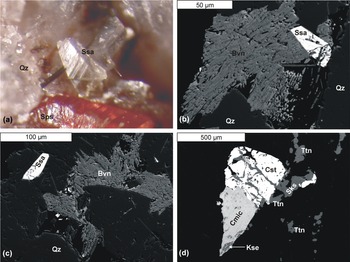
The Häiviäntien silesiaite occurs as colourless to rarely greenish-grey, transparent tapering single crystals or intergrowths, up to 1.5 mm in length, grown in small pegmatite voids, in which it can be associated with spessartine, epidote, pumpellyite-Fe and bavenite (Fig. 2). They show the typical diagonal striation on the surface, similar to the kristiansenite crystals from Norway (Raade et al., Reference Raade, Ferraris, Gula, Ivaldi and Bernhard2002). Although the studied samples of the pegmatite had no visible crystals, when examined in polished sections, several tapering crystals to ~50 μm in size were observed and analysed (Fig. 2b,c). Almost all of these were devoid of Sc. Crystals of the mineral are highly homogeneous, and no oscillatory zoning is visible in BSE images. Surprisingly, the only ~100 μm long inclusion of a kristiansenite-like phase found in a Mn-bearing calciomicrolite (6.92 wt.% CaO and 8.43 wt.% MnO; 5.18 at.% Ca versus 4.99 at.% Mn) intergrown with cassiterite was determined to be a (Ta, Nb)-bearing kristiansenite (4.27 wt.% Sc2O3, 2.04 wt.% Ta2O5, 0.91 wt.% Nb2O5). The grain is associated additionally with stokesite and a highly (Ta, Nb, Sn, Fe, Al)-substituted titanite evolving towards żabińskiite (Fig. 2d). Kristiansenite and stokesite are both new species for Finland.
Silesiaite and kristiansenite from the Häiviäntien pegmatite: (a) a crystal of silesiaite, ~0.7 mm in size, in a void formed by quartz and spessartine, (b–c) BSE images of silesiaite from the pegmatite, (d) inclusions of (Nb, Ta)-bearing kristiansenite in a calciomicrolite intergrown with cassiterite, stokesite and titanite. Mineral name abbreviations: Bvn – bavenite, Cst – cassiterite, Kse – kristiansenite, Qz – quartz, Sks – stokesite, Sps – spessartine, Ssa – silesiaite and Ttn – titanite (Warr, Reference Warr2021); Cmic – a calciomicrolite.

Composition of silesiaite
Both silesiaite crystals were analysed at the Inter-Institute Analytical Complex for Minerals and Synthetic Substances at the University of Warsaw, Poland, using a Cameca SX 100 electron microprobe operating in wavelength-dispersive X-ray spectrometry mode (WDS) with an accelerating voltage of 15 kV, a beam current of 20 nA, peak count time of 20 s, background time of 10 s, and a beam diameter of 2 μm (number of analyses n = 3 for silesiaite from Szklarska Poręba and 8 for silesiaite from the Häiviäntien pegmatite). Reference materials, analytical lines, diffracting crystals and mean detection limits (element wt.%) were as follows: albite – Na (TAP, Kα, 0.02); diopside – Mg (TAP, Kα, 0.02), Si (TAP, Kα, 0.03) and Ca (PET, Kα, 0.04); orthoclase – Al (TAP, Kα, 0.03); rutile – Ti (PET, Kα, 0.09); rhodonite – Mn (LIF, Kα, 0.12); hematite – Fe (LIF, Kα, 0.12); LiNbO3 – Nb (PET, Lα, 0.10); LiTaO3 – Ta (TAP, Mα, 0.10); cassiterite – Sn (LPET, Lα, 0.07); zircon – Zr (LPET, Lα, 0.07); and pure Sc – Sc (LPET, Kα, 0.02). The contents of Na were found to be below the detection limits. The raw data were reduced with the PAP routine of Pouchou and Pichoir (Reference Pouchou, Pichoir, Heinrich and Newbury1991). The H2O content was not analysed due to the scarcity of the material. It was calculated for one hydrogen atom, found from the difference-Fourier map during the crystal-structure analysis, which participates in the formation of one hydroxyl group in the formula calculated for Z = 4. Therefore, the empirical formulae of the studied silesiaites were normalised based on the kristiansenite stoichiometry to 13 O atoms + 1 (OH) group with a Fe3+/Fetotal ratio matching the contents of all cations to 8 atoms per formula unit (apfu). Analytical data of both crystals are given in Table 1.
Chemical compositions of the studied silesiaite crystals (wt.%).

S.D. – standard deviation; b.d.l. – below detection limit.
* Total Fe measured as Fe2O3 was equal to 7.82 wt.% (range: 7.11–8.97 wt.%; S.D.: 1.00 wt.%) in the Szklarska Poręba crystal, and 10.38 wt.% (range: 9.93–10.82 wt.%, S.D. 0.34 wt.%) in the Häiviäntien silesiaite. The presented Fe2O3 and FeO contents are calculated on the basis of the kristiansenite stoichiometry.
The empirical formula of type Szklarska Poręba silesiaite presented in the form of valence groups of octahedral cations is:
Ca2.001(2)[(Sn1.105(6)Zr0.009(1))Σ1.114(Fe3+0.523(78)Sc0.185(62)Al0.070(14))Σ0.779 (Fe2+0.065(12)Mn2+0.041(5)Mg0.003(3))Σ0.110]Σ2.003(Si3.997(2)O13OH) (numbers in parentheses are standard uncertainties). It suggests that the Ca and Si sites should be solely occupied by Ca and Si atoms, respectively, and the highest compositional differentiation takes place at the octahedral M sites. The excess of tetravalent M-site cations above 1 apfu is equal to the content of divalent occupants at the sites within the empirical accuracies. This corroborates that the two compositional variables are coupled by the substitution 2M 3+ = M 2+ + M 4+, still more pronounced in kozłowskiite (Pieczka et al., Reference Pieczka, Zelek-Pogudz, Gołębiowska, Stadnicka and Evans2022b).
The Häiviäntien silesiaite has the following empirical formula: Ca2.006(8)[(Sn1.110(18)Ti0.006(3))Σ1.107(Fe3+0.648(50)Al0.063(11))Σ0.710 (Fe2+ 0.140(30)Mn2+0.011(3)Mg0.005(2))Σ0.155(Nb0.020(6)Ta0.011(3))Σ0.040]Σ2.009 (Si3.991(14)O13OH). The formula is similar to that typical for the type specimen in terms of the Ca- and Si-site occupancies, however it differs in the M-site population. The absence of Sc needs special attention because the element is a common constituent in kristiansenite-group minerals known from other occurrences (Raade et al., Reference Raade, Ferraris, Gula, Ivaldi and Bernhard2002; Guastoni and Pezzotta, Reference Guastoni and Pezzotta2004; Prado-Herrero et al., Reference Prado-Herrero, Garcia-Guinea, Crespo-Feo, Correcher and Menor2009; Výravský et al., Reference Výravský, Škoda and Novak2017), although Cepedal et al. (Reference Cepedal, Fuertes-Fuente and Martin-Izard2021) described recently similar Sc-free silesiaite from skarns of El Valle-Boinás, Asturias, Spain. In BSE images, the Häiviäntien silesiaite seems to be texturally homogeneous because the two main constituents, Sn and Fe, fill the M sites up to ~95%. The M sites in the Szklarska Poręba silesiaite are filled with Sn and Fe only up to ~85%, while in the kristiansenite bands it is only up to ~60%, which in consequence made the Szklarska Poręba crystals distinctly zoned. The content of tetravalent M-site cations differs slightly from that of the divalent cations in the Finland crystals, however, the acceptance of the aforementioned coupled substitution indicates that a small surplus of divalent cations (~0.039 apfu) could be related to the content of Nb5+ and Ta5+ (0.031 apfu) by another coupled substitution M 4+ + M 3+ = (Nb, Ta)5+ + (Fe, Mn, Mg)2+. In consequence, the simplified formula of silesiaite, presented as the smallest formal unit, is Ca2[(Fe3+,Sc)1–2xFe2+xSn1+x)]Σ2(Si2O7)(Si2O6OH), where x ≤ 0.25. The ideal formula of the mineral is Ca2(Fe3+Sn)(Si2O7)(Si2O6OH), which requires (in wt.%): CaO 18.94, Fe2O3 13.49, SnO2 25.46, SiO2 40.59 and H2O 1.52.
In the classification of Strunz and Nickel (Reference Strunz and Nickel2001), silesiaite belongs, along with kristiansenite and kozłowskiite, to class 09.BC, i.e. sorosilicates with Si2O7 groups, without non-tetrahedral anions, cations in octahedral and higher coordination. In the classification of Dana (Gaines et al., Reference Gaines, Skinner, Foord, Mason and Rosenzweig1997), it belongs to class 56.02, i.e. sorosilicate Si2O7 groups and O, OH, F and H2O, with cations in [4] and/or >[4] coordinations (group 04: cuspidine–wöhlerite).
Raman spectroscopy
Raman spectra of silesiaite were collected in back-scattered geometry with a Horiba Labram HR spectrometer integrated with an Olympus BX 41 confocal microscope. The system was calibrated using the Rayleigh line. The spectra were recorded in the range of 50–4000 cm–1 using the 532 nm line of a solid-state Nd-YAG laser (10 mW), and 1800 grating on randomly oriented sections of the studied crystals mounted in epoxy resin. The specimens were used previously for electron microprobe analysis, and later homogeneous parts of them were extracted for the X-ray diffraction measurements. Prior to the Raman measurements, the carbon coating of the discs was removed. The Raman measurements were carried-out by an accumulation of two scans, each with an acquisition time of 600 s at a microscope magnification of 100×, with a minimum lateral and depth resolution of ~1 μm, and an estimated analytical spot size of ~5 μm.
In the range of O–H stretching modes of Raman shift of 2500–4000 cm–1, the spectra are effectively masked by superimposed luminescence and reveal no distinct absorption. Very low-intense absorption bands at ~2880, 2930 and 3070 cm–1 could be assigned to hydroxyl groups participating in the formation of moderate hydrogen bonds with parameters discussed below. However, as mentioned by Raade et al. (Reference Raade, Ferraris, Gula, Ivaldi and Bernhard2002), C–H stretching modes of organic impurities can also appear in the Raman shift range of 2700–3000 cm–1, and they are most probably responsible for the range absorption. We also assign them to absorption by epoxy resin, used in the specimen preparation.
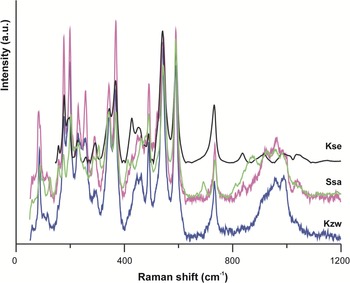
In the range of 50–1200 cm–1, the spectra of both silesiaites, from Szklarska Poręba (Fig. 3, Ssa magenta) and from Häiviäntien (Fig. 3, Ssa green), are close to those of kristiansenite (Fig. 3, Kse black) and kozłowskiite (Fig. 3, Kzw blue), which confirms that the three minerals (kristiansenite, silesiaite and kozłowskiite) share a common structure type (Pieczka et al., Reference Pieczka, Zelek-Pogudz, Gołębiowska, Stadnicka and Evans2022b). The spectrum of Szklarska Poręba silesiaite contains the following bands at Raman shifts (in cm–1; b = broad; m = medium; s = strong; w = weak): 1042 (w), 979 (m, b), 961 (m, b) corresponding to asymmetric Si–O stretching vibrations; 933 (m, b) and 840 (w) related to symmetric Si–O stretches; 734 (m), 591 (s), 543 (s), 522 (w), 491 (s), 449 (b), 429 (w) to ν4 Si–O modes; and 368 (s), 344 (m), 289 (m), 257 (m), 230 (m), 199 (s), 177 (s) and 83(m) cm–1 to Si–O bending and lattice motions. Similar bands were observed in the Raman spectrum of the Häiviäntien silesiaite: 1034 (w, b), 983 (m, b), 960 (m, b), 932 (m, b), 873 (m, b), 735 (m), 692 cm–1 (w), 590 (s), 544 (s), 490 (m), 462 (m), 429 (w), 413 (w), 369 (m), 342 (m), 305 (w), 286 (w), 255 (w, b), 231 (w, b), 202 (s), 175 (m), 157 (m), 125 (m), 99 (m) and 89 (m). The significant difference between the spectra of both crystals observed around 840–870 cm–1 can be related to different M1–M4 site-occupation schemes and the orientation of the crystal sections from which the spectra were collected.
Raman spectra of silesiaite from Szklarska Poręba (Ssa; magenta) and from Häiviäntien (Ssa; green) compared to the spectrum of kristiansenite (Kse; black; RRUFF database R090022, https://rruff.info/) and kozłowskiite (Kzw; blue).

Powder X-ray diffraction data
Powder X-ray diffraction data could not be collected due to the scarcity and heterogeneity of the silesiaite specimens. In consequence, we only calculated these data from the refined single-crystal structures using the Diamond program, Version 3.2k (Crystal Impact, 2014). The seven strongest reflections are [d in Å (I) hkl]: 5.178 (63.7) 111, 1$\bar{1}$ 1; 4.563 (30.0)${\rm \;}\bar{2}$
 02; 3.142 (64.2) 004; 3.090 (25.3) $\bar{3}$
 11,${\rm \;}\bar{3}\bar{1}$
 1; 3.083 (100) $\bar{2}\bar{2}$
 2, $\bar{2}$
 22; 2.589 (28.3) 2$\bar{2}$
 2, 222; and 2.137 (29.2) $\bar{3}$
 31, $\bar{3}\bar{3}$
 1 for silesiaite from Szklarska Poręba, and 5.188 (67.7) 111, 1$\bar{1}$
 1; 4.558 (30.6) $\bar{2}$
 02; 3.136 (63.5) 004; 3.087 (25.1) $\bar{3}$
 11, $\bar{3}\bar{1}$
 1; 3.078 (100) $\bar{2}\bar{2}$
 2, $\bar{2}$
 22; 2.584 (28.4) 2$\bar{2}$
 2, 222; and 2.133 (29.0) $\bar{3}$
 31, $\bar{3}\bar{3}$
 1 for silesiaite from Häiviäntien. Full calculated powder X-ray diffraction data have been deposited with the Principal Editors of Mineralogical Magazine and are available as Supplementary material (Tables S1a and S1b).
Single-crystal X-ray diffraction and structure determination
Sample preparation, data collection and refinement
The single crystals of silesiaites from Szklarska Poręba and from Häiviäntien were extracted in the Laboratory of Transmission Electron Microscopy, Academic Centre for Materials and Nanotechnology (ACMiN, AGH University of Science and Technology), using a Quanta 3D 200i (Thermo Fisher Scientific) scanning electron microscope equipped with a Ga+ ion gun, Pt precursor gas injection systems (GIS) and Omniprobe micromanipulator for in situ lift-out. An ion beam accelerating voltage of 30 kV and ion currents in the range of 60 nA to 1 nA were applied. Each of the samples was transferred via a micromanipulator to standard TEM copper half-ring grids. The FIB deposition process (from Pt precursor) was used to attach the manipulator probe to the sample and the foil to the grid. Subsequently, the crystal was transferred to a suitable microloop and placed on the goniometer base.
Single-crystal X-ray diffraction measurements were made in the Laboratory of Single Crystal Diffraction at the Faculty of Chemistry, Jagiellonian University in Kraków, on crystals of dimensions 0.033 × 0.026 × 0.003 mm (silesiaite from Szklarska Poręba, Poland), and 0.055 × 0.017 × 0.009 mm (silesiaite from Häiviäntien, Finland). X-ray diffraction data for each crystal were collected using a XtalLAB Synergy-S (Rigaku–Oxford Diffraction) four-circle diffractometer with a mirror monochromator and microfocus source. The data were collected at the controlled temperature of 293(2) K using MoKα radiation (λ = 0.71073 Å) to a maximum θ value of 29.992° and 29.000°, respectively. The obtained data sets were processed with CrysAlisPro 1.171.40.84a and CrysAlisPro 1.171.41.93a software (Rigaku Oxford Diffraction, 2020), respectively.
The phase problem was solved by direct methods with SHELXT-2014/5 (Sheldrick, Reference Sheldrick2015a). Parameters of the obtained structural model were refined using SHELXL-2018/3 (Sheldrick, Reference Sheldrick2015b). The figures presenting the kozłowskiite structure were prepared with ORTEP-3 for Windows version 2020.1 software (Farrugia, Reference Farrugia2012) and VESTA Version 3 (Momma and Izumi, Reference Momma and Izumi2011). The programs were operated under the WinGX integrated system, version 2020.1 (Farrugia, Reference Farrugia2012).
Silesiaite, Ca2Fe3+Sn(Si2O7)(Si2O6OH) (Z = 4), is isostructural with kristiansenite, Ca2ScSn(Si2O7)(Si2O6OH), and kozłowskiite, Ca4Fe3+Sn3(Si2O7)2(Si2O6OH)2 (Z = 2); all three are triclinic–pseudomonoclinic. The unconventional space group C1 was chosen for easier comparison with kristiansenite [a = 10.0080(2), b = 8.3622(1), c = 13.2994(2) Å, α = 89.987(1), β = 109.095(2), γ = 89.978(1)° and V = 1051.77(3) Å3, found from 14,553 reflections measured in the θ range 3.219–32.290° at 293.0(1) K for the Szklarska Poręba silesiaite, and a = 9.9985(3), b = 8.3446(2), c = 13.2760(4) Å, α = 89.986(3), β = 109.122(2), γ = 90.020(2)° and V = 1046.55(5) Å3, found from 19,753 reflections measured in the θ range 3.240–33.256° at 297.0(1) K for the Häiviäntien silesiaite], although similarly to type kristiansenite (Ferraris et al., Reference Ferraris, Gula, Ivaldi, Nespolo and Raade2001) the structures were metrically monoclinic (Laue group 2/m). From the diffraction experiment the space group was determined as pseudo C2/c. To follow the structural description in the space group C1, which was used by Ferraris et al. (Reference Ferraris, Gula, Ivaldi, Nespolo and Raade2001) to describe the structure of kristiansenite, we had to perform the refinement as 2-component inversion twins with the BASF fractional contributions of 0.372 (0.040) for the Szklarska Poręba silesiaite and 0.640 (0.049) for the Häiviäntien silesiaite. The refinement of 276 structural parameters in C1 (positional and anisotropic displacement parameters for non-hydrogen atoms and positional parameters of hydrogen atoms) gave an R 1 index of 2.02% [R 1(all) = 2.72%, wR 2(all) = 3.95%, and goodness of fit parameter S = 0.999] for the Szklarska Poręba silesiaite, and R 1 = 3.56% [R 1(all) = 4.52%, wR 2(all) = 8.19%, and S = 1.050] for the Häiviäntien silesiaite.
Full details of the diffraction data measurement and structure solution are listed in Table 2. Refined atomic coordinates, equivalent displacement parameters, occupancy for structural sites and anisotropic displacement parameters are presented in Tables 3 and 4, respectively, for silesiaite from Szklarska Poręba and from Häiviäntien. Selected bond lengths are collected in Table 5 and assigned M-site populations are shown in Table 6. Bond valences calculated on the basis of the parameters given by Gagné and Hawthorne (Reference Gagné and Hawthorne2015) are shown in Tables 7 and 8. Table 9 presents the geometrical parameters of hydrogen bonds. The crystallographic information file has been deposited with the Principal Editor of Mineralogical Magazine and is available as Supplementary material (see below).
Crystal data, intensity measurement conditions and structure refinement details for the silesiaite crystals selected from Szklarska Poręba and from Häiviäntien.

* Empirical absorption correction using spherical harmonics, implemented in SCALE3 ABSPACK scaling algorithm. Empirical correction (ABSPACK) includes absorption correction using spherical harmonics and Frame scaling.
R int = Σ|F o2-F o2(mean)|/Σ[F o2]; GoF = S = {Σ[w(F o2–F c2)2]/(n–p+r)}½; R 1 = Σ||F o|-|F c||/Σ|F o|; wR 2 = {Σ[w(F o2–F c2)2]/Σ[w(F o2)2]}½; w = 1/[σ2(F o2) + (AP)2 + BP], where P is [2F c2 + F o2)]/3
rms – root mean square
Atomic coordinates, occupancy, equivalent/isotropic and anisotropic displacement parameters (Å2) for non-hydrogen atoms for silesiaite from Szklarska Poręba, Poland.

Atomic coordinates, occupancy, equivalent/isotropic and anisotropic displacement parameters (Å2) for non-hydrogen atoms for silesiaite from Häiviäntien, Finland.

Selected interatomic distances (Å) in silesiaite from Szklarska Poręba, Poland (PL) and Häiviäntien, Finland (FIN).

Refined M site-scattering and assigned M-site populations for silesiaite.

Bond-valence analysis for the Szklarska Poręba (holotype) silesiaite (based on the assigned site-occupancies).

Bond-valence analysis for the Häiviäntien silesiaite (based on the assigned site-occupancies).

Geometrical parameters of hydrogen bonds in silesiaite (Å, °).

Silesiaite crystal structure
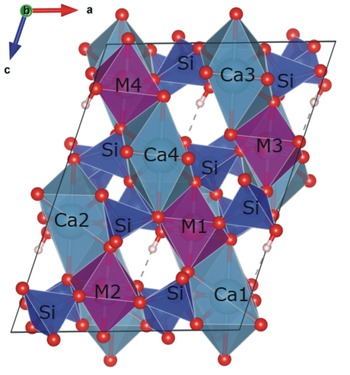
The silesiaite structure is shown in Fig. 4 projected onto (010) with the disilicate groups and the other polyhedra of cations in different alternating (10$\bar{1}$ ) planes. The M-centred octahedra occupied partially by Sn and Fe atoms are isolated from each other and aligned in [101] rows. The hydrogen bonds connect [101] rows of disilicate groups. The contents of the asymmetric unit of the structural model derived from the data for the silesiaite of Szklarska Poręba and the projections of the structure along [010] and [100] are presented in Supplementary materials as Fig. S1 (with hydrogen bonds marked by dashed lines), deposited and available with the Principal Editors of Mineralogical Magazine.
Projection of the silesiaite structure onto (010). The M positions are occupied partially by Sn (violet tint) and Fe (gold tint) atoms.

The Ca1–Ca4 sites are solely occupied by Ca2+ cations, as was also found in the kristiansenite and kozłowskiite crystal structures (Ferraris et al., Reference Ferraris, Gula, Ivaldi, Nespolo and Raade2001; Evans et al., Reference Evans, Gołębiowska, Groat and Pieczka2018; Pieczka et al., Reference Pieczka, Zelek-Pogudz, Gołębiowska, Stadnicka and Evans2022b). The occupancy of the Ca sites exclusively by Ca2+ is corroborated by the refined <Ca–O> distances (Table 5) and calculated bond-valence sums (BVS) (Tables 7, 8). The seven-fold-coordinated Ca atoms form highly distorted polyhedra with Ca–O distances ranging from almost 2.315 Å up to 2.786 Å in the Szklarska Poręba silesiaite and 2.295 Å up to 2.772 Å in that originated from the Häiviäntien pegmatite. The <VIICa1–O> to <VIICa4–O> distances are 2.488, 2.492, 2.502 and 2.493 Å, and 2.482, 2.493, 2.494 and 2.488 Å, respectively. They are slightly shorter by comparison to those found in kristiansenite and kozłowskiite but distinctly longer than the sum of Ca2+ and O2– radii, 2.42–2.44 Å, computed using radii of seven-fold-coordinated Ca2+ and (three or four)-coordinated O2– tabulated by Shannon (Reference Shannon1976). The completion of the Ca coordination sphere by oxygen atoms with two additional O sites at distances of ~3.2 Å and one at a distance of ~3.5 Å, resulting in a (7 + 2 + 1) coordination, is acceptable, as already considered by Ferraris et al. (Reference Ferraris, Gula, Ivaldi, Nespolo and Raade2001) and used in the description of the kozłowskiite structure by Pieczka et al. (Reference Pieczka, Zelek-Pogudz, Gołębiowska, Stadnicka and Evans2022b). The distances <XCa1–O> to <XCa4–O> (2.732–2.740 Å for silesiaite from Poland and 2.724–2.734 Å for silesiaite from Finland) significantly outweigh the value of ~2.59 Å corresponding to the sum of radii for Ca2+ ten-fold-coordinated by O atoms (Shannon, Reference Shannon1976). However, as in the case of kristiansenite and kozłowskiite, the calculated BVS of 1.88–1.98 and 1.90–1.98 valence units (vu), respectively, are closer to the ideal charge of Ca2+ cation. The first coordination sphere of the Ca2+ in the structure of all the kristiansenite-group minerals is indeed very distorted and the influence of more distant O atoms on the central Ca2+ cation is evident.
Compositions of the two silesiaite crystals studied (according to the accuracy level of the microprobe measurements) indicate that the Si sites are filled entirely by silicon atoms. The refined <Si–O> bond lengths, 1.616–1.631 Å in the structure of the holotype silesiaite from Szklarska Poręba and 1.618–1.640 Å in the structure of the Häiviäntien silesiaite, along with the respective BVS at the sites, 3.93–4.09 and 3.84–4.08 vu, respectively (Tables 5, 7, 8), are comparable with those observed in kristiansenite and kozłowskiite by Ferraris et al. (Reference Ferraris, Gula, Ivaldi, Nespolo and Raade2001), Evans et al. (Reference Evans, Gołębiowska, Groat and Pieczka2018) and Pieczka et al. (Reference Pieczka, Zelek-Pogudz, Gołębiowska, Stadnicka and Evans2022b).
The occupancy factors of the four M sites were refined as Sn vs Fe. The structure refinement gives the following numbers of electrons for the M1–M4 sites: 32.6(1); 39.7(1); 39.9(1); 39.6(1) e – and 35.5(2), 42.9(2), 42.2(2) and 31.6(2) e –, respectively (Table 6), resulting from the refined Sn–Fe occupancies presented in Tables 3, 4. The refined total M-site scattering, 151.8(4) e – in the case of the Szklarska Poręba crystal and 152.2(7) e – for the Häiviäntien silesiaite, agrees well with 153.5 e – and 156.7 e – calculated from the formulae derived from electron microprobe analysis for Z = 2. Empirical occupancies of the M-sites were optimised in the system of M 4+–M 3+–M 2+ cations for the Szklarska Poręba holotype silesiaite and (M 4++M 5+)–M 3+–M 2+ cations for the Häiviäntien silesiaite by minimisation of differences between the refined and estimated <M1–O>, <M2–O>, <M3–O> and <M4–O> bond lengths (Table 6). The populations indicate that in the case of the Szklarska Poręba silesiaite, the M4, M3 and M2 sites are dominated by tetravalent cations (mainly Sn4+), while the trivalent cations (mainly Fe3+ and Sc3+) are second-order, albeit significant occupants. Divalent cations are almost absent at the M4 site, and increase towards the M1 site, where they are most abundant, marking an increasing coupled substitution of M 2+ + M 4+ for 2M 3+. In the Häiviäntien silesiaite, the model of fillings of the M sites is slightly different. The sites M2 and M3 are occupied predominantly by tetravalent cations (Sn4+). At the M1 site, Fe3+ + Al3+ almost match the Sn + Ti content, while trivalent Fe + Al predominate at the M4 site, and the divalent cations distinctly concentrate at the M4 and M1 sites.
A bond-valence analysis of the M sites in the Szklarska Poręba silesiaite, calculated based on the optimised site-populations (Table 6), indicates 3.25, 3.58, 3.64 and 3.72 vu, thus almost perfectly corresponding to the valence of the assigned occupants: 3.25, 3.55, 3.59 and 3.62 vu (Table 7). A similar correspondence was observed in the case of the Häiviäntien silesiaite: 3.49, 3.92, 3.85 and 3.23 vu vs 3.37, 3.77, 3.73 and 3.16 vu for the respective populations of cations (Table 8).
The unit-cell volume of silesiaite is the smallest among the minerals of the kristiansenite group: 1051.77(3) and 1046.55(5)Å3 for the Szklarska Poręba and Häiviäntien silesiaites, respectively. The averaged radius of M-site cations of 0.684 Å and 0.677 Å in the refined silesiaite crystals is going towards the value of 0.667 Å in silesiaite of the ideal composition, calculated as (rSn4+ + rFe3+)/2, where rSn4+ and rFe3+ are the respective cation radii for six-fold-coordinated Sn4+ and Fe3+ tabulated by Shannon (Reference Shannon1976). For comparison, the ideal kozłowskiite features the averaged M-site cation radius of 0.713 Å and the kristiansenite that of 0.718 Å. The relationship is best documented by the covariation V vs <M–O> described by the equation V = 621.92 <M–O> – 223.74, having a very high correlation R 2 > 0.998, where <M–O> is the mean refined M–O distance in the structures of minerals of the kristiansenite group (Fig. 5).
Hydrogen-atom positions were found from the difference-Fourier map. Both silesiaite crystals contain four hydrogen atoms in a unit cell shared among the O17–O27 and O47–O37 oxygen atoms, forming moderate hydrogen bonds of the geometry given in Table 9. The bonds link [101] rows of M-centred octahedra with disilicate Si2O7 and Si2O6OH groups.
A relationship between the refined unit-cell volume and <M–O> distance in silesiaite (this study), kristiansenite (Ferraris et al., Reference Ferraris, Gula, Ivaldi, Nespolo and Raade2001; Evans et al., Reference Evans, Gołębiowska, Groat and Pieczka2018), and kozłowskiite (Pieczka et al., Reference Pieczka, Zelek-Pogudz, Gołębiowska, Stadnicka and Evans2022b). Mineral name abbreviations: Kse – kristiansenite, Kzw – kozłowskiite, Ssa –silesiaite (Warr, Reference Warr2021). Other abbreviations: PL – type silesiaite from Szklarska Poręba, Poland; FIN – silesiaite from Häiviäntien, Finland.

Acknowledgements
We are grateful to Uwe Kolitsch, Peter Leverett and an anonymous reviewer, in addition to Ian Graham (Associate Editor) for their helpful and constructive comments on the manuscript. RK especially thanks the late mineral collector Ulf Nyberg for his contribution of material which led to the discovery of silesiaite, kristiansenite and stokesite in Finland, and to Dr. D. Nishio-Hamane for the verification of the analyses of silesiaite from Finland. This study was supported by AGH University of Science and Technology grant 16.16.140.315.
Supplementary material
To view supplementary material for this article, please visit https://doi.org/10.1180/mgm.2023.5
Competing interests
The authors declare none.