


Introduction
Candida auris is an emerging multidrug-resistant fungal pathogen associated with high mortality in invasive infections, healthcare-associated outbreaks, and limited therapeutic options. 1–Reference Kim, Jeon and Seong4 Genomically classified into distinct clades, C. auris ranges from low-pathogenicity lineages (Clade II) to highly pathogenic, multidrug-resistant clades (Clade I) with fluconazole resistance reaching 45%. Reference Bhargava, Klamer, Sharma, Ortiz and Saravolatz3,Reference Chowdhary, Jain and Chauhan5–Reference Ahmad and Alfouzan10 In South Korea, isolates were historically dominated by Clade II from ear specimens Reference Kwon, Shin and Byun11–Reference Lee, Shin and Uh13 ; however, recent clinical reports document the emergence of Clade I and clustered hospital outbreaks, with isolates increasingly detected in invasive specimens such as blood and urine. Reference Kwon, Shin and Byun11,Reference Byun, Kwon and Lee12 In response, national health authorities have issued urgent guidelines emphasizing proactive surveillance and standardized infection control in healthcare facilities. 14
Nurses, who have the closest contact with patients, serve as the frontline defense for preventing the spread of infection. In clinical settings, early C. auris screening and accurate identification along with environmental management, hand hygiene, and contact precautions are essential. Nurses providing direct patient care serve as the core personnel implementing infection control measures, whose performance is influenced by C. auris risk awareness, education, unit-level organizational culture, leadership, and resource support. Reference Sanyaolu, Okorie and Marinkovic15,Reference Fasciana, Cortegiani and Ippolito16 Previous studies have reported that nurses generally have inadequate C. auris-specific knowledge, particularly regarding disinfection and isolation protocols, which directly affect performance. Reference Lal, Namat and Yousaf17
In South Korea, C. auris has recently emerged as a formidable multidrug-resistant fungal pathogen, necessitating infection prevention strategies aligned with established multidrug-resistant organism (MDRO) guidelines. 14 Although previous research has predominantly focused on epidemiology, pathogen characteristics, and diagnostic methods, there is a distinct lack of studies that have simultaneously quantified the impact of knowledge, awareness, and organizational culture of nurses on infection control performance. Reference Eix and Nett2,Reference Kim, Cha and Bahn9,Reference Ahmad and Alfouzan10,Reference Kwon, Shin and Byun11 Given the recent domestic increase in Clade I C. auris, coupled with reports of severe infections and healthcare-associated outbreaks, it is critical to assess the performance of frontline nurses and the factors influencing their preventive practices. This study aimed to identify the key determinants of C. auris infection control by integrating individual-level (knowledge and awareness) and organizational-level factors (organizational culture). By elucidating these multifaceted influences, this study sought to provide an empirical basis for developing comprehensive strategies to mitigate the transmission of this emerging pathogen in clinical settings.
Methods
Study design and participants
This multicenter cross-sectional descriptive correlational study was conducted to evaluate nurses’ knowledge, awareness, and organizational culture regarding C. auris infection control and to identify the key factors influencing their clinical performance.
Data were collected from nurses at six healthcare institutions in the Seoul metropolitan area of South Korea, including acute care settings. Participants included nurses with at least three months of clinical experience at public and private tertiary referral centers and general hospitals with 500 or more beds. Upon completion of the survey, a small gift was provided to respondents as a token of appreciation for their participation. This criterion was informed by prior evidence indicating that new nurses require 8–12 months for clinical adaptation, with the first 3 months being critical for the formation of organizational attitudes. Reference Shin, Lee and Lim18,Reference Sohn, Kim and Kwon19 Eligible participants were nurses providing direct patient care in general wards, intensive care units, operating rooms, and emergency departments, who voluntarily consented to the survey. The exclusion criteria were nurses currently on leave, those with administrative/managerial roles without direct patient care, and probationary staff.
The sample size was calculated using G * Power 3.1.9.4 for multiple regression (α = 0.05, power = 0.85, medium effect size f 2 = 0.15, 19 predictors), and yielded 153 participants. Accounting for a 20% dropout rate, 195 were targeted, with zero incomplete responses among the 195 collected.
Data collection and participant recruitment
Data were collected from February 1 to 9, 2026. Following IRB approval and administrative approvals from the participating hospitals, nurses were recruited via convenience sampling. Online recruitment flyers containing study details, eligibility criteria, and a Google Forms hyperlink/QR code were distributed through unit-level mobile messaging networks (KakaoTalk) with nurse managers’ cooperation. Eligible participants provided electronic informed consent on the first page of the survey before proceeding. A total of 195 eligible nurses across the six participating hospitals were invited to participate in the study, and all 195 nurses completed the survey, yielding a 100% response rate. The online survey platform enforced mandatory response settings across all items, resulting in 195 fully completed questionnaires with no missing data for final analysis.
Ethical considerations
This study was approved by the Institutional Review Board of OO Hospital (IRB No. 001-251029-001). The participants were informed of the study purpose and procedures, and informed consent was obtained prior to participation. All data were collected anonymously and used solely for research purposes.
Study instruments
The four principal study measures comprised 60 items in total. The researcher-developed knowledge, awareness, and infection control performance measures were evaluated for content validity by a panel of four infection control and nursing specialists, retaining items with an item-level content validity index (I-CVI) ≥ 0.80. Organizational culture was assessed using an adapted existing instrument. Internal consistency was evaluated using Kuder–Richardson Formula 20 (KR-20) for the dichotomous knowledge scale and Cronbach’s α for the remaining Likert-scale measures.
-
• Knowledge: C. auris knowledge was assessed using a 19-item scale developed from WHO and national guidelines. 1,Reference Kwon, Shin and Byun11,Reference Byun, Kwon and Lee12,Reference AlJohani, Karuppiah, Al Mutairi and Al Mutairi20 The scale covers three domains: epidemiological characteristics (6 items, e.g., environmental persistence, biofilm formation, transmission routes), clinical symptoms and risk factors (5 items), and nursing-relevant infection control measures (8 items, e.g., hand hygiene, isolation, ineffective vs effective disinfectants such as quaternary ammonium limitations, and dedicated medical equipment decontamination). Items were scored 1 for correct answers and 0 for incorrect or “don’t know” responses, with higher scores reflecting greater knowledge (KR-20 = 0.902).
-
• Awareness: C. auris risk awareness was evaluated using a 16-item scale (5-point Likert) based on national and WHO guidelines, 1,14,Reference AlJohani, Karuppiah, Al Mutairi and Al Mutairi20 with higher scores indicating higher awareness (Cronbach’s α = 0.937).
-
• Organizational Culture: In healthcare settings, organizational culture regarding infection control is conceptualized as an aspect of patient safety climate, reflecting collective perceptions of management commitment, open communication, supervisor feedback, and systemic resources dedicated to infection prevention. Reference Park21,Reference Moon22 In this study, organizational culture was measured using an adapted 10-item scale (5-point Likert) derived from Park Reference Park21 and Moon, Reference Moon22 with higher scores indicating a more supportive safety culture (Cronbach’s α = 0.875).
-
• Infection Control Performance: Performance was measured using a 15-item scale (5-point Likert) adapted from national guidelines, 1,Reference Kwon, Shin and Byun11,Reference Byun, Kwon and Lee12 spanning five domains: standard precautions (4 items), environmental disinfection (3 items, focusing on decontamination of high-touch medical equipment and patient-zone surfaces using appropriate disinfectants), isolation (3 items), screening/surveillance cultures (3 items, assessing adherence to specimen collection protocols upon physician order or institutional criteria), and information sharing/personnel management (2 items) (Cronbach’s α = 0.875).
Data analysis
Data were analyzed using IBM SPSS Statistics software version 31.0. Descriptive statistics were used to summarize the participants’ characteristics, including frequencies, percentages, means, and standard deviations (SD). The knowledge, awareness, organizational culture, and infection control performance related to C. auris were summarized using means and SDs, and normality was assessed. Differences in infection control performance according to participant characteristics were analyzed using independent t-tests for two groups and one-way analysis of variance with Scheffé’s post hoc tests for three or more groups. Pearson’s correlation analysis was used to examine the relationships among knowledge, awareness, organizational culture, and performance. Multiple regression analysis was conducted to identify the factors influencing infection control performance.
Results
General and infection control–related characteristics of participants
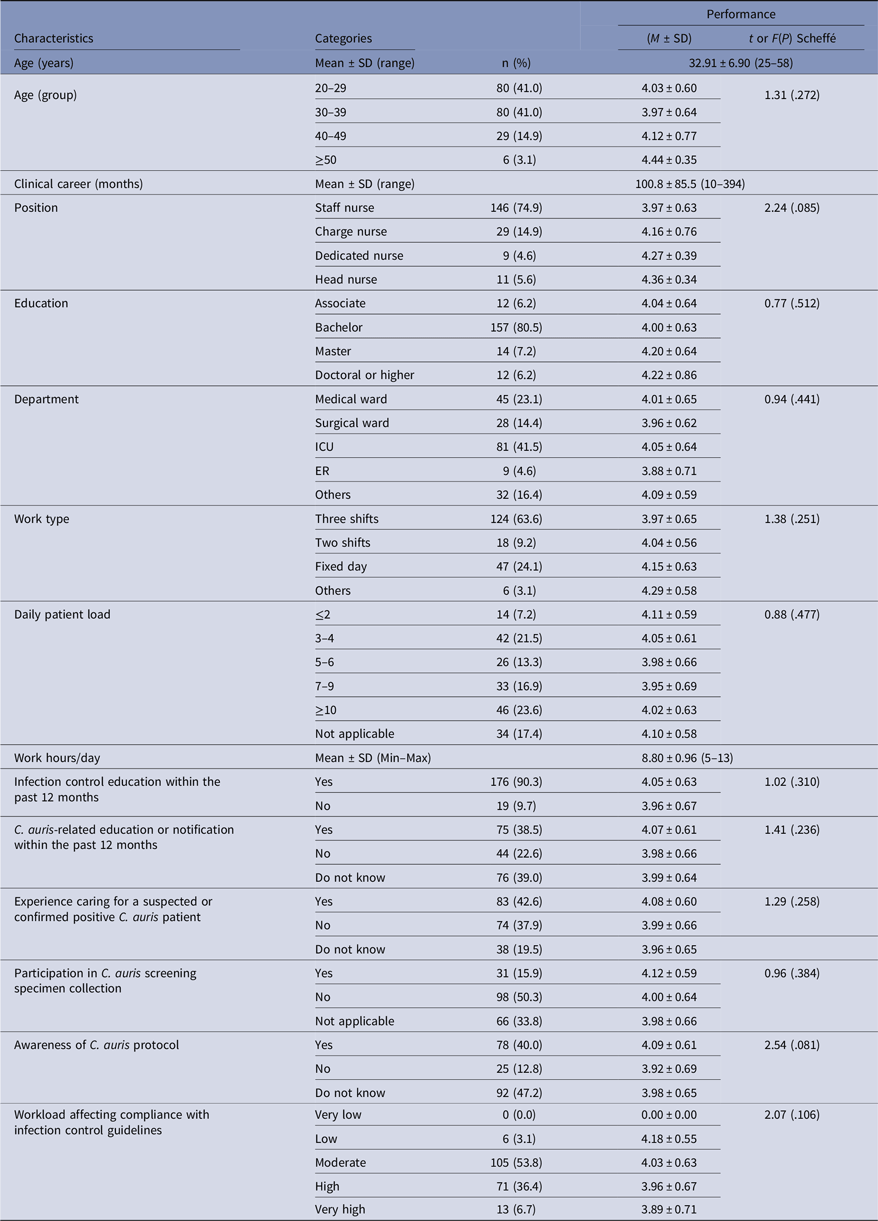
A total of 195 nurses participated in the study. The mean age was 32.91 ± 6.90 years (range, 25–58). Most participants were staff nurses (74.9%) and held a bachelor’s degree (80.5%). The mean clinical experience was 100.8 ± 85.5 months (range, 10–394). The largest proportion worked in intensive care units (41.5%) and 63.6% worked three-shift rotations. The most common daily patient load was ≥10 patients (23.6%), and the mean daily working hours were 8.80 ± 0.96 (range: 5.0–13.0) (Table 1).
General characteristics of participants and differences in Candida auris infection control performance (N = 195)

Table 1. Long description
A table with 195 rows and 10 columns detailing the characteristics and performance of nurses in a study on Candida auris infection control. The table is divided into two main sections: Characteristics and Performance. The Characteristics section includes columns for Age (years), Age (group), Clinical career (months), Position, Education, Department, Work type, Daily patient load, Work hours/day, Infection control education within the past 12 months, C. auris-related education or notification within the past 12 months, Experience caring for a suspected or confirmed positive C. auris patient, Participation in C. auris screening specimen collection, Awareness of C. auris protocol, and Workload affecting compliance with infection control guidelines. The Performance section includes columns for Categories, n (%), M (SD), t or F(P), and Scheffé. Each row provides specific data for individual nurses, including their age, position, education, department, work type, daily patient load, work hours per day, infection control education, C. auris-related education, experience with C. auris patients, participation in screening, awareness of protocols, and workload impact on compliance. Notable trends include the majority of participants being staff nurses with a bachelor’s degree, working in intensive care units, and having a mean clinical experience of 100.8 months.
Regarding C. auris-related characteristics, 90.3% of the participants reported receiving infection control education within the past year, whereas only 38.5% had received C. auris-specific training. In addition, 42.6% had experience in caring for suspected or confirmed cases, whereas 50.3% had no experience in screening specimen collection. Awareness of institutional protocols was reported by 40.0% of the participants, whereas 47.2% reported being unaware. Moderate workload affecting compliance with infection control guidelines was most commonly reported (53.8%) (Table 1).
Infection control performance by participant characteristics
No significant differences were observed in C. auris infection control performance according to the participant characteristics (P > .05; Table 1).
Levels of C. auris infection control knowledge, awareness, organizational culture, and performance
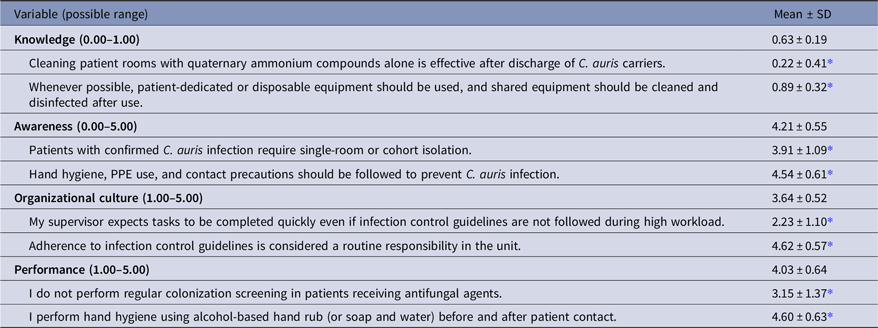
The mean score for C. auris infection control knowledge was 0.63 ± 0.19. The highest correct response rate was observed for the item on the need for cleaning and disinfection after using patient-dedicated or disposable equipment (0.89 ± 0.32), whereas the lowest was for postdischarge environmental cleaning of patient rooms (0.22 ± 0.41).
The mean score for C. auris infection control awareness was 4.21 ± 0.55 (on a 5-point scale). The highest-scoring items were adherence to hand hygiene, personal protective equipment use, and contact precautions for C. auris prevention (4.54 ± 0.61). In contrast, the lowest-scoring item was the need for single-room or cohort isolation for confirmed cases (3.91 ± 1.09).
The mean score for organizational culture was 3.64 ± 0.52. The highest-scoring item was the perception that adherence to infection control guidelines was a routine responsibility within the department (4.62 ± 0.57), whereas the lowest-scoring item was prioritizing task completion over adherence to infection control guidelines during high workload (2.23 ± 1.10).
The mean score for C. auris infection control performance was 4.03 ± 0.64. The highest-scoring item was performing hand hygiene before and after contact with patients with C. auris (4.60 ± 0.63), whereas the lowest-scoring item was failure to perform regular colonization screening in patients receiving antifungal agents (3.15 ± 1.37) (Table 2).
Descriptive statistics of items of Candida auris infection control knowledge, awareness, organizational culture, and performance (N = 195)

Table 2. Long description
A table with five rows and three columns. The columns are labeled ‘Variable (possible range)’, ‘Mean’, and ‘SD’. The rows are labeled with different variables related to Candida auris infection control. The first row shows ‘Knowledge (0.00-1.00)’ with a mean of 0.63 and SD of 0.19. The second row discusses cleaning patient rooms with quaternary ammonium compounds alone, with a mean of 0.22 and SD of 0.41. The third row mentions using patient-dedicated or disposable equipment, with a mean of 0.89 and SD of 0.32. The fourth row covers awareness (0.00-5.00), with a mean of 4.21 and SD of 0.55. The fifth row discusses the requirement for single-room or cohort isolation for patients with confirmed C. auris infection, with a mean of 3.91 and SD of 1.09. The sixth row highlights the importance of hand hygiene, PPE use, and contact precautions, with a mean of 4.54 and SD of 0.61. The seventh row addresses organizational culture (1.00-5.00), with a mean of 3.64 and SD of 0.52. The eighth row discusses the expectation to complete tasks quickly even if infection control guidelines are not followed, with a mean of 2.23 and SD of 1.10. The ninth row mentions adherence to infection control guidelines, with a mean of 4.62 and SD of 0.57. The tenth row covers performance (1.00-5.00), with a mean of 4.03 and SD of 0.64. The eleventh row discusses the lack of regular colonization screening in patients receiving antifungal agents, with a mean of 3.15 and SD of 1.37. The twelfth row highlights performing hand hygiene before and after patient contact, with a mean of 4.60 and SD of 0.63.
* The lowest or highest-scoring item in the subs.
Correlations among knowledge, awareness, organizational culture, and infection control performance
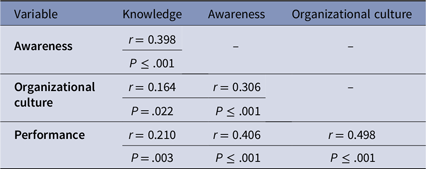
Pearson’s correlation analysis showed that infection control performance related to C. auris was significantly correlated with knowledge (r = 0.210, P = .003), awareness (r = 0.406, P < .001), and organizational culture (r = 0.498, P < .001) (Table 3).
Correlations among Candida auris infection control knowledge, awareness, organizational culture, and performance (N = 195)

Table 3. Long description
A table with four rows and three columns showing correlations among Candida auris infection control knowledge, awareness, organizational culture, and performance. The columns are labeled Knowledge, Awareness, and Organizational culture. The rows are labeled Awareness, Organizational culture, and Performance. Each cell contains correlation coefficients (r) and P-values. Row 1: Awareness, Knowledge r = 0.398, P ≤ .001. Row 2: Organizational culture, Knowledge r = 0.164, P = .022; Awareness r = 0.306, P ≤ .001. Row 3: Performance, Knowledge r = 0.210, P = .003; Awareness r = 0.406, P ≤ .001; Organizational culture r = 0.498, P ≤ .001.
Factors influencing C. auris infection control performance
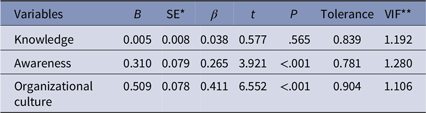
Multiple regression analysis was conducted using C. auris infection control knowledge, awareness, and organizational culture as independent variables. The model was statistically significant (F = 22.979, P < .001), explaining 32.0% of the variance in infection control performance (R 2 = 0.320, adjusted R 2 = 0.309; Durbin–Watson = 1.891). Organizational culture (β = 0.411, P < .001) and awareness (β = 0.265, P < .001) significantly predicted performance, whereas knowledge was not significant (β = 0.038, P = .565). No multi-collinearity was detected (VIF = 1.106–1.280) (Table 4).
Factors influencing Candida auris infection control performance (N = 195)

Table 4. Long description
A table with three rows and seven columns comparing the influence of different factors on Candida auris infection control performance. The columns are labeled Variables, B, SE, Beta, t, P, Tolerance, and VIF. The rows are labeled Knowledge, Awareness, and Organizational culture. Row 1: Knowledge, 0.005, 0.008, 0.038, 0.577, 0.565, 0.839, 1.192. Row 2: Awareness, 0.310, 0.079, 0.265, 3.921, <.001, 0.781, 1.280. Row 3: Organizational culture, 0.509, 0.078, 0.411, 6.552, <.001, 0.904, 1.106.
Model fit: R 2 = 0.320, adjusted R 2 = 0.309, F = 22.979, P < .001, Durbin–Watson = 1.891.
* SE: standard error **VIF: variance inflation factor.
Discussion
The primary finding of this study is that infection control performance regarding C. auris among frontline nurses is predominantly driven by organizational culture (β = 0.411, P < .001) and risk awareness (β = 0.265, P < .001), whereas knowledge alone was not a significant independent predictor in the final multivariable model despite its bivariate correlation (r = 0.21, P = .003). This critical “knowledge–performance gap” demonstrates that while individual understanding of pathogen transmission is foundational, clinical execution is heavily dictated by systemic and structural factors within clinical environments—such as unit-level safety climate, workload pressures, and supervisory feedback—that either facilitate or impede the translation of knowledge into bedside practice. Reference Kim and Choi23,Reference Colet, Cruz and Cacho24,Reference Cen, Lao and Li25,Reference Sim26,Reference van Buijtene and Foster27
Nurses’ knowledge of C. auris infection control measures was 63% correct, consistent with prior reports of 60%–70% among healthcare workers. Reference Sodhi, Chanchalani and Arya28 High accuracy was observed for basic precautions (hand hygiene and personal protective equipment [PPE]), whereas knowledge regarding C. auris-specific environmental persistence, biofilm formation, and effective disinfectant selection (eg, limitations of quaternary ammonium compounds) was relatively lower. This pattern aligns with Da’seh et al., Reference Al-Zaru, Hayajneh and Obaid29 who noted that healthcare workers are proficient in standard precautions but vulnerable to environmental reservoir management. Although general facility sanitation is delegated to dedicated environmental services, direct-care nurses play an indispensable role in maintaining immediate patient-zone hygiene and decontaminating medical devices. Integrating pathogen-specific, evidence-based environmental controls into nursing education is both clinically realistic and imperative for suppressing healthcare-associated outbreaks.
Awareness scores (4.21/5) were high and comparable to those for Kim and Choi Reference Kim and Choi23 ; however, specific items, such as isolation requirements, showed relatively lower scores, consistent with Hammoud et al., Reference Hammoud, Ghazi, Nassredine and Haidar30 reflecting a limited understanding of pathogen-specific guidelines.
Organizational culture averaged 3.64/5, with strong internalization of infection control as a routine duty (4.62), but with lower levels of supervisor feedback (3.33) and open communication (3.32). This aligns with Colet et al., Reference Colet, Cruz and Cacho24 who reported relatively weak organizational support and leadership, underscoring the need for structured, manager-led audit and feedback systems and open communication to foster a positive culture for infection control.
Infection control performance averaged 4.03 ± 0.64 (max score 5), with the highest compliance observed in routine activities such as hand hygiene and PPE use. This pattern suggests that frequently performed basic measures tend to achieve higher adherence, which is consistent with previous studies reporting superior performance in hand hygiene and glove use. Reference Kim and Hwang31,Reference Russell, Dowding and McDonald32 In contrast, lower scores were observed for screening specimen collection, which may reflect a limited exposure to situation-specific procedures. Given that 50.3% of the participants lacked experience in C. auris screening, restricted opportunities for practice may have contributed to the lower performance observed.
Taken together, these findings underscore that education focused solely on knowledge transmission is insufficient to improve adherence to infection control measures. Instead, a robust organizational support system that facilitates “blame-free” communication and consistent supervisory feedback is indispensable. Reference Ivers, Jamtvedt and Flottorp33 From a policy perspective, healthcare institutions should integrate C. auris-specific competency modules into mandatory continuing education while establishing unit-based safety champions to bridge the gap between guidelines and bedside practice. Reference van Buijtene and Foster27,Reference Russell, Dowding and McDonald32 This study is distinguished by the development and validation of a C. auris-specific instrument tailored for the Korean nursing context, providing a reliable tool for future multicenter benchmarking. However, this study had some limitations that should be acknowledged. The recruitment of participants from a specific geographic region may have limited the generalizability of the findings to other settings. Additionally, reliance on self-reported data may introduce social desirability bias; thus, future studies should incorporate direct observation or objective clinical indicators to validate these findings. Moreover, adopting longitudinal or observational designs as well as intervention studies focusing on organizational culture would be instrumental in clarifying causal relationships and providing stronger evidence to optimize infection control performance.
Conclusion
This study underscores that adherence to C. auris infection control measures among nurses is a multifaceted outcome driven by both individual and organizational factors. Although knowledge and awareness are foundational, our findings identify organizational culture (β = 0.411) and awareness (β = 0.265) as the primary determinants of adherence to infection control protocols. Notably, the predominance of organizational culture suggests that performance is not merely a product of individual competence, but is profoundly shaped by unit-level communication, constructive supervisory feedback, and systemic support. Therefore, mitigating the transmission of C. auris requires a paradigm shift from purely knowledge-based training to integrated organizational strategies that foster a culture of safety and accountability. These results provide a robust, evidence-based foundation for the development of targeted educational programs and institutional policies designed to combat the global threat of emerging MDRO in the clinical setting.
Supplementary material
The supplementary material for this article can be found at https://doi.org/10.1017/ash.2026.10857.
Acknowledgments
None.


 Open access

