


1. Introduction
The purpose of this paper is to construct a frictional labor model including the automation sector and to explore the impact of the development of automation on macroeconomic performance, particularly on job reallocation (comprising both job creation and job destruction) and related variables in labor markets. The key innovation of the paper is that in addition to the goods-producing sector, our model also includes a sector that develops automation, which has a self-accumulation ability, nonrival characteristics, and can replace human labor in the production of goods. Workers with heterogeneous skills then search for jobs in different labor markets, including markets for developing automation and for producing goods. The contributions of the paper are as follows. First, we discuss the impact of automation becoming more important in production on job reallocation in different labor markets along the transitional dynamics path and the related macroeconomic variables in the long run. Second, we consider the case where workers face occupational choices made available by learning skills and discuss the impact of government subsidy policies.
Gross employment flows, represented by concomitant job creation and job destruction, are important for economy-wide resource allocation and economic growth. In turn, technological progress can lead to the creation of innovative jobs and the destruction of technologically obsolete jobs, known better as Schumpeter’s creative destruction. That is, when a new technology is invented, there should be many new jobs created as well as many existing jobs destroyed, especially with the current massive development of artificial intelligence and automation.
However, the most recent data suggest a more ominous situation, with Fig. 1 illustrating that job reallocation has declined in the US in recent decades. To conserve space, we do not present the comparable figures for job creation and job destruction separately, but both have also declined.Footnote 1 According to the World Robotics Reports, published by the International Federation of Robotics (https://ifr.org/), the density of robots in the United States increased significantly during this period. Given that technology is constantly being developed, and job reallocation is constantly declining, there must be some reason, perhaps including the incentives of labor market participants or the development of some new technology, such as automation. Therefore, the purpose of this paper is to investigate the impact of automation development on job reallocation and related variables in labor markets.
Job reallocation rate. Note. The job reallocation rates during the period 2002–2019 are obtained directly from the US Census Bureau’s Business Dynamics Statistics ( https://www.census.gov/programs-surveys/bds.html ).

Some existing studies (as listed in Section 2) examine the cyclical features of job creation and destruction. However, because the actual data show that US job reallocation has declined in recent decades, there must be long-term factors other than shocks causing these economic fluctuations. In this paper, we consider that technological progress and the development of automation may have had a large impact on the employment of differently skilled labor, and thus examine the impact of automation development on the different labor markets. When considering the transitional dynamics, we obtain that the increasing importance of automation in the goods production may be responsible for a reduction in job reallocation. That is, although automation has changed production, it has not created as many new jobs as was first envisioned.
This paper extends the models in Diamond (Reference Diamond1982), Mortensen (Reference Mortensen1982), and Pissarides (Reference Pissarides1984) with labor market frictions to include the automation development sector. In this model, workers can increase their skills through learning. Thus, they possess heterogeneous skills while searching for jobs in different labor markets, in which skilled labor can be invested in the automation development sector and the remaining labor only used in the goods production sector. We investigate the impact of automation development along the transitional dynamics path and in the long run. We also discuss the impact of government policies whereby the government can encourage investment in the automation sector by subsidizing the cost of learning.
The main result of the paper is as follows. The increasing importance of automation in production may be responsible for the reduction in job reallocation along the transitional dynamics path. Automation also increases the total unemployment rate and reduces overall labor force participation in the long run. Intuitively, when automation becomes important in the production process, firms producing final goods will replace human (unskilled) labor with automation, so automation is not conducive to employment in the unskilled labor market. However, because skilled labor is required to invest in developing automation, the development of automation is beneficial to the skilled labor market. These findings are consistent with a phenomenon associated with skill-biased technical change (SBTC), for which we provide some empirical evidence from past studies. If the negative effect on the unskilled labor market dominates the positive effect on the skilled labor market, the development of automation is not good for the overall labor market. Moreover, we are additionally concerned with the effects of increased production capacity in the automation sector. Furthermore, we obtain that appropriate government subsidy policies can improve business dynamics across the labor market.
The remainder of the paper is structured as follows. Section 2 discusses the related literature. In Section 3, we construct a labor search model including an automation sector and provide the equilibrium equations. In Section 4, we analyze the impact of automation along the transitional dynamics path and provide some comparative statics analysis in the long run. Section 5 offers some concluding remarks. Technical details are in the Appendix.
2. Literature review
There is much literature already relating to the issue of declining job reallocation. For example, Akcigit and Ates (Reference Akcigit and Ates2021) constructed an endogenous growth model and used the decline in knowledge diffusion to discuss ten facts concerning declining business dynamism in the US, of which one was declining job reallocation. Note that we focus on the labor market and use the development of automation to discuss the decline in job reallocation. The subsequent literature has sought an explanation for this feature. Decker et al. (Reference Decker, Haltiwanger, Jarmin and Miranda2016a) and (Reference Decker, Haltiwanger, Jarmin and Miranda2016b) believed it related to the fact that young high-tech establishments increased in the 1990s then declined dramatically in the 2000s.
Elsewhere, Decker et al. (Reference Decker, Haltiwanger, Jarmin and Miranda2014) and (Reference Decker, Haltiwanger, Jarmin and Miranda2017) have discussed the role of entrepreneurship in US job creation and the related business dynamism, whereas Goldschlag and Tabarrok (Reference Goldschlag and Tabarrok2018) analyzed whether regulation was the cause of the decline in American entrepreneurship and business dynamism.Footnote 2
Many existing studies have also examined the cyclical features of job creation and destruction. For example, Cabaliero and Hammour (Reference Cabaliero and Hammour1996) used a theoretical model to discuss cyclical features, including creation and destruction during recessions, providing findings consistent with those of Davis and Haltiwanger (Reference Davis and Haltiwanger1992), who focused on specific plants and showed that job reallocation (and especially job losses) occurred disproportionately during recessions. In other work, Davis and Haltiwanger (Reference Davis and Haltiwanger1999) discussed the driving forces of the cyclical movement of employment and job redistribution, Davis and Haltiwanger (Reference Davis and Haltiwanger2001) analyzed the effects of oil price shocks on job creation and destruction, and Decker et al. (Reference Decker, Haltiwanger, Jarmin and Miranda2020) obtained that a decline in job reallocation was from either the slower dispersion of idiosyncratic shocks or the weaker marginal responsiveness of firms to shocks. However, as discussed earlier, because the actual data show that US job reallocation has declined in recent decades, there must be long-term factors other than shocks accounting for these economic fluctuations.
A voluminous literature has also explored the impact of automation. Autor (Reference Autor2015), Acemoglu and Restrepo (Reference Acemoglu and Restrepo2018, Reference Acemoglu and Restrepo2019), and Agrawal et al. (Reference Agrawal, Gans and Goldfarb2019) discussed the case where automation may replace human labor and focused on employment or labor demand. Elsewhere, Autor and Salomons (Reference Autor and Salomons2018), Prettner (Reference Prettner2019), and Heer and Irmen (Reference Heer and Irmen2019) considered the impact of automation on growth accounting or the labor share of production. Unlike these studies, and except for employment, our paper specifies a sector that develops automation, which has a self-accumulation ability, a nonrival characteristic, and can replace human labor in the production of goods. There is also labor involving different technical abilities in our model. Using this, we can analyze the impact of automation on differently skilled labor along the transitional dynamics path and obtain that job reallocation will decline when firms producing final goods use automation to replace labor.Footnote 3 In addition, we discuss the impact of automation on the total unemployment rate and labor force participation in the long run. Moreover, our paper considers the endogenous occupational choices of workers and discusses the impact of government subsidy policies.Footnote 4
In similar work, Cortes et al. (Reference Cortes, Jaimovich and Siu2017) formulated a neoclassical framework including automation and obtained that an increase in automation technology embodies a tradeoff between reallocating employment across occupations and reallocating workers toward nonemployment. These results are consistent with one of our conclusions whereby an increase in the importance of automation in goods production, or an increase in the productivity of the automation sector, will decrease overall labor force participation. Further, whereas an increase in the importance of automation in goods production will increase employment in the automation sector, it will also decrease employment participating in the goods sector. As our paper comprises a frictional labor market setting, we can not only discuss the long-run effects of automation on unemployment and related macroeconomic variables but also job reallocation along the transitional dynamics path.
Recently, Leduc and Liu (Reference Leduc and Liu2019) developed a framework including search frictions and endogenous automation decisions to examine the interactions between automation and the labor market over the business cycle. Our paper also constructs a labor search model with endogenous automation decisions. Comparing Leduc and Liu (Reference Leduc and Liu2019) with our paper, there are the following differences. First, in the Leduc and Liu (Reference Leduc and Liu2019) setting, when the cost of automation falls below a certain threshold, firms can choose whether to replace human labor with automation. In our model, automation and human labor can also be substituted for each other in producing final goods in line with a constant elasticity of substitution (CES) production function, that is, both models incorporate endogenous automation decisions. However, we further provide two types of labor with different skills that can either develop automation or produce final goods. This allows our model to additionally analyze the impact of automation on the two different skilled labor markets. Note that Leduc and Liu (Reference Leduc and Liu2019) did not consider heterogeneously skilled labor.
Second, Leduc and Liu (Reference Leduc and Liu2019) focused on business cycle analysis and obtained the finding that automation amplifies unemployment fluctuations and mutes wage increases, thereby contributing to a decline in the labor income share during business cycle expansions. In contrast, our analysis can not only discuss the impact of automation on job creation, destruction, and reallocation in two different skilled labor markets along the transitional dynamics paths but also the impact of automation on unemployment and labor participation in the long run. We obtain that automation may be responsible for the reduction in job reallocation. Third, Leduc and Liu (Reference Leduc and Liu2019) did not address the sources of automation, the accumulation of which is directly and exogenously given. In comparison, the accumulation of automation is endogenously determined by our model. One innovation of the paper is that we incorporate a sector that develops automation, which has a self-accumulation ability, a nonrival characteristic, and can replace human labor in the production of goods.
In addition, in terms of a theoretical analysis employing a frictional labor market to discuss job reallocation, Garibaldi (Reference Garibaldi1998) investigated the impact of firing restrictions on job reallocation, and Gouge and King (Reference Gouge and King1997) obtained that job creation is procyclical whereas job destruction and job reallocation are countercyclical. Similarly, Michelacci and Lopez-Salido (Reference Michelacci and Lopez-Salido2007) used the Solow growth model with neutral investment-specific technology shocks to investigate the impact of technological progress on job reallocation and to discuss Schumpeterian creative destruction. Unlike these studies, our analysis employs a labor search model, including the automation sector and focuses on the impact of automation, particularly its impact on job reallocation, which we believe is more consistent with the current real-world situation.
Other than declining job reallocation, automation has other impacts. Acemoglu and Autor (Reference Acemoglu and Autor2011), Autor et al. (Reference Autor, Levy and Murnane2003), and Goos et al. (Reference Goos, Manning and Salomons2014) showed that recent technological change is biased toward replacing labor in routine tasks, that is, job polarization will take place. Cortes et al. (Reference Cortes, Jaimovich and Siu2017) found falling transition rates into routine employment, and rising transition rates out of routine employment. In addition, Petropolous (Reference Petropolous2018) and Brekelmans and Petropolous (Reference Brekelmans and Petropolous2020) provided evidence that medium-skilled jobs (routine work) may be more exposed to artificial intelligence.Footnote 5 The results of our study are consistent with their conclusion. That is, the unskilled labor in our model can be replaced by automation, placing these workers in the same situation as those handling routine tasks.
However, we also conclude that when firms use more automation to produce goods, this will be detrimental to unskilled labor (workers performing routine tasks) in both the short and long run. Note that whereas this study primarily focuses on job reallocation, it can be extended as a benchmark model to include different types of labor, including high-tech labor able to develop automation technology (or artificial intelligence); labor that handles routine work; labor in low-paid and least-skilled jobs; and labor in jobs requiring personal contact with people, each comprising different labor markets, and each producing different goods (and so different production sectors). We would then be able to discuss job polarization. However, in order not to confuse the focus or complicate the analysis in this paper, we defer these interests to future research.
It is worth noting that some studies suggest that an explanation for the observed decline in job reallocation rates concerns worker dynamics and demographic structure (e.g., workers aging). For example, Hyatt and Spletzer (Reference Hyatt and Spletzer2013) explained the recent decline in employment dynamics, with one set of reasons concerning changes in the composition of the employed and another, that of employers. For example, the postwar baby boom generation is aging, and the employment-to-population ratio of teenagers has been falling. Hyatt and Spletzer (Reference Hyatt and Spletzer2013) showed that changes in a variety of worker characteristics (including age, gender, and education) and firm characteristics (including size and age) explain some share of the changes in worker flows, including job-to-job transitions, hiring rates, and separation rates. In addition, Molloy et al. (Reference Molloy, Smith and Wozniak2014) discussed the impact of downward trends in a variety of labor market transitions and the aging of the population on the decline in interstate migration. Although that paper focuses on the reduction of immigration, it also discusses the impact of demographic structure on the labor market.
Moreover, Molloy et al. (Reference Molloy, Smith, Trezzi and Wozniak2016) present evidence for a variety of hypotheses that might explain the downward trend in labor market fluidity, which is partly related to population demographics, and obtained that demographic shifts explain some of the secular decline in fluidity. Furthermore, Acemoglu and Restrepo (Reference Acemoglu and Restrepo2022) documented a positive relationship between demographic change and robot adoption across US local labor markets. They found that demographic changes that reduce the ratio of middle-aged to older workers increase labor costs in production and encourage the adoption and development of automation technologies. Unlike their analysis focusing on the effects of demographic changes on automation (or the determinants of automation), we address the impact of automation on job reallocation (or the implications of automation).
As for the evidence and empirical studies relating to SBTC, Autor (Reference Autor2014, Figure 1) observed that the college/high school median annual earnings gap in the US has increased. Generally, the higher the education level is, the higher the skill level becomes, so this evidence also represents the increasing wage gap between skilled and unskilled labor. Furthermore, both the data and the literature also reveal that workers with a bachelor’s degree or higher are increasing year by year (Restuccia and Vandenbroucke (Reference Restuccia and Vandenbroucke2013), Autor et al. (Reference Autor, Goldin and Katz2020), and Blankenau and Cassou (Reference Blankenau and Cassou2006)), which means that the supply of skilled labor is also increasing year on year. Autor (Reference Autor2014, Figure 1) shows that the wages of skilled labor are rising, which also means that the demand for skilled labor by firms has risen even more. Note that SBTC is a shift in the production technology that favors skilled over unskilled labor by increasing its relative productivity, and therefore its relative demand. Therefore, SBTC can be represented by the wage difference between skilled and unskilled labor, that is, the skill premium.
In addition, Acemoglu and Restrepo (Reference Acemoglu and Restrepo2020) showed that the reason for the increase in the skill premium has been rapid automation replacing tasks previously performed by unskilled workers. A number of empirical studies, such as Bound and Johnson (Reference Bound and Johnson1992), Murphy and Welch (Reference Murphy and Welch1992), Autor et al. (Reference Autor, Katz and Krueger1998), and Berman et al. (Reference Berman, Bound and Machin1998), have pointed to the significant impact of SBTC on the evolution of wage inequality (also refer to Aghion (Reference Aghion2002), Card and DiNardo (Reference Card and DiNardo2002), and Thoenig and Verdier (Reference Thoenig and Verdier2003)). Although our model can obtain consistent results with this earlier work, as we focus on job reallocation, we do not specifically address the wage differences for differently skilled labor.
3. The model
We consider a discrete-time model with a continuum of identical infinitely lived firms producing final goods, firms developing automation technologies, large households, and a fiscal authority. We consider a large household setup, such that there is no heterogeneity in welfare between the skilled and the unskilled or between the employed and the unemployed. Employment at a given time is predetermined and only changes gradually as the unemployed find new jobs and old jobs are dissolved.
3.1 Households
The representative large household has unified preferences that bring together all the resources and enjoyments of its members.Footnote
6
The household comprises two differently skilled workers, and the members of the household can increase their skills through learning, but only skilled workers can develop automation technologies. Workers can work in the automation sector if they work hard to learn skills, or in the final goods sector if they do not increase their skills. A proportion
 $n_t$
of the members of the household are skilled workers and the remainder
 $1-n_t$
are unskilled.Footnote
7
We allow people to make occupational choices through the endogenization of the proportion of skilled members in the household,
 $n_t$
, by paying the cost of learning
 $\kappa n_t^\xi$
, where
 $\kappa \gt 0$
is the unit cost of learning and
 $\xi \geq 1$
as the cost function is convex. Note that when the cost of learning is higher, the larger is the gap in technical ability between labor representing different skills. We additionally allow the government to encourage household members to invest in the automation sector by subsidizing the cost of learning. That is, the real learning cost paid by the household is
 $(1-\tau ) \kappa n_t^\xi$
, where
 $1\gt \tau \geq 0$
is the government subsidy.
Note that household members who become skilled workers choose not to work in the final goods sector because the wages in the automation sector are higher. However, there is an additional cost to learn the technology. This is confirmed by subsequent numerical analysis. Moreover, unskilled labor cannot work in the automation sector because of insufficient skills.
In period
 $t$
, a proportion
 $e^A_t$
of the skilled household members are employed in firms developing automation technologies, a proportion
 $s^A_t$
are searching for jobs, and the remaining proportion
 $1-e^A_t-s^A_t$
are outside the labor force (following Arseneau and Chugh (Reference Arseneau and Chugh2012), we refer to these as household members pursuing leisure). Similarly, a proportion
 $e^Y_t$
of unskilled household members are employed in firms producing final goods, a proportion
 $s^Y_t$
are searching for jobs, and the remaining proportion
 $1-e^Y_t-s^Y_t$
are engaged in leisure. The household allocates a share
 $u_t$
of capital to producing final goods and the remaining
 $1-u_t$
to developing automation technologies. We denote
 $k_t$
as capital and
 $A_t$
as the stock of automation.
The level of employment of the skilled (unskilled) members from the household perspective is given by the following process:
 \begin{equation} e^A_{t+1} n_{t+1}=(1-\psi ^A) e^A_t n_t + \mu ^A_t s^A_t n_t, \end{equation}
 \begin{equation} e^Y_{t+1} (1-n_{t+1})=(1-\psi ^Y) e^Y_t (1-n_t)+ \mu ^Y_t s^Y_t (1-n_t), \end{equation}
where
 $\mu ^A_t$
(
 $\mu ^Y_t$
) denotes the endogenous job-finding rate and
 $\psi ^A$
(
 $\psi ^Y$
) is the exogenous job-separation rate for the skilled (unskilled) labor market, respectively. Thus, the change in employment is equal to the inflow of workers into the employment pool net of the outflow from separation.
We use
 $w^A_t$
,
 $w^Y_t$
,
 $r^A_t$
, and
 $r^Y_t$
to denote the wage and rental rates the household earns from firms developing automation and producing final goods, respectively. The representative household’s budget constraint is:
 \begin{align} k_{t+1} &=(1-\delta ) k_t+ w^A_t e^A_t n_t+ w^Y_t e^Y_t (1-n_t)+ r^A_t (1-u_t) k_t+r^Y_t u_t k_t \notag \\[5pt] &\quad +\pi ^A_t+\pi ^Y_t-c+b^A_t s^A_t n_t+ b^Y_t s^Y_t (1-n_t)-T_t-(1-\tau ) \kappa n_t^\xi, \end{align}
where
 $c_t$
is consumption,
 $\delta$
is the depreciation rate of capital,
 $\pi ^A_t$
(
 $\pi ^Y_t$
) is the profits of the firm developing automation (producing final goods), given households own the firm’s shares,
 $b^A_t$
(
 $b^Y_t$
) is unemployment compensation in the skilled (unskilled) labor market, and
 $T_t$
is lump-sum taxes. The budget constraint indicates that unspent income is used to accumulate capital.
The representative household’s utility is:
 \begin{align} &{\ u(c_t, 1-e^A_t-s^A_t, 1-e^Y_t-s^Y_t, n_t) } \notag \\[5pt] &\quad ={\ \ln\!(c_t)+n_t \chi ^A \frac{(1-e^A_t-s^A_t)^{1-\sigma ^A}}{1-\sigma ^A}+(1-n_t)\chi ^Y \frac{(1-e^Y_t-s^Y_t)^{1-\sigma ^Y}}{1-\sigma ^Y} }, \end{align}
where the parameter
 $\chi ^A\gt 0$
(
 $\chi ^Y\gt 0$
) measures the importance of leisure relative to consumption for skilled (unskilled) labor in utility. In (3), we use a conventional additively separable utility between consumption and leisure, with a unit intertemporal elasticity of substitution (IES) for consumption and the Frisch labor supply elasticity equal to
 $(1-e^A_t-s^A_t)/[\sigma ^A (e^A_t+s^A_t)]$
and
 $(1-e^Y_t-s^Y_t)/[\sigma ^Y (e^Y_t+s^Y_t)]$
for skilled and unskilled labor, respectively.
The household’s dynamic programing problem is written as the following Bellman equation:
 \begin{equation*} U(k_t, e^A_t, e^Y_t)=\max\!\left[u\left(c_t, 1-e^A_t-s^A_t, 1-e^Y_t-s^Y_t, n_t\right)+{\ \frac {1}{1+\rho } } U\left(k_{t+1}, e^A_{t+1}, e^Y_{t+1}\right)\right], \end{equation*}
subject to the constraints (1a), (1b), and (2), taking as given the factor prices, firm profits, unemployment compensation, taxes, and the initial levels of employment (
 $e^A_0$
and
 $e^Y_0$
) and capital (
 $k_0$
), where
 $\rho \gt 0$
is the time preference rate. We simplify the household’s necessary conditions into the following five equations.
The first is the consumption Euler equation:
 \begin{equation} u_c(c_t, 1-e^A_t-s^A_t, 1-e^Y_t-s^Y_t, n_t)={\ \frac{1-\delta +r_{t+1}}{1+\rho } } u_c(c_{t+1}, 1-e^A_{t+1}-s^A_{t+1}, 1-e^Y_{t+1}-s^Y_{t+1}, n_{t+1}). \end{equation}
(4a) can be rewritten as
 $1/c_t=(1-\delta +r_{t+1})/[(1+\rho )c_{t+1}]$
.
Next, we have the learning–working tradeoff condition (the optimal labor market participation behavior) in the skilled labor market, which implies that leisure utility (here the marginal utility of those not participating in the labor force) equals the marginal benefit of participating in the labor force, after considering unemployment compensation and the discounted marginal value of employment when job matching. The equation is as follows:
 \begin{align} \chi ^A (1-e^A_t-s^A_t)^{-\sigma ^A}&={\ \frac{b^A_t}{c_t} }+{\ \frac{\mu ^A_t}{1+\rho } \Bigg[ \frac{1-\psi ^A-\mu ^A_{t+1}}{\mu ^A_{t+1}} \chi ^A (1-e^A_{t+1}-s^A_{t+1})^{-\sigma ^A} }\nonumber\\[5pt] &+{\ \frac{w^A_{t+1}}{c_{t+1}}-\frac{b^A_{t+1}(1-\psi ^A)}{c_{t+1} \mu ^A_{t+1}} \Bigg] }. \end{align}
Similarly, we derive the learning–working tradeoff condition (the optimal labor market participation behavior) in the unskilled labor market as follows:
 \begin{align} \chi ^Y (1-e^Y_t-s^Y_t)^{-\sigma ^Y}&={\ \frac{b^Y_t}{c_t} }+{\ \frac{\mu ^Y_t}{1+\rho } \Bigg[ \frac{1-\psi ^Y-\mu ^Y_{t+1}}{\mu ^Y_{t+1}} \chi ^Y (1-e^Y_{t+1}-s^Y_{t+1})^{-\sigma ^Y} }\nonumber \\[5pt] &+{\ \frac{w^Y_{t+1}}{c_{t+1}}-\frac{b^Y_{t+1}(1-\psi ^Y)}{c_{t+1} \mu ^Y_{t+1}} \Bigg] }. \end{align}
We then have the no-arbitrage condition of capital in two sectors (final goods and automation technologies) as follows:
 \begin{equation} r^A_t= r^Y_t \equiv r_t. \end{equation}
Finally, the following equation equates the marginal benefit of choosing to be skilled labor and its opportunity cost (the marginal benefit of choosing to be unskilled labor).
 \begin{align} &{\ \chi ^A \frac{(1-e^A_t-s^A_t)^{1-\sigma ^A}}{1-\sigma ^A} -\chi ^Y \frac{(1-e^Y_t-s^Y_t)^{1-\sigma ^Y}}{1-\sigma ^Y} } \notag \\[5pt] &\quad{\ +\frac{1}{c_t}[w^A_t e^A_t-w^Y_t e^Y_t+b^A_t s^A_t-b^Y_t s^Y_t-(1-\tau ) \kappa \xi n_t^{\xi -1}] } \notag \\[5pt] &\quad{\ +[(1-\psi ^A)e^A_t+\mu ^A_t s^A_t][ \frac{\chi ^A(1-e^A_t-s^A_t)^{-\sigma ^A}}{\mu ^A_t}-\frac{b^A_t}{c_t \mu ^A_t}] } \notag \\[5pt] &\quad{\ -[(1-\psi ^Y)e^Y_t+\mu ^Y_t s^Y_t][ \frac{\chi ^Y(1-e^Y_t-s^Y_t)^{-\sigma ^Y}}{\mu ^Y_t}-\frac{b^Y_t}{c_t \mu ^Y_t}]=0 }. \end{align}
3.2 Firms producing final goods
The representative firm produces a single final good
 $y_t$
by renting capital and automation technologies and employing unskilled labor under the following production technology:
 \begin{equation} y_t=F (u_t k_t)^{1-\alpha } \{a [e^Y_t (1-n_t)]^\varepsilon +(1-a) A_t^\varepsilon \}^{\frac{\alpha }{\varepsilon }}, \end{equation}
where
 $F \gt 0$
is productivity,
 $u_t$
is the share of capital that the household allocates to producing final goods, and
 $1-\alpha \in (0, 1)$
is the capital share. Because automation technology is widely used in production, it is one of the key production inputs of firms. As this paper focuses on the impact of the development of automation on the labor market, we focus on the ability of automation to replace labor. Therefore, we use a CES production function where automation and human labor can replace each other. Note that
 $\varepsilon =1-1/\varepsilon _{e^Y, A} \in (\!-\!\infty, 1]$
, in which
 $\varepsilon _{e^Y, A} \geq 0$
is the elasticity of substitution between human labor and automation, and
 $a \in (0, 1)$
is the share parameter. The larger is
 $1-a$
, the more automation is used (compared with human labor) for production.Footnote
8
The representative firm creates and maintains multiple job vacancies (
 $v^Y_t$
) to recruit workers. Following the setting in Domeij (Reference Domeij2005) and Arseneau and Chugh (Reference Arseneau and Chugh2006), we assume that the hiring cost is linear in terms of vacancies, that is,
 $\lambda ^Y v^Y_t$
, where
 $\lambda ^Y \gt 0$
denotes the unit hiring cost. From the firm’s perspective, employment (unskilled labor market) in the next period is:
 \begin{equation} (1-n_{t+1}) e^Y_{t+1}=(1-\psi ^Y) (1-n_t) e^Y_t +\eta ^Y_t v^Y_t, \end{equation}
where
 $\eta ^Y_t$
is the (endogenous) recruitment rate. Thus, the change in employment is equal to employee inflow net of employee outflow.
The firm’s profit is:
 \begin{equation} \pi ^Y_t=y_t-w^Y_t e^Y_t (1-n_t) -r^Y_t u_t k_t - p^A_t A_t -\lambda ^Y v^Y_t, \end{equation}
where
 $p^A_t$
is the rental rate of automation. The firm’s dynamic programing problem is written as the following Bellman equation:
 \begin{equation*} \Pi ^Y(e^Y_t)=\max\![{\ \pi ^Y_t +\frac {1}{1+r_t} } \Pi ^Y(e^Y_{t+1})], \end{equation*}
subject to the constraint (6).
We simplify the firm’s necessary conditions into the following three equations. The first equation equates the firm’s marginal product of capital to the rental rate (marginal cost) of capital:
 \begin{equation} {\ (1-\alpha ) \frac{y_t}{u_t k_t}=r^Y_t. } \end{equation}
The second equation ensures the firm’s marginal product of automation equals the rental rate (marginal cost) of automation:
 \begin{equation} {\ \frac{\alpha y_t (1-a) A_t^{\varepsilon -1}}{a [e^Y_t (1-n_t)]^\varepsilon +(1-a) A_t^\varepsilon } =p^A_t. } \end{equation}
The third equation equates a firm’s marginal value of recruitment in the next period to the marginal hiring cost. The firm’s marginal value of recruitment is the sum of the firm’s surplus from a successful match and the savings of tomorrow’s discounted marginal cost of vacancy creation and maintenance if separation does not subsequently occur. Note that with search frictions, the bargained wage is smaller than the marginal product of labor; therefore, profits are positive. The equation is as follows:
 \begin{equation} {\ \frac{\lambda ^Y}{\eta ^Y_t}(1+r_t)=\frac{\alpha y_{t+1} a[e^Y_{t+1} (1-n_{t+1})]^{\varepsilon -1}}{a [e^Y_{t+1}(1-n_{t+1})]^\varepsilon +(1-a) A_{t+1}^\varepsilon } }{\ -w^Y_{t+1} +\frac{\lambda ^Y}{\eta ^Y_{t+1}} } (1-\psi ^Y). \end{equation}
3.3 Firms developing automation
Automation in our model is a stock, so it is like a type of capital that accumulates by itself through use, just as human capital does. The development of automation requires both machines (such as computers) and humans to write programs. Therefore, the accumulation of automation depends on the resources available, and the effort devoted to developing automation. Thus, the accumulation equation for automation contains capital and human labor allocated to the development of automation. In addition, the greater the stock of automation is, the more advanced automation technology can be developed. This is like artificial intelligence, which can rely on deep machine learning and reinforcement to accumulate itself. That is, the accumulation equation should also include the automation stock itself. The process of automation accumulation is as follows:
 \begin{equation} A_{t+1}=D [(1-u_t) k_t]^\theta (e^A_t n_t)^\phi A_t^{1-\theta -\phi }+(1-\delta ^A) A_t, \end{equation}
where
 $\theta, \phi, 1-\theta -\phi \in (0,1)$
,
 $\delta ^A$
is the depreciation rate of automation, and
 $D \gt 0$
measures the efficiency of the process of automation accumulation, that is, the productivity of the automation sector.
Accordingly, the representative firm develops automation technologies and creates and maintains multiple job vacancies (
 $v^A_t$
) by renting capital and employing skilled labor. Similarly, we assume that the hiring cost is linear in terms of vacancies, that is,
 $\lambda ^A v^A_t$
, where
 $\lambda ^A \gt 0$
denotes the unit hiring cost. From the firm’s perspective, employment (in the skilled labor market) in the next period is:
 \begin{equation} n_{t+1} e^A_{t+1}=(1-\psi ^A) n_t e^A_t +\eta ^A_t v^A_t, \end{equation}
where
 $\eta ^A_t$
is the (endogenous) recruitment rate. Thus, the change in employment is equal to employee inflow net of employee outflow.
The firm’s profit is:
 \begin{equation} \pi ^A_t=p^A_t A_t-w^A_t e^A_t n_t -r^A_t (1-u_t) k_t -\lambda ^A v^A_t. \end{equation}
Note that automation is like certain types of technology or knowledge, in that its use in the production of final goods does not reduce its ability to accumulate itself, that is, the nonrival characteristic. This feature also makes automation a different type of capital. That is,
 $A_t$
can exist in both the final goods and automation development sector without needing to be divided like capital (
 $u_t k_t$
and
 $(1-u_t) k_t$
).Footnote
9
The firm’s dynamic programing problem is written as the following Bellman equation:
 \begin{equation*} \Pi ^A(e^A_t, A_t)=\max\![{\ \pi ^A_t +\frac {1}{1+r_t} } \Pi ^A(e^A_{t+1}, A_{t+1})], \end{equation*}
subject to the constraints (10) and (9).
We simplify the firm’s necessary conditions into the following two equations. The first equation states that in the optimum case, the marginal cost of creating and maintaining vacancies today is equal to the marginal benefit of hiring, which is the sum of the firm’s surplus from a successful match and the savings of the discounted expected marginal cost of creating and maintaining vacancies tomorrow if the match is not separated. The equation is as follows:
 \begin{equation} {\ \frac{\lambda ^A}{\eta ^A_t} (1+r_t)=\frac{\phi }{\theta } r^A_{t+1} (1-u_{t+1})\frac{k_{t+1}}{n_{t+1} e^A_{t+1}} }{\ -w^A_{t+1} +\frac{\lambda ^A}{\eta ^A_{t+1}} } (1-\psi ^A). \end{equation}
In addition, we have the following relationship:
 \begin{align}{\ r^A_t \frac{1}{\theta D} }& [(1-u_t)k_t]^{1-\theta } (e^A_t n_t)^{-\phi } A_t^{\theta +\phi -1} (1+r_t) = p^A_{t+1} \notag \\[5pt] &{\ +r_{t+1}[\frac{1-\theta -\phi }{\theta } (1-u_{t+1}) \frac{k_{t+1}}{A_{t+1}} }{\ +\frac{1-\delta ^A}{\theta D} [(1-u_{t+1})k_{t+1}]^{1-\theta } (e^A_{t+1}n_{t+1})^{-\phi } A_{t+1}^{\theta +\phi -1} ] }. \end{align}
This implies that the marginal cost of developing automation equates to the marginal benefit of automation accumulation. The former is that the development of automation will use resources (capital). The latter is the discounted marginal value of future returns and the related benefit of assisting with the production of final goods and automation accumulation.
3.4 Labor matching and wage bargaining
Both labor markets exhibit search frictions. The creation of new jobs requires that firms post vacancies and that the unemployed search for job opportunities. According to Diamond (Reference Diamond1982), new jobs in both labor markets are generated by the following constant returns matching technology:
 \begin{equation} M^A_t=m^A (s^A_t n_t)^{\beta ^A} (v^A_t)^{1-\beta ^A}, \end{equation}
 \begin{equation} M^Y_t=m^Y [s^Y_t (1-n_t)]^{\beta ^Y} (v^Y_t)^{1-\beta ^Y}, \end{equation}
where the superscript
 $A$
(
 $Y$
) denotes the skilled (unskilled) labor market,
 $m^A (m^Y)$
 $\gt 0$
measures the degree of matching efficacy, and
 $\beta ^A (\beta ^Y) \in (0, 1)$
is the contributions of a skilled (unskilled) job seeker in the formation of a match.
The effective wage rate is determined by Nash bargaining, which maximizes the product of the firm’s and the worker’s surpluses from a match. The worker’s surplus acquired from a successful match is evaluated by its augmented value of supplying an additional worker, which is
 $U_{e^A}(k_t, e^A_t, e^Y_t)$
for skilled labor and
 $U_{e^Y}(k_t, e^A_t, e^Y_t)$
for unskilled labor. The firm’s surplus gained from a successful match is gauged by its added value from recruiting an extra worker, which is
 $\Pi ^A_{e^A}(e^A_t, A_t)$
for the firm developing automation and
 $\Pi ^Y_{e^Y}(e^Y_t)$
for the firm producing final goods. Thus, the wages in both labor markets at time
 $t$
solve the following cooperative bargaining game, respectively:
 \begin{equation} \max _{w^A_t} \,\,[U_{e^A}(k_t, e^A_t, e^Y_t)]^{\gamma ^A} [\Pi ^A_{e^A}(e^A_t, A_t)]^{1-\gamma ^A}, \end{equation}
 \begin{equation} \max _{w^Y_t} \,\,[U_{e^Y}(k_t, e^A_t, e^Y_t)]^{\gamma ^Y} [\Pi ^Y_{e^Y}(e^Y_t)]^{1-\gamma ^Y}, \end{equation}
where
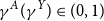 $\gamma ^A (\gamma ^Y) \in (0, 1)$
is the skilled (unskilled) worker’s bargaining share.
3.5 The government, aggregate resources, and search equilibrium
The government levies lump-sum taxes to finance unemployment compensation and subsidies for learning costs, and meets the following budget constraint:
 \begin{equation} T_t=b^A_t s^A_t n_t+b^Y_t s^Y_t (1-n_t)+ \tau \kappa n_t^\xi. \end{equation}
To simplify the model, we assume that the government has no other public expenditure.
Unlike the labor markets, the goods market is frictionless. Using the household’s budget constraint, (2), both firms’ profit functions, (7) and (11), and the government’s balanced budget constraint, (14), we obtain the following aggregate goods market constraint:
 \begin{equation} k_{t+1}= y_t + (1-\delta ) k_t-c_t -\lambda ^Y v^Y_t-\lambda ^A v^A_t-\kappa n_t^\xi. \end{equation}
The matching number is equal to the search inflow into the employment pool and to the newly occupied vacancies, that is,
 $m^A (s^A_t n_t)^{\beta ^A} (v^A_t)^{1-\beta ^A}=\mu ^A_t s^A_t n_t=\eta ^A_t v^A_t$
for the skilled labor and
 $m^Y [s^Y_t (1-n_t)]^{\beta ^Y} (v^Y_t)^{1-\beta ^Y}=\mu ^Y_t s^Y_t (1-n_t)=\eta ^Y_t v^Y_t$
for the unskilled labor in equilibrium. Thus, the employment equilibrium conditions in both labor markets are as follows, respectively:
 \begin{equation} e^A_{t+1} n_{t+1}=(1-\psi ^A) e^A_t n_t +m^A (s^A_t n)^{\beta ^A} (v^A_t)^{1-\beta ^A}, \end{equation}
 \begin{equation} e^Y_{t+1}(1- n_{t+1})=(1-\psi ^Y) e^Y_t (1-n_t) +m^Y [s^Y_t (1-n_t)]^{\beta ^Y} (v^Y_t)^{1-\beta ^Y}. \end{equation}
A search equilibrium consists of the households’ and the firms’ choices
 $\{c_t, s^A_t, s^Y_t,$
 $u_t, v^A_t, v^Y_t, k_t, e^A_t, e^Y_t, A_t, n_t\}$
, prices
 $\{r^Y_t, r^A_t, p^A_t, w^A_t, w^Y_t\}$
, and matching rates
 $\{M^A_t, M^Y_y,$
 $\mu ^A_t, \mu ^Y_t, \eta ^A_t, \eta ^Y_t\}$
, such that: (i) households optimize; (ii) both kinds of firms optimize; (iii) the employment evolution conditions in both labor markets hold; (iv) the labor market matching and wage bargaining conditions in both labor markets are met; (v) the government’s budget is balanced; and (vi) all markets clear.
Using (4a), (4b), (4c), (4e), (8c), (9), (12a), (12b), (15), (16), and (17), along with (4d), (8a), (8b), (13c), and (13d), we derive the time paths of
 $c_t, s^A_t, s^Y_t,$
 $u_t, v^A_t, v^Y_t, k_t, e^A_t, e^Y_t, n_t$
, and
 $A_t$
, and their steady-state values. The technical details are in the Appendix.
This paper focuses on whether automation will affect the labor market, particularly the impact of the increasing importance of automation in production, that is, an increase in
 $1-a$
. We use the following two equations to analyze this feature:Footnote
10
 \begin{equation} {\ \frac{1-\alpha }{\theta } \frac{1-u}{u} y \frac{a [e^Y(1-n)]^{\varepsilon -1}}{(1-a)A^\varepsilon } \frac{\rho +\delta +(\phi +\theta )\delta ^A}{\delta ^A} }{\ =b^Y+\frac{\lambda ^Y}{(1-\gamma ^Y)\eta ^Y}(\rho +\delta +\psi ^Y) }, \end{equation}
 \begin{equation} {\ \frac{1-\alpha }{\theta } \frac{1-u}{u} y \frac{\phi }{e^A n}=b^A+\frac{\lambda ^A}{(1-\gamma ^A)\eta ^A}(\rho +\delta +\psi ^A) }, \end{equation}
where (18a) and (18b) are the long-run vacancy creation conditions for the unskilled and skilled labor markets, respectively. Note that (18a) and (18b) have similar functional forms.
(18a) shows firms producing final goods will consider the relative importance of human labor (
 $e^Y$
) and automation (
 $A$
) in the production process when opening vacancies (
 $v^Y$
) or hiring labor (
 $e^Y$
). (18b) implies that firms developing automation will take into account the contribution of skilled labor in the process of cumulative automation when opening vacancies (
 $v^A$
) or hiring labor (
 $e^A$
). Therefore, when the importance of automation in production increases, that is, an increase in
 $1-a$
, firms producing final goods will use automation to replace human labor. That is, we will obtain that
 $e^Y$
decreases and
 $A$
increases when
 $1-a$
increases, and thus firms producing final goods reduce the opening of job vacancies, that is,
 $v^Y$
declines. We also obtain the same result from (18a), where
 $e^Y$
must decrease to maintain the condition in (18a) when
 $1-a$
increases. The accumulation of automation requires more factor inputs, so we can obtain the increase of
 $1-u$
and
 $e^A$
according to (9), as does an increase in
 $v^A$
. As before, the increasing importance of automation in production is good for the skilled labor market but bad for the unskilled labor market. If the increase in
 $e^A$
(
 $v^A$
) is not enough to dominate the decline in
 $e^Y$
(
 $v^Y$
), automation is bad for the overall labor market.
Although this study is not the only one to consider the long-run impact of automation on the labor market, it is the first to discuss whether this might be the cause of declining job reallocation. According to the definition in Decker et al. (Reference Decker, Haltiwanger, Jarmin and Miranda2020), job reallocation is total employment created by entering and expanding establishments plus total employment destruction through downsizing and exiting establishments. Here, job creation in the skilled (or unskilled) labor market is
 $m^A (s^A_t n_t)^{\beta ^A} (v^A_t)^{1-\beta ^A}$
(or
 $m^Y [s^Y_t (1-n_t)]^{\beta ^Y} (v^Y_t)^{1-\beta ^Y}$
), and job destruction in the skilled (or unskilled) labor market is
 $\psi ^A e^A_t n_t$
(or
 $\psi ^Y e^Y_t (1-n_t)$
). However,
 $m^A (s^A n)^{\beta ^A} (v^A)^{1-\beta ^A}=\psi ^A e^A n$
and
 $m^Y [s^Y (1-n)]^{\beta ^Y} (v^Y)^{1-\beta ^Y}=\psi ^Y e^Y (1-n)$
in the steady state. Therefore, if we wish to distinguish between the impact of automation on job creation and destruction in different labor markets, we need to evaluate them along the transitional dynamics path. To understand the impact of automation development on macroeconomic performance along the transitional dynamics path and in the long run more clearly, we undertake a numerical analysis in the following section.
4. Numerical analysis
Here, we conduct a numerical analysis to discuss the effect of automation along the transitional dynamics path and in the long run. The key focus of this paper is the impact of the increasing importance of automation in production, that is, an increase in
 $1-a$
in our model. Moreover, we are additionally concerned with the effects of increased production capacity in the automation sector, and the effects of the lower cost of learning, including a government subsidy for learning.
4.1 Calibration
To quantify the results, we calibrate the search model in the long run to reproduce the key features of the US economy at a quarterly frequency. As COVID-19 has had a significant impact on the labor market, we do not use data beyond 2019 to explore the impact of automation more simply. We use data for the period 2002–2019.Footnote
11
According to the Bureau of Labor Statistics, the average quarterly employment-to-population ratio in the US during 2002–2019 was
 $0.6057$
, which is
 $n e^A+(1-n) e^Y$
in this paper. By using the definition of the high-technology industry definition in Hecker (Reference Hecker2005, Table 1) and the data in the Business Dynamics Statistics, we derive that the high-technology employment-to-total employment ratio in the US during the period 2002–2019 was about
 $0.1190$
, which is
 $n e^A/[n e^A+(1-n) e^Y]$
in this paper. Assume that this is also the proportion of the skilled members of the household, that is, we set
 $n=0.1190$
. Therefore, we can calibrate that
 $e^A=0.6057$
and
 $e^Y=0.6057$
.
According to Hagedorn et al. (Reference Hagedorn, Manovskii and Stetsenko2016), the average monthly job-finding rate is
 $0.3618$
for skilled workers and
 $0.4185$
for unskilled workers. In addition, the separation rate for workers that leave jobs and become unemployed, not adjusted for time aggregation, equals
 $0.0097$
for the skilled and
 $0.0378$
for the unskilled workers. Based on these data, we calculate the quarterly separation rates for skilled and unskilled workers to be
 $\psi ^A=1-(1-0.0097)^{3}=0.0288$
and
 $\psi ^Y=1-(1-0.0378)^{3}=0.1092$
, respectively. The quarterly job-finding rates for skilled and unskilled workers are calculated to be
 $\mu ^A=1-(1-0.3618)^{3}=0.7401$
and
 $\mu ^Y=1-(1-0.4185)^{3}=0.8034$
, respectively.
In the steady state, (1a), (1b), (6), (10), (16), and (17) yield the long-run matching equilibrium conditions:
 $m^A (s^A n)^{\beta ^A} (v^A_t)^{1-\beta ^A}=\mu ^A s^A n=\eta ^A v^A=\psi ^A e^A n$
and
 $m^Y [s^Y (1-n)]^{\beta ^Y} (v^Y)^{1-\beta ^Y}=\mu ^Y s^Y (1-n)=\eta ^Y v^Y=\psi ^Y e^Y (1-n)$
. Then, we calibrate the fractions of skilled and unskilled labor engaged in search activities as
 $s^A=0.0236$
and
 $s^Y=0.0823$
, respectively. Following Hagedorn and Manovskii (Reference Hagedorn and Manovskii2008), which finds that monthly labor market tightness is
 $0.634$
, we derive that quarterly labor market tightness is
 $v^A/(s^A n)=v^Y/[s^Y (1-n)]=1-(1-0.634)^{3}=0.9510$
. Thus, we use the long-run matching equilibrium conditions to calibrate and obtain
 $v^A=0.0027$
,
 $v^Y=0.0690$
,
 $\eta ^A=0.7782$
,
 $\eta ^Y=0.8448$
,
 $m^A=0.7551$
, and
 $m^Y=0.8197$
.
According to the data in the Penn World Tables (Version 10.0),Footnote
12
we find that the annual capital-to-output ratio and the share of labor compensation in gross domestic product (GDP) at current national prices in the US during 2002–2019 were
 $3.5209$
and
 $0.6010$
, respectively. We use the former to derive a quarterly capital-to-output ratio of around
 $k/y=14.0835$
, and the latter to set the labor share of output at
 $\alpha =0.6010$
. Kydland and Prescott (Reference Kydland and Prescott1991) used
 $4\%$
as the annual rate of time preference; thus, we set
 $\rho =0.01$
in this analysis. In addition, we set
 $\delta =\delta ^A=0.02$
,
 $\phi =0.5$
,
 $\theta =0.2$
, and
 $D=0.05$
, and following Acemoglu and Restrepo (Reference Acemoglu and Restrepo2019), set the elasticity of substitution between capital and labor at
 $0.8$
. We assume that level as the elasticity of substitution between human labor and automation and thus derive
 $\varepsilon =-0.2500$
.Footnote
13
By normalizing
 $k$
to
 $1$
and by using the long-run conditions (4a), (9), (12b), and the production function (5), along with (4d), (8a), and (8b), we can calibrate that
 $y=0.0710$
,
 $u=0.9443$
,
 $A=0.2480$
,
 $a=0.6154$
, and
 $F=0.1278$
.
The Organization for Economic Co-operation and Development Quarterly National Accounts show that the share of household consumption to GDP (US dollars, millions, 2015) in the US during 2002–2019 was
 $0.6726$
, and thus we set
 $c/y=0.6726$
and calculate that
 $c=0.0478$
. By assuming that the cost of learning is
 $1\%$
of GDP, initial
 $\tau =0$
, and
 $\lambda ^A=\lambda ^Y$
, and by using (15), we can calibrate
 $\lambda ^A=\lambda ^Y=0.0355$
. In addition, the IES for labor ranges from close to
 $0$
(MaCurdy (Reference MaCurdy1981)) to
 $3.8$
(Imai and Keane (Reference Imai and Keane2004)). Following Hansen and Imrohoroğlu (Reference Hansen and Imrohoroğlu2009), we choose a midrange value of the Frisch labor supply elasticity of
 $1.9$
as our benchmark case, which implies that
 $\sigma ^A=0.3100$
and
 $\sigma ^Y=0.2386$
.
The value of the worker’s bargaining share is in the commonly used range of 0.3–0.6 (e.g., see Andolfatto (Reference Andolfatto1996), Shi and Wen (Reference Shi and Wen1999), and Domeij (Reference Domeij2005)). We set the worker’s bargaining share at
 $0.6$
as our benchmark case. Furthermore, we equate bargaining power and the elasticity of the matching function to internalize the externality generated by the search friction, that is, the Hosios condition is met; therefore,
 $\gamma ^A=\gamma ^Y=\beta ^A=\beta ^Y=0.6$
.Footnote
14
By using (4b), (4c), (8c), and (12a), along with (4d), (8a), (13c), and (13d), we can calibrate that
 $b^A=0.0512$
,
 $b^Y=0.0309$
,
 $\chi ^A=0.8477$
,
 $\chi ^Y=0.6113$
,
 $\xi =3.2300$
, and
 $\kappa =0.6866$
. The wage rates in the two labor markets are
 $w^A=0.0553$
and
 $w^Y=0.0397$
, respectively, according to (13c) and (13d). Using the above parameters and variables, we obtain the household’s welfare as
 $-267.6563$
. Note that for parameters with directly given values, we have changed the parameter values slightly one by one and have redone all subsequent comparative static and dynamic analyses. Our conclusions still hold, so our numerical analysis is highly robust. We summarize benchmark parameter values and calibration results in Table 1 and compile the key macroeconomic variables in Table 2 (case A) for comparison with the later comparative static results.
Benchmark parameter values and calibration

Note: Key macroeconomic variables compiled in Table 2 (case A).
Calibration results and comparative statics

4.2 Transitional dynamics
In this section, we examine the impact of changing the parameters related to automation along the transitional dynamics path. In this paper, we focus on the impact of the increasing importance of automation in production, that is, the degree to which AI can replace human labor in the production of final goods (the CES share of automation in the production function), or the productivity of the automation sector, and the effects of the lower cost of learning, including the government subsidy for learning. That is, we investigate the transition impact of an increase in
 $1-a$
,
 $D$
, and
 $\tau$
, and a decrease in
 $\kappa$
. In addition to the impact on macroeconomic variables in Table 2, we are particularly interested in the impact of automation on job reallocation, where job creation in the skilled (or unskilled) labor market is
 $m^A (s^A_t n_t)^{\beta ^A} (v^A_t)^{1-\beta ^A}$
(or
 $m^Y [s^Y_t (1-n_t)]^{\beta ^Y} (v^Y_t)^{1-\beta ^Y}$
), and job destruction in the skilled (or unskilled) labor market is
 $\psi ^A e^A_t n_t$
(or
 $\psi ^Y e^Y_t (1-n_t)$
) along the transitional dynamics path.Footnote
15
Recall that job reallocation is job creation plus job destruction.
4.2.1 Transitional dynamics under an increase in the CES share of automation in the goods production function
We first discuss the transition results of the case where firms producing final goods use more automation to replace human labor, that is,
 $1-a$
increases and thus
 $a$
decreases. We analyze the case that
 $a$
ranges from
 $0.6154$
to
 $0.55$
, that is, the transitional dynamics of case (B) in Table 2 with case (A) as the initial point. The results are depicted in Fig. 2. To clearly understand the impact of the moment when
 $1-a$
increases, we only show the changes for the first
 $20$
periods. Here, we focus on the short-run impact, leaving the long-run impact to the next section.
Transitional dynamics under an increase in the CES share of automation in the goods production function. Note: The initial point at time
 $0$
is the benchmark case, that is, case (A) in Table 2.
 $un^A=s^A/(e^A+s^A)$
,
 $un^Y=s^Y/(e^Y+s^Y)$
, and
 $un=[s^A n+s^Y (1-n)]/[(e^A+s^A) n+(e^Y+s^Y)(1-n)]$
are the unemployment rates in the skilled, unskilled, and overall labor markets, respectively.
 $JC^A$
(
 $JC^Y$
,
 $JC$
),
 $JD^A$
(
 $JD^Y$
,
 $JD$
), and
 $JR^A$
(
 $JR^Y$
,
 $JR$
) are job creation, job destruction, and job reallocation in the skilled (unskilled, overall) labor market.

As automation becomes more important, there is an incentive for the population to invest in the automation sector. Therefore, the proportion of people becoming skilled workers through learning will increase when
 $1-a$
increases, so
 $n$
immediately increases. As the production of goods can be replaced by automation, the vacancies (
 $v^Y$
) provided by the firms producing final goods will decrease, but the vacancies (
 $v^A$
) provided by the firms developing automation will increase. That is, fewer unskilled members of the household are willing to look for work, whereas more skilled members are willing to look for work, that is, short-run
 $s^Y$
decreases and short-run
 $s^A$
increases. Therefore, the unemployment rate in skilled labor markets increases immediately whereas that in the unskilled labor market declines at the precise moment
 $1-a$
increases. This is because employment is the predetermined variable. However, employment in the skilled labor market increases and employment in the unskilled labor market declines, as both kinds of firms change the volume of vacancies they offer.
We obtain higher short-run job creation, job destruction, and job reallocation in the skilled labor market as short-run
 $s^A$
,
 $v^A$
, and
 $e^A$
increase, whereas the situation in the unskilled labor market is opposite as short-run
 $s^Y$
,
 $v^Y$
, and
 $e^Y$
decrease. Nevertheless, the positive effects of business dynamics in the skilled labor market are not sufficient to offset the negative effects in the unskilled labor market. Job creation, job destruction, and job reallocation in the overall labor market all decline. Using automation to replace human labor in the goods production sector may then be responsible for the reduction in job reallocation, especially in the short run.
Regarding the other variables, the household allocates more capital to the automation sector, that is,
 $1-u_t$
increases as automation becomes important. Output production then declines due to fewer resources being allocated to the final goods sector, as do consumption and utility, which are derived directly from (3). It is worth noting that when we confirm a smaller value of
 $a$
, the transitional dynamics path resembles Fig. 2. Our numerical analysis is then highly robust.
4.2.2 Transitional dynamics under an increase in the accumulation ability of automation
We continue to discuss the transition results from an increase in the accumulation ability of automation in which
 $D$
ranges from
 $0.05$
to
 $0.055$
, that is, the transitional dynamics of case (C) in Table 2 with case (A) as the initial point. The results are illustrated in Fig. 3. Because of the higher productivity of the automation sector, the workers have an incentive to work in the automation sector. This is like the effect of an increase in
 $1-a$
, where we obtain that
 $n$
jumps up immediately when
 $D$
increases. In addition, when
 $D$
increases, the firm that develops automation increases job vacancies given higher productivity. Thus, because the number of skilled members in the household engaged in looking for a job has increased immediately, the employment volume has also increased. That is, both job creation and job destruction in the skilled labor market increase in the short run, as does job reallocation. However, the effect of an increase in
 $s^A$
is greater than that of an increase in
 $e^A$
, so the short-run unemployment rate in the skilled labor market increases.
Transitional dynamics under an increase in the accumulation ability of automation. Note: Refer to Fig. 2.

The impact on unskilled labor is the opposite. As the productivity in the automation development sector increases, the household allocates more capital to that sector, that is,
 $1-u_t$
increases. This means the household’s resources allocated to the final goods sector decline. Thus, the number of unskilled members in the household engaged in looking for a job has decreased immediately. However, with the help of automation, the firm that produces final goods has an incentive to produce more and thus increases job vacancies, so the employment volume has also increased. We obtain lower short-run job creation, job destruction, and job reallocation in the unskilled labor market. Besides, as short-run
 $s^A$
decreases, the short-run unemployment rate in the unskilled labor market decreases.
Overall, the higher productivity in the automation development sector increases short-run job creation and job reallocation in the overall labor market. That is, an increase in
 $D$
is good for business dynamics as job reallocation can increase. However, it is not good for the short-run unemployment rate in the overall labor market as it increases the moment
 $D$
increases. Short-run output production also declines given lower resources allocated to the final goods sector, and capital accumulation and consumption in the short run also fall, as does short-run utility. However, as time passes, the accumulation of automation will help the production of final goods, so households have more resources to accumulate capital and consume, and utility will also increase over time.
4.2.3 Transitional dynamics under a lower cost of learning
In this paper, household members can become skilled workers by learning and paying the cost of learning. Therefore, the level of learning costs will also affect the choice of which job market they should invest in. Here, we discuss the transition results of a decrease in the cost of learning in which
 $\kappa$
is decreased by
 $10\%$
from
 $0.6866$
to
 $0.6180$
, that is, the transitional dynamics of case (D) in Table 2 with case (A) as the initial point. The results are shown in Fig. 4. As the cost of learning falls, there is an incentive for household members to become skilled workers through learning because wages are higher in the automation sector and the cost of learning is lower. Note that, when
 $\kappa$
is reduced to
 $0.6180$
, the wages for skilled and unskilled labor are
 $w^A=0.0549$
and
 $w^Y=0.0398$
, respectively. Therefore,
 $n$
jumps up immediately when
 $\kappa$
decreases and the proportion of skilled members in the household increases.
Transitional dynamics under a lower cost of learning. Note: Refer to Fig. 2.

As the skilled population increases, competition in the skilled labor market increases, the incentive for the skilled members in the household to look for jobs decreases, that is,
 $s^A$
decreases, and thus the short-run unemployment rate instantly decreases when
 $\kappa$
decreases. The firm developing automation also reduces job vacancies, so employment in the skilled labor market also falls. These changes cause short-run job creation to immediately fall and short-run job destruction in the skilled labor market to immediately rise. Note that job destruction in the skilled labor market along the transitional dynamics path is
 $\psi ^A e^A_t n_t$
. Although
 $\psi ^A e^A_t$
does not change precisely when
 $\kappa$
decreases,
 $n_t$
increases. We obtain that the negative impact of lower job creation dominates the positive impact of higher job destruction, and thus short-run job reallocation in the skilled labor market declines. More skilled members in the household are then not conducive to business dynamics in the skilled labor market. A lower
 $\kappa$
has the opposite effect on the unskilled labor market.
Because the proportion of unskilled members relative to skilled members in the household is still much higher, the impact of a decrease in
 $\kappa$
on the overall labor market is primarily determined by the unskilled labor market. Regarding job reallocation in the overall labor market, although it increases for a very short time, it then decreases quickly. Therefore, having a more skilled population is not necessarily good for business dynamics in the overall labor market.
Regarding the other variables, because more household members join automation departments given the lower
 $\kappa$
, the household allocates more capital to that sector, that is,
 $1-u_t$
increases. Thus, the short-run output production declines when less resources are allocated to the final goods sector. Regarding the (short-run) time paths of consumption and utility, as the cost of learning falls, the disposable income of the household increases, so the expenditure available to the household for consumption can increase, and so does the utility. We confirm this with a different value of
 $\kappa$
and obtain a similar transitional dynamics path as Fig. 4. That is, our numerical analysis is highly robust.
If we look at a longer time path, falling learning costs help business dynamics in the skilled labor market, and although job reallocation in the skilled labor market decreases when
 $\kappa$
decreases, it quickly increases beyond its original level. The situation in the unskilled labor market is the opposite and has a major influence on the overall labor market. Although job reallocation in the unskilled labor market increases when
 $\kappa$
decreases, it quickly drops below its original level. Falling learning costs in turn lead to a decline in business dynamics in the overall labor market. Note that the lower learning cost means that workers can easily become skilled workers, that is, there is little difference between skilled and unskilled labor. In terms of the short-run labor market, especially for job reallocation, lower learning costs do not seem to be such a good thing.
4.2.4 Transitional dynamics under a subsidy for the cost of learning
The aforementioned fall in learning costs represents an increase in the ease of household members becoming skilled workers as it is one of the incentives for them to do so. However, given the constant cost of learning, the government can encourage people to learn or encourage people to invest in the automation sector through subsidies. Here, we discuss the transition results of the case where the government subsidizes the cost of learning, in which
 $\tau$
ranges from
 $0$
to
 $10\%$
, that is, the transitional dynamics of case (E) in Table 2 with case (A) as the initial point. The results are shown in Fig. 5. Because learning costs for household members to become skilled workers fall, where the original cost is
 $\kappa n^\xi$
and now it falls to
 $(1-\tau )\kappa n^\xi$
, household members have an incentive to learn more skills and to work in the automation sector. Thus,
 $n$
jumps up immediately when
 $\tau$
changes from
 $0$
to positive.
Transitional dynamics under a subsidy for the cost of learning. Note: Refer to Fig. 2.

Long-run impact of changing the CES share of automation in the goods production function.

The pattern of the time paths for all other macroeconomic variables except for job reallocation (including job creation and job destruction), consumption, and utility are like those under the case of decreasing
 $\kappa$
, that is, Fig. 4, as are their economic intuitions. The short-run job reallocation in the unskilled labor market increases when
 $\tau$
increases. That is, government subsidies for learning costs help short-run job reallocation in the unskilled labor market and have a positive impact on short-run job reallocation in the overall labor market. This implies that a government subsidy policy for reducing learning costs can help business dynamics in the overall labor market. Regarding the time paths of consumption and utility, although the marginal cost of learning declines because of the government subsidies, the government needs to levy more taxes to cover the subsidies, and these taxes are still paid by households. Thus, household consumption decreases when
 $\tau$
increases, as does the time path of utility.
4.3 Long-run comparative static analysis
Now, we investigate the long-run effects of different parameter values related to automation on macroeconomic performance.
4.3.1 Long-run impact of changing the CES share of automation in the goods production function
We first discuss the long-run impact of an increase in the CES share of automation in the goods production function, that is, an increase in
 $1-a$
or a decrease in
 $a$
, that is, the impact of the increasing importance of automation in production, which is the key focus of this paper. Fig. 6 depicts the results. When automation becomes more important in the goods production sector, household members have an incentive to invest more in the automation sector through learning, so
 $n$
increases as
 $1-a$
increases (
 $a$
decreases). When firms producing final goods use more automation to replace human labor, that is,
 $a$
decreases, they offer fewer job openings, and thus
 $v^Y$
decreases as
 $a$
decreases. As automation becomes more important in the production of final goods, the household raises capital allocated in the automation sector, that is,
 $1-u$
increases (
 $u$
decreases) as
 $a$
decreases, and firms developing automation offer more job vacancies, that is,
 $v^A$
increases as
 $a$
decreases. That is, the accumulation of automation (
 $A$
) increases with certainty as
 $a$
decreases. Although more automation stocks are helpful in producing final goods, the other factors of the firm producing final goods decrease, so we obtain that output decreases as
 $a$
decreases until
 $a$
decreases to a certain extent (when
 $A$
accumulates to a certain quantity, output increases as
 $a$
decreases). Capital accumulation, consumption, and even household welfare react in the same way.
The effects of an increase in the CES share of automation in the goods production function on labor search are not monotonic. When the CES share is sufficiently high, that is,
 $1-a$
is sufficiently high, as firms producing final goods do not need much labor to put into production, the household’s labor search (
 $s^Y$
) decreases as
 $1-a$
increases (
 $a$
decreases), whereas when the CES share is not very high, because firms producing final goods still need labor to put into production, the household’s labor search (
 $s^Y$
) increases as
 $1-a$
increases. Regarding labor search in the skilled labor market, when the CES share is not very high, that is, the value of
 $1-a$
is low, the household’s labor search (
 $s^A$
) increases as
 $1-a$
increases (
 $a$
decreases) because automation becomes important, and it is worth working in the automation sector. However, when the CES share is sufficiently high, because enough automation has accumulated, the household can obtain greater profit distribution from the automation sector, and people are reluctant to work more, so labor search (both
 $s^A$
and
 $s^Y$
) is reduced.
In any case, however, the number of matches and thus employment are primarily affected by the number of job vacancies offered by the firms. When the CES share of automation in the goods production function increases, the level of employment increases and the unemployment rate (if the value of
 $1-a$
is not too low) decreases in the skilled labor market, but the level of employment decreases and the unemployment rate increases in the unskilled labor market. Overall, automation becoming more important to production is detrimental to employment rates in the overall labor market, in which unemployment rates increase as
 $a$
decreases unless
 $a$
is sufficiently low. The improvement of automation is then only beneficial to labor that can be put into the automation industry but has a harmful impact on the labor of other regular occupations. In addition, it is not necessarily good for the overall labor market, for example, that the overall unemployment rate increases and overall labor market participation (not shown in Fig. 6) declines as
 $1-a$
increases.
4.3.2 Long-run impact of an increase in the accumulation ability of automation
We continue to discuss the long-run impact of an increase in the accumulation ability of automation, that is, an increase in
 $D$
. Fig. 7 illustrates the results. When
 $D$
is very small,
 $n$
decreases as
 $D$
increases. This may be because the productivity of the automation sector is not sufficiently high to increase the incentive for people to invest in that sector. In addition to the aforementioned special cases, as in the short-run analysis, when the accumulation capacity of automation increases, because the productivity in the automation sector will be higher (note that
 $w^A$
increases as
 $D$
increases), the proportion of household members invested in the automation sector through learning skills will increase, that is,
 $n$
increases as
 $D$
increases.
As the productivity of the automation sector increases, firms developing automation have incentives to offer more job vacancies, and thus
 $v^A$
increases. The accumulation of automation then surely increases given the higher productivity, and this will not only assist in the accumulation of future automation but also in the production of final goods, as well as the accumulation of capital and consumption. Thus, firms producing final goods are more willing to provide more vacancies, and thus
 $v^Y$
also increases. Because the accumulation ability of automation is improved, the household unit does not have to allocate too many resources to the automation sector, so the capital allocated to the final goods sector will increase, that is,
 $u$
increases.
Long-run impact of an increase in the accumulation ability of automation.

The production and thus the profits of both kinds of firms increase, and thus the households also earn more income, given that households own the firm’s shares. Therefore, households do not need to invest in as many members to find a job, and thus both
 $s^A$
and
 $s^Y$
decrease. The number of matches still increases so that employment
 $e^Y$
in the unskilled labor market increases when
 $D$
increases because of the larger number of vacancies, that is, the positive effects of a higher
 $v^Y$
dominate the negative effects of a lower
 $s^Y$
. The unemployment rates in the unskilled labor market decrease as
 $D$
increases. However, the situation in the skilled labor market is different. When the value of
 $D$
is not high, like that in the unskilled labor market, the number of matches increases so that employment
 $e^A$
in the skilled labor market increases when
 $D$
increases because of the larger number of vacancies. When the value of
 $D$
is too high, the number of matches decreases so that employment
 $e^A$
in the skilled labor market decreases when
 $D$
increases, because too few people are entering the labor market looking for jobs (
 $s^A$
is very small when the value of
 $D$
is large to a certain extent). Regardless, the unemployment rate in the skilled labor market falls as
 $D$
increases.
Although an increase in the accumulation ability of automation is good for output production and household welfare, it could also change the source of household income. Although the unemployment rate in the overall labor market will decline, the source of household income will become more dependent on the distribution of firm profits than salary income, that is, labor market participation will decline (not shown in Fig. 7, but overall labor market participation
 $(s^A+e^A) n+ (s^Y+e^Y) (1-n)$
decreases as
 $D$
increases). Nonetheless, GDP is still increasing for the economy. As we use a representative household model, a decline in labor market participation does not result in a decline in household income or even in favor of welfare as leisure increases. However, if different households have different labor skills and different sources of income, the increase in the accumulation ability of automation may lead to the problem of income inequality. Note that as we focus on job reallocation, we defer the issue of heterogeneous households and income inequality to future research.
Note that the results of increasing either the accumulation ability of automation or the importance of automation in goods production, that is, increasing in
 $D$
or
 $1-a$
, regardless of whether along the transitional dynamics path or in the long run, suggest that the proportion of labor will decrease in the process of creating GDP, and the proportion of profits in household income will increase, that is, the labor share of output has declined, and the profit share of GDP has increased. These results are consistent with declining business dynamism in the US according to Akcigit and Ates (Reference Akcigit and Ates2021).
4.3.3 Long-run impact of changing the cost of learning
We next discuss the long-run impact of changing the cost of learning, that is, changing
 $\kappa$
. The results are depicted in Fig. 8. When the cost of learning (
 $\kappa$
) decreases, it is easier for workers to become skilled through learning, so the proportion of household members invested in the automation sector increases, that is,
 $n$
increases as
 $\kappa$
decreases. There is then more skilled labor that can contribute to the accumulation of automation, and thus
 $A$
increases as
 $\kappa$
decreases. The number of people in the household that can be invested in automation also increases, so additional resources (capital) are invested in the goods production sector, and thus
 $u$
increases as
 $\kappa$
decreases. Because the accumulation of automation can also help goods production and the capital allocated to the goods sector also increases, we obtain that
 $y$
also increases as
 $\kappa$
decreases. As output increases, decreasing the cost of learning also has the same effect on capital accumulation, consumption, and household welfare.
Long-run impact of changing the cost of learning.

Because there is more skilled labor, firms developing automation can hire employees easily without opening too many vacancies, and
 $v^A$
decreases as
 $\kappa$
decreases. As job vacancies drop, the number of matches and thus the level of employment in the skilled labor market decreases as
 $\kappa$
decreases. Therefore, even with increased competition (because of the increase in the number of skilled people), the number of skilled workers engaged in finding jobs has increased, that is,
 $s^A$
increases as
 $\kappa$
decreases. More workers then look for work and fewer are employed, so the unemployment rate in the skilled labor market increases as
 $\kappa$
decreases.
Regarding the situation in the unskilled labor market, the decision of firms producing final goods to offer job vacancies is consistent with its production decision, so
 $v^Y$
increases as
 $\kappa$
decreases. Because firms producing final goods provide more vacancies, unskilled workers do not need to spend too much effort finding a job (because it is easy to match with a job), so the impact of decreasing
 $\kappa$
on
 $v^Y$
and that on
 $s^Y$
are exactly the opposite, but the number of matches and the level of employment in the unskilled labor market increase as
 $\kappa$
decreases, and thus the unemployment rate in the unskilled labor market decreases as
 $\kappa$
decreases. Overall, the impact of decreasing learning costs on the unskilled labor market dominates that on the skilled labor market. Falling learning costs can reduce unemployment rates in the entire labor market. However, if the unemployment rate falls not because of increased job matching but because fewer people are entering the job market, then it will be detrimental to the overall labor market. In this case, we obtain that overall labor market participation (not shown in Fig. 8) decreases when the cost of learning becomes lower. That is, even in terms of the long-run labor market, lower learning costs do not seem to be such a good thing.
4.3.4 Long-run impact of changing the subsidy for the cost of learning
We now discuss the long-run impact of government subsidies on the cost of learning, that is,
 $\tau$
goes from 0 to positive. The results are depicted in Fig. 9. If the value of
 $\tau$
is not too high, the basic effects of an increase in
 $\tau$
on all macroeconomic variables are the same as those of a decrease in
 $\kappa$
because both cases reduce a household’s learning costs. However, if the value of
 $\tau$
is too high, unemployment rates in the skilled and overall labor markets greatly increase because of the massive increase in the number of workers looking for jobs (especially in the skilled labor market). Furthermore, as the household must pay more tax to support these subsidies, household consumption will decrease, so welfare will also decrease if
 $\tau$
increases too much. Overall, it is an effective policy for the government to appropriately subsidize the cost of learning. This can encourage people to invest in the automation sector, assist production, improve household welfare, reduce overall unemployment, and increase labor market participation (not shown in Fig. 9 where overall labor market participation increases as
 $\tau$
increases). However, too high a level of subsidies has adverse effects.
Long-run impact of changing the subsidy for the cost of learning.

5. Concluding remarks
This paper introduces the automation development sector into a labor search model and explores the impact of automation on macroeconomic performance, particularly the impact on distinct labor markets along the transitional dynamics path and in the long run. The main innovation of the paper is that in addition to the sector that produces goods, our model also includes a sector that develops automation, which has a self-accumulation ability, a nonrival characteristic, and can replace human labor in the production of goods. There are two labor markets in the analysis: one relates to skilled labor that can develop automation, and the other concerns unskilled labor that can produce final goods. In addition, workers can choose to work in the automation sector by learning skills. The contributions of the paper are as follows. First, we discuss the impact of automation becoming more important in production on job reallocation in different labor markets along the transitional dynamics path and the related macroeconomic variables in the long run. Second, we consider the case where people have occupational choices made available by learning skills and discuss the impact of government subsidy policies.
The main conclusions are as follows. We find that along the transitional dynamics path, increasing productivity in the automation sector can increase overall job reallocation, whereas using more automation to replace human labor in the goods production sector may be responsible for a reduction in job reallocation. In the long run, an increase in the accumulation ability of automation changes household income sources, and both the unemployment rate and labor market participation fall across the overall labor market. Automation becoming more important to final goods production also increases the overall unemployment rate and reduces overall labor market participation.
Moreover, decreasing the variance of differently skilled labor is detrimental to job reallocation along the transitional dynamics path. In the long run, although the overall unemployment rate reduces, overall labor market participation also declines when household members can more easily become skilled workers. Furthermore, the government can use policies to improve business dynamics in the overall labor market. Appropriately subsidizing the cost of learning by the government can increase overall job reallocation in the short run, increase overall labor market participation, and reduce the overall unemployment rate in the long run.
Automation is becoming ever more important and may change the distribution of income. Although the income of those holding equity in automation-related firms will increase, those who rely solely on salary income, especially unskilled workers (or those who cannot benefit from automation), may suffer losses. Therefore, the problems arising from automation will not only cause declining job reallocation but may also worsen income inequality. Note that Moll et al. (Reference Moll, Rachel and Restrepo2022) investigated the impact of automation on income and wealth inequality. Their paper is organized by the concept of assets and shows that automation increases the return gap, which depends on dissipation shocks, the IES, and the net capital share that rises with automation. However, our framework includes two types of firms (final goods and automation technologies) with differently skilled labor, and may further specifically discuss the wage inequality among different skilled labor and the income gap between firm owners and salaried workers. We defer such analyses to future research.
Acknowledgment
This research did not receive any specific grant from funding agencies in the public, commercial, or not-for-profit sectors.
Appendix: The Calculation Details
The household’s dynamic programing problem is written as the following Bellman equation:
 \begin{equation*} U(k_t, e^A_t, e^Y_t)=\max\![u(c_t, 1-e^A_t-s^A_t, 1-e^Y_t-s^Y_t, n_t)+{\ \frac {1}{1+\rho } } U(k_{t+1}, e^A_{t+1}, e^Y_{t+1})], \end{equation*}
subject to the constraints (1a), (1b), and (2), taking as given the factor prices, firms’ profits, unemployment compensation, taxes, and the initial levels of employment (
 $e^A_0$
and
 $e^Y_0$
) and capital (
 $k_0$
), where
 $\rho \gt 0$
is the time preference rate.
The first-order conditions with respect to
 $c_t$
,
 $s^A_t$
,
 $s^Y_t, u_t$
, and
 $n_t$
, respectively, are:
 \begin{equation} u_c(c_t, 1-e^A_t-s^A_t, 1-e^Y_t-s^Y_t, n_t)={\ \frac{1}{1+\rho } } U_k(k_{t+1}, e^A_{t+1}, e^Y_{t+1}), \end{equation}
 \begin{align} -u_{s^A}(c_t, 1-e^A_t-s^A_t, 1-e^Y_t-s^Y_t, n_t) &={\ \frac{1}{1+\rho } } [U_k(k_{t+1}, e^A_{t+1}, e^Y_{t+1}) b^A_t n_t \notag \\[5pt] &\quad{\ + U_{e^A}(k_{t+1}, e^A_{t+1}, e^Y_{t+1}) \frac{\mu ^A_t n_t}{n_{t+1}}]}, \end{align}
 \begin{align} -u_{s^Y}(c_t, 1-e^A_t-s^A_t, 1-e^Y_t-s^Y_t, n_t) &={\ \frac{1}{1+\rho } } [U_k(k_{t+1}, e^A_{t+1}, e^Y_{t+1}) b^Y_t (1-n_t) \notag \\[5pt] &\quad{\ + U_{e^Y}(k_{t+1}, e^A_{t+1}, e^Y_{t+1}) \frac{\mu ^Y_t (1-n_t)}{1-n_{t+1}}]}, \end{align}
 \begin{equation} {\ \frac{1}{1+\rho } } U_k(k_{t+1}, e^A_{t+1}, e^Y_{t+1}) r^A_t k_t={\ \frac{1}{1+\rho } }U_k(k_{t+1}, e^A_{t+1}, e^Y_{t+1}) r^Y_t k_t, \end{equation}
 \begin{align} &u_n(c_t, 1-e^A_t-s^A_t, 1-e^Y_t-s^Y_t, n_t) +{\ \frac{1}{1+\rho } } \{U_k(k_{t+1}, e^A_{t+1}, e^Y_{t+1}) [\!-\!w^Y_t e^Y_t+w^A_t e^A_t+b^A_t s^A_t-b^Y_t s^Y_t\notag \\[5pt] &-\kappa \xi n^{\xi -1}_t (1-\tau )]{\ + U_{e^A}(k_{t+1}, e^A_{t+1}, e^Y_{t+1}) \frac{(1-\psi ^A)e^A_t+\mu ^A_t s^A_t}{n_{t+1}} }\nonumber \\[5pt] &-{U_{e^Y}(k_{t+1}, e^A_{t+1}, e^Y_{t+1}) \frac{(1-\psi ^Y)e^Y_t+\mu ^Y_t s^Y_t}{1-n_{t+1}} \}=0 }. \end{align}
That is, we can define that
 $ r^A_t= r^Y_t \equiv r_t$
, that is, (4d), by using (A1d). The Benveniste–Scheinkman (envelope) conditions for
 $k_t$
,
 $e^A_t$
, and
 $e^Y_t$
, respectively, are:
 \begin{equation} U_k(k_t, e^A_t, e^Y_t) ={\ \frac{1}{1+\rho } } U_k(k_{t+1}, e^A_{t+1}, e^Y_{t+1}) [1-\delta +r^A_t(1-u_t)+r^Y_t u_t], \end{equation}
 \begin{align} U_{e^A}(k_t, e^A_t, e^Y_t) &= u_{e^A}(c_t, 1-e^A_t-s^A_t, 1-e^Y_t-s^Y_t, n_t)+{\ \frac{1}{1+\rho } } [U_k(k_{t+1}, e^A_{t+1}, e^Y_{t+1}) w^A_t n_t \notag \\[5pt] &\quad{\ +U_{e^A}(k_{t+1}, e^A_{t+1}, e^Y_{t+1})\frac{(1-\psi ^A)n_t}{n_{t+1}} ]}, \end{align}
 \begin{align} U_{e^Y}(k_t, e^A_t, e^Y_t) &= u_{e^Y}(c_t, 1-e^A_t-s^A_t, 1-e^Y_t-s^Y_t, n_t)+{\ \frac{1}{1+\rho } } [U_k(k_{t+1}, e^A_{t+1}, e^Y_{t+1}) w^Y_t (1-n_t) \notag \\[5pt] &\quad{\ +U_{e^Y}(k_{t+1}, e^A_{t+1}, e^Y_{t+1})\frac{(1-\psi ^Y)(1-n_t)}{1-n_{t+1}} ]}. \end{align}
By combining (A1a), (A1d), and (A1f), we derive the consumption Euler equation (4a). Moreover, using (A1a), (A1b), and (A1g) we can derive (4b). Similarly, by combining (A1a), (A1c), and (A1h), we can derive (4c). Finally, by combining (A1a), (A1b), (A1c), and (A1e), we derive the optimal condition with respect to
 $n_t$
, (4e).
Regarding firms producing final goods, the firm’s dynamic programing problem is written as the following Bellman equation:
 \begin{equation*} \Pi ^Y(e^Y_t)=\max\!\left[{\pi ^Y_t +\frac {1}{1+r_t} } \Pi ^Y(e^Y_{t+1})\right], \end{equation*}
subject to the constraint (6).
The first-order conditions with respect to
 $k_t$
,
 $A_t$
and
 $v^Y_t$
, respectively, are:
 \begin{equation} {\ (1-\alpha ) \frac{y_t}{u_t k_t}=r^Y_t, } \end{equation}
 \begin{equation} {\ \frac{\alpha y_t (1-a) A_t^{\varepsilon -1}}{a [e^Y_t (1-n_t)]^\varepsilon +(1-a) A_t^\varepsilon } =p^A_t, } \end{equation}
 \begin{equation} \lambda ^Y={\ \frac{1}{1+r_t}\Pi ^Y_{e^Y}(e^Y_{t+1}) \frac{\eta ^Y_t}{1-n_{t+1}} }. \end{equation}
The Benveniste–Scheinkman (envelope) condition for
 $e^Y_t$
is:
 \begin{equation} \Pi ^Y_{e^Y}(e^Y_t)={\ \frac{\alpha y_t}{e^Y_t} \frac{a [e^Y_t (1-n_t)]^\varepsilon }{a [e^Y_t (1-n_t)]^\varepsilon +(1-a) A_t^\varepsilon }-w^Y_t (1-n_t)}{\ +\frac{1}{1+r_t} \Pi ^Y_{e^Y}(e^Y_{t+1}) \frac{(1-\psi ^Y)(1-n_t)}{1-n_{t+1}} }. \end{equation}
By combining (A2c) and (A2d), we can derive (8c).
As for firms developing automation, the firm’s dynamic programing problem is written as the following Bellman equation:
 \begin{equation*} \Pi ^A(e^A_t, A_t)=\max\!\left[{\pi ^A_t +\frac {1}{1+r_t} } \Pi ^A\left(e^A_{t+1}, A_{t+1}\right)\right], \end{equation*}
subject to the constraints (10) and (9).
The first-order conditions with respect to
 $k_t$
and
 $v^A_t$
, respectively, are:
 \begin{equation} {\ r^A_t=\frac{1}{1+r_t} \Pi ^A_A(e^A_{t+1}, A_{t+1}) \theta D [(1-u_t)k_t]^{\theta -1} (e^A_t n_t)^\phi A_t^{1-\theta -\phi }, } \end{equation}
 \begin{equation} \lambda ^A={\ \frac{1}{1+r_t}\Pi ^A_{e^A}(e^A_{t+1}, A_{t+1}) \frac{\eta ^A_t}{n_{t+1}} }. \end{equation}
The Benveniste–Scheinkman (envelope) conditions for
 $e^A_t$
and
 $A_t$
are, respectively:
 \begin{align} \Pi ^A_{e^A}(e^A_t, A_t)=&{\ -w^A_t n_t+\frac{1}{1+r_t} \{ \Pi ^A_{e^A}(e^A_{t+1}, A_{t+1})(1-\psi ^A) \frac{n_t}{n_{t+1}} } \notag \\[5pt] &\quad{\ +\Pi ^A_A(e^A_{t+1}, A_{t+1})\phi D [(1-u_t)k_t]^\theta (e^A_t)^{\phi -1} n_t^\phi A_t^{1-\theta -\phi } \} }, \end{align}
 \begin{equation} {\ \Pi ^A_{A}(e^A_t, A_t)=p^A_t+\frac{1}{1+r_t} \Pi ^A_A(e^A_{t+1}, A_{t+1}) \{(1-\theta -\phi ) D [(1-u_t)k_t]^\theta (e^A_t n_t)^\phi A_t^{-\theta -\phi } }+1-\delta ^A\}. \end{equation}
By combining (A3a), (A3b), and (A3c), we derive (12a). In addition, (A3a) and (A3d) yield (12b).
The effective wage rate is determined by Nash bargaining, which maximizes the product of the firm’s and the worker’s surpluses from a match. The worker’s surplus acquired from a successful match is evaluated by its augmented value of supplying an additional worker, which is
 $U_{e^A}(k_t, e^A_t, e^Y_t)$
in (A1g) for skilled labor and
 $U_{e^Y}(k_t, e^A_t, e^Y_t)$
in (A1h) for unskilled labor. The firm’s surplus gained from a successful match is gauged by its added value from recruiting an extra worker, which is
 $\Pi ^A_{e^A}(e^A_t, A_t)$
in (A3c) for the firm developing automation and
 $\Pi ^Y_{e^Y}(e^Y_t)$
in (A2d) for the firm producing final goods. Thus, the wages in both labor markets at time
 $t$
solve the following cooperative bargaining game, (13c) and (13d), respectively. The first-order conditions in both labor markets are, respectively:
 \begin{equation} {\ \frac{\gamma ^A}{U_{e^A}(k_t, e^A_t, e^Y_t)} \frac{dU_{e^A}(k_t, e^A_t, e^Y_t)}{dw^A_t} }{\ =-\frac{1-\gamma ^A}{\Pi ^A_{e^A}(e^A_t, A_t)} \frac{d\Pi ^A_{e^A}(e^A_t, A_t)}{dw^A_t} }, \end{equation}
 \begin{equation} {\ \frac{\gamma ^Y}{U_{e^Y}(k_t, e^A_t, e^Y_t)} \frac{dU_{e^Y}(k_t, e^A_t, e^Y_t)}{dw^Y_t} }{\ =-\frac{1-\gamma ^Y}{\Pi ^Y_{e^Y}(e^Y_t)} \frac{d\Pi ^Y_{e^Y}(e^Y_t)}{dw^Y_t} }. \end{equation}
At the steady state, all variables are constant, and thus
 $x_{t+1}=x_t \equiv x$
, where x =
 $c, s^A, s^Y$
 $u, v^A, v^Y, k, e^A, e^Y$
,
 $n$
, and
 $A$
. Using (4a), (4b), (4c), (4e), (8c), (9), (12a), (12b), (15), (16), and (17), along with (4d), (8a), (8b), (A4a), and (A4b), we derive the following relationships:
 \begin{equation} {\ v^A=\left[\frac{\psi ^A e^A n}{m^A (s^A n)^{\beta ^A}}\right]^{\frac{1}{1-\beta ^A}} }, \end{equation}
 \begin{equation} {\ v^Y=\left[\frac{\psi ^Y e^Y (1-n)}{m^Y (s^Y (1-n))^{\beta ^Y}}\right]^{\frac{1}{1-\beta ^Y}} }, \end{equation}
 \begin{equation} {\ \frac{u}{1-u}= \frac{1-\alpha }{\alpha } \frac{1}{\theta \delta ^A} \left[\frac{a}{1-a}\left(\frac{e^Y (1-n)}{A}\right)^\varepsilon +1\right] }{\ \left[\rho +\delta +(\theta +\phi ) \delta ^A\right] }, \end{equation}
 \begin{equation} {\ A=\{ \frac{D}{\delta ^A} (\frac{u}{1-u})^{\frac{\theta }{\varepsilon }-\theta } (\frac{1-\alpha }{\rho +\delta } F)^{\frac{\theta }{\alpha }} }{\ (\frac{\alpha }{1-\alpha } \theta \delta ^A \frac{1-a}{\rho +\delta +(\theta +\phi )\delta ^A})^{\frac{\theta }{\varepsilon }} \}^{\frac{1}{\phi }} e^A n }, \end{equation}
 \begin{equation} {\ k=(\frac{1-\alpha }{\rho +\delta } F)^{\frac{1}{\alpha }} [a(e^Y(1-n))^\varepsilon +(1-a)A^\varepsilon ]^{\frac{1}{\varepsilon }} \frac{1}{u} }, \end{equation}
 \begin{equation} {\ c=(\frac{\rho +\delta }{1-\alpha } u-\delta ) k-\lambda ^Y v^Y-\lambda ^A v^A-\kappa n^\xi }, \end{equation}
 \begin{equation} {\ \alpha y \frac{a (e^Y(1-n))^{\varepsilon -1}}{a(e^Y(1-n))^\varepsilon +(1-a)A^\varepsilon }=b^Y+\frac{\lambda ^Y}{(1-\gamma ^Y)\eta ^Y}(\rho +\delta +\psi ^Y) }, \end{equation}
 \begin{equation} {\ b^Y+\frac{\gamma ^Y}{1-\gamma ^Y} \frac{\lambda ^Y}{\eta ^Y} \frac{\mu ^Y}{\rho +\psi ^Y+\mu ^Y} (\rho +\delta +\psi ^Y)=\chi ^Y (1-e^Y-s^Y)^{-\sigma ^Y}c }, \end{equation}
 \begin{equation} {\ \frac{\phi }{\theta } (1-\alpha )\frac{1-u}{u} \frac{y}{e^A n}=b^A+\frac{\lambda ^A}{(1-\gamma ^A)\eta ^A}(\rho +\delta +\psi ^A) }, \end{equation}
 \begin{equation} {\ b^A+\frac{\gamma ^A}{1-\gamma ^A} \frac{\lambda ^A}{\eta ^A} \frac{\mu ^A}{\rho +\psi ^A+\mu ^A} (\rho +\delta +\psi ^A)=\chi ^A (1-e^A-s^A)^{-\sigma ^A}c }, \end{equation}
 \begin{align} &{\ c \chi ^A (1-e^A-s^A)^{-\sigma ^A}(\frac{1-e^A-s^A}{1-\sigma ^A}+e^A+s^A+\frac{(1+\rho )e^A}{\mu ^A}) }\notag \\[5pt] &\quad -{\ c \chi ^Y (1-e^Y-s^Y)^{-\sigma ^Y}(\frac{1-e^Y-s^Y}{1-\sigma ^Y}+e^Y+s^Y+\frac{(1+\rho )e^Y}{\mu ^Y}) } \notag \\[5pt] &\quad{\ =e^A b^A \frac{1+\rho }{\mu ^A}-e^Y b^Y \frac{1+\rho }{\mu ^Y}+\kappa \xi (1-\tau ) n^{\xi -1} }. \end{align}
where
 $\mu ^Y=\psi ^Y e^Y/s^Y$
,
 $\eta ^Y=\psi ^Y e^Y (1-n)/v^Y$
,
 $\mu ^A=\psi ^A e^A/s^A$
, and
 $\eta ^A=\psi ^A e^A n/v^A$
.
According to (A5a)–(A5f), the steady-state values of
 $v^A, v^Y, u, A, K$
, and
 $c$
are functions of
 $e^Y, s^Y, e^A$
,
 $s^A$
, and
 $n$
. By using (A5g)–(A5k), we can derive the steady-state values of
 $e^Y, s^Y, e^A$
,
 $s^A$
, and
 $n$
. Among these, (A5g) and (A5h) are the long-run vacancy creation and employment–search tradeoff conditions for the unskilled labor market, respectively, and (A5i) and (A5j) are the long-run vacancy creation and employment–search tradeoff conditions for the skilled labor market, respectively. (A5g) and (A5i) have similar functional forms, as do (A5h) and (A5j).
Once we derive the steady-state values of
 $e^Y, s^Y, e^A$
,
 $s^A$
, and
 $n$
by using (A5g)–(A5k), the steady-state values of
 $A$
and
 $u$
can be derived by combining (A5c) and (A5d). Then the steady-state values of
 $v^A$
,
 $v^Y$
,
 $k$
and
 $c$
can be derived from (A5a), (A5b), (A5e), and (A5f).
By using (A5c), we can rewrite (A5g) as follows:
 \begin{equation} {\ \frac{1-\alpha }{\theta } \frac{1-u}{u} y \frac{a [e^Y(1-n)]^{\varepsilon -1}}{(1-a)A^\varepsilon } \frac{\rho +\delta +(\phi +\theta )\delta ^A}{\delta ^A} }{\ =b^Y+\frac{\lambda ^Y}{(1-\gamma ^Y)\eta ^Y}(\rho +\delta +\psi ^Y) }. \end{equation}



