INTRODUCTION
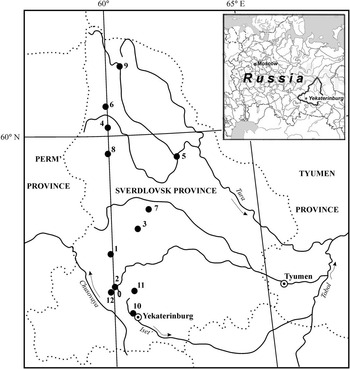
The Trans-Urals region of Russia is situated between eastern Europe and western Siberia. It can be associated with the greater Urals, east of the watershed divide of the Ural Mountains (Figure 1). Although the region contains several important dry “upland” sites, it is famous for waterlogged (wetland) archaeological sites, which have been under investigation since the 1870s (see Chairkina Reference Chairkina2010; Kuzmin Reference Kuzmin2013). At present, more than 60 wetland sites have been discovered and partly excavated. The artifacts they contain span from the Mesolithic to Late Bronze Age. Cultural layers of these wetland sites were formed when conditions were suitable for the creation of peat bogs and/or lakes in depressions. Due to the waterlogged conditions, numerous perishable artifacts made of wood, bark, and bone have survived and have been subsequently recovered and radiocarbon dated (see Chairkina et al. Reference Chairkina, Kuzmin and Burr2013).
Position of investigated sites in the Trans-Urals: 1 – Beregovaya 2, Beregovaya 13 (Filin Ostrov), Strelka, Gorbunovo; 2 – Shigir Fortress, Shigirskoe A, Varga 2, Annin Ostrov (also initial location of Big Shigir Idol and items of Shigir collection); 3 – Koksharovo-Yurinskaya 1–2, Koksharovsky Kholm; 4 – Pokrovsk-Uralskoe 7; 5 – Ust-Vagilsky Kholm; 6 – Nizhnee Ozero 3; 7 – Uklon 7; 8 – Zhilishche Sokola; 9 – Burmantovsky Grotto; 10 – Shuvakish 1; 11 – Elnichnoe 1A; and 12 – Shaitanskoe Ozero 2.

The chronology of prehistoric cultural complexes in the Trans-Urals is still poorly developed (see review: Kuzmin Reference Kuzmin2013: 147–8). The upland sites in particular have been challenging due to the absence of sedimentation and the mixing of cultural materials of different time periods, from the Mesolithic to the Middle Ages. Wetland sites provide excellent opportunities to create reliable chronologies for ancient cultural complexes because of the clear stratigraphic deposition and good preservation of material for 14C dating. In the last decade or so, wetland archaeological research in this region has really accelerated (e.g. Chairkina Reference Chairkina2010; Chairkina et al. Reference Chairkina, Kuzmin and Burr2013; Zaretskaya et al. Reference Zaretskaya, Hartz, Terberger, Savchenko and Zhilin2012, Reference Zaretskaya, Panova, Zhilin, Antipina, Uspenskaya and Savchenko2014; Zhilin et al. Reference Zhilin, Savchenko, Nikulina, Schmölcke, Hartz and Terberger2014; Savchenko et al. Reference Savchenko, Lillie, Zhilin and Budd2015).
The prehistoric cultural complexes of the Trans-Urals have previously been delineated as follows. The Mesolithic sites in the Trans-Urals do not have any pottery in their assemblages. The pottery Neolithic is divided into two stages, early and late (Kovaleva Reference Kovaleva1989; Chairkina and Kosinskaia Reference Chairkina and Kosinskaia2009). The early stage is associated with several pottery types: Koshkino, Koksharovsko-Yuriynsky, Satyginsky, Kozlovsky, and probably Sumpanya. The late stage is represented by the Boborykino, Basyanovsky, and Poludensky pottery types. Some sites cannot be correlated with a particular stage, and they are labeled just as “Neolithic” (see Table 1). The Aeneolithic cultural complexes are now well studied (Chairkina Reference Chairkina2005), and it is easy to identify them based upon ceramic typologies. Cultural schemes of the Bronze Age in the Trans-Urals were established in the 1970–1990s based mainly on pottery typology, and partly on stratigraphy and solitary 14C dates (e.g. Kosarev Reference Kosarev1981, Reference Kosarev1987). Since then, very little new information accumulated regarding the archaeology and chronology of the Bronze Age in this region.
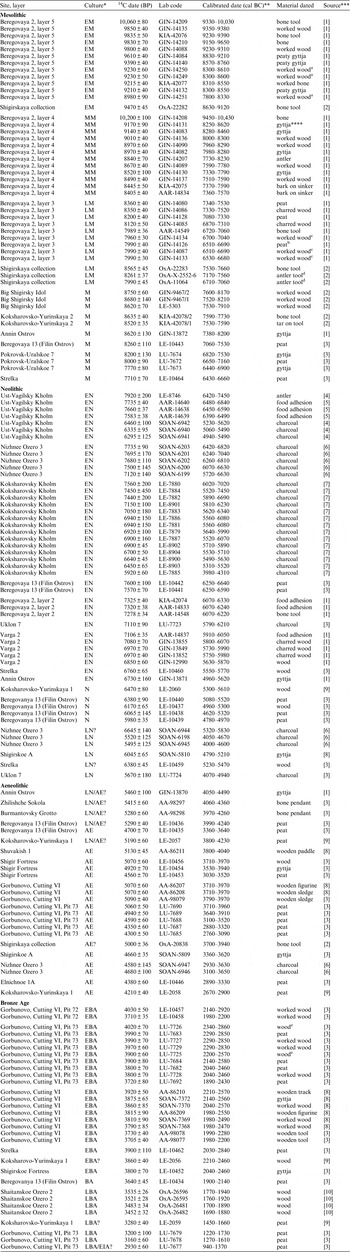
14C dates for the Mesolithic, Neolithic, Aeneolithic, and Bronze Age sites of the Trans-Urals.

*Abbreviations: M – Mesolithic; EM – Early Mesolithic; MM – Middle Mesolithic; LM – Late Mesolithic; N – Neolithic; EN – Early Neolithic; LN – Late Neolithic; AE – Aeneolithic; BA – Bronze Age; EBA – Early Bronze Age; LBA – Late Bronze Age; EIA – Early Iron Age.
**IntCal13 data set was used (Reimer et al. Reference Reimer, Bard, Bayliss, Beck, Blackwell, Bronk Ramsey, Buck, Cheng, Edwards, Friedrich, Grootes, Guilderson, Haflidason, Hajdas, Hatté, Heaton, Hoffmann, Hogg, Hughen, Kaiser, Kromer, Manning, Niu, Reimer, Richards, Scott, Southon, Staff, Turney and van der Plicht2013), with 2σ, and all possible intervals are rounded to the next 10 yr and combined.
***[1] – Zaretskaya et al. (Reference Zaretskaya, Hartz, Terberger, Savchenko and Zhilin2012, Reference Zaretskaya, Panova, Zhilin, Antipina, Uspenskaya and Savchenko2014); [2] – Savchenko et al. (Reference Savchenko, Lillie, Zhilin and Budd2015); [3] – this study; [4] – Panina (Reference Panina2011); [5] – Panina (Reference Panina2014); [6] – Chairkin et al. (Reference Chairkin, Chairkina and Shakaev2009); [7] – Shorin and Shorina (Reference Shorin and Shorina2011); [8] – Chairkina et al. (Reference Chairkina, Kuzmin and Burr2013); [9] – Serikov (Reference Serikov1992); [10] – Korochkova et al. (Reference Korochkova, Spiridonov and Stefanov2015).
****This is also called “sapropel.”
a These are fragments of a single wooden structure.
b Level of wooden track.
c Wooden track; the same feature was dated.
d Made of antler of extinct giant deer (Megaloceros giganteus) (see Stuart et al. Reference Stuart, Kosintsev, Higham and Lister2004); the same specimen was dated twice (see Savchenko et al. Reference Savchenko, Lillie, Zhilin and Budd2015).
e Wooden structure.
This article presents a comprehensive list of 14C dates for the Mesolithic, Neolithic, Aeneolithic, and Bronze Age wetland sites in the Trans-Urals, many previously published but with the addition of some new dates and upland sites. We interpret 14C records and create the first chronological framework for the previously established cultural complexes, and briefly discuss its implication for the broader Uralian region.
MATERIAL AND METHODS
In order to establish the 14C chronology for prehistoric complexes of the Trans-Urals, data were generated from several sites belonging to the Mesolithic, Neolithic, Aeneolithic (a.k.a. Eneolithic, Chalcolithic, and Copper Age), and Bronze Age (Figure 1). This is based on our own studies conducted mainly in 2013–2015, and the results obtained by other researchers. The objects of this study include several wetland sites [Beregovaya 2, Beregovaya 13 (Filin Ostrov), Koksharovsko-Yurinskaya 1–2, Annin Ostrov, Strelka, Pokrovsk-Uralskoe 7, Varga 2, Shigirskoe A, Shigirskoe Fortress, Shuvakish 1, Elnichnoe 1A, and the Gorbunovo cluster], as well as localities on dry ground (“upland sites”), Ust-Vagilsky Kholm, Koksharovsky Kholm, Nizhnee Ozero 3, Uklon 7, and Shaitanskoe Ozero 2 (see Table 1)]. The Zhilishche Sokola and Burmantovsky Grotto are situated in natural grottos in rock massifs. Samples from items stored at the Sverdlovsk Regional Museum (Yekaterinburg), Shigirskaya collection and Big Shigirsky Idol, were also 14C dated.
The 14C dating was performed by two methods, liquid scintillation counting (Russian laboratories) and AMS (Arizona, Oxford, Kiel, and Aarhus labs). Pretreatment of different types of material (wood, bark, bone, antler, peat, gyttja, food residues, and charcoal) followed routine procedures (e.g. Jull and Burr Reference Jull and Burr2006; Jull 2007; Taylor and Bar-Yosef Reference Taylor and Bar-Yosef2014: 65–96). In several cases, the dating of artifacts was done by the accelerator mass spectrometry (AMS) technique. The total data set known to us today (mid-2016) is 153 14C values (Table 1). Calibration of 14C values followed the IntCal13 data set (Reimer et al. Reference Reimer, Bard, Bayliss, Beck, Blackwell, Bronk Ramsey, Buck, Cheng, Edwards, Friedrich, Grootes, Guilderson, Haflidason, Hajdas, Hatté, Heaton, Hoffmann, Hogg, Hughen, Kaiser, Kromer, Manning, Niu, Reimer, Richards, Scott, Southon, Staff, Turney and van der Plicht2013).
At this stage, we accept our data set (Table 1) as the basis for general conclusions on the chronology of the Mesolithic, Neolithic, Aeneolithic, and Bronze Age complexes of the Trans-Urals. It seems to be too early to conduct any in-depth analyses, besides Bayesian modeling for the Mesolithic components at the Beregovaya 2 site (see below).
RESULTS
Mesolithic Complexes
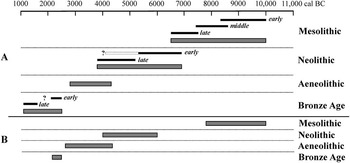
We can now firmly determine the duration of Mesolithic in the Trans-Urals (Table 1; Figure 2, A). The key site is Beregovaya 2 in the Gorbunovo peatbog area, which has an undisturbed stratigraphy (Zaretskaya et al. Reference Zaretskaya, Hartz, Terberger, Savchenko and Zhilin2012, Reference Zaretskaya, Panova, Zhilin, Antipina, Uspenskaya and Savchenko2014; Zhilin et al. Reference Zhilin, Savchenko, Nikulina, Schmölcke, Hartz and Terberger2014). Three stages of the Mesolithic can thus be established: early (~10,000–7800 cal BC), middle (~10,400–7400 cal BC), and late (~7500–6500 cal BC). At first glance, it seems that the early and middle stages overlap (Table 1). However, the most compact intervals for them are ~10,000–8300 cal BC (early stage) and ~8600–7400 cal BC (middle stage). They can be now accepted as timespans for these intervals of the Mesolithic (Figure 2, A).
Duration of the prehistoric cultural complexes in the Trans-Urals (general scheme): (A) based on this study; (B) based on previous research (for Mesolithic: Zaretskaya et al. Reference Zaretskaya, Hartz, Terberger, Savchenko and Zhilin2012, Reference Zaretskaya, Panova, Zhilin, Antipina, Uspenskaya and Savchenko2014; Zhilin et al. Reference Zhilin, Savchenko, Nikulina, Schmölcke, Hartz and Terberger2014; for Neolithic: Vybornov et al. Reference Vybornov, Mosin and Epimakhov2014; for Aeneolithic: Mosin et al. Reference Mosin, Epimakhov, Vybornov and Korolev2014; and for Bronze Age: Chairkina et al. Reference Chairkina, Kuzmin and Burr2013; Mosin et al. Reference Mosin, Epimakhov, Vybornov and Korolev2014).

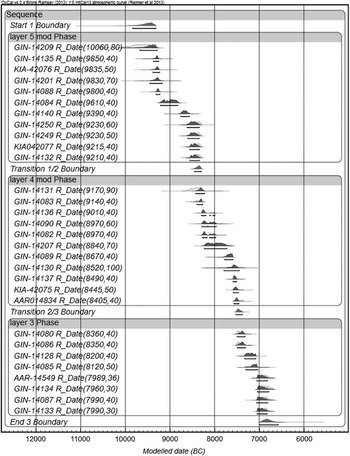
For the Beregovaya 2 site, Bayesian analysis (e.g. Bronk Ramsey Reference Bronk Ramsey2009) was performed. Initially, Layer 5 was analyzed as a single phase, and its boundary start and end probability density functions were defined. A similar single-phase analysis of Layer 4 suggested that the oldest sample, GIN-14208, is an outlier. An outlier analysis using the OxCal algorithm supported this. With this data point excluded [Layer 4 mod(ified)], Layers 5 and 4 were modeled as two continuous phases. In this model, the youngest value for Layer 5, GIN-14251, appeared to fit better into Layer 4. This data point was excluded from the Layer 5 data set (Layer 5 mod), and then a model was constructed incorporating Layer 5 mod, Layer 4 mod, and Layer 3.
The results are shown in Figure 3. The Early Mesolithic is placed at 9840–8300 cal BC, the Middle Mesolithic at 8450–7380 cal BC, and the Late Mesolithic at 7530–6580 cal BC. The Early/Middle Mesolithic boundary seems to be quite arbitrary. This is similar to general ranges based on 14C dating and archaeological information on tool typology (Figure 2, A).
Bayesian modeling for 14C dates from the Mesolithic complexes, Beregovaya 2 site

Some sites cannot be assigned to a particular stage of the Mesolithic (Table 1), and they are labeled just as “Mesolithic.” Their ages are in the range of ~9100–6300 cal BC. According to the Beregovaya 2 site master chronology, the majority of them (Koksharovsko-Yurinskaya 2, Pokrovsk-Uralskoe 7, Strelka, and Beregovaya 13 sites) can be attributed to the Late Mesolithic. The Annin Ostrov site most probably belongs to the Middle Mesolithic; the famous Big Shigirsky Idol can be also associated with this stage, but the older age—Early Mesolithic—cannot be excluded.
Neolithic Complexes
Modeling the chronology for the Neolithic in the Trans-Urals and adjacent parts of the Urals and western Siberia presents serious problems due to the often observed mixing of different types of pottery within a stratum. Because pottery is the main indicator for distinguishing cultural complexes (“cultures” in Russian archaeological terminology) and stages (see Chairkina and Kosinskaia Reference Chairkina and Kosinskaia2009), for a long time it was not possible to establish the firm chronological boundary between the early and late stages of the Trans-Uralian Neolithic. As explained by Chairkina and Kosinskaya (2009: 213), “... poor regional chronologies continue to hinder more coherent understanding of the Neolithic . . . including the emergence of pottery and general patterns of cultural interaction and exchange.” Based on our research and data generated by other scholars, it is now possible to determine the main chronological boundaries of the principal Trans-Uralian Neolithic complexes.
The Early Neolithic cultural complexes are now securely dated to ~6500–5300 cal BC based on about 40 14C values. Previously, the beginning of the Neolithic based on 14C records was associated with the time interval ~6300–5700 cal BC. It is possible that the Early Neolithic pottery of Koshkino type survived until ~4100 cal BC (Figure 2, A), although we are now not certain that the late Koshkino pottery belongs to the Early Neolithic, and more work is still needed to understand it. Less information is available for the Late Neolithic, but it can be tentatively dated to ~5200–3800 cal BC, where the Poludensky complex existed at ~5200–4500 cal BC, the Basyanovsky complex at ~5000–4400 cal BC, and the Boborykino complex at ~4700–3800 cal BC. The Neolithic/Aeneolithic boundary can be set at ~4300–3800 cal BC (Figure 2, A).
Aeneolithic and Bronze Age Complexes
After extensive studies and dating the Aeneolithic complexes in undisturbed stratigraphic contexts of wetland sites (especially at the Gorbunovo cluster), including direct 14C dates of artifacts (Chairkina et al. Reference Chairkina, Kuzmin and Burr2013), it is now clear that these cultural assemblages existed in the Trans-Urals at ~4300–2800 cal BC (Figure 2, A). The Early Bronze Age sites are extensively dated by our team in the last few years, and now its ages are much more securely established than before. Based on ~20 14C values, its age is ~2500–2100 cal BC.
The Late Bronze Age is not well dated, and its duration can provisionally be assigned to ~1600–1100 cal BC. This is still a tentative conclusion due to the deficit of 14C values associated with the Late Bronze Age of Trans-Urals. The latest studies at the Shaitanskoe Ozero 2 sanctuary, situated 70 km north of Yekaterinburg and near the Shigir peatbog (Serikov et al. Reference Serikov, Korochkova, Kuzminykh and Stefanov2009; Korochkova et al. Reference Korochkova, Spiridonov and Stefanov2015), allowed us to place the Late Bronze Age complex at ~1900–1800 cal BC. The lacuna between early and late stages of the Bronze Age (see Figure 2, A) could be filled out when more dates become available.
DISCUSSION
The new information obtained by our team along with previously acquired data allows us to establish the basic chronology for major prehistoric complexes of the Trans-Urals (Figure 2, A). Some changes occurred after incorporating the new results into existing schemes (Figure 2, B). Nevertheless, the results correspond well to existing knowledge on the duration of relevant cultures from the neighboring Urals (Hanks et al. Reference Hanks, Epimakhov and Renfrew2007; Mosin et al. Reference Mosin, Epimakhov, Vybornov and Korolev2014; Vybornov et al. Reference Vybornov, Mosin and Epimakhov2014). However, several issues are still unsolved, including the upper boundary of the Mesolithic and the lower limit of the Neolithic. In the Trans-Urals, sites attributed to the final Mesolithic are currently unknown. The earliest Neolithic can be associated with the Koshkino complexes; according to our data (see Figure 2, A), they existed in the Trans-Urals for a long time, and probably coincided with other Neolithic cultures. This requires additional studies and determination of the precise cultural affiliation for assemblages that traditionally belong to the Koshkino complex.
The age of the Aeneolithic in the Trans-Urals can now be securely established. Previously, it was associated with a much later time, the beginning of the 3rd millennium BC. It is noteworthy that the majority of dates correspond to the early stage (Shuvakish and Lipchinsky complexes), and information about the 14C age of the last phase of the Aeneolithic (Ayatsky complex) is currently absent. A new series of 14C dates has been obtained for the Early Bronze Age (the Karasye Ozero complex) (Table 1; Figure 2, A). Its lower boundary does not correlate with the preliminary established upper limit of the Aeneolithic. It is clear that there was no break in the cultural sequence between the Aeneolithic and the Bronze Age, but when exactly the transition occurred it not yet clear, and future research may shed new light on this issue.
The absence of clear chronological “boundaries” between archaeological epochs—Mesolithic and Neolithic, Neolithic and Aeneolithic, and Aeneolithic and the Bronze Age—suggests that precise criteria for the determination of the beginnings and endings of these epochs and cultures might not exist. We assume that changes from one epoch to another did not happen very quickly, and there is a chance that they coexisted for some time, perhaps 300–500 yr or so.
CONCLUSIONS
Cultural layers of the Mesolithic in Trans-Urals are now dated to ~10,000–6500 cal BC (Preboreal and Boreal periods of the Holocene). The Neolithic complexes existed at ~6500–3800 cal BC (Atlantic period). The Aeneolithic epoch is dated to ~4300–2800 cal BC (the end of the Atlantic period, and the beginning of the Subboreal period). The Early Bronze Age assemblages existed at ~2500–2100 cal BC, corresponding to the early Subboreal period. The Late Bronze Age of the Trans-Urals can be preliminary assigned to ~1600–1100 cal BC, and perhaps up to ~1900 cal BC. The continuation of research will allow us to refine this general chronological framework.
ACKNOWLEDGMENTS
This research was conducted with funding provided by the Russian Foundation for Basic Sciences (RFFI), grants Nos. 13-06-00363, 13-06-10012, 14-06-10021, 15-06-10183, and 12-06-00045; and by the Tomsk State University Program “Academician D I Mendeleev Fund” (2015–6) for the Laboratory of Mesozoic and Cenozoic Continental Ecosystems. We are grateful to numerous colleagues in both Russia and the USA for help with fieldwork, processing of samples, and discussion of the results obtained; and to the two anonymous reviewers for their comments and suggestions. The contribution of numerous scholars and 14C dating laboratories (Russia, Germany, UK, Denmark, and USA), which resulted in the creation of the cultural chronology for the Trans-Urals, is also acknowledged.