INTRODUCTION
Quality of life has been well researched, especially with regards to people with cancer, but not necessarily from the perspective of the patient and not in Third World, resource-poor countries. A number of quality of life measures such as the Karnofsky Index, EORTC Index and Spitzer Index are frequently used in medical research (Illhardt & Ten Have, Reference Illhardt, Ten Have, Ten Have and Clark2002). Michael (Reference Michael, Ferrel and Coyle2001) mentions >20 quality of life measures, measuring various domains such as physical well-being and functioning, how illness affects the patient's behavior, social support, spirituality, financial well-being, and even symptoms. The use of these quality of life measures raises questions such as from whose perspective is quality of life determined, and the applicability to people of various cultural groups. Carr and Higginson (Reference Carr and Higginson2001) also ask whether quality of life measures are really patient centered, as questionnaires may restrict the patient's choice and might not measure what constitutes quality of life for the patient. This study is significant, as quality of life was explored from the perspective of palliative care patients living in a resource-poor community in Tshwane, South Africa.
In 1993, the World Health Organization Quality of Life Group (Bowling, Reference Bowling1993) defined quality of life as “an individual's perception of their position in life in the context of the culture and value systems in which they live and in relation to their goals, expectations, standards and concerns. It is a broad ranging concept affected in a complex way by the person's physical health, psychological state, level of independence, social relationships and their relationships to salient features of their environment.” Quality of life, however, does not have the same meaning to every person (Chippendale, Reference Chippendale, Kinghorn and Gamlin2001, Reference Chippendale, Kinghorn and Gaines2007). Carr and Higginson (Reference Carr and Higginson2001) suggest that there are some aspects of quality of life that are universal to quality of life, whereas other aspects would only be important to the individual. The interaction between these aspects – generic and individual – will also vary among individuals. The factors and their interrelationships are also not static and would most probably change over time in response to life circumstances such as life-threatening or chronic illness.
The importance of assessing the quality of life of patients receiving palliative care has for many years been widely recognized, according to Chui et al. (Reference Chui, Kuan and Fu2009). Palliative care, like quality of life, has different meanings to different people.
The World Health Organization in 2008 defined palliative care as “an approach that improves the quality of life of patients and their families facing problems associated with life-threatening illness through the prevention and relief of suffering by means of early identification and impeccable assessment and treatment of pain and other problems, physical, psychosocial and spiritual” (Bennett & Closs, Reference Bennett, Closs, Payne, Seymore and Ingleton2008). The United States Department of Health and Human Services in 2001 defined patients eligible for palliative care as having a medical diagnosis with a life expectancy of ≤6 months if the disease runs its natural course (Kinzbrunner, Reference Kinzbrunner, Kuebler, Davis and Moore2005). However, according to the World Health Organization (2011), the concept that palliative care is applicable only to the last few weeks of life when no other treatment is helpful, is outdated. A more appropriate concept would be that palliative care is offered from the time of diagnosis in addition to curative treatment, as people needing care and their families experience many problems during the course of an illness and need help, especially when problems change and become more complex. Palliative care should, therefore, start at diagnosis and continue through disease progression and end of life. Kinzbrunner (Reference Kinzbrunner, Kuebler, Davis and Moore2005) supports not limiting palliative care to end of life and states that palliative care should “reach beyond the patient with a life-limiting illness to patients with chronic longstanding illnesses and even patients with acute, potentially curable illness and provide interventions alongside curative interventions.”
According to Kalichman and Simbayi (Reference Kalichman and Simbay2003), in South Africa, people with HIV and AIDS have not necessarily been tested for this disease. Symptoms are used as indicators of disease and disease progression. Life expectancy can also not always be predicted. In a context such as South Africa, the country with the largest number of people affected by HIV and AIDS (Demmer, Reference Demmer2010), Kinzbrunner's (2005) definition of palliative care, namely “any care provided to treat the symptoms of any illness without curing the illness, for example providing a patient with an analgesic medication for the treatment of a painful joint secondary to chronic osteoarthritis” seems the most applicable. It is most likely that people suffering from chronic long-standing illnesses could also have a life-limiting illness in the form of HIV and AIDS.
STUDY AIMS
Evidence as to what quality of life means to resource-poor palliative care patients living in South Africa is lacking, and nurses, therefore, do not know which interventions to focus on to improve the patient's quality of life. This study, therefore, aimed to explore quality of life from the perspective of patients managed at a palliative care clinic serving a resource-poor community of Tshwane in South Africa.
METHOD
Research Approach and Context
The study was exploratory and contextual. An exploratory research approach was applicable to the study, as little was known about the phenomenon. An exploratory approach, furthermore, allowed the phenomenon to be investigated in its full nature, the manner in which it manifests, and other related factors. Exploratory studies are not intended for generalization to large populations (Burns & Grove, Reference Burns and Grove2005; Polit & Beck, Reference Polit and Beck2008). The context for this study was a resource-poor community of Tshwane, South Africa. This community forms part of a township 45 km from Pretoria. In 2008, the community consisted of 703 households consisting of ~2533 people, of whom 1320 were ≥20 years of age. Only 2% of the population lived in brick houses; the rest of the inhabitants lived in informal dwellings. Approximately 30% of people ≥20 years of age were illiterate, and >50% of the adult population was unemployed.
Poverty was extensive, and only 25% of the population lived above the poverty index of 2 USD per day. The community had access to running water, mostly provided by a tap in the yard or a communal tap. Only 2% of households had running water in the house. Latrines were provided in the form of pit- or flush latrines in the yard. Once again, 2% of households had access to a flush latrine in the house. Approximately 10% of the population reported that they shared latrines with another family, and <1% indicated not having access to any latrine (Maree & Ferns, Reference Maree and Ferns2008).
Research Design and Recruitment Strategy
A qualitative phenomenological design was used. This design allowed for in-depth, holistic inquiry applicable to a study on quality of life (Patton, Reference Patton2002). Qualitative research focuses on aspects such as meaning, experience, and understanding, whereas phenomenology focuses on persons' lived experiences of events that they live through (McCance & Mcilfatrick, Reference McCance and Mcilfatrick2008). Sampling was convenience. All patients ≥18 years of age residing in the specific resource-poor community and registered as patients at the palliative care clinic, who were willing to participate in the study, were recruited. Recruitment continued until data saturation (n = 10). A total of 12 patients were approached to participate in the study, but one refused and the other one did not turn up for appointments.
Data Gathering
Self-report data were gathered by means of in-depth interviews. The interviews were conducted in the palliative care clinic or in the participants' homes. Demographic data were gathered by means of a pre-interview questionnaire. A topic guide was used to guide the gathering of the qualitative data. To test the data gathering, the topic guide and the use of the voice recorder were pretested using the first participant. The topic guide was changed after the pretest, as the questions contained in the topic guide had to be rephrased several times, because the participant did not understand them. After the pretest, two topics were explored, namely “what makes your life good” and “what makes life hard for you.” The data gathered during the pretest were included in the study because of prolonged engagement, allowing the gathering of data over time.
Data Analysis
Verbatim transcription of recorded interviews was done. Transcribed data were analyzed by means of Patton's (2002) method of open coding. After identifying the categories, a template guided by the two topics explored was used to group the categories into themes.
Trustworthiness
The criteria of Lincoln and Guba (Reference Lincoln and Guba1985): credibility, dependability, confirmability, and transferability were applied in order to ensure trustworthiness. Credibility was ensured by means of prolonged engagement with participants, which created trust. The research proposal for the study was peer reviewed. Furthermore, member checks were done. Dependability was ensured, as a research proposal was written explaining what was planned, while the research report serves as evidence of the implementation of the plan. Confirmability was ensured by developing an audit trail.
Ethics
The study was approved by the Ethics Committee of the Tshwane University of Technology. The ethical principles outlined by Haigh (Reference Haigh, Watson, McKenna and Cowman2008), namely, autonomy, beneficence, nonmaleficence, informed consent, confidentiality, and dissemination of the results were followed in the study.
RESULTS
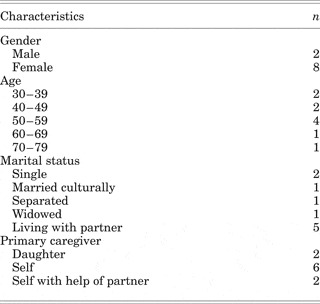
Except for the general characteristics, three themes emerged from the data. The themes were factors that had a positive influence on quality of life, factors that had a negative influence on quality of life, and experience of quality of life. Narratives of some of the participants are reflected in the results. Pseudonyms are used to protect the identity of the participants. The demographic data of the sample (n = 10) are reflected in Table 1.
Demographic data (N = 10)

The sample had a variety of health problems. Four of the participants were reported to be HIV positive. One participant was reported to have had a cerebrovascular incident. She had loss of function of her right hand and ptosis of her left eye. She was also on treatment for pulmonary tuberculosis and was suspected to be HIV positive. Four participants suffered from severe pain: two from osteoarthritis and two from rheumatoid arthritis. The last participant had cancer of the floor of the mouth. Nine participants were ambulant but only able to perform light work, whereas one was in bed 50% of waking hours.
Two participants received a monthly old age pension and two a disability grant. The rest were dependent on family members for financial support or had temporary jobs, such as washing and cleaning for neighbors, in order to buy food. Four participants lived in brick houses with running water and latrines in the house. These participants had access to electricity if they could afford to buy it. The other six participants lived in informal dwellings with no running water or latrines in the house or yard. These participants had to use latrines that were placed at the side of the roads 20–40 m from their homes. They also had to fetch water from other people's yards and heat the water for washing. The majority (6 of 10) had to cope on their own, whereas two had help of their partners and two help from their daughters.
Theme 1: Factors That Had a Positive Influence on Quality of Life
Being able to work played a very important role in the lives of all the participants (10 of 10) as it meant keeping busy and having no time for thinking and stressing about their illness. For five, being able to do “piece jobs” (temporary work) meant having money for food as they had no fixed income. Being able to work also meant being able to take care of themselves and a spouse or children and being able to visit family. The importance of work was expressed as follows:
Work makes me feel better, because I do not stress, I do not think, I just carry on … (Patricia, 42).
I feel happy, while I am working, I feel happy, Sister… I feel happy, because, if I'm working, I know, by the end of the month I'm going to get my salary and I know, I write down what I want to buy, and then I have to catch the bus in Bosman to go to Kwa-Zulu Natal to see my family, my children again, and then I'm happy, more happy than ever (Mavis, 50).
If maybe I can't get the job, life will be too hard for me…is when I see I can suffer… (Mary, 38).
Receiving an old age pension added to the quality of life of 2 of the 10 participants.
When I have everything, the food, a little pension… the money from the pension… my life is better, I'm alright (Johanna, 61).
Support from friends and family as well as healthcare professionals was one of the factors adding to quality of life. For 6 of the 10 participants, the support of friends was important. The support of friends meant companionship, someone to talk to about life and hardships and someone who gave comfort. Going to the doctor and getting tablets and being visited by nursing staff from the palliative care clinic also meant support. Receiving support was furthermore experienced as bringing hope. The importance of support is illustrated by the following:
I live with my neighbours, we ask each other and when they ask me, I give, when I ask them, they give me. When I am with people who talk to me and chat and keep me company, I feel much better (Patricia, 42).
My child comes here, he tells me that I am not the only one that is sick, I must pray, I must believe that God is there (Annah, 48).
People who help me, I will say are the doctor and the Lord…You sisters, I am very happy that you are here…you help me…I am sure the doctor will get it right, definitely, it will get better (George, 59).
Religion played a significant role in the lives of 7 out of 10 participants, who loved attending church services and singing in the choir, and who derived strength from prayer and faith. Five of the participants said going to church made them happy, gave them strength and comfort, and made them feel “alright,” whereas four mentioned that their relationship with God made them happy and gave them strength. One participant was of the opinion that God had saved her when she had been very sick and that He had given her HIV to show her the way.
I feel very happy after going to church, because there they talk about the Lord, how He likes a person, how one should follow the Word of the Lord… I talk of the Lord a lot… that is why I am getting so strong (Patricia, 42).
I pray every day, that I can be well…I think of God…Every day, where I go, I pray: God bless… Yes, she has her own Bible in Afrikaans…I have my Bible in Xhosa… She uses hers, I use mine, when we have finished, we sit, we talk. We show each other, this and this in the Bible (George, 59).
I know that I'm HIV positive. Others they take it as an illness, while it is not an illness, but I must be happy, because God gave me the sick that is not a sickness. So I'm glad, as God shows me this life, how must I take nice ways for the life… I was ill inside the hospital and I was seeing there was God, because now I was wake up and coming home, because of God. If there was no God, maybe I was not inside my place now, I was gone (Mary, 38).
Only one participant linked symptom control with quality of life:
…my body was itching, and I used to scratch my body, and then I was bleeding…you told me the other plan…you told me I must take warm water, sit in the bath, put little bit salt, sit and my private parts was itching, today they were not itching anymore… ARV's they changed my life…my stomach was always running…the whole month, or two months… ARV's they help me a lot. Now I go to the toilet as I was before I get sick (Mavis, 50).
Theme 2: Factors That Had a Negative Influence on Quality of Life
Poverty was the predominant factor that took away participants' quality of life. For 8 out of 10 participants, life was a daily struggle for survival. Poverty meant begging other people for food and basic necessities such as a bar of soap, wearing second-hand clothes, not having proper furniture in the house, not having a choice of food, not being able to keep a pet, and having to endure rudeness and feeling inferior.
Sometimes when you go to a friend's house, you find that she is rude to you, maybe the next day she will not greet you, you don't know what you did to her … The people do that so that you stay away from them and do not go and ask things from them, you must not ask a bit of sugar or mealie-meal (Jeanette, 54).
We suffer… tonight we eat, tomorrow night we sleep without food, we get up and have some tea … (Monica, 51).
I do not like to be…peoples give, shame Mavis…this clothes I'm wearing now is not my clothes … these clothes I wear I do not like them … I do not like my house … If I want to eat something like bread, if I do not get that bread, I cannot eat porridge if I want bread, I'd rather stay without eating… I feel like stupid … I feel like nobody (Mavis, 50).
Lacking employment decreased quality of life. Six of the 10 participants expressed their desire to have a job. Loss of employment meant inability to provide for themselves and their children, inability to buy things they needed or desired, stress, depression, loss of status and self-esteem, and destitution.
My life is hard, because I do not have work and cannot take care of myself very well … When I work I feel better, because I don't have stress and do not think a lot, I just carry on (Patricia, 42).
All I want is to work … I can buy my things again (Mavis, 50).
I pray every day to get well … if I can get up, I will be able to work, do a good job… Life is a bit hard, because I cannot walk … (George, 59).
Isolation from children was another factor that decreased quality of life. Five of the 10 participants experienced loneliness because of separation from their children. One participant felt so alone that she wanted to adopt a baby or small child to curb her loneliness.
Many people that I see have children and they still make children, they live, life goes on. I mean if I can get a baby or if I can get a child, life will go on (Patricia, 42).
Rejection and stigmatization added to poor quality of life. Four of the participants expressed being rejected or stigmatized by community members and family, mostly because of HIV and AIDS.
This illness changed my life, for now there is not one who wants to live with me, from my family… People do not talk to me nicely, some others shout at me (Patricia, 42).
Nobody likes me, they used to say ‘she've got AIDS, she must die’. They used to throw stones at me (Mavis, 50).
Experiencing symptoms had a negative influence on quality of life. The sample experienced various symptoms of which pain was the most commonly described symptom (7 of 10). Itching, weight loss, depression, fatigue, and fear were also reported. Experiencing pain was described as follows:
The pains trouble me, here at the joints, they pain, they stab me, if they don't stab me at this joint, they stab at the other joint … It makes me sad…Every day I worry about the illness … Life is hard, because I cannot walk … (George, 59).
… the pain, it comes, like now, it stabs in my ear. If I drink the tablets of Panado, then I can sleep, after three to four hours I get up. I only bought one packet … I pray to the Lord that the time can pass so that I can get to the hospital, to get medication (Monica, 51).
Other symptoms were described as:
I was so skinny, I was only the bones and my soul was left to me… I was so skinny, I … you could not look at me (Mavis, 50).
My stomach was running … I cried the whole day…other people said I must not cry, I will get better … I will get the medicine at the clinic (Annah, 48).
I used to scratch my body … my private parts was terrible … I used to take my panty, scratch with my panty, ‘cause I could not scratch with my nails, ‘cause the skin of my private parts is very soft, and then I used to scratch my body with the panty and my palm as well (Mavis, 50).
I get tired easily … then I get irritable … then I just sleep (Annah, 48).
Sister, I feel I sit … It sometimes makes me depressed, because I cannot deal with it … how such an illness came to catch me … My life is boring … I have to sit … it is boring (Monica, 51).
Theme 3: Experience of Quality of Life
The sample was divided in terms of the quality of life they were experiencing. Half of the participants (5 of 10) were of the opinion that they had a better quality of life before becoming ill. Being able to work was mentioned as a reason for having a better quality of life. The reasons for having a better quality of life were: not having to take care of underage children without a husband, not having to share a partner, receiving food and support from friends, and receiving an old age pension.
Life was beautiful … I had a job … I wore nice clothes … Now I feel stupid … I feel like nobody … I fight for my life (Mavis, 50).
I cannot get it right (George, 59).
Before I get sick, my life was bad, because I was not having a right boyfriend. I was sharing here and there and there for partners … So, I have thought that maybe it is that thing which made me to have this illness (Mary, 38).
My life now … it is much better, it is not like the time when I brought up the children. Now it is much, much better … I live a bit better now (Johanna, 61).
DISCUSSION
The study provided evidence that having a regular income played a pivotal role in quality of life. Quality of life was primarily associated with the ability to work, being employed, and receiving a pension, as it resulted in the ability to buy food and other basic commodities. Not having a regular income resulted in having to beg neighbors for food and necessities, or do “piece jobs” such as washing and cleaning in exchange for food. Poverty changes the face of a decreasing health status and an inability to work from a decrease in satisfaction with life, to selling assets (Emanuel et al., Reference Emanuel, Simon and Burt2010), to not having food to eat, as found in the current study. Poverty, furthermore, leads to more complex health problems, more complications, and physical limitations resulting from chronic diseases, leading to a decrease of quality of life (McEwen & Pullis, Reference McEwen and Pullis2009). Work also meant keeping busy, with less time to think and stress about illness and circumstances. Not being able to work resulted in loss of income, status, and self-esteem. The value of work in terms of keeping busy is supported by Whyte (Reference Whyte2007), stating that it is important for HIV and AIDS patients to keep occupied to prevent depression.
Social support in the form of support from friends and the clinic staff played an important role in quality of life. Friends provided companionship, encouragement, and, also, food. Not having relatives living close by led to fear of having to cope alone when health failed, and isolation from children decreased quality of life. Social support as a factor for improving quality of life is supported by Motyka et al. in Burkhart et al. (Reference Burkhart, Schmidt and Hogan2011) who found a positive correlation between social support and quality of life. Palliative care patients felt happier when their children were around, and were of the opinion that the support of family, friends, and healthcare professionals helped them through difficult times.
Rejection and stigmatization had a negative impact on quality of life, and resulted in feelings of hurt, fear, and isolation. Sow in Van Dyk (Reference Van Dyk2008) explains that the community plays an important role in traditional life in Africa, as the traditional belief is that a person cannot exist alone. Personal identity is embedded in the collective existence of the community. In the African community, the individual does not suffer alone and does not rejoice alone, but with neighbors and relatives. Having HIV and AIDS seems to change the rules of a collective existence, as found in this study and supported by Van Dyk (Reference Van Dyk2008), who states that stigmatization and ostracism are real, and deprive people of care and support.
The study further provided evidence that religion added to quality of life. Being able to sing in the church choir was a source of comfort and happiness. Strength to carry on was derived from prayer and faith.
Experiencing symptoms had a negative influence on quality of life. Pain was the most commonly described symptom. Chui et al. (Reference Chui, Kuan and Fu2009) say that pain management “remains a challenge” for healthcare professionals, as in their study, 50% of patients reported still experiencing pain even though they received palliative care. Experiencing physical pain provokes emotional, social, and existential distress in a patient with cancer, and affects the patient's mood, social activities and activities of daily living, sleep, and cognitive functions (Farrer, Reference Farrer, Kinghorn and Gamlin2001). Fatigue was a common adverse effect of treatment, as well as the result of severe poverty, which often led to irritability and made it hard for participants to perform daily activities such as cleaning their houses and cooking. Chui et al. (Reference Chui, Kuan and Fu2009) support this finding by stating that fatigue has a negative influence on mobility and physical functioning and can lead to an impaired ability to practice self-care. This adds to physical distress and loss of quality of life. Weight loss also negatively influenced quality of life as confirmed by Lamb (Reference Lamb, Ferrell and Coyle2001). Being a thin black woman has unique challenges as being fat is associated with being healthy, respected, dignified, and strong, whereas being thin is perceived as a sign of health problems (Bentley et al., Reference Bentley, Corneli and Piwoz2005) and HIV and AIDS (Goedecke & Jennings, Reference Goedecke and Jennings2006). Being thin therefore makes being ill visible to others.
LIMITATIONS OF THE STUDY
Palliative care is indicated throughout the illness trajectory, but is expected to be most beneficial during the terminal stage. In this study, only one participant was terminally ill. It is therefore not known whether participants would have experienced their quality of life differently, had they been in a more advanced stage of the disease. The study was qualitative and the sample size determined by data saturation. The findings of the study cannot, therefore, be generalized to the larger population. The study was contextual and conducted in one resource-poor community using a convenience sampling design; therefore, the results cannot be generalized to other palliative care patients attending other clinics and hospitals in South Africa.
CONCLUSION
Life was a daily struggle for survival. Poverty was so overwhelming that quality of life was primarily measured in terms of the ability to buy food and other basic commodities.
ACKNOWLEDGMENTS
The Atlantic Philanthropies through the University-Based Nursing Education in South Africa (UNEDSA) project as well as the Adelaide Tambo School of Nursing Science of the Tshwane University of Technology supported this study financially.